- Market Value (2025): USD 1.14 Bn
- Estimated Value (2026): USD 1.22 Bn
- Forecast Value (2036): USD 2.31 Bn
- CAGR (2026-2036): 6.6%
What is the Commercial Vehicle Parking Sensor Market forecast to be worth by 2036?
USD 1.2 billion in 2026 to USD 2.3 billion by 2036, at a 6.6% CAGR.
- The commercial vehicle parking sensor market reached USD 1.14 billion in 2025.
- As per Fact.MR analysis, sales are projected to rise from USD 1.22 billion in 2026 to USD 2.31 billion by 2036.
- The market is forecast to record a 6.6% CAGR during 2026 to 2036 as vehicle builders and fleet operators evaluate low-speed obstacle warnings.
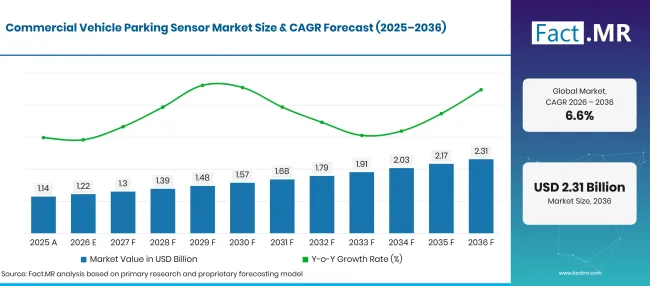
Factmr Commercial Vehicle Parking Sensor Market Forecast Global | Source: Fact.MR
| Year | Basis | Market Value (USD billion) |
|---|---|---|
| 2025 | Historical | 1.1 |
| 2026 | Estimate | 1.2 |
| 2036 | Forecast | 2.3 |
| CAGR 2026 to 2036 | Forecast period | 6.6% |
Source: Fact.MR analysis. Updated Oct 21, 2026
What are the defining numbers behind Commercial Vehicle Parking Sensor Market growth?
USD 1.1 billion absolute opportunity between 2026 and 2036, with ultrasonic sensors and light commercial vehicles shaping sales.
- Demand Drivers in the Market
- Fleet operators need reliable warnings when drivers reverse close to loading docks. The warnings help drivers judge tight spaces that can be hard to assess using mirrors alone.
- Van manufacturers compare sensor cost and bumper fitment across several body sizes. Common parts simplify vehicle assembly and give dealers a familiar system to diagnose during service.
- Truck body builders look for sensors that remain useful around tail lifts and rear steps. The position of each sensor affects how accurately the system detects objects behind the vehicle.
- Commercial fleet managers increasingly evaluate reversing assistance as part of day-to-day yard safety. A useful system must give drivers clear alerts without creating frequent false warnings.
- Key Segments Analyzed
- By Sensor Type: Ultrasonic sensors hold 42.3% share in 2026 because they measure nearby clearance around bumpers.
- By Vehicle Type: Light Commercial Vehicles account for 56.7% share in 2026, reflecting frequent reversing during urban deliveries.
- By Application: OEM systems represent 61.8% share in 2026 where sensors are fitted during vehicle assembly.
- By Technology: Proximity Sensors capture 72.4% share in 2026 because short-range warning remains central to parking assistance.
- Analyst Opinion at Fact.MR
- Shambhu Nath Jha, Principal Consultant at Fact.MR, states, “For commercial vehicles, a parking sensor earns its place when it remains dependable after daily exposure to road dirt and vehicle vibration. System designers can focus on mounting position and warning consistency before adding more display functions. “
- Strategic Implications
- Commercial vehicle manufacturers should match warning coverage to each bumper and body design, including vehicles fitted with rear steps or load platforms.
- fleet workshops should check connector protection and sensor placement during retrofit work so the installed system gives drivers useful warnings.
- Component developers should test signal performance around rain and surface dirt because unwanted alerts make drivers less likely to trust a warning.
- Distributors should identify vehicle-specific fitment needs before quoting a retrofit kit, including the number of sensors and required cab display.
Germany is forecast to post a 7.8% CAGR through 2036, compared with 7.1% for Brazil and 6.5% for the United States. The United Kingdom follows at 5.8%, while Japan is projected to record 5.1%. Each country has different fleet renewal conditions and vehicle-body requirements.
How does the Commercial Vehicle Parking Sensor Market break down by segment?
Ultrasonic 42.3%; Light Commercial Vehicles 56.7%; OEM 61.8%; Proximity Sensors 72.4% in 2026.
Which Sensor Type dominates?
Ultrasonic holds 42.3% share in 2026.
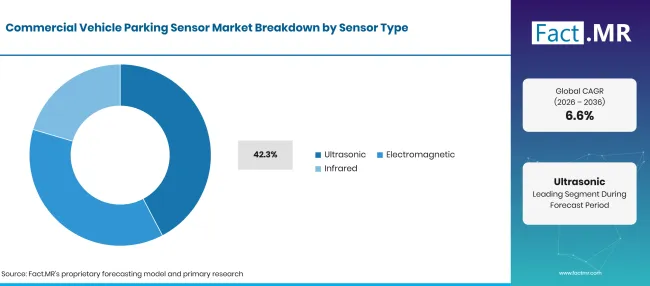
Factmr Commercial Vehicle Parking Sensor Market Breakdown Sensor Type | Source: Fact.MR
| Sensor Type | Share (2026) |
|---|---|
| Ultrasonic (Leading segment) | 42.3% |
| Other segments combined | 57.7% |
| Total | 100.0% |
Source: Fact.MR analysis. Updated Oct 21, 2026
Ultrasonic units measure nearby obstacles using reflected sound. They are suited to the short distances involved in reversing a delivery van. Electromagnetic designs use a different detection approach and require suitable installation around the bumper. Infrared solutions depend on their operating conditions and placement. For a fleet with mixed vehicles, the choice often comes down to signal reliability and straightforward replacement during workshop visits.
What leads the Vehicle Type segment?
Light Commercial Vehicles account for 56.7% share in 2026.
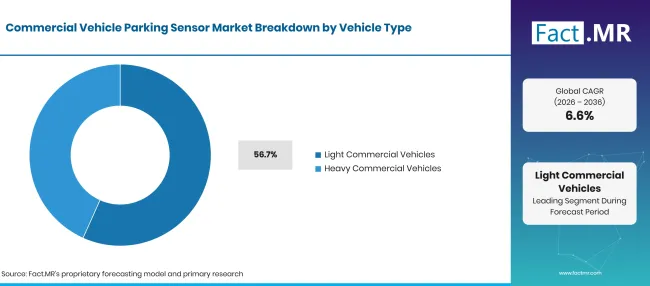
Factmr Commercial Vehicle Parking Sensor Market Breakdown Vehicle Type | Source: Fact.MR
| Vehicle Type | Share (2026) |
|---|---|
| Light Commercial Vehicles (Leading segment) | 56.7% |
| Other segments combined | 43.3% |
| Total | 100.0% |
Source: Fact.MR analysis. Updated Oct 21, 2026
Light commercial vehicles make frequent stops at shops and distribution points. Parking sensors offer useful short-range feedback where loading space is tight. Heavy commercial vehicles have longer bodies and varied rear equipment, so the mounting layout needs careful planning. A rear camera may help the driver see the area, while a sensor alert adds a distance warning. Fleet operators assess both functions against the vehicle’s daily route.
How does Application shape sales?
OEM holds 61.8% share in 2026.
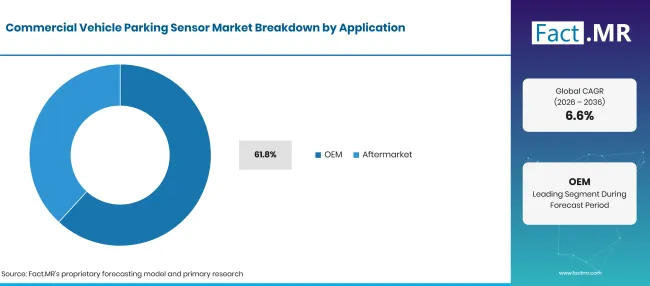
Factmr Commercial Vehicle Parking Sensor Market Breakdown Application | Source: Fact.MR
| Application | Share (2026) |
|---|---|
| OEM (Leading segment) | 61.8% |
| Other segments combined | 38.2% |
| Total | 100.0% |
Source: Fact.MR analysis. Updated Oct 21, 2026
OEM sensor systems are fitted during vehicle production and connected to the original display or warning controls. This approach lets manufacturers check bumper locations before vehicles reach customers. Aftermarket kits serve fleets adding a warning system to vehicles already in use. Installation quality varies with vehicle age and bodywork, making workshop experience relevant. Fleet owners generally compare fitting time with the cost of taking a vehicle off its delivery schedule.
Which Technology serves the larger share?
Proximity Sensors lead with 72.4% share in 2026.
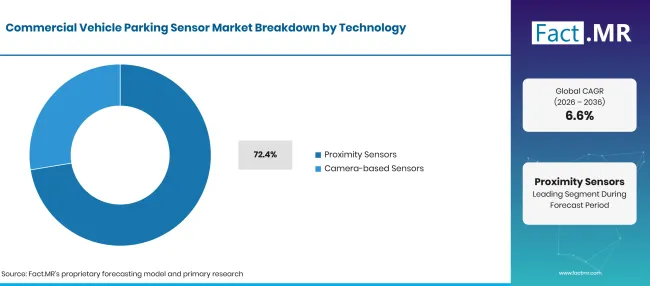
Factmr Commercial Vehicle Parking Sensor Market Breakdown Technology | Source: Fact.MR
| Technology | Share (2026) |
|---|---|
| Proximity Sensors (Leading segment) | 72.4% |
| Other segments combined | 27.6% |
| Total | 100.0% |
Source: Fact.MR analysis. Updated Oct 21, 2026
Proximity sensors focus on obstacles close to the vehicle during parking or reversing. Camera-based sensors add a visual view and can support the driver when objects lie beyond a sensor’s usual coverage. For vans carrying parcels, warnings must remain easy to understand during repeated stops. Heavy trucks need designs that account for wider body profiles.
What is accelerating Commercial Vehicle Parking Sensor Market adoption, and what is holding it back?
Urban delivery activity supports fitment; incorrect mounting and alert reliability can slow purchasing decisions.
Drivers Impact Analysis
| DRIVER | (~) % IMPACT ON CAGR | GEOGRAPHIC RELEVANCE | IMPACT TIMELINE |
|---|---|---|---|
| Frequent delivery stops | +1.0% | Global | Medium term (2–4 years) |
| Factory-installed reversing systems | +0.8% | Europe, North America | Medium term (2–4 years) |
| Fleet safety reviews | +0.7% | Global | Short term (<= 2 years) |
| Vehicle body integration | +0.5% | Europe, Japan | Medium term (2–4 years) |
| Workshop retrofit programs | +0.4% | Latin America, North America | Long term (>= 4 years) |
Source: Fact.MR analysis. Updated Oct 21, 2026
Opportunity Impact Analysis
| OPPORTUNITY | (~) % IMPACT ON CAGR | GEOGRAPHIC RELEVANCE | IMPACT TIMELINE |
|---|---|---|---|
| Vehicle-specific retrofit kits | +0.8% | Global | Medium term (2–4 years) |
| Sensor-camera integration | +0.6% | Europe, Japan | Medium term (2–4 years) |
| Serviceable sensor modules | +0.5% | Global | Short term (<= 2 years) |
| Body-builder partnerships | +0.4% | North America, Brazil | Medium term (2–4 years) |
Source: Fact.MR analysis. Updated Oct 21, 2026
Restraints Impact Analysis
| RESTRAINT | (~) % IMPACT ON CAGR | GEOGRAPHIC RELEVANCE | IMPACT TIMELINE |
|---|---|---|---|
| False warnings | -0.8% | Global | Short term (<= 2 years) |
| Retrofit labour | -0.6% | Global | Medium term (2–4 years) |
| Body design variation | -0.5% | Global | Medium term (2–4 years) |
| Repair and replacement cost | -0.4% | Global | Long term (>= 4 years) |
Source: Fact.MR analysis. Updated Oct 21, 2026
Which countries are scaling Commercial Vehicle Parking Sensor Market through 2036?
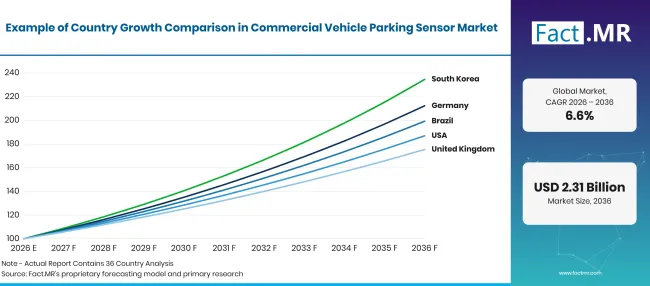
Factmr Commercial Vehicle Parking Sensor Market Growth Index | Source: Fact.MR
| Country | CAGR (2026–2036) |
|---|---|
| Germany | 7.8% |
| Brazil | 7.1% |
| United States | 6.5% |
| United Kingdom | 5.8% |
| Japan | 5.1% |
Source: Fact.MR analysis. Updated Oct 21, 2026
Why is Germany leading parking sensor adoption?
7.8% CAGR, influenced by vehicle manufacturing and van replacement activity.
Germany’s commercial vehicle fleet provides a potential customer base for parking assistance systems. New truck registrations can support factory-fitted equipment sales, while vehicles already in operation create opportunities for sensor servicing and replacement. Vehicle registrations and fleet size describe the potential customer base for parking assistance, rather than measured sensor installations.
How is Brazil expanding commercial vehicle parking assistance?
7.1% CAGR, linked to fleet replacement and depot operating conditions.
The Brazilian Development Bank (BNDES) provides BRL 10 billion in financing under its fleet renewal programme for purchases of new and eligible used trucks [1]. The São Paulo municipal government recorded 13,816 buses in its contracted fleet in September 2026 [2], providing a measure of the city’s public transport fleet size.
What supports commercial vehicle parking sensor sales in the United States?
6.5% CAGR, supported by commercial fleet servicing and reversing operations.
The Federal Highway Administration published its state motor-vehicle registration table for 2024 in January 2026 [3]. The table identifies truck registrations separately from other vehicle types. This official vehicle-base measure helps describe possible service coverage, without equating registered trucks with installed parking sensors.
How is the United Kingdom developing the market?
5.8% CAGR, influenced by light-goods fleets and repeated urban deliveries.
The Department for Transport reported 4.880 million licensed light goods vehicles in the United Kingdom during 2025 [4]. The same department recorded 682,000 first vehicle registrations across all vehicle categories in the second quarter of 2026 [5]. These statistics describe the wider vehicle population and turnover, while the commercial parking sensor outlook depends on model fitment and fleet purchasing choices.
Why is Japan maintaining measured growth?
5.1% CAGR, shaped by vehicle integration and careful system checks.
The Japan Automobile Manufacturers Association released its fiscal 2025 overseas vehicle production figures in May 2026 [6]. The release covers production outside Japan by Japanese manufacturers and provides background on the scale of their international vehicle operations. It is a manufacturing indicator rather than a measure of domestic commercial parking sensor sales.
Who leads the Commercial Vehicle Parking Sensor Market?
Bosch Mobility, Valeo and FORVIA HELLA participate in parking assistance technology and related vehicle electronics.
Robert Bosch GmbH (Bosch Mobility) have experience in vehicle sensing and driver-assistance integration. Valeo SE and FORVIA HELLA supply automotive sensing equipment used in low-speed assistance. Commercial fleets judge these firms by system compatibility and workshop support, not only by a sensor’s purchase price. The way sensors connect to vehicle displays affects the effort needed for factory installation. The automotive radar sensors category addresses a different sensing approach used in vehicle assistance.
Denso Corporation, ZF Friedrichshafen AG, Aptiv PLC and Magna International Inc. operate in related vehicle electronics or driver-assistance businesses. Their involvement should be understood according to component type and project fit, since semiconductor suppliers and complete parking-kit manufacturers serve different parts of the chain.
Which companies are the key providers?
Key companies include Robert Bosch GmbH (Bosch Mobility); Denso Corporation; Valeo SE; ZF Friedrichshafen AG; Aptiv PLC; Magna International Inc.; and FORVIA HELLA.
- Robert Bosch GmbH (Bosch Mobility)
- Denso Corporation
- Valeo SE
- ZF Friedrichshafen AG
- Aptiv PLC
- Magna International Inc.
- FORVIA HELLA
What is the report’s scope and coverage?
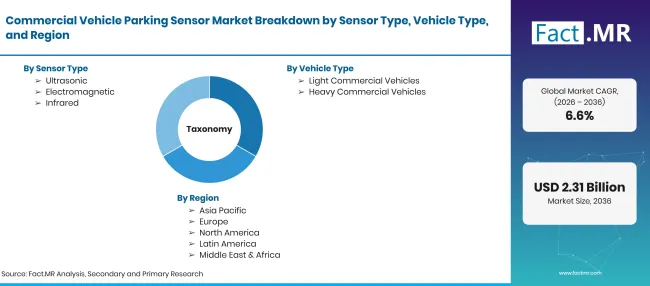
Factmr Commercial Vehicle Parking Sensor Market Taxonomy | Source: Fact.MR
| Attribute | Details |
|---|---|
| Quantitative Units | USD billion in 2026 to USD billion in 2036, at CAGR |
| Market Definition | Parking proximity sensor components and integrated warning systems for commercial vehicles |
| Sensor Type | Ultrasonic; Electromagnetic; Infrared |
| Vehicle Type | Light Commercial Vehicles; Heavy Commercial Vehicles |
| Application | OEM; Aftermarket |
| Technology | Proximity Sensors; Camera-based Sensors |
| Regions Covered | North America; Latin America; Western Europe; Eastern Europe; East Asia; South Asia & Pacific; Middle East & Africa |
| Countries Covered | Germany; Brazil; United States; United Kingdom; Japan |
| Companies Profiled | Robert Bosch GmbH (Bosch Mobility); Denso Corporation; Valeo SE; ZF Friedrichshafen AG; Aptiv PLC; Magna International Inc.; and FORVIA HELLA. |
| Forecast Period | 2026 to 2036 |
| Approach | Commercial vehicle applications, sensor technologies, official fleet statistics, and supplier product portfolios |
Source: Fact.MR analysis. Updated Oct 21, 2026
Bibliography
- [1] Banco Nacional de Desenvolvimento Econômico e Social. (n.d.). Programa BNDES Renovação de Frota – aquisição de caminhões novos e seminovos.
- [2] Prefeitura de São Paulo. (2026, October 5). Frota contratada.
- [3] Federal Highway Administration. (2026, January). Highway statistics 2024: State motor-vehicle registrations (Table MV-1). U.S. Department of Transportation.
- [4] Department for Transport. (2026, April 29). Vehicle licensing statistics, United Kingdom: 2025.
- [5] Department for Transport. (2026, September 23). Vehicle licensing statistics: April to June 2026.
- [6] Japan Automobile Manufacturers Association. (2026, May 29). 2026 [Overseas production statistics for the first quarter of 2026 and cumulative fiscal 2025].
This Report Answers
- The report examines why ultrasonic sensing suits commercial vehicle parking and reversing operations.
- The vehicle-type comparison assesses short-range warnings on light and heavy commercial vehicles.
- The application analysis distinguishes factory-fitted equipment from retrofit sensor kits.
- Country coverage compares Germany, Brazil, the United States, the United Kingdom and Japan.
- Supplier analysis separates system integrators from electronic component providers.
- Technology coverage compares direct proximity alerts with camera-based observation and warning functions.
What does the Commercial Vehicle Parking Sensor Market cover?
The market covers commercial vehicle proximity sensors and related parking-warning hardware. It includes vehicle systems used to alert drivers to nearby objects at low speeds and during reversing. The scope distinguishes sensors sold through vehicle manufacturing programs from equipment fitted later by fleet workshops. Other vehicle electronics categories include vehicle occupant sensing systems used for cabin safety.
What is included in the scope?
Included equipment covers ultrasonic and other proximity sensing approaches fitted to commercial vehicles. The analysis includes light commercial vans and heavier truck platforms. Factory-installed equipment and aftermarket purchases are considered separately because their buyers have different fitting requirements. Parking warning functions remain the focus, even when an OEM integrates sensors into a broader vehicle electronics package.
What is excluded from the scope?
The scope excludes stand-alone parking payment systems and urban parking infrastructure. Forward collision sensors that have no parking or low-speed obstacle-warning function remain outside the central market definition. Complete vehicles are excluded from sensor sales. General-purpose chips are considered only where they form part of a commercial vehicle parking sensing design.
How Was the Analysis Built?
The analysis draws on 120+ sources, 35+ company portfolios, 25+ countries, and more than 20 industry interviews.
- Primary Research: Primary research includes discussions with manufacturers, service providers, technology developers, distributors, end users, and subject-matter experts. These conversations examine purchasing priorities, product adoption, operational challenges, approval requirements, competitive positioning, and the factors that influence wider market acceptance.
- Desk Research: Desk research covers government statistics, regulatory publications, company filings, trade data, technical studies, industry associations, standards, public policy, and other authoritative sources. Every source used in the analysis is documented in the bibliography.
- Market Sizing and Forecasting: Market estimates combine historical performance, demand indicators, pricing and volume trends, segment shares, company participation, country-level growth, adoption patterns, investment activity, and barriers to market expansion.
- Data Validation and Update Cycle: Findings are validated by comparing primary interviews with public data, company activity, regulatory changes, trade patterns, and industry developments. Regular updates review new product launches, capacity changes, partnerships, approvals, and shifts in commercial adoption.
Segmentation
How is the market segmented?
-
By Sensor Type
- Ultrasonic
- Electromagnetic
- Infrared
-
By Vehicle Type
- Light Commercial Vehicles
- Heavy Commercial Vehicles
-
By Application
- OEM
- Aftermarket
-
By Technology
- Proximity Sensors
- Camera-based Sensors
-
By Region
- North America
- Latin America
- Western Europe
- Eastern Europe
- East Asia
- South Asia & Pacific
- Middle East & Africa
Frequently Asked Questions
How big is the commercial vehicle parking sensor market in 2026?
What is the CAGR from 2026 to 2036?
Which sensor type leads?
Which vehicle type accounts for the greater share?
Who are the main companies in the commercial vehicle parking sensor market?
Who worked on this report


Preview the report firsthand - request a free sample
Free SampleGet the brochure for pricing and purchase details
Download PDF