- Base Value(2026): 775.5 Mn
- Estimated Value(2026): 775.5 Mn
- Forecast Value (2036): 1239.4 Mn
- CAGR (2026 - 2036): 4.8%
Commercial Vehicle Anti-Vibration Fasteners Market Forecast Outlook 2026 to 2036
The commercial vehicle anti-vibration fasteners market is projected to reach USD 775.5 million in 2026 and grow to USD 1,239.4 million by 2036, reflecting a CAGR of 4.8%.
Key Takeaways from Commercial Vehicle Anti-Vibration Fasteners Market
- Commercial Vehicle Anti-Vibration Fasteners Market Value (2026): USD 775.5 million
- Commercial Vehicle Anti-Vibration Fasteners Market Forecast Value (2036): USD 1,239.4 million
- Commercial Vehicle Anti-Vibration Fasteners Market Forecast CAGR 2026 to 2036: 4.8%
- Leading Segment in Commercial Vehicle Anti-Vibration Fasteners Market: OEM Direct (57%)
- Key Growth Region in Commercial Vehicle Anti-Vibration Fasteners Market: Asia Pacific
- Key Players in Commercial Vehicle Anti-Vibration Fasteners Market: Trelleborg Automotive, Vibracoustic, Hutchinson, Sumitomo Riko, ContiTech, Parker LORD, Meidoh, Sundram Fasteners, SFS Group, Bulten
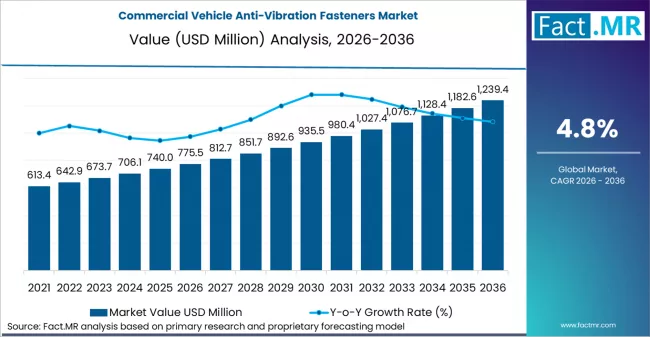
Commercial Vehicle Anti Vibration Fasteners Market Market Value Analysis | Source: Fact.MR
This market occupies a crucial position within the broader commercial vehicle manufacturing ecosystem, serving as a key enabler of vehicle performance and longevity. Anti-vibration fasteners reduce noise and wear, enhancing driving comfort and safety, making them essential in vehicle assembly.
The market’s role is increasingly pivotal as manufacturers prioritize both vehicle durability and comfort in response to regulatory and consumer demands. Competitive weight is heavily influenced by companies’ ability to provide high-performance, cost-effective solutions that meet stringent industry standards. As the demand for commercial vehicles continues to grow, the space will remain highly competitive, with larger players leveraging economies of scale to maintain a dominant position. Smaller companies, however, may differentiate themselves through specialized products and strategic partnerships with OEMs.
Commercial Vehicle Anti-Vibration Fasteners Market
| Metric | Value |
|---|---|
| Estimated Value in (2026E) | USD 775.5 million |
| Forecast Value in (2036F) | USD 1,239.4 million |
| Forecast CAGR 2026 to 2036 | 4.8% |
Source: Fact.MR analysis. Updated Jan 22, 2026
Category
| Category | Segments |
|---|---|
| Product Type | Rubber-Bonded Fasteners; Spring-Loaded Fasteners; Damped Stud Assemblies; Other |
| Vehicle Type | Heavy Trucks; Light Commercial Vehicles; Buses; Off-Highway CV; Other |
| Application | Cab Mounting Points; Powertrain Mounting; Exhaust or Aftertreatment Brackets; Other |
| Sales Channel | OEM Direct; Tier-1 Modules; Aftermarket; Other |
| Region | North America; Europe; Asia Pacific; Latin America; Middle East & Africa |
Source: Fact.MR analysis. Updated Jan 22, 2026
Segmental Analysis
What Is the Impact of Sales Channel on the Commercial Vehicle Anti-Vibration Fasteners Market?
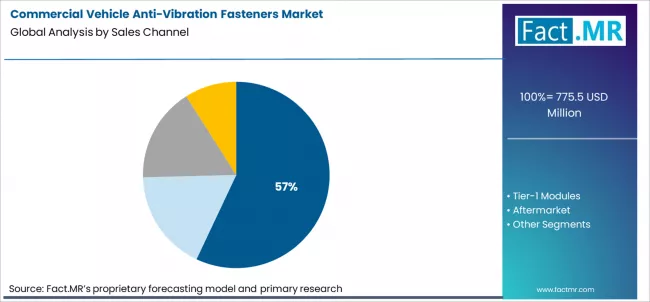
Commercial Vehicle Anti Vibration Fasteners Market Analysis By Sales Channel | Source: Fact.MR
In the commercial vehicle anti-vibration fasteners market, sales channel is crucial in determining the distribution and adoption of fasteners. OEM direct sales lead the market with a 57% share, as original equipment manufacturers (OEMs) require fasteners that meet stringent quality standards for their vehicles. These fasteners are integral in reducing vibrations in commercial vehicles, ensuring smoother performance and improving component longevity. As commercial vehicle manufacturers continue to prioritize quality and durability, the demand for anti-vibration fasteners through OEM direct channels will remain a key factor in the market’s growth, especially in heavy-duty and commercial vehicle production.
What Is the Impact of Vehicle Type on the Commercial Vehicle Anti-Vibration Fasteners Market?
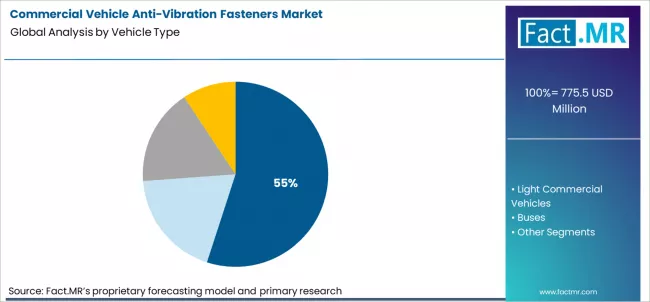
Commercial Vehicle Anti Vibration Fasteners Market Analysis By Vehicle Type | Source: Fact.MR
Vehicle type plays a significant role in shaping the demand for anti-vibration fasteners, with heavy trucks accounting for 55% of the market share. Heavy trucks experience more vibration due to their size and the nature of their operations, making high-quality anti-vibration fasteners essential for maintaining structural integrity and driver comfort. The demand for anti-vibration solutions in light commercial vehicles, buses, and off-highway CVs will also drive market growth as these vehicles require similar solutions for reducing vibration, enhancing performance, and improving safety. As the commercial vehicle industry continues to evolve, the need for anti-vibration fasteners in various vehicle types will support the market's expansion.
What are the Drivers, Restraints, and Key Trends in the Commercial Vehicle Anti Vibration Fasteners Market?
Demand for commercial vehicle anti vibration fasteners has been shaped by manufacturers’ requirements to mitigate vibration, noise, and mechanical fatigue in heavy duty trucks, buses, and utility vehicles. Engineers specify anti vibration fasteners that decouple structural attachments, secure mounts, and isolate sensitive components such as cab assemblies, exhaust systems, and drivetrain interfaces. Procurement and quality teams prioritize fasteners that deliver consistent damping performance, dimensional accuracy, and material strength to support extended service intervals and high mileage applications. Commercial vehicle OEMs and tier 1 suppliers evaluate suppliers based on traceability, part standardization, and on time delivery to maintain lean inventory and support production throughput. Growth in regulatory focus on NVH performance, driver comfort, and component durability further influences fastener sourcing and design choices.
Variability in load spectra, operating temperatures, and exposure to road contaminants affects the performance expectations for anti vibration fasteners, creating challenges in design validation and qualification testing. Some fastener producers refine elastomeric formulations, metal resin interfaces, and geometry to achieve target isolation characteristics while maintaining retention under shock and thermal cycling. Limited availability of standardized anti vibration fasteners across diverse commercial platforms has constrained broader adoption in retrofit and aftermarket segments. Work on advanced simulation tools and material characterization is progressing. Collaboration among OEMs, fastener manufacturers, and material scientists aims to expand validated solutions that balance vibration control, durability, and cost requirements.
Analysis of the Commercial Vehicle Anti-Vibration Fasteners Market by Key Country
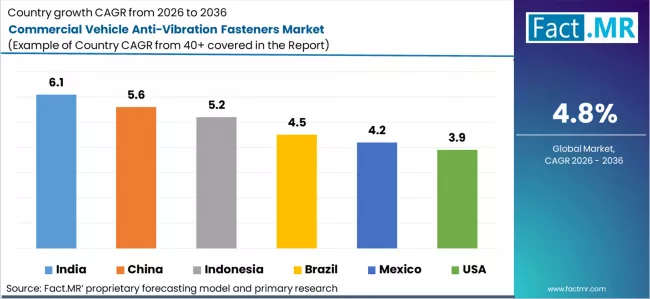
Commercial Vehicle Anti Vibration Fasteners Market Cagr Analysis By Country | Source: Fact.MR
| Country | CAGR (2026-2036) |
|---|---|
| India | 6.1% |
| China | 5.6% |
| Indonesia | 5.2% |
| Brazil | 4.5% |
| Mexico | 4.2% |
| USA | 3.9% |
Source: Fact.MR analysis. Updated Jan 22, 2026
The report covers an in-depth analysis of 40+ countries; top-performing countries are highlighted below.
What is the Outlook on the Commercial Vehicle Anti-Vibration Fasteners Market in India?
India market in commercial vehicle anti-vibration fasteners is projected to grow at a CAGR of 6.1% from 2026 to 2036. The demand for anti-vibration fasteners is increasing as the commercial vehicle sector in India continues to expand, driven by both domestic transportation needs and export growth. These fasteners are essential in reducing noise and improving the comfort and durability of commercial vehicles. As India’s automotive industry strengthens and demand for more reliable, long-lasting vehicles rises, the market for anti-vibration fasteners is expected to grow steadily.
What is the Demand for Commercial Vehicle Anti-Vibration Fasteners in China?
China sales of commercial vehicle anti-vibration fasteners are expected to grow at a CAGR of 5.6% from 2026 to 2036. As one of the largest automotive manufacturing hubs globally, China’s demand for anti-vibration fasteners is driven by the rapid growth of its commercial vehicle sector. These fasteners play a key role in enhancing vehicle durability and driver comfort by reducing vibrations. With China’s continued focus on expanding its transportation and logistics infrastructure, the market for anti-vibration fasteners in commercial vehicles is expected to experience steady growth.
What is the Sales Outlook on Commercial Vehicle Anti-Vibration Fasteners in Indonesia?
Indonesia demand for commercial vehicle anti-vibration fasteners is projected to grow at a CAGR of 5.2% from 2026 to 2036. As Indonesia’s automotive sector grows, particularly in the commercial vehicle segment, the need for effective anti-vibration solutions is increasing. These fasteners are essential for ensuring the stability and comfort of vehicles, which are crucial factors for the commercial vehicle sector. With increasing domestic production and a rising focus on transportation infrastructure, the market for anti-vibration fasteners in Indonesia is expected to continue expanding.
What is the Demand for Commercial Vehicle Anti-Vibration Fasteners in Brazil?
Brazil market in commercial vehicle anti-vibration fasteners is forecast to grow at a CAGR of 4.5% from 2026 to 2036. Brazil’s commercial vehicle industry is expanding, driven by both domestic demand and increasing investments in infrastructure. The need for anti-vibration fasteners is growing as manufacturers focus on improving vehicle performance, durability, and comfort. These fasteners are critical in reducing noise and vibration, which enhances the overall experience for commercial vehicle operators. The market for anti-vibration fasteners in Brazil is expected to grow steadily as the country’s automotive sector continues to develop.
What is the Sales Outlook on Commercial Vehicle Anti-Vibration Fasteners in Mexico?
Mexico demand for commercial vehicle anti-vibration fasteners is set to grow at a CAGR of 4.2% from 2026 to 2036. Mexico’s automotive manufacturing industry, particularly in commercial vehicles, is increasing as the country becomes a key player in North American supply chains. Anti-vibration fasteners are in high demand as they help ensure vehicle durability and operator comfort. With Mexico’s continued focus on improving its manufacturing capabilities and expanding its role as an automotive hub, the market for anti-vibration fasteners in commercial vehicles is expected to grow steadily.
What is the Market Expansion Outlook for Commercial Vehicle Anti-Vibration Fasteners in the USA?
USA sales of commercial vehicle anti-vibration fasteners are projected to grow at a CAGR of 3.9% from 2026 to 2036. The demand for these fasteners in the USA is driven by the need for durable, high-performance components in commercial vehicles. Anti-vibration fasteners play a vital role in ensuring the reliability, comfort, and longevity of commercial vehicles, which are essential for the transportation sector. Despite being a mature market, the ongoing demand for innovative, high-quality components in the commercial vehicle sector will continue to drive steady growth for anti-vibration fasteners in the USA.
How Are Key Players Competing in the Commercial Vehicle Anti Vibration Fasteners Market?
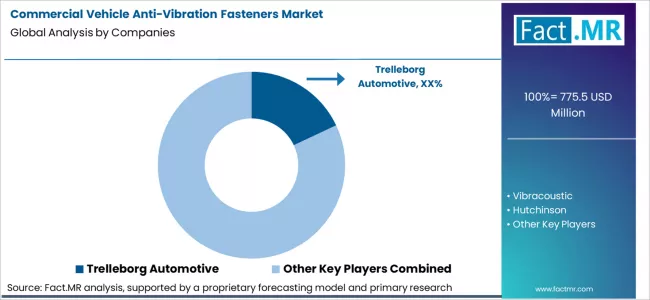
Commercial Vehicle Anti Vibration Fasteners Market Analysis By Company | Source: Fact.MR
Competition in the commercial vehicle anti vibration fasteners market is structured around vibration dampening performance, material durability, and integration with suspension and chassis systems. Trelleborg Automotive and Vibracoustic focus on engineered elastomer metal assemblies that reduce operational noise and fatigue under heavy loads. Hutchinson and Sumitomo Riko supply anti vibration modules designed for thermal and mechanical stability across extended duty cycles.
ContiTech and Parker LORD emphasise validated performance data and compliance with commercial vehicle endurance criteria. Meidoh and Sundram Fasteners offer fasteners tailored for secure attachment of dampers to structural interfaces. SFS Group and Bulten differentiate through precision machining, corrosion resistance, and supply chain responsiveness. Competitive positioning is defined by qualification to industry standards, long term reliability in dynamic environments, and capability to support large scale production requirements.
Key Players of the Commercial Vehicle Anti-Vibration Fasteners Market
- Trelleborg Automotive
- Vibracoustic
- Hutchinson
- Sumitomo Riko
- ContiTech
- Parker LORD
- Meidoh
- Sundram Fasteners
- SFS Group
- Bulten
Bibliographies
- International Organization for Standardization. (2024). ISO 16750: Road vehicles - Environmental conditions and testing.
- SAE International. (2023). SAE J1455: Environmental practices for heavy-duty vehicles.
- ASTM International. (2023). ASTM D2240: Rubber property - Durometer hardness.
- United Nations Economic Commission for Europe. (2023). UN Regulation No. 13 - Braking systems for heavy vehicles.
- European Commission. (2024). Regulation (EU) 2018/858 on motor vehicle type approval.
- National Highway Traffic Safety Administration. (2023). Federal Motor Vehicle Safety Standards.
Segmentation
Scope of the Report
| Items | Values |
|---|---|
| Quantitative Units (2026) | USD Million |
| Product Type | Rubber-Bonded Fasteners, Spring-Loaded Fasteners, Damped Stud Assemblies, Other |
| Vehicle Type | Heavy Trucks, Light Commercial Vehicles, Buses, Off-Highway CV |
| Application | Cab Mounting Points, Powertrain Mounting, Exhaust or Aftertreatment Brackets, Other |
| Sales Channel | OEM Direct, Tier-1 Modules, Aftermarket, Other |
| Regions Covered | North America, Europe, Asia Pacific, Latin America, Middle East & Africa |
| Countries Covered | United States, Canada, Mexico, Brazil, Germany, United Kingdom, France, Italy, Spain, China, Japan, South Korea, India, Australia & New Zealand |
| Key Companies Profiled | Trelleborg Automotive, Vibracoustic, Hutchinson, Sumitomo Riko, ContiTech, Parker LORD, Meidoh, Sundram Fasteners, SFS Group, Bulten |
| Additional Attributes | Dollar revenue by product type, vehicle type, application, and sales channel; regional demand trends, competitive landscape, technological advancements in anti-vibration fasteners, and innovations in commercial vehicle fastening systems |
Source: Fact.MR analysis. Updated Jan 22, 2026
Commercial Vehicle Anti-Vibration Fasteners Market Key Segments
-
Product Type :
- Rubber-Bonded Fasteners
- Spring-Loaded Fasteners
- Damped Stud Assemblies
- Other
-
Vehicle Type :
- Heavy Trucks
- Light Commercial Vehicles
- Buses
- Off-Highway CV
-
Application :
- Cab Mounting Points
- Powertrain Mounting
- Exhaust or Aftertreatment Brackets
- Other
-
Sales Channel :
- OEM Direct
- Tier-1 Modules
- Aftermarket
- Other
-
Region :
- North America
- USA
- Canada
- Mexico
- Europe
- Germany
- UK
- France
- Italy
- Spain
- Nordic Countries
- BENELUX
- Rest of Europe
- Asia Pacific
- China
- Japan
- South Korea
- India
- Australia
- Rest of Asia Pacific
- Latin America
- Brazil
- Argentina
- Rest of Latin America
- Middle East and Africa
- Kingdom of Saudi Arabia
- United Arab Emirates
- South Africa
- Rest of Middle East and Africa
- Other Regions
- Oceania
- Central Asia
- Other Markets
- North America
Frequently Asked Questions
How big is the commercial vehicle anti-vibration fasteners market in 2026?
What will be the size of commercial vehicle anti-vibration fasteners market in 2036?
How much will be the commercial vehicle anti-vibration fasteners market growth between 2026 and 2036?
What are the key product types in the commercial vehicle anti-vibration fasteners market?
Which vehicle type segment to contribute significant share in the commercial vehicle anti-vibration fasteners market in 2026?
Who worked on this report


Preview the report firsthand - request a free sample
Free SampleGet the brochure for pricing and purchase details
Download PDF