- Market size in 2025:USD 620 Million
- Estimated market size in 2026:USD 675 Million
- Projected market size by 2036:USD 1.45 Billion
- CAGR (2026-2036):7.90%
What is the silver foam dressings market forecast to be worth by 2036?
USD 675 million in 2026 to USD 1,450 million by 2036, at 7.90% CAGR.
- The silver foam dressings market crossed a valuation of USD 620 million in 2025.
- Demand is expected to increase from USD 675 million in 2026 to USD 1,450 million by 2036.
- The market is forecast to record 7.90% CAGR from 2026 to 2036 as wound clinics and hospitals use silver foam formats for exuding wounds at infection risk.
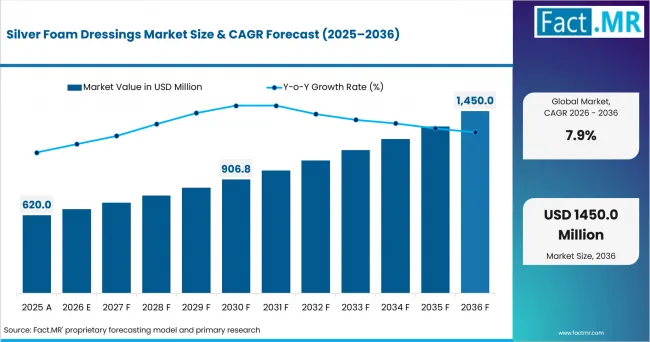
Silver Foam Dressings Market Market Value Analysis | Source: Fact.MR
What are the defining numbers behind silver foam dressings market growth?
USD 775 million absolute opportunity by 2036, led by antimicrobial foam use in exuding chronic wounds.
- Demand Drivers in the Market
- Wound care physicians need antimicrobial foam dressings for wounds with exudate and infection risk.
- Wound clinic nurses need dressings that manage fluid while reducing dressing-change complexity.
- Long-term care coordinators need products that support pressure injury care with fewer handling steps.
- Home healthcare teams need silver foam formats that are easier to apply during repeated visits.
- Key Segments Analyzed
- By Foam Type: Polyurethane foam is expected to hold 43.0% share in 2026 because it offers familiar absorption performance across chronic wounds.
- By Silver Type: Ionic silver leads because clinicians are familiar with its role in antimicrobial dressings. The segment is projected to capture 45.0% share in 2026.
- By Wound Type: Exuding wounds are likely to account for 35.0% share in 2026 because foam dressings are selected when wound fluid needs active management.
- By End User: Hospitals lead because complex wounds are first managed in specialist departments. The segment is expected to hold 41.0% share in 2026.
- By Geography: The United States is projected to record 8.8% CAGR through 2036 as wound clinics expand silver foam dressing use.
- Analyst Opinion at Fact.MR
- Shambhu Nath Jha, Senior Analyst at Fact.MR, states, “Silver foam dressings are selected when clinicians need two jobs from one product. The foam must manage exudate, while silver must support antimicrobial control inside the dressing environment. We see stronger supplier positions where product design reduces leakage and makes application easier for wound clinics and home care teams.”
- Strategic Implications
- Dressing suppliers should define value through exudate control and silver-release behavior.
- Wound clinics should match silver foam selection with wound fluid level and infection risk.
- Home healthcare providers need easy-to-apply formats that reduce variation across repeated dressing changes.
- Distributors should separate silver foam dressings from generic antimicrobial dressing assortments.
Silver foam dressings sit within the wider advanced wound care otc ecosystem because selected products are used across clinical and patient-accessible wound care channels. The category differs from ordinary foam dressings because silver is added to support antimicrobial activity while the foam layer manages wound fluid.
Smith+Nephew launched ALLEVYN COMPLETE CARE Foam Dressing in 2026, positioning foam dressing innovation around leakage reduction, healing support and pressure injury prevention. [1] This supports the broader foam dressing environment in which silver variants compete through antimicrobial function.
The United States is projected to record 8.8% CAGR through 2036 as wound clinics and hospitals use silver foam dressings for diabetic ulcers and pressure injuries. Germany is expected to post 8.3% CAGR through 2036 as chronic wound protocols support antimicrobial dressing use. Japan is likely to record 7.9% CAGR as long-term care settings require exudate control. China is forecast to advance at 7.6% CAGR as hospital wound care programs expand. India is set to record 7.2% CAGR as diabetic wound treatment increases in urban hospitals.
How does the silver foam dressings market break down by segment?
Polyurethane foam leads at 43.0%; ionic silver leads at 45.0%.
Which foam type dominates?
Polyurethane foam holds 43.0% share in 2026.
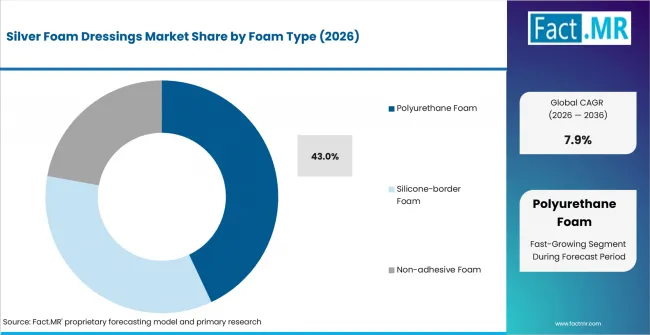
Silver Foam Dressings Market Analysis By Foam Type | Source: Fact.MR
Polyurethane foam is expected to hold 43.0% share in 2026 because it is a familiar absorption platform for moderate to high-exudate wounds. The material helps manage wound fluid while supporting a moist wound environment. Silicone-border foam is gaining ground where atraumatic removal and patient comfort matter. Adhesive foam supports easier placement in outpatient care. Non-adhesive foam is useful when secondary fixation is preferred. Cavity foam supports deeper wound spaces where standard flat dressings are less effective. The segment connects with medical foam because foam structure determines absorption, flexibility and dressing handling.
Which silver type dominates?
Ionic silver leads with 45% share in 2026.
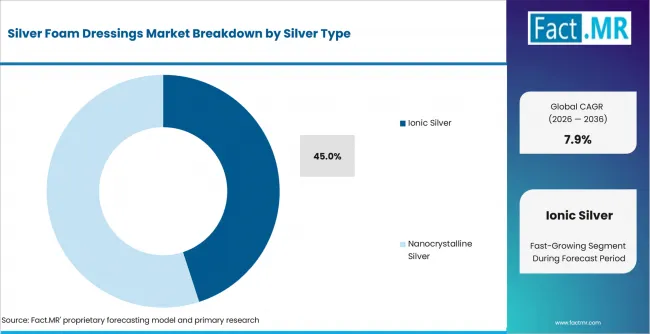
Silver Foam Dressings Market Analysis By Silver Type | Source: Fact.MR
Ionic silver leads because clinicians recognize its role in reducing microbial burden inside antimicrobial dressings. The segment is projected to capture 45.0% share in 2026 as wound clinics use ionic silver formats for infected or infection-risk wounds. Nanocrystalline silver creates premium positioning where sustained antimicrobial activity is emphasized. Silver sulfadiazine remains associated with burn care, but foam formats are more procedure-specific. Silver-coated foam supports direct antimicrobial contact. Sustained-release silver formats gain attention where dressing wear time and controlled activity matter. Coloplast describes Biatain Silicone Ag as a polyurethane foam dressing containing an ionic silver complex. [3]
Which wound type dominates?
Exuding wounds hold 35.0% share in 2026.
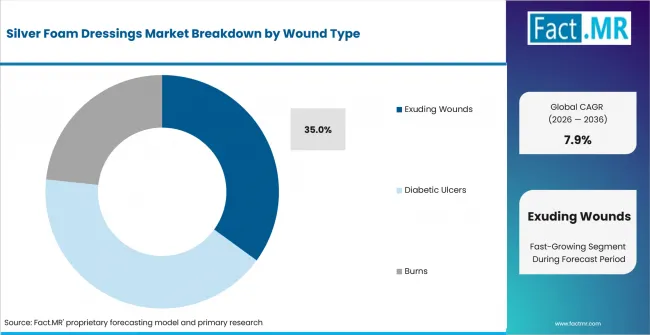
Silver Foam Dressings Market Analysis By Wound Type | Source: Fact.MR
Exuding wounds lead because foam dressings are chosen when fluid management is central to wound care. The wound type is likely to account for 35.0% share in 2026 as clinicians need dressings that absorb fluid while supporting antimicrobial control. Diabetic ulcers create strong use because infection risk and exudate can both complicate healing. Pressure injuries support demand in long-term care. Burns need careful antimicrobial dressing selection and gentle removal. Post-surgical wounds add demand where drainage and infection prevention are both priorities. Mölnlycke’s Mepilex Ag is designed for low to moderately exuding leg and foot ulcers, pressure ulcers and partial-thickness burns. [2]
Which end user dominates?
Hospitals leads with 41.0% share in 2026.
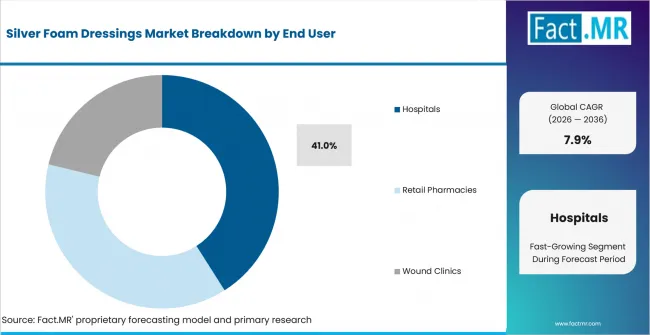
Silver Foam Dressings Market Analysis By End User | Source: Fact.MR
Hospitals lead because complex wounds are often assessed and treated in acute or specialist departments. These settings carry silver foam dressings for diabetic ulcers, pressure injuries, burns and post-surgical wounds. The hospital segment is expected to hold 41.0% share in 2026 because severe wounds need clinician-led dressing choice. Wound clinics are expanding as chronic wound care becomes more structured. Long-term care uses silver foam formats for pressure injury management. Home healthcare grows when dressing changes move closer to the patient. Retail pharmacies support selected OTC access. Care setting demand connects with wound healing assessment as clinicians monitor response before changing dressing type.
What is accelerating silver foam dressing adoption, and what is holding it back?
Chronic exuding wound care and diabetic ulcer treatment drive it, while premium pricing and silver-use caution restrain it.
Drivers Impact Analysis
| DRIVER | (~) % IMPACT ON CAGR | GEOGRAPHIC RELEVANCE | IMPACT TIMELINE |
|---|---|---|---|
| Chronic exuding wounds requiring combined absorption and antimicrobial support | +0.9% | North America, Europe, East Asia | Medium term (2–4 years) |
| Diabetic ulcer care using silver foam for infection-risk wounds | +0.8% | United States, China, India, Germany | Medium term (2–4 years) |
| Long-term care pressure injury management | +0.6% | United States, Japan, Europe | Short term (≤ 2 years) |
| Home healthcare dressing changes moving outside hospitals | +0.5% | North America, Europe, urban Asia | Medium term (2–4 years) |
| Silicone-border designs improving comfort and dressing retention | +0.4% | Global, strongest in wound clinics | Long term (≥ 4 years) |
Source: Fact.MR analysis. Updated Jun 30, 2026
- Chronic exuding wounds: Chronic exuding wounds are the main demand base because clinicians need a dressing that absorbs fluid while reducing microbial risk. Foam gives the dressing fluid-handling capacity, while silver supports antimicrobial control. The driver is strongest where diabetic ulcers and pressure injuries require repeated dressing changes over longer care cycles.
- Diabetic ulcer care: Diabetic ulcer care supports silver foam use because wounds may be exuding and infection-prone. Wound clinics often need dressings that can manage fluid without creating frequent disruption for the patient. Silver foam formats help clinicians align antimicrobial support with absorption. Convatec’s AQUACEL Ag Foam combines an AQUACEL Ag contact layer, foam comfort and ionic silver activity. [4]
- Long-term care pressure injuries: Long-term care settings create steady demand because pressure injuries often require extended dressing management. Silver foam dressings are useful when the wound is exuding and needs antimicrobial support. Staff also value dressings that stay in place and reduce leakage. The driver is strongest where facilities standardize wound care protocols.
- Home healthcare use: Home healthcare is expanding demand because many patients need dressing changes outside hospitals. Nurses need formats that are easy to apply and remove. Silicone-border and adhesive silver foam dressings support this shift because they reduce secondary fixation needs. Clear labeling and packaging help reduce application variation during home visits.
- Silicone-border designs: Silicone-border designs improve dressing retention and patient comfort during removal. This is important for fragile periwound skin and repeated changes. The design helps wound clinics manage exudate while lowering trauma during dressing removal. It also supports retail and home-care use where application simplicity matters.
Opportunity Impact Analysis
| OPPORTUNITY | (~) % IMPACT ON CAGR | GEOGRAPHIC RELEVANCE | IMPACT TIMELINE |
|---|---|---|---|
| Sustained-release silver foam for longer wear cycles | +0.6% | North America, Europe, Japan | Medium term (2–4 years) |
| Cavity foam formats for deeper exuding wounds | +0.5% | Hospitals and wound clinics globally | Medium term (2–4 years) |
| Retail pharmacy access for selected silver foam products | +0.4% | North America, Europe, urban Asia | Long term (≥ 4 years) |
| Home-care kits combining silver foam and secondary supplies | +0.3% | United States, Japan, India | Short term (≤ 2 years) |
Source: Fact.MR analysis. Updated Jun 30, 2026
- Sustained-release silver foam: Sustained-release silver foam creates opportunity where clinicians want antimicrobial activity across the dressing wear period. These products can reduce uncertainty when wounds are exuding and dressing changes are spaced out. Suppliers that explain release behavior clearly can gain stronger acceptance in wound clinics.
- Cavity foam formats: Cavity foam formats create opportunity in deeper wounds where flat foam does not maintain contact with the wound bed. These formats help clinicians manage fluid inside irregular wound spaces. The opportunity is strongest in wound clinics and hospitals where nurses can assess cavity depth and choose a suitable dressing.
- Retail pharmacy access: Retail pharmacy access can expand selected silver foam use for less complex wounds. Patients and caregivers may seek advanced dressings when ordinary bandages fail to manage fluid. This opportunity connects with advanced wound care otc because pharmacy channels are expanding beyond basic wound coverage.
- Home-care kits: Home-care kits can combine silver foam dressings with secondary covers and clear instructions. This reduces variation when wound care shifts from clinic to home. The opportunity connects with ai-enabled wound analysis as remote wound monitoring supports product adjustment between visits.
Restraints Impact Analysis
| RESTRAINT | (~) % IMPACT ON CAGR | GEOGRAPHIC RELEVANCE | IMPACT TIMELINE |
|---|---|---|---|
| Premium pricing versus standard foam dressings | -0.6% | Global, strongest in public health systems | Medium term (2–4 years) |
| Silver-use caution where antimicrobial need is unclear | -0.5% | North America, Europe, Japan | Medium term (2–4 years) |
| Overlap with silver gels, alginates and fiber dressings | -0.4% | Global | Short term (≤ 2 years) |
| Application errors in home healthcare and retail use | -0.3% | Home care and OTC channels globally | Long term (≥ 4 years) |
Source: Fact.MR analysis. Updated Jun 30, 2026
- Premium pricing: Premium pricing is a major restraint because silver foam dressings cost more than standard foam dressings. Hospitals and wound clinics need a clear reason to use silver when infection risk is not obvious. If exudate control is the only need, standard foam can win. Suppliers need to prove where silver adds value.
- Silver-use caution: Clinicians may avoid silver dressings when antimicrobial support is not needed. This restraint is important because unnecessary silver use can increase cost and may not improve wound progress. Wound care teams must assess bioburden, exudate and infection risk before choosing silver foam. Clear usage guidance can reduce overuse concerns.
- Category overlap: Silver foam dressings compete with silver gels and silver fiber dressings. In some wounds, clinicians may prefer a gelling fiber or alginate instead of foam. This overlap can slow silver foam adoption unless the wound clearly needs foam absorption. Suppliers need precise positioning by wound fluid level and dressing-contact need.
- Application errors: Home healthcare and retail settings create growth, but they also raise application risk. A dressing may fail if it is placed on the wrong wound type or changed too late. Patients may also use silver foam for wounds that need clinical evaluation. This restraint supports clearer instructions and stronger clinician involvement.
Which countries are scaling silver foam dressings fastest?
United States 8.8%; Germany 8.3%; Japan 7.9%; China 7.6%; India 7.2%.
Based on regional analysis, the silver foam dressings market is segmented into North America, Europe, East Asia, South Asia, Latin America, and Middle East and Africa.
| Country | CAGR |
|---|---|
| United States | 8.8% |
| Germany | 8.3% |
| Japan | 7.9% |
| China | 7.6% |
| India | 7.2% |
Source: Fact.MR analysis. Updated Jun 30, 2026
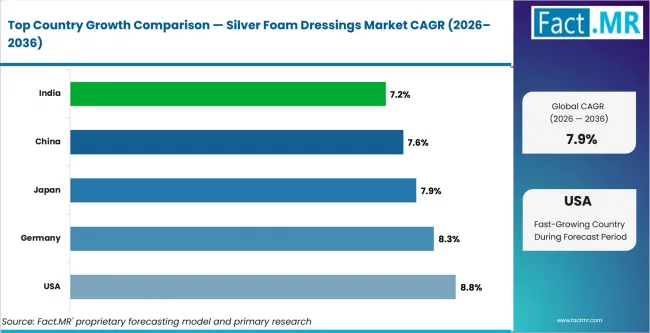
Silver Foam Dressings Market Cagr Analysis By Country | Source: Fact.MR
What is powering the United States lead?
8.8% CAGR, driven by Smith+Nephew and wound clinic use of antimicrobial foam dressings.
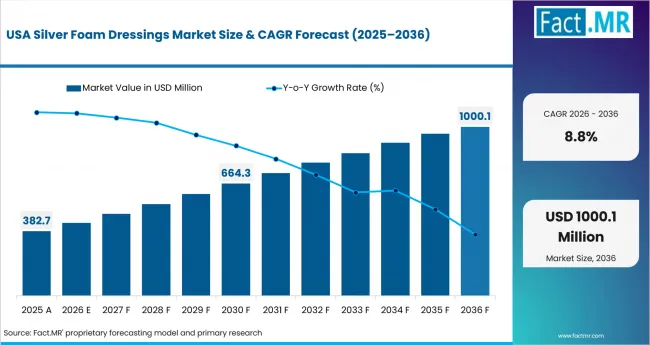
Silver Foam Dressings Market Country Value Analysis | Source: Fact.MR
The United States is projected to record 8.8% CAGR from 2026 to 2036 as wound clinics and hospitals use silver foam dressings for diabetic ulcers, pressure injuries and exuding wounds. Growth will favor suppliers with strong clinical education, home-care channel support and broad dressing portfolios.
How is Germany scaling silver foam dressing demand?
Germany is expected to post 8.3% CAGR through 2036, supported by structured chronic wound protocols and formulary-driven product choice.
Wound care teams need dressings that combine fluid control with antimicrobial support when infection risk is present. Germany is expected to post 8.3% CAGR through 2036 as wound clinics and long-term care providers standardize dressing choices. Growth will favor suppliers with clear product evidence and strong hospital access.
What supports Japan’s outlook?
7.9% CAGR, driven by aging care networks and pressure injury management.
Japan is likely to record 7.9% CAGR by 2036 as long-term care settings and hospitals manage more chronic wounds. Silver foam demand will benefit from pressure injury care and exuding wounds that need gentle removal. Suppliers with silicone-border products and nurse education will be better placed.
What underpins China’s growth?
China is forecast to advance at 7.6% CAGR through 2036, supported by hospital wound care programs and diabetic ulcer treatment.
China is forecast to advance at 7.6% CAGR through 2036 as urban hospitals and wound clinics expand advanced dressing access. Silver foam dressings will gain traction where clinicians need both antimicrobial support and fluid handling. Local distribution and product affordability will shape supplier performance.
How is India scaling silver foam dressing adoption?
7.2% CAGR, driven by diabetic wound treatment and private hospital expansion.
India is set to record 7.2% CAGR through 2036 as private hospitals and specialty clinics treat more diabetic ulcers and post-surgical wounds. Demand will favor affordable polyurethane foam and ionic silver formats. Suppliers with wider distributor coverage will have stronger access.
Who leads the silver foam dressings market?
Smith+Nephew and Mölnlycke lead through advanced wound care and antimicrobial foam portfolios.
Silver foam dressings are supplied by advanced wound care companies, medical dressing manufacturers and hospital consumable firms. Smith+Nephew competes through ALLEVYN foam dressing platforms and advanced wound care channel strength. Mölnlycke is relevant through Mepilex Ag and silicone foam dressing expertise.
ConvaTec competes through AQUACEL Ag Foam and Hydrofiber-based silver foam formats. Coloplast adds depth through Biatain Silicone Ag. Medline supports hospital and home-care channels through Optifoam Ag+ silver foam dressings. Hartmann compete through antimicrobial wound dressing portfolios and chronic wound care reach. Competition also connects with wound care biologics where clinics compare advanced material function across complex wounds.
Competition through 2036 will depend on antimicrobial positioning, foam performance, wear time and care-setting fit. Suppliers that compete only on silver claims will face price pressure. Suppliers that combine leakage control, comfort and clear wound-type guidance can defend stronger value. The field also connects with advanced wound care because silver foam dressings sit inside broader chronic wound treatment pathways.
Which companies are the key providers?
Smith+Nephew and Mölnlycke are key providers. Solventum / 3M Medical Solutionsand ConvaTec are also profiled. Coloplast, Medline, Hartmann complete the company set.
- Smith+Nephew
- Mölnlycke
- Solventum / 3M Medical Solutions
- ConvaTec
- Coloplast
- Medline
- Hartmann
Bibliography
- [1] Smith+Nephew. (2026, March 10). Smith+Nephew launches next-generation ALLEVYN COMPLETE CARE foam dressing. Smith+Nephew.
- [2] Mölnlycke Health Care. (2026). Mepilex® Ag. Mölnlycke Health Care.
- [3] Coloplast. (2026). Biatain® Silicone Ag. Coloplast.
- [4] ConvaTec. (2026). AQUACEL® Ag Foam dressing. ConvaTec.
This Report Addresses
- Strategic intelligence on silver foam dressings across foam type and silver type.
- Segment analysis covering Polyurethane Foam and Ionic Silver.
- Regional outlook covering the United States, Germany, Japan, China, and India.
- Competitive analysis of Smith+Nephew, Mölnlycke, Solventum / 3M Medical Solutions, ConvaTec, Coloplast, Medline, Hartmann.
- Technology assessment covering silver release, foam absorption, silicone borders and exudate control.
- Use case assessment covering exuding wounds, diabetic ulcers, pressure injuries, burns and post-surgical wounds.
- Primary interviews, provider checks and official source review support the forecast.
What does the silver foam dressings market cover?
Silver-containing foam dressings used for exuding and infection-risk wounds.
The silver foam dressings market covers polyurethane foam, silicone-border foam, adhesive foam, non-adhesive foam and cavity foam formats that incorporate ionic silver or sustained-release silver systems.
The market differs from broad wound dressing coverage because the scope is limited to foam dressings with silver-based antimicrobial function. Generic foams without silver are excluded unless they are part of a silver foam dressing system.
What is included in the scope?
Silver-impregnated and silver-coated foam dressings used across wound care settings.
The scope includes polyurethane foam and cavity foam. It also includes ionic silver and sustained-release silver formats. Covered wound types include exuding wounds, diabetic ulcers, pressure injuries, burns and post-surgical wounds.
The scope includes use in hospitals and retail pharmacies. The category also connects with advanced wound dressing because silver foam products combine antimicrobial support with exudate management.
What is excluded from the scope?
Non-silver foam and non-foam antimicrobial dressings are outside the scope.
The scope excludes standard foam dressings without silver, ordinary gauze, hydrocolloids, alginate-only dressings, and simple films. It also excludes silver gels and silver fiber dressings unless foam is the main wound-contact or absorption format. Broader wound gel products are outside scope when the revenue function is gel-based wound contact instead of foam-based absorption.
How was the analysis built?
100+ sources, 40+ company portfolios, 25+ countries, 20+ interviews.
- Primary Research: Primary research includes interviews with wound care physicians and wound clinic nurses. It includes input from long-term care coordinators, home healthcare managers and hospital supply chain teams.
- Desk Research: Desk research reviews official silver foam dressing portfolios and antimicrobial dressing documentation. It covers foam layer design, silver release methods, adhesive formats and wound-type positioning.
- Market-Sizing and Forecasting: Forecasting uses chronic wound care adoption, silver foam attachment rates, end-user purchasing cycles and wound-type demand patterns.
- Data Validation and Update Cycle: Forecasts are validated through provider checks and wound clinic feedback. Product portfolio reviews and channel availability checks help confirm market direction.
Segmentation
What is the report’s scope and coverage?
| Attribute | Details |
|---|---|
| Quantitative Units | USD Million in 2026 to USD Million by 2036 at CAGR |
| Market Definition | Silver-containing foam dressings used for exuding and infection-risk wounds |
| Foam Type | Polyurethane foam; silicone-border foam; adhesive foam; non-adhesive foam; cavity foam |
| Silver Type | Ionic silver; nanocrystalline silver; silver sulfadiazine; silver-coated foam; sustained-release silver |
| Wound Type | Exuding wounds; diabetic ulcers; pressure injuries; burns; post-surgical wounds |
| End User | Hospitals; wound clinics; long-term care; home healthcare; retail pharmacies |
| Regions Covered | North America; Europe; East Asia; South Asia; Latin America; Middle East and Africa |
| Countries Covered | United States; Germany; Japan; China; India |
| Key Companies Profiled | Smith+Nephew; Mölnlycke; Solventum / 3M Medical Solutions; ConvaTec; Coloplast; Medline; Hartmann |
| Forecast Period | 2026 to 2036 |
| Approach | Hybrid top-down and bottom-up approach using chronic wound care adoption, silver foam attachment rates, wound-type mix and provider validation |
Source: Fact.MR analysis. Updated Jun 30, 2026
How is the market segmented?
-
By Foam Type:
- Polyurethane foam
- Silicone-border foam
- Adhesive foam
- Non-adhesive foam
- Cavity foam
-
By Silver Type:
- Ionic silver
- Nanocrystalline silver
- Silver sulfadiazine
- Silver-coated foam
- Sustained-release silver
-
By Wound Type:
- Exuding wounds
- Diabetic ulcers
- Pressure injuries
- Burns
- Post-surgical wounds
-
By End User:
- Hospitals
- Wound clinics
- Long-term care
- Home healthcare
- Retail pharmacies
-
Region:
- North America
- United States
- Canada
- Europe
- Germany
- United Kingdom
- France
- Italy
- Netherlands
- East Asia
- Japan
- China
- South Korea
- South Asia
- India
- Thailand
- Singapore
- Latin America
- Brazil
- Mexico
- Chile
- Middle East & Africa
- UAE
- Saudi Arabia
- South Africa
- Israel
- North America
Frequently Asked Questions
Which foam type leads the Silver Foam Dressings Market?
Which silver type leads the Silver Foam Dressings Market?
Which wound type leads the Silver Foam Dressings Market?
Which end user leads the Silver Foam Dressings Market?
Which region leads the Silver Foam Dressings Market?
Which country expands fastest in the Silver Foam Dressings Market?
How does Germany perform in the Silver Foam Dressings Market?
How does Japan perform in the Silver Foam Dressings Market?
How does China perform in the Silver Foam Dressings Market?
How does India perform in the Silver Foam Dressings Market?
What is the primary driver in the Silver Foam Dressings Market?
What is the main restraint in the Silver Foam Dressings Market?
Why is polyurethane foam important?
Why do hospitals dominate demand?
Who worked on this report


Preview the report firsthand - request a free sample
Free SampleGet the brochure for pricing and purchase details
Download PDF