- Market Value (2025): USD 2.4 Bn
- Estimated Value (2026): USD 2.8 Bn
- Forecast Value (2036): USD 10.9 Bn
- CAGR (2026-2036): 14.6%
What is the Compostable Single-Serve Laminates Market forecast to be worth by 2036?
USD 2.8 billion in 2026 to USD 10.9 billion by 2036 at a 14.6% CAGR.
- The Compostable Single-Serve Laminates Market reached USD 2.4 billion in 2025.
- Demand is projected to increase from USD 2.8 billion in 2026 to USD 10.9 billion by 2036.
- The market is forecast to record 14.6% CAGR from 2026 to 2036 as food brands and flexible-packaging converters replace difficult-to-recycle small formats with certified compostable structures.
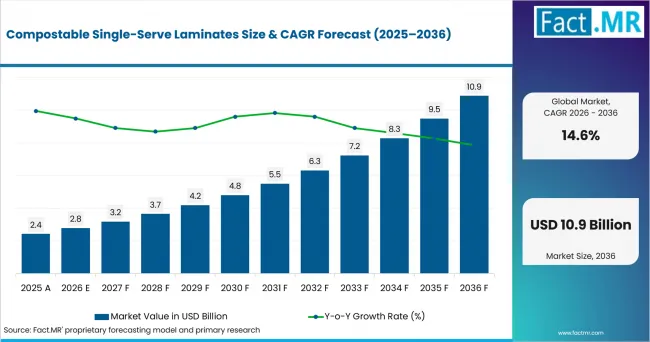
Compostable Single Serve Laminates Value Analysis | Source: Fact.MR
What are the defining numbers behind Compostable Single-Serve Laminates Market growth?
An absolute opportunity of USD 8.1 billion is expected between 2026 and 2036.
- Demand Drivers in the Market
- Food brands need thin single-portion packs that preserve seal strength and oxygen control while reducing reliance on persistent multilayer waste. Qualification therefore centers on a laminate that protects the product during distribution and still carries a clear compostability route after use.
- Coffee and snack packers require structures that tolerate filling-line heat while retaining a certified organic-recovery route for food-soiled packs. Heat resistance must work alongside moisture and aroma control because small packs expose more seal area relative to the quantity of product inside.
- Converters need compostable films that run on established printing and lamination equipment so qualification remains practical on current converting platforms. Familiar process windows shorten line trials and help converters compare seal behavior across PLA-based, cellulose-based and paper-biopolymer structures.
- European Commission guidance published in June 2026 states that permeable tea, coffee or other beverage bags and soft after-use system single-serve units covered by Article 9 must be designed for composting by 12 February 2028. This establishes a defined compliance date for the packaging formats covered by that provision. Material selection is therefore expected to move earlier into pack development when barrier layers and sealing systems are specified.
- Key Segments Analyzed
- By Laminate Platform: PLA-based is expected to hold 31.0% share in 2026 owing to established film-processing routes for compostable portion packs.
- By Barrier Level: High oxygen barrier is projected to account for 29.0% share in 2026 as coffee and dry foods need oxidation protection.
- By Pack Format: Single-serve sachets are anticipated to capture 36.0% share in 2026 because portion packs combine high volumes with low material use per pack.
- By End-of-Life: Industrial compostable is estimated to represent 34.0% share in 2026 since controlled facilities provide defined composting conditions.
- Analyst Opinion at Fact.MR
- Shambhu Nath Jha, Principal Consultant at Fact.MR, states, “A compostable laminate must protect the product and reach the intended disposal route. Demand is expected to favor structures that pair barrier performance with clear certification. Suppliers should align materials and converting guidance around the complete pack.”
- Strategic Implications
- Resin producers should publish converting windows and compostability documentation for the film and coating combinations used in single-serve lines. Clear operating ranges help converters assess temperature limits and sealing behavior before the material enters a full packaging qualification cycle.
- Film converters should validate barrier performance after printing and sealing because downstream processing can change oxygen or moisture protection. Finished-pack testing is especially relevant for coffee and powdered foods where aroma retention depends on the complete printed and sealed structure.
- Brand owners should align disposal instructions with local recovery systems. Eurostat reported in October 2025 that the EU generated 79.7 million tonnes of packaging waste in 2023.
- Packaging developers should limit unnecessary layers so sealing trials, food-contact review and compostability certification remain manageable. Each functional layer should have a defined role in barrier, print or seal performance so the finished laminate remains easier to qualify and communicate.
France is forecast to post 15.2% CAGR through 2036, followed by China at 14.5%. The USA and Japan each reach 14.0%, while Germany records 13.8%. Local packaging rules, food channels and waste systems create different adoption conditions.
How does the Compostable Single-Serve Laminates Market break down by segment?
Single-serve sachets lead Pack Format at 36.0%; Industrial compostable leads End-of-Life at 34.0%.
Which Laminate Platform leads?
PLA-based is expected to hold 31.0% share in 2026.
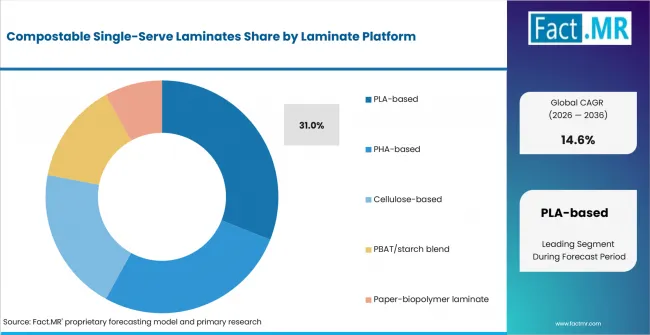
Compostable Single Serve Laminates Analysis By Laminate Platform | Source: Fact.MR
PLA-based structures can be converted into oriented films and seal layers for compact food packs. Their established film-processing route supports small sachets and lidding structures where converters need heat-seal performance and certified compostability. The 31.0% share therefore reflects a platform that can serve film production and finished-pack qualification across multiple single-serve formats.
What leads the Barrier Level segment?
High oxygen barrier is projected to account for 29.0% share in 2026.
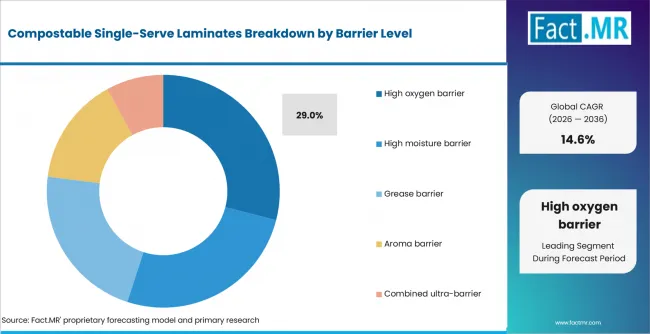
Compostable Single Serve Laminates Analysis By Barrier Level | Source: Fact.MR
High oxygen barrier structures protect coffee, powders and other aroma-sensitive products in compact packs. On April 29, 2026, BASF expanded its ecovio portfolio with certified home-compostable grades for film lamination and extrusion coating. The portfolio includes adjustable oxygen and moisture barriers for flexible packaging. The 29.0% share reflects the commercial need to preserve product quality while retaining a defined compostability route.
How does Pack Format shape demand?
Single-serve sachets are anticipated to capture 36.0% share in 2026.
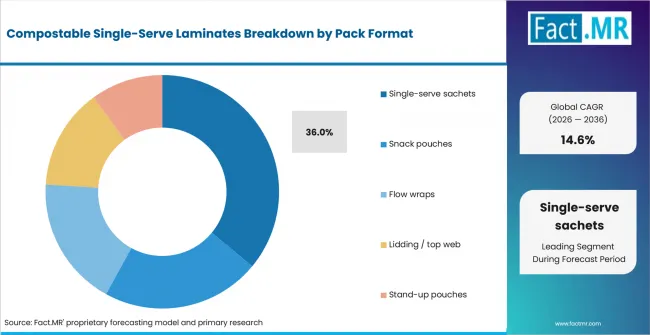
Compostable Single Serve Laminates Analysis By Pack Format | Source: Fact.MR
Sachets concentrate demand around machinability, seal consistency and barrier control. Compact pack formats need laminate structures that protect food during distribution while preserving the certified end-of-life route. Their 36.0% share also reflects the high number of individual packs created from a relatively small amount of material per serving.
What supports Industrial compostable within End-of-Life?
Industrial compostable is estimated to represent 34.0% share in 2026.
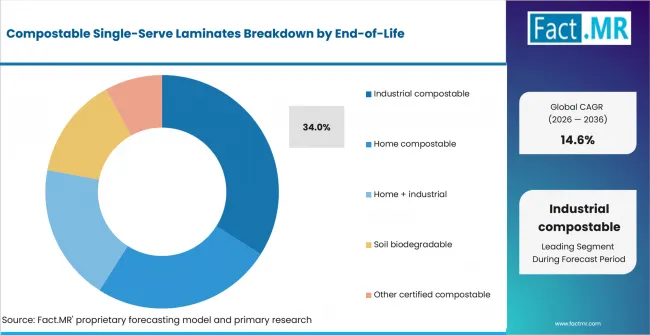
Compostable Single Serve Laminates Analysis By End Of Life | Source: Fact.MR
Industrial composting offers controlled processing conditions that support standardized certification. Article 9(1) of Regulation (EU) 2025/40 requires the packaging covered by that paragraph to be compatible with composting under industrially controlled conditions in bio-waste treatment facilities and, where required by Member States, with the applicable home-composting standards. The 34.0% share reflects the value of a defined treatment environment for packs that carry food residue after use.
What is accelerating Compostable Single-Serve Laminates Market adoption, and what is holding it back?
Adoption is supported by small-format packaging redesign and compostability rules; constraints include infrastructure fit, certification cost and competing reuse or recycling requirements.
Drivers Impact Analysis
| DRIVER | MARKET EFFECT | GEOGRAPHIC RELEVANCE | IMPACT TIMELINE |
|---|---|---|---|
| Single-serve formats that are difficult to sort mechanically | Positive | North America, Europe, East Asia | Short term (<= 2 years) |
| Rules directing selected food-soiled single-serve units toward compostability | Positive | Europe | Medium term (2-4 years) |
| Barrier-resin and coating improvements for flexible laminates | Positive | Global | Medium term (2-4 years) |
| Food and e-commerce growth in portioned formats | Positive | USA, China, Japan | Long term (>= 4 years) |
Opportunity Impact Analysis
| OPPORTUNITY | MARKET EFFECT | GEOGRAPHIC RELEVANCE | IMPACT TIMELINE |
|---|---|---|---|
| High-barrier sachets for coffee, snacks and powdered foods | Positive | Global | Short term (<= 2 years) |
| Paper-biopolymer laminates with organics or paper recovery routes | Positive | Europe, North America | Medium term (2-4 years) |
| Home-compostable structures for accepted local collection systems | Positive | Europe, selected North American markets | Long term (>= 4 years) |
Restraints Impact Analysis
| RESTRAINT | MARKET EFFECT | GEOGRAPHIC RELEVANCE | IMPACT TIMELINE |
|---|---|---|---|
| Uneven access to industrial composting and separate bio-waste collection | Constraining | Global | Short term (<= 2 years) |
| Competing reuse and material-recycling obligations | Constraining | Europe | Medium term (2-4 years) |
| Barrier and sealing qualification across multilayer structures | Constraining | Global | Medium term (2-4 years) |
Which countries are scaling the Compostable Single-Serve Laminates Market through 2036?
- France remains 0.7 percentage point above China as EU packaging requirements and food-channel demand support redesign of small flexible formats.
- China remains 0.5 percentage point above the USA as foodservice scale and online food sales expand demand for compact flexible packs.
- The USA matches Japan at 14.0% CAGR as both markets combine large packaged-food demand with active packaging-material qualification.
- Japan remains 0.2 percentage point above Germany as household spending and portioned-food channels support flexible packaging demand.
- Germany closes the displayed range at 13.8% CAGR as EU packaging rules and converter capability support certified compostable structures.
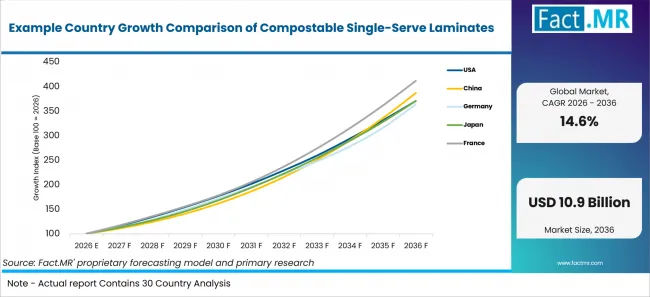
Example Country Growth Comparison Of Compostable Single Serve Laminates | Source: Fact.MR
| Country | CAGR (2026-2036) |
|---|---|
| France | 15.2% |
| China | 14.5% |
| United States | 14.0% |
| Japan | 14.0% |
| Germany | 13.8% |
What supports France adoption?
15.2% CAGR, supported by food demand and EU packaging requirements.
France combines a large consumer-food base with packaging rules that are tightening design requirements for selected small formats. INSEE reported in June 2026 that spending on restaurants and accommodation in 2025 was more than 20% above its 2019 level. Compostable laminate demand is expected to favor formats that pair barrier performance with a recovery route accepted by local organic-waste systems.
How is China scaling demand?
14.5% CAGR, driven by foodservice scale and online food sales.
China combines high foodservice turnover with digital retail channels that use large volumes of compact packs. The National Bureau of Statistics of China reported in January 2026 that catering income reached CNY 5,798.2 billion in 2025, up 3.2% from 2024. Suppliers are expected to gain from laminate structures that maintain sealing performance while meeting local material and end-of-life requirements.
What supports USA adoption?
14.0% CAGR, supported by a large food-spending base and small-format packaging use.
The United States provides a large addressable base for portion packs across retail and foodservice. USDA Economic Research Service reported on June 11, 2026 that inflation-adjusted U.S. food spending by consumers, businesses and government entities reached USD 2.51 trillion in 2025. Compostable laminates are expected to gain where brand specifications align barrier needs with an available organic-recovery pathway.
How does Japan perform?
14.0% CAGR, supported by household spending and compact food formats.
Japan combines dense retail channels with established demand for compact packaged-food formats. The Statistics Bureau of Japan reported on February 6, 2026 that average monthly consumption expenditure per two-or-more-person household was JPY 314,001 in 2025, up 4.6% in nominal terms and 0.9% in real terms from 2024. Laminate suppliers are expected to compete on seal quality and barrier control while keeping the claimed compostability route clear for the finished pack.
What is supporting Germany adoption?
13.8% CAGR, supported by consumer spending and EU packaging rules.
Germany combines a developed converting base with EU-wide packaging requirements that shape material qualification. Destatis reported on January 15, 2026 that Germany's price-adjusted household final consumption expenditure increased by 1.4% in 2025. Compostable laminate adoption is expected to focus on applications where certified end-of-life design complements barrier performance and established converting processes.
Who leads the Compostable Single-Serve Laminates Market?
Parkside Flexibles and BASF are active in compostable flexible-packaging materials. BASF provides certified compostable ecovio® materials for flexible barrier structures with adjustable grease, liquid, oxygen and moisture protection.
TIPA announced the acquisition of SEALPAP on October 20, 2025, combining TIPA’s certified compostable flexible-packaging technologies with SEALPAP’s recyclable coated-paper solutions. Bio4Pack, Novamont and Futamura Chemical add compostable resin, film, coating and flexible-packaging capabilities through Luminy® PLA, MATER-BI and NatureFlex™ technologies, respectively.
Competitive differentiation across these portfolios includes barrier performance, sealing capability, food-contact suitability, compostability certification and compatibility with printing, coating and lamination processes. Suppliers with capabilities spanning films, sealing layers, coated paper and laminate structures can address a broad range of flexible-packaging formats, including sachets and lidding applications. Technical documentation covering processing conditions, food-contact compliance and end-of-life certification also supports converter and brand qualification activities.
Which companies are the key providers?
Parkside Flexibles, Bio4Pack, BASF, Novamont, TIPA and Futamura Chemical are profiled providers.
- Parkside Flexibles
- Bio4Pack
- BASF
- Novamont
- TIPA
- Futamura Chemical
What is the report’s scope and coverage?
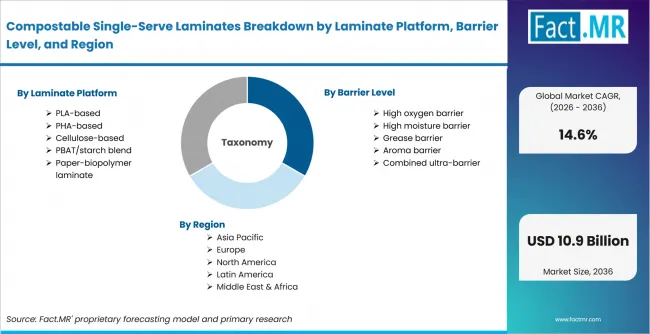
Compostable Single Serve Laminates Breakdown By Laminate Platform, Barrier Level, And Region | Source: Fact.MR
| Attribute | Details |
|---|---|
| Quantitative Units | USD billion |
| Market Definition | Compostable single-serve laminate structures used for small portion packs where multiple film, coating or paper-biopolymer layers provide sealing and barrier performance with a certified compostable end-of-life route. |
| Laminate Platform | PLA-based; PHA-based; Cellulose-based; PBAT/starch blend; Paper-biopolymer laminate |
| Barrier Level | High oxygen barrier; High moisture barrier; Grease barrier; Aroma barrier; Combined ultra-barrier |
| Pack Format | Single-serve sachets; Snack pouches; Flow wraps; Lidding / top web; Stand-up pouches |
| End-of-Life | Industrial compostable; Home compostable; Home + industrial; Soil biodegradable; Other certified compostable |
| Regions Covered | North America; Latin America; Western Europe; Eastern Europe; East Asia; South Asia & Pacific; Middle East & Africa |
| Countries Covered | United States; China; Germany; Japan; France |
| Key Companies Profiled | Parkside Flexibles; Bio4Pack; BASF; Novamont; TIPA; Futamura Chemical |
| Forecast Period | 2026 to 2036 |
| Approach | Primary-source policy review; official country statistics; company portfolio validation; segment and end-of-life analysis |
Bibliography
- European Parliament & Council of the European Union. (2025, January 22). Regulation (EU) 2025/40 of the European Parliament and of the Council of 19 December 2024 on packaging and packaging waste, amending Regulation (EU) 2019/1020 and Directive (EU) 2019/904, and repealing Directive 94/62/EC. Official Journal of the European Union, L, 2025/40.
- European Commission. (2026, June 10). Commission Notice – Guidance document for Regulation (EU) 2025/40 on packaging and packaging waste. Official Journal of the European Union, C/2026/3084.
- Eurostat. (2025, October 22). Plastic packaging waste in the EU: 35.3 kg per person.
- BASF. (2026, April 29). New ecovio® portfolio for flexible packaging: Multiple barrier options combined with organic or paper recycling.
- Beretti, P.-A., & Pereira, É. (2026, June 16). Household consumption in 2025: Household consumption slowed despite a sharp deceleration in prices. INSEE.
- National Bureau of Statistics of China. (2026, January 19). National economy pushed forward with innovation-led and high-quality development and expected targets achieved successfully in 2025.
- Zeballos, E., & Sinclair, W. (2026, June 11). Total U.S. food spending reached $2.51 trillion in 2025. U.S. Department of Agriculture, Economic Research Service.
- Statistics Bureau, Ministry of Internal Affairs and Communications. (2026, February 6). 2025 yearly average.
- Federal Statistical Office (Destatis). (2026, January 15). Gross domestic product up 0.2% in 2025.
- TIPA. (2025, October 20). TIPA® acquires SEALPAP®: Delivering full-service sustainable packaging for a circular future.
This Report Addresses
- The report assesses laminate platforms and barrier choices for single-serve compostable structures.
- Segment analysis covers PLA-based laminates, high oxygen barriers, sachets and industrial compostability.
- Pack-format coverage includes sachets, snack pouches, flow wraps, lidding and stand-up pouches.
- Country analysis covers France, China, the United States, Japan and Germany.
- Competitive analysis reviews Parkside Flexibles, Bio4Pack, BASF, Novamont, TIPA and Futamura Chemical across compostable film and laminate participation.
- End-of-life analysis separates industrial, home, combined, soil-biodegradable and other certified routes.
- Official statistics and company portfolios support the analysis.
What does the Compostable Single-Serve Laminates Market cover?
Compostable multilayer films and paper-biopolymer structures used for single-portion flexible packaging.
The market covers flexible single-serve structures where barrier performance, heat sealing and a certified compostable end-of-life route are integral to the pack. Platforms include PLA, PHA, cellulose, PBAT/starch and paper-biopolymer laminates.
The assessment focuses on flexible laminates with a defined compostability pathway. Rigid compostable containers fall outside the category unless the assessed product is a flexible laminate component.
What is included in the scope?
Certified compostable laminate structures used in single-serve flexible packs.
Coverage includes the listed laminate platforms, barrier levels and pack formats. The analysis connects single-serve structures with adjacent sustainable packaging and bioplastics for packaging categories when the material is part of a qualified compostable laminate. Industrial and home compostability are covered when the finished pack carries relevant certification.
What is excluded from the scope?
Conventional laminates and rigid packaging sit outside the scope when the assessed product lacks a certified compostable flexible laminate component.
The scope separates this category from conventional PE, PP or PET laminates and from rigid packs that lack a flexible laminate component. Broader biodegradable packaging materials are treated as adjacent categories unless they form part of a single-serve laminate structure.
How Was the Analysis Built?
The analysis draws on 120+ sources, 35+ company portfolios, 25+ countries, and more than 20 industry interviews.
- Primary Research: Primary research includes discussions with manufacturers, service providers, technology developers, distributors, end users, and subject-matter experts. These conversations examine purchasing priorities, product adoption, operational challenges, approval requirements, competitive positioning, and the factors that influence wider market acceptance.
- Desk Research: Desk research covers government statistics, regulatory publications, company filings, trade data, technical studies, industry associations, standards, public policy, and other authoritative sources. Every source used in the analysis is documented in the bibliography.
- Market Sizing and Forecasting: Market estimates combine historical performance, demand indicators, pricing and volume trends, segment shares, company participation, country-level growth, adoption patterns, investment activity, and barriers to market expansion.
- Data Validation and Update Cycle: Findings are validated by comparing primary interviews with public data, company activity, regulatory changes, trade patterns, and industry developments. Regular updates review new product launches, capacity changes, partnerships, approvals, and shifts in commercial adoption.
How is the market segmented?
-
By Laminate Platform
- PLA-based
- PHA-based
- Cellulose-based
- PBAT/starch blend
- Paper-biopolymer laminate
-
By Barrier Level
- High oxygen barrier
- High moisture barrier
- Grease barrier
- Aroma barrier
- Combined ultra-barrier
-
By Pack Format
- Single-serve sachets
- Snack pouches
- Flow wraps
- Lidding / top web
- Stand-up pouches
-
By End-of-Life
- Industrial compostable
- Home compostable
- Home + industrial
- Soil biodegradable
- Other certified compostable
-
By Region
- North America
- Latin America
- Western Europe
- Eastern Europe
- East Asia
- South Asia & Pacific
- Middle East & Africa