- Market Value (2025): USD 0.7 Bn
- Estimated Value (2026): USD 0.8 Bn
- Forecast Value (2036): USD 1.8 Bn
- CAGR (2026-2036): 8.2%
What is the Compostable Food Liners Market forecast to be worth by 2036?
USD 0.8 billion in 2026 and USD 1.8 billion by 2036, reflecting a 8.2% CAGR.
- The market reached USD 0.7 billion in 2025 as foodservice accounts expanded liner qualification across recurring purchasing programs.
- Compostable food liners demand is anticipated to rise from USD 0.8 billion in 2026 to USD 1.8 billion by 2036.
- The market is forecast to record an 8.2% CAGR as operators replace selected conventional coated liners through 2036.
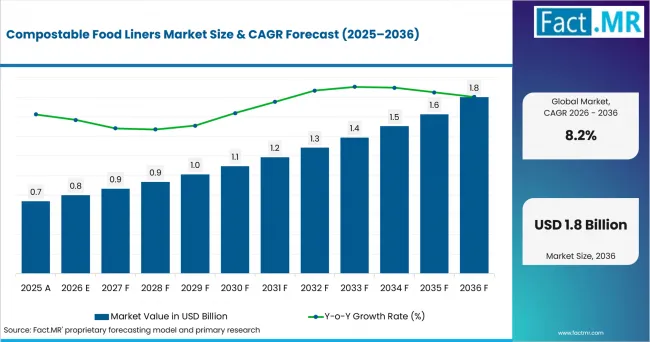
Compostable Food Liners Market Value Analysis | Source: Fact.MR
What are the defining numbers behind Compostable Food Liners Market growth?
USD 1.0 billion absolute opportunity by 2036, led by PLA-coated paper and industrially compostable formats alongside grease-resistant treatments.
- Demand Drivers in the Market
- Quick-service restaurant operators need grease-resistant liners that preserve kitchen speed and familiar handling routines throughout service.
- Packaging converters need coated paper structures that run consistently on existing printing and cutting equipment during repeat production.
- Institutional foodservice accounts need certification records matching the commercial composting route accepted at each operating location.
- Food processors and grocery teams need consistent liner dimensions and barrier duration across contracts and distributor replenishment.
- Key Segments Analyzed
- By material: PLA-coated paper is expected to hold 32.0% share in 2026 due to familiar converting performance.
- By certification: Industrially compostable formats are projected to account for 64.0% share in 2026 owing to established testing routes.
- By barrier – treatment: Grease-resistant liners are anticipated to capture 46.0% share in 2026 due to frequent oil exposure.
- By application: Quick-service restaurants are estimated to represent 40.0% share in 2026 attributable to standardized transactions.
- By end use: Foodservice is forecast to account for 64.0% share in 2026 driven by recurring kitchen use.
- By sales channel: Direct - OEM is expected to capture 42.0% share in 2026 supported by qualification requirements.
- Analyst Opinion at Fact.MR
- Shambhu Nath Jha, Principal Consultant at Fact.MR states, “Compostable liner sales depend on verified barriers and accepted disposal routes that manufacturers support with stable certification records and repeatable commercial performance.”
- Strategic Implications
- Packaging converters should test coating weight and sealing behavior on commercial equipment before approving recurring volumes.
- Restaurant groups need to confirm processor acceptance and hauling arrangements before extending one liner across multiple sites.
- Food processors should separate grease and moisture requirements so each liner uses the minimum structure needed.
- Distributors should maintain traceable certification files and consistent lots across institutional foodservice accounts and regional programs.
Commercial liner development increasingly combines certified compostability with repeatable grease protection across standard converting lines. Novolex reported in April 2025 that its compostable butter wrap earned BPI certification and an industry award, giving dairy converters a documented liner option for recurring qualification.
India is forecast at 10.7% CAGR while China at 9.7% CAGR as enforcement and converting scale support qualification. The United Kingdom is anticipated at 8.7% CAGR and Brazil records expected 8.6% CAGR across national foodservice packaging collection systems. Germany is set to rise a CAGR of 7.8% as certified food packaging claims face stricter disposal review for coated structures.
How does the Compostable Food Liners Market break down by segment?
PLA-coated paper is expected to hold 32.0% share while industrially compostable formats account for 64.0% share in 2026.
Which material dominates?
PLA-coated paper is projected to account for 32.0% share in 2026
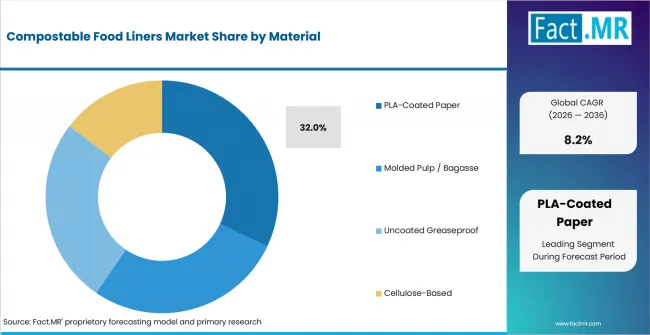
Compostable Food Liners Market Analysis By Material | Source: Fact.MR
Based on material, PLA-coated paper is projected to account for 32.0% in 2026 due to familiar converting and adjustable coatings. BASF and Metpack reported in May 2025 that certified home-compostable coated paper ran on standard forming lines across the greaseproof paper market.
What leads the certification segment?
Industrially compostable formats are estimated to garner 64.0% share in 2026
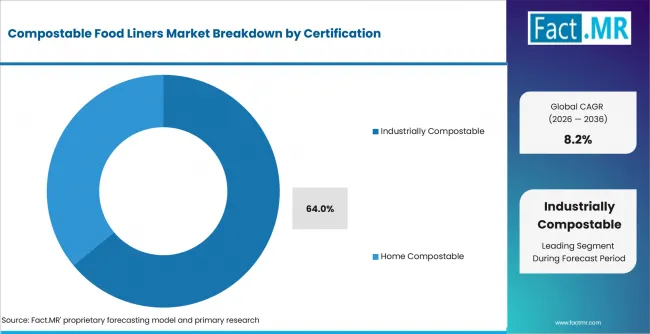
Compostable Food Liners Market Analysis By Certification | Source: Fact.MR
By certification, industrially compostable formats are estimated to hold 64.0% in 2026 owing to established testing routes. Institutional accounts require component records and confirmed processor acceptance across biodegradable packaging materials used at multiple sites.
How does barrier - treatment shape demand?
Grease-resistant liners are forecast to capture 46.0% share in 2026
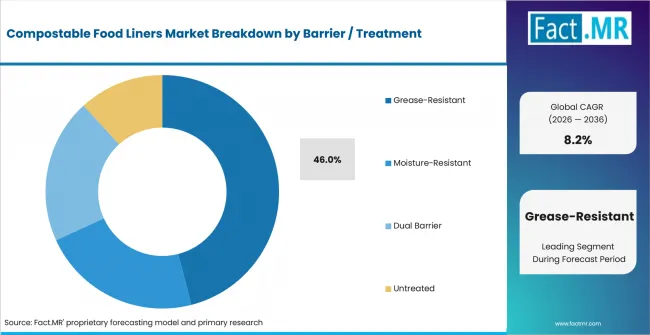
Compostable Food Liners Market Analysis By Barrier Treatment | Source: Fact.MR
Grease-resistant liners are forecast to represent 46.0% in 2026 driven by immediate oil exposure during service. Sabert reported in November 2025 that its BPI-certified Pulp Ultra formulation resisted hot oil and grease up to 185°F across fluorine-free barrier coatings.
What supports quick-service restaurants within application?
Quick-service restaurants are expected to represent 40.0% share in 2026
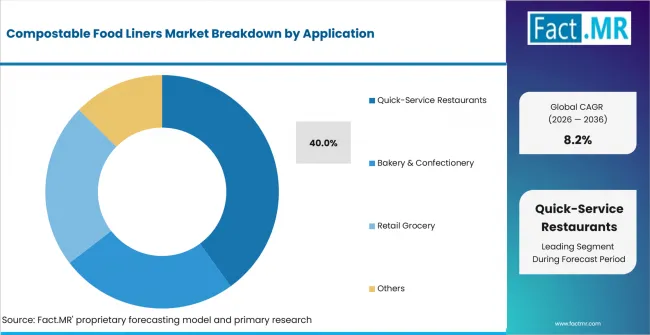
Compostable Food Liners Market Analysis By Application | Source: Fact.MR
Based on application, quick-service restaurants are projected to account for 40.0% in 2026 due to standardized transactions. Repeated menu formats favor food service liners that preserve kitchen speed while matching grease exposure and collection instructions across locations.
How does foodservice shape end-use demand?
Foodservice is anticipated to hold 64.0% share in 2026
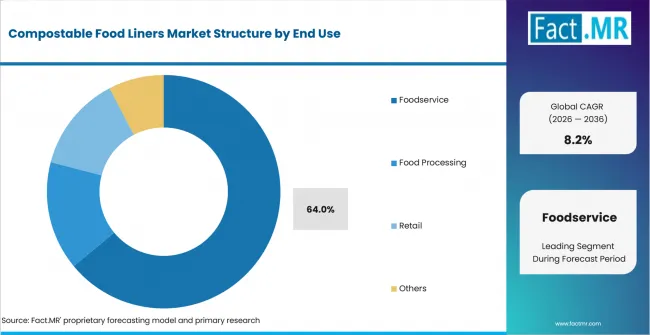
Compostable Food Liners Market Analysis By End Use | Source: Fact.MR
The end-use category is forecast to be led by foodservice at 64.0% in 2026 due to recurring kitchen use. Repeat orders across fiber-based packaging depend on coordinated bin instructions and contracted recovery services at each operating site.
What supports direct - OEM within sales channel?
Direct - OEM is estimated to account for 42.0% share in 2026
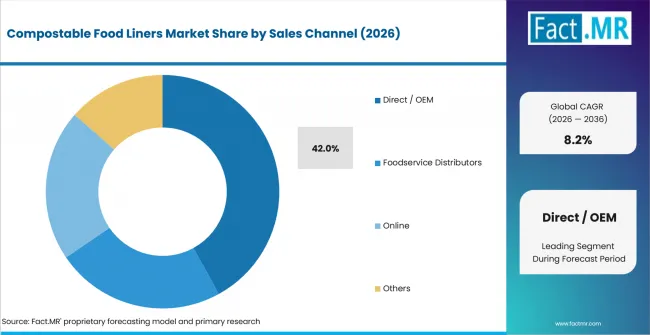
Compostable Food Liners Market Analysis By Sales Channel | Source: Fact.MR
Direct - OEM is projected to hold 42.0% in 2026 owing to qualification and continuity requirements. Direct account support links paper barrier coatings with trial material and change control without adding waste-service revenue to liner valuation.
What is accelerating Compostable Food Liners Market adoption, and what is holding it back?
Regulatory substitution is anticipated to support demand while uneven recovery access restrains repeated deployment across multi-site foodservice programs.
Drivers Impact Analysis
| DRIVER | (~) % IMPACT ON CAGR | GEOGRAPHIC RELEVANCE | IMPACT TIMELINE |
|---|---|---|---|
| Plastic-reduction rules and foodservice specification changes | +1.0% | India, Europe and North America | Medium term (2-4 years) |
| Commercial compostability certification in institutional purchasing | +0.8% | North America and Europe | Medium term (2-4 years) |
| Grease-resistant fiber replacement across takeaway applications | +0.7% | Global with QSR concentration | Medium term (2-4 years) |
| Food-waste collection programs linking packaging and organics | +0.5% | United Kingdom and selected cities | Long term (>= 4 years) |
| Converter demand for familiar paper-based production routes | +0.4% | China, India and Europe | Long term (>= 4 years) |
Source: Fact.MR analysis. Updated Aug 1, 2026
- Plastic-reduction rules: Restaurant groups revisit coated liners during packaging changes once barrier performance and local recovery support repeated use.
- Institutional certification: EPA model language connects compostability claims with local program availability and product acceptance before recurring purchasing receives approval.
- Barrier-led substitution: Packaging engineers qualify lighter compostable structures that preserve grease resistance and print quality during high-volume foodservice use.
- Food-waste integration: Compostable liners gain repeat demand inside controlled organics systems that align product selection with bins and processor acceptance.
Opportunity Impact Analysis
| OPPORTUNITY | (~) % IMPACT ON CAGR | GEOGRAPHIC RELEVANCE | IMPACT TIMELINE |
|---|---|---|---|
| PFAS-conscious grease barriers for high-volume foodservice liners | +0.7% | North America and Europe | Short term (<= 2 years) |
| Integrated product, bin and hauling programs for institutions | +0.6% | United States and United Kingdom | Medium term (2-4 years) |
| Localized coated-paper conversion for price-sensitive markets | +0.5% | India, China and Brazil | Medium term (2-4 years) |
| Dual-barrier liners for prepared foods and grocery counters | +0.4% | Global organized retail | Long term (>= 4 years) |
Source: Fact.MR analysis. Updated Aug 1, 2026
- PFAS-conscious barriers: Foodservice accounts test grease barriers without intentionally added PFAS once chemistry records and commercial run data support qualification.
- Integrated recovery programs: Venue and campus operators protect repeat use by coordinating packaging selection with contracted recovery and early collection reviews.
- Localized conversion: Manufacturers improve response times in India and China by combining domestic coating with recognized certification and consistent batches.
Restraints Impact Analysis
| RESTRAINT | (~) % IMPACT ON CAGR | GEOGRAPHIC RELEVANCE | IMPACT TIMELINE |
|---|---|---|---|
| Uneven commercial composting acceptance and service distance | -0.8% | North America, Europe and Asia | Medium term (2-4 years) |
| Conflicting recycling and compostability instructions | -0.6% | Germany and United Kingdom | Short term (<= 2 years) |
| Barrier performance variation during commercial conversion | -0.4% | Global converters | Medium term (2-4 years) |
| Price premiums and fragmented low-volume purchasing | -0.3% | Price-sensitive markets | Long term (>= 4 years) |
Source: Fact.MR analysis. Updated Aug 1, 2026
- Composting access: Restaurant groups delay deployment where commercial certification does not provide confirmed hauling and processor acceptance for each site.
- Conflicting instructions: Multi-site operators postpone deployment until product disposal wording matches the collection service available at each operating location.
- Conversion variation: Manufacturers retain direct contracts by detecting coat-weight and moisture drift before commercial shipments reach large foodservice accounts.
Which countries are scaling Compostable Food Liners Market fastest?
the United Kingdom records 8.7%; Brazil records 8.6%; Germany records 7.8%.
The 2.9 percentage-point spread reflects different policy and recovery conditions across North America and Latin America while Europe and Asia Pacific remain part of the wider assessment.
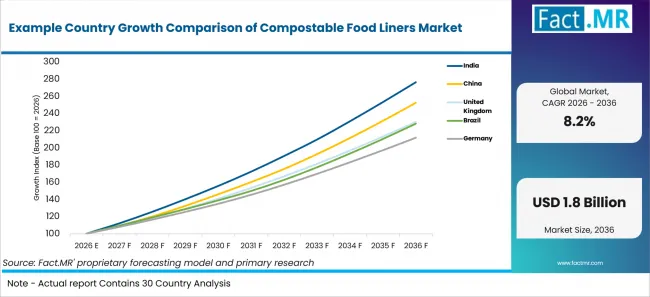
Example Country Growth Comparison Of Compostable Food Liners Market | Source: Fact.MR
| COUNTRY | CAGR |
|---|---|
| United Kingdom | 8.7% |
| Brazil | 8.6% |
| Germany | 7.8% |
Source: Fact.MR analysis. Updated Aug 1, 2026
What is driving growth in India’s Compostable Food Liners market?
10.7% CAGR supported by plastic-reduction enforcement and an expanding domestic base of certified alternatives.
Indian foodservice accounts balance plastic restrictions with strict price checks and local sourcing during qualification. Demand is expected to record a 10.7% CAGR by 2036, underpinned by an August 2025 compendium supporting commercial bioplastics sourcing despite uneven collection.
How is China scaling Compostable Food Liners demand?
9.7% CAGR, driven by converting scale and current paper-tableware standards for commercial qualification.
Chinese packaging converters combine high-volume pricing with formal documentation and batch consistency during commercial qualification. Market in China is projected to post a 9.7% CAGR through 2036, bolstered by GB/T 27591-2025 support for product review despite uneven municipal acceptance.
What supports the United Kingdom outlook?
8.7% CAGR, owing to collection changes and dedicated recovery programs across operating sites.
United Kingdom foodservice operators separate packaging selection from the collection service available at each site. Demand is anticipated to advance at an 8.7% CAGR through 2036, aided by March 2025 workplace rules supporting food-waste separation while compostable packaging continues to require dedicated recovery.
What underpins Brazil’s growth?
8.6% CAGR between 2026 and 2036 attributable to packaging policy changes and regional converting opportunities.
Brazilian foodservice groups face new reverse-logistics rules and uneven collection capacity during qualification across states. Industry is estimated to record an 8.6% CAGR through 2036, supported by Decree 12,688 clarifying obligations while treatment routes remain uncertain.
How is Germany developing Compostable Food Liners demand?
7.8% CAGR across the forecast horizon supported by technical review and documented recovery claims for coated food-contact structures.
German packaging teams evaluate compostability inside a strict design-for-recycling framework and claims review for coatings. Demand is forecast to increase at a 7.8% CAGR through 2036, reinforced by the August 2025 minimum standard that keeps packaging coatings under detailed review.
Who leads the Compostable Food Liners Market?
Huhtamaki and Novolex anchor scaled foodservice conversion while Vegware and Eco-Products strengthen compostable implementation support.
Competition centers on national foodservice accounts requiring dependable conversion and multi-site delivery while specialist producers enter through certified greaseproof sheets protected by qualification and recovery support. Companies such as Huhtamaki and Novolex compete through broad converting networks while Vegware and Eco-Products add implementation support and molded-fiber specialists compete beside Nordic Paper’s greaseproof supply.
Which companies are the key providers?
Huhtamaki and Novolex provide scaled conversion while Vegware and Eco-Products add implementation support alongside Sabert, BioPak, Detmold Group, Nordic Paper, Pactiv Evergreen, and Genpak.
- Huhtamaki
- Novolex
- Vegware
- Eco-Products
- Sabert
- BioPak
- Detmold Group
- Nordic Paper
- Pactiv Evergreen
- Genpak
Bibliography
- U.S. Environmental Protection Agency. (2026, January 5). Cafeteria and food services model contract language.
- State Administration for Market Regulation and Standardization Administration of China. (2025, May 30). GB-T 27591-2025: Paper tableware. National Public Service Platform for Standards Information.
- Central Agency Packaging Register. (2025, August 28). Minimum standard for determining the recyclability of packaging: Edition 2025.
- Department for Environment, Food & Rural Affairs and Environment Agency. (2025, March 31). New rules simplifying recycling for workplaces in England come into force. GOV.UK.
- Presidency of the Republic of Brazil. (2025, October 21). Decree No. 12,688 of October 21, 2025. Planalto.
- Press Information Bureau. (2025, August 4). Parliament question: One nation one mission: End plastic pollution. Government of India.
- Sabert Corporation. (2025, November 19). Sabert Corporation’s Pulp Ultra® wins 2025 U.S. Plastics Pact Packaging Innovation Award for compostability.
- BASF. (2025, May 6). Metpack and BASF cooperate to demonstrate certified home-compostable, coated paper for food packaging.
This Report Addresses
- The study contrasts material options and certification formats for the compostable food liners category.
- Buyer demand is assessed across Barrier - Treatment uses and Application operating conditions.
- United Kingdom, Brazil, and Germany markets frame the country-level forecast comparison.
- Company assessment considers technical capability and qualification pathways across Compostable Food Liners.
- End Use routes show where procurement activity concentrates across commercial accounts.
- Forecasts for Compostable Food Liners integrate historical movement with current adoption evidence.
What does the Compostable Food Liners Market cover?
Compostable sheets and wraps are covered alongside inserts and conversion-ready stock used for food-contact barrier control.
The market covers separately sold liners providing grease or moisture control with documented compostability across coated paper, molded fiber, greaseproof paper, and cellulose structures.
Finished packaging remains outside the boundary unless the liner is sold separately as a distinct commercial input.
What is included in the scope?
Certified liner formats used across foodservice and processing are covered alongside retail grocery and related food-contact applications.
The scope includes four materials and two certification routes with barrier treatments covering restaurants, bakeries, grocery counters, food processing, direct accounts, distributors, and online orders.
What is excluded from the scope?
Complete food containers and raw resins are excluded alongside coatings, waste services, and conventional non-compostable liners.
The scope excludes complete packages without a separately priced liner while raw resins, coatings, waste services, and conventional liners remain outside valuation.
How Was the Analysis Built?
The analysis draws on 120+ sources, 35+ company portfolios, 25+ countries, and more than 20 industry interviews.
- Primary Research: Primary research includes discussions with manufacturers, service providers, technology developers, distributors, end users, procurement teams, and subject-matter experts. These conversations examine purchasing priorities, product adoption, operational challenges, approval requirements, competitive positioning, and the factors that influence wider market acceptance.
- Desk Research: Desk research covers government statistics, regulatory publications, company filings, trade data, technical studies, industry associations, standards, public policy, and other authoritative sources. Every source used in the analysis is documented in the bibliography.
- Market Sizing and Forecasting: Market estimates combine historical performance, demand indicators, pricing and volume trends, segment shares, company participation, country-level growth, adoption patterns, investment activity, and barriers to market expansion.
- Data Validation and Update Cycle: Findings are validated by comparing primary interviews with public data, company activity, regulatory changes, trade patterns, and industry developments. Regular updates review new product launches, capacity changes, partnerships, approvals, procurement trends, and shifts in commercial adoption.
Segmentation
What is the report’s scope and coverage?
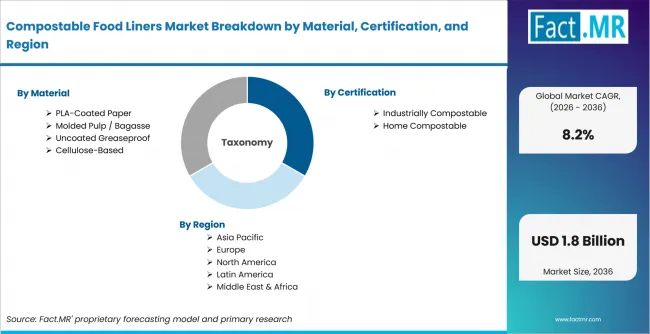
Compostable Food Liners Market Breakdown By Material, Certification, And Region | Source: Fact.MR
| Coverage field | Report scope |
|---|---|
| Quantitative Units | USD Billion |
| Market Definition | Separately sold compostable liners, sheets, wraps, inserts, and conversion-ready liner stock used for food contact and handling |
| Material | PLA-Coated Paper, Molded Pulp - Bagasse, Uncoated Greaseproof, Cellulose-Based |
| Certification | Industrially Compostable, Home Compostable |
| Barrier - Treatment | Grease-Resistant, Moisture-Resistant, Dual Barrier, Untreated |
| Application | Quick-Service Restaurants, Bakery & Confectionery, Retail Grocery, Others |
| End Use | Foodservice, Food Processing, Retail, Others |
| Sales Channel | Direct - OEM, Foodservice Distributors, Online, Others |
| Regions Covered | North America, Latin America, Western Europe, Eastern Europe, East Asia, South Asia and Pacific, Middle East and Africa |
| Countries Covered | United States, Canada, Brazil, Mexico, Argentina, Chile, Germany, France, United Kingdom, Italy, Spain, Japan, South Korea, Australia, and 30+ countries |
| Key Companies Profiled | Huhtamaki, Novolex, Vegware, Eco-Products, Sabert, BioPak, Detmold Group, Nordic Paper, Pactiv Evergreen, Genpak |
| Forecast Period | 2026 to 2036 |
| Approach | Hybrid demand-side and supply-side approach using liner volumes, barrier and material mix, average selling prices, application consumption, channel structure, certification requirements, and local recovery conditions |
Source: Fact.MR analysis. Updated Aug 1, 2026
How is the market segmented?
-
By Material:
- PLA-Coated Paper
- Molded Pulp - Bagasse
- Uncoated Greaseproof
- Cellulose-Based
-
By Certification:
- Industrially Compostable
- Home Compostable
-
By Barrier - Treatment:
- Grease-Resistant
- Moisture-Resistant
- Dual Barrier
- Untreated
-
By Application:
- Quick-Service Restaurants
- Bakery & Confectionery
- Retail Grocery
- Others
-
By End Use:
- Foodservice
- Food Processing
- Retail
- Others
-
By Sales Channel:
- Direct - OEM
- Foodservice Distributors
- Online
- Others
-
By Region:
- North America
- United States
- Canada
- Latin America
- Brazil
- Mexico
- Argentina
- Chile
- Western Europe
- Germany
- France
- United Kingdom
- Italy
- Spain
- Benelux
- Nordics
- Eastern Europe
- Poland
- Czech Republic
- Romania
- Hungary
- East Asia
- Japan
- South Korea
- South Asia and Pacific
- ASEAN
- Australia and New Zealand
- Middle East and Africa
- GCC Countries
- South Africa
- Türkiye
- Israel
- North America
Frequently Asked Questions
What share is PLA-coated paper expected to capture by material?
How are industrially compostable formats positioned by certification?
Which barrier treatment is projected to account for the primary share?
What supports quick-service restaurants within application demand?
How much share is foodservice estimated to garner by end use?
Which sales route is projected to capture the primary share?
Which operating factor drives liner adoption?
Which condition most limits repeated liner deployment?
Who worked on this report


Preview the report firsthand - request a free sample
Free SampleGet the brochure for pricing and purchase details
Download PDF