- Market Value (2025): USD 245.0 Mn
- Estimated Value (2026): USD 266.1 Mn
- Forecast Value (2036): USD 607.2 Mn
- CAGR (2026-2036): 8.6%
What is the Compostable Sleeve Materials Market forecast to be worth by 2036?
USD 266.1 million in 2026 to USD 607.2 million by 2036, recording a 8.6% CAGR.
- The compostable sleeve materials market crossed USD 245.0 million in 2025 as fiber conversion expanded across foodservice programs.
- Compostable sleeve materials market is forecast to climb from USD 266.1 million in 2026 to USD 607.2 million by 2036.
- The market is forecast to record 8.6% CAGR through 2036, because operators qualify lower-plastic sleeve constructions.
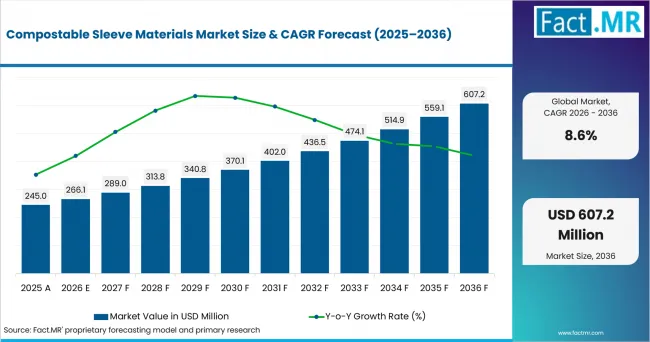
Compostable Sleeve Materials Market Value Analysis | Source: Fact.MR
What are the defining numbers behind Compostable Sleeve Materials Market growth?
USD 341.1 million absolute opportunity by 2036, led by molded pulp and bagasse and food tray sleeves.
- Demand Drivers in the Market
- Foodservice operators need sleeves that preserve grip and insulation throughout high-volume serving periods.
- Packaging teams need product-level certification since broad claims do not verify coatings and adhesives together.
- Manufacturers need stable fiber density so automated equipment handles sleeves without curling or registration losses.
- Waste-service companies need clear identifiers so processors protect accepted organics streams from contamination.
- Key Segments Analyzed
- By Material: Molded pulp and bagasse is expected to account for 44.0% share in 2026, due to shaped protection.
- By Product type: Food tray sleeves are projected to garner 34.0% share in 2026, owing to easier handling.
- By Certification: Industrially compostable products are anticipated to record 66.0% share in 2026, attributable to controlled testing.
- By Application: Food service is estimated to hold 44.0% share in 2026, driven by concentrated use.
- By Sales channels: Direct and brand OEM programs are forecast to capture 46.0% share in 2026, reinforced by custom approval.
- Analyst Opinion at Fact.MR
- Shambhu Nath Jha, Principal Consultant at Fact.MR states: “Commercial success depends on matching certified sleeves with packing lines and recovery routes. Demand is expected to favor documented materials before trials. Strong programs combine conversion support with labels and processor acceptance.”
- Strategic Implications
- Foodservice groups should confirm processor acceptance before standardizing sleeves across operating locations.
- Packaging teams should approve coatings and inks with base fiber since certification covers finished constructions.
- Converters should test sleeve geometry at commercial speeds before replacing established packaging formats.
- Waste-service companies should publish accepted product lists for local organics systems.
Regional conversion strengthens provider scale alongside established foodservice relationships. In July 2025, Sabert completed its Colpac acquisition and added United Kingdom paperboard manufacturing that links sleeve design with regional production.
United Kingdom demand is anticipated to rise at 8.9% CAGR by 2036, through zero-waste packaging routes. Brazil is forecast to advance at 8.3% CAGR between 2026 and 2036, through lower-plastic formats. Germany is expected to expand at 8.1% CAGR over the forecast horizon, owing to contamination controls.
How does the Compostable Sleeve Materials Market break down by segment?
Molded Pulp and Bagasse is projected to account for 44.0% share, Food Tray Sleeves are estimated to garner 34.0% share.
Which material category holds the primary position?
Molded Pulp and Bagasse is projected to account for 44.0% share in 2026
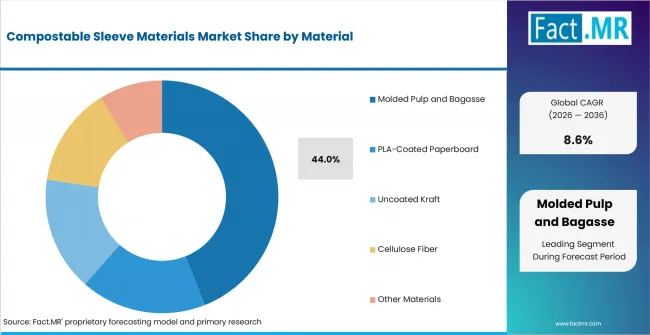
Compostable Sleeve Materials Market Analysis By Material | Source: Fact.MR
Within the material category molded pulp and bagasse is estimated to hold 44.0% share in 2026, owing to formability. Huhtamaki expanded molded-fiber capacity in October 2024 to support consistent dimensions and regional bagasse fibre supply while PLA barrier systems serve thinner sleeves.
What leads the product type segment?
Food Tray Sleeves are estimated to garner 34.0% share in 2026
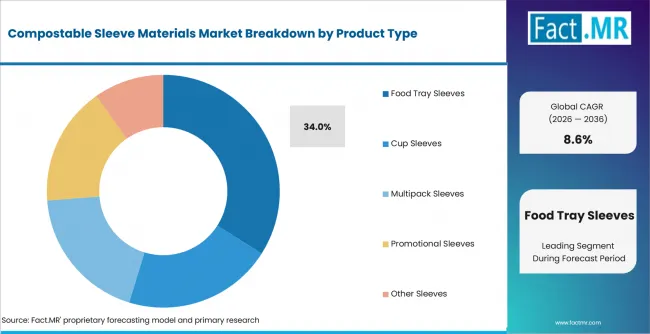
Compostable Sleeve Materials Market Analysis By Product Type | Source: Fact.MR
Food tray sleeves are expected to lead product type with 34.0% share in 2026, because they improve handling. Colpac introduced redesigned platter sleeves in September 2025 for faster catering assembly and stronger folding carton formats across prepared-food programs.
How does certification shape demand?
Industrially Compostable products are anticipated to record 66.0% share in 2026
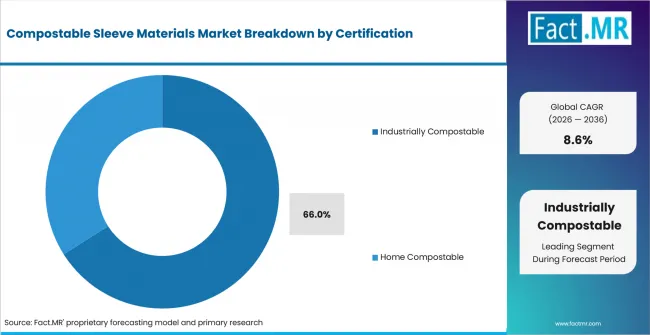
Compostable Sleeve Materials Market Analysis By Certification | Source: Fact.MR
Industrially compostable products are forecast to represent 66.0% share in 2026, driven by controlled testing. Home-compostable options face variable treatment conditions while October 2025 EPA guidance ties certified biodegradable packaging materials to local acceptance and arranged hauling.
What supports food service within application?
Food Service is estimated to hold 44.0% share in 2026
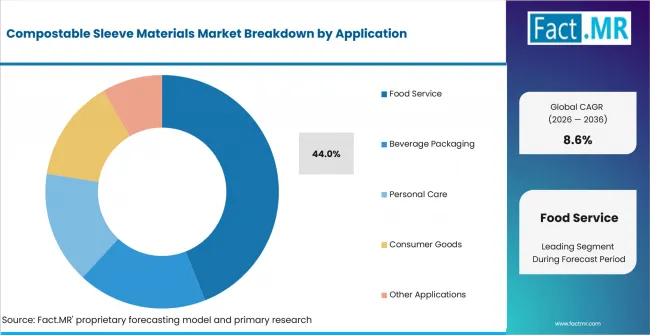
Compostable Sleeve Materials Market Analysis By Application | Source: Fact.MR
Food service is projected to hold 44.0% share in 2026, owing to concentrated daily use. Operators gain more value from foodservice packaging if collection instructions remain consistent and Vegware's September 2025 matchday partnership connected packs with a named treatment route.
Which sales channel supports direct qualification?
Direct and Brand OEM programs are forecast to capture 46.0% share in 2026
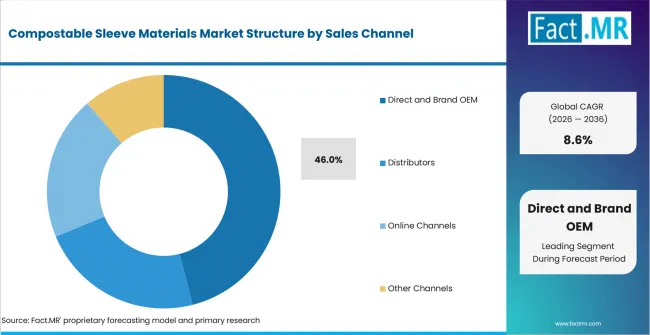
Compostable Sleeve Materials Market Analysis By Sales Channel | Source: Fact.MR
Direct and brand OEM programs are forecast to capture 46.0% share in 2026, due to custom specifications. Direct approval coordinates geometry and artwork with line trials while distributors serve standard sizes and smaller orders.
What is accelerating Compostable Sleeve Materials Market adoption, and what is holding it back?
Packaging compliance drives adoption, processor acceptance and material performance restrain conversion.
Drivers Impact Analysis
| Driver | (~) % Impact on CAGR | Geographic Relevance | Impact Timeline |
|---|---|---|---|
| Packaging compliance and product-level documentation | +0.8% | Europe and North America | Short term (<= 2 years) |
| Foodservice handling and insulation requirements | +0.7% | Global foodservice hubs | Medium term (2-4 years) |
| Plastic reduction across visible secondary components | +0.6% | Europe and Asia Pacific | Medium term (2-4 years) |
| Regional fiber conversion and forming capacity | +0.5% | Asia Pacific and Europe | Long term (>= 4 years) |
| Separate food-waste collection at controlled sites | +0.4% | United Kingdom and Europe | Medium term (2-4 years) |
Source: Fact.MR analysis. Updated Aug 1, 2026
- Packaging compliance: Brand teams need product records because the February 2025 EU framework expands coating and adhesive documentation.
- Foodservice handling: Sleeves must retain grip and insulation so commercial trials test heat and moisture before purchasing.
- Plastic reduction: Teams redesign sleeves if fiber formats preserve graphics and packing-line performance.
- Fiber conversion capacity: Regional forming shortens sampling while production trials correct line-fit problems before rollout.
- Separate food-waste collection: England's March 2025 rules require dedicated routes and contracts identifying accepted sleeves.
Opportunity Impact Analysis
| Opportunity | (~) % Impact on CAGR | Geographic Relevance | Impact Timeline |
|---|---|---|---|
| Low-coating fiber systems for hot food | +0.5% | Europe and United Kingdom | Short term (<= 2 years) |
| Integrated tray and sleeve foodservice programs | +0.4% | North America | Medium term (2-4 years) |
| Direct custom conversion for brand programs | +0.4% | Global branded packaging | Medium term (2-4 years) |
| Collection partnerships for closed-site programs | +0.3% | North America and Europe | Long term (>= 4 years) |
Source: Fact.MR analysis. Updated Aug 1, 2026
- Low-coating fiber systems: Hot-food programs need clear barrier chemistry and Sabert's January 2026 launch disclosed coating levels.
- Integrated tray and sleeve programs: Concentrated cafeteria volumes allow compatible components to simplify qualification and collection instructions.
- Direct custom conversion: Brand programs require proprietary dimensions which converters validate through approved drawings and line trials.
- Collection partnerships: Confirmed waste contracts add value because controlled bins and named processors support repeat demand.
Restraints Impact Analysis
| Restraint | (~) % Impact on CAGR | Geographic Relevance | Impact Timeline |
|---|---|---|---|
| Processor contamination limits and acceptance gaps | -0.6% | Germany and Europe | Short term (<= 2 years) |
| Heat and moisture performance tradeoffs | -0.5% | Global foodservice programs | Medium term (2-4 years) |
| Mixed-material regulatory boundaries | -0.4% | Europe and Latin America | Medium term (2-4 years) |
| Premium delivered cost across small programs | -0.3% | Price-sensitive markets | Long term (>= 4 years) |
Source: Fact.MR analysis. Updated Aug 1, 2026
- Processor acceptance: Germany's May 2025 controls require recognizable sleeves and consistent sorting before biological treatment.
- Heat and moisture performance: Fiber softens during hot-food service so samples must match commercial operating conditions.
- Mixed-material boundaries: Inks and adhesives affect classification which makes controlled material records necessary during artwork revisions.
- Delivered cost: Standard formats improve small-program economics while controlled printing preserves brand communication.
Which countries are scaling Compostable Sleeve Materials Market fastest?
United Kingdom 8.9%, Brazil 8.3%, Germany 8.1%.
Regional analysis covers North America, Europe, Asia Pacific, Central and South America, and the Middle East and Africa.
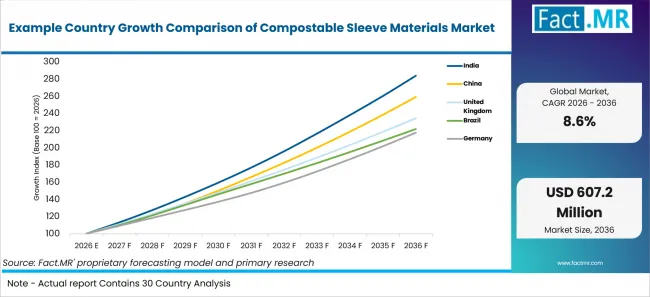
Example Country Growth Comparison Of Compostable Sleeve Materials Market | Source: Fact.MR
| Country | CAGR |
|---|---|
| United Kingdom | 8.9% |
| Brazil | 8.3% |
| Germany | 8.1% |
Source: Fact.MR analysis. Updated Aug 1, 2026
What shapes the United Kingdom outlook?
8.9% CAGR, driven by controlled collection planning and foodservice qualification.
United Kingdom workplaces separate food waste but compostable packaging requires dedicated routes. The market is anticipated to register 8.9% CAGR by 2036, as caterers seek clearer instructions. Location-specific hauling constrains national rollouts.
What underpins Brazil's development?
8.3% CAGR, reinforced by food-contact compliance and growing interest in lower-plastic fiber formats.
Brazilian converters follow food-contact requirements while municipal composting routes differ. The market is forecast to advance at 8.3% CAGR through 2036, as brands assess fiber formats. Anvisa guidance supports compliance while conversion cost limits wider adoption.
How does Germany's operating environment influence growth?
8.1% CAGR, owing to strict contamination controls and detailed material documentation.
German organics systems prioritize sorting purity before biological treatment. The market is expected to expand at 8.1% CAGR over the forecast horizon, as brands seek documented components. May 2025 controls restrict poorly identified sleeves.
Who leads the Compostable Sleeve Materials Market?
Huhtamaki and Novolex lead broad foodservice access, Sabert and Graphic Packaging strengthen fiber conversion and custom sleeve capability.
Competition centers on certified materials and reliable conversion while large groups compete through scale and specialists use custom geometry. Regional entrants need repeatable barrier control before national approval.
Huhtamaki combines molded-fiber capacity with beverage accessories while Novolex brings Eco-Products distribution and Sabert adds shaped pulp with Colpac conversion. Duni Group reaches operators through BioPak while Graphic Packaging and Detmold strengthen paperboard capability across compostable packaging systems that compete on line fit and recovery proof.
Which companies are the key providers?
Some of the key players profiled include Huhtamaki Oyj, Novolex Holdings LLC, Sabert Corporation, Duni Group, Graphic Packaging International, Detmold Group.
- Huhtamaki Oyj
- Novolex Holdings LLC
- Sabert Corporation
- Duni Group
- Graphic Packaging International
- Detmold Group.
Bibliography
- European Commission. (2025, February 11). Packaging waste. European Commission.
- U.S. Environmental Protection Agency. (2025, October 22). Identifying Sustainable Food Service and Food Service Ware. U.S. Environmental Protection Agency.
- Department for Environment, Food & Rural Affairs. (2024, November 29). Simpler recycling: workplace recycling in England. GOV.UK.
- National Health Surveillance Agency. (2026, May 5). Regularização de matérias primas, ingredientes e embalagens. Government of Brazil.
- Delhi Pollution Control Committee. (2026, July 28). Plastic Waste. Government of NCT of Delhi.
- Federal Ministry for the Environment, Climate Action, Nature Conservation and Nuclear Safety. (2025, April 22). Verordnung über die Verwertung von Bioabfällen (BioAbfV). Federal Government of Germany.
- Colpac. (2025, August 5). Sabert Acquires Colpac Limited, Strengthening Sustainable Food Packaging Leadership in the UK and Beyond. Colpac.
- Colpac. (2025, September 5). Colpac Redevelops Food Platters for Delivery & Catering Customers. Colpac.
- Huhtamaki. (2024, October 18). Huhtamaki Expands Its Capacity for Fiber Lid Production to Lurgan, Northern Ireland. Huhtamaki.
- Vegware. (2025, September 26). Closing the loop on matchdays. Vegware News.
- Graphic Packaging International. (2025, May 14). Graphic Packaging Launches New Portfolio of Paperboard Sushi Packaging To Support Regulatory Compliance of European Foodservice Operators. Graphic Packaging International.
- Sabert Corporation Europe. (2026, January 15). Sabert launches PULP Ultra®, a game-changer in food packaging. Sabert Corporation Europe.
- Novolex. (2025, May 1). Eco-Products and DNO Produce Help Bring Environmental Sustainability to K-12 School Cafeterias. Novolex.
- Duni Group. (2026, July 14). Interim Report January 1 - June 30, 2026. Duni Group.
- Detmold Group. (2026, February 5). Detmold Group on track with 2025-2050 sustainability goals. Detmold Group.
This Report Addresses
- The report covers material and product decisions affecting sleeve qualification.
- Segment analysis compares molded pulp with food tray sleeves.
- Regional outlook evaluates India and China with three other markets.
- Competitive analysis profiles six fiber and paperboard providers.
- Material assessment covers molded pulp and paperboard and kraft and cellulose.
- Application assessment covers foodservice and beverage and consumer-goods programs.
- The forecast combines converter capacity with country evidence.
What does the Compostable Sleeve Materials Market cover?
Molded pulp, coated paperboard, kraft, and cellulose sleeves used for protection, insulation, grouping, handling, or printed communication.
The market covers separately sold sleeve materials used around trays and cups. These products add protection or printed communication without replacing primary packages.
The boundary excludes complete cups and trays. A package enters scope only if its sleeve is separately specified and priced.
What is included in the scope?
Compostable sleeve materials used in foodservice and beverage and branded consumer packaging programs.
Coverage includes molded pulp and paperboard and kraft and cellulose sleeves. Products include tray and cup sleeves with multipack and promotional formats. Certification separates industrial and home-compostable claims. Revenue excludes enclosed products and complete containers.
What is excluded from the scope?
Complete cups and trays and non-compostable sleeve products are outside the scope.
The analysis excludes downstream product revenue and complete containers without separate sleeves. Conventional plastic sleeves and reusable carriers remain outside scope.
How Was the Analysis Built?
The analysis draws on 120+ sources, 35+ company portfolios, 25+ countries, and more than 20 industry interviews.
- Primary Research: Primary research includes discussions with manufacturers, service providers, technology developers, distributors, end users, procurement teams, and subject-matter experts. These conversations examine purchasing priorities, product adoption, operational challenges, approval requirements, competitive positioning, and the factors that influence wider market acceptance.
- Desk Research: Desk research covers government statistics, regulatory publications, company filings, trade data, technical studies, industry associations, standards, public policy, and other authoritative sources. Every source used in the analysis is documented in the bibliography.
- Market Sizing and Forecasting: Market estimates combine historical performance, demand indicators, pricing and volume trends, segment shares, company participation, country-level growth, adoption patterns, investment activity, and barriers to market expansion.
- Data Validation and Update Cycle: Findings are validated by comparing primary interviews with public data, company activity, regulatory changes, trade patterns, and industry developments. Regular updates review new product launches, capacity changes, partnerships, approvals, procurement trends, and shifts in commercial adoption.
Segmentation
What is the report's scope and coverage?
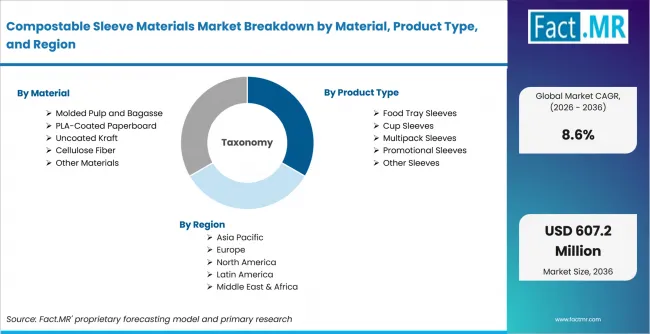
Compostable Sleeve Materials Market Breakdown By Material, Product Type, And Region | Source: Fact.MR
| Coverage field | Report scope |
|---|---|
| Quantitative Units | USD Million |
| Market Definition | Revenue from compostable sleeve materials and converted sleeve components sold separately around trays and cups or grouped packs for protection and handling or printed communication. |
| Material | Molded Pulp and Bagasse, PLA-Coated Paperboard, Uncoated Kraft, Cellulose Fiber, Other Materials |
| Product Type | Food Tray Sleeves, Cup Sleeves, Multipack Sleeves, Promotional Sleeves, Other Sleeves |
| Certification | Industrially Compostable, Home Compostable |
| Application | Food Service, Beverage Packaging, Personal Care, Consumer Goods, Other Applications |
| Sales Channel | Direct and Brand OEM, Distributors, Online Channels, Other Channels |
| Regions Covered | North America, Europe, Asia Pacific, Central and South America, Middle East and Africa |
| Countries Covered | India, China, United Kingdom, Brazil, Germany and additional countries within the regional coverage |
| Key Companies Profiled | Huhtamaki Oyj, Novolex Holdings LLC, Sabert Corporation, Duni Group, Graphic Packaging International, Detmold Group |
| Forecast Period | 2026 to 2036 |
| Approach | Hybrid top-down and bottom-up market estimation using converter capacity, sleeve volumes, material mix, end-use activity, channel structure, replacement cycles and country operating conditions |
Source: Fact.MR analysis. Updated Aug 1, 2026
How is the market segmented?
-
By Material:
- Molded Pulp and Bagasse
- PLA-Coated Paperboard
- Uncoated Kraft
- Cellulose Fiber
- Other Materials
-
By Product Type:
- Food Tray Sleeves
- Cup Sleeves
- Multipack Sleeves
- Promotional Sleeves
- Other Sleeves
-
By Certification:
- Industrially Compostable
- Home Compostable
-
By Application:
- Food Service
- Beverage Packaging
- Personal Care
- Consumer Goods
- Other Applications
-
By Sales Channel:
- Direct and Brand OEM
- Distributors
- Online Channels
- Other Channels
-
By Region:
- North America
- United States
- Canada
- Europe
- Germany
- United Kingdom
- France
- Italy
- Spain
- Asia Pacific
- Japan
- South Korea
- Australia
- Central and South America
- Brazil
- Argentina
- Mexico
- Chile
- Middle East and Africa
- United Arab Emirates
- Saudi Arabia
- South Africa
- North America
Frequently Asked Questions
What share is molded pulp and bagasse expected to capture?
How are food tray sleeves positioned within product type?
Which certification category accounts for the primary share?
What supports food service within the application split?
How are direct and brand OEM programs positioned?
Which operating factor drives market adoption?
What restraint limits repeat commercial orders?
Why do foodservice operators carry commercial weight?
Who worked on this report


Preview the report firsthand - request a free sample
Free SampleGet the brochure for pricing and purchase details
Download PDF