- Market Value (2025): USD 19.2 Bn
- Estimated Value (2026): USD 20.3 Bn
- Forecast Value (2036): USD 35.3 Bn
- CAGR (2026-2036): 5.7%
What is the Construction Additives Market forecast to be worth by 2036?
USD 20.3 billion in 2026 to USD 35.3 billion by 2036 at a 5.7% CAGR.
- As per Fact.MR analysis, the construction additives market reached USD 19.2 billion in 2025.
- Demand will increase from USD 20.3 billion in 2026 to USD 35.3 billion by 2036.
- The construction additives market will record 5.7% CAGR from 2026 to 2036.
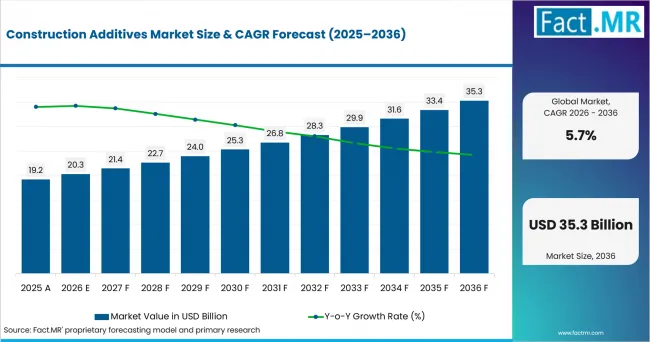
Construction Additives Market Value Analysis | Source: Fact.MR
What are the defining numbers behind Construction Additives Market growth?
An absolute opportunity of USD 15.0 billion will be created between 2026 and 2036.
- Demand Drivers in the Market
- Cement producers are shifting to blended binders, and concrete made with them often needs admixture adjustment to keep setting time and early strength on target. The U.S. Geological Survey reported in February 2026 that blended cement made up 63% of U.S. cement shipments in the first nine months of 2025, with portland-limestone cement at 95% of those blended shipments [1].
- Embodied carbon targets are pushing specifiers to cut cement content per cubic meter of concrete. The UN Environment Programme reported in May 2026 that buildings and construction account for around 37% of global CO2 emissions and nearly 50% of global material extraction [2]. Carbon targets will therefore lift plasticizer dosage per batch.
- Product documentation rules in Europe are raising the value of additives with tested performance data. The revised EU Construction Products Regulation entered into force on 7 January 2025 and introduces digital product passports that carry performance declarations and safety information [3]. Suppliers with verified data for waterproofing and admixture products will gain easier access to cross-border projects.
- Repair work on aging concrete is widening demand beyond new construction. Tunnels, parking decks and bridges need integral waterproofing and corrosion protection. Contractors will favor ready-to-dose products on these jobs.
- Key Segments Analyzed
- By Type: Waterproofing will hold 42.3% share in 2026 owing to below-grade and wet-area protection needs in commercial and infrastructure structures.
- By End-use: Commercial will account for 64.2% share in 2026 given that offices, warehouses and data centers write admixture and waterproofing systems into project specifications.
- By Form: Liquid will capture 65.0% share in 2026 since ready-mix and precast plants meter liquid admixtures automatically at the batching stage.
- Analyst Opinion at Fact.MR
- Shambhu Nath Jha, Principal Consultant at Fact.MR, states, “Cement chemistry is changing faster than many mix designs, and additive suppliers earn their place in that gap. Ready-mix producers switching to limestone and other blended cements will lean harder on water reducers and accelerators to keep strength and setting time predictable. Suppliers that pair liquid admixtures with plant-level technical service and documented waterproofing performance will win repeat commercial specifications.”
- Strategic Implications
- Admixture suppliers should build dosage guides for portland-limestone and other blended cements, since setting behavior shifts when producers switch binders.
- Waterproofing product makers should publish third-party test data early, given that EU specifiers will request product passport information in tenders.
- Ready-mix producers should pair automated liquid dosing with plant quality checks so cement savings hold up across seasons.
- Distributors in Poland and the Netherlands should stock repair mortars and waterproofing additives near expanding civil engineering corridors.
Poland will lead at 7.1% CAGR, supported by specialised construction growth and rising housing permits. The United States will follow at 6.3% on the back of highway work and nonresidential building programs. In the United Kingdom, growth will reach 5.9% through repair work and higher-risk building approvals. The Netherlands will record 5.6% as housing permits climb, while Germany will post 4.8% with civil engineering orders recovering. Japan will close at 4.1%, backed by steady public and private construction investment.
How does the Construction Additives Market break down by segment?
Waterproofing will lead Type at 42.3%; Commercial will lead End-use at 64.2%; Liquid will lead Form at 65.0%.
Which Type dominates?
Waterproofing will hold 42.3% share in 2026.
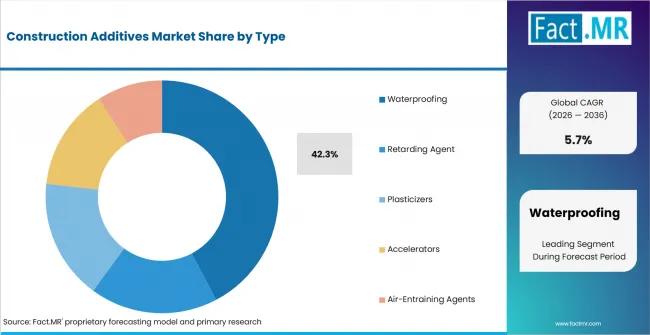
Construction Additives Market Analysis By Type | Source: Fact.MR
Waterproofing additives will lead because water entry drives rebar corrosion, freeze-thaw damage and leaks in below-grade structures. Specifiers write integral waterproofing into basements, podium decks and water tanks, since fixing a leaking structure after handover costs far more than treating the concrete at batching. Broader waterproofing chemical ranges serve roofs and wet rooms in the same buildings.
Plasticizers reduce water content and improve flow in pumped and self-compacting concrete. Retarding agents extend working time on hot-weather pours. Accelerators and air-entraining agents serve precast plants and freeze-thaw exposed paving. Demand for plasticizer concrete admixtures will rise with lower-clinker cement use.
What leads the End-use segment?
Commercial will account for 64.2% share in 2026.
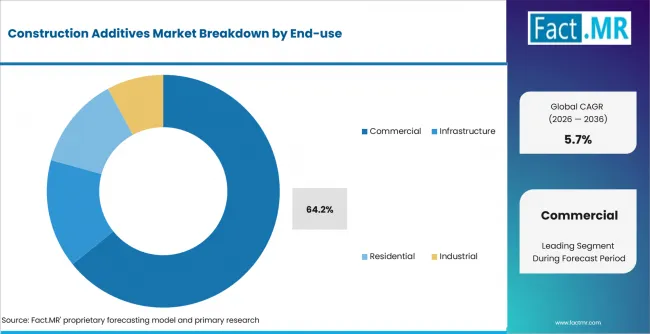
Construction Additives Market Analysis By End Use | Source: Fact.MR
Commercial projects will lead given that offices, hospitals and data centers pour large volumes of structural concrete under strict specifications. Project engineers set limits for water-cement ratio and permeability, which contractors meet with admixtures chosen at the design stage.
The U.S. Census Bureau reported in September 2026 that private nonresidential construction ran at a seasonally adjusted annual rate of USD 755.2 billion in July 2026 [4]. Spending at that scale keeps commercial concrete volumes large when housing slows.
How does Form shape demand?
Liquid will capture 65.0% share in 2026.
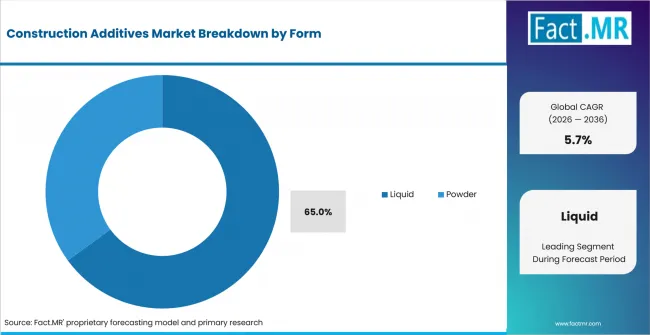
Construction Additives Market Analysis By Form | Source: Fact.MR
Liquid additives will lead because batching plants meter them automatically into each load with close dosing control. Ready-mix trucks and precast lines depend on that precision, since small dosage errors change slump, air content and set time. Liquid superplasticizer grades such as polycarboxylate ethers are widely used in high-flow and self-compacting concrete.
The U.S. Geological Survey estimated that 70% to 75% of U.S. cement sales in 2025 went to ready-mixed concrete producers [1]. Powder additives stay relevant in dry mix mortar additives for tile adhesives and self-leveling compounds. Factory-blended bags need dry ingredients, which keeps redispersible polymer powder and cellulose ethers in steady use.
What is accelerating Construction Additives Market adoption, and what is holding it back?
Demand will rise with blended cement use, embodied carbon targets and waterproofing needs in commercial and infrastructure work. Growth will be limited by volatile raw material costs, cement compatibility problems and slow housing starts in parts of Europe.
Drivers Impact Analysis
| DRIVER | (~) % IMPACT ON CAGR | GEOGRAPHIC RELEVANCE | IMPACT TIMELINE |
|---|---|---|---|
| Blended and portland-limestone cement adoption requiring admixture adjustment | +1.4% | North America, Europe | Short term (<= 2 years) |
| Embodied carbon targets lowering cement content per cubic meter | +1.2% | Europe, North America | Medium term (2-4 years) |
| Waterproofing specifications in commercial and below-grade structures | +1.0% | Global | Short term (<= 2 years) |
| Infrastructure repair and rehabilitation programs | +0.8% | North America, Western Europe, Japan | Medium term (2-4 years) |
| Digital product passports under the EU Construction Products Regulation | +0.5% | Europe | Long term (>= 4 years) |
Opportunity Impact Analysis
| OPPORTUNITY | (~) % IMPACT ON CAGR | GEOGRAPHIC RELEVANCE | IMPACT TIMELINE |
|---|---|---|---|
| Accelerator systems for low-clinker precast concrete | +1.0% | Europe, North America | Medium term (2-4 years) |
| Crystalline waterproofing for tunnels and water infrastructure | +0.8% | Eastern Europe, East Asia | Long term (>= 4 years) |
| Low-carbon polymer additives for factory-made dry mortars | +0.6% | Western Europe | Medium term (2-4 years) |
Restraints Impact Analysis
| RESTRAINT | (~) % IMPACT ON CAGR | GEOGRAPHIC RELEVANCE | IMPACT TIMELINE |
|---|---|---|---|
| Raw material and energy price swings for polymers and dispersions | -0.7% | Europe, North America | Short term (<= 2 years) |
| Compatibility issues between admixtures and variable cement blends | -0.5% | Global | Medium term (2-4 years) |
| Weak residential starts in parts of Europe | -0.4% | Western Europe, Eastern Europe | Short term (<= 2 years) |
Which countries are scaling the Construction Additives Market through 2036?
- The country comparison spans 3.0 percentage points between Poland at 7.1% and Japan at 4.1%.
- Poland will remain 0.8 percentage point above the United States through specialised construction growth and rising housing permits.
- The United States will remain 0.4 percentage point above the United Kingdom as highway and nonresidential programs keep ready-mix volumes large.
- United Kingdom demand will remain 0.3 percentage point above the Netherlands through repair work and safety approvals for higher-risk buildings.
- The Netherlands will remain 0.8 percentage point above Germany on the back of rising housing permits and civil engineering turnover.
- Germany will remain 0.7 percentage point above Japan through a recovery in civil engineering orders.
- Japan will close the displayed range through steady public investment and maintenance of aging bridges and tunnels.
Comparable CAGRs create different entry conditions for additive suppliers, shaped by cement supply and public works budgets. Full report coverage includes North America, Latin America, Western Europe, Eastern Europe, East Asia, South Asia & Pacific, Middle East & Africa.
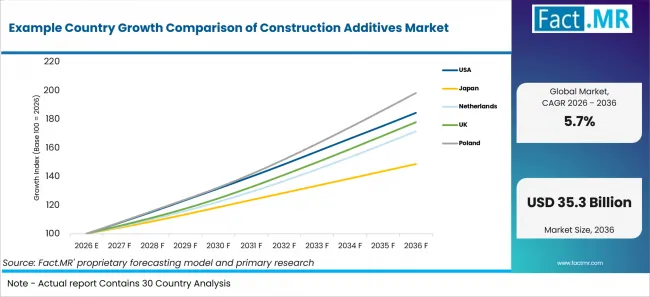
Example Country Growth Comparison Of Construction Additives Market | Source: Fact.MR
| Country | CAGR (2026-2036) |
|---|---|
| Poland | 7.1% |
| United States | 6.3% |
| United Kingdom | 5.9% |
| Netherlands | 5.6% |
| Germany | 4.8% |
| Japan | 4.1% |
What supports Poland adoption?
7.1% CAGR, supported by specialised construction growth and rising housing permits.
Statistics Poland reported that construction and assembly production rose 3.9% year on year in May 2026 [5]. Specialised construction activities grew 10.8% in the same month, and that division covers the installation and finishing trades where waterproofing and repair mortars are applied [5]. The number of dwellings granted permits in January to April 2026 was 15.8% higher than a year earlier [6].
How is the United States scaling demand?
6.3% CAGR, driven by highway work and large public construction budgets.
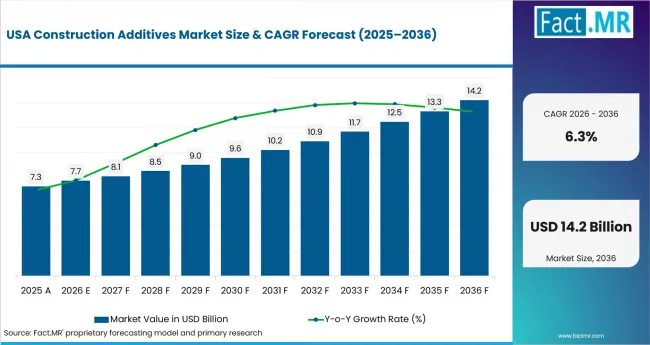
Construction Additives Market Country Value Analysis | Source: Fact.MR
The U.S. Census Bureau reported that public construction spending ran at a seasonally adjusted annual rate of USD 543.4 billion in July 2026 [4]. Highway construction accounted for USD 150.3 billion of that rate, and bridge and pavement concrete relies on air-entraining agents for freeze-thaw and deicing salt exposure [4]. State transportation departments write these requirements into their concrete specifications, which favors suppliers on approved product lists.
What supports the United Kingdom’s growth?
5.9% CAGR, backed by repair work and higher-risk building approvals.
The Office for National Statistics estimated that construction output grew 0.3% in the second quarter of 2026, with new work up 0.4% and repair and maintenance up 0.2% [7]. The Building Safety Regulator approved 46 applications for new higher-risk buildings and conversions between June and August 2026, covering 9,362 residential units [8]. Contractors on these schemes need waterproofing and repair systems backed by test evidence that clears regulator review.
How is the Netherlands developing demand?
5.6% CAGR, supported by rising housing permits and civil engineering turnover.
Statistics Netherlands reported that permits were issued for 23.5 thousand new-build homes in the first quarter of 2026, which is 4.7 thousand more than a year earlier [9]. Construction turnover rose 5.2% in the second quarter of 2026, and civil engineering firms posted a 5.9% gain [10]. Soft, water-saturated ground means Dutch basement and tunnel concrete needs integral waterproofing.
What is supporting Germany’s adoption?
4.8% CAGR, driven by recovering civil engineering orders.
German construction orders are improving after a weak housing cycle. Destatis reported that real order intake in main construction was 11.3% higher in June 2026 than a year earlier [11]. Civil engineering orders rose 9.3% in the second quarter of 2026 compared with the first quarter [11]. Rail and bridge projects use concrete with strict durability classes, which will support plasticizer and retarder demand.
How does Japan perform?
4.1% CAGR, led by steady construction investment and infrastructure maintenance.
Japan’s Ministry of Land, Infrastructure, Transport and Tourism projected fiscal 2026 construction investment at JPY 81.47 trillion [12]. The ministry expects a 2.9% increase over fiscal 2025 [12]. Public works increasingly go to maintaining bridges, tunnels and seawalls from the high-growth decades. Aging structures need repair mortars, corrosion inhibitors and surface waterproofing.
Who leads the Construction Additives Market?
Sika AG supplies concrete admixtures, waterproofing systems and repair mortars. The company opened a production and concrete service hub at Ham in Belgium in June 2026. Its new site pairs an automated admixture plant with laboratories serving ready-mix and precast customers across the Benelux [13].
Saint-Gobain (including Chryso, GCP and Fosroc) runs admixture and waterproofing ranges within its construction chemicals business. The group completed the acquisition of Fosroc in February 2025 [14]. Master Builders Solutions operates as an independent admixture supplier after Sika divested MBCC admixture assets in several regions in 2023. In May 2026, it launched a three-component acceleration system for precast concrete made with low-clinker cements [15].
Mapei serves contractors with admixtures, waterproofing membranes and tile adhesives. In February 2026, the company introduced Mapeair 154 in the United States, an air-entraining admixture for ready-mix and precast concrete that is compatible with Type IL and blended cements [16]. BASF stays active through its construction additives range, including Melflux superplasticizers and concrete admixture intermediates for dry mortar and admixture producers.
Arkema supplies Ethacryl polycarboxylate superplasticizers and Rhealis auxiliaries for ready-mix and precast concrete. Dow Inc. offers WALOCEL cellulose ethers and DOW Latex Powders for tile adhesives and renders, while Wacker Chemie AG supplies VINNAPAS dispersible polymer powders for waterproofing membranes and tile adhesives. Competition centers on cement compatibility, plant dosing support and documented performance in low-carbon mixes.
Which companies are the key providers?
Key companies include Sika AG; Saint-Gobain (including Chryso, GCP and Fosroc); Master Builders Solutions; Mapei; BASF; Arkema; Dow Inc.; and Wacker Chemie AG.
- Sika AG
- Saint-Gobain (including Chryso, GCP and Fosroc)
- Master Builders Solutions
- Mapei
- BASF
- Arkema
- Dow Inc.
- Wacker Chemie AG
Bibliography
- [1] U.S. Geological Survey. (2026, February). Mineral Commodity Summaries 2026: Cement.
- [2] UN Environment Programme. (2026, May 19). Global Status Report for Buildings and Construction 2025-2026.
- [3] European Commission, Directorate-General for Internal Market, Industry, Entrepreneurship and SMEs. (2025, January 7). New EU rules on the safety and sustainability of construction products mark a new step for the sector’s competitiveness.
- [4] U.S. Census Bureau. (2026, September 1). Monthly Construction Spending, July 2026.
- [5] Statistics Poland. (2026, June 22). Construction and assembly production in May 2026.
- [6] Statistics Poland. (2026, May 21). Residential construction in the period of January-April 2026.
- [7] Office for National Statistics. (2026, August 13). Construction output in Great Britain: June 2026, new orders and Construction Output Price Indices, April to June 2026.
- [8] Building Safety Regulator. (2026, September 15). Building Safety Regulator building control approval application data June to August 2026.
- [9] Statistics Netherlands. (2026, May 29). Meer vergunde nieuwbouwwoningen in eerste kwartaal [More permitted new-build homes in the first quarter].
- [10] Statistics Netherlands. (2026, August 20). Bouw zet meer om in tweede kwartaal [Construction turnover rises in the second quarter].
- [11] Statistisches Bundesamt. (2026, August 25). Auftragseingang im Bauhauptgewerbe im Juni 2026: +6,0 % zum Vormonat [Order intake in main construction in June 2026: +6.0% on the previous month].
- [12] Ministry of Land, Infrastructure, Transport and Tourism. (2026, August 31). 令和8年度(2026年度)建設投資見通し [Construction investment outlook for fiscal 2026].
- [13] Sika. (2026, June 9). Sika opens state-of-the-art production and concrete service hub in the Benelux region.
- [14] Saint-Gobain. (2025, February 10). Saint-Gobain completes the acquisition of FOSROC, a leading player in construction chemicals in Asia and emerging markets, further strengthening its worldwide presence in the sector.
- [15] Master Builders Solutions. (2026, May 20). Master Builders Solutions Unlocks the “Instinct of Speed” with New Three-Component Acceleration System for Sustainable Precast Concrete.
- [16] MAPEI. (2026, February 9). MAPEI introduces Mapeair 154 next-generation air-entraining admixture for consistent performance in ready-mix and precast concrete.
This Report Answers
- The report explains how waterproofing agents, plasticizers, retarders, accelerators and air-entraining agents are used across four end uses.
- Segment analysis identifies the top-share subsegment in each type, end use and form category, with the plant and site conditions behind it.
- Country analysis reviews Poland, the United States, the United Kingdom, the Netherlands, Germany and Japan through construction output, permits and public investment.
- Competitive analysis covers admixture specialists, construction chemical groups and polymer suppliers active in low-emission admixtures and waterproofing ranges.
- Application analysis assesses how blended cements and embodied carbon targets change additive dosage. The review extends to calcium formate accelerators used in cold-weather concrete.
What does the Construction Additives Market cover?
The Construction Additives Market covers chemical products added to concrete, mortar and grout to change how they mix, set, harden and resist water. It includes waterproofing agents, retarding agents, plasticizers, accelerators and air-entraining agents sold in liquid or powder form.
The assessment follows demand from commercial, infrastructure, residential and industrial construction. It separates additives dosed at ready-mix and precast plants from those blended into factory-made dry mortars.
What is included in the scope?
The scope includes integral waterproofing admixtures, crystalline additives and water-repellent agents dosed into concrete or mortar. It covers plasticizers, retarders, accelerators and air-entraining agents used in ready-mix, precast and site-mixed concrete. Corrosion-control products such as migrating corrosion inhibitors are included when they are dosed into fresh concrete or repair mortar.
What is excluded from the scope?
The scope excludes cement, aggregates, supplementary cementitious materials and ready-mixed concrete itself. Sheet and liquid-applied waterproofing membranes are excluded when they are sold as standalone roofing or tanking systems.
Crack repair products such as polyurethane and epoxy injection resins fall outside the scope.
How Was the Analysis Built?
The analysis draws on 120+ sources, 35+ company portfolios, 25+ countries, and more than 20 industry interviews.
- Primary Research: Primary research includes discussions with manufacturers, service providers, technology developers, distributors, end users, and subject-matter experts. These conversations examine purchasing priorities, product adoption, operational challenges, approval requirements, competitive positioning, and the factors that influence wider market acceptance.
- Desk Research: Desk research covers government statistics, regulatory publications, company filings, trade data, technical studies, industry associations, standards, public policy, and other authoritative sources. Every source used in the analysis is documented in the bibliography.
- Market Sizing and Forecasting: Market estimates combine historical performance, demand indicators, pricing and volume trends, segment shares, company participation, country-level growth, adoption patterns, investment activity, and barriers to market expansion.
- Data Validation and Update Cycle: Findings are validated by comparing primary interviews with public data, company activity, regulatory changes, trade patterns, and industry developments. Regular updates review new product launches, capacity changes, partnerships, approvals, and shifts in commercial adoption.
What is the report’s scope and coverage?
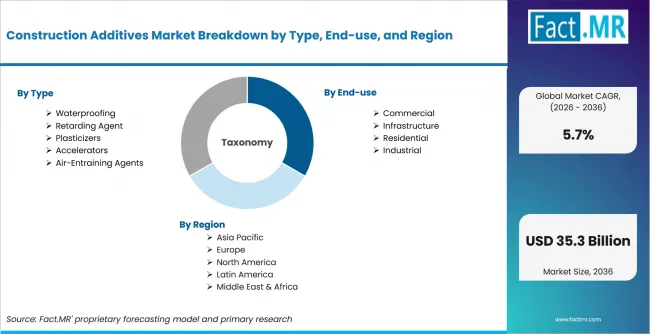
Construction Additives Market Breakdown By Type, End Use, And Region | Source: Fact.MR
| Attribute | Details |
|---|---|
| Quantitative Units | USD billion |
| Market Definition | Chemical additives dosed into concrete, mortar and other cementitious systems to control water demand, setting time, air content, workability and water resistance. |
| Type | Waterproofing; Retarding Agent; Plasticizers; Accelerators; Air-Entraining Agents |
| End-use | Commercial; Infrastructure; Residential; Industrial |
| Form | Liquid; Powder |
| Regions Covered | North America; Latin America; Western Europe; Eastern Europe; East Asia; South Asia & Pacific; Middle East & Africa |
| Countries Covered | Poland; United States; United Kingdom; Netherlands; Germany; Japan |
| Key Companies Profiled | Sika AG; Saint-Gobain; Master Builders Solutions; Mapei; BASF; Arkema; Dow Inc.; Wacker Chemie AG |
| Forecast Period | 2026 to 2036 |
| Approach | Hybrid top-down and bottom-up approach using cement and ready-mix volumes; additive dosage rates by type; construction spending by end use; country construction output and permits; and supplier portfolio review. |
How is the market segmented?
-
By Type:
- Waterproofing
- Retarding Agent
- Plasticizers
- Accelerators
- Air-Entraining Agents
-
By End-use:
- Commercial
- Infrastructure
- Residential
- Industrial
-
By Form:
- Liquid
- Powder
-
By Region:
- North America
- Latin America
- Western Europe
- Eastern Europe
- East Asia
- South Asia & Pacific
- Middle East & Africa