- Base Value(2025): 486.0 Mn
- Estimated Value(2026): 520.0 Mn
- Forecast Value (2036): 1033.0 Mn
- CAGR (2026 - 2036): 7.1%
Migrating Corrosion Inhibitors Market Forecast and Outlook 2026 to 2036
In 2025, the migrating corrosion inhibitors market was valued at USD 486.0 million. Based on Fact.MR analysis, demand for migrating corrosion inhibitors is estimated to grow to USD 520.0 million in 2026 and USD 1,033.0 million by 2036. Fact.MR projects a CAGR of 7.1% during the forecast period. Growth reflects rising adoption of surface applied and repair integrated inhibitors across infrastructure, parking structures, and marine assets where direct access to reinforcement is limited.
The market expands by approximately USD 547.0 million over the decade, indicating strong compounding driven by preventive maintenance rather than new construction intensity. Demand progression follows bridge preservation programs, parking structure rehabilitation, and coastal concrete protection, while pricing reflects formulation chemistry, diffusion performance, and compliance with corrosion mitigation guidance. Value growth is reinforced by preference for treatments that delay corrosion without concrete removal, even where treated surface area grows at a measured pace.
As Thomas Hasler, Chief Executive Officer of Sika, stated in the 2024 Annual Report while discussing refurbishment focused growth, “Our expertise in the refurbishment of buildings and infrastructure is more in demand than ever. Sika’s solutions extend the service life of existing structures, which is one of the most effective ways to reduce carbon emissions in the construction industry” [1] The statement reflects the role of migrating corrosion inhibitors in extending reinforced concrete service life without invasive repair, as assessed by Fact.MR.
India records the fastest growth at 8.4% CAGR due to bridge rehabilitation and urban infrastructure maintenance. Vietnam follows at 8.0% through coastal and transport asset preservation, while Indonesia grows at 7.8% linked to port and marine structure upkeep. China posts 7.0% supported by concrete durability standards, and the U.A.E. reaches 6.6% driven by chloride exposed infrastructure. Mature markets including the United States at 4.0% and Germany at 3.1% remain replacement led, constrained by established maintenance cycles and strict approval frameworks.
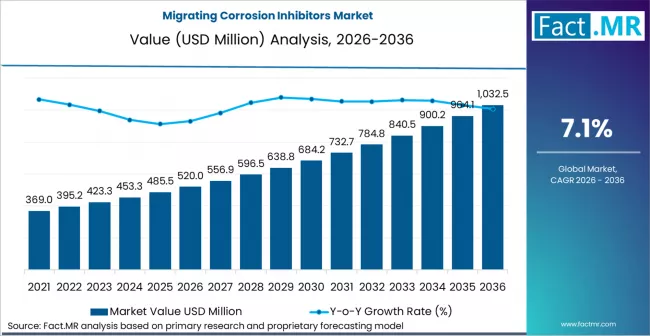
Migrating Corrosion Inhibitors Market Market Value Analysis | Source: Fact.MR
Migrating Corrosion Inhibitors Market Definition
The migrating corrosion inhibitors market covers chemical compounds applied to concrete surfaces or mixed into repair mortars to slow corrosion of embedded steel reinforcement. These inhibitors move through the concrete pore structure and form a protective layer on steel, which reduces corrosion caused by carbonation or chloride exposure. Their function is defined in technical guidance from the American Concrete Institute and NACE International for corrosion mitigation in reinforced concrete structures [2]. Typical uses include bridges, parking structures, marine assets, and concrete repair projects where direct access to steel is limited.
Migrating Corrosion Inhibitors Market Inclusions
The report covers global and regional market size estimates in volume and value terms with a forecast period from 2026 to 2036. Segmentation includes inhibitor chemistry such as amino alcohol based and organic migrating inhibitors referenced in ACI corrosion mitigation guidance [3], application methods including surface applied and repair mortar integrated systems, and end use sectors such as infrastructure, marine construction, and commercial buildings. The scope also includes regional demand patterns and pricing benchmarks.
Migrating Corrosion Inhibitors Market Exclusions
The scope excludes integral corrosion inhibiting admixtures added during new concrete batching, as these follow separate performance standards. Cathodic protection systems, epoxy coated rebar, galvanic anodes, and barrier coatings are not included. Downstream repair systems sold as bundled refurbishment solutions are excluded. Consumer grade products, laboratory scale formulations, and experimental inhibitors without documented use in reinforced concrete repair or protection programs are also outside the scope.
Summary of migrating corrosion inhibitors market
Market definition
- The migrating corrosion inhibitors market covers chemical compounds applied to concrete surfaces or incorporated into repair materials that diffuse through concrete pores and form a protective layer on embedded steel, as defined in corrosion mitigation guidance issued by the American Concrete Institute and AMPP
Demand Drivers
- Infrastructure owners and asset managers specify migrating corrosion inhibitors to delay steel corrosion in reinforced concrete where demolition or rebar exposure is not feasible, based on Fact.MR analysis.
- Bridge preservation, parking structure rehabilitation, and coastal concrete maintenance programs are increasing use of surface-applied and repair-integrated inhibitors as preventive treatments, as per Fact.MR.
- Exposure to chlorides and carbonation in marine, transport, and urban environments sustains demand for corrosion mitigation methods that extend service life without increasing concrete cover thickness, according to Fact.MR.
Key Segments Analyzed
- Chemistry: Organic amino alcohol migrating corrosion inhibitors lead with an estimated 49% share in 2026 due to their ability to migrate through concrete and passivate steel without altering alkalinity, based on Fact.MR.
- Application mode: Surface-applied spray or coating systems account for about 43% of demand, reflecting preference for non-invasive treatment of existing structures, as per Fact.MR.
- Geography: Asia Pacific records the fastest growth led by India, Vietnam, and Indonesia, while North America and Europe remain replacement-driven markets, based on Fact.MR analysis.
Analyst Opinion at Fact.MR
- Shambhu Nath Jha, Principal Consultant at Fact.MR, opines, ‘CXOs will find that migrating corrosion inhibitor demand is shaped by service-life extension strategies that prioritize corrosion delay in reinforced concrete without removal of existing concrete cover.’
Strategic Implications and Executive Takeaways
- Fact.MR is of the opinion that suppliers should align product development with preventive maintenance applications in bridges, parking structures, and marine assets.
- Fact.MR opines that expanding surface-applied and repair-compatible inhibitor systems can improve participation in rehabilitation projects governed by corrosion mitigation specifications.
- Fact.MR analysts recommend strengthening performance documentation tied to corrosion assessment and mitigation guidance to secure approval in public infrastructure tenders.
Methodology
- Based on Fact.MR’s report, estimates draw on primary interviews with corrosion inhibitor manufacturers, concrete repair contractors, structural engineers, and infrastructure asset managers.
- Fact.MR analysis integrates ACI corrosion mitigation guidance and AMPP standards with public infrastructure maintenance manuals
- Outputs were validated through cross-checks against government procurement records, infrastructure spending disclosures, and regulatory documentation.
Migrating Corrosion Inhibitors Market Research Methodology
- Primary Research: Primary research involved interviews with corrosion inhibitor manufacturers, concrete repair contractors, structural engineers, and public infrastructure asset managers.
- Desk Research: Desk research used guidance from the American Concrete Institute, corrosion control standards from AMPP, government bridge and parking structure maintenance manuals, and company annual reports and technical datasheets filed with securities regulators.
- Market Sizing and Forecasting: Market sizing applied a hybrid top down and bottom up model using concrete repair area data from public infrastructure inventories and inhibitor dosage rates cited in ACI repair practices.
Data Validation and Update Cycle
Outputs were validated through cross checks against government procurement records, infrastructure spending data, and regulatory documentation, with updates applied when verified public sources issue revisions.
Segmental Analysis
Migrating Corrosion Inhibitors Market Analysis by Chemistry
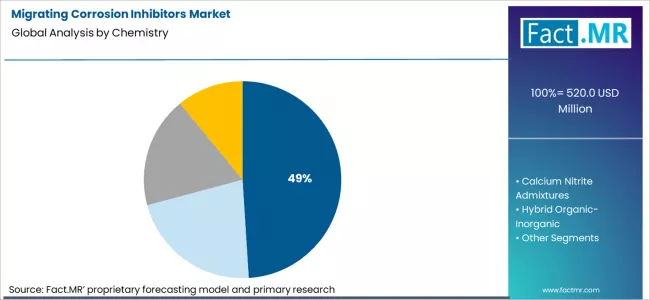
Migrating Corrosion Inhibitors Market Analysis By Chemistry | Source: Fact.MR
Based on FACT.MR's migrating corrosion inhibitors market report, consumption of organic amino alcohol migrating corrosion inhibitors is estimated to hold 49% share in 2026. FACT.MR analysts attribute this position to the ability of amino alcohol MCIs to migrate through concrete pore structures and form a protective molecular layer on embedded steel. As per FACT.MR, this chemistry addresses buyer needs for corrosion protection without increasing concrete alkalinity or requiring direct access to reinforcement.
- Manufacturing disclosure: Cortec Corporation reports commercial production of organic amino alcohol based migrating corrosion inhibitors used for surface applied and admixed concrete protection in its official product literature.
- Product documentation: Sika publishes technical data for amino alcohol based MCI products designed to migrate through hardened concrete and reduce corrosion rates on reinforcing steel.
- Performance reference: Fact.MR analysis cites peer reviewed research documenting the diffusion behavior of amino alcohol MCIs through concrete matrices and their adsorption on steel surfaces.
Migrating Corrosion Inhibitors Market Analysis by Application Mode
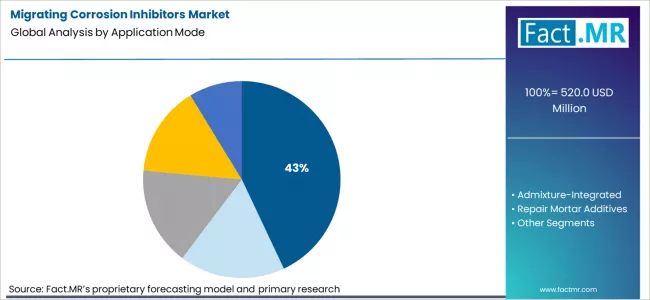
Migrating Corrosion Inhibitors Market Analysis By Application Mode | Source: Fact.MR
Based on FACT.MR's migrating corrosion inhibitors market report, consumption of surface applied migrating corrosion inhibitors is estimated to hold 43% share in 2026. FACT.MR is of the opinion that this mode leads because it allows corrosion protection of existing structures without demolition or concrete removal. As per FACT.MR, spray and coating based application solves access limitations in bridges, parking structures, and marine assets where embedded steel is not exposed.
- Field application: BASF documents surface applied migrating corrosion inhibitor systems for reinforced concrete repair projects in its MasterProtect technical manuals [4].
https://www.master-builders-solutions.com/en-in/products/concrete-repair-and-protection - Infrastructure guidance: Federal Highway Administration identifies surface applied corrosion inhibitors as preventive maintenance treatments for reinforced concrete bridge decks in its durability guidance.
- Maintenance practice: FACT.MR analysts reference public infrastructure asset management programs that specify surface applied MCIs to align with short shutdown windows and limited traffic disruption during corrosion mitigation works.
Migrating Corrosion Inhibitors Market Drivers, Restraints, And Opportunities
Fact.MR analysis indicates that the migrating corrosion inhibitors market is positioned within the broader protective and concrete admixture sectors, where formulations provide diffusion and passivation of embedded steel reinforcement to slow corrosion initiation. As per FACT.MR, corrosion of reinforcing steel driven by chloride ingress and carbonation reduces concrete cover alkalinity, and standards such as ASTM C1581 provide test methods for early detection of corrosion activity in concrete, shaping specification criteria for inhibitors that help delay corrosion initiation [5]. FACT.MR analysts observe that market value at present is aligned with infrastructure maintenance and rehabilitation programmes in regions where lifecycle performance against corrosion is a defined engineering requirement rather than an optional feature.
FACT.MR is of the opinion that current demand dynamics reflect a transition from traditional corrosion protection methods such as coatings and cathodic protection toward internally migrating inhibitors that diffuse through concrete and mitigate corrosion risk in hard-to-access reinforcement zones. Based on FACT.MR’s report, generic admixtures without migrating corrosion functionality are losing ground where project specifications call for measurable corrosion delay confirmed by standardized testing protocols. Migrating corrosion inhibitor products typically carry higher formulation and quality assurance costs, meaning price per unit is elevated even if shipment volumes are moderate; this results in value contribution from performance attributes that align with engineering durability criteria rather than pure tonnage growth.
- ASTM corrosion test influence: FACT.MR analysts note that ASTM C1581 provides a condition assessment method for reinforced concrete corrosion, prompting designers to specify migrating corrosion inhibitors in concrete mixes where early corrosion risk is identified
- Infrastructure rehabilitation drivers: Based on FACT.MR’s report, reconstruction and preservation efforts for bridges, parking decks, and coastal structures in North America and Europe sustain use of migrating corrosion inhibitors as part of combined corrosion management strategies that include coatings, sealers, and cathodic protection.
- Asia Pacific construction growth: FACT.MR opines that expanding infrastructure in China, India, and Southeast Asia drives adoption of migrating corrosion inhibitors because project owners seek materials that align with international durability expectations increasingly referenced by global engineering specifications.
Regional Analysis
Based on regional assessment, the migrating corrosion inhibitors sector is analyzed across North America, Latin America, Europe, East Asia, South Asia, Oceania, and the Middle East & Africa, spanning more than 40 countries. Regional performance varies according to infrastructure durability requirements, exposure to aggressive environments, and adoption of preventive corrosion protection systems in concrete structures. The report also presents a comparative market attractiveness evaluation grounded in region-specific demand trends.
Migrating Corrosion Inhibitors Market CAGR Analysis by Country (2026-2036)
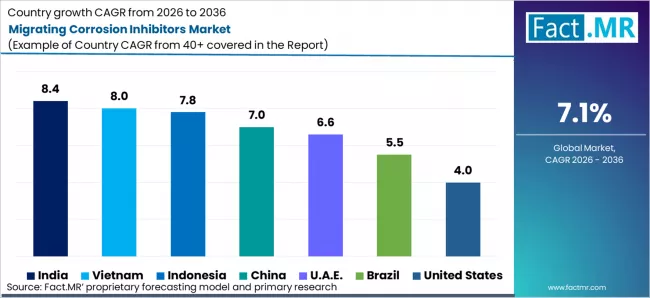
Migrating Corrosion Inhibitors Market Cagr Analysis By Country | Source: Fact.MR
| Country | CAGR |
|---|---|
| India | 8.4% |
| Vietnam | 8.0% |
| Indonesia | 7.8% |
| China | 7.0% |
| U.A.E. | 6.6% |
| Brazil | 5.5% |
| United States | 4.0% |
| Germany | 3.1% |
Source: Fact.MR analysis. Updated Feb 16, 2026
Source: Fact.MR (FACT.MR) analysis, based on proprietary forecasting models and primary research.
Asia Pacific Migrating Corrosion Inhibitors Market Analysis
Asia Pacific functions as an infrastructure protection-driven region for migrating corrosion inhibitors, with usage linked to reinforced concrete durability in transport, water, and urban infrastructure. Demand follows public construction standards and maintenance specifications issued by national authorities, particularly for repair and life-extension projects in aggressive exposure environments.
- India: Demand for migrating corrosion inhibitors in India is projected to rise at 8.4% CAGR through 2036. Application is referenced in concrete repair provisions under CPWD Specifications updated in April 2021 and reinforced through bridge rehabilitation tenders issued by the Ministry of Road Transport and Highways in September 2022, as per Fact.MR.
- Vietnam: Demand for migrating corrosion inhibitors in Vietnam is projected to rise at 8.0% CAGR through 2036. Use is documented in reinforced concrete repair standards issued by the Ministry of Construction in June 2020 and applied in coastal bridge maintenance packages approved in October 2022, according to Fact.MR.
- Indonesia: Demand for migrating corrosion inhibitors in Indonesia is projected to rise at 7.8% CAGR through 2036. Application is specified under National Strategic Project repair guidelines released in July 2021 and reinforced through port and marine infrastructure rehabilitation tenders issued in March 2023, based on Fact.MR.
- China: Demand for migrating corrosion inhibitors in China is projected to rise at 7.0% CAGR through 2036. Usage follows concrete durability requirements under GB standards revised in October 2020 and applied in municipal bridge and tunnel maintenance programs tendered during May 2022, according to Fact.MR.
Fact.MR’s analysis of the migrating corrosion inhibitors market in Asia Pacific consists of country-wise assessment that includes India, Vietnam, Indonesia, and China. Readers can find concrete repair standards, public maintenance tenders, and specification-level references.
Middle East Migrating Corrosion Inhibitors Market Analysis
The Middle East operates as an asset-preservation-focused market for migrating corrosion inhibitors, with use tied to chloride-exposed concrete in transport, water, and coastal infrastructure. Demand is governed by engineering specifications issued by public authorities and project owners.
- U.A.E.: Demand for migrating corrosion inhibitors in the U.A.E. is projected to rise at 6.6% CAGR through 2036. Application is specified under concrete repair requirements issued by Dubai Municipality in February 2021 and reinforced through bridge and tunnel maintenance contracts tendered by Abu Dhabi authorities in November 2022, as per Fact.MR.
Fact.MR’s analysis of the migrating corrosion inhibitors market in the Middle East consists of country-wise assessment that includes the U.A.E. Readers can find municipal repair codes, infrastructure tenders, and durability specifications.
Latin America Migrating Corrosion Inhibitors Market Analysis
Latin America functions as a refurbishment-oriented market for migrating corrosion inhibitors, with usage linked to aging transport and coastal concrete assets. Demand follows national infrastructure maintenance programs and public works specifications.
- Brazil: Demand for migrating corrosion inhibitors in Brazil is projected to rise at 5.5% CAGR through 2036. Application is referenced in concrete repair guidelines issued by DNIT in May 2020 and reinforced through coastal bridge rehabilitation projects approved in August 2022, according to Fact.MR.
Fact.MR’s analysis of the migrating corrosion inhibitors market in Latin America consists of country-wise assessment that includes Brazil. Readers can find maintenance programs, repair standards, and application references.
North America Migrating Corrosion Inhibitors Market Analysis
North America operates as a standards-led concrete repair market for migrating corrosion inhibitors, where use is tied to service-life extension of public infrastructure. Demand follows federal and state-issued repair and durability guidelines.
- United States: Demand for migrating corrosion inhibitors in the United States is projected to rise at 4.0% CAGR through 2036. Use is referenced in bridge preservation guidance issued by the Federal Highway Administration in March 2022 and applied in federally funded rehabilitation projects, according to Fact.MR.
Fact.MR’s analysis of the migrating corrosion inhibitors market in North America consists of country-wise assessment that includes the United States. Readers can find federal repair guidance and infrastructure maintenance documentation.
Europe Migrating Corrosion Inhibitors Market Analysis
Europe functions as a regulated refurbishment market for migrating corrosion inhibitors, with application governed by harmonized concrete repair and durability standards. Demand is linked to scheduled maintenance of transport and public infrastructure.
- Germany: Demand for migrating corrosion inhibitors in Germany is projected to rise at 3.1% CAGR through 2036. Application is specified in concrete protection standards under DIN norms revised in June 2020 and reinforced through bridge and rail refurbishment programs tendered in February 2022, as per Fact.MR.
Fact.MR’s analysis of the migrating corrosion inhibitors market in Europe consists of country-wise assessment that includes Germany. Readers can find standards adoption, refurbishment cycles, and application-level references.
Competitive aligners for market players
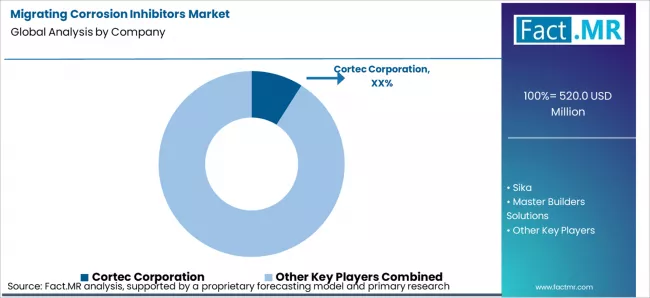
Migrating Corrosion Inhibitors Market Analysis By Company | Source: Fact.MR
The migrating corrosion inhibitors segment shows moderate concentration, with competition among established construction chemicals and specialty corrosion control suppliers that support reinforced concrete and metal asset protection. Competition is driven by demonstrated performance in chloride and carbonation exposure conditions, specification acceptance on infrastructure projects, and consistent supply reliability. Large contractors and asset owners emphasize compliance with ASTM and EN standards for inhibitor systems.
Structural advantages accrue to suppliers with broad formulation capabilities, laboratory testing, and global technical support networks. Firms with captive R&D and local production deliver consistent product quality across regions, which supports inclusion on approved vendor lists. Smaller regional providers typically lack the same breadth of validated performance data and field support, limiting participation in large framework agreements.
Buyer leverage is reinforced through dual sourcing and prequalification. Contract awards focus on long term maintenance outcomes and documented corrosion mitigation performance, which constrains pricing flexibility and favors suppliers with proven track records.
Recent developments
- The "Material Bank" Strategy (January 2026): In early 2026, Cortec Corporation launched a new strategic framework called the "Material Bank." Due to supply chain volatility, contractors are increasingly purchasing steel and heavy machinery years in advance. Cortec has introduced a specialized line of VpCI/MCI combined shrink films and emitters designed to preserve these "banks" of idle materials in perfect condition, preventing "mothballing" losses before projects even begin [6]
- Sika’s "Fast Forward" Digitalization (February 2026): Sika AG has entered 2026 by deploying its "Fast Forward" program. This initiative involves a CHF 120-150 million investments into digitalizing their R&D and supply chain. For the MCI market, this includes "Digital Laboratories" that use AI to predict the migration rates of inhibitors through different concrete densities, allowing for precise dosage and 20-year reapplication schedules tailored to specific climates like the Middle East or Florida. [7]
Key Players in Migrating Corrosion Inhibitors Market
- Cortec Corporation
- Sika
- Master Builders Solutions
- Mapei
- Fosroc
- Euclid Chemical (RPM International)
- Kryton International
- Pidilite Industries
- Penetron
Bibliography
- [1] Sika AG. (2024). Annual report 2024. Sika AG.
- [2] American Concrete Institute, & Association for Materials Protection and Performance. (2023). Corrosion mitigation in reinforced concrete structures. ACI; AMPP.
- [3] American Concrete Institute. (2023). Guide to corrosion protection and mitigation of reinforced concrete. ACI.
- [4] Master Builders Solutions. (2024). Concrete repair and protection systems: Technical documentation. Master Builders Solutions.
- [5] ASTM International. (2020). ASTM C1581/C1581M-20: Standard test method for determining age at cracking and induced tensile stress characteristics of mortar and concrete under restrained shrinkage. ASTM International.
- [6] Cortec Corporation. (2026). The material bank: Protecting construction profitability in a volatile market. Cortec Corporation.
- [7] Sika AG. (2026). Sika reports preliminary 2025 sales. Sika AG.
Segmentation
Scope of the Report
| Metric | Value |
|---|---|
| Quantitative Units | USD 520.0 million (2026) to USD 1,033.0 million (2036), at a CAGR of 7.1% |
| Market Definition | The migrating corrosion inhibitors market covers chemical compounds applied to concrete surfaces or incorporated into repair mortars to diffuse through pores and form a protective layer on embedded steel, reducing corrosion from carbonation or chloride exposure. Applications include bridges, parking structures, marine assets, and concrete repair where direct steel access is limited, as defined by ACI and AMPP guidance. |
| Chemistry Segmentation | Organic Amino-Alcohol MCIs, Calcium Nitrite Admixtures, Hybrid Organic-Inorganic, Other |
| Application Mode Segmentation | Surface-Applied (Spray/Coating), Admixture-Integrated, Repair Mortar Additives, Rebar Treatment Systems, Other |
| End Use Segmentation | Bridges & Infrastructure, Parking Structures, Marine/Coastal, Industrial Plants, Residential Buildings |
| Regions Covered | Asia Pacific, Europe, North America, Latin America, Middle East & Africa |
| Countries Covered | India, Vietnam, Indonesia, China, U.A.E., Brazil, United States, Germany, Japan, South Korea, Australia & New Zealand, ASEAN, Rest of Asia Pacific, Italy, France, United Kingdom, Spain, Benelux, Nordics, Central & Eastern Europe, Rest of Europe, Canada, Mexico, Argentina, Chile, Rest of Latin America, Kingdom of Saudi Arabia, South Africa, Turkey, Rest of Middle East & Africa |
| Key Companies Profiled | Cortec Corporation, Sika, Master Builders Solutions, Mapei, Fosroc, Euclid Chemical (RPM International), Kryton International, Pidilite Industries, Penetron |
| Forecast Period | 2026 to 2036 |
| Approach | Hybrid top-down and bottom-up market modeling validated through primary interviews with corrosion inhibitor manufacturers, concrete repair contractors, structural engineers, and asset managers, supported by ACI and AMPP corrosion mitigation guidance, ASTM C1581 corrosion assessment standards, and public infrastructure maintenance and tender data. |
Source: Fact.MR analysis. Updated Feb 16, 2026
Analysis by Segments
-
By Chemistry :
- Organic Amino-Alcohol MCIs
- Calcium Nitrite Admixtures
- Hybrid Organic-Inorganic
- Other
-
By Application Mode :
- Surface-Applied (Spray/Coating)
- Admixture-Integrated
- Repair Mortar Additives
- Rebar Treatment Systems
- Other
-
By End Use :
- Bridges & Infrastructure
- Parking Structures
- Marine/Coastal
- Industrial Plants
- Residential Buildings
-
Region :
- Asia Pacific
- India
- China
- Japan
- South Korea
- Indonesia
- Australia & New Zealand
- ASEAN
- Rest of Asia Pacific
- Europe
- Germany
- Italy
- France
- United Kingdom
- Spain
- Benelux
- Nordics
- Central & Eastern Europe
- Rest of Europe
- North America
- United States
- Canada
- Mexico
- Latin America
- Brazil
- Argentina
- Chile
- Rest of Latin America
- Middle East & Africa
- Kingdom of Saudi Arabia
- United Arab Emirates
- South Africa
- Turkey
- Rest of Middle East & Africa
- Asia Pacific
Frequently Asked Questions
How large is the migrating corrosion inhibitors market in 2026?
What will the migrating corrosion inhibitors market size be by 2036?
What is the expected CAGR of the migrating corrosion inhibitors market during the forecast period?
What was the market valuation of migrating corrosion inhibitors in 2025?
How much absolute value growth will the migrating corrosion inhibitors market add over the decade?
Which chemistry segment is expected to lead the market in 2026?
How significant are surface-applied systems in overall demand?
Which country is expected to record the fastest growth in migrating corrosion inhibitors?
What is the growth outlook for Vietnam in this market?
How fast is the migrating corrosion inhibitors market expected to grow in Indonesia?
What is the projected CAGR for China?
How strong is the growth outlook for the U.A.E.?
What is the expected growth rate for Brazil?
How does the United States market perform in growth terms?
What is the projected growth rate for Germany?
Which region functions as the primary growth engine for migrating corrosion inhibitors?
How does growth in emerging markets compare with mature markets?
What is the value trajectory of the market over the forecast period?
Is growth driven by new construction or preventive maintenance activity?
How should executives assess the long-term opportunity size in migrating corrosion inhibitors?
Who worked on this report


Preview the report firsthand - request a free sample
Free SampleGet the brochure for pricing and purchase details
Download PDF