Low-Emission Admixtures for Concrete and Mortars Market

Low-Emission Admixtures for Concrete and Mortars Market Size and Share Forecast Outlook 2026 to 2036

Low-emission admixtures for concrete and mortars market is projected to grow from USD 1.4 billion in 2026 to USD 3.3 billion by 2036, at a CAGR of 9.3%. Low-VOC solvent-free plasticizers & superplasticizers will dominate with a 28.0% market share, while precast & precast-finished products will lead the application segment with a 30.0% share.

Low-Emission Admixtures for Concrete and Mortars Market Forecast and Outlook 2026 to 2036

The global low-emission admixtures for concrete and mortars market is projected to reach USD 3.32 billion by 2036. The market is valued at USD 1.36 billion in 2026 and is set to rise at a CAGR of 9.3% during the assessment period.

By product type, low-VOC solvent-free plasticizers & superplasticizers hold a leading 28% share. Precast & precast-finished products represent the dominant application at 30%, while Low VOC Indoor Air Quality Compliance is the primary performance focus, accounting for 36.00% market share.

Key Takeaways from the Low-Emission Admixtures for Concrete and Mortars Market

  • Market Value for 2026: USD 1.36 Billion
  • Market Value for 2036: USD 3.32 Billion
  • Forecast CAGR (2026-2036): 9.3%
  • Leading Product Type Share (2026): Low-VOC Solvent-Free Plasticizers & Superplasticizers (28%)
  • Leading Application Share (2026): Precast & Precast-Finished Products (30%)
  • Leading Performance Focus Share (2026): Low VOC Indoor Air Quality Compliance (36.00%)
  • Key Players in the Market: Sika AG, MBCC Group (Master Builders Solutions), BASF, Mapei, GCP Applied Technologies, RPM
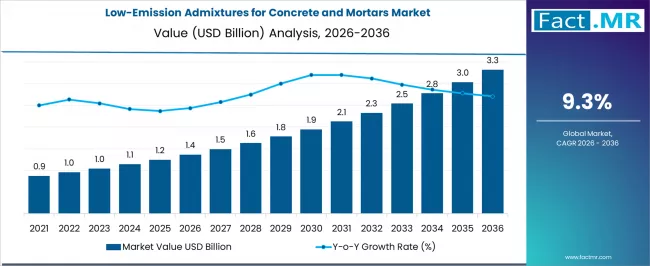
Low Emission Admixtures For Concrete And Mortars Market Market Value Analysis

Defining trends involve the comprehensive reformulation of concrete chemical additives to eliminate volatile organic compounds (VOCs), formaldehyde, and other hazardous air pollutants without compromising performance. Innovation is rapidly advancing in bio-based surfactants and biodegradable polymers that provide essential functions like air-entrainment and water reduction. Integration of these green admixtures with low-carbon cement blends and recycled aggregates is becoming critical for producing next-generation sustainable construction materials.

Regulatory frameworks, particularly indoor air quality standards (e.g., LEED, BREEAM, WELL) and chemical emission regulations (e.g., EU VOC Directive), are the primary market drivers. Policies promoting healthy buildings and protecting construction worker safety act as significant catalysts, positioning low-emission admixtures as mandatory for specification in modern residential, commercial, and public infrastructure projects.

Low-Emission Admixtures for Concrete and Mortars Market

Metric Value
Market Value (2026) USD 1.36 Billion
Market Forecast Value (2036) USD 3.32 Billion
Forecast CAGR (2026-2036) 9.3%

Category

Category Segments
Product Type Low-VOC solvent-free plasticizers & superplasticizers, Low-emission set accelerators, Bio-based & biodegradable air-entrainers & surfactants, Low-formaldehyde polymeric admixtures, Low-odor retarders & curing aids, Low-residual corrosion-inhibitor packages, Recycling-compatible, Proprietary eco-formulation blends
Application Precast & precast-finished products, Ready-mix concrete, Mortars & repair products, Self-consolidating & high-performance concrete, Masonry & block manufacture, Specialty
Performance Focus Low VOC Indoor Air Quality Compliance, Low Residuals, Regulatory & Green Building Compliance, Worker Safety, Recyclability
Region North America, Latin America, Western Europe, Eastern Europe, East Asia, South Asia & Pacific, MEA

Segmental Analysis

By Product Type, Which Additives are Central to Workability and Strength without Emissions?
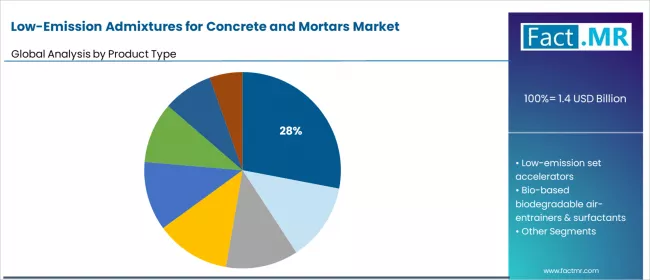
Low Emission Admixtures For Concrete And Mortars Market Analysis By Product Type

Low-VOC solvent-free plasticizers & superplasticizers lead the segment with a 28% share. This dominance is due to their critical role in reducing water content and enhancing workability, which are fundamental requirements for almost all modern concrete. Replacing traditional lignosulfonate or naphthalene-based products that contain solvents and impurities with high-purity, synthetic polymers eliminates a major source of VOCs and odors on-site and in finished buildings, directly addressing core indoor air quality concerns.

By Application, Which Sector Demands the Highest Finish Quality and Factory-Controlled Conditions?
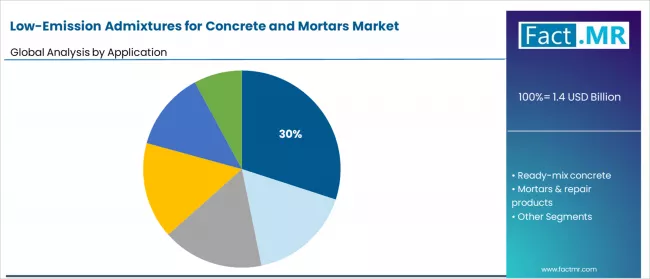
Low Emission Admixtures For Concrete And Mortars Market Analysis By Application

Precast & precast-finished products command the largest application share at 30%. Precast manufacturing occurs in enclosed factory settings where worker exposure to emissions is a significant concern, and the high-quality surface finish of products is sensitive to staining or discoloration from admixture residues. This sector has been an early and rigorous adopter of low-emission, low-staining admixtures to ensure worker safety, plant air quality, and product aesthetics.

By Performance Focus, What is the Most Stringent and Widespread Driver for Reformulation?
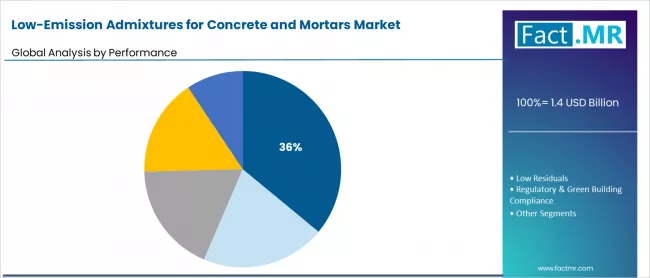
Low Emission Admixtures For Concrete And Mortars Market Analysis By Performance

Low VOC indoor air quality compliance represents the leading performance focus at 36.00%. This is driven by the proliferation of green building standards worldwide that set strict limits on VOC emissions from all building materials, including concrete admixtures that can off-gas during placement and curing. Compliance is non-negotiable for projects seeking certification and is increasingly a baseline specification to ensure healthy indoor environments in schools, hospitals, and residences.

What are the Drivers, Restraints, and Key Trends of the Low-Emission Admixtures for Concrete and Mortars Market?

Market growth is driven by the global enforcement of stringent indoor air quality (IAQ) regulations and the rise of green building certification systems. Increasing awareness of construction worker health and safety is pushing for safer site materials. The growing use of concrete in enclosed spaces and the trend towards faster project timelines (where off-gassing can be a critical path issue) further propel demand. Additionally, corporate sustainability commitments from construction firms and material suppliers are accelerating the shift.

A significant restraint is the perceived or real higher cost of advanced low-emission formulations compared to conventional admixtures. Performance parity, especially in extreme climates or with challenging mix designs, can require extensive re-engineering and testing. The fragmentation of the ready-mix and construction industry can slow the adoption of new specifications. Furthermore, a lack of universal global standards for "low-emission" can lead to market confusion and varying requirements.

Key trends include the development of "multi-functional" admixtures that combine plasticizing, air-entraining, and setting properties in a single low-emission product. There is strong R&D into admixtures derived from 100% bio-based or recycled feedstocks. The integration of admixture selection with digital mix design and lifecycle assessment tools is emerging. Furthermore, the focus is expanding beyond VOCs to include low residues that ensure compatibility with surface treatments and the recyclability of concrete at end-of-life.

Analysis of the Low-Emission Admixtures for Concrete and Mortars Market by Key Countries
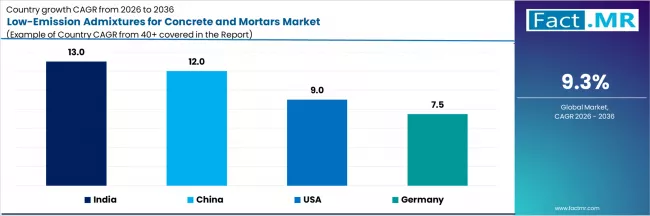
Low Emission Admixtures For Concrete And Mortars Market Cagr Analysis By Country

Country CAGR (2026-2036)
India 13.00%
China 12.00%
USA 9.00%
Germany 7.50%

How does India's Construction Boom and Emerging Green Building Focus Drive High Growth?

India leads with a 13.00% CAGR, fueled by an explosive construction sector and the rapid adoption of green building standards (e.g., IGBC, GRIHA) in major urban developments. Growing awareness of urban air pollution and indoor health is pushing regulators and developers to specify low-emission materials. The vast scale of ongoing infrastructure and residential projects creates immense volume potential for compliant admixtures, driving domestic production and innovation.

Why is China's Dual Carbon Policy and Massive Urbanization a Key Driver?

China's 12.00% growth is anchored in its "Dual Carbon" goals and the continuous development of mega-cities. National standards promoting "green building materials" and healthier living environments are mandating the reduction of chemical emissions from construction products. As the world's largest producer and consumer of concrete, the shift towards low-emission admixtures in China represents a monumental market transition, supported by a strong domestic chemical manufacturing base.

What Role does the USA's Mature Green Building Ecosystem and Regulatory Landscape Play?
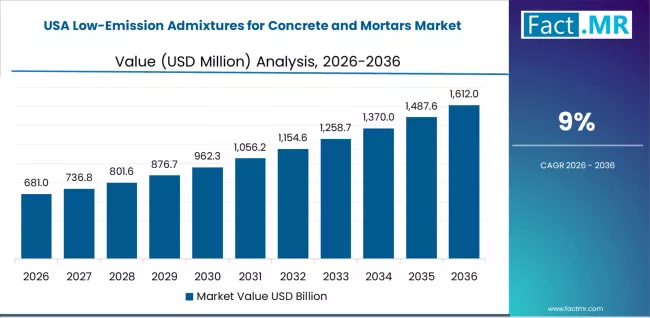
Low Emission Admixtures For Concrete And Mortars Market Country Value Analysis

The USA's 9.00% growth is underpinned by the world's most mature green building ecosystem, where LEED and other standards are widely mandated. Strict regulations like California's CARB rules for VOC content create compliance-driven demand. The high value placed on indoor environmental quality in commercial and residential construction, coupled with a focus on construction worker safety, makes low-emission admixtures a standard specification in high-value projects.

How does Germany's Engineering Precision and Stringent EU Regulations Influence the Market?

Germany's 7.50% growth reflects its engineering leadership and its central role in shaping stringent EU regulations on construction product emissions (CPR) and chemical safety (REACH). The German market demands admixtures that deliver extreme performance consistency while meeting the highest environmental and health standards. The strong focus on factory-based prefabrication (precast) also aligns perfectly with the need for controlled, low-emission production environments.

Competitive Landscape of the Low-Emission Admixtures for Concrete and Mortars Market
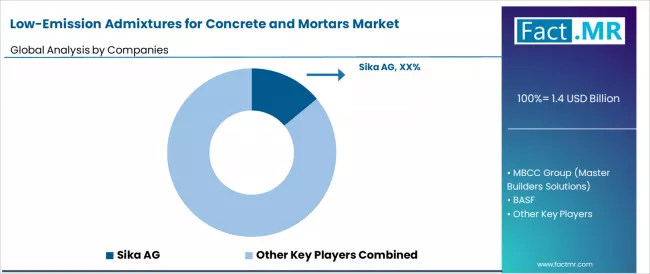
Low Emission Admixtures For Concrete And Mortars Market Analysis By Company

The competitive landscape is concentrated among global construction chemical specialists who are integrating sustainability into their core product development. Leaders like Sika AG, MBCC Group (Master Builders Solutions), and BASF compete by offering comprehensive portfolios of low-VOC, low-emission admixtures across all functional classes, backed by extensive R&D and global technical support networks.

Companies like Mapei, GCP Applied Technologies, and RPM compete with deep application expertise in specific segments like repair mortars or specialty concrete. Competition intensifies around securing approvals for green building certifications, providing verified environmental product declarations (EPDs), and forming strategic partnerships with leading green architects, specifiers, and ready-mix producers.

Key Players in the Low-Emission Admixtures for Concrete and Mortars Market

  • Sika AG
  • MBCC Group (Master Builders Solutions)
  • BASF
  • Mapei
  • GCP Applied Technologies
  • RPM

Scope of Report

Items Values
Quantitative Units USD Billion
Product Type Low-VOC plasticizers & superplasticizers, Low-emission accelerators, Bio-based air-entrainers, Low-formaldehyde polymers, Low-odor retarders/curing aids, Low-residual corrosion inhibitors, Recycling-compatible, Proprietary blends
Application Precast, Ready-mix, Mortars & repair, Self-consolidating concrete, Masonry/block, Specialty
Performance Focus Low VOC IAQ Compliance, Low Residuals, Regulatory Compliance, Worker Safety, Recyclability
Key Countries India, China, USA, Germany
Key Companies Sika AG, MBCC Group, BASF, Mapei, GCP Applied Technologies, RPM
Additional Analysis Analysis of VOC content testing, impact on concrete strength and durability, compatibility with supplementary cementitious materials, worker exposure level comparisons, and end-of-life concrete recyclability performance.

Low-Emission Admixtures for Concrete and Mortars Market by Segments

  • Product Type :

    • Low-VOC solvent-free plasticizers & superplasticizers
    • Low-emission set accelerators
    • Bio-based & biodegradable air-entrainers & surfactants
    • Low-formaldehyde polymeric admixtures
    • Low-odor retarders & curing aids
    • Low-residual corrosion-inhibitor packages
    • Recycling-compatible
    • Proprietary eco-formulation blends
  • Application :

    • Precast & precast-finished products
    • Ready-mix concrete
    • Mortars & repair products
    • Self-consolidating & high-performance concrete
    • Masonry & block manufacture
    • Specialty
  • Performance Focus :

    • Low VOC Indoor Air Quality Compliance
    • Low Residuals
    • Regulatory & Green Building Compliance
    • Worker Safety
    • Recyclability
  • Region :

    • North America

      • USA
      • Canada
    • Latin America

      • Brazil
      • Mexico
      • Rest of Latin America
    • Western Europe

      • Germany
      • France
      • UK
      • BENELUX
      • Rest of Western Europe
    • Eastern Europe

      • Poland
      • Russia
      • Czech Republic
      • Rest of Eastern Europe
    • East Asia

      • China
      • Japan
      • South Korea
      • Rest of East Asia
    • South Asia & Pacific

      • India
      • Australia
      • ASEAN
      • Rest of South Asia & Pacific
    • MEA

      • GCC Countries
      • South Africa
      • Rest of MEA

Table of Content

  1. Executive Summary
    • Global Market Outlook
    • Demand to side Trends
    • Supply to side Trends
    • Technology Roadmap Analysis
    • Analysis and Recommendations
  2. Market Overview
    • Market Coverage / Taxonomy
    • Market Definition / Scope / Limitations
  3. Market Background
    • Market Dynamics
      • Drivers
      • Restraints
      • Opportunity
      • Trends
    • Scenario Forecast
      • Demand in Optimistic Scenario
      • Demand in Likely Scenario
      • Demand in Conservative Scenario
    • Opportunity Map Analysis
    • Product Life Cycle Analysis
    • Supply Chain Analysis
    • Investment Feasibility Matrix
    • Value Chain Analysis
    • PESTLE and Porter’s Analysis
    • Regulatory Landscape
    • Regional Parent Market Outlook
    • Production and Consumption Statistics
    • Import and Export Statistics
  4. Global Market Analysis 2021 to 2025 and Forecast, 2026 to 2036
    • Historical Market Size Value (USD Million) Analysis, 2021 to 2025
    • Current and Future Market Size Value (USD Million) Projections, 2026 to 2036
      • Y to o to Y Growth Trend Analysis
      • Absolute $ Opportunity Analysis
  5. Global Market Pricing Analysis 2021 to 2025 and Forecast 2026 to 2036
  6. Global Market Analysis 2021 to 2025 and Forecast 2026 to 2036, By Product Type
    • Introduction / Key Findings
    • Historical Market Size Value (USD Million) Analysis By Product Type, 2021 to 2025
    • Current and Future Market Size Value (USD Million) Analysis and Forecast By Product Type, 2026 to 2036
      • Low-VOC solvent-free plasticizers & superplasticizers
      • Low-emission set accelerators
      • Bio-based biodegradable air-entrainers & surfactants
      • Low-formaldehyde polymeric admixtures
      • Low-odor retarders & curing aids
      • Low-residual corrosion-inhibitor packages
      • Recycling-compatible
      • Proprietary eco-formulation blends
    • Y to o to Y Growth Trend Analysis By Product Type, 2021 to 2025
    • Absolute $ Opportunity Analysis By Product Type, 2026 to 2036
  7. Global Market Analysis 2021 to 2025 and Forecast 2026 to 2036, By Application
    • Introduction / Key Findings
    • Historical Market Size Value (USD Million) Analysis By Application, 2021 to 2025
    • Current and Future Market Size Value (USD Million) Analysis and Forecast By Application, 2026 to 2036
      • Precast & precast-finished products
      • Ready-mix concrete
      • Mortars & repair products
      • Self-consolidating & high-performance concrete
      • Masonry & block manufacture
      • Specialty
    • Y to o to Y Growth Trend Analysis By Application, 2021 to 2025
    • Absolute $ Opportunity Analysis By Application, 2026 to 2036
  8. Global Market Analysis 2021 to 2025 and Forecast 2026 to 2036, By Performance
    • Introduction / Key Findings
    • Historical Market Size Value (USD Million) Analysis By Performance, 2021 to 2025
    • Current and Future Market Size Value (USD Million) Analysis and Forecast By Performance, 2026 to 2036
      • Low VOC Indoor Air Quality Compliance
      • Low Residuals
      • Regulatory & Green Building Compliance
      • Worker Safety
      • Recyclability
    • Y to o to Y Growth Trend Analysis By Performance, 2021 to 2025
    • Absolute $ Opportunity Analysis By Performance, 2026 to 2036
  9. Global Market Analysis 2021 to 2025 and Forecast 2026 to 2036, By Region
    • Introduction
    • Historical Market Size Value (USD Million) Analysis By Region, 2021 to 2025
    • Current Market Size Value (USD Million) Analysis and Forecast By Region, 2026 to 2036
      • North America
      • Latin America
      • Western Europe
      • Eastern Europe
      • East Asia
      • South Asia and Pacific
      • Middle East & Africa
    • Market Attractiveness Analysis By Region
  10. North America Market Analysis 2021 to 2025 and Forecast 2026 to 2036, By Country
    • Historical Market Size Value (USD Million) Trend Analysis By Market Taxonomy, 2021 to 2025
    • Market Size Value (USD Million) Forecast By Market Taxonomy, 2026 to 2036
      • By Country
        • USA
        • Canada
        • Mexico
      • By Product Type
      • By Application
      • By Performance
    • Market Attractiveness Analysis
      • By Country
      • By Product Type
      • By Application
      • By Performance
    • Key Takeaways
  11. Latin America Market Analysis 2021 to 2025 and Forecast 2026 to 2036, By Country
    • Historical Market Size Value (USD Million) Trend Analysis By Market Taxonomy, 2021 to 2025
    • Market Size Value (USD Million) Forecast By Market Taxonomy, 2026 to 2036
      • By Country
        • Brazil
        • Chile
        • Rest of Latin America
      • By Product Type
      • By Application
      • By Performance
    • Market Attractiveness Analysis
      • By Country
      • By Product Type
      • By Application
      • By Performance
    • Key Takeaways
  12. Western Europe Market Analysis 2021 to 2025 and Forecast 2026 to 2036, By Country
    • Historical Market Size Value (USD Million) Trend Analysis By Market Taxonomy, 2021 to 2025
    • Market Size Value (USD Million) Forecast By Market Taxonomy, 2026 to 2036
      • By Country
        • Germany
        • UK
        • Italy
        • Spain
        • France
        • Nordic
        • BENELUX
        • Rest of Western Europe
      • By Product Type
      • By Application
      • By Performance
    • Market Attractiveness Analysis
      • By Country
      • By Product Type
      • By Application
      • By Performance
    • Key Takeaways
  13. Eastern Europe Market Analysis 2021 to 2025 and Forecast 2026 to 2036, By Country
    • Historical Market Size Value (USD Million) Trend Analysis By Market Taxonomy, 2021 to 2025
    • Market Size Value (USD Million) Forecast By Market Taxonomy, 2026 to 2036
      • By Country
        • Russia
        • Poland
        • Hungary
        • Balkan & Baltic
        • Rest of Eastern Europe
      • By Product Type
      • By Application
      • By Performance
    • Market Attractiveness Analysis
      • By Country
      • By Product Type
      • By Application
      • By Performance
    • Key Takeaways
  14. East Asia Market Analysis 2021 to 2025 and Forecast 2026 to 2036, By Country
    • Historical Market Size Value (USD Million) Trend Analysis By Market Taxonomy, 2021 to 2025
    • Market Size Value (USD Million) Forecast By Market Taxonomy, 2026 to 2036
      • By Country
        • China
        • Japan
        • South Korea
      • By Product Type
      • By Application
      • By Performance
    • Market Attractiveness Analysis
      • By Country
      • By Product Type
      • By Application
      • By Performance
    • Key Takeaways
  15. South Asia and Pacific Market Analysis 2021 to 2025 and Forecast 2026 to 2036, By Country
    • Historical Market Size Value (USD Million) Trend Analysis By Market Taxonomy, 2021 to 2025
    • Market Size Value (USD Million) Forecast By Market Taxonomy, 2026 to 2036
      • By Country
        • India
        • ASEAN
        • Australia & New Zealand
        • Rest of South Asia and Pacific
      • By Product Type
      • By Application
      • By Performance
    • Market Attractiveness Analysis
      • By Country
      • By Product Type
      • By Application
      • By Performance
    • Key Takeaways
  16. Middle East & Africa Market Analysis 2021 to 2025 and Forecast 2026 to 2036, By Country
    • Historical Market Size Value (USD Million) Trend Analysis By Market Taxonomy, 2021 to 2025
    • Market Size Value (USD Million) Forecast By Market Taxonomy, 2026 to 2036
      • By Country
        • Kingdom of Saudi Arabia
        • Other GCC Countries
        • Turkiye
        • South Africa
        • Other African Union
        • Rest of Middle East & Africa
      • By Product Type
      • By Application
      • By Performance
    • Market Attractiveness Analysis
      • By Country
      • By Product Type
      • By Application
      • By Performance
    • Key Takeaways
  17. Key Countries Market Analysis
    • USA
      • Pricing Analysis
      • Market Share Analysis, 2025
        • By Product Type
        • By Application
        • By Performance
    • Canada
      • Pricing Analysis
      • Market Share Analysis, 2025
        • By Product Type
        • By Application
        • By Performance
    • Mexico
      • Pricing Analysis
      • Market Share Analysis, 2025
        • By Product Type
        • By Application
        • By Performance
    • Brazil
      • Pricing Analysis
      • Market Share Analysis, 2025
        • By Product Type
        • By Application
        • By Performance
    • Chile
      • Pricing Analysis
      • Market Share Analysis, 2025
        • By Product Type
        • By Application
        • By Performance
    • Germany
      • Pricing Analysis
      • Market Share Analysis, 2025
        • By Product Type
        • By Application
        • By Performance
    • UK
      • Pricing Analysis
      • Market Share Analysis, 2025
        • By Product Type
        • By Application
        • By Performance
    • Italy
      • Pricing Analysis
      • Market Share Analysis, 2025
        • By Product Type
        • By Application
        • By Performance
    • Spain
      • Pricing Analysis
      • Market Share Analysis, 2025
        • By Product Type
        • By Application
        • By Performance
    • France
      • Pricing Analysis
      • Market Share Analysis, 2025
        • By Product Type
        • By Application
        • By Performance
    • India
      • Pricing Analysis
      • Market Share Analysis, 2025
        • By Product Type
        • By Application
        • By Performance
    • ASEAN
      • Pricing Analysis
      • Market Share Analysis, 2025
        • By Product Type
        • By Application
        • By Performance
    • Australia & New Zealand
      • Pricing Analysis
      • Market Share Analysis, 2025
        • By Product Type
        • By Application
        • By Performance
    • China
      • Pricing Analysis
      • Market Share Analysis, 2025
        • By Product Type
        • By Application
        • By Performance
    • Japan
      • Pricing Analysis
      • Market Share Analysis, 2025
        • By Product Type
        • By Application
        • By Performance
    • South Korea
      • Pricing Analysis
      • Market Share Analysis, 2025
        • By Product Type
        • By Application
        • By Performance
    • Russia
      • Pricing Analysis
      • Market Share Analysis, 2025
        • By Product Type
        • By Application
        • By Performance
    • Poland
      • Pricing Analysis
      • Market Share Analysis, 2025
        • By Product Type
        • By Application
        • By Performance
    • Hungary
      • Pricing Analysis
      • Market Share Analysis, 2025
        • By Product Type
        • By Application
        • By Performance
    • Kingdom of Saudi Arabia
      • Pricing Analysis
      • Market Share Analysis, 2025
        • By Product Type
        • By Application
        • By Performance
    • Turkiye
      • Pricing Analysis
      • Market Share Analysis, 2025
        • By Product Type
        • By Application
        • By Performance
    • South Africa
      • Pricing Analysis
      • Market Share Analysis, 2025
        • By Product Type
        • By Application
        • By Performance
  18. Market Structure Analysis
    • Competition Dashboard
    • Competition Benchmarking
    • Market Share Analysis of Top Players
      • By Regional
      • By Product Type
      • By Application
      • By Performance
  19. Competition Analysis
    • Competition Deep Dive
      • Sika AG
        • Overview
        • Product Portfolio
        • Profitability by Market Segments (Product/Age /Sales Channel/Region)
        • Sales Footprint
        • Strategy Overview
          • Marketing Strategy
          • Product Strategy
          • Channel Strategy
      • MBCC Group (Master Builders Solutions)
      • BASF
      • Mapei
      • GCP Applied Technologies
      • RPM
  20. Assumptions & Acronyms Used
  21. Research Methodology

List Of Table

  • Table 1: Global Market Value (USD Million) Forecast by Region, 2021 to 2036
  • Table 2: Global Market Value (USD Million) Forecast by Product Type, 2021 to 2036
  • Table 3: Global Market Value (USD Million) Forecast by Application, 2021 to 2036
  • Table 4: Global Market Value (USD Million) Forecast by Performance, 2021 to 2036
  • Table 5: North America Market Value (USD Million) Forecast by Country, 2021 to 2036
  • Table 6: North America Market Value (USD Million) Forecast by Product Type, 2021 to 2036
  • Table 7: North America Market Value (USD Million) Forecast by Application, 2021 to 2036
  • Table 8: North America Market Value (USD Million) Forecast by Performance, 2021 to 2036
  • Table 9: Latin America Market Value (USD Million) Forecast by Country, 2021 to 2036
  • Table 10: Latin America Market Value (USD Million) Forecast by Product Type, 2021 to 2036
  • Table 11: Latin America Market Value (USD Million) Forecast by Application, 2021 to 2036
  • Table 12: Latin America Market Value (USD Million) Forecast by Performance, 2021 to 2036
  • Table 13: Western Europe Market Value (USD Million) Forecast by Country, 2021 to 2036
  • Table 14: Western Europe Market Value (USD Million) Forecast by Product Type, 2021 to 2036
  • Table 15: Western Europe Market Value (USD Million) Forecast by Application, 2021 to 2036
  • Table 16: Western Europe Market Value (USD Million) Forecast by Performance, 2021 to 2036
  • Table 17: Eastern Europe Market Value (USD Million) Forecast by Country, 2021 to 2036
  • Table 18: Eastern Europe Market Value (USD Million) Forecast by Product Type, 2021 to 2036
  • Table 19: Eastern Europe Market Value (USD Million) Forecast by Application, 2021 to 2036
  • Table 20: Eastern Europe Market Value (USD Million) Forecast by Performance, 2021 to 2036
  • Table 21: East Asia Market Value (USD Million) Forecast by Country, 2021 to 2036
  • Table 22: East Asia Market Value (USD Million) Forecast by Product Type, 2021 to 2036
  • Table 23: East Asia Market Value (USD Million) Forecast by Application, 2021 to 2036
  • Table 24: East Asia Market Value (USD Million) Forecast by Performance, 2021 to 2036
  • Table 25: South Asia and Pacific Market Value (USD Million) Forecast by Country, 2021 to 2036
  • Table 26: South Asia and Pacific Market Value (USD Million) Forecast by Product Type, 2021 to 2036
  • Table 27: South Asia and Pacific Market Value (USD Million) Forecast by Application, 2021 to 2036
  • Table 28: South Asia and Pacific Market Value (USD Million) Forecast by Performance, 2021 to 2036
  • Table 29: Middle East & Africa Market Value (USD Million) Forecast by Country, 2021 to 2036
  • Table 30: Middle East & Africa Market Value (USD Million) Forecast by Product Type, 2021 to 2036
  • Table 31: Middle East & Africa Market Value (USD Million) Forecast by Application, 2021 to 2036
  • Table 32: Middle East & Africa Market Value (USD Million) Forecast by Performance, 2021 to 2036

List Of Figures

  • Figure 1: Global Market Pricing Analysis
  • Figure 2: Global Market Value (USD Million) Forecast 2021 to 2036
  • Figure 3: Global Market Value Share and BPS Analysis by Product Type, 2026 and 2036
  • Figure 4: Global Market Y to o to Y Growth Comparison by Product Type, 2026 to 2036
  • Figure 5: Global Market Attractiveness Analysis by Product Type
  • Figure 6: Global Market Value Share and BPS Analysis by Application, 2026 and 2036
  • Figure 7: Global Market Y to o to Y Growth Comparison by Application, 2026 to 2036
  • Figure 8: Global Market Attractiveness Analysis by Application
  • Figure 9: Global Market Value Share and BPS Analysis by Performance, 2026 and 2036
  • Figure 10: Global Market Y to o to Y Growth Comparison by Performance, 2026 to 2036
  • Figure 11: Global Market Attractiveness Analysis by Performance
  • Figure 12: Global Market Value (USD Million) Share and BPS Analysis by Region, 2026 and 2036
  • Figure 13: Global Market Y to o to Y Growth Comparison by Region, 2026 to 2036
  • Figure 14: Global Market Attractiveness Analysis by Region
  • Figure 15: North America Market Incremental Dollar Opportunity, 2026 to 2036
  • Figure 16: Latin America Market Incremental Dollar Opportunity, 2026 to 2036
  • Figure 17: Western Europe Market Incremental Dollar Opportunity, 2026 to 2036
  • Figure 18: Eastern Europe Market Incremental Dollar Opportunity, 2026 to 2036
  • Figure 19: East Asia Market Incremental Dollar Opportunity, 2026 to 2036
  • Figure 20: South Asia and Pacific Market Incremental Dollar Opportunity, 2026 to 2036
  • Figure 21: Middle East & Africa Market Incremental Dollar Opportunity, 2026 to 2036
  • Figure 22: North America Market Value Share and BPS Analysis by Country, 2026 and 2036
  • Figure 23: North America Market Value Share and BPS Analysis by Product Type, 2026 and 2036
  • Figure 24: North America Market Y to o to Y Growth Comparison by Product Type, 2026 to 2036
  • Figure 25: North America Market Attractiveness Analysis by Product Type
  • Figure 26: North America Market Value Share and BPS Analysis by Application, 2026 and 2036
  • Figure 27: North America Market Y to o to Y Growth Comparison by Application, 2026 to 2036
  • Figure 28: North America Market Attractiveness Analysis by Application
  • Figure 29: North America Market Value Share and BPS Analysis by Performance, 2026 and 2036
  • Figure 30: North America Market Y to o to Y Growth Comparison by Performance, 2026 to 2036
  • Figure 31: North America Market Attractiveness Analysis by Performance
  • Figure 32: Latin America Market Value Share and BPS Analysis by Country, 2026 and 2036
  • Figure 33: Latin America Market Value Share and BPS Analysis by Product Type, 2026 and 2036
  • Figure 34: Latin America Market Y to o to Y Growth Comparison by Product Type, 2026 to 2036
  • Figure 35: Latin America Market Attractiveness Analysis by Product Type
  • Figure 36: Latin America Market Value Share and BPS Analysis by Application, 2026 and 2036
  • Figure 37: Latin America Market Y to o to Y Growth Comparison by Application, 2026 to 2036
  • Figure 38: Latin America Market Attractiveness Analysis by Application
  • Figure 39: Latin America Market Value Share and BPS Analysis by Performance, 2026 and 2036
  • Figure 40: Latin America Market Y to o to Y Growth Comparison by Performance, 2026 to 2036
  • Figure 41: Latin America Market Attractiveness Analysis by Performance
  • Figure 42: Western Europe Market Value Share and BPS Analysis by Country, 2026 and 2036
  • Figure 43: Western Europe Market Value Share and BPS Analysis by Product Type, 2026 and 2036
  • Figure 44: Western Europe Market Y to o to Y Growth Comparison by Product Type, 2026 to 2036
  • Figure 45: Western Europe Market Attractiveness Analysis by Product Type
  • Figure 46: Western Europe Market Value Share and BPS Analysis by Application, 2026 and 2036
  • Figure 47: Western Europe Market Y to o to Y Growth Comparison by Application, 2026 to 2036
  • Figure 48: Western Europe Market Attractiveness Analysis by Application
  • Figure 49: Western Europe Market Value Share and BPS Analysis by Performance, 2026 and 2036
  • Figure 50: Western Europe Market Y to o to Y Growth Comparison by Performance, 2026 to 2036
  • Figure 51: Western Europe Market Attractiveness Analysis by Performance
  • Figure 52: Eastern Europe Market Value Share and BPS Analysis by Country, 2026 and 2036
  • Figure 53: Eastern Europe Market Value Share and BPS Analysis by Product Type, 2026 and 2036
  • Figure 54: Eastern Europe Market Y to o to Y Growth Comparison by Product Type, 2026 to 2036
  • Figure 55: Eastern Europe Market Attractiveness Analysis by Product Type
  • Figure 56: Eastern Europe Market Value Share and BPS Analysis by Application, 2026 and 2036
  • Figure 57: Eastern Europe Market Y to o to Y Growth Comparison by Application, 2026 to 2036
  • Figure 58: Eastern Europe Market Attractiveness Analysis by Application
  • Figure 59: Eastern Europe Market Value Share and BPS Analysis by Performance, 2026 and 2036
  • Figure 60: Eastern Europe Market Y to o to Y Growth Comparison by Performance, 2026 to 2036
  • Figure 61: Eastern Europe Market Attractiveness Analysis by Performance
  • Figure 62: East Asia Market Value Share and BPS Analysis by Country, 2026 and 2036
  • Figure 63: East Asia Market Value Share and BPS Analysis by Product Type, 2026 and 2036
  • Figure 64: East Asia Market Y to o to Y Growth Comparison by Product Type, 2026 to 2036
  • Figure 65: East Asia Market Attractiveness Analysis by Product Type
  • Figure 66: East Asia Market Value Share and BPS Analysis by Application, 2026 and 2036
  • Figure 67: East Asia Market Y to o to Y Growth Comparison by Application, 2026 to 2036
  • Figure 68: East Asia Market Attractiveness Analysis by Application
  • Figure 69: East Asia Market Value Share and BPS Analysis by Performance, 2026 and 2036
  • Figure 70: East Asia Market Y to o to Y Growth Comparison by Performance, 2026 to 2036
  • Figure 71: East Asia Market Attractiveness Analysis by Performance
  • Figure 72: South Asia and Pacific Market Value Share and BPS Analysis by Country, 2026 and 2036
  • Figure 73: South Asia and Pacific Market Value Share and BPS Analysis by Product Type, 2026 and 2036
  • Figure 74: South Asia and Pacific Market Y to o to Y Growth Comparison by Product Type, 2026 to 2036
  • Figure 75: South Asia and Pacific Market Attractiveness Analysis by Product Type
  • Figure 76: South Asia and Pacific Market Value Share and BPS Analysis by Application, 2026 and 2036
  • Figure 77: South Asia and Pacific Market Y to o to Y Growth Comparison by Application, 2026 to 2036
  • Figure 78: South Asia and Pacific Market Attractiveness Analysis by Application
  • Figure 79: South Asia and Pacific Market Value Share and BPS Analysis by Performance, 2026 and 2036
  • Figure 80: South Asia and Pacific Market Y to o to Y Growth Comparison by Performance, 2026 to 2036
  • Figure 81: South Asia and Pacific Market Attractiveness Analysis by Performance
  • Figure 82: Middle East & Africa Market Value Share and BPS Analysis by Country, 2026 and 2036
  • Figure 83: Middle East & Africa Market Value Share and BPS Analysis by Product Type, 2026 and 2036
  • Figure 84: Middle East & Africa Market Y to o to Y Growth Comparison by Product Type, 2026 to 2036
  • Figure 85: Middle East & Africa Market Attractiveness Analysis by Product Type
  • Figure 86: Middle East & Africa Market Value Share and BPS Analysis by Application, 2026 and 2036
  • Figure 87: Middle East & Africa Market Y to o to Y Growth Comparison by Application, 2026 to 2036
  • Figure 88: Middle East & Africa Market Attractiveness Analysis by Application
  • Figure 89: Middle East & Africa Market Value Share and BPS Analysis by Performance, 2026 and 2036
  • Figure 90: Middle East & Africa Market Y to o to Y Growth Comparison by Performance, 2026 to 2036
  • Figure 91: Middle East & Africa Market Attractiveness Analysis by Performance
  • Figure 92: Global Market - Tier Structure Analysis
  • Figure 93: Global Market - Company Share Analysis

- FAQs -

How big is the low-emission admixtures for concrete and mortars market in 2026?

The global low-emission admixtures for concrete and mortars market is estimated to be valued at USD 1.4 billion in 2026.

What will be the size of low-emission admixtures for concrete and mortars market in 2036?

The market size for the low-emission admixtures for concrete and mortars market is projected to reach USD 3.3 billion by 2036.

How much will be the low-emission admixtures for concrete and mortars market growth between 2026 and 2036?

The low-emission admixtures for concrete and mortars market is expected to grow at a 9.3% CAGR between 2026 and 2036.

What are the key product types in the low-emission admixtures for concrete and mortars market?

The key product types in low-emission admixtures for concrete and mortars market are low-voc solvent-free plasticizers & superplasticizers, low-emission set accelerators , bio-based biodegradable air-entrainers & surfactants, low-formaldehyde polymeric admixtures, low-odor retarders & curing aids, low-residual corrosion-inhibitor packages, recycling-compatible and proprietary eco-formulation blends.

Which application segment to contribute significant share in the low-emission admixtures for concrete and mortars market in 2026?

In terms of application, precast & precast-finished products segment to command 30.0% share in the low-emission admixtures for concrete and mortars market in 2026.

Low-Emission Admixtures for Concrete and Mortars Market