- Market Value (2025): USD 230.8 Mn
- Estimated Value (2026): USD 261.0 Mn
- Forecast Value (2036): USD 893.1 Mn
- CAGR (2026-2036): 13.1%
What is the Consumer EEG Headbands Market forecast to be worth by 2036?
USD 261.0 million in 2026 to USD 893.1 million by 2036 at a 13.1% CAGR.
- Consumer EEG headband sales totalled USD 230.8 million in 2025, with meditation and sleep headbands accounting for most first purchases.
- Revenue will expand from USD 261.0 million in 2026 to USD 893.1 million by 2036 as EEG sensing spreads from headbands into earbuds and headphones.
- A 13.1% CAGR through 2036 reflects a small installed base meeting wider app ecosystems, subscription revenue and clearer rules for neural data.
| Year | Basis | Market Value (USD million) |
|---|---|---|
| 2025 | Actual | 230.8 |
| 2026 | Estimate | 261.0 |
| 2036 | Forecast | 893.1 |
| CAGR 2026 to 2036 | Forecast period | 13.1% |
Source: Fact.MR analysis. Updated Nov 12, 2026
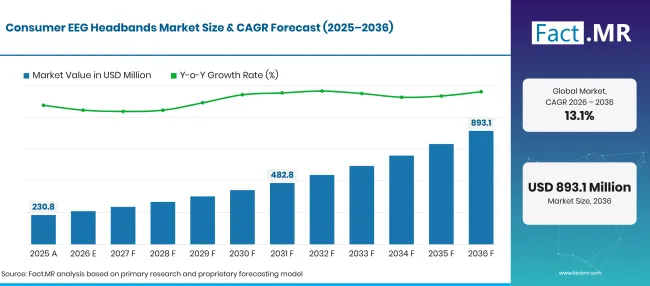
Consumer Eeg Headbands Market Forecast Global | Source: Fact.MR
What are the defining numbers behind Consumer EEG Headbands Market growth?
The 2026 to 2036 period adds USD 632.1 million in new value, led by dry-electrode headbands sold for home wellness use.
- Demand Drivers in the Market
- Public attention on brain data is building trust frameworks that consumer brands can work within. UNESCO member states adopted the first global framework on neurotechnology ethics in November 2025, and the text names connected headbands and headphones that collect neural data to track stress or sleep.
- National industrial policy is pulling brain-computer interface products toward everyday use. China set a goal in August 2025 to reach key BCI breakthroughs by 2027 and to speed adoption in health care, manufacturing and consumption, with two to three globally influential firms targeted by 2030.
- EEG is moving into products people already wear for hours each day. Neurable opened orders for Neurable One in October 2026, a pair of noise-cancelling headphones with 12 EEG sensors woven into the ear pads and US shipping scheduled for November. Hiding sensors inside familiar hardware lowers the social barrier that has kept many buyers away from visible headbands.
- Buyers now expect honest explanations of what the readings mean. EMOTIV describes its attention, stress and relaxation outputs as company-defined metrics that reflect patterns within a task, and states that wearing a device does not by itself improve focus. Brands that publish these limits will earn repeat use from customers who might otherwise abandon the app after a few weeks.
- Key Segments Analyzed
- By EEG Electrode Architecture: Dry-Contact Electrodes will hold 32.2% of 2026 value, since users can put the band on in seconds with no gel or saline to prepare.
- By Device Form Factor: Head / Body Wearable will capture 26.5% of 2026 revenue, helped by headbands that fit sleep, meditation and desk work alike.
- By Data Processing: On-Device Algorithm will account for 24.8% of 2026 sales, as local signal handling gives instant feedback even when a phone connection drops.
- By Sales Channel: Pharmacy / Wellness Retail will take 27.7% in 2026, where shoppers meet EEG headbands next to sleep aids and relaxation products.
- Analyst Opinion at Fact.MR
- Shambhu Nath Jha, Principal Consultant at Fact.MR, states, “Consumer EEG has a credibility problem as much as a hardware problem, and the brands that explain what a focus score can and cannot show will keep their users longest. Dry sensors and headphone-style designs will widen the buyer pool well beyond meditation enthusiasts. Neural data rules now forming in the United States, China and through UNESCO will reward suppliers that build consent and local processing into the product from day one.”
- Strategic Implications
- Device manufacturers should invest in electrode fit across head shapes and hair types, because a poor contact on the first night is the main reason a headband ends up in a drawer.
- App developers should present brainwave results as trends tied to a session, and keep any wording that suggests diagnosis of attention or mood disorders out of the interface.
- Retailers should train store staff to separate meditation headbands from clinical EEG equipment, so shoppers buy for realistic goals and return rates stay low.
- Institutional buyers in research and education should check raw data access, channel count and software licensing terms before placing bulk orders for classrooms or labs.
Country growth spreads across 3.5 percentage points. South Korea leads at 16.0%, only 0.4 points ahead of China at 15.6%, as both pair dense mobile use with public BCI programs. The United States follows at 15.5%, a mere 0.1 point behind China, since its brand-direct online channel and gaming crossovers offset a smaller policy push. A wider 1.7-point step separates the US from Japan at 13.8%, where older buyers and a sleep-focused use case slow first purchases. Germany closes the range at 12.5%, 1.3 points lower, given that buyers there tend to wait for proof of benefit before paying for wellness devices.
How does the Consumer EEG Headbands Market break down by segment?
Dry-Contact Electrodes will lead EEG Electrode Architecture at 32.2%; Head / Body Wearable will head Device Form Factor at 26.5%; On-Device Algorithm will top Data Processing at 24.8%; Pharmacy / Wellness Retail will lead Sales Channel at 27.7% in 2026.
Which EEG Electrode Architecture leads?
Dry-Contact Electrodes hold 32.2% of 2026 sales.
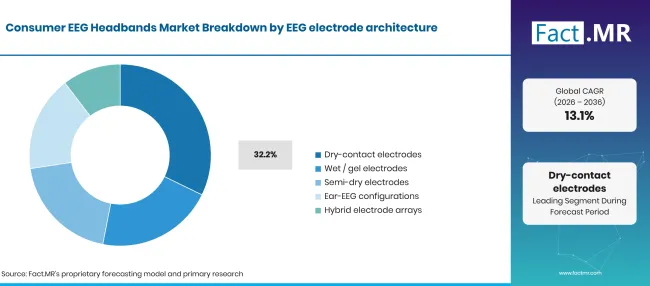
Consumer Eeg Headbands Market Breakdown Eeg Electrode Architecture | Source: Fact.MR
| EEG Electrode Architecture | Share (2026) |
|---|---|
| Dry-Contact Electrodes (Leading segment) | 32.2% |
| Other segments combined | 67.8%* |
| Total | 100.0% |
Source: Fact.MR analysis. Updated Nov 12, 2026
Home users rarely tolerate a setup routine before a ten-minute meditation, and that habit favors sensors that work straight out of the case. EMOTIV states that its EPOC X PRO sets up in a few minutes with no saline to prepare, while its sockets still accept saline felt pads when a study protocol calls for them. Suppliers of disposable EEG electrodes feel the gap here, since consumer bands avoid consumables entirely. Wet and gel electrodes keep a place in research kits where signal quality outranks convenience. Semi-dry designs fall between the two, and EMOTIV notes that dry and semi-dry sensors reduce setup for repeated use. Ear-EEG configurations and hybrid arrays target people who will not wear a visible band in public, so they will gain share as earbuds and headphones carry more sensors.
What leads the Device Form Factor segment?
Head / Body Wearable captures 26.5% of 2026 revenue.
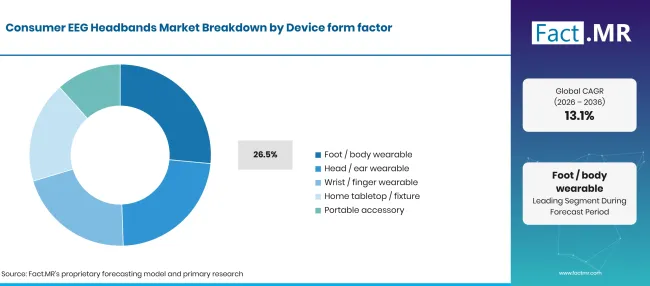
Consumer Eeg Headbands Market Breakdown Device Form Factor | Source: Fact.MR
| Device Form Factor | Share (2026) |
|---|---|
| Head / Body Wearable (Leading segment) | 26.5% |
| Other segments combined | 73.5%* |
| Total | 100.0% |
Source: Fact.MR analysis. Updated Nov 12, 2026
A soft band across the forehead suits lying down, sitting still and short work breaks, which covers most consumer EEG sessions today. Headbands also give stable electrode pressure without the bulk of a cap, and many models add heart rate or motion sensors that feed the same app. Sleep users who already track rest with actigraphy and PSG devices see a forehead band as a natural next step. Head and ear wearables, including EEG headphones and earbuds, form the challenger group as audio brands add brain sensing to hardware people already use daily. Wrist and finger devices contribute motion and heart data that apps combine with EEG readings.
How does Data Processing shape demand?
On-Device Algorithm takes 24.8% of 2026 value.
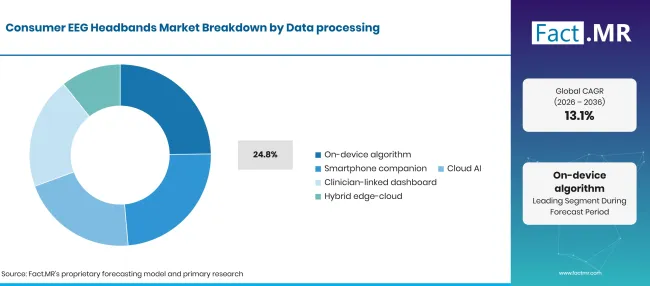
Consumer Eeg Headbands Market Breakdown Data Processing | Source: Fact.MR
| Data Processing | Share (2026) |
|---|---|
| On-Device Algorithm (Leading segment) | 24.8% |
| Other segments combined | 75.2%* |
| Total | 100.0% |
Source: Fact.MR analysis. Updated Nov 12, 2026
Instant feedback is the core of neurofeedback, and a delay of a few seconds breaks the training loop. Processing on the band or earbud keeps that loop tight and limits how much raw neural data leaves the device. EMOTIV explains that its cognitive metrics are estimated by software from task-bound brain activity patterns, which places weight on the quality of the embedded algorithm. Smartphone companion apps carry guided sessions, history charts and subscription content, much like mindfulness meditation apps that many users already pay for. Cloud AI services support longer-term pattern analysis, while clinician-linked dashboards serve supervised wellness programs.
Which Sales Channel shows the most pull?
Pharmacy / Wellness Retail represents 27.7% of 2026 spending.
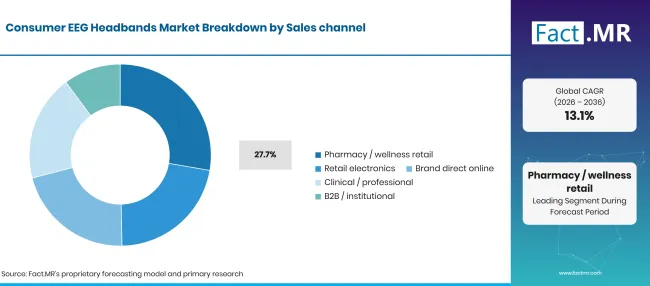
Consumer Eeg Headbands Market Breakdown Sales Channel | Source: Fact.MR
| Sales Channel | Share (2026) |
|---|---|
| Pharmacy / Wellness Retail (Leading segment) | 27.7% |
| Other segments combined | 72.3%* |
| Total | 100.0% |
Source: Fact.MR analysis. Updated Nov 12, 2026
Shoppers looking for better sleep or less stress often start in a pharmacy or wellness store, where a headband shares shelf space with supplements and white-noise machines. Retail electronics chains reach buyers comparing headbands with smartwatches and headphones. Brand-direct online stores let makers bundle hardware with app memberships and explain features in detail. Clinical and professional channels serve therapists and coaches, and B2B or institutional orders supply universities and corporate wellness programs that buy in volume.
What is accelerating Consumer EEG Headbands Market adoption, and what is holding it back?
Cheaper dry sensors, EEG built into headphones and growing interest in sleep and focus tracking will keep pulling new buyers into the category. Noisy signals, inconsistent electrode contact and thin evidence for lasting neurofeedback benefits still cause many users to stop after the first month.
Drivers Impact Analysis
| DRIVER | (~) % IMPACT ON CAGR | GEOGRAPHIC RELEVANCE | IMPACT TIMELINE |
|---|---|---|---|
| Rising interest in brainwave-based wellness tracking | +1.1% | North America, East Asia | Medium term (2-4 years) |
| Wider use of consumer wearables | +0.9% | Global | Short term (<=2 years) |
| Demand for home-based neurofeedback tools | +0.8% | North America, Western Europe | Medium term (2-4 years) |
| Improvements in dry-electrode design | +0.7% | Global | Long term (>=4 years) |
Source: Fact.MR analysis. Updated Nov 12, 2026
Opportunity Impact Analysis
| OPPORTUNITY | (~) % IMPACT ON CAGR | GEOGRAPHIC RELEVANCE | IMPACT TIMELINE |
|---|---|---|---|
| Personalized neurofeedback programs | +0.9% | North America, East Asia | Medium term (2-4 years) |
| Sleep and relaxation monitoring applications | +0.8% | Global | Medium term (2-4 years) |
| Institutional research and training programs | +0.7% | North America, Western Europe | Long term (>=4 years) |
| EEG sensors built into headphones and earbuds | +0.6% | Global | Medium term (2-4 years) |
Source: Fact.MR analysis. Updated Nov 12, 2026
Restraints Impact Analysis
| RESTRAINT | (~) % IMPACT ON CAGR | GEOGRAPHIC RELEVANCE | IMPACT TIMELINE |
|---|---|---|---|
| Signal noise and inconsistent electrode contact | -0.9% | Global | Short term (<=2 years) |
| Limited evidence for consumer neurofeedback outcomes | -0.8% | Global | Medium term (2-4 years) |
| High product and subscription costs | -0.6% | Global | Short term (<=2 years) |
| Consumer concerns about brain-data privacy | -0.5% | North America, Western Europe, East Asia | Medium term (2-4 years) |
Source: Fact.MR analysis. Updated Nov 12, 2026
Which countries are scaling the Consumer EEG Headbands Market through 2036?
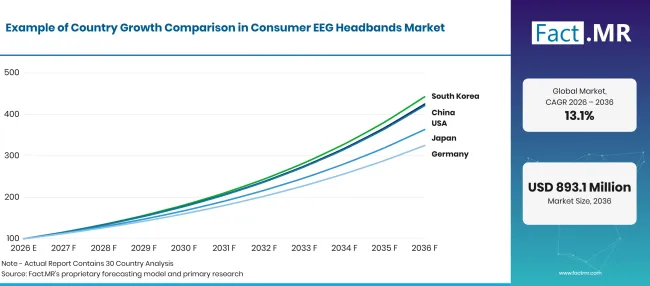
Consumer Eeg Headbands Market Growth Index | Source: Fact.MR
| Country | CAGR (2026 to 2036) |
|---|---|
| South Korea | 16.0% |
| China | 15.6% |
| United States | 15.5% |
| Japan | 13.8% |
| Germany | 12.5% |
Source: Fact.MR analysis. Updated Nov 12, 2026
What supports South Korea’s adoption?
16.0% CAGR, helped by heavy mobile use and a public research base in brain science.
South Korean consumers adopt connected gadgets early, and local electronics groups already ship earbuds and smartwatches with health sensors. Public research institutes and university hospitals run BCI programs that feed engineering talent into startups. EEG headband brands will find a receptive audience among students and office workers who use focus apps once Korean-language coaching content is ready at launch.
How is China developing demand?
15.6% CAGR, driven by digital spending and state backing for BCI products.
China’s online shoppers spent 9.37 trillion yuan on digital consumption in the first half of 2025, equal to 46.5% of household consumer spending, and nearly four in ten internet users bought smart appliances, digital devices or wearables in that period. Domestic BCI targets for 2027 add policy support for consumer pilots. Local brands with ecommerce reach and low-cost dry sensors will set price points that foreign suppliers must match.
What is supporting United States adoption?
15.5% CAGR, reflecting a wellness-friendly device policy and an active neurotech startup base.
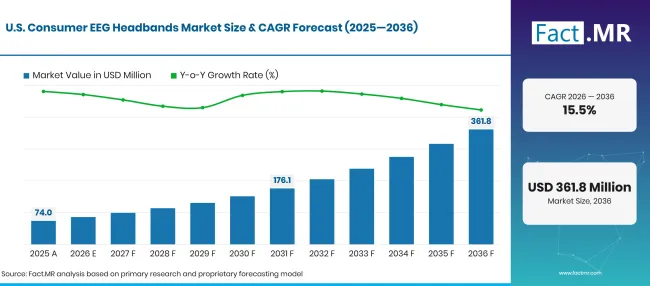
Consumer Eeg Headbands Market Forecast Usa | Source: Fact.MR
The FDA issued an updated version of its general wellness policy for low-risk devices on January 6, 2026, covering products that promote a healthy lifestyle. That guidance gives headband makers a route to market without device clearance when claims stay within wellness. Federal lawmakers also introduced the MIND Act on September 29, 2025, which would direct the FTC to study neural data and report within one year.
How is Japan building demand?
13.8% CAGR, shaped by near-universal smartphone access and strong interest in sleep quality.
Smartphones are present in 91.8% of Japanese households, according to the Ministry of Internal Affairs and Communications survey released on May 29, 2026. This gives every headband a ready companion screen. Japanese buyers favor quiet, compact designs, so ear-EEG formats and soft sleep bands will sell better than visible headsets.
What supports Germany’s adoption?
12.5% CAGR, as reimbursed digital health apps build trust in evidence-backed tools.
Germany’s digital health application program marked five years in December 2025, with the Federal Ministry of Health citing a growing number of listed apps and prescriptions and a BfArM fast-track review of at most three months. That system teaches German consumers to expect proof before they pay. EEG headband brands that publish validation data and keep data processing inside the EU will convert cautious buyers faster than those relying on lifestyle marketing.
Who leads the Consumer EEG Headbands Market?
Competition splits into three groups. Wellness specialists such as InteraXon, with its Muse headbands, and Elemind, whose sleep headband reads EEG and responds with timed sound, compete on comfort, sleep content and app subscriptions.
Audio-led entrants form the second group: Neurable launched Neurable One headphones with 12 ear-pad EEG sensors in October 2026, and in January 2026 it announced a gaming headset with built-in neurotechnology developed with HyperX. Research-grade suppliers, namely EMOTIV, OpenBCI and NeuroSky, win on raw data access, channel count and developer tools; EMOTIV’s dry-sensor EPOC X PRO shows how this group is cutting setup time to reach semi-professional users. The supplier that pairs reliable dry contact with transparent neural data handling will hold the strongest position as rules tighten in the United States and Asia.
Which companies are the key providers?
Key companies in the Consumer EEG Headbands Market include InteraXon (Muse), EMOTIV, Neurable, NeuroSky, OpenBCI and Elemind Technologies.
- InteraXon (Muse)
- EMOTIV
- Neurable
- NeuroSky
- OpenBCI
- Elemind Technologies
Bibliography
- Bundesministerium für Gesundheit. (2025, December 15). 5 Jahre DiGA.
- EMOTIV. (2026, February 9). Best Neurofeedback Headsets for Home Training and Research.
- EMOTIV. (2026, August 26). Wearables for Focus and Attention: What Can They Actually Measure?.
- EMOTIV. (2026, October 23). EPOC X PRO vs Other Dry Sensor EEG Systems.
- Ministry of Internal Affairs and Communications, Japan. (2026, May 29). Results of the 2025 Communications Usage Trend Survey.
- Neurable. (2026, January 5). Neurable Introduces Neurotechnology-Powered Gaming Wearable Headset With HyperX.
- Neurable. (2026, October 1). Neurable One Is Here: The Headphones I’ve Wanted to Build for 10 Years.
- The State Council of the People’s Republic of China. (2025, August 7). China aims to achieve breakthroughs in brain-computer interface technology by 2027.
- The State Council of the People’s Republic of China. (2025, December 17). China’s digital consumption accounts for nearly half of household spending in H1: report.
- U.S. Congress. (2025, September 29). S.2925: Management of Individuals’ Neural Data Act of 2025.
- U.S. Food and Drug Administration. (2026, January 6). General Wellness: Policy for Low Risk Devices.
- UK National Commission for UNESCO. (2025, November 18). UNESCO Adopts First Global Framework on Neurotechnology Ethics.
This Report Answers
- How large the consumer EEG headband category will grow between 2026 and 2036.
- Why dry-contact sensors hold the lead in electrode design.
- Which form factors, processing models and sales channels carry the most revenue today.
- How growth in South Korea, China, the United States, Japan and Germany differs.
- Where wellness brands, audio entrants and research-grade suppliers compete.
- What neural data rules from UNESCO, US lawmakers and Chinese ministries mean for product design and marketing claims.
What does the Consumer EEG Headbands Market cover?
This study tracks revenue from consumer EEG headbands and closely related head-worn EEG wearables, such as EEG earbuds and EEG headphones, that are sold for personal wellness, focus or sleep use. Values reflect manufacturer selling prices for the hardware, with bundled app memberships counted when sold together with the device.
Clinical monitoring systems belong to adjacent studies on brain monitoring devices, while implanted and medical-grade interfaces are tracked under brain computer interface systems.
What is included in the scope?
Consumer EEG headbands, sleep bands and meditation headsets with dry, wet, semi-dry or hybrid electrodes.
EEG earbuds and headphones that record brain activity for wellness, focus or gaming feedback.
Companion apps and data processing models bundled with the device, including on-device, phone, cloud and hybrid processing.
Research and developer kits sold to universities, schools and corporate wellness programs for non-clinical use.
What is excluded from the scope?
Hospital and clinical EEG systems used for diagnosing epilepsy, sleep disorders or other neurological conditions.
Implanted neural devices and medical-grade wireless neural interfaces.
Standalone brain-computer interface software sold without EEG hardware.
Neurostimulation devices and wearables that track only movement, heart rate or other non-EEG signals.
How Was the Analysis Built?
The analysis draws on 120+ sources, 35+ company portfolios, 25+ countries, and more than 20 industry interviews.
- Primary Research: Primary research includes discussions with manufacturers, service providers, technology developers, distributors, end users, and subject-matter experts. These conversations examine purchasing priorities, product adoption, operational challenges, approval requirements, competitive positioning, and the factors that influence wider market acceptance.
- Desk Research: Desk research covers government statistics, regulatory publications, company filings, trade data, technical studies, industry associations, standards, public policy, and other authoritative sources. Every source used in the analysis is documented in the bibliography.
- Market Sizing and Forecasting: Market estimates combine historical performance, demand indicators, pricing and volume trends, segment shares, company participation, country-level growth, adoption patterns, investment activity, and barriers to market expansion.
- Data Validation and Update Cycle: Findings are validated by comparing primary interviews with public data, company activity, regulatory changes, trade patterns, and industry developments. Regular updates review new product launches, capacity changes, partnerships, approvals, and shifts in commercial adoption.
Segmentation
What is the report’s scope and coverage?
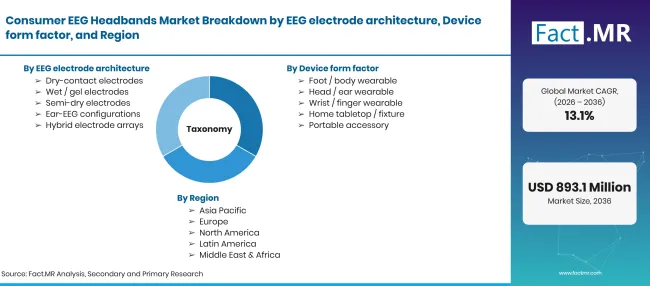
Consumer Eeg Headbands Market Taxonomy | Source: Fact.MR
| Attribute | Details |
|---|---|
| Quantitative Units | USD million |
| Market Definition | Non-invasive consumer EEG wearables that record electrical brain activity through headbands, earbuds or headphones for meditation, sleep, focus training and neurofeedback outside clinical diagnosis. |
| EEG Electrode Architecture | Dry-Contact Electrodes; Wet / Gel Electrodes; Semi-Dry Electrodes; Ear-EEG Configurations; Hybrid Electrode Arrays |
| Device Form Factor | Head / Body Wearable; Head / Ear Wearable; Wrist / Finger Wearable; Home Tabletop / Fixture; Portable Accessory |
| Data Processing | On-Device Algorithm; Smartphone Companion; Cloud AI; Clinician-Linked Dashboard; Hybrid Edge-Cloud |
| Sales Channel | Pharmacy / Wellness Retail; Retail Electronics; Brand Direct Online; Clinical / Professional; B2B / Institutional |
| Regions Covered | North America; Latin America; Western Europe; Eastern Europe; East Asia; South Asia & Pacific; Middle East & Africa |
| Countries Covered | South Korea; China; United States; Japan; Germany |
| Companies Profiled | InteraXon (Muse); EMOTIV; Neurable; NeuroSky; OpenBCI; Elemind Technologies |
| Forecast Period | 2026 to 2036 |
| Approach | Device shipment and price tracking by form factor, cross-checked with app subscription models, company product pages and national digital usage statistics. |
Source: Fact.MR analysis. Updated Nov 12, 2026
How is the market segmented?
-
By EEG Electrode Architecture
- Dry-Contact Electrodes
- Wet / Gel Electrodes
- Semi-Dry Electrodes
- Ear-EEG Configurations
- Hybrid Electrode Arrays
-
By Device Form Factor
- Head / Body Wearable
- Head / Ear Wearable
- Wrist / Finger Wearable
- Home Tabletop / Fixture
- Portable Accessory
-
By Data Processing
- On-Device Algorithm
- Smartphone Companion
- Cloud AI
- Clinician-Linked Dashboard
- Hybrid Edge-Cloud
-
By Sales Channel
- Pharmacy / Wellness Retail
- Retail Electronics
- Brand Direct Online
- Clinical / Professional
- B2B / Institutional
-
By Region
- North America
- Latin America
- Western Europe
- Eastern Europe
- East Asia
- South Asia & Pacific
- Middle East & Africa
Frequently Asked Questions
How large is the consumer EEG headbands market in 2026?
What growth rate will the consumer EEG headbands market record?
Which EEG electrode architecture leads?
Which device form factor leads?
Which data processing model leads?
Which sales channel leads?
Which country will grow quickest?
Who are the main companies?
What holds the market back?
Who worked on this report


Preview the report firsthand - request a free sample
Free SampleGet the brochure for pricing and purchase details
Download PDF