- Base Value(2025): 8203 Mn
- Forecast Value (2035): 25477.3 Mn
- CAGR (2035): 12.6%
Neurostim Pain Devices Market Outlook 2025 to 2035
Global neurostim pain devices market is expected to reach USD 25,477.3 million by 2035, up from USD 8,203 million in 2025. During the forecast period 2025 to 2035, the industry is projected to expand at a CAGR of 12.0%.
The global neurostim pain devices market is becoming increasingly popular due to the increasing cases of chronic pains and neurological disorders, as people are becoming more and more interested in the use of effective non-drug alternatives such spinal cord and peripheral nerve stimulators. Added innovations such as rechargeable implants, closed loop systems, and minimally invasive devices improve the precision of treatment, personalization and comfort of the patient, improving adoption.
Quick Stats for Neurostim Pain Devices Market
- Industry Value (2025): USD 8,203 Million
- Projected Value (2035): USD 25,477.3 Million
- Forecast CAGR (2025 to 2035): 12.0%
- Leading Segment (2025): Spinal Cord Stimulators (52.5% Market Share)
- Fastest Growing Country (2025-2035): Japan (12.3% CAGR)
- Top Key Players: Abbott, Medtronic, Boston Scientific, Neuronetics, Bayer AG, and Nalu Medical
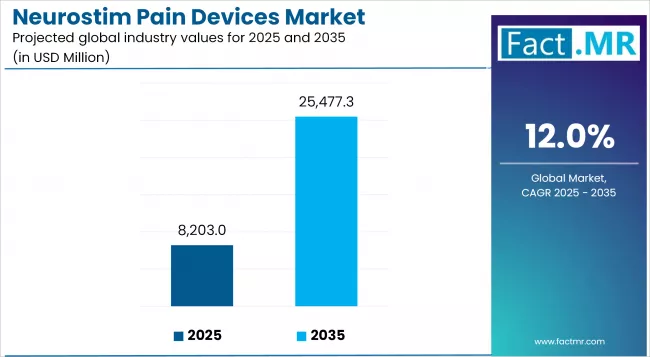
Neurostim Pain Devices Market Industry Value Analysis | Source: Fact.MR
What are the drivers of the neurostim pain devices market?
The increasing numbers of chronic pain and neurological disorders are a primary force in the neurostimulation devices market. Given that patients are looking to avoid long-term use of medication, primarily opioids, implants such as the spinal cord stimulators and peripheral nerve stimulators are becoming more common. This increased need to have effective and non-drug therapies is driving the growth of markets worldwide.
Neurostimulation devices have also led to great growth of the market due to technological developments. This is improved through innovations like rechargeable implants, closed-loop systems, and minimally invasive devices to improve the treatment and comfort of patients. The ongoing advances in accuracy and customization of treatment are bringing on board new healthcare providers and patients.
Positive regulatory environments and reimbursement are favoring the use of neuro stimulation devices. The barriers to entry are lowered by approvals of major health authorities and insurance cover towards such therapies. This stimulates the investment of young neuromodulation technologies by hospitals and clinics, which leads to even more development of the market.
What are the regional trends of the neurostim pain devices market?
The market of neurostimulation devices is concentrated in North America because of the well-developed healthcare system and the level of embracing new medical technologies. The US, specifically, has the first position because of the high availability of the key manufacturers and good reimbursement policies.
Europe has a great portion, and Germany, the UK, and France are the most adopted. The primary growth drivers are increasing chronic pain and neurological illnesses, as well as well-developed healthcare systems.
The Asian-Pacific is the region with the most rapid rates of development, as more and more people are investing in healthcare and are becoming more aware of the possibilities of managing pain. Asia (Japan, China, and India) is rapidly developing the market of neurostimulation devices.
Latin America is moderately growing, with the increased access to health care and slow pace of integration of new medical technologies. The major players in this region are Brazil and Mexico.
The Middle East & Africa region has an emerging potential that is backed by growing healthcare infrastructure and governmental efforts to enhance access to advanced therapy. The rate of growth is low but stable in the other regions.
What are the challenges and restraining factors of the neurostim pain devices market?
The expensive prices of the neurostimulation equipment is a key obstacle to the market growth. The equipment and the process of implantation is very expensive and therefore sometimes may be an obstacle to the patient and the health care giver. This is quite restrictive in emerging markets where affordability of the same is a very important issue.
Another challenge posed to the mass adoption is the technical complexity of the devices in neurostimulation. These demands a great level of skilled medical personnel that cannot always be counted on to properly implant, to calibrate, and to follow up. Lack of knowledge might reduce the rate of adoption and also limit access to these treatments.
High regulatory conditions serve as a major limitation to market expansions. The process of getting approvals of health authorities is lengthy and expensive and puts off introduction of new devices. This raises costs of development amongst producers and may hamper the growth of the market overall.
Country-Wise Insights
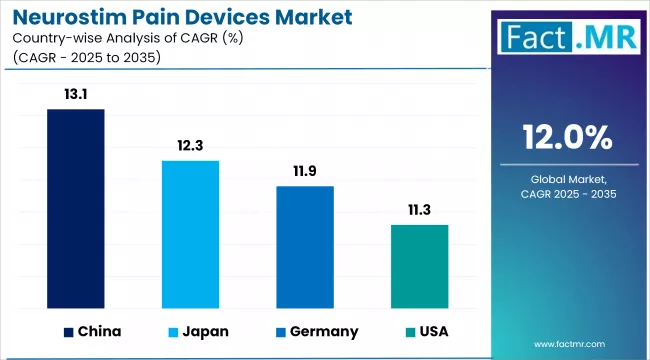
Neurostim Pain Devices Market Cagr Analysis By Country | Source: Fact.MR
Advanced healthcare infrastructure and rising chronic pain prevalence drive the USA’s neurostimulation devices market
The USA is experiencing a stable trend of neurostimulation devices due to high expenditures on health, the broad presence of specialized healthcare institutions, and the high rate of neuro modulation technologies. The rising cases of chronic pain, neurological, and opioid substitutes are contributing to the need of spinal cord stimulators, deep brain stimulators, and peripheral nerve stimulators.
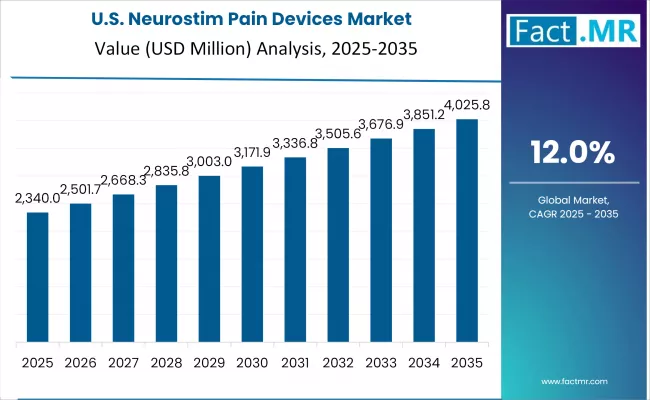
Neurostim Pain Devices Market Country Value Analysis | Source: Fact.MR
Patient convenience and precision of treatments are improved with integration with smart device monitoring, AI-assisted programming and telemedicine follow-ups. Positive government regulations, attractive reimbursement systems, and ongoing investment by the major medical devices firms make the adoption process accelerated making the USA a world leader in the development of neurostimulation devices.
Strong healthcare system and technological adoption drive Germany’s neurostimulation devices market
The developed healthcare system of Germany and the high health spending are the factors which contribute to the stable development of the neurostimulation devices market. The increasing number of chronic pain and neurological conditions in the aging population supports the demand of the spinal cord stimulators, deep brain stimulators, and peripheral nerve stimulators. The high-tech hospitals and clinics are embracing minimally invasive surgery, programmable devices, and AI-aided solutions of neuro modulation to improve treatment. The innovation support and reimbursement policy promoted by government also create further incentives to adoption, and thus Germany is one of the best locations in Europe to develop neurostimulation devices.
Technological innovation and aging population drive Japan’s neurostimulation devices market
The developed healthcare sector and innovativeness in the medical environment in Japan drive the steady increase in the market of neurostimulation devices. The rising trends of chronic pain and neurological conditions (particularly in the aged population) drive the demand of the spinal cord stimulators, deep brain stimulators as well as peripheral nerve stimulators.
Combination with AI-assisted programming, distantly observing, and telehealth advances the convenience of patients and accuracy of treatment. Government projects facilitating healthcare technology and investments in digital health drive the adoption and make Japan a major player in the Asia-Pacific market of neurostimulation devices.
Category-Wise Analysis
Rising chronic pain cases and technological advancements drive the spinal cord stimulators market.
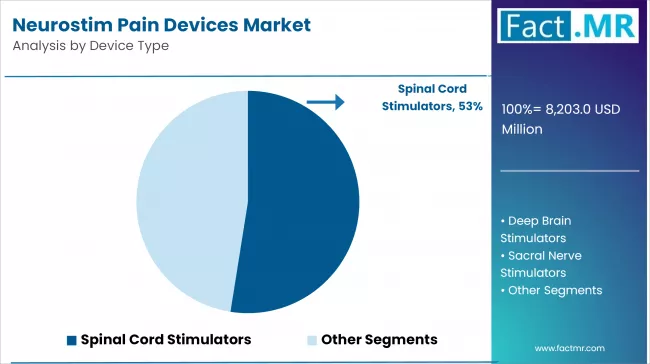
Neurostim Pain Devices Market Analysis By Device Type | Source: Fact.MR
The spinal cord stimulators section is registering robust growth owing to the rising cases of chronic pain and neuropathic cases in the world. These devices provide the healthcare provider and patients with an effective alternative to long-term opioid therapy that is minimally invasive. Further functionality, rechargeable and closed-loop feedback, and AI-assisted programming promote treatment accuracy and comfort on the side of the patient.
Positive reimbursement practices, increased awareness of neuromodulation therapy and continued investment of major medical device firms make the difference in adoption further making spinal cord stimulators a major growth driver in the neurostimulation devices market.
Increasing chronic pain prevalence and demand for non-drug therapies drive the pain management segment.
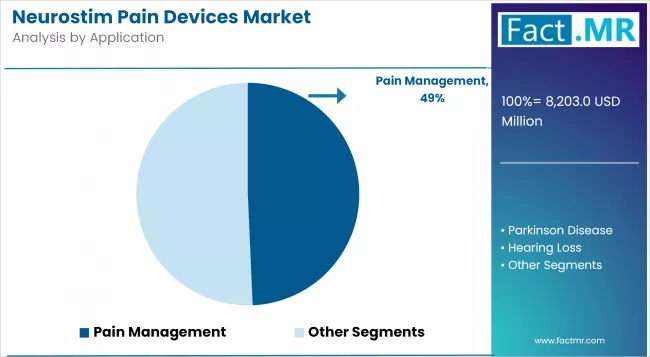
Neurostim Pain Devices Market Analysis By Application | Source: Fact.MR
The neurostimulation devices market segment of pain management is also increasing at a steady pace as patients are finding viable alternatives to long term medication, mostly opioids. Spinal cord stimulator devices, peripheral nerve stimulator devices, and dorsal root ganglion stimulator devices offer specific pain relief to a wide range of chronic pain disorders because they enhance a better quality of life.
Combination with remote monitoring, AI-enhanced programming, and mobile health solutions increases the convenience and personalization of treatment. Increasing knowledge among medical professionals, favorable reimbursement frameworks and the continuous technological advancements are also helping the uptake, thus making the management of pain a fundamental usage in the neurostimulation devices segment.
Advanced healthcare infrastructure and specialized expertise drive the hospital segment.
Hospitals are still the main end-users of neurostimulation devices because they have access to advanced medical facilities and qualified specialists who can carry out the implantation and follow-up procedures. The increasing cases of chronic pain and neurological conditions raise the need to use spinal cord stimulators, deep brain stimulators as well as peripheral nerve stimulators within the hospitals.
Combination with AI-assisted programming, remote monitoring, and telemedicine can improve accuracy of treatment and patient results. The supportive reimbursement policies and ongoing investments in the hospital based neuromodulation technologies also help to accelerate the adoption process as the neurostimulation devices market is concentrated through the hospitals.
Competitive Analysis
The competition in the market of neurostimulation devices is very high, and the technological novelty and the constant enhancement of the products are also quite high. Of interest to crucial stakeholders are enhanced accuracy of devices, level of comfort, and connection through provision of such features as closed-loop, rechargeable implants and AI-aided programmation. Another is also in strategic collaborations and partnerships in the market, which are geographic expansion and access to advanced neuromodulation therapies.
The growing demand of less invasive solutions and tailored treatment methods also increases competition. Companies also incur high expenditure in the research and development to differentiate their products to remain in the market. Ease of facilitating delivery of holistic services to the patients in terms of regulatory approvals, reimbursement policies, and the ability to support these services are also quite primordial in competitiveness maintenance.
Key players in the neurostim pain devices market are Abbott, Medtronic, Boston Scientific, Neuronetics, Bayer AG, Nalu Medical, and others.
Recent Developments
- In August 2025, Nalu Medical launches smaller wearable device for chronic pain therapy
- In April 2024, Medtronic receives FDA approval for Inceptiv closed-loop spinal cord stimulator
Fact.MR has provided detailed information about the price points of key manufacturers of Neurostim Pain Devices Market positioned across regions, sales growth, production capacity, and speculative technological expansion, in the recently published report.
Methodology and Industry Tracking Approach
The Global Neurostim Pain Devices Market Report 2025 insights refer to the rigorous survey of more than 10,750 representatives of interdependent industries: healthcare, neurology, medical devices, rehabilitation, and patient care. It consisted of developers of medical device, innovation leaders, product management, neurologists, regulatory advisors, and supply chain experts involved in innovations in the field of neurostimulation technology.
The research study applies a horizontal research design where structured questionnaires are used and is planned between September 2024 and August 2025. The methodology measures adoption rates, scalability, clinical effectiveness, and integration of neurostim devices with special attention to spinal cord stimulators, deep brain stimulators, sacral and vagus nerve stimulators, wearable neurostim technology, real-time monitoring functionalities, point-of-care integration, user-friendliness of the patient, and therapy-specific optimization to improve the operational efficiency and clinical outcome.
With Fact.MR monitoring consumer behavior, product efficacy, industry trends, and market opportunities since 2018, this report is becoming an authoritative source of information that stakeholders can rely on.
Segmentation
Segmentation of Neurostim Pain Devices Market
-
By Device Type :
- Spinal Cord Stimulators
- Deep Brain Stimulators
- Sacral Nerve Stimulators
- Vagus Nerve Stimulators
- Vacuums
-
By Application :
- Pain Management
- Hearing Loss
- Parkinson Disease
- Urinary Incontinence
- Others
-
By End-User :
- Hospital
- Cognitive Care Centers
- Research Institutes
- Others
-
By Region :
- North America
- Latin America
- Western Europe
- Eastern Europe
- East Asia
- South Asia & Pacific
- Middle East & Africa
Frequently Asked Questions
What was the neurostim pain devices market size reported by Fact.MR for 2025?
Who are the major players operating in the neurostim pain devices market?
What is the estimated valuation of the neurostim pain devices market in 2035?
What value CAGR did the neurostim pain devices market exhibit over the last five years?
Who worked on this report


Preview the report firsthand - request a free sample
Free SampleGet the brochure for pricing and purchase details
Download PDF