- Market Value (2025): USD 434.4 Mn
- Estimated Value (2026): USD 468.0 Mn
- Forecast Value (2036): USD 985.0 Mn
- CAGR (2026-2036): 7.7%
What is the Continuous Crystallizers Market forecast to be worth by 2036?
USD 468.0 million in 2026 to USD 985.0 million by 2036 at 7.7% CAGR.
- The continuous crystallizers market was valued at USD 434.4 million in 2025.
- The market is projected to grow from USD 468.0 million in 2026 to USD 985.0 million by 2036.
- The market is forecast to record an 7.7% CAGR from 2026 to 2036, driven by wider use of continuous manufacturing and growing demand for consistent crystal quality.
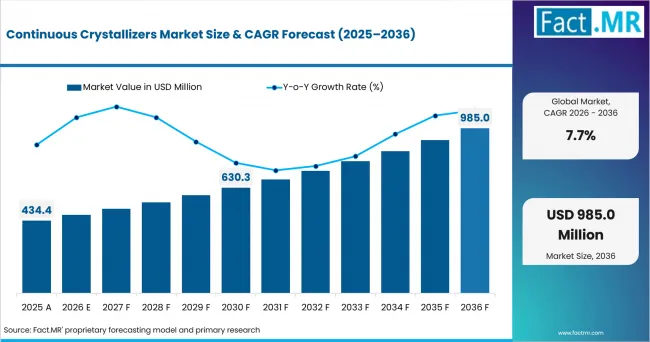
Continuous Crystallizers Market Value Analysis | Source: Fact.MR
What are the defining numbers behind Continuous Crystallizers Market growth?
USD 517.0 million absolute opportunity by 2036. MSMPR crystallizers and Cooling crystallization lead the segment view alongside Lab/pilot systems, Pharmaceuticals and Pharma manufacturers.
- Demand Drivers in the Market
- Pharmaceutical and fine chemical companies need crystal size, purity and form to stay consistent during long production runs. Continuous crystallizers help maintain these qualities while the material moves through the system without repeated stops.
- Linking material production, crystal formation and solid separation in one continuous flow reduces delays between each stage. It also lowers the number of transfers, which helps protect product quality.
- Small-scale testing remains important before a full system is approved. Each compound reacts differently during crystallization, so flow time, crystal starting conditions and slurry removal must be checked first.
- Real-time monitoring is expected to support wider use of these systems. It helps operators track the amount of solids, crystal size and any material that falls outside the required quality range. These readings also guide changes in temperature, feed rate and product removal.
- Key Segments Analyzed
- By Crystallizer Type: MSMPR crystallizers are expected to hold 31.0% share in 2026 due to broad literature support and practical familiarity among process engineers.
- By Crystallization Method: Cooling crystallization is projected to account for 32.0% share in 2026 because temperature control gives many compounds a direct route to supersaturation.
- By Capacity: Lab/pilot is anticipated to capture 24.0% share in 2026 as producer’s test residence time, seeding and fouling behavior before buying production systems.
- By Application: Pharmaceuticals are estimated to represent 32.0% share in 2026 attributable to strict crystal-form control and strong use of continuous manufacturing concepts.
- By End User: Pharma manufacturers are forecast to hold 32.0% share in 2026 as in-house process teams validate crystallization before commercial API campaigns.
- Analyst Opinion at Fact.MR
- Shambhu Nath Jha, Senior Analyst at Fact.MR, states, “Continuous crystallizers become useful for full production when they keep crystal size, purity and form steady during long runs. Equipment companies must show that crystal starting conditions, crystal growth and slurry removal stay consistent beyond a short laboratory test. Systems that reduce buildup, lower startup losses and use real-time readings to guide operating changes are likely to see wider use in pharmaceutical and fine chemical production.”
- Strategic Implications
- Equipment companies should share test results from materials with similar solubility and buildup patterns. Engineers can then compare processing time, mixing and slurry removal before approving a full production system.
- Pharmaceutical manufacturers should include real-time process checks during the first design review. These readings are more useful when the control system clearly shows how poor-quality material is found and removed from the line.
- Crystallizer makers should address material buildup through equipment design instead of treating it only as a maintenance issue. Clear records on run time, cleaning access and startup losses help reduce concerns during equipment approval.
- Service companies should keep important pumps, sensors and spare parts close to major production sites. Fast technical help reduces the risk that one failed part stops the full continuous line.
In December 2024, GEA reported evaporation and crystallization work for POSCO Argentina after laboratory tests and semi-industrial pilot trials. The package included forced circulation crystallizers and mechanical vapor recompression for a corrosive lithium process. The project shows that process proof is becoming an important part of equipment approval before full installation. It also supports demand for pilot testing in high-value chemical and battery-material applications.
The UAE is projected to post an 8.4% CAGR as new industrial projects increase demand for compact and automated process trains. The USA is anticipated to grow at a 7.7% CAGR through advanced manufacturing programs and pharmaceutical process development. Japan is estimated to reach an 7.6% CAGR through careful scale-up and high-purity production needs. The United Kingdom is forecast at 7.4%, while Germany is projected to record an 7.1% CAGR through specialty chemical production and disciplined engineering review.
How does the Continuous Crystallizers Market break down by segment?
MSMPR crystallizers are expected to lead Crystallizer Type at 31.0% share in 2026. Cooling crystallization is projected to lead Crystallization Method at 32.0% share in 2026.
Why do MSMPR crystallizers lead Crystallizer Type?
MSMPR crystallizers are estimated to hold 31.0% share in 2026.
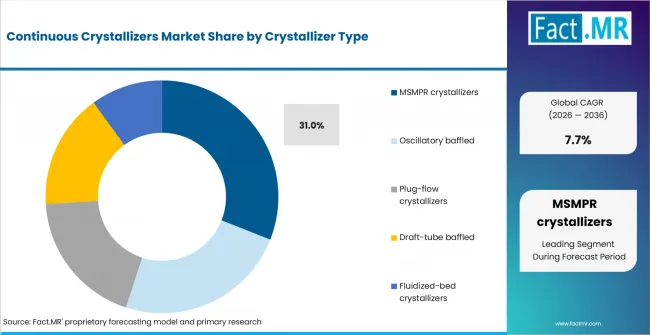
Continuous Crystallizers Market Analysis By Crystallizer Type | Source: Fact.MR
MSMPR units give engineers a clear way to manage feed entry, keep crystals moving and remove the final product from one vessel. Their mixed setup helps keep the amount of solids steady and makes processing time easier to estimate when moving to a larger system. This experience also helps companies compare pilot results with full production needs. Plug-flow and oscillatory systems remain useful when tighter control over processing time or a smaller system size is more important.
Why does Cooling crystallization lead Crystallization Method?
Cooling crystallization is projected to account for 32.0% share in 2026.
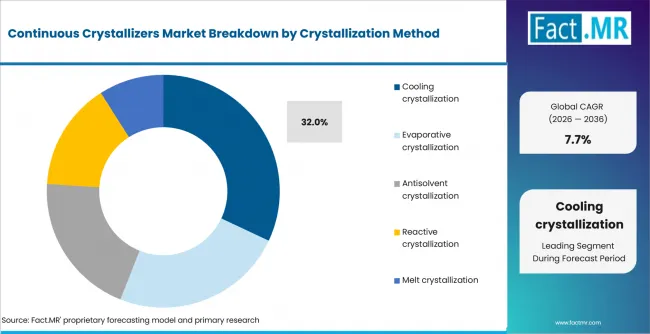
Continuous Crystallizers Market Analysis By Crystallization Method | Source: Fact.MR
Many materials form crystals as the temperature falls. This gives cooling systems a simple route without adding another liquid to the process. Operators adjust the cooling rate to guide crystal growth and final particle size. The method also works well in plants that already have reliable heating and cooling equipment. Antisolvent or evaporation methods remain better suited when cooling alone does not produce enough crystals.
Why does Lab/pilot lead Capacity?
Lab/pilot is anticipated to capture 24.0% share in 2026.
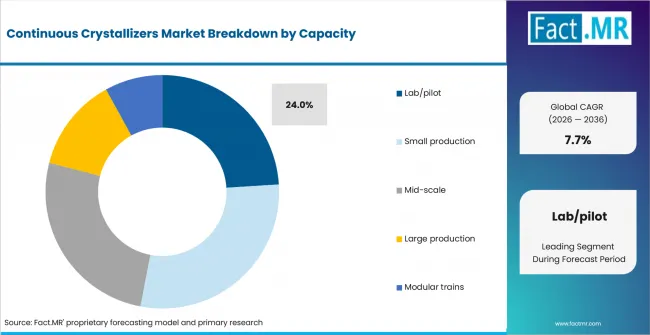
Continuous Crystallizers Market Analysis By Capacity | Source: Fact.MR
Continuous crystallization is hard to move from theory to full production because each material reacts differently to mixing, seed crystals and temperature changes. Pilot systems let companies study buildup, slurry flow and crystal damage while using only a small amount of material. They also show how the process behaves during startup and longer runs. These results help set the right equipment size and control settings before a larger line is approved.
Why does Pharmaceuticals lead Application?
Pharmaceuticals are estimated to represent 32.0% share in 2026.
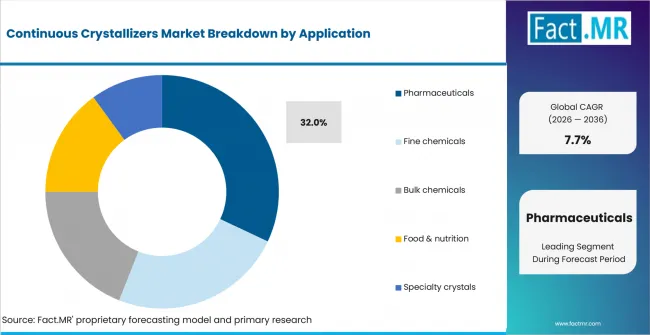
Continuous Crystallizers Market Analysis By Application | Source: Fact.MR
Drug production requires close control over crystal form, purity and particle size. These features affect later filtration, drying and final product preparation. Continuous crystallizers help keep them steady during long production runs instead of relying on separate batch results. The equipment also supports real-time checks and clear process records. This makes pharmaceutical use more demanding and more valuable than applications where wider product differences are acceptable.
Why do Pharma manufacturers lead End User?
Pharma manufacturers are forecast to hold 32.0% share in 2026.
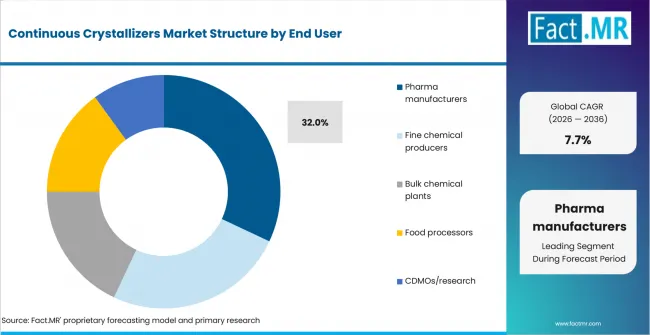
Continuous Crystallizers Market Analysis By End User | Source: Fact.MR
Pharma manufacturers manage the process from early development through approval and full production. This gives them a clear reason to invest in crystallizers that improve consistency and reduce changes between production runs. Their own technical staff also use pilot results to prepare testing plans and quality records. Contract manufacturers remain important where drug companies outsource development. Chemical and food companies invest when the value of the product supports the extra testing and control work.
What is accelerating Continuous Crystallizers Market adoption, and what is holding it back?
Continuous manufacturing programs are expected to expand demand, although fouling and validation burden are anticipated to restrain adoption.
Drivers Impact Analysis
| DRIVER | (~) % IMPACT ON CAGR | GEOGRAPHIC RELEVANCE | IMPACT TIMELINE |
|---|---|---|---|
| Continuous manufacturing programs | +2.2% | USA; Japan; Germany; pharma manufacturing | Short term (<= 2 years) |
| Crystal-quality control requirements | +1.6% | Pharmaceuticals; fine chemicals | Short term (<= 2 years) |
| Pilot validation before scale-up | +1.2% | USA; UK; Germany | Medium term (2-4 years) |
| Inline PAT and process models | +0.7% | Regulated manufacturing; CDMOs | Medium term (2-4 years) |
Source: Fact.MR analysis. Updated Jul 21, 2026
- Continuous manufacturing programs: FDA finalized the Advanced Manufacturing Technologies Designation Program in December 2024. That framework supports earlier engagement when a drug process uses advanced manufacturing, which makes continuous crystallization easier to discuss during process design.
- Crystal-quality control requirements: Crystal size, form and purity are directly tied to filtration and drying performance. Continuous crystallizers gain attention when steady supersaturation gives plants a cleaner path to repeatable product attributes.
- Pilot validation before scale-up: The GEA and POSCO Argentina work reported in December 2024 included laboratory testing and semi-industrial pilot validation before crystallization process scale-up. That sequence matches how customers reduce risk before buying commercial equipment.
- Inline PAT and process models: FDA issued draft guidance in January 2025 on 21 CFR 211.110 and discussed process models in commercial control strategies. This supports crystallizer projects where operators need measured evidence during continuous operation.
Opportunity Impact Analysis
| OPPORTUNITY | (~) % IMPACT ON CAGR | GEOGRAPHIC RELEVANCE | IMPACT TIMELINE |
|---|---|---|---|
| Modular skid designs | +1.4% | China and UAE | Short term (<= 2 years) |
| Fouling-resistant operation | +1.0% | USA; Japan; Germany | Short term (<= 2 years) |
| Integrated filtration and washing | +0.7% | Pharmaceuticals; fine chemicals | Medium term (2-4 years) |
| Battery-material and specialty salt projects | +0.5% | UAE; global chemical projects | Long term (>= 4 years) |
Source: Fact.MR analysis. Updated Jul 21, 2026
- Modular skid designs: Standardized skids are expected to shorten engineering cycles when a producer runs several related molecules. The opportunity is strongest where plant teams want controlled trials before a permanent line is built.
- Fouling-resistant operation: Longer campaigns are expected to carry commercial value because cleaning breaks reduce the advantage of continuous operation. Vendors that show easier access and lower deposit formation have a clearer selling point.
- Integrated filtration and washing: Continuous crystallization gains more value when the next solids-handling steps are connected cleanly. Integration reduces transfer points where crystals break, agglomerate or pick up extra variability.
- Battery-material and specialty salt projects: GEA’s work for POSCO Argentina shows crystallization moving into high-value lithium processing. Similar projects are expected to favor vendors with testing centers and corrosion-aware materials experience.
Restraints Impact Analysis
| RESTRAINT | (~) % IMPACT ON CAGR | GEOGRAPHIC RELEVANCE | IMPACT TIMELINE |
|---|---|---|---|
| Fouling and plugging | -1.7% | Global | Short term (<= 2 years) |
| Control and validation burden | -1.2% | USA; Japan; Germany; regulated plants | Short term (<= 2 years) |
| Compound-specific fit limits | -0.9% | Pharma and fine chemicals | Medium term (2-4 years) |
| Maintenance and spare-part dependence | -0.5% | UAE; remote process sites | Medium term (2-4 years) |
Source: Fact.MR analysis. Updated Jul 21, 2026
- Fouling and plugging: Crystals that build on walls, probes or transfer lines interrupt the steady operation that customers are paying for. This remains the most direct technical objection during scale-up discussions.
- Control and validation burden: Startup, shutdown and diversion logic need documentation before a regulated plant accepts the process. FDA’s January 2025 draft guidance reinforces the need to explain control strategies for advanced manufacturing.
- Compound-specific fit limits: Some compounds crystallize slowly or shift form under small changes in temperature and mixing. Those products are expected to stay with batch crystallization until continuous trials show a dependable process window.
- Maintenance and spare-part dependence: A continuous line depends on pumps, sensors and controls working together. Sites far from service centers are expected to value local spares and field support more heavily.
Which countries are scaling Continuous Crystallizers Market fastest?
The global growth rate combines results from every country covered in the study. China and UAE are projected to grow faster than the global average. USA and Japan are expected to advance at a measured pace, with UK and Germany following the same careful adoption pattern. The six countries shown are examples and do not cover the full market.
- Growth follows a different path in each country. Continuous crystallizer demand depends on chemical project activity, pharmaceutical process development and confidence in scale-up evidence.
- China benefits from a large chemical and pharmaceutical manufacturing base where new lines are more likely to consider continuous processing early. UAE starts from a smaller base, but new industrial projects make compact and automated process trains more relevant.
- The USA has strong regulatory support for advanced manufacturing and a deep pharmaceutical development base. Japan relies on careful process engineering and long validation cycles, which supports steady adoption after pilot data is available.
- The UK and Germany have experienced pharmaceutical and specialty chemical teams that often ask for strong validation before equipment purchase. Local service and documented run length influence adoption in both countries.
Countries with similar growth rates often buy different systems. A pharmaceutical site usually asks for PAT and documented control logic. A chemical producer usually focuses on corrosion resistance and heat integration. The complete report covers North America, Latin America and Europe. It also covers East Asia and South Asia and Oceania. The Middle East and Africa complete the geographic scope.
.webp "Example Country Growth Comparison Of Continuous Crystallizers Market (1)")
Example Country Growth Comparison Of Continuous Crystallizers Market (1) | Source: Fact.MR
| COUNTRY | CAGR |
|---|---|
| UAE | 8.4% |
| USA | 7.7% |
| Japan | 7.6% |
| UK | 7.4% |
| Germany | 7.1% |
Source: Fact.MR analysis. Updated Jul 21, 2026
How is the UAE scaling demand?
8.4% CAGR, driven by local manufacturing plans and investment in compact production sites.
More pharmaceuticals and chemicals are being produced inside the UAE under national industry programs. Healthcare and chemicals are listed as priority sectors under Operation 300bn, and local purchasing policies give domestic production greater support. Compact crystallizer units fit these plans because they take up less space and reduce the amount of manual work needed at the site.
What supports USA adoption?
7.7% CAGR, backed by early regulatory discussion for new pharmaceutical production methods.
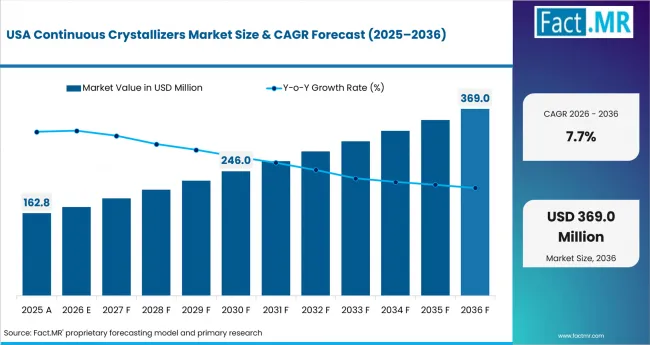
Continuous Crystallizers Market Country Value Analysis | Source: Fact.MR
Drug companies in the USA have a clearer way to discuss new manufacturing methods with the FDA before completing a full application. Under the Advanced Manufacturing Technologies Designation Program, companies may present how the process works and how product quality is checked. This helps continuous crystallization projects where crystal quality, process control and removal of poor-quality material must be explained early.
How is Japan developing demand?
7.6% CAGR, shaped by close review of continuous drug production.
Japan’s market places more weight on proof of stable operation than on fast equipment replacement. PMDA guidance under ICH Q13 covers processing time, alarms, product removal and checks during production. Crystallizer makers therefore have to show that crystal quality remains steady during startup, long runs and changes from one product to another.
What shapes United Kingdom growth?
7.4% CAGR, supported by research programs and new rules for modular production.
The United Kingdom has a strong research base in continuous manufacturing and crystallization through centers such as CMAC. New rules introduced in July 2025 also cover licensing and quality requirements for modular manufacturing sites. This gives compact crystallizer systems a clearer route from development trials to approved production, especially when cleaning records and control steps are clearly documented.
How does Germany perform?
7.1% CAGR, backed by stronger local pharmaceutical production and careful equipment approval.
Germany is placing greater attention on keeping medicine production within Europe and reducing supply risk. Even so, new systems still face strict checks before they enter pharmaceutical or specialty chemical plants. Product purity, steady performance and results from long production runs are expected to carry more weight than the speed of installation.
Who leads the Continuous Crystallizers Market?
GEA and Veolia’s HPD business have a strong position across industrial crystallization systems. Sulzer stands out more in high-purity separation, while Dedert Corporation and Swenson Technology add focused equipment for continuous crystal and slurry handling.
GEA offers forced-circulation, Oslo and other crystallizer designs. It also supports projects with pilot testing and full process planning. Veolia HPD works across chemical recovery, salt production and zero-liquid-discharge projects using MSMPR, forced-circulation and draft-tube-baffle units. Sulzer focuses more on suspension and melt crystallization where product purity and careful heat control are especially important. Dedert Corporation provides forced-circulation systems for steady feed and slurry movement. Swenson Technology serves industrial projects with forced-circulation, surface-cooled and draft-tube-baffle equipment.
Through 2036, project decisions are likely to depend heavily on results from real process trials. Chemical and pharmaceutical companies will look at material buildup, steady crystal size, startup losses and ease of cleaning before approving a system. Companies with good pilot facilities, clear help when moving to full production and nearby engineering support are likely to have a stronger chance in more demanding projects.
Which companies are the key providers?
Key companies include GEA; Sulzer; Dedert Corporation; Veolia (HPD); Swenson Technology.
- GEA
- Sulzer
- Dedert Corporation
- Veolia (HPD)
- Swenson Technology
Bibliography
- U.S. Food and Drug Administration. (2024, December). Advanced Manufacturing Technologies Designation Program. U.S. Food and Drug Administration.
- Medicines and Healthcare products Regulatory Agency. (2025, July 23). Human medicines modular manufacture and point of care regulations 2025: Overview. GOV.UK.
- European Commission. (2025, March 11). Commission proposes new rules to ensure stable supply of critical medicines. European Commission.
- U.S. Department of Energy. (2025, June 3). ICYMI: Trump Administration adds two DOE lithium processing projects to federal permitting dashboard. U.S. Department of Energy.
This Report Answers
- The report provides strategic intelligence on Continuous Crystallizers Market across Crystallizer Type and Crystallization Method choices that shape equipment selection.
- Segment analysis covers MSMPR crystallizers as the share leader within the 2026 market structure.
- Regional outlook evaluates China and UAE alongside USA and Japan, while UK and Germany complete the growth comparison.
- Competitive analysis profiles GEA and Sulzer alongside Veolia (HPD) and Swenson Technology, followed by additional active providers.
- Application assessment covers Pharmaceuticals and Fine chemicals alongside Bulk chemicals, Food & nutrition and Specialty crystals.
What does the Continuous Crystallizers Market cover?
The Continuous Crystallizers Market covers equipment and integrated systems that form crystals from solution or melt while feed and product move through the process continuously.
The market covers MSMPR crystallizers and oscillatory baffled units. It also covers plug-flow crystallizers, draft-tube baffled systems and fluidized-bed crystallizers. Coverage extends to cooling and evaporative crystallization. It also includes antisolvent, reactive and melt crystallization when the system is specified as part of a continuous package. It includes lab and pilot systems plus production units. Modular trains and automation are included when they attach directly to crystallization. PAT integration and solids-transfer modules follow the same scope rule.
The market differs from general separation equipment because value comes from controlled crystal formation during continuous operation. Dryers, standalone filters and complete drug-production lines remain outside the boundary unless they are sold as a directly integrated crystallization package.
What is included in the scope?
Included products are continuous crystallizer bodies and feed systems. Heat-transfer equipment and temperature control also remain in scope.
Seeding support and slurry withdrawal are included when tied to crystallization. PAT, automation and integrated solids handling follow the same rule. These elements are included when they control residence time and supersaturation. Crystal growth and product removal must also sit within the crystallization step.
Included demand comes from Pharmaceuticals and Fine chemicals. Bulk chemicals, Food & nutrition and Specialty crystals complete the application scope. End-user coverage includes Pharma manufacturers and Fine chemical producers. Bulk chemical plants, Food processors and CDMOs/research are included because each group specifies crystallizers for different needs.
What is excluded from the scope?
Excluded categories are batch crystallizers and dryers. Standalone centrifuges, formulation equipment and complete drug-production lines outside the crystallization package are also excluded. These categories are excluded because they do not represent continuous crystal formation or they belong to a downstream unit operation.
General evaporation systems are excluded when no crystallization step is specified. Laboratory glassware, research-only instruments and consulting services are also excluded unless they are tied to the sale or validation of a continuous crystallizer system.
How Was the Analysis Built?
The analysis draws on 120+ sources, 35+ company portfolios, 25+ countries, and more than 20 industry interviews.
- Primary Research: Primary research includes discussions with manufacturers, service providers, technology developers, distributors, end users, procurement teams, and subject-matter experts. These conversations examine purchasing priorities, product adoption, operational challenges, approval requirements, competitive positioning, and the factors that influence wider market acceptance.
- Desk Research: Desk research covers government statistics, regulatory publications, company filings, trade data, technical studies, industry associations, standards, public policy, and other authoritative sources. Every source used in the analysis is documented in the bibliography.
- Market Sizing and Forecasting: Market estimates combine historical performance, demand indicators, pricing and volume trends, segment shares, company participation, country-level growth, adoption patterns, investment activity, and barriers to market expansion.
- Data Validation and Update Cycle: Findings are validated by comparing primary interviews with public data, company activity, regulatory changes, trade patterns, and industry developments. Regular updates review new product launches, capacity changes, partnerships, approvals, procurement trends, and shifts in commercial adoption.
Segmentation
What is the report’s scope and coverage?
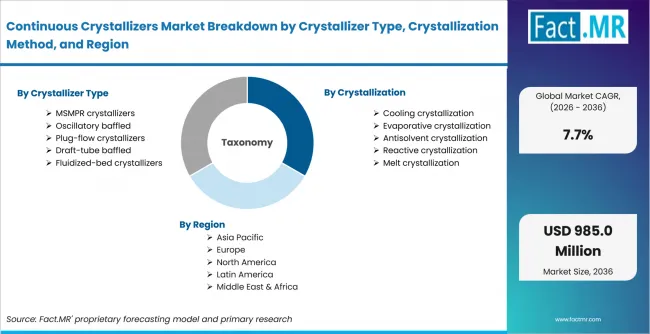
Continuous Crystallizers Market Breakdown By Crystallizer Type, Crystallization Method, And Region | Source: Fact.MR
| Attribute | Details |
|---|---|
| Quantitative Units | USD Million in 2026 to USD Million by 2036 at CAGR |
| Market Definition | A continuous crystallizer does what a batch crystallizer does: it converts a dissolved compound into solid crystals, but the process runs without stopping. |
| Crystallizer Type | MSMPR crystallizers; Oscillatory baffled; Plug-flow crystallizers; Draft-tube baffled; Fluidized-bed crystallizers |
| Crystallization Method | Cooling crystallization; Evaporative crystallization; Antisolvent crystallization; Reactive crystallization; Melt crystallization |
| Capacity | Lab/pilot; Small production; Mid-scale; Large production; Modular trains |
| Application | Pharmaceuticals; Fine chemicals; Bulk chemicals; Food & nutrition; Specialty crystals |
| End User | Pharma manufacturers; Fine chemical producers; Bulk chemical plants; Food processors; CDMOs/research |
| Regions Covered | North America; Latin America; Europe; East Asia; South Asia & Oceania; Middle East & Africa |
| Countries Covered | USA; Canada; Brazil; Mexico; Germany; U.K.; France; Italy; Spain; South Korea; Japan; Australia & New Zealand; GCC Countries; South Africa; UAE |
| Key Companies Profiled | GEA, Sulzer, Dedert Corporation, Veolia (HPD), and Swenson Technology |
| Forecast Period | 2026 to 2036 |
| Approach | Hybrid top-down and bottom-up approach using demand indicators across Crystallizer Type, Crystallization Method, Capacity, Application, End User; country-level growth; company participation and outsourcing or adoption trends |
Source: Fact.MR analysis. Updated Jul 21, 2026
How is the market segmented?
-
By Crystallizer Type:
- MSMPR crystallizers
- Oscillatory baffled
- Plug-flow crystallizers
- Draft-tube baffled
- Fluidized-bed crystallizers
-
By Crystallization Method:
- Cooling crystallization
- Evaporative crystallization
- Antisolvent crystallization
- Reactive crystallization
- Melt crystallization
-
By Capacity:
- Lab/pilot
- Small production
- Mid-scale
- Large production
- Modular trains
-
By Application
- Pharmaceuticals
- Fine chemicals
- Bulk chemicals
- Food & nutrition
- Specialty crystals
-
By End User
- Pharma manufacturers
- Fine chemical producers
- Bulk chemical plants
- Food processors
- CDMOs/research
-
By Region
- North America
- USA
- Canada
- Latin America
- Brazil
- Mexico
- Rest of Latin America
- Europe
- Germany
- U.K.
- France
- Italy
- Spain
- Rest of Europe
- East Asia
- South Korea
- Japan
- China
- South Asia & Oceania
- India
- Australia & New Zealand
- Rest of South Asia & Oceania
- Middle East & Africa
- GCC Countries
- South Africa
- UAE
- Rest of Middle East & Africa
- North America
Frequently Asked Questions
Which Crystallizer Type leads the Continuous Crystallizers Market?
Which Crystallization Method leads the Continuous Crystallizers Market?
Which Capacity leads the Continuous Crystallizers Market?
Which Application leads the Continuous Crystallizers Market?
Which End User leads the Continuous Crystallizers Market?
How does UAE perform in the Continuous Crystallizers Market?
How does USA perform in the Continuous Crystallizers Market?
What is the primary driver in the Continuous Crystallizers Market?
What is the main restraint in the Continuous Crystallizers Market?
Who worked on this report


Preview the report firsthand - request a free sample
Free SampleGet the brochure for pricing and purchase details
Download PDF