- Market Value (2025): USD 1.76 Bn
- Estimated Value (2026): USD 1.84 Bn
- Forecast Value (2036): USD 2.9 Bn
- CAGR (2026-2036): 4.7%
Amylopectin Market Forecast and Outlook 2026 to 2036
The amylopectin market is projected to grow from USD 1.8 billion in 2026 to USD 2.9 billion by 2036. Demand for amylopectin is likely to grow at a CAGR of 4.7% over the forecast period.
Demand for amylopectin is rising as food manufacturers require starch ingredients that deliver consistent viscosity, texture and water retention in processed foods. Suppliers of amylopectin are expanding waxy corn and waxy potato starch capacity and application support to meet that requirement. For example, in April 2026, Roquette inaugurated a starch and polyol pilot center at its Lianyungang site in China to shorten product development and scale-up for food customers. Similar investments are projected to drive sales of amylopectin in countries with large processed-food industries.
Key Takeaways from the Amylopectin Market
- Amylopectin Market Value (2026): USD 1.84 billion
- Amylopectin Market Forecast Value (2036): USD 2.9 billion
- Amylopectin Market Forecast CAGR (2026-2036): 4.7%
- Leading Source: Corn (42.5%)
- Key Market Participants: Cargill Incorporated, Roquette Frères, Ingredion Incorporated, Tate & Lyle PLC, Avebe U.A., AGRANA Beteiligungs-AG
- Key Growth Regions: Japan, United States, Germany, Brazil, United Kingdom
In 2026, AGRANA reported that specialty corn, mainly waxy and organic corn, accounted for about 30% of the corn processed at its Austrian sites during the 2025|26 year. Demand for high-amylopectin starches is growing as processors of sauces, fillings and convenience foods specify grades that give smooth texture and high viscosity. Suppliers of amylopectin are responding by processing more specialty corn and by positioning dedicated waxy starch grades for food formulators. Similar shifts in feedstock mix are projected to drive sales of amylopectin across Europe, North America and East Asia.
Amylopectin Market
| Metric | Value |
|---|---|
| Estimated Value in (2026) | USD 1.8 billion |
| Forecast Value in (2036) | USD 2.9 billion |
| Forecast CAGR (2026 to 2036) | 4.7% |
Source: Fact.MR analysis. Updated Nov 16, 2026
Source: Fact.MR analysis. Updated 14 Nov 2026
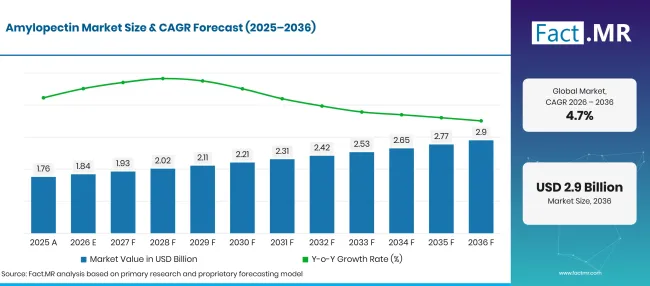
Amylopectin Market Forecast Global | Source: Fact.MR
Category
| Category | Segments |
|---|---|
| Source | Corn, Potato, Rice, Wheat, Others |
| Application | Food and Beverages, Pharmaceuticals, Animal Feed, Others |
| End-User Industry | Food Industry, Pharmaceutical Industry, Animal Nutrition, Others |
| Region | Japan; United States; Germany; Brazil; United Kingdom |
Source: Fact.MR analysis. Updated Nov 16, 2026
Source: Fact.MR analysis. Updated 14 Nov 2026
Segmental Analysis
How is established corn wet-milling positioning corn as the leading source in the Amylopectin Market?
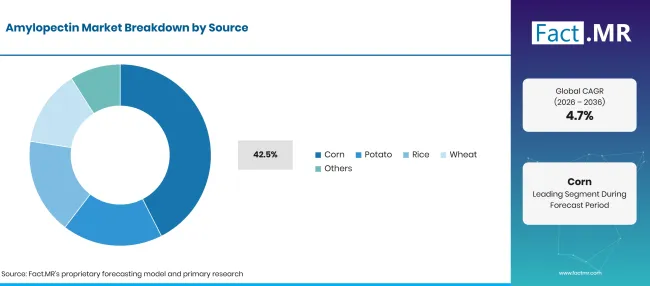
Amylopectin Market Breakdown Source | Source: Fact.MR
In September 2026, Japan's Ministry of Agriculture, Forestry and Fisheries projected domestic starch demand at 2.374 million tonnes for the 2026 starch year, with corn starch supplying 2.053 million tonnes of it. Demand for corn-derived amylopectin accounts for 42.5% of the amylopectin market in 2026, about USD 765 million, as processors rely on the established corn wet-milling supply chain for native, modified and waxy starches. Suppliers of corn starch are maintaining broad portfolios that span conventional and waxy corn grades for food and industrial customers. Similar supply depth is projected to keep corn the leading source of amylopectin through 2036.
Why does food and beverage processing lead application demand in the Amylopectin Market?
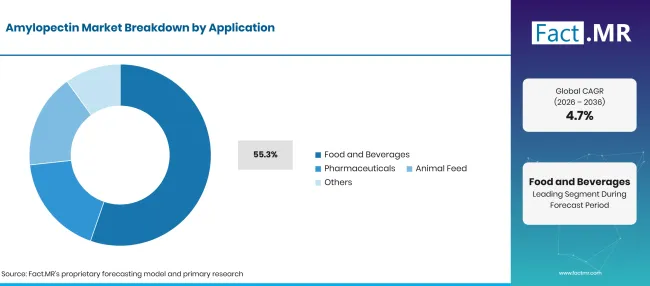
Amylopectin Market Breakdown Application 1 | Source: Fact.MR
Demand from food and beverage manufacturers accounts for 55.3% of amylopectin application revenue in 2026, about USD 995 million, as sauces, fillings, desserts and ready meals depend on reliable thickening and texture. For example, in May 2026, Tate & Lyle reported a 9% like-for-like increase in new-product revenue for the year to March 2026, with starch-based mouthfeel solutions among its innovation programs. Suppliers of amylopectin are developing starch-based texture systems for these formulations and backing them with application laboratories. Similar formulation-led innovation is projected to drive sales of amylopectin in processed-food categories worldwide.
Why does the food industry lead end-user demand in the Amylopectin Market?
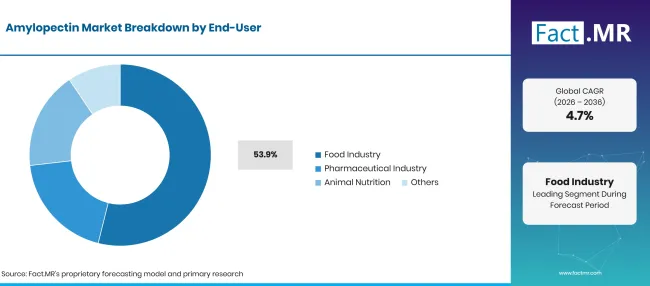
Amylopectin Market Breakdown End User | Source: Fact.MR
Demand from the food industry accounts for 53.9% of amylopectin end-user revenue in 2026, about USD 970 million, as food processors require consistent thickening performance across large production runs. For example, in April 2026, India's Press Information Bureau reported that the Production Linked Incentive Scheme for food processing had supported 165 approved applications across 274 project locations and added 3.4 million tonnes a year of processing capacity. Similar capacity additions are projected to drive sales of amylopectin to food manufacturers in fast-growing economies. Suppliers of amylopectin are expanding capacity in markets where food-processing investment is growing.
Amylopectin Market-Drivers, Restraints & Trends
- Drivers: Demand for functional starch ingredients is rising as food manufacturers seek dependable thickening, viscosity and texture across processed foods. For example, in November 2026, Ireland's Central Statistics Office reported that production in grain milling, starch products and prepared animal feed rose 19.2% year on year in July to September 2026, with turnover up 9.5%. Suppliers of amylopectin-rich starches are widening native and specialty grades to serve this requirement. Similar growth in ingredient-consuming industries is projected to drive sales of amylopectin through the forecast period.
- Restraints: Demand for amylopectin remains exposed to agricultural supply conditions because corn, potato, wheat and rice feedstocks vary in price and availability. For example, in March 2026, the USDA Foreign Agricultural Service forecast a record Indian corn crop of 43.0 million tonnes for 2025/26 while reporting domestic prices near INR 1,600 per quintal as ethanol feedstock demand and export competition shifted. Similar volatility in raw-material markets is projected to complicate cost planning and slow sales growth for amylopectin in price-sensitive applications. Suppliers of amylopectin must hold consistent starch specifications despite differences in botanical origin and crop quality.
- Trend: Waxy Starches for Specialized Formulations In 2026, Royal Avebe reported increased availability of its waxy potato starch, which contains nearly 100% amylopectin. Demand for waxy starch varieties is rising as food manufacturers specify high viscosity, smooth texture and clarity that conventional native starches do not provide. Similar portfolio moves are projected to drive sales of amylopectin in premium and clean-label food formulations. Suppliers of amylopectin are increasing availability of waxy potato and waxy corn grades and labeling them for sauces, fillings and frozen foods.
- Trend: Regional Pilot and Partnership Capacity Demand for locally developed starch solutions is rising as food processors in Asia ask for faster formulation support and regional supply. Suppliers of amylopectin are forming partnerships and building pilot facilities close to these customers. For example, in May 2026, Ingredion announced a joint venture with India's Sanstar Limited, alongside a 9% equity investment, to build a greenfield facility for specialty starch-based ingredients. Similar regional partnerships are projected to drive sales of amylopectin across South Asia and East Asia.
Amylopectin Market by Analysis by Key Country
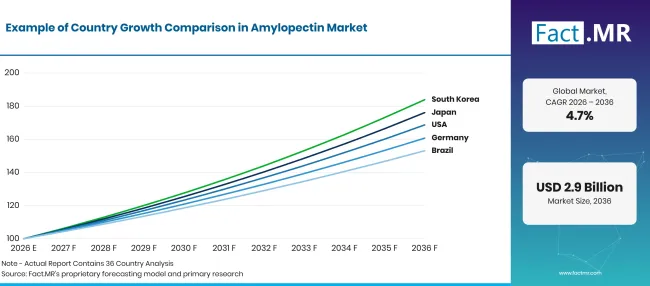
Amylopectin Market Growth Index | Source: Fact.MR
| Country | CAGR (2026-2036) |
|---|---|
| Japan | 5.8% |
| United States | 5.4% |
| Germany | 4.9% |
| Brazil | 4.4% |
| United Kingdom | 3.5% |
Source: Fact.MR analysis. Updated Nov 16, 2026
Source: Fact.MR analysis. Updated 14 Nov 2026
What is driving amylopectin demand in Japan?
In November 2026, the Ministry of Agriculture, Forestry and Fisheries reported that biscuit output rose 8.5% year on year in September 2026 and that wheat flour use in bread manufacturing increased 2.9%. Demand for amylopectin in Japan is projected to grow at a 5.8% CAGR, the fastest among the five key countries, as processed-food manufacturers require consistent texture and viscosity across bakery, dessert and ready-meal products. Similar output growth is projected to drive sales of amylopectin to Japanese food processors. Suppliers of amylopectin are aligning starch grades with Japan's large food-manufacturing base.
How is processed-food spending supporting amylopectin sales in the United States?
Sales of amylopectin in the United States are projected to grow at a 5.4% CAGR, adding the largest dollar increment among the five countries, as food manufacturers serve a large and growing food market. Suppliers of amylopectin are offering native and specialty starch portfolios for sauces, soups and bakery applications to U.S. processors. For example, in June 2026, the USDA Economic Research Service reported that inflation-adjusted U.S. food spending reached USD 2.51 trillion in 2025, including USD 1.10 trillion on food at home. Similar scale in downstream food demand is projected to drive sales of amylopectin in the United States.
What manufacturing base is supporting amylopectin demand in Germany?
The Federal Ministry for Economic Affairs and Energy reported that the German food industry generated EUR 232.7 billion in revenue in 2024 across about 5,991 establishments. Demand for amylopectin in Germany is projected to grow at a 4.9% CAGR as the country's food industry requires functional ingredients for bakery, confectionery and prepared foods. Suppliers of amylopectin are serving German processors from Central European starch plants with corn, potato and wheat grades. Similar industrial scale is projected to sustain sales of amylopectin in Germany through 2036.
What is shaping amylopectin demand in Brazil?
Sales of amylopectin in Brazil are projected to grow at a 4.4% CAGR as the country's food-processing sector, its largest industrial employer, uses corn-based starch ingredients in local formulations. For example, in June 2026, the Brazilian Institute of Geography and Statistics reported that food-product manufacturing employed about 2.1 million people in 2024. Suppliers of amylopectin are positioning corn and other botanical grades suited to Brazilian processors. Similar depth in food manufacturing is projected to drive sales of amylopectin in Brazil, although the sector's 5.9% output decline in September 2026 points to near-term pressure.
Why is amylopectin growth slower in the United Kingdom?
Demand for amylopectin in the United Kingdom is projected to grow at a 3.5% CAGR, the slowest among the five countries, as a mature food and drink manufacturing sector grows gradually. For example, in July 2026, the Department for Environment, Food and Rural Affairs reported that UK food and drink manufacturing generated GBP 39.3 billion in gross value added in 2024 and employed 444,000 people in 2025. Similar established demand is projected to keep sales of amylopectin in the United Kingdom steady rather than fast-growing. Suppliers of amylopectin are competing on formulation performance and consistency rather than volume in this market.
Competitive Landscape for Amylopectin Market
Competition in the amylopectin market is divided between integrated starch and ingredient companies with multi-source portfolios and specialists with dedicated high-amylopectin products. Cargill, Ingredion, Roquette and Tate & Lyle compete on botanical-source coverage, functional native starches and application support, while Avebe and AGRANA compete through waxy potato and waxy corn grades marketed for their amylopectin content. Buyers select suppliers on amylopectin content, viscosity, swelling behavior, clarity and stability under their own processing conditions.
From 2025 onward, competition shifted toward regional development capacity and partnership-based supply. Roquette opened a pilot center in China in April 2026, Ingredion agreed a joint venture with Sanstar in India in May 2026, and Tate & Lyle reported GBP 86 million invested in innovation and solution selling for the year to March 2026. Suppliers with application laboratories and reliable access to corn and potato crops are best placed to serve regional formulation requirements.
Recent Developments
- In May 2026, Ingredion announced a strategic partnership and joint venture with Sanstar Limited in India, including a 9% equity investment, to build a greenfield facility for specialty starch-based ingredients.
- In May 2026, Tate & Lyle reported a 9% like-for-like increase in new-product revenue for the year ended 31 March 2026 and GBP 86 million invested in innovation and solution selling.
- In April 2026, Roquette inaugurated a starch and polyol pilot center of more than 1,000 square meters at its Lianyungang facility in China.
- In 2026, AGRANA reported EUR 982.3 million of starch-segment revenue for 2025|26 and EUR 18.5 million invested in the segment, with specialty corn about 30% of corn processed in Austria.
Key Players in Amylopectin Market
Key companies profiled include Cargill Incorporated; Roquette Frères; Ingredion Incorporated; Tate & Lyle PLC; Avebe U.A.; and AGRANA Beteiligungs-AG.
- Cargill Incorporated
- Roquette Frères
- Ingredion Incorporated
- Tate & Lyle PLC
- Avebe U.A.
- AGRANA Beteiligungs-AG
Bibliography
- AGRANA Beteiligungs-AG. 2026. ACS Starch segment. AGRANA Annual Report 2025|26. Vienna: AGRANA.
- Central Statistics Office. 2026. Industrial production and turnover, September 2026. Cork: CSO Ireland.
- Department for Environment, Food and Rural Affairs. 2026. Food statistics in your pocket. London: DEFRA.
- Instituto Brasileiro de Geografia e Estatística. 2026. Food-product manufacturing employment, 2024. Rio de Janeiro: IBGE.
- Ministry of Agriculture, Forestry and Fisheries. 2026. Food manufacturing production trends, September 2026. Tokyo: MAFF.
- U.S. Department of Agriculture, Economic Research Service. 2026. Total U.S. food spending reached USD 2.51 trillion in 2025. Washington, DC: USDA ERS.
- U.S. Department of Agriculture, Foreign Agricultural Service. 2026. India grain and feed annual, Report IN2026-0019. Washington, DC: USDA FAS.
Segmentation
Scope of Report
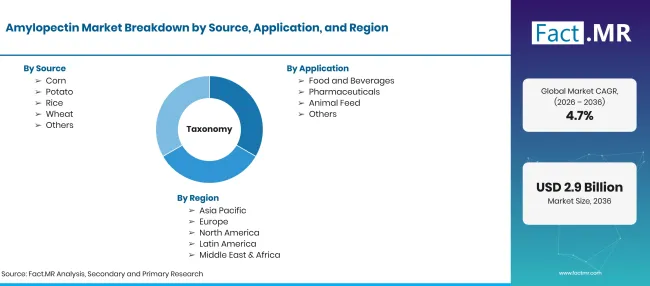
Amylopectin Market Taxonomy | Source: Fact.MR
| Items | Values |
|---|---|
| Quantitative Units (2026) | USD 1.8 Billion |
| Source | Corn, Potato, Rice, Wheat, Others |
| Application | Food and Beverages, Pharmaceuticals, Animal Feed, Others |
| End-User Industry | Food Industry, Pharmaceutical Industry, Animal Nutrition, Others |
| Regions Covered | North America, Latin America, Europe, East Asia, South Asia and Pacific, Middle East & Africa |
| Countries Covered | United States, Germany, Japan, United Kingdom, Brazil, and other countries |
| Key Companies Profiled | Cargill Incorporated, Roquette Frères, Ingredion Incorporated, Tate & Lyle PLC, Avebe U.A., AGRANA Beteiligungs-AG |
| Additional Attributes | Dollar revenue in the Amylopectin Market is segmented by source (corn, potato, rice, wheat), application (food and beverages, pharmaceuticals, animal feed), end-user industry (food, pharmaceutical, animal nutrition) and region. |
Source: Fact.MR analysis. Updated Nov 16, 2026
Amylopectin Market by Segments
-
Source
- Corn
- Potato
- Rice
- Wheat
- Others
-
Application
- Food and Beverages
- Pharmaceuticals
- Animal Feed
- Others
-
End-User Industry
- Food Industry
- Pharmaceutical Industry
- Animal Nutrition
- Others
-
Region:
- North America
- United States
- Canada
- Mexico
- Europe
- Germany
- United Kingdom
- France
- Italy
- Spain
- Rest of Europe
- Asia Pacific
- China
- India
- Japan
- South Korea
- Australia
- Rest of Asia Pacific
- Latin America
- Brazil
- Mexico
- Argentina
- Rest of Latin America
- Middle East & Africa
- GCC Countries
- South Africa
- Rest of Middle East & Africa
- North America
Frequently Asked Questions
How big is the global Amylopectin Market in 2026?
What will be the size of the Amylopectin Market by 2036?
How fast will the Amylopectin Market grow during the forecast period?
Which source segment holds the largest share of the Amylopectin Market?
Who worked on this report


Preview the report firsthand - request a free sample
Free SampleGet the brochure for pricing and purchase details
Download PDF