- Market Value (2025): USD 461.5 Mn
- Estimated Value (2026): USD 499.9 Mn
- Forecast Value (2036): USD 1111.7 Mn
- CAGR (2026-2036): 8.3%
What is the Cold-Water Soluble Hydrocolloids Market forecast to be worth by 2036?
USD 499.9 million in 2026 to USD 1111.7 million by 2036 at an 8.3% CAGR.
- Fact.MR estimates that the cold-water soluble hydrocolloids market was valued at USD 461.5 million in 2025.
- Demand is projected to increase from USD 499.9 million in 2026 to USD 1111.7 million by 2036.
- The forecast represents an 8.3% CAGR from 2026 to 2036 as food manufacturers seek ingredients that support texture, stability, and convenient processing.
| Year | Basis | Market Value (USD million) |
|---|---|---|
| 2025 | Actual | 461.5 |
| 2026 | Estimate | 499.9 |
| 2036 | Forecast | 1111.7 |
| CAGR 2026 to 2036 | Forecast period | 8.3% |
Source: Fact.MR analysis. Updated Nov 11, 2026
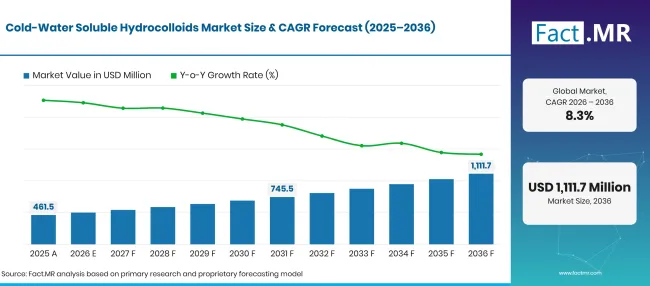
Cold Water Soluble Hydrocolloids Forecast Global | Source: Fact.MR
What are the defining numbers behind Cold-Water Soluble Hydrocolloids Market growth?
USD 611.8 million in additional market value between 2026 and 2036.
- Demand Drivers in the Market
- Expansion of food processing supports demand for functional ingredients. India's Ministry of Food Processing Industries reported in February 2026 that the sector's gross value added increased from ₹1.34 lakh crore in 2014–15 to ₹2.24 lakh crore in 2023–24. Processed food exports also increased to 20.4% of agricultural exports in 2024–25, compared with 13.7% in 2014–15.
- Rising dairy production strengthens demand for stabilization and texture control. India's Ministry of Fisheries, Animal Husbandry and Dairying reported in March 2026 that milk production reached approximately 248 million tonnes in 2024–25, compared with 239 million tonnes in 2023–24. The government also reported 117,928 food businesses holding FSSAI licenses or registration certificates under the milk and milk products manufacturer category as of February 28, 2026.
- Growth in food manufacturing creates opportunities across processed food applications. Eurostat reported in August 2026 that the value of sold production of EU food products increased by 3.8% in 2025 compared with 2024, measured at constant prices. Higher food manufacturing activity can support demand for hydrocolloids used in bakery products, beverages, sauces, prepared foods, and confectionery to deliver consistent texture and processing performance.
- Higher food spending supports demand for convenient and consistent food formats. The USDA Economic Research Service reported in June 2026 that inflation-adjusted U.S. food spending reached USD 2.51 trillion in 2025, up from USD 2.49 trillion in 2024. Food-away-from-home expenditure accounted for 56.3% of total food spending in 2025.
- Key Segments Analyzed
- By Hydrocolloid Type: Acacia is projected to account for 30.2% of the market in 2026, supported by its use in beverage emulsification, stabilization, and confectionery applications.
- By Commercial Ingredient Form: Granulate / Agglomerate is expected to lead with a 26.3% share in 2026. This format can support handling, dosing, and dispersion in industrial food preparation.
- By Food Application: Dairy / Alternatives is projected to hold 26.3% of the market in 2026 as manufacturers use hydrocolloids to manage texture, stability, and consistency.
- By Functional Purchasing Driver: Shelf-life is expected to represent 30.1% of purchasing demand in 2026, reflecting the importance of maintaining product quality during storage and distribution.
- Analyst Opinion at Fact.MR
- Shambhu Nath Jha, Principal Consultant at Fact.MR, states, “Cold-water soluble hydrocolloids are likely to gain attention as food manufacturers look for reliable ways to manage texture and stability without adding complex processing steps. Suppliers that provide consistent hydration performance and application-specific formulation support can strengthen their position across food categories.”
- Strategic Implications
- Manufacturers can strengthen product consistency by providing clear hydration instructions and specifying the recommended water temperature, mixing speed, addition sequence, and dispersion time for each hydrocolloid grade. Detailed technical guidance helps food processors achieve uniform hydration, minimize lump formation, and maintain predictable viscosity across different production batches.
- Ingredient suppliers can expand their application-specific portfolios by developing hydrocolloid grades and blends suited to dairy alternatives, beverages, bakery products, and savory formulations. Tailored solutions that address differences in acidity, processing temperature, ingredient compatibility, and desired texture can help food manufacturers improve formulation performance and reduce product development time.
- Food processors benefit from evaluating ingredient performance under actual manufacturing conditions rather than relying exclusively on laboratory specifications. Testing viscosity development, texture, phase stability, and shelf-life across different processing and storage conditions helps identify suitable hydrocolloid concentrations and reduces the risk of inconsistent finished products.
- Distributors play an important role in improving customer adoption by offering practical guidance on dosage, ingredient compatibility, hydration procedures, and processing requirements. Technical support during ingredient selection and initial production trials can help customers avoid clumping, uneven dispersion, and formulation failures while building confidence in the supplier's product portfolio.
India is projected to record the highest CAGR of 11.0% through 2036, followed by China at 10.5%. The USA is expected to advance at 8.5%, while France is forecast to grow at 7.9% and Germany at 7.1%.
How does the Cold-Water Soluble Hydrocolloids Market break down by segment?
Fact.MR finds that Acacia leads Hydrocolloid Type at 30.2%; Granulate / Agglomerate leads Commercial Ingredient Form at 26.3%; Dairy / Alternatives leads Food Application at 26.3%; and Shelf-life leads Functional Purchasing Driver at 30.1%.
Which Hydrocolloid Type dominates?
Acacia is set to hold a 30.2% share in 2026.
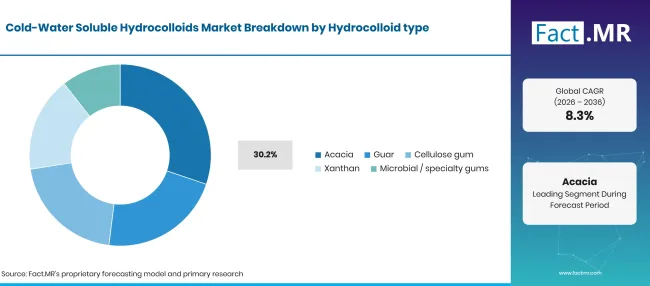
Cold Water Soluble Hydrocolloids Breakdown Hydrocolloid Type | Source: Fact.MR
| Hydrocolloid Type | Share (2026) |
|---|---|
| Acacia (Leading segment) | 30.2% |
| Other segments combined | 69.8%* |
| Total | 100.0% |
Source: Fact.MR analysis. Updated Nov 11, 2026
Acacia gum is used in food formulations where emulsification, stabilization, and controlled texture are important. Its functionality makes it relevant to beverages and confectionery products. Guar gum and xanthan gum serve different thickening and stabilization requirements, while cellulose gum is used to control viscosity and improve consistency. Microbial and specialty gums address more specific formulation needs.
What leads the Commercial Ingredient Form segment?
Granulate / Agglomerate is set to represent a 26.3% share in 2026.
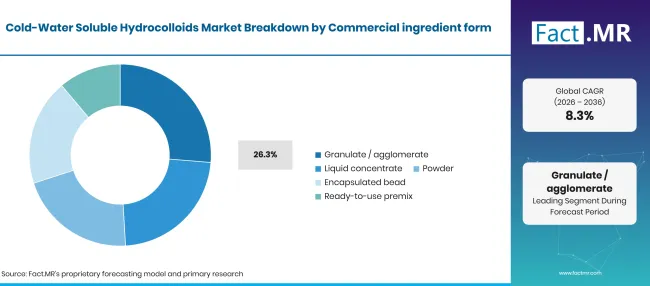
Cold Water Soluble Hydrocolloids Breakdown Commercial Ingredient Form | Source: Fact.MR
| Commercial Ingredient Form | Share (2026) |
|---|---|
| Granulate / Agglomerate (Leading segment) | 26.3% |
| Other segments combined | 73.7%* |
| Total | 100.0% |
Source: Fact.MR analysis. Updated Nov 11, 2026
Granulated and agglomerated ingredients can improve handling and support controlled dosing in food manufacturing. Liquid concentrates are useful where manufacturers prefer ready-to-use ingredient systems, while powders remain relevant for dry blending and formulations that require longer storage. Encapsulated beads and ready-to-use premixes serve specialized applications where controlled ingredient delivery or simplified preparation is important.
Which Food Application accounts for the largest share?
Dairy / Alternatives is projected to account for 26.3% of the market in 2026.
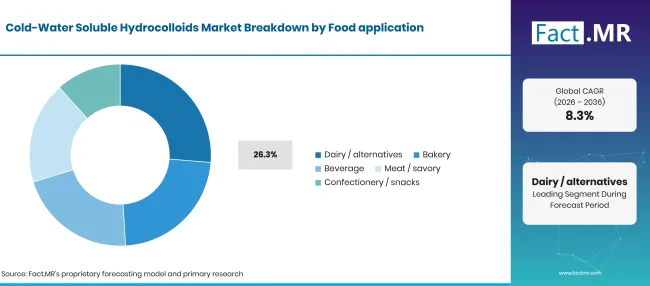
Cold Water Soluble Hydrocolloids Breakdown Food Application | Source: Fact.MR
| Food Application | Share (2026) |
|---|---|
| Dairy / Alternatives (Leading segment) | 26.3% |
| Other segments combined | 73.7%* |
| Total | 100.0% |
Source: Fact.MR analysis. Updated Nov 11, 2026
Dairy products and dairy alternatives require consistent texture and stability across processing and storage. Hydrocolloids can help manage viscosity, reduce phase separation, and improve mouthfeel in products such as yogurt, flavored milk, plant-based beverages, and dairy-style desserts. Beverage manufacturers use hydrocolloids to suspend ingredients and maintain consistency. Bakery, meat and savory, and confectionery applications require different combinations of binding, thickening, and moisture management.
Which Functional Purchasing Driver leads demand?
Shelf-life is expected to account for 30.1% of the market in 2026.
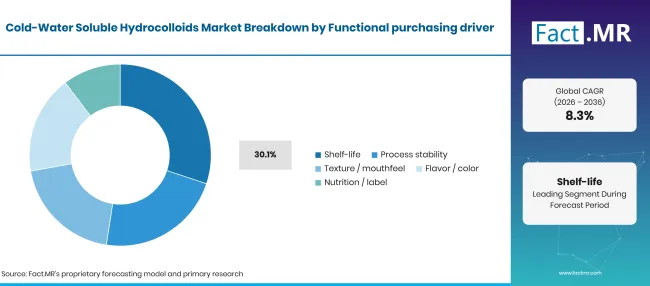
Cold Water Soluble Hydrocolloids Breakdown Functional Purchasing Driver | Source: Fact.MR
| Functional Purchasing Driver | Share (2026) |
|---|---|
| Shelf-life (Leading segment) | 30.1% |
| Other segments combined | 69.9%* |
| Total | 100.0% |
Source: Fact.MR analysis. Updated Nov 11, 2026
Shelf-life requirements influence hydrocolloid selection because manufacturers need products to retain acceptable texture and consistency throughout storage. Process stability is also important during mixing, filling, transportation, and temperature changes. Texture and mouthfeel remain major formulation priorities, particularly in dairy alternatives, beverages, and confectionery. Flavor and color preservation and nutrition or label considerations influence ingredient selection in specific product categories.
What is accelerating Cold-Water Soluble Hydrocolloids Market adoption, and what is holding it back?
Demand for stable textures and convenient food processing supports adoption, while formulation complexity and ingredient costs can limit wider use.
Drivers Impact Analysis
| DRIVER | (~) % IMPACT ON CAGR | GEOGRAPHIC RELEVANCE | IMPACT TIMELINE |
|---|---|---|---|
| Demand for longer product shelf life | +1.0% | Global | Medium term (2–4 years) |
| Growth in dairy and plant-based alternatives | +0.9% | North America, Europe, Asia | Medium term (2–4 years) |
| Demand for improved texture and mouthfeel | +0.7% | Global | Short term (≤ 2 years) |
| Cold-water processing convenience | +0.6% | Global | Medium term (2–4 years) |
| Wider use of hydrocolloids in beverages | +0.5% | Asia, Americas | Long term (≥ 4 years) |
Source: Fact.MR analysis. Updated Nov 11, 2026
Opportunity Impact Analysis
| OPPORTUNITY | (~) % IMPACT ON CAGR | GEOGRAPHIC RELEVANCE | IMPACT TIMELINE |
|---|---|---|---|
| Hydrocolloid systems for dairy alternatives | +0.8% | North America, Europe, Asia | Medium term (2–4 years) |
| Improved instant dispersion and hydration | +0.7% | Global | Medium term (2–4 years) |
| Application-specific blends and premixes | +0.6% | Global | Short term (≤ 2 years) |
| Clean-label formulation development | +0.5% | North America, Europe | Long term (≥ 4 years) |
Source: Fact.MR analysis. Updated Nov 11, 2026
Restraints Impact Analysis
| RESTRAINT | (~) % IMPACT ON CAGR | GEOGRAPHIC RELEVANCE | IMPACT TIMELINE |
|---|---|---|---|
| Raw material price volatility | -0.8% | Global | Short term (≤ 2 years) |
| Clumping and inconsistent hydration | -0.6% | Global | Short term (≤ 2 years) |
| Formulation compatibility constraints | -0.5% | Global | Medium term (2–4 years) |
| Cost pressure in price-sensitive food categories | -0.4% | Asia, Latin America | Medium term (2–4 years) |
Source: Fact.MR analysis. Updated Nov 11, 2026
Which countries are scaling the Cold-Water Soluble Hydrocolloids Market through 2036?
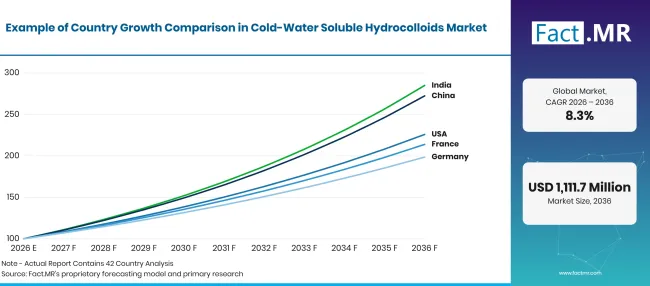
Cold Water Soluble Hydrocolloids Growth Index | Source: Fact.MR
| Country | CAGR (2026–2036) |
|---|---|
| India | 11.0% |
| China | 10.5% |
| USA | 8.5% |
| France | 7.9% |
| Germany | 7.1% |
Source: Fact.MR analysis. Updated Nov 11, 2026
What supports adoption in India?
11.0% CAGR, supported by expanding processed food demand and a broad range of food manufacturing applications.
India's food processing industry serves dairy, bakery, beverage, confectionery, and savory product categories. Hydrocolloids can help manufacturers improve consistency and manage texture across packaged food formats. Suppliers can address this opportunity through cost-effective ingredient grades, dependable local distribution, and technical support for small and large food processors.
What factors are driving growth in China?
10.5% CAGR, driven by food product innovation and demand for functional ingredients across packaged food categories.
China's large food manufacturing base creates opportunities for hydrocolloids in beverages, dairy products, bakery items, and prepared foods. Manufacturers can use cold-water soluble ingredients to manage viscosity, suspension, and texture in products that require consistent performance. China's National Bureau of Statistics reported in February 2026 that value added in the processing of agricultural and sideline food products increased by 5.6% in 2025.
What Supports Adoption of Cold-Water Soluble Hydrocolloids in United States?
8.5% CAGR, supported by demand for convenient food formulations and product consistency.
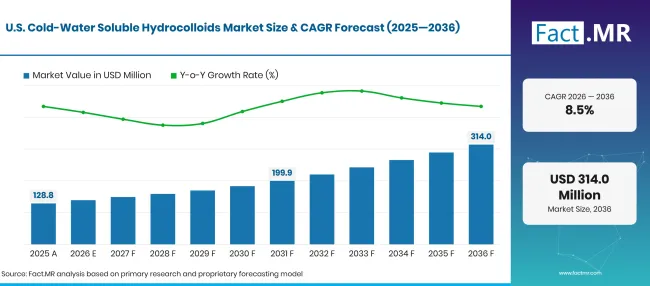
Cold Water Soluble Hydrocolloids Forecast Usa | Source: Fact.MR
The U.S. market includes established demand for dairy products, plant-based alternatives, beverages, sauces, and packaged foods. Hydrocolloids help food manufacturers manage texture and stability while adapting formulations to different processing and storage requirements. Suppliers that provide clear technical documentation and reliable hydration performance can support adoption across food categories.
How is France building adoption?
7.9% CAGR, shaped by demand for functional ingredients across dairy, bakery, beverage, and specialty food applications.
France has an established food processing sector in which product texture and quality are important formulation considerations. Hydrocolloids can support stabilization and mouthfeel in dairy products, desserts, sauces, and beverages. Ingredient suppliers can strengthen their position through application testing and formulation support tailored to food manufacturers. France's Ministry of Agriculture published its 2026 food-industry overview in February 2026, covering company numbers, employment, turnover, value added, and international trade. INSEE reported in July 2026 that French agricultural production increased by 4.7% in value in 2025, while livestock production value rose by 10.1%. This production base supports food manufacturing across dairy, bakery, beverages, and prepared foods. Hydrocolloids can help processors manage stability, viscosity, and mouthfeel in these applications.
Which Factors Drive market growth in Germany?
7.1% CAGR, led by demand for consistent ingredient performance in processed foods and industrial food production.
Germany's food manufacturing sector uses functional ingredients to maintain product quality across bakery, dairy, and prepared food categories. Cold-water soluble hydrocolloids can help simplify selected processing steps and support repeatable texture. Manufacturers are likely to assess hydration behavior, dosage requirements, and compatibility with existing production systems before adopting new grades. Germany's Federal Statistical Office reported that the country had approximately 209,815 manufacturing enterprises employing 7.47 million people in 2024, according to its business register data.
Who leads the Cold-Water Soluble Hydrocolloids Market?
Fact.MR identifies Tate & Lyle PLC, including CP Kelco; Cargill, Incorporated; Ingredion Incorporated; Jungbunzlauer Suisse AG; and International Flavors & Fragrances Inc. (IFF) as key companies in the competitive landscape.
Tate & Lyle's portfolio includes hydrocolloid and texturizing ingredient capabilities through CP Kelco. Cargill and Ingredion participate in the supply of functional food ingredients used for texture and stabilization. Jungbunzlauer offers specialty ingredients including xanthan gum and other hydrocolloid-related products. IFF participates in food ingredient systems and texture solutions through its ingredient portfolio.
Competition depends on ingredient functionality, quality consistency, technical service, supply reliability, and the ability to tailor formulations to specific food applications. Suppliers need to demonstrate how their products perform under the customer's actual mixing, hydration, processing, and storage conditions.
Which companies are the key providers?
Key companies include Tate & Lyle PLC (including CP Kelco); Cargill, Incorporated; Ingredion Incorporated; Jungbunzlauer Suisse AG; and International Flavors & Fragrances Inc. (IFF).
- Tate & Lyle PLC (including CP Kelco)
- Cargill, Incorporated
- Ingredion Incorporated
- Jungbunzlauer Suisse AG
- International Flavors & Fragrances Inc. (IFF)
Bibliography
- Eurostat. (2026, August 24). EU industrial production rebounds in 2025.
- Institut national de la statistique et des études économiques. (2026, July 7). Second Estimates for the 2025 Agricultural Accounts: Prices and Volumes Rebounded After the Decline in 2024. Insee Première, No. 2116.
- Ministry of Agriculture, Agrifood and Food Sovereignty, France. (2026, February 20). Industries agroalimentaires : les chiffres et indicateurs clés 2026..
- National Bureau of Statistics of China. (2026, February 28). Statistical Communiqué of the People’s Republic of China on the 2025 National Economic and Social Development..
- Press Information Bureau, Ministry of Fisheries, Animal Husbandry and Dairying, Government of India. (2026, March 13). Production and Consumption of Milk..
- Press Information Bureau, Ministry of Food Processing Industries, Government of India. (2026, February 6). Status and Progress of Food Processing Sector.
- Statistisches Bundesamt (Destatis). (2025, December 1). Business Register: Legal Units, Employees and Turnover 2024.
- U.S. Department of Agriculture, Economic Research Service. (2026, June 11). Total U.S. food spending reached $2.51 trillion in 2025.
This Report Answers
- The report examines demand for cold-water soluble hydrocolloids across the specified hydrocolloid types and commercial ingredient forms.
- Segment analysis compares the leading food applications and functional purchasing drivers using their 2026 market shares.
- Country analysis discusses the USA, China, Germany, India, and France alongside their projected market growth rates.
- The competitive overview profiles Tate & Lyle, Cargill, Ingredion, Jungbunzlauer, and IFF.
- Application analysis explains how hydrocolloid functionality supports shelf-life, process stability, texture, and other food formulation requirements.
What does the Cold-Water Soluble Hydrocolloids Market cover?
The market covers food-grade hydrocolloid ingredients that hydrate or disperse in cold or ambient-temperature water and provide functional properties in food formulations. It includes acacia, guar, cellulose gum, xanthan, and microbial or specialty gums supplied in the specified commercial forms. Applications include dairy and dairy alternatives, bakery, beverages, meat and savory products, and confectionery and snacks.
What is included in the scope?
Included products are food-grade hydrocolloids marketed for cold-water hydration or dispersion and used to provide thickening, stabilization, suspension, binding, or texture control.
The scope covers granulates and agglomerates, liquid concentrates, powders, encapsulated beads, and ready-to-use premixes when they are sold for the food applications.
What is excluded from the scope?
The analysis excludes hydrocolloids sold solely for pharmaceutical, personal care, oilfield, paper, textile, or other non-food applications.
It also excludes food ingredients that do not meet the defined cold-water solubility or dispersion requirement. Finished food and beverage products, food processing equipment, and general-purpose stabilizer systems without the specified hydrocolloid ingredients are outside the defined market boundary.
How Was the Analysis Built?
The analysis draws on 120+ sources, 35+ company portfolios, 25+ countries, and more than 20 industry interviews.
- Primary Research: Primary research includes discussions with hydrocolloid manufacturers, ingredient suppliers, food processors, distributors, application specialists, and subject-matter experts. These conversations examine ingredient selection, purchasing priorities, hydration performance, processing challenges, pricing, and adoption across food applications.
- Desk Research: Desk research covers government publications, company filings, product documentation, food industry data, trade publications, technical studies, industry associations, and regulatory materials. Sources used in the analysis are documented in the bibliography.
- Market Sizing and Forecasting: Market estimates combine historical performance, ingredient demand, pricing and volume trends, segment shares, company participation, country-level growth, food processing activity, and barriers to market expansion.
- Data Validation and Update Cycle: Findings are validated by comparing primary interviews with public information, company product portfolios, technical documentation, and industry developments. Regular updates review product launches, portfolio changes, capacity developments, partnerships, and shifts in commercial adoption.
Segmentation
What is the report's scope and coverage?
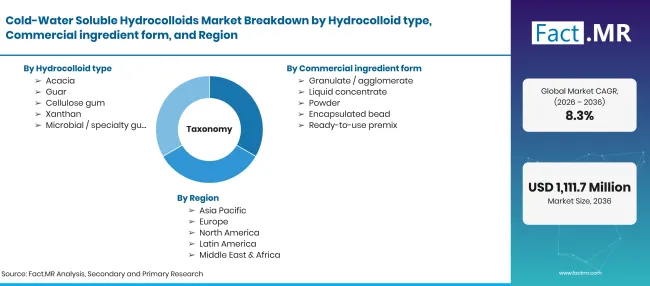
Cold Water Soluble Hydrocolloids Taxonomy | Source: Fact.MR
| Attribute | Details |
|---|---|
| Quantitative Units | USD million in 2026 to USD million by 2036, at CAGR |
| Market Definition | Cold-water soluble hydrocolloids are food-grade ingredients that hydrate or disperse in cold water to provide thickening and stabilization. They improve viscosity and texture while maintaining product consistency in dairy products and beverages as well as bakery items and processed foods. |
| Hydrocolloid Type | Acacia; Guar; Cellulose Gum; Xanthan; Microbial / Specialty Gums |
| Commercial Ingredient Form | Granulate / Agglomerate; Liquid Concentrate; Powder; Encapsulated Bead; Ready-to-Use Premix |
| Food Application | Dairy / Alternatives; Bakery; Beverage; Meat / Savory; Confectionery / Snacks |
| Functional Purchasing Driver | Shelf-life; Process Stability; Texture / Mouthfeel; Flavor / Color; Nutrition / Label |
| Regions Covered | North America; Latin America; Western Europe; Eastern Europe; East Asia; South Asia & Pacific; Middle East & Africa |
| Countries Covered | USA; China; Germany; India; France |
| Companies Profiled | Tate & Lyle PLC (including CP Kelco); Cargill; Ingredion; Jungbunzlauer; IFF |
| Forecast Period | 2026 to 2036 |
| Approach | Market segmentation and scenario-based analysis supported by food processing trends, company portfolios, and industry demand indicators |
Source: Fact.MR analysis. Updated Nov 11, 2026
How is the market segmented?
-
By Hydrocolloid Type
- Acacia
- Guar
- Cellulose Gum
- Xanthan
- Microbial / Specialty Gums
-
By Commercial Ingredient Form
- Granulate / Agglomerate
- Liquid Concentrate
- Powder
- Encapsulated Bead
- Ready-to-Use Premix
-
By Food Application
- Dairy / Alternatives
- Bakery
- Beverage
- Meat / Savory
- Confectionery / Snacks
-
By Functional Purchasing Driver
- Shelf-life
- Process Stability
- Texture / Mouthfeel
- Flavor / Color
- Nutrition / Label
-
By Region
- North America
- Latin America
- Western Europe
- Eastern Europe
- East Asia
- South Asia & Pacific
- Middle East & Africa
Frequently Asked Questions
How big is the Cold-Water Soluble Hydrocolloids Market in 2026?
What is the CAGR from 2026 to 2036?
Which hydrocolloid type has the largest share?
Which commercial ingredient form leads?
Which food application has the largest share?
Which functional purchasing driver leads?
Which countries are covered in the report?
Which companies are covered?
Who worked on this report


Preview the report firsthand - request a free sample
Free SampleGet the brochure for pricing and purchase details
Download PDF