- Market Value (2025): USD 129.9 Mn
- Estimated Value (2026): USD 140.0 Mn
- Forecast Value (2036): USD 296.7 Mn
- CAGR (2026-2036): 7.8%
Controlled-Release Nutrient Matrices Market Forecast and Outlook 2026 to 2036
The controlled-release nutrient matrices market is poised to expand from USD 140.0 million in 2026 to USD 296.7 million by 2036. Demand for controlled-release nutrient matrices is forecast to record a CAGR of 7.8% over the forecast period.
Demand is increasing as makers of supplements and medical nutrition want vitamins, minerals, amino acids, caffeine and probiotics to be released over hours or at a chosen point in the gut, so that blood levels stay steady, stomach irritation is reduced and sensitive actives survive stomach acid. Ingredient suppliers are offering biopolymer microspheres, coated granules, lipid matrices and hydrogels made with pharmaceutical coating and extrusion methods. For example, in November 2026, Evonik reported a 40% rise in third-quarter adjusted EBITDA to EUR 629 million and lifted its profit outlook.
Market Highlights for the Controlled-Release Nutrient Matrices Market
- Sales of controlled-release nutrient matrices stood at USD 129.9 million in 2025
- Controlled-Release Nutrient Matrices Market Value (2026): USD 140.0 million
- Controlled-Release Nutrient Matrices Market Forecast Value (2036): USD 296.7 million
- Controlled-Release Nutrient Matrices Market Forecast CAGR (2026-2036): 7.8%
- Leading Product Type: Biopolymer microsphere (26.3%)
- Key Market Participants: Balchem, Lonza, Glatt, DSM-Firmenich, BASF, Evonik
- Key Growth Regions: Germany, United Kingdom, Switzerland, France, Japan
In October 2026, Balchem reported that earnings from operations in Human Nutrition and Health rose 11.8% to USD 45.6 million on higher sales and a favorable mix. Customer interest is increasing as higher-value delivery forms lift supplier margins and encourage investment. Delivery-technology developers are adapting drug delivery polymers to food-grade rules. Balchem’s Human Nutrition and Health results show supplier activity, while demand for controlled-release nutrient matrices requires product-level evidence.
Controlled-Release Nutrient Matrices Market
| Metric | Value |
|---|---|
| Estimated Value in (2026) | USD 140.0 million |
| Forecast Value in (2036) | USD 296.7 million |
| Forecast CAGR (2026 to 2036) | 7.8% |
Source: Fact.MR analysis. Updated Nov 21, 2026
Source: Fact.MR analysis.
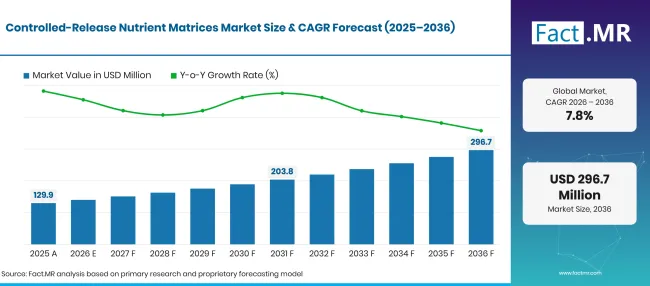
Controlled Release Nutrient Matrices Forecast Global | Source: Fact.MR
Category
| Category | Segments |
|---|---|
| Product Type | Biopolymer microsphere, Coated nutrient granule, Lipid sustained-release matrix, Hydrogel controlled release, Hybrid nutrient release |
| Delivery Form | Medical device and system, Liquid, Tablet and capsule, Powder, Specialty controlled-release |
| Clinical Use | Preventive care, Acute care, Nutrition support, Specialty and rare condition, Long-term management |
| Purchasing Channel | Specialty clinic, Medical nutrition OEM, Pharmacy, Hospital, Home and community |
| Region | Germany; United Kingdom; Switzerland; France; Japan |
Source: Fact.MR analysis. Updated Nov 21, 2026
Segmental Analysis
Why do biopolymer microspheres lead product demand in the Controlled-Release Nutrient Matrices Market?
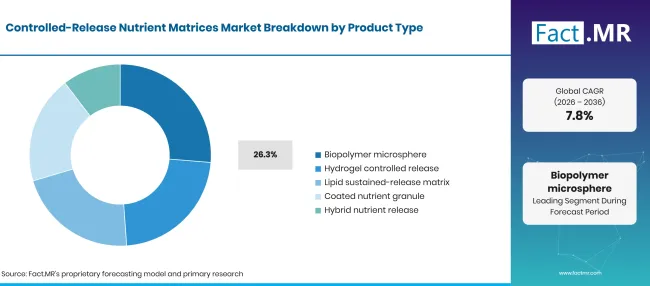
Controlled Release Nutrient Matrices Breakdown Product Type | Source: Fact.MR
Biopolymer microspheres hold 26.3% of the controlled-release nutrient matrices market in 2026, valued at USD 36.8 million, because materials such as alginate, pectin and zein can protect nutrients and control their release during digestion. A June 2025 study examined pectin-zein beads for delivering bioactive compounds to the colon, showing their ability to protect encapsulated ingredients and manage release under simulated digestive conditions.
How are medical devices and systems leading form demand in the Controlled-Release Nutrient Matrices Market?
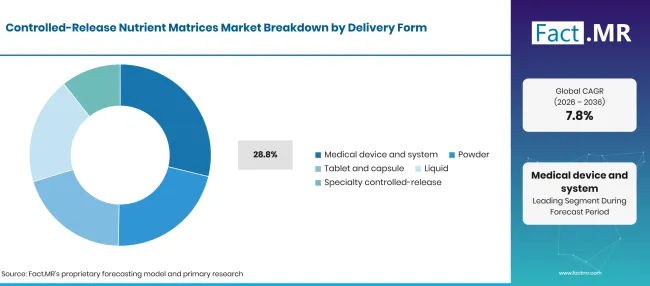
Controlled Release Nutrient Matrices Breakdown Delivery Form | Source: Fact.MR
Medical device and system formats account for a reported 28.8% of controlled-release nutrient matrices revenue in 2026, equivalent to USD 40.3 million. Specialized clinical delivery systems can support controlled nutrient administration and tailored nutritional care. Their application depends on compatibility with clinical equipment, formulation stability and suitable nutrient-release characteristics. Manufacturers are developing delivery technologies that support consistent administration and nutritional performance.
Why does preventive care lead clinical demand in the Controlled-Release Nutrient Matrices Market?
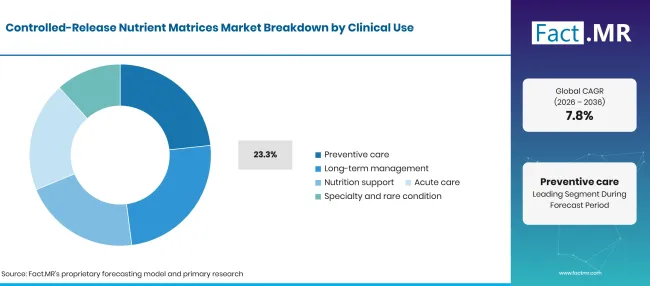
Controlled Release Nutrient Matrices Breakdown Clinical Use | Source: Fact.MR
Preventive care represents 23.3% of controlled-release nutrient matrices revenue in 2026, equivalent to USD 32.6 million, as consumers seek convenient supplement formats for daily nutritional support. In January 2025, The Vitamin Shoppe introduced BodyTech Elite Creatine Beadlets using Specnova's NovaQSpheres multilayer encapsulation technology, designed for time-release delivery. The launch demonstrates commercial interest in alternative nutrient delivery formats.
How are specialty clinics leading channel demand in the Controlled-Release Nutrient Matrices Market?
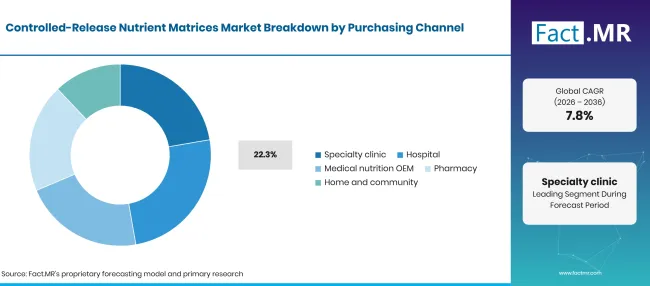
Controlled Release Nutrient Matrices Breakdown Purchasing Channel | Source: Fact.MR
Specialty clinics contribute 22.3% of controlled-release nutrient matrices revenue in 2026, worth USD 31.2 million, because patients receiving bariatric, metabolic and nutritional care often require supplements selected for their individual absorption needs. Updated bariatric nutrition guidance published in 2025 emphasized the importance of tailored micronutrient supplementation and regular nutritional monitoring after surgery.
Controlled-Release Nutrient Matrices Market-Drivers, Restraints & Trends
Drivers
Demand is increasing as nutrition and health ingredient suppliers expand. For example, dsm-firmenich reported 5% organic growth in Health, Nutrition & Care in the third quarter of 2026 and raised its full-year outlook, citing more contract wins. Delivery-technology developers are winning projects where brands want differentiated delivery.
Restraints
Demand for controlled-release nutrient matrices is constrained by the limited list of coating materials permitted in food, added cost and regulatory change. For example, advisers warned in June 2026 that harmonized EU maximum levels for vitamins and minerals were coming and would likely be low, which affects high-dose sustained-release products.
Trend
Pharmaceutical Technology in Nutrition Demand for supplements made with fluid-bed coating, hot-melt extrusion and multiparticulate capsules is rising. Suppliers are transferring pharmaceutical know-how to nutrition lines. UK manufacturers are expanding supplement formulation and production activities, while nutrient microencapsulation technologies are being offered to domestic food and nutrition producers.
Trend
Probiotic and Gut-Targeted Release In November 2026, dsm-firmenich reported strong demand for human milk oligosaccharides within Early Life Nutrition. Demand for matrices that deliver actives to the lower intestine is rising.
Controlled-Release Nutrient Matrices Market by Analysis by Key Country
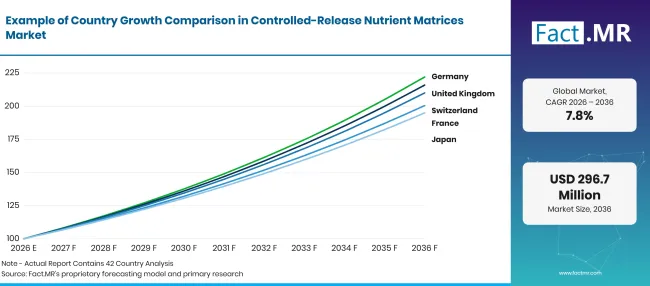
Controlled Release Nutrient Matrices Growth Index | Source: Fact.MR
| Country | CAGR (2026-2036) |
|---|---|
| Germany | 8.3% |
| United Kingdom | 8.0% |
| Switzerland | 7.7% |
| France | 7.2% |
| Japan | 6.9% |
Source: Fact.MR analysis. Updated Nov 21, 2026
Source: Fact.MR analysis.
What is driving controlled-release nutrient matrices demand in Germany?
In November 2026, Evonik, a leading maker of functional coating polymers, raised its profit outlook after a strong third quarter.
Demand for controlled-release nutrient matrices in Germany is projected to grow at an 8.3% CAGR, the fastest among the five key countries, as German coating technology firms such as Glatt and polymer suppliers work with a large contract manufacturing base for supplements.
How is life sciences investment supporting controlled-release nutrient matrices sales in the United Kingdom?
Sales of controlled-release nutrient matrices in the United Kingdom are projected to grow at an 8.0% CAGR as supplement manufacturing and nutrient encapsulation activities expand.
In 2026, UK supplement manufacturer Chrysalis Health announced an expansion of its manufacturing operations through a move to purpose-built premises. The UK also has commercial activity in nutrient microencapsulation, including Xampla's technology partnership with Lehmann Ingredients for food and beverage applications. Formulation specialists are working with supplement producers to improve nutrient protection, processing stability and targeted delivery.
What is shaping controlled-release nutrient matrices demand in Switzerland?
Demand for controlled-release nutrient matrices in Switzerland is projected to grow at a 7.7% CAGR as the country hosts global nutrition and capsule companies.
dsm-firmenich, based in Kaiseraugst, raised its outlook in November 2026, and Lonza supplies specialty capsules for delayed release. Ingredient suppliers are working with Swiss nutrition and pharmaceutical groups.
How is supplement demand shaping controlled-release nutrient matrices sales in France?
Sales of controlled-release nutrient matrices in France are projected to grow at a 7.2% CAGR as the supplement market grows.
Synadiet reported in March 2026 that French supplement sales passed EUR 3 billion in 2025. Delivery-technology developers are serving French laboratories that sell sustained-release magnesium, iron and sleep products through pharmacies.
Why is growth slower for controlled-release nutrient matrices in Japan?
Demand for controlled-release nutrient matrices in Japan is projected to grow at a 6.9% CAGR, the slowest among the five countries, as Japanese consumers favor small tablets, drinks and jellies and strict additive rules narrow the choice of coating materials.
The elderly share of the population reached a record 29.6% in September 2026, which supports demand for easy-to-take products. Matrix producers are adapting systems to Japanese formats.
Competitive Landscape for Controlled-Release Nutrient Matrices Market
Product development in the controlled-release nutrient matrices market spans encapsulated ingredients, specialized capsules and coating technologies. Balchem offers encapsulation solutions for nutrient stability and controlled delivery, while Lonza provides capsule systems designed for delayed release. Glatt contributes fluid-bed processing and formulation services. DSM-Firmenich and BASF supply vitamin-based ingredient formulations, whereas Evonik specializes in functional polymers for controlled-release applications. Differences in nutrient protection, release timing, ingredient compatibility and production costs influence purchasing decisions.
In November 2026, DSM-Firmenich increased its full-year like-for-like sales growth outlook to around 5%, while Evonik maintained its adjusted EBITDA guidance of EUR 2.0 billion to EUR 2.2 billion, targeting the upper half of that range. Balchem reported an 8.1% increase in Human Nutrition and Health sales during the third quarter of 2026. Alongside these developments, European food supplement rules continue to influence ingredient selection and formulation standards. Manufacturers offering consistent nutrient release, suitable food-grade materials and reliable product performance will have stronger opportunities to secure customer contracts.
Recent Developments
- In November 2024, DSM-Firmenich partnered with Rohto Pharmaceutical to launch Vision R in Japan, incorporating patented Sprinkle It Technology with multilayered nutrient granules designed to protect micronutrients and support their release after consumption.
Key Players in Controlled-Release Nutrient Matrices Market
Key companies profiled include Balchem; Lonza; Glatt; DSM-Firmenich; BASF; and Evonik.
- Balchem
- Lonza
- Glatt
- DSM-Firmenich
- BASF
- Evonik
Bibliography
- Agence nationale de sécurité sanitaire de l’alimentation, de l’environnement et du travail. (2026, November 9). Avis relatif à l’évaluation d’une quantité journalière maximale de 5 g de créatine dans les compléments alimentaires.
- BASF. (2025, October 15). BASF launches combined vitamin A and D3 product for animal nutrition.
- Balchem Corporation. (2026, October 23). Balchem reports third quarter 2026 financial results.
- DSM-Firmenich. (2024, November 7). dsm-firmenich launches innovative multivitamin solution to support healthy longevity amongst Japanese seniors.
- dsm-firmenich. (2026, November 4). dsm-firmenich reports Q3 2026 trading update.
- Evonik Industries AG. (2026, November 3). Evonik more optimistic after strong third quarter.
- Glanbia plc. (2026, November 4). Third quarter 2026 interim management statement.
- Herbalife Ltd. (2026, November 2). Herbalife achieves third quarter net sales growth of 6.0%; strong profitability and robust operating cash flow; fifth consecutive quarter of expansion.
- HM Treasury. (2026, October 28). Budget 2026. GOV.UK.
- Synadiet. (2026, February 12). Santé mentale, numérique, pouvoir d’achat, compléments alimentaires : la santé du quotidien devient une priorité pour les Français.
- U.S. Food and Drug Administration. (2026, October 19). FDA issues guidance on identity and safety information for new dietary ingredient notifications.
- U.S. Food and Drug Administration. (2026, November 16). FDA issues proposed rule on NAC products as dietary supplements.
Segmentation
Scope of Report
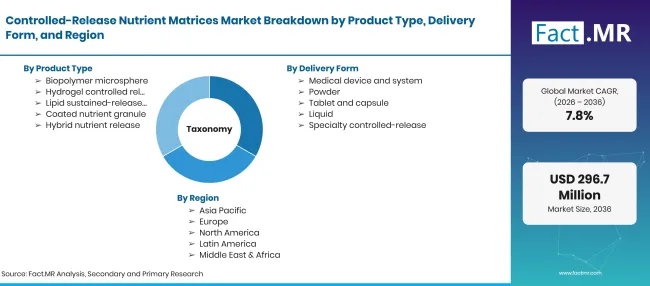
Controlled Release Nutrient Matrices Taxonomy | Source: Fact.MR
| Items | Values |
|---|---|
| Quantitative Units (2026) | USD 140.0 Million |
| Product Type | Biopolymer microsphere, Coated nutrient granule, Lipid sustained-release matrix, Hydrogel controlled release, Hybrid nutrient release |
| Delivery Form | Medical device and system, Liquid, Tablet and capsule, Powder, Specialty controlled-release |
| Clinical Use | Preventive care, Acute care, Nutrition support, Specialty and rare condition, Long-term management |
| Purchasing Channel | Specialty clinic, Medical nutrition OEM, Pharmacy, Hospital, Home and community |
| Regions Covered | North America, Latin America, Europe, East Asia, South Asia and Pacific, Middle East & Africa |
| Countries Covered | Germany, United Kingdom, Switzerland, France, Japan, and other countries |
| Key Companies Profiled | Balchem, Lonza, Glatt, DSM-Firmenich, BASF, Evonik |
| Additional Attributes | Dollar revenue in the Controlled-Release Nutrient Matrices Market is segmented by product type (biopolymer microsphere, coated granule, lipid sustained-release matrix, hydrogel, hybrid release), delivery form, clinical use, purchasing channel and region. |
Source: Fact.MR analysis. Updated Nov 21, 2026
Controlled-Release Nutrient Matrices Market by Segments
-
Product Type
- Biopolymer microsphere
- Coated nutrient granule
- Lipid sustained-release matrix
- Hydrogel controlled release
- Hybrid nutrient release
-
Delivery Form
- Medical device and system
- Liquid
- Tablet and capsule
- Powder
- Specialty controlled-release
-
Clinical Use
- Preventive care
- Acute care
- Nutrition support
- Specialty and rare condition
- Long-term management
-
Purchasing Channel
- Specialty clinic
- Medical nutrition OEM
- Pharmacy
- Hospital
- Home and community
-
Region:
- North America
- United States
- Canada
- Mexico
- Europe
- Germany
- United Kingdom
- France
- Italy
- Spain
- Rest of Europe
- Asia Pacific
- China
- India
- Japan
- South Korea
- Australia
- Rest of Asia Pacific
- Latin America
- Brazil
- Mexico
- Argentina
- Rest of Latin America
- Middle East & Africa
- GCC Countries
- South Africa
- Rest of Middle East & Africa
- North America
Frequently Asked Questions
How big is the global Controlled-Release Nutrient Matrices Market in 2026?
What will be the size of the Controlled-Release Nutrient Matrices Market by 2036?
How fast will the Controlled-Release Nutrient Matrices Market grow during the forecast period?
Which product type segment holds the largest share of the Controlled-Release Nutrient Matrices Market?
Who worked on this report


Preview the report firsthand - request a free sample
Free SampleGet the brochure for pricing and purchase details
Download PDF