- Market Value (2025): USD 453.1 Mn
- Estimated Value (2026): USD 160.0 Mn
- Forecast Value (2036): USD 1487.2 Mn
- CAGR (2026-2036): 11.4%
Microencapsulated Meat Acidulants Market Forecast and Outlook 2026 to 2036
According to the Fact.MR analysis, the microencapsulated meat acidulants market was valued at USD 453.1 million in 2025 and is projected to grow from USD 160.0 million in 2026 to USD 1,487.2 million by 2036. Demand for microencapsulated meat acidulants is likely to grow at a CAGR of 11.4% over the forecast period.
Demand for microencapsulated meat acidulants is rising as sausage, cured meat and ready-meal makers use coated acids that release during cooking or drying to lower pH quickly and safely. Encapsulation keeps acids from damaging meat proteins and color during mixing, then triggers acidification at a set temperature. For example, EU Regulation (EU) 2023/2108 lowered permitted nitrite and nitrate levels in meat products, with new limits applying from October 2025, increasing interest in other safety hurdles such as controlled acidification. Similar rules are projected to drive sales of microencapsulated meat acidulants through 2036.
Key Takeaways from the Microencapsulated Meat Acidulants Market
- Microencapsulated Meat Acidulants Market Value (2025): USD 453.1 million
- Microencapsulated Meat Acidulants Market Value (2026): USD 160.0 million
- Microencapsulated Meat Acidulants Market Forecast Value (2036): USD 1,487.2 million
- Microencapsulated Meat Acidulants Market Forecast CAGR (2026-2036): 11.4%
- Leading Meat acidulant function: Cured meats (28.4%)
- Key Market Participants: Corbion, Jungbunzlauer, Balchem, Kerry Group, Innophos, Cargill
- Key Growth Regions: China, Brazil, United States, France, Germany
In June 2025, JBS listed its shares on the New York Stock Exchange, highlighting the scale of Brazilian meat processing serving global markets. Demand for microencapsulated meat acidulants is growing as large processors standardize fermented and cooked products across plants. Manufacturers such as Balchem, Corbion and Kerry offer encapsulated acids for meat. Similar industry scale is projected to drive sales of microencapsulated meat acidulants worldwide.
Microencapsulated Meat Acidulants Market
| Metric | Value |
|---|---|
| Estimated Value in (2026) | USD 160.0 million |
| Forecast Value in (2036) | USD 1,487.2 million |
| Forecast CAGR (2026 to 2036) | 11.4% |
Source: Fact.MR analysis. Updated Nov 20, 2026
Source: Fact.MR analysis.
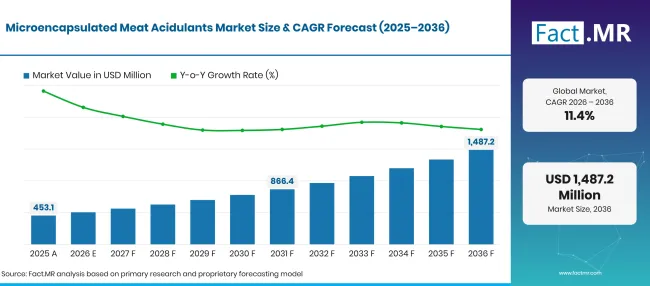
Microencapsulated Meat Acidulants Forecast Global | Source: Fact.MR
Category
| Category | Segments |
|---|---|
| Meat acidulant function | Fermented sausage, Cured meats, Ready meals, Meat alternatives, Cooked meat preservation |
| Commercial form | Powder, Liquid concentrate, Granulate, Encapsulated bead, Ready-to-use premix |
| Food application | Bakery, Dairy / alternatives, Beverage, Meat / savory, Confectionery / snacks |
| Primary function | Shelf-life, Texture / rheology, Taste / color, Nutritional functionality, Processing stability |
| Region | China; Brazil; United States; France; Germany |
Source: Fact.MR analysis. Updated Nov 20, 2026
Source: Fact.MR analysis.
Segmental Analysis
Why do Cured meats lead function demand in the Microencapsulated Meat Acidulants Market?
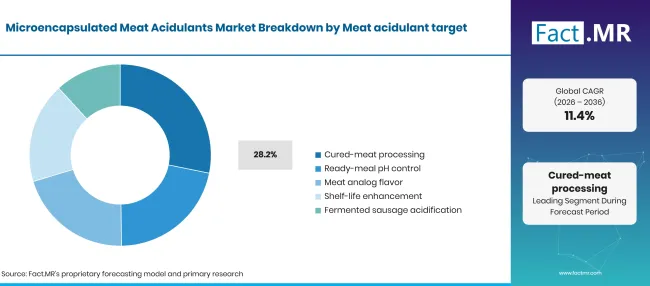
Microencapsulated Meat Acidulants Breakdown Meat Acidulant Target | Source: Fact.MR
Sales of cured meats account for 28.2% of revenue in 2026, about USD 45.4 million, as hams, bacon and dry-cured products use acidulants to support curing, color and safety, especially with lower nitrite levels. Fermented sausages and meat alternatives follow. Manufacturers are offering acidulants tuned for cure systems. Demand for controlled acid delivery is particularly relevant in formulations requiring precise pH management. In April 2026, India's FSSAI extended the compliance period for revised meat sausage standards by six months, reflecting ongoing regulatory and technical adjustments in processed meat manufacturing. These developments support demand for specialized ingredients in meat processing.
Why do Granulates lead commercial-form demand in the Microencapsulated Meat Acidulants Market?
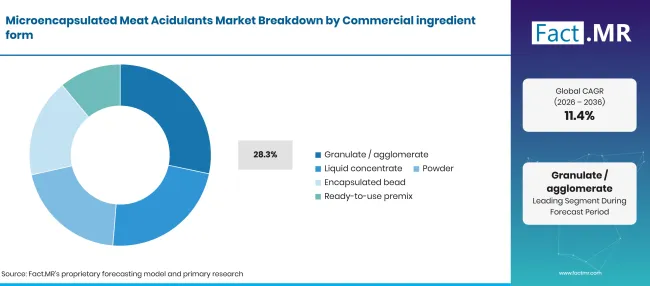
Microencapsulated Meat Acidulants Breakdown Commercial Ingredient Form | Source: Fact.MR
Demand for granulates captures 28.3% of revenue in 2026, about USD 51.5 million, as granular encapsulates survive grinding and mixing and disperse evenly in meat batters. Encapsulated beads follow. Manufacturers are offering size-graded granules. Granular encapsulates can be incorporated into meat batters while helping protect acidulants from premature release during processing. In June 2026, U.S. commercial red meat production reached 4.39 billion pounds, with pork production increasing 7% year over year. This large-scale processing activity supports demand for ingredients that can be consistently incorporated into industrial meat formulations.
Why does Dairy / alternatives lead application demand in the Microencapsulated Meat Acidulants Market?
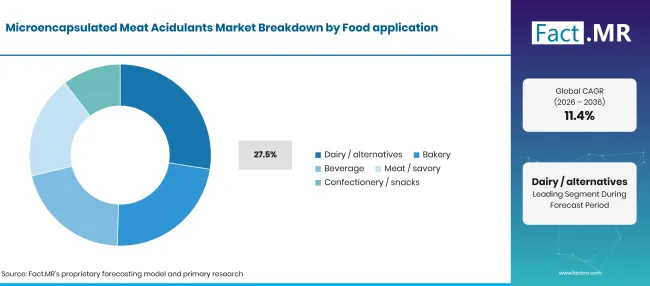
Microencapsulated Meat Acidulants Breakdown Food Application | Source: Fact.MR
Sales of dairy / alternatives holds 27.5% of revenue in 2026, about USD 42.4 million, as the same encapsulation technology is used in cheese, cultured dairy and plant-based alternatives that mimic meat and dairy textures. Bakery and beverage follow. Manufacturers are extending meat acidulants into adjacent uses. The technology offers opportunities to manage acidity during processing while supporting product consistency. According to USDA, U.S. cheese production reached 1.23 billion pounds in September 2026, increasing 0.7% year over year. This production activity provides a supporting indicator for demand across industrial dairy ingredient applications.
Why does Texture / rheology lead primary function in the Microencapsulated Meat Acidulants Market?
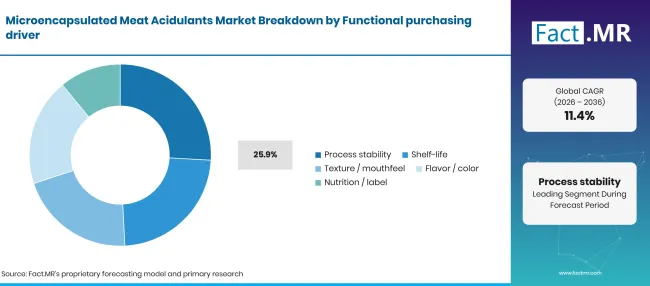
Microencapsulated Meat Acidulants Breakdown Functional Purchasing Driver | Source: Fact.MR
Texture / rheology accounts for 25.9% of revenue in 2026, about USD 37.0 million, as timed pH drops firm meat proteins and give sliceable texture in sausages. Processing stability and shelf life follow. Manufacturers market texture control alongside safety. Encapsulation helps prevent premature acidification during mixing and allows more controlled release during subsequent processing. India's FSSAI added revised categories for fresh, cooked, smoked and dry-fermented meat sausages to its food standards database in January 2026. These regulatory developments reinforce the importance of formulation consistency and processing control in commercial meat production.
Microencapsulated Meat Acidulants Market-Drivers, Restraints & Trends
Drivers – Faster Processing and Higher Meat Production
Demand for microencapsulated meat acidulants is increasing as sausage and snack-stick manufacturers seek shorter acidification cycles, consistent product quality and improved production-line efficiency. Encapsulated lactic and citric acid systems can provide controlled acid release, helping processors accelerate pH reduction in selected fermented meat formulations. According to the UK Department for Environment, Food and Rural Affairs, meat production reached 4.116 million tonnes in 2025, with the figures published in September 2026. Separately, USDA projected U.S. per-capita availability of beef, pork, broilers and turkey at 228.8 pounds in 2026. These figures indicate a substantial meat supply base for value-added processing applications.
Restraints – Traditional Flavor Expectations and Product Acceptance
Sales of microencapsulated meat acidulants can be constrained when accelerated acidification produces sharper sourness, different aroma profiles or textural changes compared with conventional starter-culture fermentation. This is particularly relevant to premium dry sausages, where consumers expect established flavor characteristics from traditional curing and maturation. The UK Food Standards Agency's 2026 Food and You 2 survey found that 49% of respondents had eaten less processed food for health reasons during the preceding 12 months. This indicates additional pressure on processed-meat manufacturers to demonstrate product quality and consumer acceptance. Acidulant suppliers must balance faster processing with flavor consistency and formulation stability.
Opportunity – Nitrite Reduction and Multi-Hurdle Preservation
Demand for acidulants that support reduced-nitrite meat formulations is creating opportunities for encapsulated ingredient suppliers. Meat processors are exploring combinations of organic acids, vegetable-derived curing ingredients and antimicrobial systems to maintain microbial control while meeting changing formulation requirements. The USDA Food Safety and Inspection Service recognizes nitrite's role in controlling Clostridium botulinum, preserving cured-meat color and developing characteristic flavor. This makes validated alternative preservation systems important when reducing curing ingredients.
Trend – Plant-Based Meat Acidification
Demand for specialized acidulants is expanding into plant-based meat formulations as manufacturers adapt sausages, burgers and meat alternatives to different protein structures and flavor requirements. Plant proteins respond differently to changes in pH than animal proteins, creating opportunities for encapsulated acids that provide controlled acidification without compromising texture, moisture retention and taste. India's Ministry of Food Processing Industries reported in February 2026 that food-processing sector GVA reached INR 2.24 lakh crore in 2023–24, while processed-food exports increased to 20.4% of agricultural exports in 2024–25. This expanding processing ecosystem creates opportunities for specialized ingredient development.
Microencapsulated Meat Acidulants Market by Analysis by Key Country
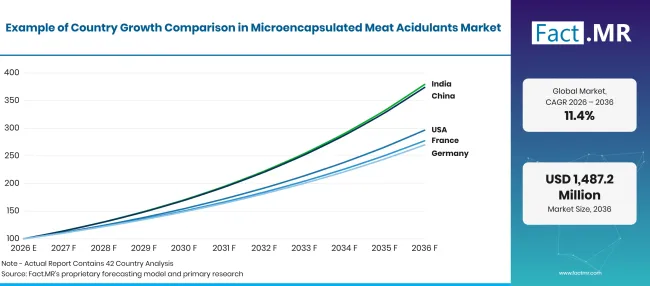
Microencapsulated Meat Acidulants Growth Index | Source: Fact.MR
| Country | CAGR (2026-2036) |
|---|---|
| China | 10.8% |
| Brazil | 10.5% |
| United States | 9.3% |
| France | 8.7% |
| Germany | 8.6% |
Source: Fact.MR analysis. Updated Nov 20, 2026
Source: Fact.MR analysis.
WHAT is accelerating China's demand for microencapsulated meat acidulants?
China's microencapsulated meat acidulant market is projected to grow at a 10.8% CAGR, supported by large-scale pork processing, packaged meat production and demand for convenient ready-to-eat foods.
Major processors such as WH Group require consistent acidity management across sausage and processed pork production. China's National Bureau of Statistics reported that the country's pork production reached 42.38 million tonnes in the first three quarters of 2026, increasing 2.2% year over year. Higher pork output supports opportunities for specialized ingredients that improve formulation consistency and controlled acid release.
WHICH factors are expanding microencapsulated meat acidulant sales in Brazil?
Brazil is forecast to record a 10.5% CAGR as large processors such as JBS and BRF expand processed poultry, pork products and value-added meat exports.
Microencapsulated acidulants offer controlled acidification in sausages and fermented meat formulations, helping manufacturers manage processing consistency and product quality. According to Brazil's Ministry of Agriculture and Livestock, the country exported approximately 5.3 million tonnes of poultry meat in 2025, reinforcing its position as a major global poultry supplier. This substantial processing and export base supports demand for specialized meat-processing ingredients.
HOW are meat snack manufacturers supporting microencapsulated meat acidulant demand in the United States?
The United States is projected to register a 9.3% CAGR as meat snack manufacturers expand production of beef sticks, jerky and fermented sausages requiring controlled acidification.
Brands such as Jack Link's and Chomps serve consumers seeking convenient protein snacks, creating opportunities for encapsulated acidulants in fermentation and flavor-control applications. The USDA Economic Research Service projected per-capita availability of beef, pork, poultry and turkey at 228.8 pounds in 2026, indicating a substantial domestic meat supply for fresh and processed food applications.
WHAT is encouraging French charcuterie manufacturers to adopt microencapsulated meat acidulants?
France is forecast to record an 8.7% CAGR as charcuterie manufacturers adapt formulations to tighter nitrite requirements and growing demand for processed meats with reduced additive levels.
EU Regulation 2023/2108 lowered maximum permitted nitrite addition levels for several meat categories from 9 October 2025. France's Ministry of Agriculture also introduced a 2026 surveillance programme covering sausages, cooked meats and dry-cured products targeted by its nitrite-reduction plan. These changes encourage processors to evaluate controlled acidification technologies that support product safety and formulation consistency.
WHICH factors are limiting Germany's growth in microencapsulated meat acidulants?
Germany is projected to record a comparatively slower 8.6% CAGR as changing dietary preferences and pressure on conventional meat processing limit expansion opportunities.
However, established sausage and charcuterie production continues to support ingredient purchases for fermented and processed meat formulations. Destatis reported that commercial meat production declined 0.7% year over year to approximately 3.4 million tonnes in the first half of 2026, while pork production remained nearly unchanged at 2.1 million tonnes. This relatively subdued production environment may moderate additional demand for specialized acidulants.
Competitive Landscape for Microencapsulated Meat Acidulants Market
Competition in the microencapsulated meat acidulants market is shaped by specialized encapsulation manufacturers and diversified food ingredient suppliers. Balchem, Wenda Ingredients and PHS Life Sciences compete through encapsulated lactic acid, citric acid and glucono-delta-lactone solutions designed for controlled acid release in processed meats. Gadot Biochemical Industries and Muby Chemicals offer additional encapsulated acidulant capabilities.
Corbion, Jungbunzlauer, Kerry Group, Innophos and Cargill participate in the broader food acidulant and preservation value chain. Buyers evaluate suppliers on acid-release profiles, coating materials, processing stability, flavor retention, food safety compliance and formulation costs.
From 2025 onward, competition is increasingly influenced by demand for controlled acidification, improved shelf life and reduced dependence on conventional preservatives. Manufacturers offering meat-specific encapsulation technologies, consistent release performance and application support are better positioned to attract processed meat manufacturers. Balchem's planned microencapsulation facility expansion also reflects investment in specialized ingredient production capacity.
Recent Developments
- In October 2025, lower EU nitrite and nitrate limits for meat products began to apply.
- In June 2025, JBS listed on the New York Stock Exchange.
- On November 2, 2026, Wenda Ingredients launched SafeRelease encapsulation technology, introducing SafeRelease 930 Encapsulated Lactic Acid and three encapsulated citric acid products (SafeRelease 350, 360 and 372). The products provide controlled acidification in snack sticks, summer sausages and other fermented-style meat products.
- In November 2026, Balchem, Showcased its MeatShure microencapsulated meat ingredients at Fi Europe 2026 in Frankfurt, held November 17–19. The presentation highlighted its meat ingredient technology and application capabilities.
- In September 8, 2026, Corbion Launched Verdad Essence WH150, a cultured wheat solution for natural mold inhibition in bakery products.
Key Players in Microencapsulated Meat Acidulants Market
Key companies profiled include Corbion; Jungbunzlauer; Balchem; Kerry Group; Innophos; Cargill; Wenda Ingredients; PHS Life Sciences Pvt. Ltd.; Gadot Biochemical Industries Ltd.; and Muby Chemicals.
- Corbion
- Jungbunzlauer
- Balchem
- Kerry Group
- Innophos
- Cargill
- Wenda Ingredients
- PHS Life Sciences Pvt. Ltd.
- Gadot Biochemical Industries Ltd.
- Muby Chemicals
Bibliography
- Balchem Corporation. (2025). Annual report 2024. U.S. Securities and Exchange Commission.
- Cargill. (2026, November 13). Cargill showcases solutions for evolving needs at Gulfood Manufacturing 2026.
- CONAB (Companhia Nacional de Abastecimento). (2025). Perspectives for the Brazilian grain harvest 2025/26.
- Corbion. (2026, August 27). Corbion successfully defends key innovation patent, reinforcing commitment to innovation.
- Corbion. (2026, September 8). Corbion expands natural mold inhibition portfolio with Verdad® Essence WH150.
- Destatis. (2026, August 7). Fleischproduktion im 1. Halbjahr 2026 um 0,7 % gesunken [Meat production declined by 0.7% in the first half of 2026].
- Department for Environment, Food & Rural Affairs. (2026, September 3). Agriculture in the United Kingdom 2025: Chapter 8—Livestock. GOV.UK.
- Food Safety and Standards Authority of India. (2026, April 28). Direction regarding enforcement of the new standards for meat sausages notified under Food Safety and Standards (Food Products Standards and Food Additives) First Amendment Regulations, 2025.
- Food Safety and Standards Authority of India. (n.d.). Standardized food products database.
- Food Standards Agency. (2026, March 31). Food and You 2: Wave 11. GOV.UK.
- French Ministry of Agriculture and Food Sovereignty. (2025, December 19). Instruction technique DGAL/SDEIGIR/2025-836: Dispositif PSPC—Plan de surveillance de la contamination par Listeria monocytogenes et Salmonella spp. des saucissons secs et autres pièces cuites ainsi que de certains produits à cuire au stade de la distribution—Année 2026.
- Innophos. (2026, June 16). Innophos’ LEVAIR® Optimize 7000 supports clean-label bread reformulation.
- JBS Foods Group. (2025, June 13). JBS begins trading on the NYSE, completes dual listing with Brazil’s B3.
- Jungbunzlauer. (2026, June 10). Jungbunzlauer joins France Fermentation as founding member.
- Kerry Group. (2026, July 17). Kerry brought food protection innovation to the forefront at IFT FIRST.
- Ministry of Food Processing Industries, Government of India. (2026, February 6). Status and progress of food processing sector. Press Information Bureau.
- National Bureau of Statistics of China. (2026, October 19). National economy was generally stable with new achievement made in high-quality development in the first three quarters.
- PHS LifeSciences. (n.d.). Meet PHS LifeSciences at SupplySide Global 2026.
- U.S. Department of Agriculture, Economic Research Service. (2026, June 4). Animal protein continues to be plentiful for U.S. consumers.
- U.S. Department of Agriculture, Food Safety and Inspection Service. (2025, March 6). What are nitrites?
- U.S. Department of Agriculture, National Agricultural Statistics Service. (2026, July 23). Livestock slaughter (July 2026).
- U.S. Department of Agriculture, National Agricultural Statistics Service. (2026, November 5). Dairy products.
- Wenda Ingredients. (2026, November 2). Wenda Ingredients launches SafeRelease™ encapsulated ingredient technology.
Segmentation
Scope of Report
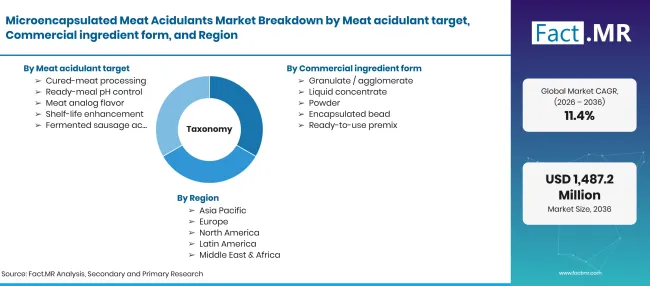
Microencapsulated Meat Acidulants Taxonomy | Source: Fact.MR
| Items | Values |
|---|---|
| Quantitative Units (2026) | USD 160.0 Million |
| Meat acidulant function | Fermented sausage, Cured meats, Ready meals, Meat alternatives, Cooked meat preservation |
| Commercial form | Powder, Liquid concentrate, Granulate, Encapsulated bead, Ready-to-use premix |
| Food application | Bakery, Dairy / alternatives, Beverage, Meat / savory, Confectionery / snacks |
| Primary function | Shelf-life, Texture / rheology, Taste / color, Nutritional functionality, Processing stability |
| Regions Covered | North America, Latin America, Europe, East Asia, South Asia and Pacific, Middle East & Africa |
| Countries Covered | China, Brazil, United States, France, Germany, and other countries |
| Key Companies Profiled | Corbion Jungbunzlauer Balchem Kerry Group Innophos Cargill Wenda Ingredients PHS Life Sciences Pvt. Ltd. Gadot Biochemical Industries Ltd. Muby Chemicals |
| Additional Attributes | Dollar revenue in the Microencapsulated Meat Acidulants Market is segmented by meat acidulant function (fermented sausage, cured meats, ready meals, meat alternatives, cooked meat preservation); commercial form (powder, liquid concentrate, granulate, encapsulated bead, ready-to-use premix); food application (bakery, dairy / alternatives, beverage, meat / savory, confectionery / snacks); primary function (shelf-life, texture / rheology, taste / color, nutritional functionality, processing stability) and region. |
Source: Fact.MR analysis. Updated Nov 20, 2026
Microencapsulated Meat Acidulants Market by Segments
-
Meat acidulant function
- Fermented sausage
- Cured meats
- Ready meals
- Meat alternatives
- Cooked meat preservation
-
Commercial form
- Powder
- Liquid concentrate
- Granulate
- Encapsulated bead
- Ready-to-use premix
-
Food application
- Bakery
- Dairy / alternatives
- Beverage
- Meat / savory
- Confectionery / snacks
-
Primary function
- Shelf-life
- Texture / rheology
- Taste / color
- Nutritional functionality
- Processing stability
-
Region:
- North America
- United States
- Canada
- Mexico
- Europe
- Germany
- United Kingdom
- France
- Italy
- Spain
- Rest of Europe
- Asia Pacific
- China
- India
- Japan
- South Korea
- Australia
- Rest of Asia Pacific
- Latin America
- Brazil
- Mexico
- Argentina
- Rest of Latin America
- Middle East & Africa
- GCC Countries
- South Africa
- Rest of Middle East & Africa
- North America
Frequently Asked Questions
How big is the global Microencapsulated Meat Acidulants Market in 2026?
What will be the size of the Microencapsulated Meat Acidulants Market by 2036?
How fast will the Microencapsulated Meat Acidulants Market grow during the forecast period?
Which meat acidulant function segment holds the largest share of the Microencapsulated Meat Acidulants Market?
Who worked on this report


Preview the report firsthand - request a free sample
Free SampleGet the brochure for pricing and purchase details
Download PDF