- Market Value (2025): USD 266.1 Mn
- Estimated Value (2026): USD 287.0 Mn
- Forecast Value (2036): USD 611.6 Mn
- CAGR (2026-2036): 7.9%
Microencapsulated Nutrient Delivery Systems Market Forecast and Outlook 2026 to 2036
The global microencapsulated nutrient delivery systems market was valued at USD 266.1 million in 2025 and reached USD 287.0 million in 2026. The market is set to reach USD 611.6 million by 2036, expanding at a CAGR of 7.9% during the 2026 to 2036 assessment period.
Microencapsulation is becoming an important formulation approach as supplement and functional-food manufacturers work with ingredients that lose potency through exposure to heat, moisture and digestive conditions. Protective coatings and carrier materials help preserve sensitive vitamins, probiotics and botanical extracts while controlling their release. The FAO's Codex food additive database, updated through its 2025 session, identifies beta-cyclodextrin as a carrier, stabilizer and thickener, with permitted applications across several food categories. This regulatory recognition adds to its relevance in food formulation and nutrient delivery.
Key Takeaways from the Microencapsulated Nutrient Delivery Systems Market
- Sales of microencapsulated nutrient delivery systems stood at USD 266.1 million in 2025.
- Microencapsulated Nutrient Delivery Systems Market Value (2026): USD 287.0 million.
- Microencapsulated Nutrient Delivery Systems Market Forecast Value (2036): USD 611.6 million.
- Microencapsulated Nutrient Delivery Systems Market CAGR (2026 to 2036): 7.9%.
- Leading Carrier Type: Cyclodextrin inclusion (27.7%).
- Key Market Participants: dsm-firmenich, Lonza, Balchem, Kerry Group, Glanbia Nutritionals and IFF.
- Key Growth Regions: India, China, United States, United Kingdom and Germany.
Manufacturers are also paying closer attention to nutrient losses during processing and storage. Excessive nutrient overages can increase formulation costs, particularly when brands work with sensitive vitamins, minerals and botanical ingredients. Encapsulation offers a way to retain active ingredient levels while reducing the need for unnecessary additions. Its commercial relevance therefore extends beyond ingredient protection to formulation economics, product consistency and shelf-life management.
Microencapsulated Nutrient Delivery Systems Market
| Metric | Value |
|---|---|
| Estimated Value in 2025 | USD 266.1 million |
| Estimated Value in 2026 | USD 287.0 million |
| Forecast Value in 2036 | USD 611.6 million |
| Forecast CAGR (2026 to 2036) | 7.9% |
Source: Fact.MR analysis. Updated Nov 20, 2026
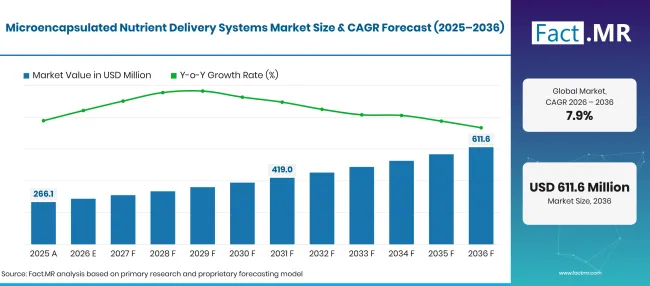
Microencapsulated Nutrient Delivery Systems Forecast Global 1 | Source: Fact.MR
Category
| Category | Segments |
|---|---|
| Carrier Type | Cyclodextrin inclusion, Polysaccharide bead, Protein matrix, Lipid microcapsule, Hybrid multilayer |
| Delivery Form | Liquid / emulsion, Capsule / tablet, Powder, Microencapsulated bead, Ready-to-drink / food |
| Health Application | Bone / joint, Cognitive health, Gut / microbiome, General nutrition, Clinical nutrition |
| Customer Channel | Supplement brand, Ingredient manufacturer, Medical nutrition OEM, Pharmacy, Direct-to-consumer |
| Region | India, China, United States, United Kingdom, Germany |
Source: Fact.MR analysis. Updated Nov 20, 2026
Segmental Analysis
Why does cyclodextrin inclusion lead carrier types in the Microencapsulated Nutrient Delivery Systems Market?
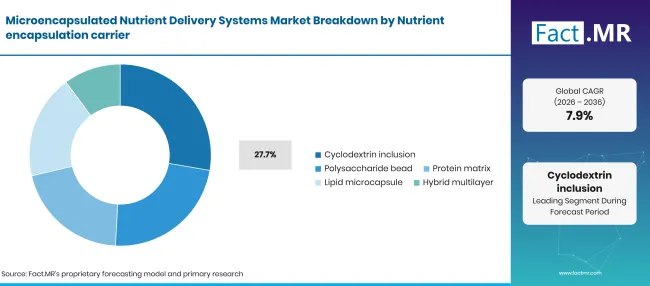
Microencapsulated Nutrient Delivery Systems Breakdown Nutrient Encapsulation Carrier | Source: Fact.MR
Cyclodextrin inclusion holds a 27.7% market share in 2026, valued at approximately USD 79.5 million. Its ability to improve the dispersibility and stability of sensitive ingredients, including fat-soluble vitamins, CoQ10 and botanical extracts, makes it useful in several formulations. It can also help mask unpleasant flavours in gummies and beverages. Lipid microcapsules and protein matrices are gaining attention for their compatibility with oil-based nutrients and different release requirements. The FAO's 2025 Codex database classifies beta-cyclodextrin as a carrier and stabilizer in food applications.
How are liquid and emulsion formats leading delivery form demand in the Microencapsulated Nutrient Delivery Systems Market?
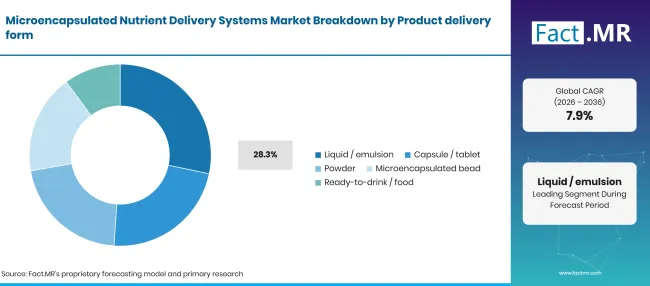
Microencapsulated Nutrient Delivery Systems Breakdown Product Delivery Form | Source: Fact.MR
Liquid and emulsion formats generated 28.3% of market revenue in 2026, equivalent to USD 81.2 million. Omega-3 oils, fat-soluble vitamins and other sensitive ingredients are increasingly incorporated into nutritional shots, beverages and liquid-filled capsules. Encapsulation helps maintain their dispersion and limits exposure to conditions that can affect stability. Powder formats attract manufacturers looking for convenient storage and dry blending, while capsules and tablets suit measured daily supplementation. The FAO's Codex database also lists beta-cyclodextrin for specified water-based flavoured drinks, including sports and electrolyte beverages.
Why does bone and joint health lead application demand in the Microencapsulated Nutrient Delivery Systems Market?
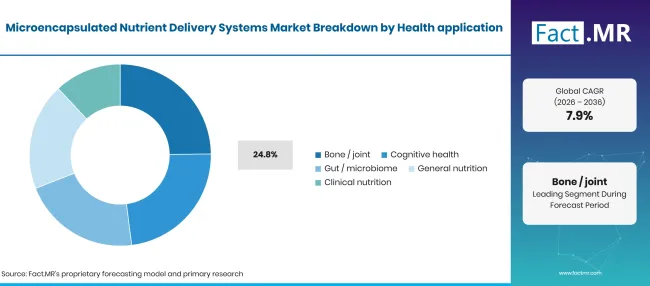
Microencapsulated Nutrient Delivery Systems Breakdown Health Application | Source: Fact.MR
Bone and joint health applications hold 24.8% of market revenue in 2026, reaching approximately USD 71.2 million. Calcium, vitamins D and K2, and collagen are frequently combined in formulations targeting bone strength and mobility. Encapsulation helps protect sensitive ingredients when several actives are brought together in one product. Cognitive health formulations are attracting interest through omega-3s and other specialized nutrients, while gut health products are creating opportunities for protected probiotics and prebiotics. General and clinical nutrition applications also benefit from technologies that maintain ingredient stability during processing and storage.
How are supplement brands shaping customer demand in the Microencapsulated Nutrient Delivery Systems Market?
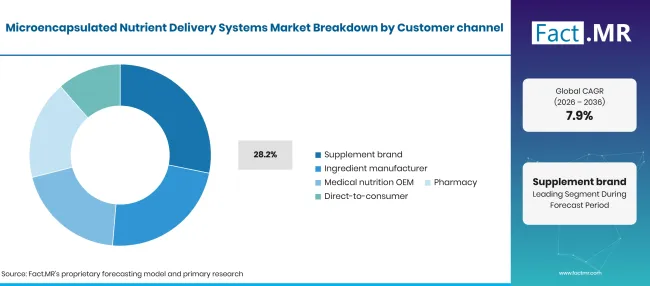
Microencapsulated Nutrient Delivery Systems Breakdown Customer Channel | Source: Fact.MR
Supplement brands hold 28.2% of market revenue in 2026, equivalent to approximately USD 80.9 million. Their product strategies increasingly involve improving taste, ingredient stability and nutrient delivery rather than relying only on longer ingredient lists. Microencapsulation helps brands work with sensitive actives in gummies, capsules, powders and liquid supplements. Functional food manufacturers and medical nutrition companies are also adopting protective delivery methods to improve formulation compatibility.
Microencapsulated Nutrient Delivery Systems Market: Drivers, Restraints and Trends
Drivers: Rising Focus on Preventive Nutrition:
Preventive healthcare is encouraging consumers to spend more on supplements and fortified foods, creating a need for ingredients that retain their potency throughout processing and storage. This is where microencapsulation becomes commercially relevant, particularly for sensitive vitamins, probiotics and botanical extracts. The CDC reported in May 2026 that 60.2% of American adults used dietary supplements during August 2021 to August 2023. Wider supplement consumption and interest in targeted nutrition are opening more applications for protected nutrient delivery across food and health products.
Restraints: Regulatory and Compliance Costs:
Microencapsulated formulations can become expensive to commercialize because manufacturers must validate coating materials, ingredient compatibility, stability and label accuracy. Regulatory differences between countries add another layer of work, particularly for products containing multiple active ingredients. Smaller manufacturers may struggle with testing expenses and reformulation costs when a product fails stability or compliance checks. These financial and technical hurdles can slow product launches and limit the adoption of advanced delivery systems among price-sensitive brands. India's FSSAI maintains a separate regulatory framework for health supplements and nutraceuticals, adding specific compliance responsibilities for manufacturers.
Trend: Greater Attention to Probiotic Protection and Gut Health:
Probiotic formulations are creating new applications for microencapsulation because live cultures must withstand manufacturing conditions, storage and digestive transit. Protective carrier systems can help maintain viable microorganisms until consumption, making them relevant to gut health and microbiome products. The opportunity extends beyond probiotic supplements to functional beverages, fortified foods and specialized nutrition. Further work on coating materials, release conditions and strain compatibility is shaping this area of the market.
Trend: Stricter Manufacturing Controls and Nutrient Label Accuracy:
Manufacturers are facing closer scrutiny of food safety, ingredient traceability and nutritional labelling. In September 2025, China's National Health Commission and State Administration for Market Regulation issued the revised Good Manufacturing Practice standard for health foods, GB 17405-2025. The standard strengthened requirements covering production controls, verification, testing, food safety management and product traceability. These changes increase the importance of consistent encapsulation processes and documented ingredient performance across manufacturing batches.
Microencapsulated Nutrient Delivery Systems Market Analysis by Key Country
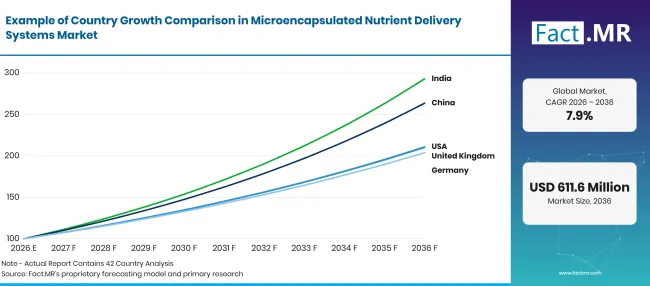
Microencapsulated Nutrient Delivery Systems Growth Index | Source: Fact.MR
| Country | CAGR (2026 to 2036) |
|---|---|
| India | 11.4% |
| China | 10.2% |
| United States | 7.7% |
| United Kingdom | 7.7% |
| Germany | 7.4% |
Source: Fact.MR analysis. Updated Nov 20, 2026
What is driving microencapsulated nutrient delivery systems demand in India?
India's expanding food-processing industry is opening opportunities for encapsulated nutrients, particularly in fortified foods, herbal supplements and probiotic formulations.
The Ministry of Food Processing Industries reported that processed food exports reached USD 10.10 billion in 2024-25, accounting for 20.44% of India's agri-food exports. Investment in food processing, rising interest in preventive nutrition and the expansion of domestic nutraceutical manufacturing are encouraging brands to adopt technologies that protect sensitive ingredients and improve shelf life.
How are regulatory changes shaping microencapsulated nutrient delivery systems sales in China?
China's revised health-food manufacturing standards are placing greater emphasis on production consistency, ingredient controls and traceability.
In September 2025, the State Administration for Market Regulation and National Health Commission issued GB 17405-2025, replacing the previous 1998 manufacturing standard. The updated requirements are encouraging manufacturers to improve production controls and testing procedures. Wider use of vitamins, minerals, probiotics and specialized nutrition formulations is creating further opportunities for encapsulation technologies that protect sensitive ingredients.
What is shaping microencapsulated nutrient delivery systems demand in the United States?
The extensive use of dietary supplements gives American manufacturers a substantial customer base for protected nutrient ingredients.
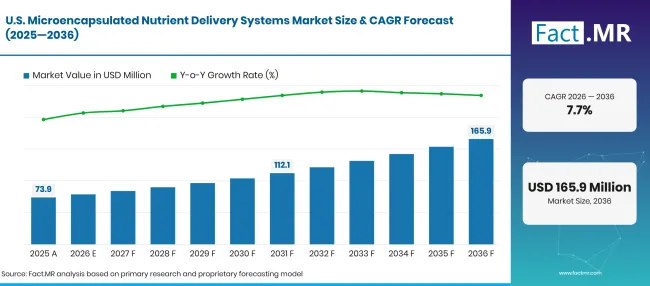
Microencapsulated Nutrient Delivery Systems Forecast Usa | Source: Fact.MR
The CDC's May 2026 report found that 60.2% of adults aged 20 and older used dietary supplements during August 2021 to August 2023. Brands working with omega-3 fatty acids, vitamins and gut-health ingredients are paying closer attention to oxidation control, taste masking and ingredient stability. These formulation priorities are creating opportunities for microencapsulation across everyday supplements and specialized nutrition products.
Why is an ageing population creating opportunities in the United Kingdom?
The UK's changing age profile is strengthening the commercial relevance of bone, joint and general nutrition products.
The Office for National Statistics reported in October 2026 that the UK had approximately 645,000 residents aged 90 and above in 2025, an increase of 55.2% since 2005. This demographic shift is adding to interest in products containing calcium, vitamin D, minerals and other nutrients associated with healthy ageing. Manufacturers are also exploring encapsulation to maintain ingredient stability in convenient supplement formats.
How is supplement manufacturing growth supporting microencapsulated nutrient delivery systems demand in Germany?
Germany's supplement manufacturing industry is creating opportunities for advanced ingredient protection technologies.
Destatis reported that domestic manufacturers produced approximately 241,000 tonnes of dietary supplements in 2025, valued at more than EUR 2.08 billion. Production value increased by 12.6% compared with 2024. Higher manufacturing activity is encouraging greater attention to ingredient stability, processing consistency and shelf-life management. Vitamin, mineral and protein-based formulations are creating applications for encapsulation methods across both conventional supplements and specialized nutrition products.
Competitive Landscape for Microencapsulated Nutrient Delivery Systems Market
Competition in the Microencapsulated Nutrient Delivery Systems Market brings together global nutrition ingredient manufacturers and specialized capsule and coating companies. dsm-firmenich, Kerry Group, IFF and Glanbia Nutritionals compete through their broad ingredient portfolios and formulation expertise. Balchem has a distinct position in microencapsulated minerals, choline and specialty food ingredients, while Lonza brings capsule manufacturing and delivery-format capabilities to the competitive landscape.
Product stability, taste masking, bioavailability evidence and compatibility with different food and supplement formulations influence supplier selection. Manufacturers also pay attention to regulatory documentation, production consistency and the ability to adapt encapsulation methods to different active ingredients. Competition is increasingly centered on measurable formulation performance and application-specific technical expertise rather than ingredient variety alone.
Recent Developments
- On December 10, 2025, Balchem Corporation announced plans to develop a high-capacity microencapsulation manufacturing facility in Orange County, New York. The facility is intended to expand production capacity for its food ingredient encapsulation technologies.
- On September 30, 2025, BASF SE completed the sale of its Food and Health Performance Ingredients business to Louis Dreyfus Company. The transaction included food performance ingredients, omega-3 oils and other human nutrition ingredients.
- On July 29, 2025, Cargill Incorporated announced an agreement to acquire Brazilian animal nutrition company Mig-Plus, expanding its premix, feed concentrate and animal nutrition activities.
- On February 12, 2025, FrieslandCampina Ingredients announced its intention to acquire Wisconsin Whey Protein to increase whey protein isolate capacity and strengthen its North American nutrition business.
- On August 1, 2025, Glanbia completed its acquisition of Sweetmix, a Brazilian nutritional premix and ingredients business, expanding its Health & Nutrition activities in Latin America.
Key Players in Microencapsulated Nutrient Delivery Systems Market
Key companies operating in the market include Balchem Corporation, dsm-firmenich, Glanbia Nutritionals, IFF, Kerry Group, and Lonza.
- Balchem Corporation
- dsm-firmenich
- Glanbia Nutritionals
- IFF
- Kerry Group
- Lonza
Bibliography
- Centers for Disease Control and Prevention, National Center for Health Statistics. (2026, May 21). Dietary supplement use: United States, August 2021–August 2023 (NCHS Data Brief No. 561).
- Destatis. (2026, November 3). Produktion von Nahrungsergänzungsmitteln seit 2019 um 48,4 % gestiegen.
- Food and Agriculture Organization of the United Nations. (2025). GSFA online: Food additive details for beta-cyclodextrin (INS 459).
- Food Safety and Standards Authority of India. (n.d.). Health supplements.
- Ministry of Food Processing Industries, Government of India. (2026). Annual report 2025–26.
- National Health Commission of the People's Republic of China. (2025, September 2). Announcement on the release of 32 national food safety standards, including GB 2762-2025, and two amendments.
- Office for National Statistics. (2026, October 23). Estimates of the very old, including centenarians, UK: 2002 to 2025.
- State Administration for Market Regulation. (2025, September 25). Two departments jointly issue the national food safety standard for good manufacturing practice for health food.
Segmentation
Scope of Report
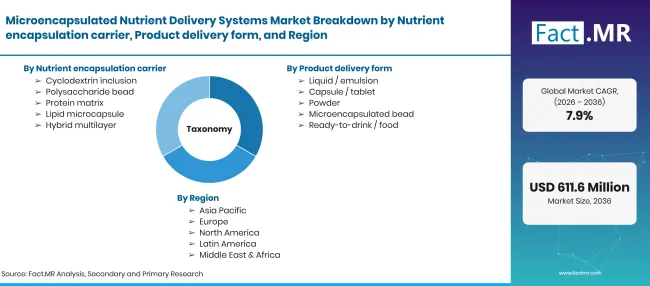
Microencapsulated Nutrient Delivery Systems Taxonomy | Source: Fact.MR
| Items | Values |
|---|---|
| Quantitative Units (2026) | USD 287.0 million |
| Carrier Type | Cyclodextrin inclusion, Polysaccharide bead, Protein matrix, Lipid microcapsule, Hybrid multilayer |
| Delivery Form | Liquid / emulsion, Capsule / tablet, Powder, Microencapsulated bead, Ready-to-drink / food |
| Health Application | Bone / joint, Cognitive health, Gut / microbiome, General nutrition, Clinical nutrition |
| Customer Channel | Supplement brand, Ingredient manufacturer, Medical nutrition OEM, Pharmacy, Direct-to-consumer |
| Regions Covered | North America, Latin America, Europe, East Asia, South Asia and Pacific, Middle East and Africa |
| Countries Covered | India, China, United States, United Kingdom, Germany and other countries |
| Key Companies Profiled | dsm-firmenich, Lonza, Balchem, Kerry Group, Glanbia Nutritionals, IFF |
| Additional Attributes | Dollar revenue in the Microencapsulated Nutrient Delivery Systems Market is segmented by carrier type, delivery form, health application, customer channel and region. |
Source: Fact.MR analysis. Updated Nov 20, 2026
Microencapsulated Nutrient Delivery Systems Market by Segments
-
Carrier Type
- Cyclodextrin inclusion
- Polysaccharide bead
- Protein matrix
- Lipid microcapsule
- Hybrid multilayer
-
Delivery Form
- Liquid / emulsion
- Capsule / tablet
- Powder
- Microencapsulated bead
- Ready-to-drink / food
-
Health Application
- Bone / joint
- Cognitive health
- Gut / microbiome
- General nutrition
- Clinical nutrition
-
Customer Channel
- Supplement brand
- Ingredient manufacturer
- Medical nutrition OEM
- Pharmacy
- Direct-to-consumer
-
Region
- North America
- United States
- Canada
- Mexico
- Europe
- Germany
- United Kingdom
- France
- Italy
- Spain
- Rest of Europe
- Asia Pacific
- China
- India
- Japan
- South Korea
- Australia
- Rest of Asia Pacific
- Latin America
- Brazil
- Mexico
- Argentina
- Rest of Latin America
- Middle East and Africa
- GCC Countries
- South Africa
- Rest of Middle East and Africa
- North America
Frequently Asked Questions
How big is the global Microencapsulated Nutrient Delivery Systems Market in 2026?
What will be the size of the Microencapsulated Nutrient Delivery Systems Market by 2036?
How fast will the Microencapsulated Nutrient Delivery Systems Market grow during the assessment period?
Which carrier type holds the largest share of the Microencapsulated Nutrient Delivery Systems Market?
Which delivery form holds the largest share of the Microencapsulated Nutrient Delivery Systems Market?
Which health application dominates the Microencapsulated Nutrient Delivery Systems Market?
Which customer channel leads the Microencapsulated Nutrient Delivery Systems Market?
Which country is recording the fastest growth in the Microencapsulated Nutrient Delivery Systems Market?
Who worked on this report


Preview the report firsthand - request a free sample
Free SampleGet the brochure for pricing and purchase details
Download PDF