- Market Value (2025): USD 210.3 Mn
- Estimated Value (2026): USD 229.9 Mn
- Forecast Value (2036): USD 561.0 Mn
- CAGR (2026-2036): 9.3%
Probiotic Stability Excipient Platforms Market Forecast and Outlook 2026 to 2036
The global probiotic stability excipient platforms market was valued at USD 210.3 million in 2025 and reached USD 229.9 million in 2026. The market will reach USD 561.0 million by 2036, expanding at a CAGR of 9.3% during the 2026 to 2036 assessment period.
Probiotic brands are taking live cultures beyond refrigerated capsules and adding them to everyday foods, drinks and gummies. This shift is creating opportunities for excipients that protect bacterial viability during drying, processing and storage. In September 2026, Kerry reported approval of a 'Live Culture' claim for its BC30 probiotic in Indonesia, opening opportunities in bakery and snack products. As food manufacturers explore more probiotic applications, the need for effective stability solutions should rise across emerging markets.
Key Takeaways from the Probiotic Stability Excipient Platforms Market
- Sales of probiotic stability excipient platforms stood at USD 210.3 million in 2025
- Probiotic Stability Excipient Platforms Market Value (2026): USD 229.9 million
- Probiotic Stability Excipient Platforms Market Forecast Value (2036): USD 561.0 million
- Probiotic Stability Excipient Platforms Market Forecast CAGR (2026-2036): 9.3%
- Leading Stabilizer Chemistry: Inulin / prebiotic (33.0%)
- Key Market Participants: DSM-Firmenich, Lonza, Balchem, Kerry Group, Glanbia Nutritionals, IFF
- Key Growth Regions: India, China, United States, Germany, United Kingdom
In June 2026, Nutraceutical Business Review highlighted how probiotic manufacturers are balancing product stability, processing costs and regulatory compliance. Keeping live cultures viable until the end of shelf life is becoming a formulation priority, particularly as brands reduce the use of excess overages. This is creating room for excipient platforms that combine protective ingredients, delivery carriers and stability testing. Their role in simplifying formulation work while controlling costs is opening wider opportunities across dietary supplements and functional foods.
Probiotic Stability Excipient Platforms Market
| Metric | Value |
|---|---|
| Estimated Value in (2025) | USD 210.3 million |
| Estimated Value in (2026) | USD 229.9 million |
| Forecast Value in (2036) | USD 561.0 million |
| Forecast CAGR (2026 to 2036) | 9.3% |
Source: Fact.MR analysis. Updated Nov 20, 2026
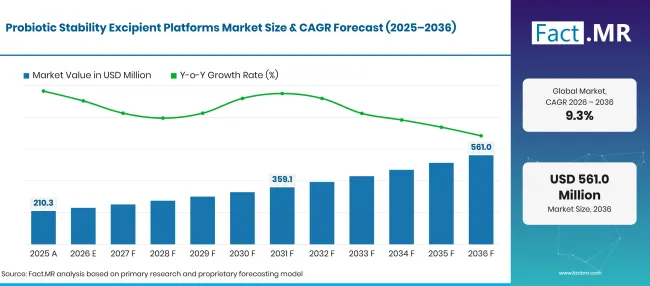
Probiotic Stability Excipient Platforms Forecast Global | Source: Fact.MR
Category
| Category | Segments |
|---|---|
| Stabilizer Chemistry | Inulin / prebiotic, Trehalose / sugar glass, Protein protectant, Lipid encapsulant, Composite excipient |
| Delivery Form | Ready-to-drink / food, Capsule / tablet, Liquid / emulsion, Microencapsulated bead, Powder |
| Health Application | General nutrition, Cognitive health, Gut / microbiome, Bone / joint, Clinical nutrition |
| Customer Channel | Ingredient manufacturer, Supplement brand, Medical nutrition OEM, Pharmacy, Direct-to-consumer |
| Region | India; China; United States; Germany; United Kingdom |
Source: Fact.MR analysis. Updated Nov 20, 2026
Segmental Analysis
Why do inulin and prebiotic excipients lead stabilizer chemistry in the Probiotic Stability Excipient Platforms Market?
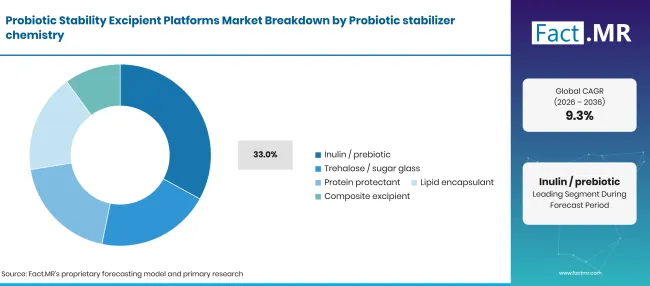
Probiotic Stability Excipient Platforms Breakdown Probiotic Stabilizer Chemistry | Source: Fact.MR
Inulin and prebiotic excipients hold 33.0% of the market in 2026, valued at approximately USD 75.9 million, because they combine bacterial protection with added fiber functionality. Their use in synbiotic formulations also gives brands an additional nutritional positioning advantage. A July 2025 study published in Carbohydrate Polymers found that FOS-integrated microcapsules achieved 83.36% probiotic survival after freeze-drying and maintained more than 6 log CFU/g for 90 days at 4°C. Other chemistries, including protein and carbohydrate protectants, are also gaining attention for strain-specific protection.
How are ready-to-drink and food formats leading delivery demand in the Probiotic Stability Excipient Platforms Market?
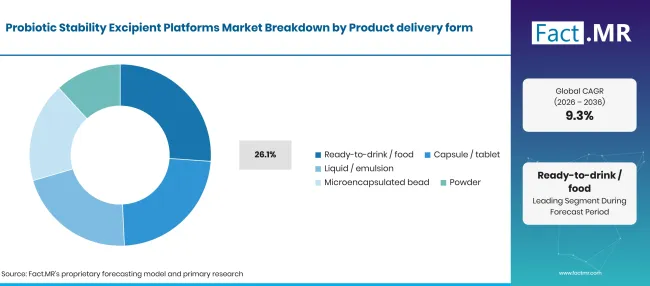
Probiotic Stability Excipient Platforms Breakdown Product Delivery Form | Source: Fact.MR
Ready-to-drink and food formats generate 26.1% of market revenue in 2026, approximately USD 60.0 million. Their position is linked to the addition of probiotics to fruit drinks, bakery products and convenient snacks, where acidity and processing conditions can affect bacterial survival. In January 2026, research published by the Royal Society of Chemistry demonstrated that encapsulated probiotics retained 8.38–9.52 log CFU/mL in apple and apple-carrot beverages. Dairy-based products and probiotic powders are also gaining traction as manufacturers explore more delivery options.
Why does general nutrition lead health application demand in the Probiotic Stability Excipient Platforms Market?
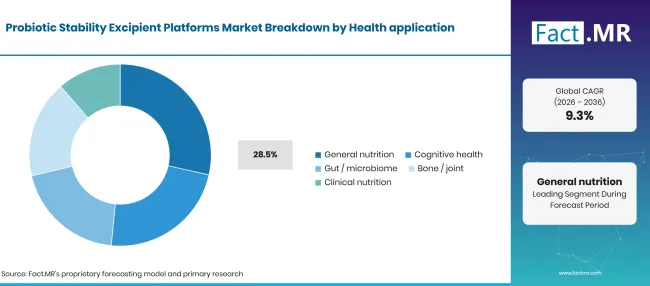
Probiotic Stability Excipient Platforms Breakdown Health Application | Source: Fact.MR
General nutrition accounts for 28.5% of market revenue in 2026, reaching approximately USD 65.5 million. Probiotics are finding space in everyday nutritional products rather than remaining limited to specialist digestive-health supplements. This shift makes long-term viability important for multinutrient powders, fortified foods and daily wellness formulations. A January 2026 study in the Journal of Drug Delivery Science and Technology reported 97% encapsulation efficiency for spray-dried Bifidobacterium longum using a protective matrix. Digestive health and immune-support applications are also attracting formulation interest.
How are ingredient manufacturers shaping customer demand in the Probiotic Stability Excipient Platforms Market?
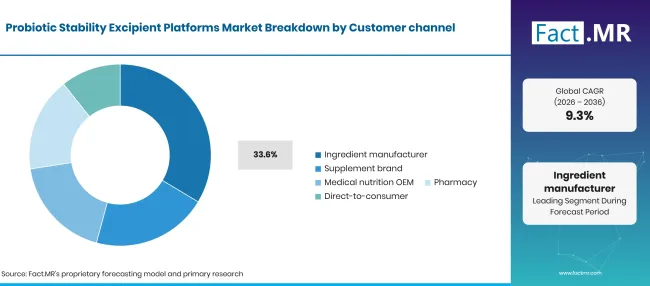
Probiotic Stability Excipient Platforms Breakdown Customer Channel | Source: Fact.MR
Ingredient manufacturers capture 33.6% of market revenue in 2026, approximately USD 77.2 million, as probiotic culture producers and premix manufacturers incorporate stabilization into their ingredient portfolios. This approach gives food brands access to ready-to-use formulations without developing protective systems independently. A January 2026 study by Anna University researchers found that combining corn starch with FOS improved probiotic survival during spray drying and storage, with the optimized powder also tested in a millet-based synbiotic health mix. Contract manufacturers and finished-product brands are also expanding their use of customized stabilization solutions.
Probiotic Stability Excipient Platforms Market-Drivers, Restraints & Trends
Drivers: Wider use of probiotics in everyday nutrition:
Probiotic stability excipient platforms are gaining attention because brands are adding live cultures to everyday foods and supplements rather than limiting them to specialist digestive-health products. This creates a greater need to protect bacterial viability across different formulations and storage conditions. In March 2026, Innova Market Insights reported that 19% of gut-health product launches in 2025 carried probiotic claims, while 38% included fiber claims. This overlap is creating opportunities for excipient systems that maintain culture stability in fiber-rich formulations.
Restraints: Strain-specific stability and validation costs:
A major limitation is that one protective excipient cannot deliver the same results across every probiotic strain. Manufacturers must test ingredient compatibility, moisture exposure and viable counts for individual formulations. This adds testing costs, extends launch timelines and makes smaller brands more dependent on specialist formulation partners. Ambient storage can also cause substantial viability losses, increasing the risk of products falling below label claims.
Trend:
More complex probiotic formulations need stronger protection:Probiotic formulations are becoming more complex as manufacturers combine multiple strains, fibers and functional ingredients in one product. A 2026 review in the Journal of Food Science highlighted viability losses during processing, storage and gastrointestinal transit as continuing formulation challenges. This creates opportunities for excipient platforms that protect multiple strains across different food matrices. Investment in strain-compatible encapsulation and moisture-control systems could open further market opportunities.
Trend: Gut health enters the healthy longevity conversation:
Gut health is gaining a wider role in healthy-ageing nutrition, moving beyond conventional digestive-health positioning. In October 2026, dsm-firmenich presented The Longevity Shift 2.0: The Gut Effect at SupplySide Global, connecting microbiome health with broader health expectancy. This creates opportunities for stability excipient manufacturers to serve age-focused supplements and functional nutrition products where reliable probiotic viability is important.
Probiotic Stability Excipient Platforms Market by Analysis by Key Country
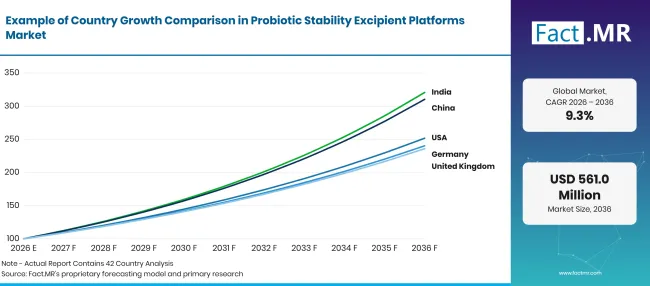
Probiotic Stability Excipient Platforms Growth Index | Source: Fact.MR
| Country | CAGR (2026-2036) |
|---|---|
| India | 12.4% |
| China | 12.0% |
| United States | 9.7% |
| Germany | 9.2% |
| United Kingdom | 9.0% |
Source: Fact.MR analysis. Updated Nov 20, 2026
What is driving probiotic stability excipient platforms demand in India?
India's probiotic market is gaining ground as consumers show greater interest in digestive wellness, preventive nutrition and clinically researched supplements.
The entry of pharmaceutical companies into specialized gut-health formulations is adding to this activity. In November 2025, Alkem Laboratories launched DSS, an eight-strain probiotic formulation in India, backed by more than 80 clinical trials. Wider supplement consumption, pharmaceutical distribution networks and interest in locally relevant formulations are creating opportunities for stability excipients that protect viable cultures during storage.
How is household adoption supporting probiotic stability excipient platforms sales in China?
China's expanding functional food and beverage industry is creating more applications for probiotic stabilization.
Consumers are encountering probiotics in products beyond conventional capsules, including fermented drinks, dairy and everyday beverages. In 2025, Yoyi C introduced a probiotic lemon tea in China, extending the ingredient into a familiar beverage format. This expansion into ambient and ready-to-drink products is increasing the need for protective excipients that maintain bacterial viability. Local strain innovation and wider e-commerce distribution are also driving sales.
What is shaping probiotic stability excipient platforms demand in the United States?
Convenience-led nutrition and the popularity of microbiome-focused supplements are keeping the US market active.
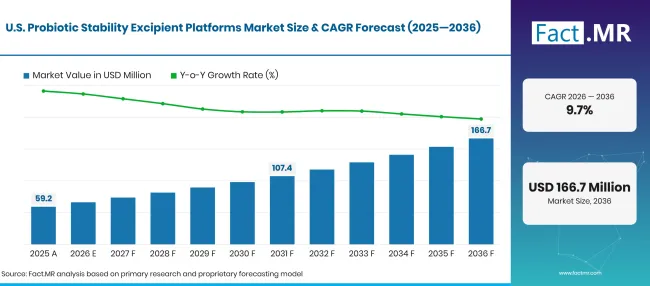
Probiotic Stability Excipient Platforms Forecast Usa | Source: Fact.MR
Probiotic ingredients are increasingly appearing in snack products, beverages and multi-benefit supplements. In May 2026, PIM Brands announced Welch's Probiotic Yogofruits, combining fruit, yogurt coating, probiotics and fiber. Such product innovation is creating opportunities for excipient platforms that protect live cultures in complex food matrices. Retail expansion, interest in digestive wellness and demand for longer shelf life are driving sales.
Why is Germany an important market for probiotic stability excipient platforms?
Germany's strong nutrition and healthcare product base is creating opportunities for probiotic stability excipients, particularly as manufacturers introduce more specialized microbiome formulations.
In September 2026, Swedish ingredient company Nordic Rebalance announced that German healthcare company vitOrgan would launch NeyBiotics, powered by its ReFerm postbiotic ingredient. The move highlights continued commercial interest in gut-health solutions. Demand for clinically researched ingredients, pharmacy distribution and premium digestive-health supplements is supporting sales of protective formulation systems.
How is healthier shopping supporting probiotic stability excipient platforms demand in the United Kingdom?
British consumers are finding more ways to access probiotic products through mainstream retail and specialized nutrition channels.
In September 2026, Kerry introduced its Bio-K+ probiotic capsule range in the UK and Ireland, with formulations containing 12.5 billion to 50 billion CFU per serving. The expansion highlights opportunities for excipient systems that maintain culture viability in high-potency supplements. Pharmacy access, science-backed digestive-health products and interest in targeted microbiome formulations are driving regional sales.
Competitive Landscape for Probiotic Stability Excipient Platforms Market
Competition in the probiotic stability excipient platforms market is led by nutrition ingredient groups that combine cultures, excipients and delivery formats. dsm-firmenich, IFF and Kerry Group compete on proprietary strains backed by stabilization know-how, while Lonza competes through capsule-based protection and Balchem and Glanbia Nutritionals through encapsulation and premix capabilities. Buyers select suppliers on viability data at end of shelf life, compatibility with their format, regulatory support and total cost per guaranteed CFU.
From 2025 onward, competition shifted toward food applications and clinically positioned strains. Kerry used Indonesia's Live Culture claim approval to target bakery and snacks in September 2026, IFF launched a metabolic-health probiotic in October 2026, and dsm-firmenich framed gut health within healthy ageing. Suppliers with strain-specific stability data and application laboratories are best placed to win long-term supply agreements.
Recent Developments
- On February 9, 2026, DSM-Firmenich agreed to sell its Animal Nutrition & Health business to CVC Capital Partners for approximately €2.2 billion while retaining a 20% stake in the business.
- On July 7, 2025, Lonza launched its next-generation 4D-Nucleofector® LV Unit PRO to improve electroporation in large-scale manufacturing of cell and gene therapies.
- On June 19, 2025, Balchem announced new functional food and beverage prototypes for IFT FIRST 2025, including INjoy™ beverage systems, MeatShure® snack sticks and high-protein chocolate oat soft serve.
- On April 20, 2026, Kerry opened an expanded biotechnology manufacturing facility in Carrigaline, Ireland, to increase production capacity for lactase enzymes used in lactose-free and reduced-sugar dairy products.
- On August 1, 2025, Glanbia acquired Brazil-based Sweetmix for approximately USD 41.4 million to expand its nutritional premix and ingredients business in Latin America.
- On May 29, 2026, IFF agreed to sell its Food Ingredients business to CVC Capital Partners for approximately USD 4.3 billion while retaining a 10% minority stake in the business.
Key Players in Probiotic Stability Excipient Platforms Market
Key companies operating in the market include DSM-Firmenich, Lonza, Balchem, Kerry Group, Glanbia Nutritionals, and IFF.
- DSM-Firmenich
- Lonza
- Balchem
- Kerry Group
- Glanbia Nutritionals
- IFF
Bibliography
- Alkem Laboratories. (2025, November 20). Alkem launches probiotic “DSS”, the original De Simone formulation, in India for gut health management.
- D'Amico, V., Siepmann, F., Siepmann, J., Neut, C., Denora, N., & Lopedota, A. A. (2026). Microencapsulation of the probiotic Bifidobacterium longum by spray-drying: Formulation and process optimisation. Journal of Drug Delivery Science and Technology, 115, Article 107670.
- dsm-firmenich. (2026, October 5). dsm-firmenich brings The Longevity Shift 2.0: The Gut Effect to SupplySide Global 2026.
- Food Standards Agency. (2026, January 20). New year, new guidance: FSA helps consumers navigate food supplements safely.
- Naseem, Z., Wani, S. M., Mir, S. A., & Nisar, N. (2026). Sustainable delivery of encapsulated probiotics and their survival in fruit-based beverages and under simulated gastrointestinal conditions. Sustainable Food Technology, 4, 2146–2158.
- Nikitina, E., & Khrundin, D. (2026). The probiotic bacteria and their encapsulated forms as food components: Survival, effects and quality. AIMS Microbiology, 12(1), 1–26.
- Nordic Rebalance. (2026, September 29). Nordic Rebalance takes ReFerm®, its Swedish-proven postbiotic platform, to Germany.
- PIM Brands. (2026, May 14). New Welch's® Probiotic Yogofruits™ advances PIM Brands leadership in functional snacking.
- Thinkohkaew, K., Jonjaroen, V., Niamsiri, N., McClements, D. J., Panya, A., Suppavorasatit, I., & Potiyaraj, P. (2025). Fabrication of synbiotic carbohydrate polymer-based microcapsules: Effect of prebiotics on probiotic viability during freeze-drying, gastrointestinal transit and storage. Carbohydrate Polymers, 359, Article 123582.
- Viswanathan, K., & Muthusamy, S. (2026). Optimizing the encapsulation of Lactiplantibacillus plantarum and Lactobacillus acidophilus for enhanced storage stability and gut viability using spray drying. Food Biomacromolecules, 3(1), 81–92.
Segmentation
Scope of Report
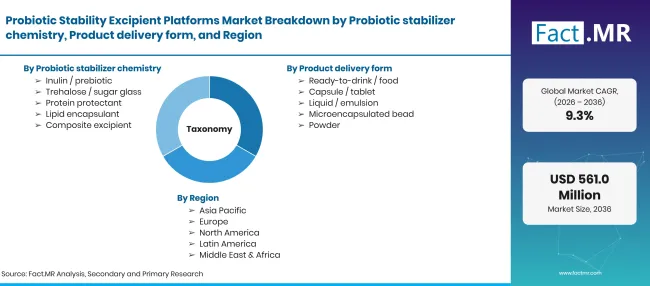
Probiotic Stability Excipient Platforms Taxonomy | Source: Fact.MR
| Items | Values |
|---|---|
| Quantitative Units (2026) | USD 229.9 Million |
| Stabilizer Chemistry | Inulin / prebiotic, Trehalose / sugar glass, Protein protectant, Lipid encapsulant, Composite excipient |
| Delivery Form | Ready-to-drink / food, Capsule / tablet, Liquid / emulsion, Microencapsulated bead, Powder |
| Health Application | General nutrition, Cognitive health, Gut / microbiome, Bone / joint, Clinical nutrition |
| Customer Channel | Ingredient manufacturer, Supplement brand, Medical nutrition OEM, Pharmacy, Direct-to-consumer |
| Regions Covered | North America, Latin America, Europe, East Asia, South Asia and Pacific, Middle East & Africa |
| Countries Covered | India, China, United States, Germany, United Kingdom, and other countries |
| Key Companies Profiled | DSM-Firmenich, Lonza, Balchem, Kerry Group, Glanbia Nutritionals, IFF |
| Additional Attributes | Dollar revenue in the Probiotic Stability Excipient Platforms Market is segmented by stabilizer chemistry (inulin / prebiotic, trehalose / sugar glass, protein protectant, lipid encapsulant, composite excipient), delivery form, health application, customer channel and region. |
Source: Fact.MR analysis. Updated Nov 20, 2026
Probiotic Stability Excipient Platforms Market by Segments
-
Stabilizer Chemistry
- Inulin / prebiotic
- Trehalose / sugar glass
- Protein protectant
- Lipid encapsulant
- Composite excipient
-
Delivery Form
- Ready-to-drink / food
- Capsule / tablet
- Liquid / emulsion
- Microencapsulated bead
- Powder
-
Health Application
- General nutrition
- Cognitive health
- Gut / microbiome
- Bone / joint
- Clinical nutrition
-
Customer Channel
- Ingredient manufacturer
- Supplement brand
- Medical nutrition OEM
- Pharmacy
- Direct-to-consumer
-
Region:
- North America
- United States
- Canada
- Mexico
- Europe
- Germany
- United Kingdom
- France
- Italy
- Spain
- Rest of Europe
- Asia Pacific
- China
- India
- Japan
- South Korea
- Australia
- Rest of Asia Pacific
- Latin America
- Brazil
- Mexico
- Argentina
- Rest of Latin America
- Middle East & Africa
- GCC Countries
- South Africa
- Rest of Middle East & Africa
- North America
Frequently Asked Questions
How big is the global Probiotic Stability Excipient Platforms Market in 2026?
What will be the size of the Probiotic Stability Excipient Platforms Market by 2036?
How fast will the Probiotic Stability Excipient Platforms Market grow during the forecast period?
Which stabilizer chemistry segment holds the largest share of the Probiotic Stability Excipient Platforms Market?
Who worked on this report


Preview the report firsthand - request a free sample
Free SampleGet the brochure for pricing and purchase details
Download PDF