- Market Value (2025): USD 8.8 Bn
- Estimated Value (2026): USD 9.32 Bn
- Forecast Value (2036): USD 16.6 Bn
- CAGR (2026-2036): 6.0%
What is the Corrective Contact Lenses Market forecast to be worth by 2036?
USD 9.3 billion in 2026 to USD 16.6 billion by 2036, at a CAGR of 6.0%.
- As per Fact.MR analysis, the corrective contact lenses market was valued at USD 8.8 billion in 2025.
- Demand will grow from USD 9.32 billion in 2026 to USD 16.6 billion by 2036.
- The forecast records a 6.0% CAGR from 2026 to 2036 due to rising prevalence of refractive errors and increasing demand for convenient vision-correction solutions.
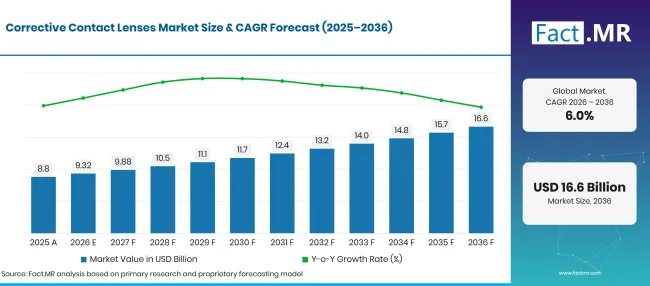
Corrective Contact Lenses Market Forecast Global | Source: Fact.MR
| Year | Basis | Market Value (USD billion) |
|---|---|---|
| 2025 | Actual | 8.8 |
| 2026 | Estimate | 9.32 |
| 2036 | Forecast | 16.6 |
| CAGR 2026 to 2036 | Forecast period | 6.0% |
Source: Fact.MR analysis. Updated Nov 5, 2026
What are the defining numbers behind Corrective Contact Lenses Market growth?
USD 7.3 billion absolute opportunity between 2026 and 2036.
- Demand Drivers in the Market
- Growing demand for vision correction supports recurring contact lens purchases. The US Centers for Disease Control and Prevention states that approximately 45 million people in the United States wear contact lenses and emphasizes proper wear and care to reduce eye infection risks. This wearer estimate is a US figure and does not measure global contact lens sales growth [1]. [1]
- Preference for advanced materials supports the silicone hydrogel contact lens category. EuromContact reported that silicone hydrogel lenses represented 93.8% of the weekly, bi-weekly and monthly soft contact lens market value in the EMEA countries covered by its 2025 report. The figure refers to that reusable replacement-schedule segment rather than all contact lenses [2]. [2]
- Increasing interest in myopia management is creating opportunities for specialty corrective lenses. CooperVision's MiSight 1 day is designed for myopia control in children, while its Biofinity range includes lenses for myopia, hyperopia, astigmatism and presbyopia [3].
- Key Segments Analyzed
- By Product Type: Soft lenses will account for 68.5% of the market in 2026, reflecting their broad use for routine vision correction.
- By Application: Myopia will represent 55.4% of the market in 2026, supported by the large population requiring correction for nearsightedness.
- By Distribution Channel: Online stores hold a 34.9% share in 2026, as digital ordering supports convenient repeat purchases.
- By Material: Silicone hydrogel leads with 52.7% of the market in 2026, supported by demand for materials that provide high oxygen transmissibility.
- Analyst Opinion at Fact.MR
- Shambhu Nath Jha, Principal Consultant at Fact.MR, states, “Corrective contact lenses are becoming more differentiated as wearers seek solutions that address their vision needs alongside comfort and convenience. Manufacturers should continue to improve material performance and lens designs, while eye-care professionals remain important in matching products to individual prescriptions and wearing requirements.”
- Strategic Implications
- Manufacturers should expand lens designs for astigmatism and presbyopia while maintaining broad prescription coverage.
- Material developers need to demonstrate oxygen transmissibility, moisture retention and on-eye performance through appropriate testing.
- Online retailers must maintain prescription verification and clear replacement guidance to support safe repeat purchases.
- Optical stores and clinics need to strengthen fitting services and follow-up care for first-time wearers and patients changing lens types.
- Suppliers can explain the differences between hydrogel, silicone hydrogel and rigid gas permeable lenses to support informed product selection.
Germany is projected to record a 7.1% CAGR through 2036. Brazil is set to post 6.5%, followed by the USA at 5.9%. The UK is estimated to advance at 5.3%, while Japan is forecast to grow at 4.7%.
How does the Corrective Contact Lenses Market break down by segment?
Fact.MR finds that Soft Lenses lead the Product Type segment at 68.5%; Myopia leads the Application segment at 55.4%; Online Stores lead the Distribution Channel segment at 34.9%; and Silicone Hydrogel leads the Material segment at 52.7%.
Which Product Type dominates?
Soft Lenses are set to hold a 68.5% share in 2026.
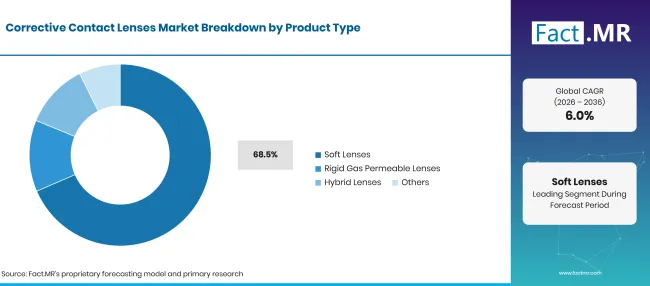
Corrective Contact Lenses Market Breakdown Product Type | Source: Fact.MR
| Product Type | Share (2026) |
|---|---|
| Soft Lenses (Leading segment) | 68.5% |
| Other segments combined | 31.5%* |
| Total | 100.0% |
Source: Fact.MR analysis. Updated Nov 5, 2026
Soft contact lenses dominate because they are available in multiple replacement schedules and prescription designs. Their flexibility and ease of fitting make them suitable for a broad range of wearers. Rigid gas permeable lenses serve patients who require specific optical correction or specialty fitting. Hybrid lenses combine a rigid central optical zone with a softer outer skirt, offering another option for selected prescriptions. Other lens types address more specialized requirements.
Which Application leads the market?
Myopia is set to represent 55.4% of the market in 2026.
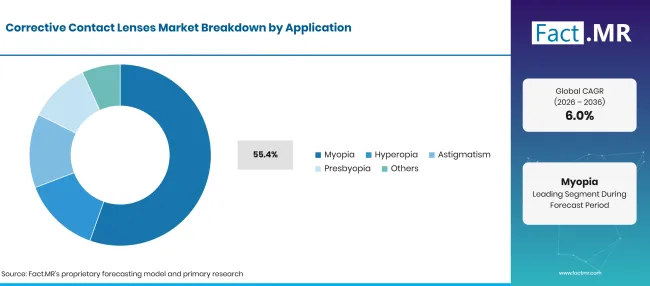
Corrective Contact Lenses Market Breakdown Application | Source: Fact.MR
| Application | Share (2026) |
|---|---|
| Myopia (Leading segment) | 55.4% |
| Other segments combined | 44.6%* |
| Total | 100.0% |
Source: Fact.MR analysis. Updated Nov 5, 2026
Myopia leads because nearsightedness is a common refractive error requiring regular vision correction. Soft spherical lenses are widely used for routine myopia correction, while specialty designs can address additional clinical needs. Hyperopia requires lenses designed to correct farsightedness. Astigmatism is addressed through toric lenses or specialty rigid designs, while presbyopia can be managed through multifocal and other presbyopia-correcting contact lenses.
What leads the Distribution Channel segment?
Online Stores are likely to account for 34.9% of the market in 2026.
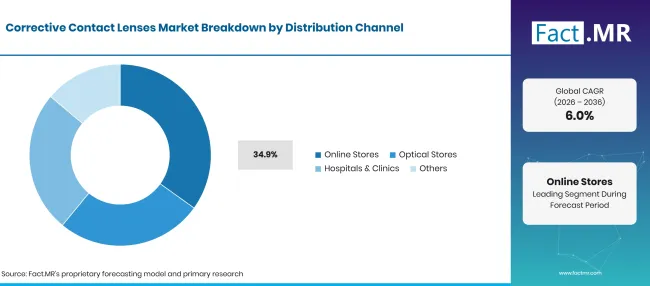
Corrective Contact Lenses Market Breakdown Distribution Channel | Source: Fact.MR
| Distribution Channel | Share (2026) |
|---|---|
| Online Stores (Leading segment) | 34.9% |
| Other segments combined | 65.1%* |
| Total | 100.0% |
Source: Fact.MR analysis. Updated Nov 5, 2026
Online stores support convenient replenishment for established contact lens wearers who already have a valid prescription and understand their replacement schedule. Digital platforms can provide access to multiple brands and lens configurations. Optical stores remain important because customers can receive fitting support and professional advice. Hospitals and clinics contribute through prescription, diagnosis and specialty lens services. The channel mix depends on local regulations and the extent of professional involvement in contact lens purchases.
Which Material is gaining prominence?
Silicone Hydrogel is projected to account for 52.7% of the market in 2026.
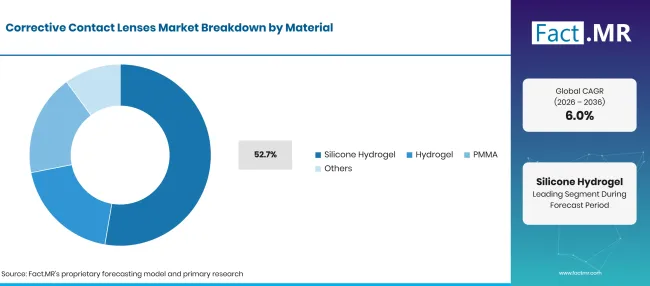
Corrective Contact Lenses Market Breakdown Material | Source: Fact.MR
| Material | Share (2026) |
|---|---|
| Silicone Hydrogel (Leading segment) | 52.7% |
| Other segments combined | 47.3%* |
| Total | 100.0% |
Source: Fact.MR analysis. Updated Nov 5, 2026
Silicone hydrogel materials are widely used in soft contact lenses because they allow high oxygen transmission through the lens. Manufacturers continue to refine surface treatments and material formulations to improve wettability and wearing comfort. Conventional hydrogel lenses remain relevant across daily disposable and reusable products. PMMA is associated with older rigid lens technology and has limited flexibility compared with modern gas permeable materials. Other materials serve specific specialty and fitting requirements.
What is accelerating Corrective Contact Lenses Market adoption, and what is holding it back?
Demand for comfortable lenses and recurring vision correction supports market growth, while fitting requirements and concerns over lens-related eye health can limit adoption.
Drivers Impact Analysis
| DRIVER | (~) % IMPACT ON CAGR | GEOGRAPHIC RELEVANCE | IMPACT TIMELINE |
|---|---|---|---|
| Rising demand for routine refractive error correction | +1.0% | Global | Short term (≤ 2 years) |
| Preference for daily disposable contact lenses | +0.8% | Europe, North America, Asia | Medium term (2–4 years) |
| Adoption of silicone hydrogel materials | +0.7% | Global | Medium term (2–4 years) |
| Growth in myopia management products | +0.6% | Asia, Europe, North America | Long term (≥ 4 years) |
| Expansion of online lens replenishment | +0.5% | Global | Short term (≤ 2 years) |
Source: Fact.MR analysis. Updated Nov 5, 2026
Opportunity Impact Analysis
| OPPORTUNITY | (~) % IMPACT ON CAGR | GEOGRAPHIC RELEVANCE | IMPACT TIMELINE |
|---|---|---|---|
| Advanced lenses for astigmatism and presbyopia | +0.8% | Global | Medium term (2–4 years) |
| Specialty contact lenses for myopia management | +0.7% | Asia, Europe, North America | Long term (≥ 4 years) |
| Higher-performance silicone hydrogel materials | +0.6% | Global | Medium term (2–4 years) |
| Digital prescription and replenishment services | +0.5% | North America, Europe, Asia | Short term (≤ 2 years) |
| Wider access through optical retail networks | +0.4% | Latin America, Asia | Medium term (2–4 years) |
Source: Fact.MR analysis. Updated Nov 5, 2026
Restraints Impact Analysis
| RESTRAINT | (~) % IMPACT ON CAGR | GEOGRAPHIC RELEVANCE | IMPACT TIMELINE |
|---|---|---|---|
| Risk of eye infections from improper lens care | -0.8% | Global | Short term (≤ 2 years) |
| Need for professional fitting and prescription checks | -0.6% | Global | Short term (≤ 2 years) |
| Premium pricing of advanced lens materials | -0.5% | Emerging markets | Medium term (2–4 years) |
| Discomfort and dryness among some wearers | -0.5% | Global | Medium term (2–4 years) |
| Competition from spectacles and refractive procedures | -0.4% | Global | Long term (≥ 4 years) |
Source: Fact.MR analysis. Updated Nov 5, 2026
Which countries are scaling the Corrective Contact Lenses Market through 2036?
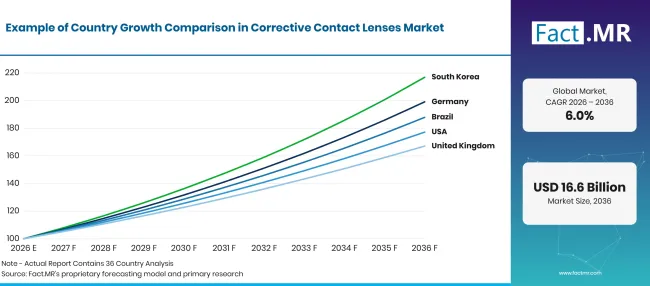
Corrective Contact Lenses Market Growth Index | Source: Fact.MR
| Country | CAGR (2026–2036) |
|---|---|
| Germany | 7.1% |
| Brazil | 6.5% |
| USA | 5.9% |
| UK | 5.3% |
| Japan | 4.7% |
Source: Fact.MR analysis. Updated Nov 5, 2026
What supports Germany's adoption?
7.1% CAGR, supported by established optical retail and opportunities to increase contact lens penetration.
Germany's contact lens market is supported by optical retailers and eye-care professionals. EuromContact's 2025 industry report covers Germany within a wider EMEA analysis and identifies silicone hydrogel as a major material in reusable soft contact lenses. Its regional material share should not be presented as a Germany-specific penetration rate without a country-level table [4].[4]
What supports market development in the Brazil?
6.5% CAGR, driven by established international suppliers and opportunities to expand access to vision correction.
Brazil's corrective contact lens market includes internationally active manufacturers and domestic optical distributors. Johnson & Johnson Vision Care, CooperVision, Alcon and Bausch + Lomb offer corrective contact lens portfolios, although the available ANVISA document does not establish their 2025 retail value shares in Brazil. Competitive positioning should therefore be described without unsupported percentage shares [5].[5]
How is the United States supporting market growth?
5.9% CAGR, supported by a large contact lens wearer base and continued product innovation.
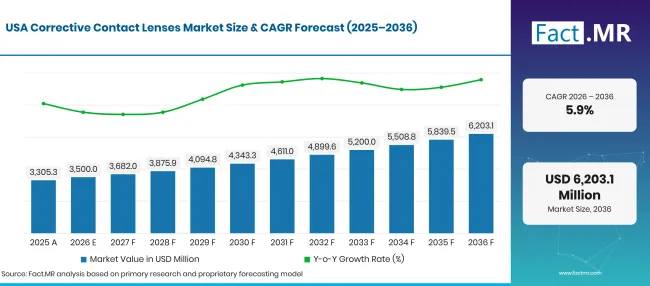
Corrective Contact Lenses Market Forecast Usa | Source: Fact.MR
The United States has a substantial established population of contact lens users. The Centers for Disease Control and Prevention reports that approximately 45 million people in the country wear contact lenses [6]. This creates recurring demand for replacement lenses and products designed for different refractive errors. Manufacturers are also expanding daily disposable and specialty lens portfolios. Continued attention to prescription compliance and safe lens care remains important for sustained adoption.
How is the United Kingdom advancing in the market?
5.3% CAGR, shaped by established lens use and continued demand for daily disposable products.
The UK has an established contact lens market supported by optical retailers and professional fitting services. EuromContact's 2025 industry data reported 9.6% soft contact lens wearer penetration for the combined UK and Ireland reporting market. This is a combined-market measure rather than a UK-only figure. The previously stated 67% daily disposable fitting share requires a separate original prescribing survey [7].[7]
What supports Japan adoption?
4.7% CAGR, driven by a mature contact lens industry and continued product development.
Japan has an established contact lens market supported by domestic manufacturers and specialist optical retailers. Contact lens suppliers provide daily disposable, toric and multifocal products for a range of prescription needs. The linked PMDA medical-device review material does not establish 2024 or 2025 Japan Contact Lens Association shipment totals, so the specific reported values have been withheld pending the original association tables [8].[8]
Who leads the Corrective Contact Lenses Market?
Fact.MR identifies Johnson & Johnson Vision Care, Alcon, Bausch + Lomb, CooperVision, HOYA Corporation, Menicon and SEED as key companies in the competitive landscape.
Johnson & Johnson Vision Care competes through its ACUVUE portfolio, including OASYS MAX 1-Day lenses made from senofilcon A [9]. Alcon offers DAILIES TOTAL1, PRECISION1 and TOTAL30 products across daily disposable and reusable categories [10]. Bausch + Lomb participates through its ULTRA silicone hydrogel range, while CooperVision offers Biofinity and MyDay products for different refractive requirements [11] [12].
HOYA Corporation has a contact lens division and develops its own contact lens products, including rigid lenses and multifocal design. Menicon participates in rigid gas permeable and orthokeratology lenses through products such as Menicon Z and Z Night. SEED offers daily disposable lenses, including products designed for astigmatism and presbyopia.
Competition depends on material performance, prescription coverage, replacement schedules, comfort and professional fitting support. Manufacturers are also differentiating their portfolios through daily disposable lenses and specialty products for myopia management. Retail partnerships and access to eye-care professionals remain important to market reach.
Which companies are the key providers?
Key companies include Johnson & Johnson Vision Care, Alcon, Bausch + Lomb, CooperVision, HOYA Corporation, Menicon and SEED.
- Johnson & Johnson Vision Care, Inc.
- Alcon, Inc.
- Bausch + Lomb
- CooperVision, Inc.
- HOYA Corporation
- Menicon Co., Ltd.
- SEED Co., Ltd.
Bibliography
- [1] Centers for Disease Control and Prevention. (2025, May 27). About contact lenses.
- [2] EuromContact. (2026, May 5). EMEA soft contact lens market reports 6% growth in 2025 [Press release].
- [3] CooperVision. (n.d.). Our products.
- [4] EuromContact. (2026, May 5). EMEA soft contact lens market reports 6% growth in 2025 [Press release].
- [5] Agência Nacional de Vigilância Sanitária. (2026, February 25). Lista de tipos de dispositivos médicos com transmissão suspensa ao SIUD.
- [6] Centers for Disease Control and Prevention. (2025, May 27). About contact lens types.
- [7] EuromContact. (2026, May 5). EMEA soft contact lens market reports 6% growth in 2025 [Press release].
- [8] Pharmaceuticals and Medical Devices Agency. (2025, August). MiSight 1 Day: Medical device review report.
- [9] Johnson & Johnson Vision Care. (n.d.). ACUVUE OASYS MAX 1-Day.
- [10] Alcon. (2026, February 17). Alcon launches TOTAL30 Multifocal for Astigmatism, the world’s only monthly multifocal toric contact lens with Water Gradient Technology.
- [11] Bausch + Lomb. (n.d.). ULTRA contact lenses.
- [12] CooperVision. (2026, May 18). CooperVision completes enrollment for world’s largest pediatric myopia control clinical study.
This Report Answers
- The report describes how corrective contact lenses address different refractive errors.
- Product analysis compares soft, rigid gas permeable and hybrid contact lenses.
- Application analysis examines demand across myopia, hyperopia, astigmatism and presbyopia.
- Distribution analysis compares online stores, optical stores and hospitals and clinics.
- Material analysis evaluates silicone hydrogel, hydrogel and PMMA lenses.
- Country analysis discusses Germany, Brazil, USA, UK and Japan alongside available industry statistics.
- The competitive overview profiles seven contact lens manufacturers and suppliers.
What does the Corrective Contact Lenses Market cover?
The market covers contact lenses designed to correct refractive errors and improve vision. It includes soft lenses, rigid gas permeable lenses and hybrid designs. Application coverage includes myopia, hyperopia, astigmatism and presbyopia. The analysis also considers material composition and the distribution channels through which corrective contact lenses reach consumers.
What is included in the scope?
Included products are corrective contact lenses sold for vision correction.
The scope covers soft hydrogel and silicone hydrogel lenses, rigid gas permeable lenses and hybrid lenses. It includes products for spherical prescriptions and specialty designs for astigmatism and presbyopia. Distribution coverage includes online stores, optical stores, hospitals and clinics.
What is excluded from the scope?
The analysis excludes non-corrective cosmetic lenses that do not provide vision correction.
Contact lens care solutions and accessories are excluded unless explicitly included in the market-sizing definition. Intraocular lenses, spectacle lenses and refractive surgery procedures are outside the product boundary. Diagnostic equipment and general ophthalmic services are also excluded.
How Was the Analysis Built?
The analysis draws on 120+ sources, 35+ company portfolios, 25+ countries, and more than 20 industry interviews.
- Primary Research: Primary research includes discussions with manufacturers, service providers, technology developers, distributors, end users, and subject-matter experts. These conversations examine purchasing priorities, product adoption, operational challenges, approval requirements, competitive positioning, and the factors that influence wider market acceptance.
- Desk Research: Desk research covers government statistics, regulatory publications, company filings, trade data, technical studies, industry associations, standards, public policy, and other authoritative sources. Every source used in the analysis is documented in the bibliography.
- Market Sizing and Forecasting: Market estimates combine historical performance, demand indicators, pricing and volume trends, segment shares, company participation, country-level growth, adoption patterns, investment activity, and barriers to market expansion.
- Data Validation and Update Cycle: Findings are validated by comparing primary interviews with public data, company activity, regulatory changes, trade patterns, and industry developments. Regular updates review new product launches, capacity changes, partnerships, approvals, and shifts in commercial adoption.
Segmentation
What is the report's scope and coverage?
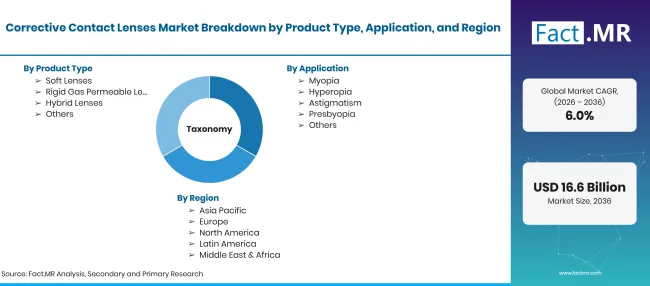
Corrective Contact Lenses Market Taxonomy | Source: Fact.MR
| Attribute | Details |
|---|---|
| Quantitative Units | USD billion |
| Market Definition | The corrective contact lenses market comprises lenses designed to correct refractive errors by modifying how light focuses on the retina. These lenses are worn directly on the surface of the eye and address vision conditions such as myopia and hyperopia as well as astigmatism and presbyopia. |
| Product Type | Soft Lenses; Rigid Gas Permeable Lenses; Hybrid Lenses; Others |
| Application | Myopia; Hyperopia; Astigmatism; Presbyopia; Others |
| Distribution Channel | Online Stores; Optical Stores; Hospitals & Clinics |
| Material | Silicone Hydrogel; Hydrogel; PMMA; Others |
| Regions Covered | North America; Latin America; Western Europe; Eastern Europe; East Asia; South Asia & Pacific; Middle East & Africa |
| Countries Covered | Germany; Brazil; USA; UK; Japan |
| Companies Profiled | Johnson & Johnson Vision Care; Alcon; Bausch + Lomb; CooperVision; HOYA Corporation; Menicon; SEED |
| Forecast Period | 2026 to 2036 |
| Approach | Market segmentation and scenario-based analysis supported by company product portfolios and contact lens industry statistics |
Source: Fact.MR analysis. Updated Nov 5, 2026
How is the market segmented?
-
By Product Type
- Soft Lenses
- Rigid Gas Permeable Lenses
- Hybrid Lenses
- Others
-
By Application
- Myopia
- Hyperopia
- Astigmatism
- Presbyopia
- Others
-
By Distribution Channel
- Online Stores
- Optical Stores
- Hospitals & Clinics
-
By Material
- Silicone Hydrogel
- Hydrogel
- PMMA
- Others
-
By Region
- North America
- Latin America
- Western Europe
- Eastern Europe
- East Asia
- South Asia & Pacific
- Middle East & Africa
Frequently Asked Questions
How big is the Corrective Contact Lenses Market in 2026?
What is the CAGR from 2026 to 2036?
Which product type has the largest share?
Which application leads the market?
Which distribution channel has the largest share?
Which material leads the market?
Which companies are covered?
Who worked on this report


Preview the report firsthand - request a free sample
Free SampleGet the brochure for pricing and purchase details
Download PDF