- Market Value (2025): USD 129.6 Mn
- Estimated Value (2026): USD 134.7 Mn
- Forecast Value (2036): USD 198.9 Mn
- CAGR (2026-2036): 4.0%
What is the Thymopentin Market forecast to be worth by 2036?
USD 134.7 million in 2026 to USD 198.9 million by 2036 at a 4.0% CAGR.
- Thymopentin demand came to USD 129.6 million in 2025, with hospital pharmacies in China accounting for most finished-dose purchasing.
- Revenue will grow from USD 134.7 million in 2026 to USD 198.9 million by 2036 as injectable use in immune dysfunction settings holds steady and research supply widens.
- A 4.0% CAGR reflects a mature prescription base that adds volume slowly, with quality upgrades and country registrations giving the extra lift.
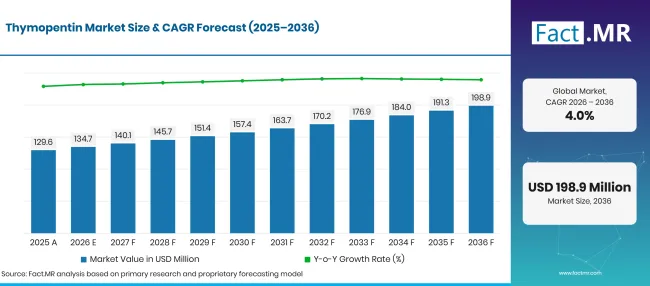
Thymopentin Market Forecast Global | Source: Fact.MR
| Year | Basis | Market Value (USD million) |
|---|---|---|
| 2025 | Actual | 129.6 |
| 2026 | Estimate | 134.7 |
| 2036 | Forecast | 198.9 |
| CAGR 2026 to 2036 | Forecast period | 4.0% |
Source: Fact.MR analysis. Updated Nov 5, 2026
What are the defining numbers behind Thymopentin Market growth?
New value of USD 64.1 million will be added between 2026 and 2036, most of it through hospital channels and synthetic peptide supply.
- Demand Drivers in the Market
- Hospital and outpatient traffic in China creates a wide setting for supervised injectable therapy. The National Bureau of Statistics recorded 10.58 billion medical visits in 2025, a volume that keeps supportive immune treatments in daily clinical rotation [1].
- Insurance funding keeps institutional prescribing active. Employee medical insurance paid RMB 1,846.27 billion in medical institution expenses during 2025, and the cross-province settlement network reached 655,800 designated medical and pharmaceutical institutions [2].
- Contract manufacturing rules are lifting quality expectations for sterile peptide injections. An NMPA announcement issued on 30 December 2025 makes marketing authorization holders and contract manufacturers jointly responsible for drug quality, with extra experience requirements for sterile products [3].
- The 2025 Chinese Pharmacopoeia took effect on 1 October 2025 as the legal standard for drug production, distribution and use, so thymopentin holders had to align registration standards with the new edition [4]. Producers with strong analytical control gain an edge under that review.
- Key Segments Analyzed
- By Product Type: Synthetic Thymopentin will account for 72.0% of 2026 revenue, since solid-phase synthesis gives a defined five-amino-acid sequence with batch-to-batch consistency.
- By Application: Immunotherapy will capture 42.3% of 2026 demand, given that immune restoration is the main reason clinicians prescribe the peptide.
- By Distribution Channel: Hospitals will hold 44.0% of 2026 value, as injections need supervised administration and pharmacy review.
- By End-User: Healthcare Providers will represent 74.0% of 2026 sales, reflecting their control over prescribing and dosing.
- Analyst Opinion at Fact.MR
- Shambhu Nath Jha, Principal Consultant at Fact.MR, states, “Thymopentin will keep a steady role in hospital immunomodulation, but growth will come from better quality and wider registration more than from new indications. China’s tighter rules on contract manufacturing and pharmacopoeia standards will reward producers that control both peptide synthesis and sterile filling. Outside China, research-grade supply will grow faster than clinical use until regulators see stronger evidence.”
- Strategic Implications
- Manufacturers should invest in impurity profiling and sterile fill capacity, since inspectors now judge contract partners on their sterile track record.
- Distributors should build cold-chain and pharmacy-review support for hospital tenders, where injectable thymopentin is bought through provincial online procurement.
- Hospital buyers should check each product’s approved indication and specification before listing it, because labels differ by registration holder.
- Investors should look at firms that own both peptide API and finished-dose assets, as that structure lowers supply risk under the new quality rules.
Japan will post the quickest pace at 5.2%, helped by an aging population and steady interest in immune support among older patients. The United States follows at 4.8%, where demand leans on research use and an active review pipeline. The United Kingdom at 4.3% benefits from high public health spending. Brazil at 3.7% draws on a wide pharmaceutical retail base, while Germany at 3.2% grows slowest because prescribers rely on established immunology products.
How does the Thymopentin Market break down by segment?
Synthetic Thymopentin will lead Product Type at 72.0%; Immunotherapy will head Application at 42.3%; Hospitals will lead Distribution Channel at 44.0%; Healthcare Providers will hold End-User at 74.0% in 2026.
Which Product Type leads?
Synthetic Thymopentin takes 72.0% of 2026 sales.
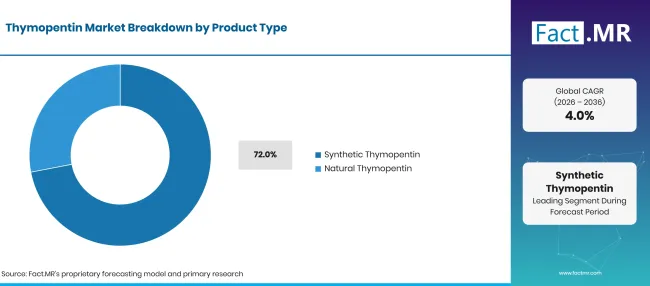
Thymopentin Market Breakdown Product Type | Source: Fact.MR
| Product Type | Share (2026) |
|---|---|
| Synthetic Thymopentin (Leading segment) | 72.0% |
| Other segments combined | 28.0%* |
| Total | 100.0% |
Source: Fact.MR analysis. Updated Nov 5, 2026
Drug makers need a peptide that passes pharmacopoeia testing every batch, and chemical synthesis delivers that control. Thymopentin is the Arg-Lys-Asp-Val-Tyr fragment of thymopoietin, so it can be built residue by residue and purified to a tight specification. The same chemistry supports peptide synthesis services that supply both clinical and research grades. Natural Thymopentin covers material described as tissue-derived or semi-purified. Its role is small, as reproducibility and regulatory documentation are harder to secure. Most buyers in this category are laboratories comparing native and synthetic peptides.
What supports Immunotherapy within Application?
Immunotherapy represents 42.3% of 2026 revenue.
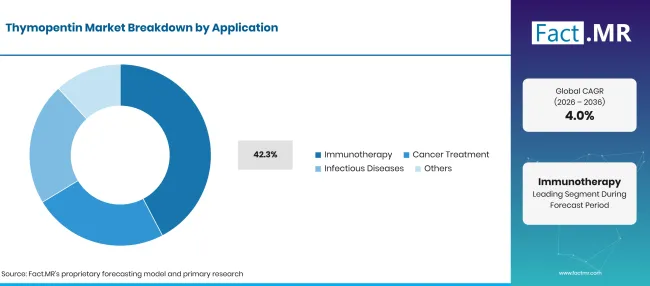
Thymopentin Market Breakdown Application | Source: Fact.MR
| Application | Share (2026) |
|---|---|
| Immunotherapy (Leading segment) | 42.3% |
| Other segments combined | 57.7%* |
| Total | 100.0% |
Source: Fact.MR analysis. Updated Nov 5, 2026
Clinicians use thymopentin to restore T-cell function in patients whose immunity has dropped. That purpose links it to wider peptide therapeutics used as supportive care in oncology and chronic infection. Cancer Treatment covers adjuvant use after radiotherapy or chemotherapy, a setting close to cancer immunotherapy programs but with simpler dosing. Infectious Diseases include chronic hepatitis B in adults, while Others cover selected autoimmune conditions. Approved indications vary by registration, so uptake differs by country and label.
How does Distribution Channel shape demand?
Hospitals account for 44.0% of 2026 market value.
| Distribution Channel | Share (2026) |
|---|---|
| Hospitals (Leading segment) | 44.0% |
| Other segments combined | 56.0%* |
| Total | 100.0% |
Source: Fact.MR analysis. Updated Nov 5, 2026
Injectable thymopentin is dispensed where a nurse or physician can give the dose. Hospital formularies show how the product is bought: a county hospital in Yantai listed a 1 ml: 10 mg thymopentin injection on its first-quarter 2025 medicine list under provincial online procurement [5]. Clinics handle follow-up courses once treatment is started. Online Pharmacies serve eligible prescriptions where local dispensing law allows injectables, and they rely on the same handling rules used in sterile compounding pharmacies. Others include specialty dispensaries and research distributors.
How does End-User shape demand?
Healthcare Providers generate 74.0% of 2026 revenue.
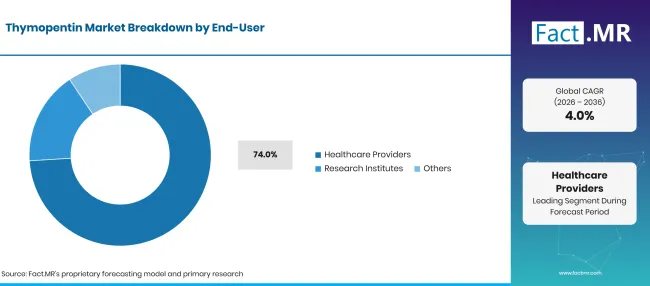
Thymopentin Market Breakdown End User | Source: Fact.MR
| End-User | Share (2026) |
|---|---|
| Healthcare Providers (Leading segment) | 74.0% |
| Other segments combined | 26.0%* |
| Total | 100.0% |
Source: Fact.MR analysis. Updated Nov 5, 2026
Prescribing physicians decide when immune support is needed and how long a course runs. Hospitals and specialist clinics also supervise injections, which keeps use tied to professional care. Suppliers of injectable drug delivery formats compete for this group. Research Institutes buy small, high-purity lots for studies of T-cell maturation and immune signaling. Many of these studies pair the peptide with biomarker-based immunoassays to track response. Others include contract laboratories and teaching centers.
What is accelerating Thymopentin Market adoption, and what is holding it back?
Steady hospital use in China and growing research demand keep the market moving. Tighter quality rules also favor experienced peptide makers. On the other side, limited modern trial evidence and the absence of approvals in major Western markets restrict wider clinical uptake. Competing immunomodulators also take share in some indications.
Drivers Impact Analysis
| DRIVER | (~) % IMPACT ON CAGR | GEOGRAPHIC RELEVANCE | IMPACT TIMELINE |
|---|---|---|---|
| Continued hospital use of thymopentin in immune dysfunction settings | +1.4% | East Asia | Medium term (2-4 years) |
| Insurance-funded institutional prescribing in China | +0.9% | East Asia | Short term (<=2 years) |
| Research demand for high-purity immunomodulatory peptides | +0.7% | Global | Medium term (2-4 years) |
| Quality upgrades driven by new pharmacopoeia and contract manufacturing rules | +0.5% | East Asia | Short term (<=2 years) |
Source: Fact.MR analysis. Updated Nov 5, 2026
Opportunity Impact Analysis
| OPPORTUNITY | (~) % IMPACT ON CAGR | GEOGRAPHIC RELEVANCE | IMPACT TIMELINE |
|---|---|---|---|
| New clinical studies on immune recovery after cancer therapy | +0.6% | Global | Long term (>=4 years) |
| Integrated peptide API and finished-dose supply chains | +0.4% | East Asia | Medium term (2-4 years) |
| Wider hospital tender access in Latin America | +0.3% | Latin America | Medium term (2-4 years) |
| Country-specific registrations outside China | +0.2% | Europe, North America | Long term (>=4 years) |
Source: Fact.MR analysis. Updated Nov 5, 2026
Restraints Impact Analysis
| RESTRAINT | (~) % IMPACT ON CAGR | GEOGRAPHIC RELEVANCE | IMPACT TIMELINE |
|---|---|---|---|
| Limited recent clinical evidence for several indications | -0.5% | Global | Long term (>=4 years) |
| Lack of approval in major Western markets | -0.3% | North America, Western Europe | Medium term (2-4 years) |
| Competition from other immunomodulators | -0.2% | Global | Medium term (2-4 years) |
| Price pressure in centralized hospital procurement | -0.1% | East Asia | Short term (<=2 years) |
Source: Fact.MR analysis. Updated Nov 5, 2026
Which countries are scaling the Thymopentin Market through 2036?
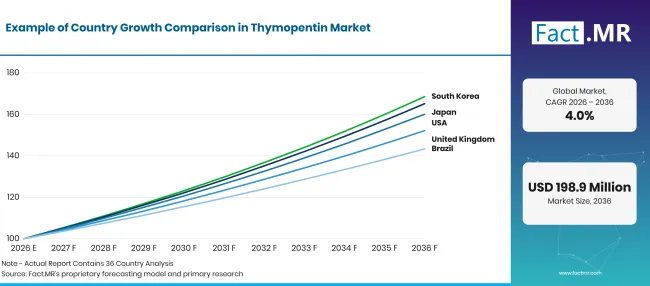
Thymopentin Market Growth Index | Source: Fact.MR
| Country | CAGR (2026 to 2036) |
|---|---|
| Japan | 5.2% |
| United States | 4.8% |
| United Kingdom | 4.3% |
| Brazil | 3.7% |
| Germany | 3.2% |
Source: Fact.MR analysis. Updated Nov 5, 2026
What places Japan ahead in country growth?
5.2% CAGR, driven by an older patient base and clinical interest in immune support.
An aging population raises the number of patients with weak immune response after cancer care. The Statistical Handbook of Japan 2026 reports that people aged 65 and over formed 29.3% of the population in 2024 [6]. Peptide importers and research suppliers serve hospital laboratories and university centers, and any clinical use will need review by Japanese regulators. Interest in healthy aging also widens study budgets for immune markers in older adults.
What is supporting United States adoption?
4.8% CAGR, backed by research spending and an active drug review system.
American demand comes mostly from research-grade supply, since thymopentin holds no US marketing approval. The pipeline for new medicines stays busy: the FDA approved 46 novel drugs in 2025 [7]. Laboratories studying immune aging and peptide signaling buy catalog thymopentin from domestic distributors.
How is the United Kingdom developing demand?
4.3% CAGR, helped by high public health spending.
The UK health system funds a large research and hospital base. The Office for National Statistics estimated healthcare spending at about GBP 345 billion in 2025, a nominal rise of 7.7%, with government financing 81% of the total [8]. Demand centers on academic immunology work and investigator-led studies. Suppliers that hold clear purity certificates and short delivery times win most repeat orders from these groups.
How is Brazil developing demand?
3.7% CAGR, as a wide pharmaceutical market supports specialty imports.
Brazil has the commercial scale for niche injectables. Anvisa reported pharmaceutical revenue of about BRL 182 billion in 2025, with 6.3 billion packages sold [9]. Entry for thymopentin will depend on local registration. Early demand comes from research institutions and private hospitals in São Paulo and Rio de Janeiro.
What supports Germany’s adoption?
3.2% CAGR, reflecting high spending but cautious prescribing.
Germany spends heavily on medicines, yet prescribers favor established immunology products. Destatis reported health expenditure of EUR 538.2 billion in 2024, with pharmaceuticals at EUR 85.1 billion, up 9.3% [10]. Thymopentin use stays in research settings and specialist studies. University hospitals in immunology and oncology form the main buyers, and growth will track academic funding cycles.
Who leads the Thymopentin Market?
Competition splits into two groups that serve different buyers. Chinese drug makers such as Chengdu Shengnuo Biotech and Anhui Anke Biotechnology (Group) supply the clinical channel, where hospitals buy injectable thymopentin through provincial tenders. Chengdu Shengnuo lists thymopentin for injection among its peptide formulations, and Anke lists thymopentin as a peptide API. Anke opened its Shanghai innovation institute on 27 November 2025 and set up a peptide unit linking API output, formulation and sales [12].
These firms compete on registration coverage, sterile capacity and tender pricing. A second group serves laboratories. Bachem, Thermo Fisher Scientific, Cayman Chemical and Tokyo Chemical Industry sell catalog thymopentin for research. Bachem reported in March 2026 that phase one of its Building K peptide plant passed Swiss inspection at the end of 2025 [11]. Research suppliers compete on purity data, pack sizes and delivery speed. Through 2036, the edge will go to firms that pair documented peptide quality with access to regulated hospital channels.
Which companies are the key providers?
Key companies in the Thymopentin Market include Chengdu Shengnuo Biotech, Anhui Anke Biotechnology (Group), Bachem, Thermo Fisher Scientific, Cayman Chemical and Tokyo Chemical Industry.
- Chengdu Shengnuo Biotech
- Anhui Anke Biotechnology (Group)
- Bachem
- Thermo Fisher Scientific
- Cayman Chemical
- Tokyo Chemical Industry
Bibliography
- [1] National Bureau of Statistics of China. (2026, February 28). Statistical Communiqué of the People’s Republic of China on the 2025 National Economic and Social Development.
- [2] National Healthcare Security Administration. (2026, July 16). 2025 Statistical Bulletin on the Development of National Healthcare Security.
- [3] National Medical Products Administration. (2026, April 14). Announcement of the National Medical Products Administration on Strengthening Supervision and Administration of Contract Manufacturing of Drugs (No. 134, 2025).
- [4] National Medical Products Administration. (2025, June 11). NMPA Announcement on Matters Related to the Implementation of the 2025 Edition of the Pharmacopoeia of the People’s Republic of China (No. 32, 2025).
- [5] Yantai Municipal Government. (2025, February 15). Yantai Penglai Hospital of Traditional Chinese Medicine: First Quarter 2025 Medicine List.
- [6] Statistics Bureau of Japan. (2026, September). Statistical Handbook of Japan 2026.
- [7] U.S. Food and Drug Administration. (2026, July 8). Novel Drug Approvals for 2025.
- [8] Office for National Statistics. (2026, April 29). Healthcare expenditure, UK Health Accounts: 2024 and 2025.
- [9] Agência Nacional de Vigilância Sanitária. (2026, September 28). CMED divulga 9° edição do Anuário Estatístico do Mercado Farmacêutico.
- [10] Statistisches Bundesamt. (2026, April 2). Gesundheitsausgaben im Jahr 2024 auf 538 Milliarden Euro gestiegen.
- [11] Bachem. (2026, March 12). Bachem reports strong sales growth and sustained high profitability.
- [12] Anhui Anke Biotechnology (Group) Co., Ltd. (2025, November 27). Anke Biotechnology (Shanghai) Innovation Research Institute Unveiled, Building a Collaborative Innovation System and Full Peptide Industry Chain.
This Report Answers
- How much value will thymopentin add between 2026 and 2036, and which channels will carry it?
- Why does synthetic material hold most product revenue?
- Which clinical uses drive immunotherapy demand, and where do labels differ?
- What separates Japan’s growth from Germany’s slower pace?
- How do Chinese drug makers and global research suppliers compete?
- Which quality rules will shape supply through 2036?
What does the Thymopentin Market cover?
Thymopentin is a synthetic pentapeptide that mimics the active site of thymopoietin. It is sold as a peptide API, as research-grade powder and as finished injections for immune dysfunction.
Value is counted at the first sale by the producer or importer. Finished doses are valued at hospital purchase prices, and research lots are valued at catalog prices.
What is included in the scope?
Thymopentin API sold to formulators under drug master files or local registrations.
Finished injectable thymopentin, including solutions and lyophilized powders, sold through hospitals, clinics and online pharmacies.Research-grade thymopentin and thymopentin acetate sold through life science catalogs.Contract synthesis of thymopentin when the output is sold as a named product.
What is excluded from the scope?
Thymalfasin, thymosin beta-4 and other thymic peptides that are sold under their own names.
Thymus extracts and traditional medicines that do not declare thymopentin content. Clinical trial services and research grants linked to thymopentin studies. General hospital or pharmacy revenue not linked to thymopentin products.
How Was the Analysis Built?
The analysis draws on 120+ sources, 35+ company portfolios, 25+ countries, and more than 20 industry interviews.
- Primary Research: Primary research includes discussions with manufacturers, service providers, technology developers, distributors, end users, and subject-matter experts. These conversations examine purchasing priorities, product adoption, operational challenges, approval requirements, competitive positioning, and the factors that influence wider market acceptance.
- Desk Research: Desk research covers government statistics, regulatory publications, company filings, trade data, technical studies, industry associations, standards, public policy, and other authoritative sources. Every source used in the analysis is documented in the bibliography.
- Market Sizing and Forecasting: Market estimates combine historical performance, demand indicators, pricing and volume trends, segment shares, company participation, country-level growth, adoption patterns, investment activity, and barriers to market expansion.
- Data Validation and Update Cycle: Findings are validated by comparing primary interviews with public data, company activity, regulatory changes, trade patterns, and industry developments. Regular updates review new product launches, capacity changes, partnerships, approvals, and shifts in commercial adoption.
Segmentation
What is the report’s scope and coverage?
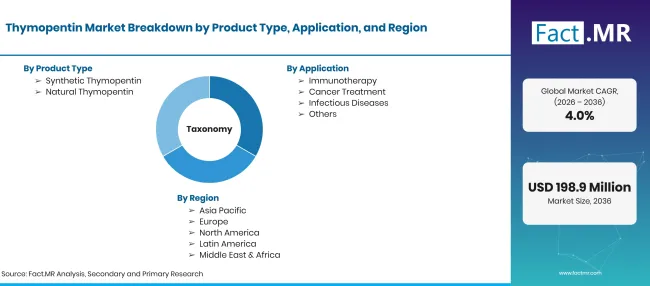
Thymopentin Market Taxonomy | Source: Fact.MR
| Attribute | Details |
|---|---|
| Quantitative Units | USD million |
| Market Definition | Revenue from thymopentin API, research-grade peptide and finished injectable formulations used in immunomodulatory therapy and research. |
| Product Type | Synthetic Thymopentin; Natural Thymopentin |
| Application | Immunotherapy; Cancer Treatment; Infectious Diseases; Others |
| Distribution Channel | Hospitals; Clinics; Online Pharmacies; Others |
| End-User | Healthcare Providers; Research Institutes; Others |
| Regions Covered | North America; Latin America; Western Europe; Eastern Europe; East Asia; South Asia & Pacific; Middle East & Africa |
| Countries Covered | Japan; United States; United Kingdom; Brazil; Germany |
| Companies Profiled | Chengdu Shengnuo Biotech; Anhui Anke Biotechnology (Group); Bachem; Thermo Fisher Scientific; Cayman Chemical; Tokyo Chemical Industry |
| Forecast Period | 2026 to 2036 |
| Approach | Product registrations, hospital procurement lists and research catalog pricing were combined with country health statistics to build the forecast. |
Source: Fact.MR analysis. Updated Nov 5, 2026
How is the market segmented?
-
By Product Type
- Synthetic Thymopentin
- Natural Thymopentin
-
By Application
- Immunotherapy
- Cancer Treatment
- Infectious Diseases
- Others
-
By Distribution Channel
- Hospitals
- Clinics
- Online Pharmacies
- Others
-
By End-User
- Healthcare Providers
- Research Institutes
- Others
-
By Region
- North America
- Latin America
- Western Europe
- Eastern Europe
- East Asia
- South Asia & Pacific
- Middle East & Africa
Frequently Asked Questions
How large is the thymopentin market in 2026?
What growth rate will the thymopentin market record?
Which product type leads?
Which application leads?
Which distribution channel leads?
Which end-user leads?
Which country will grow quickest?
Who are the main companies?
What holds the market back?
Who worked on this report


Preview the report firsthand - request a free sample
Free SampleGet the brochure for pricing and purchase details
Download PDF