- Market Value (2025): USD 2.13 Bn
- Estimated Value (2026): USD 2.28 Bn
- Forecast Value (2036): USD 4.52 Bn
- CAGR (2026-2036): 7.1%
What is the Lanreotide Market forecast to be worth by 2036?
USD 2.3 billion in 2026 to USD 4.5 billion by 2036 at a 7.1% CAGR.
- In 2025, the lanreotide market was worth USD 2.13 billion, with patients on maintenance therapy for acromegaly and neuroendocrine tumors generating most of that revenue.
- Revenue will grow from USD 2.28 billion in 2026 to USD 4.52 billion by 2036 as more patients reach long-term somatostatin analogue therapy through specialist centres.
- A 7.1% CAGR reflects wider treatment access, balanced against price pressure once several generic syringes compete for the same hospital tenders.
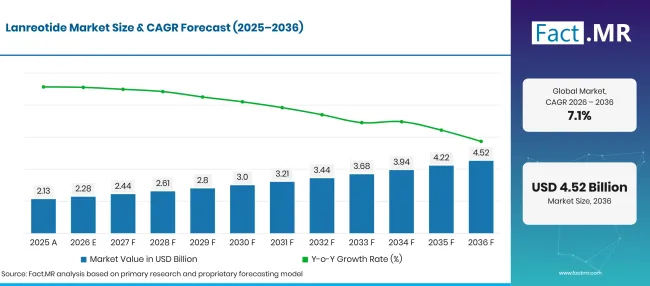
Lanreotide Market Forecast Global | Source: Fact.MR
| Year | Basis | Market Value (USD billion) |
|---|---|---|
| 2025 | Actual | 2.13 |
| 2026 | Estimate | 2.28 |
| 2036 | Forecast | 4.52 |
| CAGR 2026 to 2036 | Forecast period | 7.1% |
Source: Fact.MR analysis. Updated Nov 5, 2026
What are the defining numbers behind Lanreotide Market growth?
The 2026 to 2036 period will add USD 2.2 billion in new value, most of it in solution syringes dispensed by hospital pharmacies for acromegaly care.
- Demand Drivers in the Market
- Lifelong disease control keeps patients on therapy. The February 2025 US prescribing information for Cipla’s lanreotide covers long-term acromegaly treatment when surgery or radiotherapy fails, along with GEP-NETs and carcinoid syndrome [1]. Patients controlled on 60 mg or 90 mg may move to 120 mg every six or eight weeks, which supports adherence over many years.
- The originator still grows as generics arrive. Ipsen reported continued Somatuline growth in its October 2026 nine-month update and built its guidance on the assumed entry of generic lanreotide in the fourth quarter [2]. A stable originator base alongside new entrants widens the number of patients reached.
- European regulators keep approving lower-cost versions. Ireland’s HPRA authorised Lanreotide SUN 120 mg in a pre-filled syringe on 21 February 2025 for Sun Pharmaceutical Industries Europe [3]. Each new national licence gives hospital buyers another tender option and lowers the cost of each treated month.
- Earlier detection of neuroendocrine tumors adds new patients. Wider use of cross-sectional imaging and specialist tumour boards finds slow-growing GEP-NETs at a stage where antiproliferative therapy applies. Patients who start a somatostatin analogue at diagnosis often stay on it until progression, so each new case brings years of repeat doses.
- Key Segments Analyzed
- By Product Type: Solution will hold 68.4% share in 2026, since prefilled depot syringes need no reconstitution before a scheduled injection.
- By Application: Acromegaly will account for 54.2% of 2026 value, as patients with persistent growth hormone excess stay on therapy for years.
- By Distribution Channel: Hospital Pharmacies will capture 61.7% of 2026 demand owing to their control of specialist prescriptions and tender purchasing.
- Analyst Opinion at Fact.MR
- Shambhu Nath Jha, Principal Consultant at Fact.MR, states, “Lanreotide is a long-tenure therapy, and the value of each patient lies in years of uninterrupted four-weekly or extended-interval doses. Generic syringes will shift hospital tenders toward price, but clinicians will still judge suppliers on injection comfort, device reliability and supply continuity. Companies that can produce the peptide depot at scale and keep stock flowing to specialist clinics will hold their accounts through 2036.”
- Strategic Implications
- Manufacturers should invest in peptide depot capacity and syringe filling lines, because supply gaps quickly push hospitals to switch brands at the next tender.
- Distributors should keep cold-chain stock close to endocrine and oncology centres so that scheduled injections are never postponed.
- Hospital buyers should compare devices and dosing strengths across originator and generic products before awarding multi-year contracts.
- Investors should track national licensing in Europe and Asia, since each new authorisation widens the tender base for generic entrants.
Brazil heads the five-country group at 8.7%, where a growing cancer caseload and wider specialist access will bring new patients onto somatostatin analogue therapy. Germany follows at 7.7%, one point behind, with an established generic presence and a large pancreatic tumour burden. The United States trails Germany by only 0.3 points at 7.4%, as generic syringes reach hospital pharmacies. A wider gap of 1.7 points separates the United States from Japan at 5.7%, where an older population sustains endocrine care but price revisions limit value. The United Kingdom closes the group at 5.2%, held back by tight NHS tendering.
How does the Lanreotide Market break down by segment?
Solution will lead Product Type at 68.4%; Acromegaly will head Application at 54.2%; Hospital Pharmacies will hold Distribution Channel at 61.7% in 2026.
Which Product Type leads?
Solution takes 68.4% of 2026 sales.
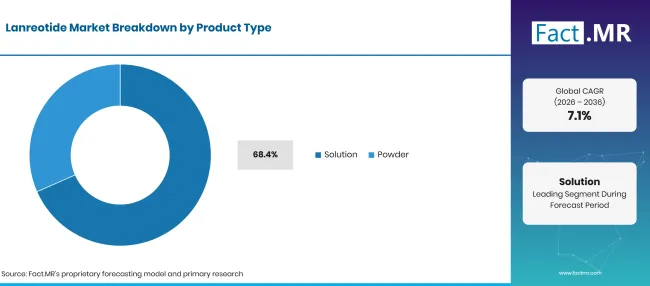
Lanreotide Market Breakdown Product Type | Source: Fact.MR
| Product Type | Share (2026) |
|---|---|
| Solution (Leading segment) | 68.4% |
| Other segments combined | 31.6%* |
| Total | 100.0% |
Source: Fact.MR analysis. Updated Nov 5, 2026
Nurses can inject a supersaturated lanreotide solution straight from the syringe, with no mixing step and little waste. Amneal’s 120 mg/0.5 mL single-dose pre-filled syringe, listed on DailyMed in September 2026, follows this same ready-to-use format [4]. The approach mirrors trends in prefilled syringes across other injectable drug classes. Powder presentations need reconstitution before injection and serve markets where lyophilised formulations remain registered or cost less to ship. They also give contract makers a route into the field without a high-pressure syringe filling line. Producers with skills in peptide synthesis services supply the active ingredient for both formats.
What supports Acromegaly within Application?
Acromegaly represents 54.2% of 2026 revenue.
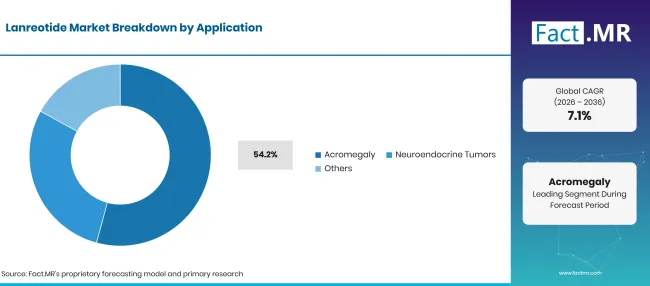
Lanreotide Market Breakdown Application | Source: Fact.MR
| Application | Share (2026) |
|---|---|
| Acromegaly (Leading segment) | 54.2% |
| Other segments combined | 45.8%* |
| Total | 100.0% |
Source: Fact.MR analysis. Updated Nov 5, 2026
Pituitary adenomas that secrete growth hormone often persist after surgery, so many patients need medical therapy for life. The US label starts most patients at 90 mg every four weeks for three months, then adjusts the dose to growth hormone and IGF-1 results [1]. Lanreotide competes here with other options covered under acromegaly treatment, including pegvisomant and oral octreotide. Neuroendocrine tumors form the second application and include well or moderately differentiated GEP-NETs, where the drug slows progression at 120 mg every four weeks. Carcinoid syndrome adds patients who need fewer flushing and diarrhoea episodes. Other uses include thyrotropin-secreting pituitary tumors in Japan, a niche that links to the wider human growth hormone field of pituitary care.
How does Distribution Channel shape demand?
Hospital Pharmacies account for 61.7% of 2026 value.
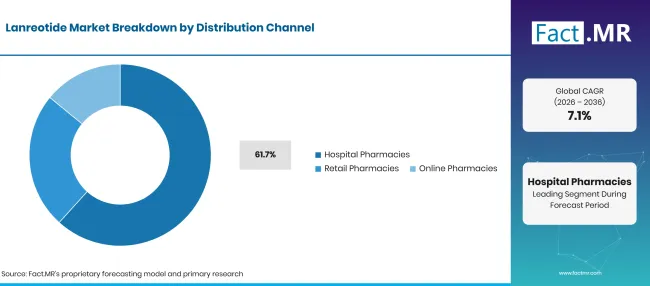
Lanreotide Market Breakdown Distribution Channel | Source: Fact.MR
| Distribution Channel | Share (2026) |
|---|---|
| Hospital Pharmacies (Leading segment) | 61.7% |
| Other segments combined | 38.3%* |
| Total | 100.0% |
Source: Fact.MR analysis. Updated Nov 5, 2026
Endocrinologists and oncologists start lanreotide in outpatient clinics attached to hospitals, and the first injections are usually given there. Hospital pharmacy teams hold the cold-chain stock, run tenders and decide which generic wins formulary status. Multi-year contracts lock in a single supplier for most patients at each centre. Retail pharmacies dispense repeat prescriptions for patients trained to self-inject or treated by home-care nurses. Online pharmacies play a small role, limited by cold-chain rules and specialist prescription controls. Price shifts in generic injectables will reach these channels once hospital contracts reset.
What is accelerating Lanreotide Market adoption, and what is holding it back?
Long treatment duration in acromegaly, rising detection of neuroendocrine tumors and the convenience of prefilled depot syringes lift demand. Price erosion from new generic entrants, the cost of monthly specialist therapy and the technical difficulty of making peptide depots hold growth below what patient numbers alone would suggest.
Drivers Impact Analysis
| DRIVER | (~) % IMPACT ON CAGR | GEOGRAPHIC RELEVANCE | IMPACT TIMELINE |
|---|---|---|---|
| Acromegaly patients staying on lanreotide for years of hormone control | +2.4% | Global | Short term (<=2 years) |
| Earlier detection and treatment of gastroenteropancreatic neuroendocrine tumors | +1.9% | North America, Western Europe, East Asia | Medium term (2-4 years) |
| Generic lanreotide syringes widening hospital tender choice | +1.4% | North America, Western Europe | Medium term (2-4 years) |
| Clinic preference for ready-to-use long-acting injections | +0.9% | Global | Short term (<=2 years) |
Source: Fact.MR analysis. Updated Nov 5, 2026
Opportunity Impact Analysis
| OPPORTUNITY | (~) % IMPACT ON CAGR | GEOGRAPHIC RELEVANCE | IMPACT TIMELINE |
|---|---|---|---|
| Extended-interval dosing that reduces clinic visits | +0.8% | Global | Medium term (2-4 years) |
| Somatostatin analogue access in emerging markets | +0.7% | Latin America, South Asia & Pacific | Long term (>=4 years) |
| Home-care and self-injection programmes | +0.5% | North America, Western Europe | Medium term (2-4 years) |
| Regional peptide depot manufacturing capacity | +0.3% | East Asia, South Asia & Pacific | Long term (>=4 years) |
Source: Fact.MR analysis. Updated Nov 5, 2026
Restraints Impact Analysis
| RESTRAINT | (~) % IMPACT ON CAGR | GEOGRAPHIC RELEVANCE | IMPACT TIMELINE |
|---|---|---|---|
| Price erosion as generic competitors enter | -1.1% | North America, Western Europe | Short term (<=2 years) |
| High treatment costs and reimbursement limits | -0.8% | Global | Medium term (2-4 years) |
| Demanding peptide depot manufacturing and quality-control standards | -0.5% | Global | Medium term (2-4 years) |
| Supply interruptions leaving strengths temporarily unavailable | -0.3% | Global | Short term (<=2 years) |
Source: Fact.MR analysis. Updated Nov 5, 2026
Which countries are scaling the Lanreotide Market through 2036?
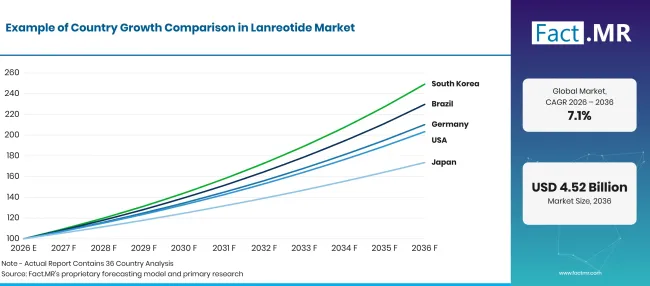
Lanreotide Market Growth Index | Source: Fact.MR
| Country | CAGR (2026 to 2036) |
|---|---|
| Brazil | 8.7% |
| Germany | 7.7% |
| United States | 7.4% |
| Japan | 5.7% |
| United Kingdom | 5.2% |
Source: Fact.MR analysis. Updated Nov 5, 2026
What supports lanreotide adoption in Brazil?
8.7% CAGR, driven by a rising cancer caseload and wider access to specialist oncology.
Brazil’s National Cancer Institute estimates 781,000 new cancer cases a year from 2026 to 2028 [5]. A share of these are digestive and pancreatic tumors that oncologists screen for neuroendocrine features. As reference centres in the public SUS network and private hospitals add tumour boards, more patients will start somatostatin analogue therapy. Acromegaly diagnosis will also improve as endocrinology services reach more state capitals.
How is Germany developing demand?
7.7% CAGR, backed by an early generic presence and dense specialist care.
Destatis counted 19,608 deaths from pancreatic cancer in Germany in 2025, or 8.57% of all deaths from malignant neoplasms [6]. That burden keeps gastroenterology and oncology units alert to pancreatic neuroendocrine tumors, which respond to lanreotide. German hospitals can already choose between originator and generic syringes, and sickness funds reward lower-priced options. Steady patient numbers and quick generic uptake will keep volumes rising faster than prices fall.
What is supporting United States adoption?
7.4% CAGR, helped by new generic syringes reaching hospital pharmacies.
The FDA lists two lanreotide approvals under its competitive generic therapy pathway: a three-strength ANDA for InvaGen Pharmaceuticals in May 2024 and a 120 mg syringe for Amneal on 18 September 2026 [7]. Amneal launched immediately and cited dedicated, large-scale in-house manufacturing [8]. More suppliers will help payers widen coverage for patients with acromegaly and GEP-NETs, even as average prices fall.
How does Japan perform?
5.7% CAGR, reflecting an ageing population under long-term endocrine care.
Japan’s Cabinet Office reported 36.24 million people aged 65 or over on 1 October 2024, or 29.3% of the population [9]. Neuroendocrine tumors and pituitary disorders are diagnosed more often in older adults, which keeps demand stable. Teijin Pharma markets Somatuline in Japan for acromegaly, pituitary gigantism, thyrotropin-secreting pituitary tumors and pancreatic and gastrointestinal neuroendocrine tumors. Regular national price revisions hold value growth below volume growth.
How is the United Kingdom scaling demand?
5.2% CAGR, as NHS tendering keeps prices tight while patient numbers grow.
The NHS Dictionary of Medicines and Devices has listed a Sun Pharma UK 120 mg/0.5 ml lanreotide syringe since 1 March 2025 [10]. Ipsen’s 60 mg, 90 mg and 120 mg syringes appear on the electronic medicines compendium with information certified in November 2025 [11]. Several listed suppliers give NHS trusts room to tender on price. Specialist centres for neuroendocrine tumors and pituitary disease will keep prescribing concentrated in hospitals.
Who leads the Lanreotide Market?
The originator tier is led by Ipsen, whose Somatuline brand set the clinical standard for depot lanreotide. Ipsen reported continued Somatuline growth in October 2026 while planning for generic entry in the fourth quarter [2].
Teijin Pharma extends that franchise in Japan under its own marketing rights. A second tier of generic producers competes on price, device feel and supply security. Amneal launched its 120 mg syringe in September 2026 with in-house manufacturing [8], and Cipla supplies a three-strength range in the United States. ADVANZ PHARMA holds UK authorisation for 60 mg, 90 mg and 120 mg syringes and revised its leaflet in February 2025 [12]. Sun Pharma and Zentiva add national licences in Ireland, the UK and Spain. Originators defend their base through clinician familiarity and patient support services, while generics win tenders with lower cost. Through 2036, reliable depot manufacturing and the ability to supply all three strengths without gaps will decide which suppliers keep hospital contracts.
Which companies are the key providers?
Key companies in the Lanreotide Market include Ipsen, Teijin Pharma, Amneal Pharmaceuticals, Cipla, ADVANZ PHARMA, Sun Pharma and Zentiva.
- Ipsen
- Teijin Pharma
- Amneal Pharmaceuticals
- Cipla
- ADVANZ PHARMA
- Sun Pharma
- Zentiva
Bibliography
- [1] Cipla USA Inc. (2025, February). LANREOTIDE ACETATE injection: prescribing information.
- [2] Ipsen. (2026, October 22). Ipsen delivers outstanding sales growth in the first nine months of 2026 and further upgrades its full-year guidance.
- [3] Health Products Regulatory Authority. (2025, February 21). Lanreotide SUN 120 mg solution for injection in a pre-filled syringe.
- [4] Amneal Pharmaceuticals LLC. (2026, September 23). LANREOTIDE ACETATE injection: label information.
- [5] Instituto Nacional de Câncer. (2026, February). INCA estima 781 mil novos casos de câncer por ano no Brasil de 2026 a 2028.
- [6] Statistisches Bundesamt. (2026, October 9). Häufigste Todesfälle durch Krebs.
- [7] U.S. Food and Drug Administration. (2026, November 3). Competitive Generic Therapy Approvals.
- [8] Amneal Pharmaceuticals. (2026, September 18). Amneal Announces FDA Approval and Launch of Lanreotide Injection.
- [9] Cabinet Office, Japan. (2025, June). Annual Report on the Ageing Society: Summary FY2025.
- [10] NHS Business Services Authority. (2025, March 1). Lanreotide 120mg/0.5ml solution for injection pre-filled syringes (Sun Pharma UK Ltd).
- [11] Ipsen Ltd. (2025, November). Somatuline Autogel 120 mg solution for injection in a prefilled syringe.
- [12] ADVANZ PHARMA. (2025, March 26). Lanreotide ADVANZ PHARMA 120 mg solution for injection in pre-filled syringe: patient leaflet.
This Report Answers
- How is lanreotide revenue split between ready-to-use solution syringes and powder presentations?
- Why does acromegaly carry more than half of 2026 value, and how fast are neuroendocrine tumor uses growing?
- What share of demand flows through hospital pharmacies, and when will retail and online channels gain?
- Where do Brazil, Germany, the United States, Japan and the United Kingdom differ in growth and pricing?
- Which originator and generic suppliers compete for hospital tenders?
- How will generic entry, reimbursement and peptide manufacturing limits shape value through 2036?
What does the Lanreotide Market cover?
This study values sales of finished-dose lanreotide, a synthetic octapeptide that binds somatostatin receptors and reduces growth hormone, IGF-1 and gut hormone secretion. Prefilled depot syringes in 60 mg, 90 mg and 120 mg strengths form the core of the product range, with powder forms tracked where registered.
Revenue is measured at manufacturer selling prices in USD billion across hospital, retail and online pharmacy channels. Both originator and generic products count toward the total.
What is included in the scope?
Lanreotide acetate solution for deep subcutaneous injection in single-dose prefilled syringes.
Powder and other registered lanreotide presentations that require reconstitution.Originator and generic products approved for acromegaly, GEP-NETs, carcinoid syndrome and other labelled indications.Sales through hospital pharmacies, retail pharmacies and online pharmacies, including home-care supply linked to peptide therapeutics programmes.
What is excluded from the scope?
Octreotide, pasireotide and other somatostatin analogues that do not contain lanreotide.
Pegvisomant, dopamine agonists and radioligand therapies used for the same conditions.Lanreotide active ingredient sold on its own, since its value is captured in finished-dose revenue.Diagnostic imaging, hospital administration fees and specialist consultation charges.
How Was the Analysis Built?
The analysis draws on 120+ sources, 35+ company portfolios, 25+ countries, and more than 20 industry interviews.
- Primary Research: Primary research includes discussions with manufacturers, service providers, technology developers, distributors, end users, and subject-matter experts. These conversations examine purchasing priorities, product adoption, operational challenges, approval requirements, competitive positioning, and the factors that influence wider market acceptance.
- Desk Research: Desk research covers government statistics, regulatory publications, company filings, trade data, technical studies, industry associations, standards, public policy, and other authoritative sources. Every source used in the analysis is documented in the bibliography.
- Market Sizing and Forecasting: Market estimates combine historical performance, demand indicators, pricing and volume trends, segment shares, company participation, country-level growth, adoption patterns, investment activity, and barriers to market expansion.
- Data Validation and Update Cycle: Findings are validated by comparing primary interviews with public data, company activity, regulatory changes, trade patterns, and industry developments. Regular updates review new product launches, capacity changes, partnerships, approvals, and shifts in commercial adoption.
Segmentation
What is the report’s scope and coverage?
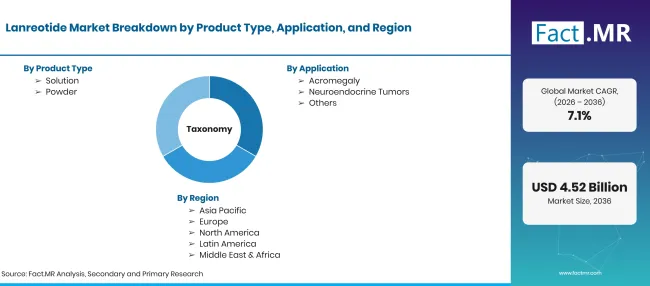
Lanreotide Market Taxonomy | Source: Fact.MR
| Attribute | Details |
|---|---|
| Quantitative Units | USD billion |
| Market Definition | Finished-dose lanreotide and lanreotide acetate products used as long-acting somatostatin analogues for acromegaly, gastroenteropancreatic neuroendocrine tumors, carcinoid syndrome and other approved indications. |
| Product Type | Solution; Powder |
| Application | Acromegaly; Neuroendocrine Tumors; Others |
| Distribution Channel | Hospital Pharmacies; Retail Pharmacies; Online Pharmacies |
| Regions Covered | North America; Latin America; Western Europe; Eastern Europe; East Asia; South Asia & Pacific; Middle East & Africa |
| Countries Covered | Brazil; Germany; United States; Japan; United Kingdom |
| Companies Profiled | Ipsen; Teijin Pharma; Amneal Pharmaceuticals; Cipla; ADVANZ PHARMA; Sun Pharma; Zentiva |
| Forecast Period | 2026 to 2036 |
| Approach | Treated patient counts in acromegaly and neuroendocrine tumors were combined with dosing schedules, product registrations and channel pricing to build value by formulation and country. |
Source: Fact.MR analysis. Updated Nov 5, 2026
How is the market segmented?
-
By Product Type
- Solution
- Powder
-
By Application
- Acromegaly
- Neuroendocrine Tumors
- Others
-
By Distribution Channel
- Hospital Pharmacies
- Retail Pharmacies
- Online Pharmacies
-
By Region
- North America
- Latin America
- Western Europe
- Eastern Europe
- East Asia
- South Asia & Pacific
- Middle East & Africa
Frequently Asked Questions
How large is the lanreotide market in 2026?
What growth rate will the lanreotide market record?
Which product type leads?
Which application leads?
Which distribution channel leads?
Which country will grow quickest?
Who are the main companies?
What holds the market back?
Who worked on this report


Preview the report firsthand - request a free sample
Free SampleGet the brochure for pricing and purchase details
Download PDF