- Market Value (2025): USD 10.2 Bn
- Estimated Value (2026): USD 11.0 Bn
- Forecast Value (2036): USD 22.3 Bn
- CAGR (2026-2036): 7.3%
What is the Disposable Sterile Needles Market forecast to be worth by 2036?
USD 11.0 billion in 2026 to USD 22.3 billion by 2036, at a CAGR of 7.3%.
- As per the Fact.MR analysis, the market was valued at USD 10.2 billion in 2025.
- Demand is projected to rise from USD 11.0 billion in 2026 to USD 22.3 billion by 2036.
- The forecast represents a 7.3% CAGR from 2026 to 2036 as healthcare facilities continue to require sterile needles for injections and other routine procedures.
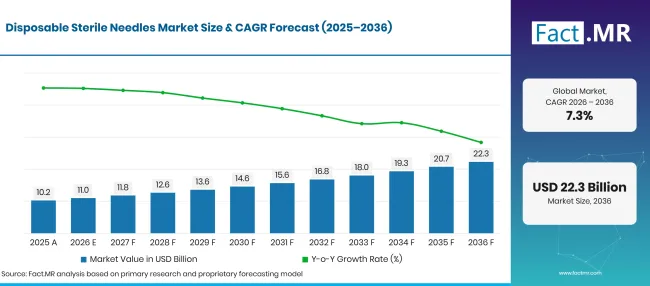
Disposable Sterile Needles Market Forecast Global | Source: Fact.MR
| Year | Basis | Market Value (USD billion) |
|---|---|---|
| 2025 | Actual | 10.2 |
| 2026 | Estimate | 11.0 |
| 2036 | Forecast | 22.3 |
| CAGR 2026 to 2036 | Forecast period | 7.3% |
Source: Fact.MR analysis. Updated Nov 5, 2026
What are the defining numbers behind Disposable Sterile Needles Market growth?
USD 11.3 billion absolute opportunity between 2026 and 2036.
- Demand Drivers in the Market
- Routine injection procedures sustain demand for sterile needles. Hospitals and clinics use these devices for vaccination, medication administration and other procedures. WHO specifically recommends auto-disable syringes for immunization and warns that reusing standard disposable syringes and needles creates serious infection risks [6].
- Growth in chronic disease management supports specialised needle demand. Insulin needles are used in diabetes care and require suitable dimensions and designs for repeated patient-administered injections. Owen Mumford's TriCare pen needles are sterile single-use products designed for use with pen injector devices [5].
- Blood collection requirements support product demand. Hospitals and diagnostic laboratories require sterile blood collection needles for routine testing and clinical investigations. BD's Vacutainer Eclipse blood collection needle includes a safety shield designed to reduce accidental needlestick injuries [1].
- Safety-engineered designs encourage product development. Manufacturers are developing needles with protective mechanisms that help reduce occupational exposure to used sharps. BD Eclipse and Terumo SurGuard product ranges illustrate the focus on safety features in disposable needle design [2].
- Key Segments Analyzed
- By Product Type: Hypodermic Needles are projected to account for 34.2% of the market in 2026, reflecting their use in routine injection procedures.
- By Application: Hospitals segment to hold 43.1% of the market in 2026 because they use sterile needles across a wide range of clinical departments.
- By Material: Stainless Steel is forecast to capture for 78.4% of the market in 2026, supported by its use in the manufacture of medical needle cannulas.
- By End User: Healthcare Facilities are projected to represent 38.5% of the market in 2026, reflecting their recurring need for sterile needles.
- Analyst Opinion at Fact.MR
- Shambhu Nath Jha, Principal Consultant at Fact.MR, states, “The disposable sterile needles market is expected to benefit from continued demand for injections and blood collection procedures across healthcare settings. Hypodermic needles remain an important product category because of their broad clinical use. Manufacturers are also focusing on safety-engineered designs that can help reduce needlestick injuries. Product consistency and reliable sterility assurance will remain important purchasing considerations for healthcare facilities.”
- Strategic Implications
- Manufacturers should strengthen product quality controls and provide clear information on sterility and single-use status.
- Healthcare facilities need to evaluate needle dimensions and product design according to the intended procedure and clinical requirements.
- Distributors must maintain reliable supplies of commonly used needle sizes and ensure that product storage conditions preserve packaging integrity.
- Product developers need to consider safety-engineered designs that reduce exposure to used needles during handling and disposal.
- Healthcare providers can ensure that used needles are immediately placed in appropriate sharps containers to reduce needlestick risks.
Germany is projected to record a 6.0% CAGR through 2036. Brazil is expected to grow at 7.8%, followed by the USA at 9.2%. The UK is forecast to advance at 7.0%, while Japan is projected to register a 5.2% CAGR.
How does the Disposable Sterile Needles Market break down by segment?
Fact.MR's analysis indicate that Hypodermic Needles lead Product Type with a 34.2% share. Hospitals lead Application with 43.1%, Stainless Steel leads Material with 78.4%, and Healthcare Facilities lead End User with 38.5% in 2026.
Which Product Type dominates?
Hypodermic Needles are set to hold a 34.2% share in 2026.
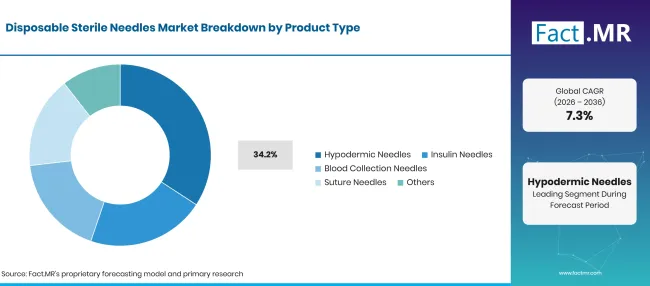
Disposable Sterile Needles Market Breakdown Product Type | Source: Fact.MR
| Product Type | Share (2026) |
|---|---|
| Hypodermic Needles (Leading segment) | 34.2% |
| Other segments combined | 65.8%* |
| Total | 100.0% |
Source: Fact.MR analysis. Updated Nov 5, 2026
Hypodermic needles are used to administer medications and withdraw fluids in routine healthcare procedures. Their broad clinical use supports demand across hospitals and clinics as well as other healthcare settings. Insulin needles serve patients who require injectable diabetes medication, while blood collection needles are designed for specimen collection. Suture needles support wound closure and surgical procedures.
What leads the Application segment?
Hospitals are set to represent 43.1% of the market in 2026.
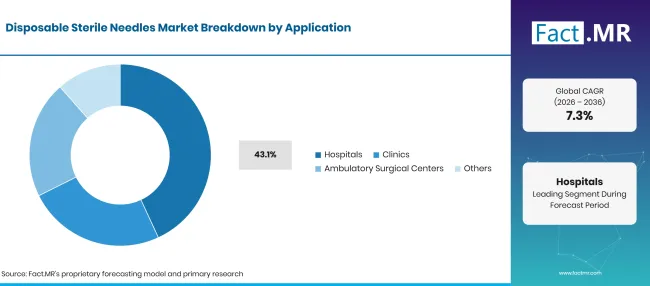
Disposable Sterile Needles Market Breakdown Application | Source: Fact.MR
| Application | Share (2026) |
|---|---|
| Hospitals (Leading segment) | 43.1% |
| Other segments combined | 56.9%* |
| Total | 100.0% |
Source: Fact.MR analysis. Updated Nov 5, 2026
Hospitals use disposable sterile needles across inpatient and outpatient departments. These products support medication administration and blood collection as well as surgical and diagnostic procedures. Clinics also require sterile needles for routine injections and treatment. Ambulatory surgical centres use specialised needles for procedures that do not require overnight admission. Product selection depends on the intended procedure and the required needle specifications.
How does Material shape demand?
Stainless Steel is likely to account for 78.4% of the market in 2026.
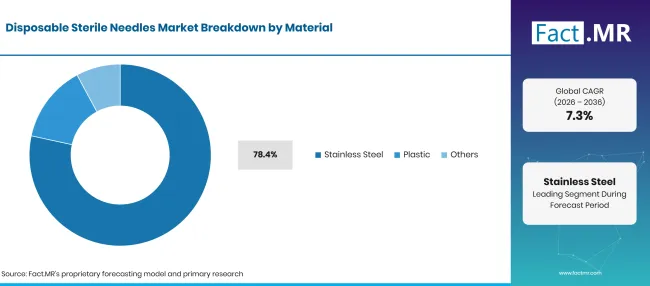
Disposable Sterile Needles Market Breakdown Material | Source: Fact.MR
| Material | Share (2026) |
|---|---|
| Stainless Steel (Leading segment) | 78.4% |
| Other segments combined | 21.6%* |
| Total | 100.0% |
Source: Fact.MR analysis. Updated Nov 5, 2026
Stainless steel is widely used for needle cannulas because it provides the strength and rigidity needed for controlled penetration. Nipro's hypodermic needle specifications identify stainless steel as the cannula material while polypropylene is used for the hub [4]. Plastic materials may be used in needle hubs and other components or in specialised needle designs. Material selection depends on the intended clinical use and device construction.
Which End User leads the market?
Healthcare Facilities are projected to account for 38.5% of the market in 2026.
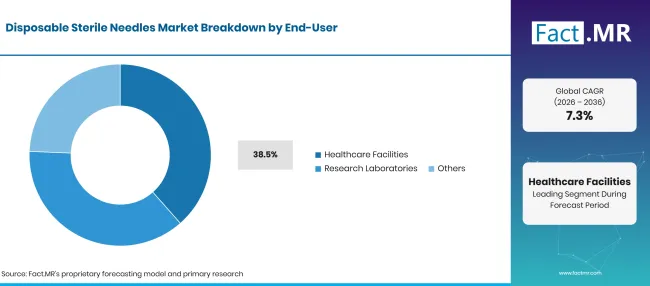
Disposable Sterile Needles Market Breakdown End User | Source: Fact.MR
| End User | Share (2026) |
|---|---|
| Healthcare Facilities (Leading segment) | 38.5% |
| Other segments combined | 61.5%* |
| Total | 100.0% |
Source: Fact.MR analysis. Updated Nov 5, 2026
Healthcare facilities require disposable sterile needles for routine patient care and clinical procedures. Hospitals and clinics purchase needles in recurring volumes to support injections and blood collection. Research laboratories may use specialised needles for sample handling and laboratory procedures. Other end users include settings that require sterile needles for defined medical or technical applications. Purchasing decisions depend on product specifications and the suitability of the needle for its intended use.
What is accelerating Disposable Sterile Needles Market adoption, and what is holding it back?
Routine injection and blood collection procedures support demand, while product cost and the need for safe sharps disposal can influence purchasing and usage decisions.
Drivers Impact Analysis
| DRIVER | (~) % IMPACT ON CAGR | Geographic relevance | Impact timeline |
|---|---|---|---|
| Recurring injection and vaccination procedures | +1.0% | Global | Short term (≤ 2 years) |
| Growth in diabetes care and insulin administration | +0.9% | Global | Medium term (2–4 years) |
| Higher use of safety-engineered needles | +0.8% | North America, Europe | Medium term (2–4 years) |
| Demand for routine blood collection | +0.6% | Global | Short term (≤ 2 years) |
| Expansion of healthcare facility capacity | +0.5% | Asia, Latin America | Long term (≥ 4 years) |
Source: Fact.MR analysis. Updated Nov 5, 2026
Opportunity Impact Analysis
| OPPORTUNITY | (~) % IMPACT ON CAGR | Geographic relevance | Impact timeline |
|---|---|---|---|
| Wider adoption of safety-engineered needles | +0.8% | Global | Medium term (2–4 years) |
| Growth in home-based insulin administration | +0.7% | North America, Europe, Asia | Medium term (2–4 years) |
| Improved needle designs for patient comfort | +0.6% | Global | Medium term (2–4 years) |
| Local manufacturing and supply reliability | +0.5% | Asia, Latin America | Long term (≥ 4 years) |
Source: Fact.MR analysis. Updated Nov 5, 2026
Restraints Impact Analysis
| RESTRAINT | (~) % IMPACT ON CAGR | Geographic relevance | Impact timeline |
|---|---|---|---|
| Price competition in standard needle categories | -0.8% | Global | Short term (≤ 2 years) |
| Raw material and manufacturing cost fluctuations | -0.6% | Global | Medium term (2–4 years) |
| Needlestick injury and disposal risks | -0.5% | Global | Short term (≤ 2 years) |
| Regulatory and quality compliance requirements | -0.4% | Global | Medium term (2–4 years) |
Source: Fact.MR analysis. Updated Nov 5, 2026
Which countries are scaling the Disposable Sterile Needles Market through 2036?
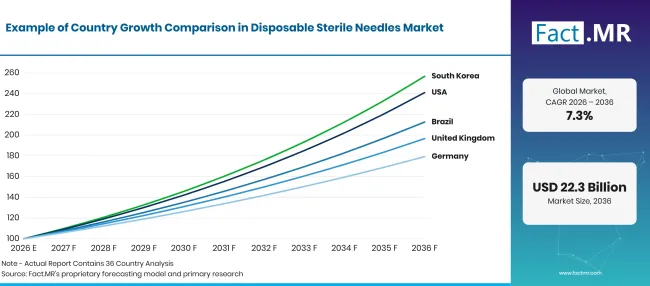
Disposable Sterile Needles Market Growth Index | Source: Fact.MR
| Country | CAGR (2026–2036) |
|---|---|
| Germany | 6.0% |
| Brazil | 7.8% |
| USA | 9.2% |
| UK | 7.0% |
| Japan | 5.2% |
Source: Fact.MR analysis. Updated Nov 5, 2026
What supports Germany adoption?
6.0% CAGR, supported by demand for reliable injection and blood collection products.
Germany's market is supported by the regular use of disposable sterile needles across hospitals and outpatient care facilities. Demand spans medication administration and blood collection as well as surgical procedures. Healthcare providers require products that meet applicable quality and sterility requirements.
How is Brazil developing disposable sterile needle adoption?
7.8% CAGR, driven by demand for routine clinical supplies and wider healthcare access.
Brazil's market benefits from the recurring need for injection and blood collection supplies across public and private healthcare facilities. Hospitals and clinics require reliable access to sterile needles for patient treatment and diagnostic procedures. Local manufacturing and distribution capabilities can support product availability across the country's healthcare network.
What supports United States adoption?
9.2% CAGR, led by demand for safety-engineered needles and specialised injection products.
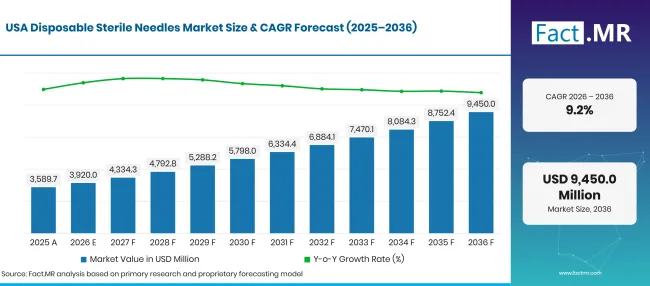
Disposable Sterile Needles Market Forecast Usa | Source: Fact.MR
The United States is projected to record the fastest growth among the listed countries. Healthcare providers are increasingly focused on reducing occupational exposure to contaminated sharps. Manufacturers offering safety-engineered hypodermic and blood collection needles can address this requirement.
How is the United Kingdom building adoption?
7.0% CAGR, shaped by injection safety and consistent demand across healthcare settings.
The UK market is supported by the need for sterile injection products across hospitals and community healthcare services. Healthcare organizations need suitable devices and safe disposal practices to reduce the risk of bloodborne virus exposure. The Health and Safety Executive advises that used needles should not be reused or routinely recapped and should be disposed of immediately in suitable sharps containers [7].
What supports Japan adoption?
5.2% CAGR, backed by routine medical procedures and demand for precision-engineered needles.
Japan's market is expected to benefit from the continuing use of disposable needles across hospitals and clinics. Hypodermic needles support medication administration while blood collection needles serve diagnostic testing requirements. Manufacturers can compete through consistent product quality and needle designs that support controlled penetration. Safety features and reliable distribution can also influence purchasing decisions among healthcare providers.
Who leads the Disposable Sterile Needles Market?
Fact.MR identifies Becton, Dickinson and Company, Terumo Corporation, B. Braun Melsungen AG, Nipro Corporation and Owen Mumford Ltd. as companies with relevant disposable sterile needle portfolios.
Becton, Dickinson and Company offers disposable hypodermic needles through its BD Eclipse range and blood collection products through BD Vacutainer Eclipse. Its safety-engineered designs include protective shields intended to reduce needlestick injuries. Terumo Corporation offers conventional hypodermic needles and safety-engineered products such as SurGuard. Its Neolus range includes sterile single-use hypodermic needles for injecting or withdrawing fluids.
B. Braun Melsungen AG offers Sterican single-use hypodermic needles for applications including insulin administration and blood sampling. Its catalogue also includes safety hypodermic needles. [3] Nipro Corporation manufactures standard hypodermic needles and safety-engineered Safetouch products. Its product specifications identify stainless steel cannulas and single-use sterilised needle configurations.
Owen Mumford Ltd. participates in the insulin needle category through its TriCare and Unifine pen needle portfolios. Its products include sterile single-use needles designed for use with insulin pen injector devices. Competition depends on product quality and reliable sterility as well as needle design and safety features. Manufacturers need to maintain consistent production standards while meeting applicable regulatory requirements. Healthcare facilities also consider product availability and compatibility with their existing injection and blood collection systems.
Which companies are the key providers?
The following companies have identifiable disposable sterile needle or pen needle product portfolios.
- Becton, Dickinson and Company
- Terumo Corporation
- B. Braun Melsungen AG
- Nipro Corporation
- Owen Mumford Ltd.
Bibliography
- [1] Becton, Dickinson and Company. (n.d.). BD Eclipse™ Needle 22G × 1 (0.7 mm × 25 mm) and BD Vacutainer® Eclipse™ blood collection needle.
- [2] Terumo Corporation. (n.d.). Neolus™ Needles and hypodermic products.
- [3] B. Braun Medical Ltd. (n.d.). Standard hypodermic needles.
- [4] Nipro Corporation. (n.d.). Standard hypodermic needle and SAFETOUCH™ hypodermic needle.
- [5] Owen Mumford Ltd. (n.d.). TriCare™ pen needles.
- [6] World Health Organization. (2026 access). E008: Single-use injection devices.
- [7] Health and Safety Executive. (n.d.). Avoiding needlestick or sharps injuries.
This Report Answers
- The report examines demand for disposable sterile needles across hypodermic needles and insulin needles as well as blood collection and suture needles.
- Product analysis identifies Hypodermic Needles as the leading category based on the 2026 share.
- Application analysis compares hospitals with clinics and ambulatory surgical centres.
- Material analysis evaluates stainless steel and plastic needle components.
- End-user analysis examines healthcare facilities and research laboratories.
- Country analysis covers Germany, Brazil, the USA, the UK and Japan.
- The competitive overview profiles manufacturers and their relevant disposable needle portfolios.
What does the Disposable Sterile Needles Market cover?
The market covers sterile needles intended for single use in medical procedures. These products include hypodermic needles for medication administration and fluid withdrawal as well as insulin needles for injectable diabetes treatment. Blood collection needles and suture needles are also included within the product segmentation. Market coverage considers applications across hospitals and clinics as well as ambulatory surgical centres and other healthcare settings.
What is included in the scope?
Included products are sterile, single-use medical needles sold for clinical and related healthcare applications. The scope covers hypodermic needles and specialised needles used for insulin administration and blood collection. Suture needles are included where they are supplied as disposable sterile products. Both conventional and safety-engineered needle designs are covered.
What is excluded from the scope?
Reusable needles and non-sterile industrial needles are excluded. Syringes without needles and other injection equipment are outside the product boundary unless supplied as part of a qualifying needle product. Needle-free injection systems are excluded because they do not use conventional needle products. Reusable surgical instruments and unrelated medical consumables are also excluded.
How Was the Analysis Built?
The analysis draws on 120+ sources, 35+ company portfolios, 25+ countries, and more than 20 industry interviews.
- Primary Research: Primary research includes discussions with manufacturers, service providers, technology developers, distributors, end users, and subject-matter experts. These conversations examine purchasing priorities, product adoption, operational challenges, approval requirements, competitive positioning, and the factors that influence wider market acceptance.
- Desk Research: Desk research covers government statistics, regulatory publications, company filings, trade data, technical studies, industry associations, standards, public policy, and other authoritative sources. Every source used in the analysis is documented in the bibliography.
- Market Sizing and Forecasting: Market estimates combine historical performance, demand indicators, pricing and volume trends, segment shares, company participation, country-level growth, adoption patterns, investment activity, and barriers to market expansion.
- Data Validation and Update Cycle: Findings are validated by comparing primary interviews with public data, company activity, regulatory changes, trade patterns, and industry developments. Regular updates review new product launches, capacity changes, partnerships, approvals, and shifts in commercial adoption.
Segmentation
What is the report's scope and coverage?
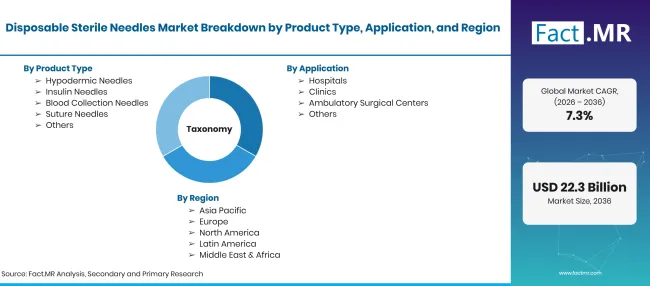
Disposable Sterile Needles Market Taxonomy | Source: Fact.MR
| Attribute | Details |
|---|---|
| Quantitative Units | USD billion in 2026 to USD billion by 2036, at CAGR |
| Market Definition | The sterile single-use medical needles market comprises individually packaged needles designed for one-time use in medical and healthcare procedures. These needles are used for drug administration and fluid withdrawal as well as blood collection and diagnostic sampling. |
| Product Type | Hypodermic Needles; Insulin Needles; Blood Collection Needles; Suture Needles; Others |
| Application | Hospitals; Clinics; Ambulatory Surgical Centers; Others |
| Material | Stainless Steel; Plastic; Others |
| End User | Healthcare Facilities; Research Laboratories; Others |
| Regions Covered | North America; Latin America; Western Europe; Eastern Europe; East Asia; South Asia & Pacific; Middle East & Africa |
| Countries Covered | Germany; Brazil; USA; UK; Japan |
| Companies Profiled | Becton, Dickinson and Company; Terumo Corporation; B. Braun Melsungen AG; Nipro Corporation; Owen Mumford Ltd. |
| Forecast Period | 2026 to 2036 |
| Approach | Market segmentation and scenario-based forecasting supported by company portfolio reviews and regulatory research |
Source: Fact.MR analysis. Updated Nov 5, 2026
How is the market segmented?
-
By Product Type
- Hypodermic Needles
- Insulin Needles
- Blood Collection Needles
- Suture Needles
- Others
-
By Application
- Hospitals
- Clinics
- Ambulatory Surgical Centers
- Others
-
By Material
- Stainless Steel
- Plastic
- Others
-
By End User
- Healthcare Facilities
- Research Laboratories
- Others
-
By Region
- North America
- Latin America
- Western Europe
- Eastern Europe
- East Asia
- South Asia & Pacific
- Middle East & Africa
Frequently Asked Questions
How big is the Disposable Sterile Needles Market in 2026?
What is the CAGR from 2026 to 2036?
Which product type has the largest share?
Which application leads the market?
Which material has the largest share?
Which end-user category has the largest share?
Which countries are covered in the report?
Which companies are covered?
Who worked on this report


Preview the report firsthand - request a free sample
Free SampleGet the brochure for pricing and purchase details
Download PDF