- Market Value (2025): USD 89.2 Bn
- Estimated Value (2026): USD 95.7 Bn
- Forecast Value (2036): USD 193.1 Bn
- CAGR (2026-2036): 7.3%
What is the Autoimmune Drugs Market forecast to be worth by 2036?
USD 95.7 billion in 2026 to USD 193.1 billion by 2036 at a CAGR of 7.3%.
- As per Fact.MR analysis, the autoimmune drugs market was valued at USD 89.2 billion in 2025.
- Demand will grow from USD 95.7 billion in 2026 to USD 193.1 billion by 2036.
- The forecast represents a 7.3% CAGR between 2026 and 2036 as demand for targeted therapies and long-term disease management expands.
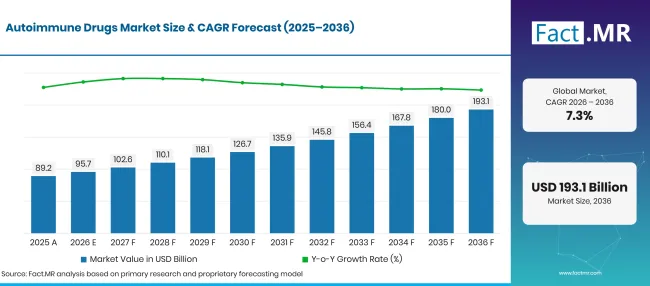
Autoimmune Drugs Market Forecast Global | Source: Fact.MR
| Year | Basis | Market Value (USD billion) |
|---|---|---|
| 2025 | Actual | 89.2 |
| 2026 | Estimate | 95.7 |
| 2036 | Forecast | 193.1 |
| CAGR 2026 to 2036 | Forecast period | 7.3% |
Source: Fact.MR analysis. Updated Nov 5, 2026
What are the defining numbers behind Autoimmune Drugs Market growth?
USD 97.4 billion absolute opportunity between 2026 and 2036
- Demand Drivers in the Market
- Growing diagnosed disease burden has driven the market growth. Autoimmune conditions affect multiple organ systems and often require long-term treatment. Germany's 2026 rheumatology estimates indicate that around 1.8 million adults live with inflammatory rheumatic diseases [1].
- Wider use of targeted biologic therapies: Biologics target specific immune pathways and have become important treatment options for conditions such as rheumatoid arthritis and inflammatory bowel disease. Continued research into new immune targets is expanding treatment options [2] [3].
- Expansion of treatment options across indications: Pharmaceutical companies are developing medicines for a wider range of immune-mediated conditions. Pfizer's current pipeline includes investigational programs for rheumatoid arthritis and inflammatory bowel disease while Bristol Myers Squibb reports ongoing autoimmune research programs [4] [5].
- Key Segments Analyzed
- By Drug Class: Biologics will account for 42.3% of the market in 2026. Their use in targeted immune modulation supports their position across several chronic autoimmune conditions.
- By Indication: Rheumatoid Arthritis lead with a 38.2% share in 2026. Long-term treatment and the use of conventional and targeted disease-modifying therapies support demand.
- By Distribution Channel: Hospital Pharmacies segment hold 44.8% share in 2026. Specialist-led treatment and the handling requirements of several advanced therapies support this channel.
- Analyst Opinion at Fact.MR
- Shambhu Nath Jha, Principal Consultant at Fact.MR, states, “The autoimmune drugs market is moving toward more targeted treatment approaches as pharmaceutical companies develop therapies for specific immune pathways and disease subtypes. Biologics and targeted small molecules are broadening treatment options. However, treatment selection still depends on disease severity and patient response as well as safety monitoring and access to specialist care.”
- Strategic Implications
- Drug manufacturers should strengthen clinical evidence for treatment effectiveness and safety across different autoimmune conditions.
- Healthcare providers need to assess disease activity and patient response when selecting or changing long-term treatment.
- Hospital pharmacies must maintain appropriate storage and handling procedures for temperature-sensitive biologics and injectable medicines.
- Healthcare payers can evaluate treatment value through long-term disease control and the potential to reduce complications and hospital visits.
Germany is projected to record a 9.0% CAGR through 2036. Brazil is set to grow at 8.2% followed by the USA at 7.4%. The UK is forecast to advance at 6.6% while Japan is expected
How does the Autoimmune Drugs Market break down by segment?
Fact.MR identifies Biologics as the leading drug class with a 42.3% share. Rheumatoid Arthritis leads the indication segment with 38.2% while Hospital Pharmacies account for 44.8% of distribution channel sales in 2026.
Which Drug Class dominates?
Biologics are set to hold a 42.3% share of the market in 2026.
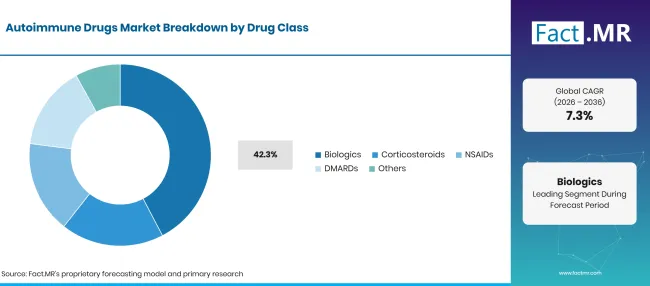
Autoimmune Drugs Market Breakdown Drug Class | Source: Fact.MR
| Drug Class | Share (2026) |
|---|---|
| Biologics (Leading segment) | 42.3% |
| Other segments combined | 57.7%* |
| Total | 100.0% |
Source: Fact.MR analysis. Updated Nov 5, 2026
Biologics are an important treatment category because they can target specific proteins and immune pathways involved in autoimmune diseases. Their use spans conditions such as rheumatoid arthritis and inflammatory bowel disease as well as multiple sclerosis. Corticosteroids remain relevant for controlling inflammation and managing disease flares. NSAIDs are mainly used to relieve pain and inflammation rather than modify the underlying autoimmune process. DMARDs help control disease activity in conditions such as rheumatoid arthritis.
What leads the Indication segment?
Rheumatoid Arthritis is set to represent a 38.2% share in 2026.
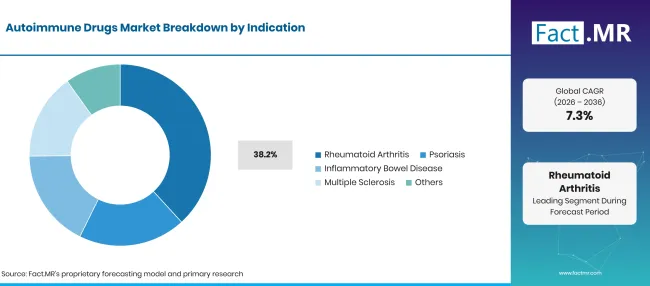
Autoimmune Drugs Market Breakdown Indication | Source: Fact.MR
| Indication | Share (2026) |
|---|---|
| Rheumatoid Arthritis (Leading segment) | 38.2% |
| Other segments combined | 61.8%* |
| Total | 100.0% |
Source: Fact.MR analysis. Updated Nov 5, 2026
Rheumatoid arthritis is a chronic inflammatory disease that primarily affects joints and can cause progressive damage when disease activity is not adequately controlled. Treatment often involves conventional DMARDs followed by biologic or targeted synthetic therapies when needed. Psoriasis and inflammatory bowel disease represent other important indications where immune-modulating medicines can help control disease activity. Multiple sclerosis requires a distinct treatment approach focused on modifying the abnormal immune response that affects the central nervous system.
How does Distribution Channel shape demand?
Hospital Pharmacies are likely to account for a 44.8% share in 2026.
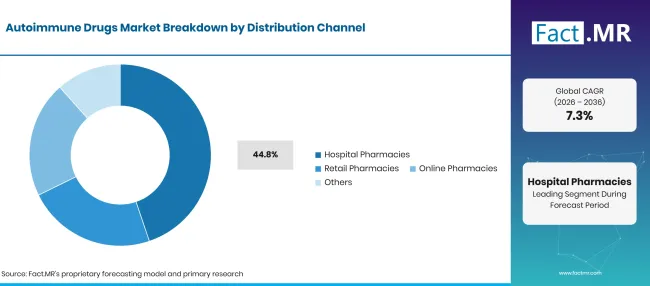
Autoimmune Drugs Market Breakdown Distribution Channel | Source: Fact.MR
| Distribution Channel | Share (2026) |
|---|---|
| Hospital Pharmacies (Leading segment) | 44.8% |
| Other segments combined | 55.2%* |
| Total | 100.0% |
Source: Fact.MR analysis. Updated Nov 5, 2026
Hospital pharmacies play an important role in dispensing specialist-prescribed therapies and managing medicines that require controlled storage or administration. Biologics and other advanced therapies may involve hospital-based initiation or monitoring. Retail pharmacies serve patients who use oral medicines and repeat prescriptions for long-term disease management. Online pharmacies provide an additional channel where regulations permit prescription fulfilment and suitable delivery conditions. Other channels may include specialist distribution arrangements and institutional supply.
What is accelerating Autoimmune Drugs Market growth, and what is holding it back?
Growing demand for targeted therapies and longer-term disease management supports market expansion. High treatment costs and safety-monitoring requirements can limit access.
Drivers Impact Analysis
| DRIVER | (~) % IMPACT ON CAGR | GEOGRAPHIC RELEVANCE | IMPACT TIMELINE |
|---|---|---|---|
| Rising diagnosis of autoimmune conditions | +1.2% | Global | Medium term (2–4 years) |
| Wider use of biologics and targeted therapies | +1.0% | North America, Europe | Short term (≤ 2 years) |
| Long-term treatment requirements | +0.8% | Global | Medium term (2–4 years) |
| Expansion of treatment indications | +0.6% | Global | Long term (≥ 4 years) |
| Improved specialist access and diagnosis | +0.5% | Asia, Latin America | Medium term (2–4 years) |
Source: Fact.MR analysis. Updated Nov 5, 2026
Opportunity Impact Analysis
| OPPORTUNITY | (~) % IMPACT ON CAGR | GEOGRAPHIC RELEVANCE | IMPACT TIMELINE |
|---|---|---|---|
| New biologic targets and mechanisms | +0.8% | Global | Long term (≥ 4 years) |
| Oral targeted therapies | +0.6% | North America, Europe, Asia | Medium term (2–4 years) |
| Biosimilar availability | +0.5% | Europe, Asia, Americas | Medium term (2–4 years) |
| Earlier diagnosis and treatment | +0.4% | Global | Long term (≥ 4 years) |
Source: Fact.MR analysis. Updated Nov 5, 2026
Restraints Impact Analysis
| RESTRAINT | (~) % IMPACT ON CAGR | GEOGRAPHIC RELEVANCE | IMPACT TIMELINE |
|---|---|---|---|
| High prices of advanced biologics | -0.9% | Global | Short term (≤ 2 years) |
| Risk of infections and other adverse effects | -0.7% | Global | Medium term (2–4 years) |
| Complex reimbursement and access pathways | -0.5% | Emerging markets | Medium term (2–4 years) |
| Treatment response variability | -0.4% | Global | Long term (≥ 4 years) |
Source: Fact.MR analysis. Updated Nov 5, 2026
Which countries are scaling the Autoimmune Drugs Market through 2036?
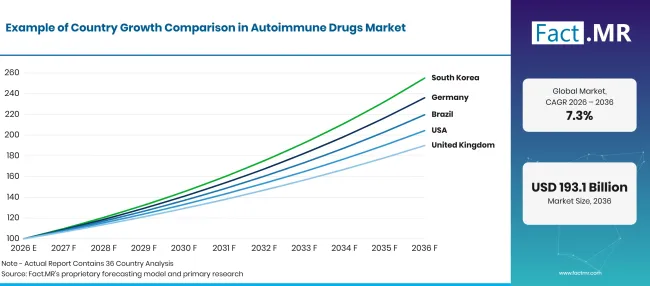
Autoimmune Drugs Market Growth Index | Source: Fact.MR
| Country | CAGR (2026–2036) |
|---|---|
| Germany | 9.0% |
| Brazil | 8.2% |
| USA | 7.4% |
| UK | 6.6% |
| Japan | 5.9% |
Source: Fact.MR analysis. Updated Nov 5, 2026
What supports Germany's market growth?
9.0% CAGR, supported by a substantial population affected by inflammatory rheumatic and other autoimmune diseases.
Germany has an established specialist-care system for inflammatory conditions. This patient population requires ongoing disease monitoring and access to treatment options ranging from conventional DMARDs to biologics. Pharmaceutical companies can address demand through targeted therapies and treatment options suited to different disease stages.
How is Brazil developing autoimmune drugs adoption?
8.2% CAGR, shaped by a rising burden of inflammatory bowel disease and growing demand for specialist treatment.
Brazil is seeing an increase in reported inflammatory bowel disease cases. Agência Brasil reported in September 2026 that a study presented at the Brazilian Congress of Coloproctology estimated an increase from 30 to 158 cases per 100,000 inhabitants between 2012 and 2025. These findings were attributed to congress researchers and should not be presented as independently validated government surveillance statistics [6]. Ongoing diagnosis and treatment needs may support demand for autoimmune medicines.
What supports United States market growth?
7.4% CAGR, led by a large diagnosed and estimated autoimmune disease population and continued investment in targeted therapies.
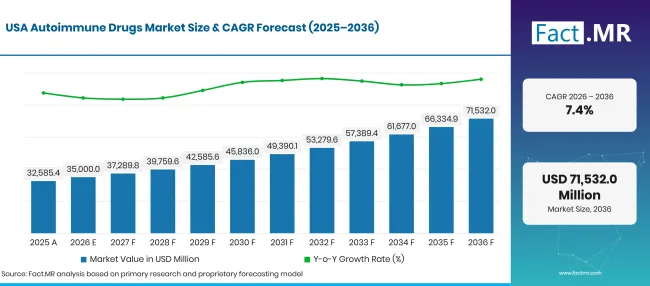
Autoimmune Drugs Market Forecast Usa | Source: Fact.MR
The USA represents a significant market for autoimmune treatments because of its large patient population and established pharmaceutical innovation base. Pharmaceutical companies continue to develop therapies for conditions such as rheumatoid arthritis and inflammatory bowel disease. Demand is also influenced by insurance coverage and access to specialist-prescribed medicines.
What is driving the United Kingdom market?
6.6% CAGR, backed by a substantial inflammatory bowel disease population and ongoing demand for long-term treatment.
The UK has a considerable population living with Crohn's disease and ulcerative colitis. Crohn's & Colitis UK reported that more than 500,000 people across the country live with these conditions [7]. Patients may require long-term treatment to manage inflammation and reduce disease flares. Biologics and other immune-modulating medicines are important options for patients whose conditions require advanced treatment.
What supports Japan's market growth?
5.9% CAGR, driven by the rising number of patients with inflammatory bowel disease and established treatment pathways for rheumatoid arthritis.
Japan has a substantial patient population requiring long-term management of autoimmune and inflammatory conditions. A nationwide epidemiological survey estimated around 316,900 patients with ulcerative colitis and 95,700 with Crohn's disease in 2023 [8]. Research also estimates that rheumatoid arthritis affects around 0.65% to 0.75% of the population. These conditions support demand for conventional DMARDs and advanced immune-modulating therapies.
Who leads the Autoimmune Drugs Market?
Fact.MR profiles Pfizer Inc., AbbVie Inc., Johnson & Johnson, Roche Holding AG, Amgen Inc., Novartis AG, Bristol Myers Squibb Company, Eli Lilly and Company, and Sanofi S.A. across the autoimmune and immunology therapeutics landscape.
AbbVie has a strong immunology portfolio that includes Humira, Skyrizi, and Rinvoq. Johnson & Johnson markets immunology medicines including Tremfya, Stelara, and Simponi. Roche offers Actemra and other medicines used in autoimmune and neurological conditions. Amgen participates through products such as Enbrel and Otezla. Novartis has immunology and dermatology products including Cosentyx and Ilaris. Bristol Myers Squibb markets Orencia and Sotyktu while its pipeline includes additional autoimmune research programs. Eli Lilly has autoimmune products including Taltz and Omvoh. Pfizer participates through medicines such as Xeljanz and Litfulo and continues to develop its immunology pipeline. Sanofi has a presence in immune-mediated conditions through its specialty-care portfolio.
Competition depends on therapeutic indication and treatment mechanism. Companies compete through clinical efficacy and safety as well as dosing convenience and access arrangements. The growth of biosimilars and targeted oral medicines is also influencing treatment choices across several autoimmune indications.
Which companies are the key providers?
The key companies covered in the competitive set are: Pfizer Inc., AbbVie Inc., Johnson & Johnson, Roche Holding AG, Amgen Inc., Novartis AG, Bristol Myers Squibb Company, Eli Lilly and Company, and Sanofi S.A.
- Pfizer Inc.
- AbbVie Inc.
- Johnson & Johnson
- Roche Holding AG
- Amgen Inc.
- Novartis AG
- Bristol Myers Squibb Company
- Eli Lilly and Company
- Sanofi S.A.
Bibliography
- [1] Deutsche Gesellschaft für Rheumatologie und Klinische Immunologie e.V. (2026, August). Daten und Fakten: Rheuma in Zahlen.
- [2] AbbVie. (n.d.). Products.
- [3] National Institutes of Health, Office of Research on Women’s Health. (2025, July 21). NIH-Wide Strategic Plan for Autoimmune Disease Research, Fiscal Years 2026–2030.
- [4] Pfizer Inc. (2026, November 3). Immunology & inflammation: Autoimmune pipeline & trials.
- [5] Bristol Myers Squibb. (2026). Pharmaceutical research and development pipeline.
- [6] Agência Brasil. (2026, September 25). Em 13 anos, doença inflamatória intestinal cresce 5 vezes no Brasil
- [7] Crohn’s & Colitis UK. (2025). Making change: Impact report 2025.
- [8] Tsutsui, A., Murakami, Y., Nishiwaki, Y., Asakura, K., Ohfuji, S., Fukushima, W., Matsuoka, K., & Hisamatsu, T. (2025, September 2). Nationwide estimates of patient numbers and prevalence rates of ulcerative colitis and Crohn’s disease in Japan in 2023. Journal of Gastroenterology, 60(12), 1513–1522.
- [9] Abend, A. H., He, I., Bahroos, N., Christianakis, S., Crew, A. B., Wise, L. M., Lipori, G. P., He, X., Murphy, S. N., Herrick, C. D., et al. (2024, December 12). Estimation of prevalence of autoimmune diseases in the United States using electronic health record data. The Journal of Clinical Investigation, 135(4), e178722.
- [10] Shanmugam, V. K., Ufret-Vincenty, C., Li, X., & Clayton, J. A. (2026). The inaugural NIH-Wide Strategic Plan for Autoimmune Disease Research (Fiscal Years 2026–2030). Arthritis & Rheumatology, 78(4), 805–808.
- [11] Ministry of Chemicals and Fertilizers, Department of Pharmaceuticals. (2026, March 27). Establishment of pharmaceutical industry. Press Information Bureau, Government of India.
- [12] AbbVie Inc. (2026, February 20). 2025 Annual Report (Form 10-K). U.S. Securities and Exchange Commission.
This Report Answers
- The report examines autoimmune medicines used across the specified drug classes and indications.
- Segment analysis compares biologics and conventional anti-inflammatory treatment categories.
- Indication analysis covers rheumatoid arthritis and other specified immune-mediated conditions.
- Country analysis discusses Germany, Brazil, the USA, the UK, and Japan.
- The competitive overview profiles nine pharmaceutical companies with autoimmune and immunology portfolios.
- Distribution analysis compares hospital pharmacies with retail and online pharmacy channels.
What does the Autoimmune Drugs Market cover?
The market covers prescription medicines used to manage autoimmune diseases and related immune-mediated conditions. These treatments help control abnormal immune responses and reduce inflammation or disease activity. Product coverage includes biologics and conventional medicines as well as disease-modifying and targeted therapies. Demand is influenced by disease prevalence and diagnosis rates as well as treatment duration and access to specialist care.
What is included in the scope?
Included products are medicines prescribed for the management of the specified autoimmune indications.
The market includes biologic therapies and conventional drug classes such as corticosteroids and NSAIDs as well as DMARDs. Distribution coverage includes hospital pharmacies and retail pharmacies along with online pharmacies and other channels involved in prescription medicine supply.
What is excluded from the scope?
The analysis excludes medicines used exclusively for non-autoimmune conditions.
Vaccines and diagnostic tests are outside the drug revenue boundary. It also excludes medical devices and hospital services as well as nutritional supplements and over-the-counter products that do not have a defined autoimmune treatment indication.
How Was the Analysis Built?
The analysis draws on 120+ sources, 35+ company portfolios, 25+ countries, and more than 20 industry interviews.
- Primary Research: Primary research includes discussions with manufacturers, service providers, technology developers, distributors, end users, and subject-matter experts. These conversations examine purchasing priorities, product adoption, operational challenges, approval requirements, competitive positioning, and the factors that influence wider market acceptance.
- Desk Research: Desk research covers government statistics, regulatory publications, company filings, trade data, technical studies, industry associations, standards, public policy, and other authoritative sources. Every source used in the analysis is documented in the bibliography.
- Market Sizing and Forecasting: Market estimates combine historical performance, demand indicators, pricing and volume trends, segment shares, company participation, country-level growth, adoption patterns, investment activity, and barriers to market expansion.
- Data Validation and Update Cycle: Findings are validated by comparing primary interviews with public data, company activity, regulatory changes, trade patterns, and industry developments. Regular updates review new product launches, capacity changes, partnerships, approvals, and shifts in commercial adoption.
Segmentation
What is the report's scope and coverage?
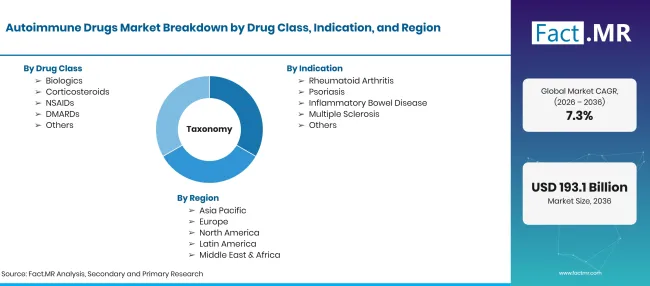
Autoimmune Drugs Market Taxonomy | Source: Fact.MR
| Attribute | Details |
|---|---|
| Quantitative Units | USD billion |
| Market Definition | The autoimmune drugs market comprises pharmaceutical products used to manage autoimmune diseases and immune-mediated conditions by regulating or suppressing abnormal immune responses. It includes biologics and targeted therapies as well as conventional immunosuppressants and anti-inflammatory medicines prescribed to control disease activity, reduce inflammation and prevent tissue damage. |
| Drug Class | Biologics; Corticosteroids; NSAIDs; DMARDs; Others |
| Indication | Rheumatoid Arthritis; Psoriasis; Inflammatory Bowel Disease; Multiple Sclerosis; Others |
| Distribution Channel | Hospital Pharmacies; Retail Pharmacies; Online Pharmacies; Others |
| Regions Covered | North America; Latin America; Western Europe; Eastern Europe; East Asia; South Asia & Pacific; Middle East & Africa |
| Countries Covered | Germany; Brazil; USA; UK; Japan |
| Companies Profiled | Pfizer Inc.; AbbVie Inc.; Johnson & Johnson; Roche Holding AG; Amgen Inc.; Novartis AG; Bristol Myers Squibb Company; Eli Lilly and Company; Sanofi S.A. |
| Forecast Period | 2026 to 2036 |
| Approach | Market segmentation and scenario-based analysis supported by disease-burden statistics and company product information |
Source: Fact.MR analysis. Updated Nov 5, 2026
How is the market segmented?
-
By Drug Class
- Biologics
- Corticosteroids
- NSAIDs
- DMARDs
- Others
-
By Indication
- Rheumatoid Arthritis
- Psoriasis
- Inflammatory Bowel Disease
- Multiple Sclerosis
- Others
-
By Distribution Channel
- Hospital Pharmacies
- Retail Pharmacies
- Online Pharmacies
- Others
-
By Region
- North America
- Latin America
- Western Europe
- Eastern Europe
- East Asia
- South Asia & Pacific
- Middle East & Africa
Frequently Asked Questions
How big is the Autoimmune Drugs Market in 2026?
What is the CAGR from 2026 to 2036?
Which drug class has the largest share?
Which indication has the largest share?
Which distribution channel leads the market?
Which companies are covered?
Who worked on this report


Preview the report firsthand - request a free sample
Free SampleGet the brochure for pricing and purchase details
Download PDF