- Market Value (2025): USD 1.72 Bn
- Estimated Value (2026): USD 1.81 Bn
- Forecast Value (2036): USD 2.99 Bn
- CAGR (2026-2036): 5.1%
What is the Cosmetic Mirrors Market forecast to be worth by 2036?
USD 1.8 billion in 2026 to USD 3.0 billion by 2036 at a 5.1% CAGR.
- Home vanity and bathroom units made up most of the base when the cosmetic mirrors market reached USD 1.72 billion in 2025, according to Fact.MR.
- By 2036, sales will move from USD 1.81 billion in 2026 to USD 2.99 billion as lighted and magnifying models take a larger part of each retail shelf.
- A 5.1% CAGR will carry the market from 2026 to 2036, helped by steady replacement of older bulb-lit mirrors with LED designs.
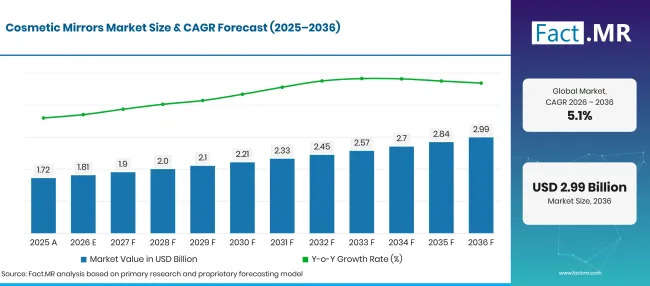
Factmr Cosmetic Mirrors Market Forecast Global | Source: Fact.MR
| Year | Basis | Market Value (USD billion) |
|---|---|---|
| 2025 | Actual | 1.72 |
| 2026 | Estimate | 1.81 |
| 2036 | Forecast | 2.99 |
| CAGR 2026 to 2036 | Forecast period | 5.1% |
Source: Fact.MR analysis. Updated Oct 21, 2026
What are the defining numbers behind Cosmetic Mirrors Market growth?
The 2026 to 2036 period adds USD 1.2 billion in new value, most of it from LED-lit home mirrors.
Demand Drivers in the Market
- Mercury rules are pushing fluorescent tubes out of vanity lighting. Annex A of the Minamata Convention, as amended in November 2025, ends the manufacture, import and export of compact fluorescent lamps above 30 W in 2026 [1]. Triband linear fluorescent lamps follow in 2027, so mirror makers are moving lighted ranges to LED modules.
- Travel growth keeps hotel bathrooms on a refurbishment cycle. UN Tourism estimated that 1.52 billion international tourists traveled in 2025, about 4% more than in 2024 [2]. Many hotels fit wall-mounted magnifying mirrors as a guest amenity.
- Online retail lets shoppers compare lux levels, magnification and size before they buy. The U.S. Census Bureau reported that e-commerce accounted for 17.1% of total U.S. retail sales in the second quarter of 2026 [3]. Product pages and reviews have turned light quality into a buying point.
- Self-filmed makeup tutorials have raised the bar for home lighting. Users who record their routines want shadow-free light, so ring-lit and Hollywood-style mirrors now sell beside basic models.
- Older users need help with fine detail, so brands sell lighted 5x, 7x and 10x options for people who apply makeup without glasses.
Key Segments Analyzed
- By Product Type: Wall-Mounted will hold 38.5% share in 2026, since bathroom installations and hotel fit-outs fix a mirror at the sink for years.
- By Magnification: 1x-3x will account for 34.8% share in 2026, as true-size and low-magnification glass covers full-face makeup and daily grooming.
- By Light Type: LED will capture 58.3% share in 2026 on the back of low heat, long module life and adjustable color temperature.
- By Distribution Channel: Supermarkets/Hypermarkets will represent 52.7% share in 2026, owing to low entry price points and mirrors bought alongside routine shopping.
- By End-User: Residential will command 68.2% share in 2026 through steady household purchases for bathrooms, bedrooms and dressing tables.
Analyst Opinion at Fact.MR
Shambhu Nath Jha, Principal Consultant at Fact.MR, states, “Shoppers now judge a cosmetic mirror by its light before its glass, so color rendering and dimming control have become the main points of comparison. Brands that publish clear lux and magnification data will win the online buyer, while mass retail will keep moving the low-priced volume. The next gains will come from hotel bathrooms and older consumers who need lighted magnification for close work.”
Strategic Implications
- Mirror brands should state color rendering, lux range and magnification on every pack and product page, since online buyers filter on those three numbers.
- Lighting module suppliers should offer sealed, low-voltage LED assemblies rated for damp bathrooms, as fluorescent replacement parts become harder to source.
- Mass retailers should keep a clear price ladder from plain 1x mirrors to lighted 10x models, so first-time buyers can trade up within the same aisle.
- Hotel procurement teams should specify hard-wired wall mirrors with replaceable drivers, because guest rooms need fixtures that last through several refurbishments.
Japan heads the group at 6.1% CAGR, where record inbound travel lifts hotel fit-outs alongside a large base of older shoppers. The United States follows at 5.1%, matching the global pace on broad online sales and new home completions. Germany will expand at 4.7% as record overnight stays support hotel bathroom upgrades. A 4.3% rate for the United Kingdom reflects a high online share of retail spending. Brazil completes the set at 3.8%, with growth tied to pharmacy and perfumery retail.
How does the Cosmetic Mirrors Market break down by segment?
Wall-Mounted will lead Product Type at 38.5%; 1x-3x will head Magnification at 34.8%; LED will top Light Type at 58.3%; Supermarkets/Hypermarkets will take first place in Distribution Channel at 52.7%; Residential will lead End-User at 68.2%.
Which Product Type dominates?
Wall-Mounted units take 38.5% of 2026 sales.
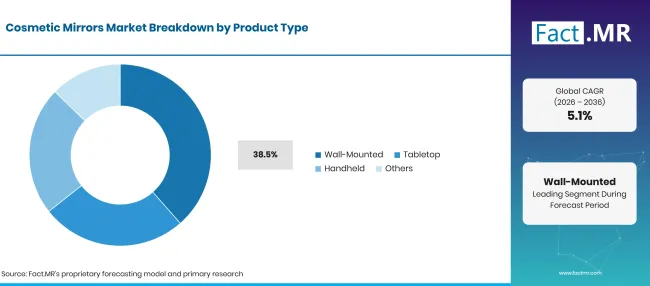
Factmr Cosmetic Mirrors Market Breakdown Product Type | Source: Fact.MR
| Product Type | Share (2026) |
|---|---|
| Wall-Mounted (Leading segment) | 38.5% |
| Other segments combined | 61.5%* |
| Total | 100.0% |
Source: Fact.MR analysis. Updated Oct 21, 2026
Bathrooms rarely have free counter space, so many households and hotels fix the mirror to the wall on an extendable arm. Hard-wired models also hide cables and suit wet areas. Glass for these units carries silver and protective mirror coatings that must resist humidity for years. New housing adds a steady base of bathrooms to fit out. The U.S. Census Bureau estimated that 1,497,800 housing units were completed in 2025, 7.9% fewer than in 2024 [4]. Tabletop mirrors serve bedrooms and dressing tables. Handheld models cover travel and close checks, using thinner coated glass to save weight.
What supports 1x-3x within Magnification?
1x-3x glass makes up 34.8% of 2026 demand.
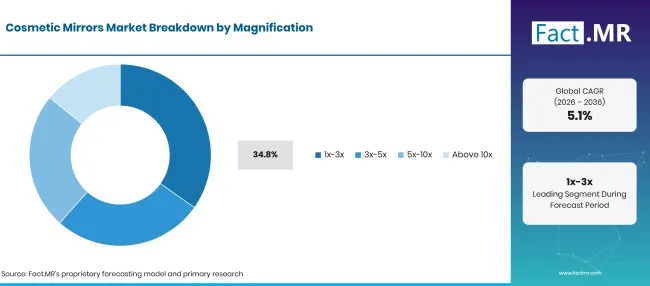
Factmr Cosmetic Mirrors Market Breakdown Magnification | Source: Fact.MR
| Magnification | Share (2026) |
|---|---|
| 1x-3x (Leading segment) | 34.8% |
| Other segments combined | 65.2%* |
| Total | 100.0% |
Source: Fact.MR analysis. Updated Oct 21, 2026
Most users apply foundation, blush and lipstick while viewing the whole face, which needs true-size or mild magnification. Many dual-sided mirrors pair a 1x face with a stronger side, so the 1x-3x view comes with most purchases. Stronger magnification serves eyeliner, lash and brow tools work, where users need to see single hairs. Demand for 5x to 10x and above 10x glass rises with age. Japan’s Statistics Bureau estimated that people aged 65 and over numbered 36.24 million, or a record 29.6% of the population, as of September 2026 [5].
What leads the Light Type segment?
LED models account for 58.3% of 2026 revenue.
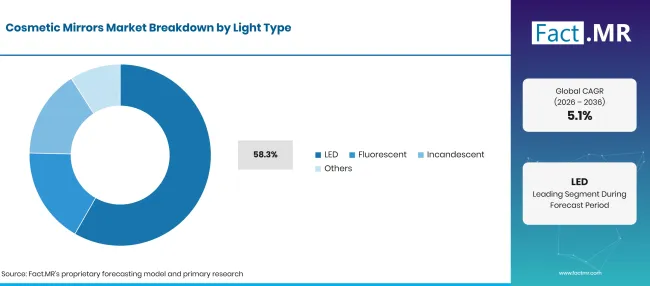
Factmr Cosmetic Mirrors Market Breakdown Light Type | Source: Fact.MR
| Light Type | Share (2026) |
|---|---|
| LED (Leading segment) | 58.3% |
| Other segments combined | 41.7%* |
| Total | 100.0% |
Source: Fact.MR analysis. Updated Oct 21, 2026
Makeup applied under poor light often looks different outdoors. LED strips and rings now reach high color rendering and let users switch between daylight and warm settings. Cheaper chip-on-board LEDs give an even ring of light without visible dots. Fluorescent mirrors remain in older hotel stock, but the mercury lamp phase-out shrinks their replacement market. Incandescent designs survive mainly in Hollywood-style frames, where shoppers want the bulb look. Many makers now fit LED bulbs into those frames to cut heat near the face.
How does Distribution Channel shape demand?
Supermarkets/Hypermarkets hold 52.7% of 2026 sales.
| Distribution Channel | Share (2026) |
|---|---|
| Supermarkets/Hypermarkets (Leading segment) | 52.7% |
| Other segments combined | 47.3%* |
| Total | 100.0% |
Source: Fact.MR analysis. Updated Oct 21, 2026
Mass grocers stock compact, tabletop and suction mirrors at prices that suit unplanned purchases. Seasonal gift sets add volume before holidays. Online Stores carry the widest range, including premium sensor models that few physical stores stock. Specialty Stores, such as beauty and bath retailers, sell higher-priced lighted mirrors with staff advice and in-store demonstrations.
What supports Residential within End-User?
Households represent 68.2% of 2026 demand.
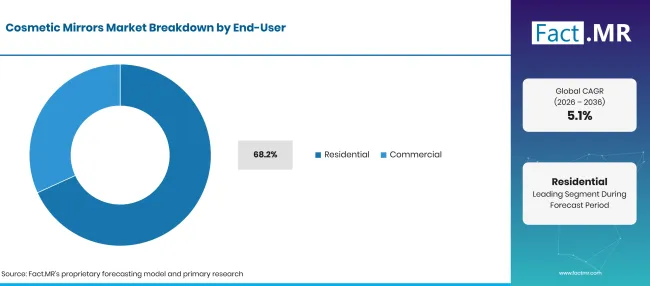
Factmr Cosmetic Mirrors Market Breakdown End User | Source: Fact.MR
| End-User | Share (2026) |
|---|---|
| Residential (Leading segment) | 68.2% |
| Other segments combined | 31.8%* |
| Total | 100.0% |
Source: Fact.MR analysis. Updated Oct 21, 2026
Home users replace mirrors when they renovate a bathroom, move house or want better light for makeup. Gift buying also lifts sales of compact and travel mirrors. Commercial buyers include hotels, salons, spas and gyms. They need wall-mounted units with durable finishes, stable light output and easy cleaning. Salon fit-outs often pair mirror stations with salon chairs bought in the same project.
What is accelerating Cosmetic Mirrors Market adoption, and what is holding it back?
Buyers will keep trading up from plain glass to lighted magnifying mirrors as LED costs fall and online pages make light quality easy to compare. Price competition from unbranded imports and slower home completions in some markets will hold value growth below that of unit growth.
Drivers Impact Analysis
| DRIVER | (~) % IMPACT ON CAGR | GEOGRAPHIC RELEVANCE | IMPACT TIMELINE |
|---|---|---|---|
| Switch from fluorescent and bulb lighting to LED in vanity mirrors | +1.4% | Global | Short term (<= 2 years) |
| Online comparison of lux, color rendering and magnification | +1.2% | North America, Western Europe, East Asia | Short term (<= 2 years) |
| Hotel and salon fit-outs with wall-mounted lighted mirrors | +1.0% | East Asia, Western Europe, Latin America | Medium term (2-4 years) |
| Aging consumers needing lighted high magnification | +0.8% | East Asia, Western Europe, North America | Long term (>= 4 years) |
| Home makeup tutorials raising lighting expectations | +0.5% | North America, East Asia | Medium term (2-4 years) |
Source: Fact.MR analysis. Updated Oct 21, 2026
Opportunity Impact Analysis
| OPPORTUNITY | (~) % IMPACT ON CAGR | GEOGRAPHIC RELEVANCE | IMPACT TIMELINE |
|---|---|---|---|
| Rechargeable cordless LED models for travel and compact use | +0.8% | Global | Short term (<= 2 years) |
| Damp-rated hard-wired mirrors for hotel bathroom refurbishment | +0.6% | East Asia, Western Europe, Middle East & Africa | Medium term (2-4 years) |
| Sensor-activated mirrors with adjustable color temperature | +0.4% | North America, Western Europe | Long term (>= 4 years) |
Source: Fact.MR analysis. Updated Oct 21, 2026
Restraints Impact Analysis
| RESTRAINT | (~) % IMPACT ON CAGR | GEOGRAPHIC RELEVANCE | IMPACT TIMELINE |
|---|---|---|---|
| Low-priced unbranded imports in online marketplaces | -0.6% | Global | Short term (<= 2 years) |
| Slower housing completions limiting new bathroom installs | -0.4% | North America, Western Europe | Medium term (2-4 years) |
| Long replacement cycle of plain glass mirrors | -0.3% | North America, Western Europe | Long term (>= 4 years) |
Source: Fact.MR analysis. Updated Oct 21, 2026
Which countries are scaling the Cosmetic Mirrors Market through 2036?
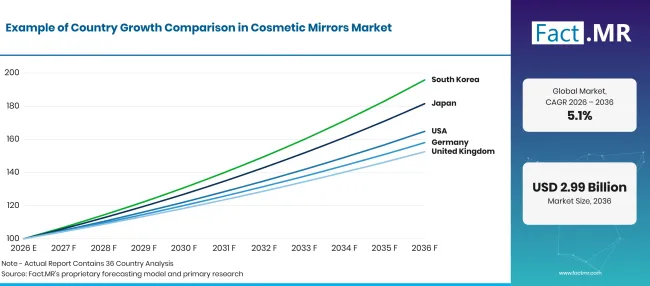
Factmr Cosmetic Mirrors Market Growth Index | Source: Fact.MR
| Country | CAGR (2026–2036) |
|---|---|
| Japan | 6.1% |
| United States | 5.1% |
| Germany | 4.7% |
| United Kingdom | 4.3% |
| Brazil | 3.8% |
Source: Fact.MR analysis. Updated Oct 21, 2026
What supports Japan’s adoption?
6.1% CAGR, driven by record inbound travel and an aging population that needs lighted magnification.
Japan’s hotels are adding and refreshing rooms to keep up with visitors. The Japan National Tourism Organization counted 42,683,600 visitor arrivals in 2025, 15.8% more than in 2024 [6]. Household budgets are also rising slowly, with monthly consumption spending per household of two or more people at 314,001 yen in 2025, up 0.9% in real terms [7]. Compact LED mirrors suit small Japanese bathrooms and dressing areas.
How is the United States scaling demand?
5.1% CAGR, backed by online sales and steady spending on personal care.
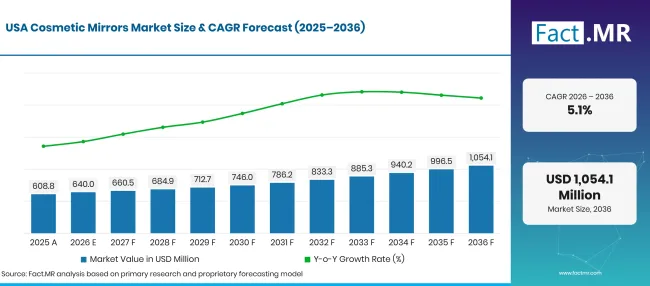
Factmr Cosmetic Mirrors Market Forecast Usa | Source: Fact.MR
American households keep budgeting for grooming items. The Bureau of Labor Statistics reported that spending on personal care products and services averaged $978 per consumer unit in 2024, up 2.9% from 2023 [8]. Sensor and hard-wired wall mirrors sell through brand sites and bath retailers. Mass grocers carry the entry-level tabletop range.
What supports Germany’s growth?
4.7% CAGR, on the back of hotel bathroom upgrades and a large housing stock.
Germany recorded 497.5 million overnight stays in tourist accommodation in 2025, a new high and 0.3% above 2024, according to Destatis [9]. Hotels refreshing rooms often install wall-mounted magnifying mirrors. Destatis also counted about 44.0 million dwellings at the end of 2025, 196,000 more than a year earlier [10]. Chrome and stainless finishes suit both hotel and home bathrooms.
How is the United Kingdom developing demand?
4.3% CAGR, helped by a high online share of retail spending.
British shoppers buy a large share of household goods online, which favors brands with detailed product pages. The Office for National Statistics reported that online sales made up 28.8% of total retail spending in Great Britain in August 2026, up from 28.4% in July [11]. Lighted vanity and travel mirrors sell through beauty retailers and online marketplaces.
How does Brazil perform?
3.8% CAGR, reflecting growth in pharmacy and perfumery retail.
Pharmacies, perfumeries and hypermarkets are key mirror outlets in Brazil. IBGE reported that sales of pharmaceutical, medical, orthopedic and perfumery goods rose 4.5% in 2025, while sales at hypermarkets, supermarkets and food, beverage and tobacco stores grew 0.8% [12]. Affordable tabletop and handheld mirrors make up most of the volume. LED models are gaining shelf space in urban stores.
Who leads the Cosmetic Mirrors Market?
The market splits into three tiers. Premium specialists such as Simplehuman compete on light quality, with its Sensor Mirror Trio offering Tru-Lux light at a color rendering index of 95 and 1x, 5x and 10x views.
Housewares brands such as Conair Corporation, Jerdon Style, Zadro Products and Ovente cover the broad middle. Across these brands, wall-mounted, tabletop and travel lines span plain glass to dimmable LED. They compete on the breadth of sizes and finishes they offer. Danielle Creations sells magnifying vanity, handheld and LED mirrors, along with gift sets. Beauty-led brands compete on design and social media appeal. Impressions Vanity featured a Care Bears LED compact mirror collection in a February 2025 post [13]. Fancii & Co. added the Meadow design by artist Amanda Houston to its Mini Taylor compact range in March 2025 [14]. Light accuracy, price tiers and the ability to win online reviews will decide who gains share.
Which companies are the key providers?
Key companies include Simplehuman; Conair Corporation; Jerdon Style; Zadro Products; Ovente; Danielle Creations; Fancii & Co.; and Impressions Vanity.
- Simplehuman
- Conair Corporation
- Jerdon Style
- Zadro Products
- Ovente
- Danielle Creations
- Fancii & Co.
- Impressions Vanity
Bibliography
- [1] Conference of the Parties to the Minamata Convention on Mercury. (2025, November 24). Decision MC-6/3: Amendments to annex A.
- [2] UN Tourism. (2026, January 20). International tourist arrivals up 4% in 2025 reflecting strong travel demand around the world.
- [3] U.S. Census Bureau. (2026, August 18). Quarterly Retail E-Commerce Sales: 2nd Quarter 2026.
- [4] U.S. Census Bureau. (2026, February 18). New Residential Construction, December 2025.
- [5] Statistics Bureau of Japan. (2026, September 20). 統計からみた我が国の高齢者:「敬老の日」にちなんで [Japan’s elderly in statistics: for Respect for the Aged Day].
- [6] Japan National Tourism Organization. (2026, January 21). Number of visitor arrivals to Japan in December 2025.
- [7] Statistics Bureau of Japan. (2026, February 6). Family Income and Expenditure Survey: 2025 Yearly Average.
- [8] U.S. Bureau of Labor Statistics. (2025, December 19). Consumer Expenditures: 2024.
- [9] Statistisches Bundesamt (Destatis). (2026, February 11). Tourismus in Deutschland im Jahr 2025: Erneut Rekordwert bei Gästeübernachtungen [Tourism in Germany in 2025: Another record for overnight stays].
- [10] Statistisches Bundesamt (Destatis). (2026, July 16). 44,0 Millionen Wohnungen in Deutschland zum Jahresende 2025 [44.0 million dwellings in Germany at the end of 2025].
- [11] Office for National Statistics. (2026, September 18). Retail sales, Great Britain: August 2026.
- [12] Instituto Brasileiro de Geografia e Estatística (IBGE). (2026, February 13). Vendas no comércio variam -0,4% em dezembro e fecham 2025 em 1,6% [Retail sales change -0.4% in December and close 2025 at 1.6%].
- [13] Impressions Vanity Co. (2025, February 27). Shine with the Care Bears LED Compact Collection.
- [14] Fancii & Co. (2025, March 11). Meadow by Amanda Houston: A Celebration of Nature and Self-Expression.
This Report Answers
- Sizing for 2026 and 2036 is split by product type, magnification, light type, channel and end-user.
- Each segment shows which subsegment heads it in 2026 and the buyer needs behind that position.
- Hotel activity, online retail and population aging frame the comparison of the five listed countries.
- Brand profiles group premium, housewares and beauty-led suppliers and note their product moves since 2025.
- Readers can trace how the fluorescent lamp phase-out reshapes mirror lighting and replacement demand.
What does the Cosmetic Mirrors Market cover?
This market tracks mirrors that people use for makeup, skincare, shaving and other close grooming tasks. It spans fixed wall units, freestanding tabletop mirrors and handheld or compact designs.
Revenue is counted at the first sale of each mirror, whether through a grocer, an online store or a specialty retailer. Light Type shares refer to illuminated mirrors. Plain glass models count in the other four segment splits.
What is included in the scope?
Lighted and unlighted cosmetic mirrors are in scope, with LED, fluorescent or incandescent light sources. Sensor-activated, rechargeable and dimmable models count here, along with dual-sided designs that pair two magnification levels.
Mirrors bought by hotels, salons and spas for guest and client grooming fall under commercial demand. Mirrors sold in gift sets with premium beauty and personal care products are counted at the mirror’s own value.
What is excluded from the scope?
Full-length, decorative and general wall mirrors sold for interior styling are out of scope. Automotive, medical, dental and industrial inspection mirrors are also excluded.
Smart displays and connected mirrors whose main role is media or home control are left out. Mirrors built into vanity tables or bathroom cabinets count only when sold as separate units.
How Was the Analysis Built?
The analysis draws on 120+ sources, 35+ company portfolios, 25+ countries, and more than 20 industry interviews.
- Primary Research: Primary research includes discussions with manufacturers, service providers, technology developers, distributors, end users, and subject-matter experts. These conversations examine purchasing priorities, product adoption, operational challenges, approval requirements, competitive positioning, and the factors that influence wider market acceptance.
- Desk Research: Desk research covers government statistics, regulatory publications, company filings, trade data, technical studies, industry associations, standards, public policy, and other authoritative sources. Every source used in the analysis is documented in the bibliography.
- Market Sizing and Forecasting: Market estimates combine historical performance, demand indicators, pricing and volume trends, segment shares, company participation, country-level growth, adoption patterns, investment activity, and barriers to market expansion.
- Data Validation and Update Cycle: Findings are validated by comparing primary interviews with public data, company activity, regulatory changes, trade patterns, and industry developments. Regular updates review new product launches, capacity changes, partnerships, approvals, and shifts in commercial adoption.
Segmentation
What is the report’s scope and coverage?
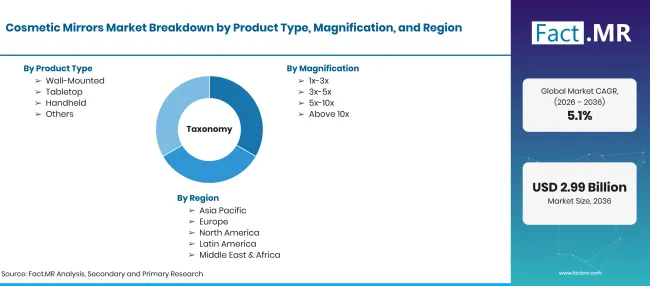
Factmr Cosmetic Mirrors Market Taxonomy | Source: Fact.MR
| Attribute | Details |
|---|---|
| Quantitative Units | USD billion in 2026 to USD billion by 2036 at CAGR |
| Market Definition | Mirrors made for makeup, skincare and grooming, sold as standalone units in wall-mounted, tabletop and handheld formats. Coverage spans plain and lighted models across magnification levels for residential and commercial use. |
| Product Type | Wall-Mounted; Tabletop; Handheld |
| Magnification | 1x-3x; 3x-5x; 5x-10x; Above 10x |
| Light Type | LED; Fluorescent; Incandescent |
| Distribution Channel | Supermarkets/Hypermarkets; Online Stores; Specialty Stores |
| End-User | Residential; Commercial |
| Regions Covered | North America; Latin America; Western Europe; Eastern Europe; East Asia; South Asia & Pacific; Middle East & Africa |
| Countries Covered | Japan; United States; Germany; United Kingdom; Brazil |
| Companies Profiled | Simplehuman; Conair Corporation; Jerdon Style; Zadro Products; Ovente; Danielle Creations; Fancii & Co.; Impressions Vanity |
| Forecast Period | 2026 to 2036 |
| Approach | Hybrid top-down and bottom-up approach using household bathroom and hotel room counts; mirror unit prices by light type and magnification; retail channel sell-through; and brand portfolio review. |
Source: Fact.MR analysis. Updated Oct 21, 2026
How is the market segmented?
-
By Product Type
- Wall-Mounted
- Tabletop
- Handheld
-
By Magnification
- 1x-3x
- 3x-5x
- 5x-10x
- Above 10x
-
By Light Type
- LED
- Fluorescent
- Incandescent
-
By Distribution Channel
- Supermarkets/Hypermarkets
- Online Stores
- Specialty Stores
-
By End-User
- Residential
- Commercial
-
By Region
- North America
- Latin America
- Western Europe
- Eastern Europe
- East Asia
- South Asia & Pacific
- Middle East & Africa
Frequently Asked Questions
How big is the cosmetic mirrors market in 2026?
What is the CAGR of the cosmetic mirrors market from 2026 to 2036?
Which product type leads the cosmetic mirrors market?
Which magnification leads the cosmetic mirrors market?
Which light type leads the cosmetic mirrors market?
Which distribution channel leads the cosmetic mirrors market?
Which end-user leads the cosmetic mirrors market?
Which country will grow the most in the cosmetic mirrors market?
Who are the main companies in the cosmetic mirrors market?
Who worked on this report


Preview the report firsthand - request a free sample
Free SampleGet the brochure for pricing and purchase details
Download PDF