- Market Value (2025): USD 5.36 Bn
- Estimated Value (2026): USD 5.74 Bn
- Forecast Value (2036): USD 11.4 Bn
- CAGR (2026-2036): 7.1%
What is the CPAP Systems Market forecast to be worth by 2036?
USD 5.7 billion in 2026 to USD 11.5 billion by 2036 at a 7.1% CAGR.
- The CPAP Systems Market was valued at USD 5.36 billion in 2025.
- Market revenue is expected to increase from USD 5.74 billion in 2026 to USD 11.4 billion by 2036, supported by rising sleep apnea diagnosis rates and growing adoption of home-based respiratory therapy.
- A 7.1% CAGR is projected for 2026–2036, driven by demand for auto-adjusting CPAP devices, improved treatment comfort, and advances in connected respiratory care.
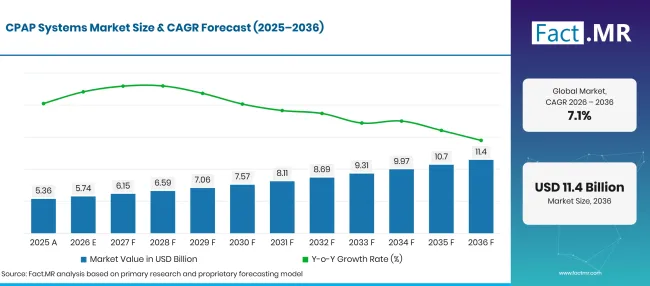
Factmr Cpap Systems Market Forecast Global | Source: Fact.MR
| Year | Basis | Market Value (USD billion) |
|---|---|---|
| 2025 | Actual | 5.36 |
| 2026 | Estimate | 5.74 |
| 2036 | Forecast | 11.4 |
| CAGR 2026 to 2036 | Forecast period | 7.1% |
Source: Fact.MR analysis. Updated Oct 19, 2026
What are the defining numbers behind CPAP Systems Market growth?
The market is projected to add USD 5.8 billion in value between 2026 and 2036, driven by rising demand for auto-adjusting CPAP devices and the expansion of home-based sleep apnea treatment.
- Demand Drivers in the Market
- Undiagnosed sleep apnea represents an opportunity for treatment expansion. The U.S. National Heart, Lung, and Blood Institute (NHLBI) reports that approximately 90% of sleep apnea cases remain undiagnosed in the United States, highlighting the potential for improved screening and diagnosis to expand the pool of patients requiring CPAP therapy [1].
- Home-based respiratory care is supporting equipment demand. The U.S. Centers for Medicare & Medicaid Services identifies CPAP therapy as an in-home treatment for obstructive sleep apnea and provides coverage for eligible patients, reinforcing the role of residential care in ongoing treatment [2].
- Key Segments Analyzed
- By Types: Auto Adjusting CPAP Devices will account for 62.3% share, driven by demand for automatic pressure adjustment and personalized sleep apnea therapy.
- By Applications: Home Care Settings will represent 58.7% share, supported by the growing adoption of residential sleep apnea treatment and long-term respiratory care.
- Analyst Opinion at Fact.MR
- Shambhu Nath Jha, Principal Consultant at Fact.MR, states, “The CPAP Systems Market is shifting toward patient-centric respiratory care, where treatment comfort, pressure accuracy, and therapy adherence influence purchasing decisions. Auto-adjusting CPAP devices and homecare solutions are positioned to benefit from growing demand for convenient sleep apnea management. Manufacturers that combine reliable device performance with effective monitoring capabilities and accessible patient support can strengthen their competitive position as the market expands.”
- Strategic Implications
- CPAP manufacturers must prioritize automatic pressure adjustment, mask comfort, and simplified device controls to improve usability and support long-term treatment adherence.
- Technology providers need to strengthen remote monitoring capabilities and therapy data reporting, enabling healthcare professionals to assess device usage and treatment effectiveness during follow-up.
- Homecare providers and distributors are advised to expand access to CPAP devices, masks, tubing, and replacement accessories to support patients throughout their treatment journey.
- Healthcare providers should improve patient education, mask fitting, and follow-up procedures to address common barriers to consistent CPAP use.
- Device manufacturers are emphasizing stringent quality standards and regulatory compliance while expanding product portfolios to meet the distinct requirements of homecare settings, hospitals, and sleep clinics.
Brazil is projected to record the fastest growth among the countries in your dataset, with a 7.8% CAGR through 2036, followed by Japan at 7.4%. Germany is expected to expand at 7.1%, while the UK will register 5.8% and the USA 5.0%.
How does the CPAP Systems Market break down by segment?
Auto Adjusting CPAP Devices lead the Product Type segment at 62.3%, while Home Care accounts for 58.7% of the Application segment.
Which Types dominates?
Auto Adjusting CPAP Devices account for 62.3% share in 2026.
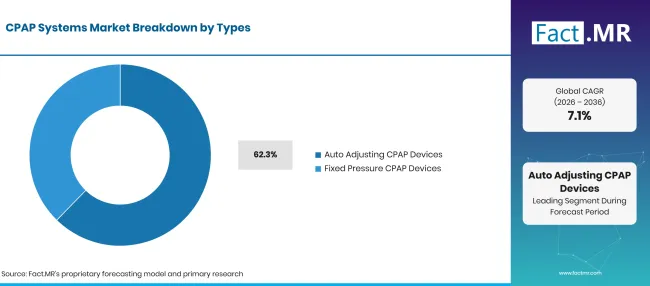
Factmr Cpap Systems Market Breakdown Types | Source: Fact.MR
| Types | Share (2026) |
|---|---|
| Auto Adjusting CPAP Devices (Leading segment) | 62.3% |
| Other segments combined | 37.7%* |
| Total | 100.0% |
Source: Fact.MR analysis. Updated Oct 19, 2026
Auto Adjusting CPAP Devices adjust airflow pressure according to patients’ changing breathing requirements during sleep. A relevant 2026 industry development is BMC Medical’s presentation of its G3 X Auto CPAP at the European Respiratory Society (ERS) Congress 2026, highlighting pressure adjustment based on respiratory events and individualized pressure-response profiles. This illustrates continued innovation in personalized positive airway pressure therapy [3].
What supports Home Care within Applications?
Home Care leads with 58.7% share in 2026.
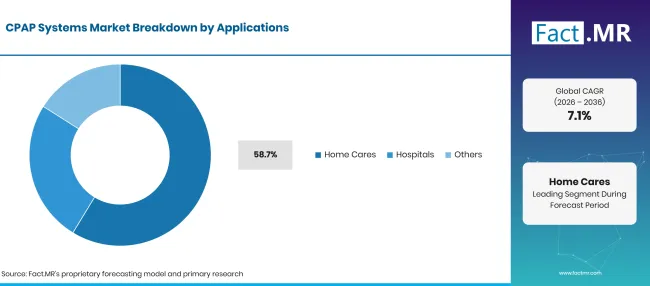
Factmr Cpap Systems Market Breakdown Applications | Source: Fact.MR
| Application | Share (2026) |
|---|---|
| Home Care (Leading segment) | 58.7% |
| Other segments combined | 41.3%* |
| Total | 100.0% |
Source: Fact.MR analysis. Updated Oct 19, 2026
Home-based treatment supports the leading application segment by allowing patients to manage sleep apnea during their regular sleeping hours without repeated visits to healthcare facilities for routine device use. Demand for convenient treatment, patient comfort, and continued therapy management supports the role of CPAP systems in residential care. Hospitals and other healthcare settings also use CPAP systems to provide respiratory support to eligible patients.
What is accelerating CPAP Systems Market adoption, and what is holding it back?
Buyers will increasingly shift from fixed-pressure CPAP devices to auto-adjusting systems as technology becomes more accessible and online platforms make device features easier to compare. Price competition from lower-cost manufacturers and budget constraints among patients and healthcare providers will moderate value growth relative to unit growth.
Drivers Impact Analysis
| DRIVER | (~) % IMPACT ON CAGR | GEOGRAPHIC RELEVANCE | IMPACT TIMELINE |
|---|---|---|---|
| Rising diagnosis and treatment of obstructive sleep apnea | +1.4% | Global | Short term (≤ 2 years) |
| Growing adoption of auto-adjusting CPAP devices | +1.2% | North America, Western Europe, East Asia | Short term (≤ 2 years) |
| Increasing preference for home-based sleep apnea management | +1.0% | North America, Western Europe, Asia-Pacific | Medium term (2–4 years) |
| Greater awareness of sleep health and the consequences of untreated sleep apnea | +0.8% | North America, Western Europe, East Asia | Long term (≥ 4 years) |
| Advances in connected CPAP devices and remote therapy monitoring | +0.5% | North America, East Asia | Medium term (2–4 years) |
Source: Fact.MR analysis. Updated Oct 19, 2026
Opportunity Impact Analysis
| OPPORTUNITY | (~) % IMPACT ON CAGR | GEOGRAPHIC RELEVANCE | IMPACT TIMELINE |
|---|---|---|---|
| Connected CPAP systems with remote monitoring and therapy data tracking | +0.8% | Global | Short term (≤ 2 years) |
| Expansion of homecare providers and CPAP equipment distribution networks | +0.6% | North America, Western Europe, Asia-Pacific | Medium term (2–4 years) |
| Development of quieter, more comfortable devices and improved mask interfaces | +0.4% | North America, Western Europe | Long term (≥ 4 years) |
Source: Fact.MR analysis. Updated Oct 19, 2026
Restraints Impact Analysis
| RESTRAINT | (~) % IMPACT ON CAGR | GEOGRAPHIC RELEVANCE | IMPACT TIMELINE |
|---|---|---|---|
| High upfront costs of CPAP devices, masks, and accessories | -0.6% | Global | Short term (≤ 2 years) |
| Inconsistent therapy adherence due to discomfort, mask leakage, or dryness | -0.4% | North America, Western Europe | Medium term (2–4 years) |
| Limited access to sleep testing and treatment in underserved areas | -0.3% | Emerging markets, rural regions globally | Long term (≥ 4 years) |
Source: Fact.MR analysis. Updated Oct 19, 2026
Which countries are scaling the CPAP Systems Market through 2036?
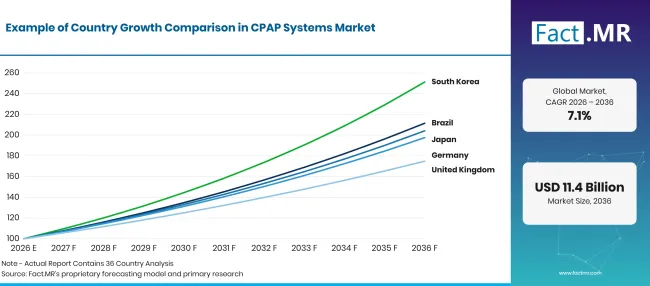
Factmr Cpap Systems Market Growth Index | Source: Fact.MR
| Country | CAGR (2026–2036) |
|---|---|
| Japan | 7.1% |
| United States | 7.8% |
| Germany | 5.0% |
| United Kingdom | 5.8% |
| Brazil | 7.4% |
Source: Fact.MR analysis. Updated Oct 19, 2026
What supports Japan’s adoption?
7.4% CAGR, supported by an aging population, rising awareness of sleep apnea, and demand for home-based respiratory care.
Japan’s aging population creates a growing need for effective diagnosis and management of sleep-related breathing disorders. CPAP systems support long-term obstructive sleep apnea treatment, while auto-adjusting devices offer pressure flexibility for eligible patients. Homecare solutions and improved therapy monitoring can further support adoption among patients requiring ongoing treatment. In March 2026, Japanese company S’UIMIN began offering its Nightgraf sleep assessment device, which supports both home-based and hospital-based testing and uses cloud-based automated analysis to help clinicians assess sleep disorders [4].
How is the United States scaling demand?
5.0% CAGR, backed by established sleep apnea treatment infrastructure and growing use of home-based CPAP therapy.
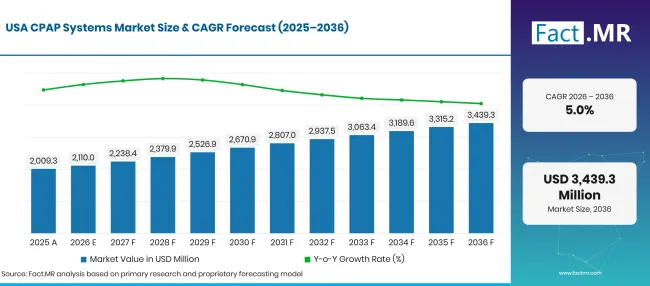
Factmr Cpap Systems Market Forecast Usa | Source: Fact.MR
The United States benefits from established sleep diagnostic services, healthcare coverage pathways, and access to respiratory equipment suppliers. Home-based CPAP therapy enables patients to manage obstructive sleep apnea during sleep, while connected devices can help healthcare professionals monitor therapy usage. Auto-adjusting CPAP systems and replacement masks and accessories provide additional opportunities for manufacturers and homecare providers.
What supports Germany’s growth?
7.1% CAGR, supported by an established healthcare system and demand for long-term sleep apnea management.
Germany’s healthcare infrastructure provides a foundation for diagnosing and treating sleep-related breathing disorders. In August 2026, Techniker Krankenkasse, health insurance organization highlighted its SLEEP WELL 2.0 telemedicine-supported care program for obstructive sleep apnea, which facilitates access to diagnostic assessment and individualized treatment recommendations. These developments underscore Germany’s growing focus on ambulatory diagnostics, digitally supported care, and patient follow-up, supporting the broader ecosystem for CPAP systems and home-based respiratory therapy [5].
How is the United Kingdom developing demand?
5.8% CAGR, supported by sleep disorder diagnosis and continued demand for respiratory care at home.
The United Kingdom’s sleep services and respiratory care pathways support the identification and treatment of obstructive sleep apnea. CPAP therapy enables patients to receive ongoing treatment at home, reducing the need for routine hospital-based device use. Demand for comfortable masks, quieter devices, and effective follow-up can encourage continued adoption, while remote monitoring may help healthcare teams assess therapy adherence.
How does Brazil perform?
7.8% CAGR, reflecting opportunities to expand sleep apnea diagnosis and access to homecare respiratory equipment.
Brazil represents a growth opportunity as access to sleep disorder diagnosis and treatment expands. CPAP devices can support long-term management of obstructive sleep apnea, while homecare providers and medical equipment distributors play an important role in supplying devices, masks, tubing, and replacement accessories. More affordable CPAP options and wider availability of auto-adjusting systems could help address differences in access to treatment across patient groups and regions.
Who leads the CPAP Systems Market?
Fact.MR profiles ResMed Inc., Philips Respironics (Royal Philips), Fisher & Paykel Healthcare Corporation Limited, BMC Medical Co., Ltd., and Löwenstein Medical SE & Co. KG across the CPAP systems competitive landscape.
ResMed offers fixed-pressure CPAP and auto-adjusting PAP devices, including the AirSense series. Fisher & Paykel Healthcare participates through its SleepStyle CPAP devices and sleep-apnea masks. BMC Medical and Löwenstein Medical also serve the positive airway pressure therapy market through sleep-respiratory care products. Philips Respironics (Royal Philips) participates through its Respironics sleep-therapy portfolio, although commercial availability of specific devices varies by market [6].
Competition in this market depends on pressure-delivery technology, patient comfort, mask compatibility, humidification, connectivity and therapy monitoring. Healthcare providers consider clinical requirements and patient tolerance when selecting devices, while manufacturers compete through product performance, distribution networks and support services.
Which companies are the key providers?
Key companies in the CPAP Systems Market include ResMed Inc.; Philips Respironics (Royal Philips); Fisher & Paykel Healthcare Corporation Limited; BMC Medical Co., Ltd.; and Löwenstein Medical SE & Co. KG.
- ResMed Inc.
- Philips Respironics (Royal Philips)
- Fisher & Paykel Healthcare Corporation Limited
- BMC Medical Co., Ltd.
- Löwenstein Medical SE & Co. KG
How is the market segmented?
-
By Types
- Auto Adjusting CPAP Devices
- Fixed Pressure CPAP Devices
-
By Applications
- Home Cares
- Hospitals
- Others
-
By Region
- North America
- Latin America
- Western Europe
- Eastern Europe
- East Asia
- South Asia & Pacific
- Middle East & Africa
Bibliography
- [1] Patil, S. P., Ayappa, I. A., Caples, S. M., Kimoff, R. J., Patel, S. R., & Harrod, C. G. (2019). Treatment of adult obstructive sleep apnea with positive airway pressure: An American Academy of Sleep Medicine clinical practice guideline. Journal of Clinical Sleep Medicine, 15(2), 335–343.
- [2] BMC Medical Co., Ltd. (2026, August 24). What is the best CPAP machine for improving treatment adherence?
- [3] Löwenstein Medical SE & Co. KG. (n.d.). Sleep apnea therapy.
- [4] National Heart, Lung, and Blood Institute. (2023, September 1). SBIR success story: Diagnosing obstructive sleep apnea at home.
- [5] Philips. (n.d.). Philips Respironics sleep and respiratory care devices: Voluntary recall information
- [6] ResMed. (n.d.). AirSense 11.
- [7] S’UIMIN Inc. (2026, March 2).[Launch of the Nightgraf sleep assessment device].
- [8] Techniker Krankenkasse. (2026, August 31). SLEEP WELL 2.0 – Digital unterstützte Schlafmedizin bei obstruktiver Schlafapnoe.
This Report Answers
- Sizing for 2026 and 2036 is split by product type and application, with country-level growth projections for Germany, Brazil, the United States, the United Kingdom and Japan.
- Each segment identifies the leading category in 2026 and the factors supporting its position, including auto-adjusting CPAP devices and homecare applications.
- Sleep apnea diagnosis, home-based respiratory care and healthcare access frame the comparison of the five listed countries.
- Company profiles cover established CPAP manufacturers and respiratory care suppliers, including ResMed Inc., Philips Respironics (Royal Philips), Fisher & Paykel Healthcare, BMC Medical, Chart Industries, ZOLL Medical Corporation and Zhongshan Goldcare Medical.
- Readers can assess how device innovation, therapy monitoring, patient comfort and access to treatment influence CPAP system adoption and market growth.
What does the CPAP Systems Market cover?
This market tracks continuous positive airway pressure (CPAP) systems used to manage obstructive sleep apnea and support breathing during sleep. It covers auto-adjusting CPAP devices, which modify pressure according to changing breathing requirements, and fixed-pressure CPAP devices, which deliver air at a prescribed, consistent pressure.
Revenue is measured in USD billion across the forecast period. The market is segmented by product type and application, including homecare, hospitals and other settings. The analysis also considers country-level growth projections and the competitive landscape.
What is included in the scope?
Auto-adjusting and fixed-pressure CPAP devices used for sleep apnea management are included, along with their use in residential care, hospitals and other relevant healthcare settings. The analysis considers device performance, pressure delivery, patient comfort, therapy adherence, remote monitoring capabilities and access to respiratory care equipment.
CPAP systems supplied for home-based treatment and clinical use fall within the application scope. Market assessment also covers the listed manufacturers and suppliers, examining their competitive positions and the factors influencing product adoption across the five countries covered.
What is excluded from the scope?
Standalone respiratory devices that do not deliver continuous positive airway pressure are excluded from the core CPAP systems market. General oxygen therapy equipment, ventilators, and other respiratory support products are not counted unless they are specifically classified as CPAP systems within the market definition.
Unrelated sleep diagnostic equipment, such as standalone polysomnography systems, is excluded. Revenue from hospitals, homecare services and sleep clinics is not counted as CPAP device revenue unless it directly relates to the sale of in-scope CPAP systems.
How Was the Analysis Built?
The analysis draws on 120+ sources, 35+ company portfolios, 25+ countries, and more than 20 industry interviews.
- Primary Research: Primary research includes discussions with manufacturers, service providers, technology developers, distributors, end users, and subject-matter experts. These conversations examine purchasing priorities, product adoption, operational challenges, approval requirements, competitive positioning, and the factors that influence wider market acceptance.
- Desk Research: Desk research covers government statistics, regulatory publications, company filings, trade data, technical studies, industry associations, standards, public policy, and other authoritative sources. Every source used in the analysis is documented in the bibliography.
- Market Sizing and Forecasting: Market estimates combine historical performance, demand indicators, pricing and volume trends, segment shares, company participation, country-level growth, adoption patterns, investment activity, and barriers to market expansion.
- Data Validation and Update Cycle: Findings are validated by comparing primary interviews with public data, company activity, regulatory changes, trade patterns, and industry developments. Regular updates review new product launches, capacity changes, partnerships, approvals, and shifts in commercial adoption.
Segmentation
What is the report’s scope and coverage?
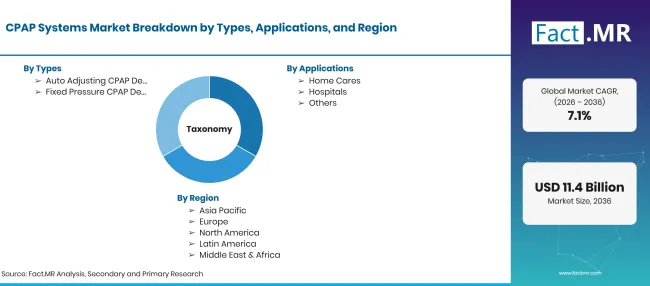
Factmr Cpap Systems Market Taxonomy | Source: Fact.MR
| Attribute | Details |
|---|---|
| Quantitative Units | USD billion |
| Market Definition | CPAP systems are medical devices that deliver continuous positive airway pressure to help keep patients’ airways open during sleep. Coverage includes auto-adjusting and fixed-pressure CPAP devices used for obstructive sleep apnea management and respiratory care across homecare and healthcare settings. |
| Product Type | Auto Adjusting CPAP Devices; Fixed Pressure CPAP Devices |
| Application | Home Care; Hospitals; Others |
| Regions Covered | North America; Latin America; Western Europe; Eastern Europe; East Asia; South Asia & Pacific; Middle East & Africa |
| Countries Covered | Japan; United States; Germany; United Kingdom; Brazil |
| Companies Profiled | ResMed Inc., Philips Respironics (Royal Philips), Fisher & Paykel Healthcare Corporation Limited, BMC Medical Co., Ltd., and Löwenstein Medical SE & Co. KG |
| Forecast Period | 2026 to 2036 |
| Approach | Hybrid top-down and bottom-up analysis using sleep apnea prevalence, CPAP adoption rates, manufacturer revenues, device sales, average selling prices, distribution channels, company portfolios, and healthcare trends to estimate market size and forecast growth. |
Source: Fact.MR analysis. Updated Oct 19, 2026
Frequently Asked Questions
How big is the CPAP Systems Market in 2026?
What is the CAGR of the CPAP Systems Market from 2026 to 2036?
Which type leads the CPAP Systems Market?
Which application leads the CPAP systems market?
Which country will grow the most in the CPAP systems market?
What is the projected CAGR of the CPAP systems market in Japan?
Who are the main companies in the CPAP systems market?
Who worked on this report


Preview the report firsthand - request a free sample
Free SampleGet the brochure for pricing and purchase details
Download PDF