
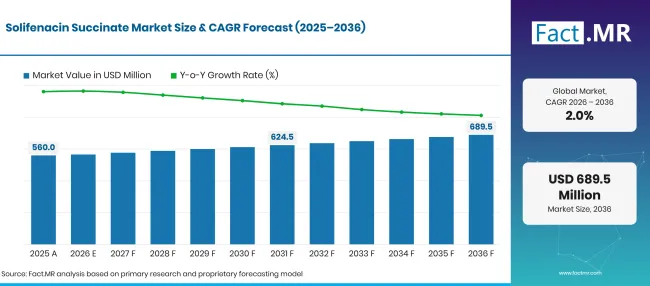
- Market Value (2025): USD 560.0 Mn
- Estimated Value (2026): USD 565.6 Mn
- Forecast Value (2036): USD 689.5 Mn
- CAGR (2026-2036): 2.0%
Solifenacin Succinate Market Forecast and Outlook 2026 to 2036
According to the Fact.MR analysis, the solifenacin succinate market surpassed a value of USD 560.0 million in 2025 and is projected to grow from USD 565.6 million in 2026 to USD 689.5 million by 2036. Demand for solifenacin succinate is likely to grow at a CAGR of 2.0% over the forecast period.
Demand for solifenacin succinate is supported by the steady number of patients treated for overactive bladder, with prescriptions now dominated by generic tablets. The key players are offering 5 mg and 10 mg film-coated tablets, fixed-dose combinations with tamsulosin and oral suspensions through retail, hospital and online pharmacy channels.
Key Takeaways from the Solifenacin Succinate Market
- Solifenacin Succinate Market Value (2025): USD 560.0 million
- Solifenacin Succinate Market Value (2026): USD 565.6 million
- Solifenacin Succinate Market Forecast Value (2036): USD 689.5 million
- Solifenacin Succinate Market Forecast CAGR (2026-2036): 2.0%
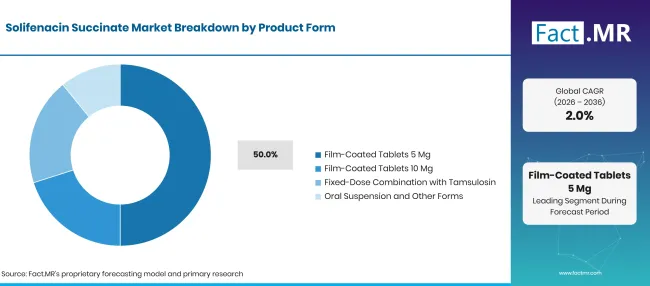
- Leading Product Form: Film-coated tablets 5 mg (50.0%)
- Key Market Participants: Astellas Pharma, Teva Pharmaceutical Industries, Sandoz, Viatris, Zydus Lifesciences
- Key Growth Countries: China, South Korea, United States, United Kingdom, Germany
Population ageing and increasing diagnosis of bladder-related conditions are expected to support demand for solifenacin succinate through 2036. According to India's Ministry of Social Justice and Empowerment, the population aged 60 years and above is projected to increase from 10 crore in 2011 to 23 crore by 2036, raising its share of the population from 8.4% to 14.9%. Additionally, the Ministry of Statistics and Programme Implementation reported in April 2026 that 43.9% of Indians aged 60 years and above reported ailments in 2025. These demographic and healthcare trends support a larger potential patient base, although generic competition, price erosion and newer bladder therapies are likely to moderate revenue growth.
Solifenacin Succinate Market
| Metric | Value |
|---|---|
| Estimated Value in (2026) | USD 565.6 million |
| Forecast Value in (2036) | USD 689.5 million |
| Forecast CAGR (2026 to 2036) | 2.0% |
Source: Fact.MR analysis.
Solifenacin Succinate Market Forecast Global | Source: Fact.MR
Category
| Category | Segments |
|---|---|
| Product Form | Film-coated tablets 5 mg, Film-coated tablets 10 mg, Fixed-dose combination with tamsulosin, Oral suspension and other forms |
| Brand Status | Unbranded generics, Branded generics, Originator brand, Authorised generics |
| Indication | Overactive bladder with urgency incontinence, Overactive bladder with frequency and urgency, Neurogenic detrusor overactivity |
| Distribution Channel | Retail pharmacies, Hospital pharmacies, Online pharmacies, Mail-order and institutional |
| Region | China; South Korea; United States; United Kingdom; Germany |
Source: Fact.MR analysis.
Segmental Analysis
What makes film-coated tablets 5 mg the leading product form segment in the Solifenacin Succinate Market?
Solifenacin Succinate Market Breakdown Product Form | Source: Fact.MR
Demand for film-coated tablets 5 mg accounts for 50.0% of revenue in 2026, about USD 282.8 million, as the 5 mg tablet is the usual starting dose for most patients and is prescribed for long-term treatment. Prescribers raise to 10 mg only where symptoms persist and the drug is tolerated. Demand is supported by its position as the recommended starting dose for adults with overactive bladder, with treatment potentially increasing to 10 mg when tolerated and clinically appropriate. The US National Library of Medicine's DailyMed published updated prescribing information in July 2026 confirming the 5 mg once-daily starting dose. This established dosing approach supports continued demand for 5 mg formulations among patients beginning treatment and those requiring maintenance therapy.
Which factors support unbranded generics as the largest brand status segment in the Solifenacin Succinate Market?
Solifenacin Succinate Market Breakdown Brand Status | Source: Fact.MR
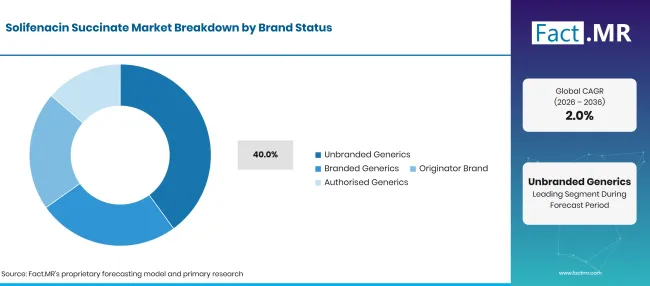
Sales of unbranded generics segment holds 40.0% of revenue in 2026, about USD 226.2 million, as unbranded generics have taken most prescriptions since patent expiry, and health systems and pharmacists favor lower-priced equivalents. Branded and authorized generics keep smaller shares in markets with brand loyalty. The US FDA reported in 2026 that approximately 9 out of 10 prescriptions filled in the United States are for generic medicines. Its September 2026 approved drug product list also includes solifenacin succinate among available generic drug products. Wider generic availability and competition between manufacturers support affordable treatment options and strengthen the position of unbranded formulations across prescription markets.
How is the urgency-incontinence patient population influencing indication-based demand for solifenacin succinate?
Solifenacin Succinate Market Breakdown Indication | Source: Fact.MR
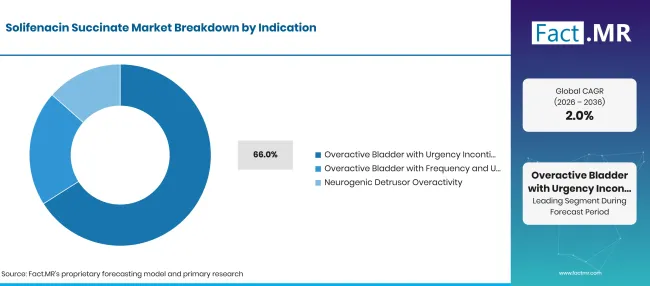
The overactive bladder with urgency incontinence segment to represent 66.0% of revenue in 2026, about USD 373.3 million, as urgency incontinence is the most common presentation of overactive bladder and the main reason for antimuscarinic treatment. Frequency and urgency without incontinence make up a further large group. Demand reflects the drug's established indication for adults experiencing urge urinary incontinence, urgency and urinary frequency. The National Institute of Diabetes and Digestive and Kidney Diseases' Urologic Diseases in America report found that antimuscarinic prescription use among patients aged 65 and older with urgency urinary incontinence remained substantial, although it declined from 49% in 2012 to 34% in 2021. This demonstrates the continued clinical role of antimuscarinic medicines in managing urgency-related bladder symptoms.
Which factors support retail pharmacies as the largest distribution channel segment in the Solifenacin Succinate Market?
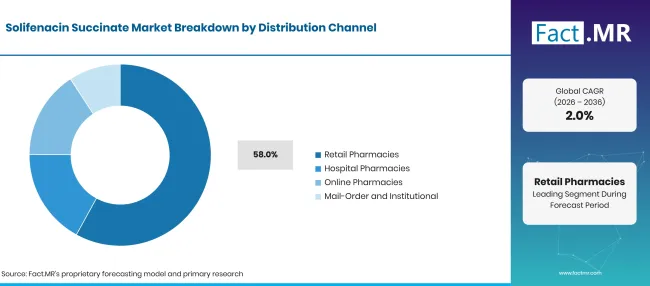
Solifenacin Succinate Market Breakdown Distribution Channel | Source: Fact.MR
Sales through retail pharmacies segment to capture 58.0% of revenue in 2026, approximately USD 328.0 million, as most patients receive repeat prescriptions for chronic bladder symptoms through community pharmacies. Hospital pharmacies serve inpatients and specialist clinics. The Centers for Medicare & Medicaid Services reported that its Medicare Quarterly Part D Spending by Drug dataset had been updated through the second quarter of 2026, providing drug-level prescription claims and spending information. This demonstrates the continued importance of outpatient prescription channels in monitoring medicine utilization. Community pharmacies remain important dispensing points for patients receiving ongoing overactive bladder treatment, while hospital pharmacies serve specialist and inpatient requirements.
Solifenacin Succinate Market-Drivers, Restraints & Trends
Drivers:
Ageing Population and Affordable Generic Treatment-: Demand for solifenacin succinate is supported by the increasing elderly population, as overactive bladder symptoms become more relevant with advancing age. India's Ministry of Social Justice and Empowerment reported in March 2026 that the population aged 60 years and above is projected to increase from approximately 10 crore in 2011 to 23 crore by 2036, raising its population share to 14.9%. The Department of Pharmaceuticals also reported that India supplies approximately 20% of global generic medicines. These developments support the long-term demand environment for affordable treatments of chronic bladder conditions, including solifenacin succinate.
Restraints:
Adverse Effects and Generic Price Competition-: Sales is constrained by generic price erosion, side effects such as dry mouth and constipation that lead some patients to stop treatment, and the use of newer drug classes in patients who do not tolerate antimuscarinics. Solifenacin succinate sales face pressure from generic price competition and treatment discontinuation associated with adverse effects. The US National Library of Medicine's DailyMed database, which publishes official drug-label information, records dry mouth in 10.9% of patients receiving 5 mg solifenacin and 27.6% receiving 10 mg in clinical trials. Constipation occurred in 5.4% and 13.4% of patients, respectively. Dry mouth was also the most frequent adverse reaction leading to treatment discontinuation, at 1.5%. These tolerability concerns can influence prescribing decisions and encourage patients to consider alternative overactive bladder treatments.
Opportunity: Expanding Generic Medicine Manufacturing
Unbranded generics account for the largest share of supply, and manufacturers compete mainly on price, supply reliability and quality assurance. Generic manufacturing offers opportunities for solifenacin succinate suppliers through competitive pricing, wider distribution and consistent product availability. India's Department of Pharmaceuticals reported in its 2025-26 Annual Report that the domestic pharmaceutical industry recorded an annual turnover of ₹4,71,898 crore in FY 2024-25, representing 13.07% annual growth. India also accounts for approximately 20% of global generic drug supply. Furthermore, the Government's Economic Survey 2025-26 highlighted the industry's growing focus on complex generics and pharmaceutical innovation. This manufacturing ecosystem creates opportunities for solifenacin succinate producers to expand domestic and international supply while strengthening quality assurance and production efficiency.
Trend: Combination Treatment for Bladder and Prostate Symptoms
Fixed-dose combinations with an alpha blocker are used in men with both bladder and prostate symptoms, adding a small but growing segment. Combination treatment is gaining clinical relevance among men experiencing both overactive bladder symptoms and benign prostatic hyperplasia. Solifenacin, an antimuscarinic, can address bladder storage symptoms, while alpha-blockers such as tamsulosin target urinary symptoms associated with prostate enlargement. The US National Library of Medicine's updated 2026 prescribing information confirms solifenacin's indication for urgency, urinary frequency and urge incontinence, while tamsulosin is indicated for symptoms of benign prostatic hyperplasia. This complementary therapeutic approach supports opportunities for solifenacin-based combination formulations, particularly among patients requiring management of overlapping urinary symptoms.
Solifenacin Succinate Market Analysis by Key Country
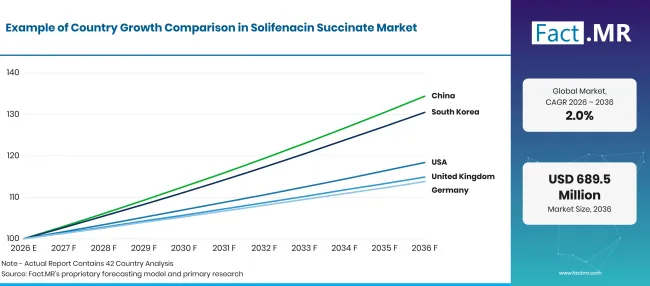
Solifenacin Succinate Market Growth Index | Source: Fact.MR
| Country | CAGR (2026-2036) |
|---|---|
| China | 3.0% |
| South Korea | 2.7% |
| United States | 1.7% |
| United Kingdom | 1.4% |
| Germany | 1.3% |
Source: Fact.MR analysis.
What is accelerating demand and sales of solifenacin succinate in China?
Demand for solifenacin succinate in China is projected to increase at a 3.0% CAGR through 2036, the fastest among the five countries.
An ageing population and expanding access to generic medicines support prescription volumes, while centralized procurement encourages price competition. China's National Bureau of Statistics reported in May 2026 that 321.22 million people were aged 60 years or older, representing 22.86% of the national population in 2025. This expanding older population provides a demographic foundation for overactive bladder treatment demand. However, competitive generic pricing and reimbursement controls are likely to limit revenue growth despite increasing prescription opportunities.
Which demographic and healthcare factors are supporting solifenacin succinate sales in South Korea?
Sales of solifenacin succinate in South Korea is expected to advance at a 2.7% CAGR through 2036, exceeding the global rate of 2.0%.
An ageing population and extensive national health insurance coverage support access to prescription treatments for overactive bladder. Statistics Korea reported in October 2026 that the population aged 65 years and above reached 11.125 million, accounting for 21.6% of the national population. Additionally, the National Health Insurance Service recorded approximately 51.37 million covered individuals in June 2026. These demographic and healthcare conditions support prescription accessibility and generic medicine sales, although competition among established pharmaceutical suppliers may constrain pricing.
How are prescription volumes and generic competition shaping solifenacin succinate demand in the United States?
Demand for solifenacin succinate in the United States is forecast to expand at a 1.7% CAGR through 2036, below the global rate of 2.0%.
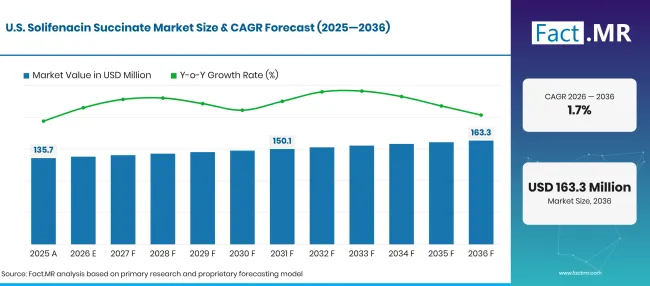
Solifenacin Succinate Market Forecast Usa | Source: Fact.MR
An established prescription market, widespread generic availability and insurance-based medicine purchasing support continued sales volumes, although pricing pressure limits revenue expansion. The US Census Bureau reported in April 2026 that it had released updated population estimates by individual age, while its 2025 population estimates indicated that 18.0% of Americans were aged 65 years and above. This demographic group represents an important potential patient base for bladder-related treatments. Generic substitution and competition from newer therapies are expected to moderate market value growth.
What is sustaining demand for generic solifenacin succinate in the United Kingdom?
Sales of solifenacin succinate in the United Kingdom is projected to grow at a 1.4% CAGR through 2036, below the global average of 2.0%.
Established primary-care pathways, generic medicine availability and national healthcare coverage support recurring prescriptions for overactive bladder treatments. The Office for National Statistics reported in October 2026 that the UK population reached 69.48 million in mid-2025, while the number of people aged 65 years and above increased across all four constituent countries. England recorded a 2.0% increase in its older population during the year. These demographic developments support the potential patient base, although generic pricing and alternative therapies limit sales value growth.
Which factors explain the relatively moderate sales growth of solifenacin succinate in Germany?
Demand for solifenacin succinate in Germany is expected to rise at a 1.3% CAGR through 2036, the slowest among the five profiled countries.
An ageing population supports continued prescription requirements, but reference pricing, generic substitution and competition from alternative overactive bladder treatments restrict revenue expansion. Germany's Federal Statistical Office reported in August 2026 that the population aged 65 years and above reached 19.3 million in 2025, representing 23% of the country's total population. This substantial older population provides a supportive demographic base for bladder treatment demand. Nevertheless, price-sensitive procurement and established generic competition are likely to keep solifenacin succinate sales growth relatively modest.
Competitive Landscape for Solifenacin Succinate Market
The solifenacin succinate market is moderately concentrated, with Astellas Pharma, Teva Pharmaceutical Industries, Sandoz, Viatris and Zydus Lifesciences together hold about 55% of 2026 revenue, based on Fact.MR estimates. Competition centers on price, supply reliability, regulatory quality and the ability to win hospital and pharmacy-chain tenders. The originator brand holds a small share against global and Indian generic makers that supply most volume.
Recent Developments
- In March 2026, Sandoz established a dedicated global biosimilar development, manufacturing and supply unit in March 2026. The organizational expansion strengthens its manufacturing and supply capabilities across affordable medicines.
- In February 2026, Viatris completed its enterprise-wide strategic review in February 2026, targeting USD 650 million in total cost savings and reinvestment in growth opportunities. The initiative supports portfolio optimization and long-term competitiveness across its generic and branded medicines businesses.
- In February 2026, Zydus entered into a settlement agreement with Astellas concerning US patent litigation involving Myrbetriq (mirabegron), a medicine used to treat overactive bladder. The development reflects ongoing competition in the OAB treatment market but is unrelated to solifenacin succinate patents.
Key Players in Solifenacin Succinate Market
Key companies operating in the market include Astellas Pharma, Teva Pharmaceutical Industries, Sandoz, Viatris, and Zydus Lifesciences.
- Astellas Pharma
- Teva Pharmaceutical Industries
- Sandoz
- Viatris
- Zydus Lifesciences
Bibliography
- Centers for Medicare & Medicaid Services. (2026). Medicare quarterly Part D spending by drug: Q2 2026. U.S. Department of Health and Human Services.
- Department of Pharmaceuticals, Ministry of Chemicals and Fertilizers, Government of India. (2026). Annual report 2025-26.
- Ministry of Social Justice and Empowerment, Government of India. (2026, March 24). Growth of elderly population. Press Information Bureau.
- Ministry of Statistics and Programme Implementation, Government of India. (2026, April 20). Household social consumption: Health, January-December 2025. Press Information Bureau.
- National Institute of Diabetes and Digestive and Kidney Diseases. (2025). Urologic diseases in America: Annual data report 2024. National Institutes of Health.
- U.S. Food and Drug Administration. (2026). Generic drugs. U.S. Department of Health and Human Services.
- U.S. National Library of Medicine. (2026a, January). Tamsulosin hydrochloride capsule: Drug label information. DailyMed.
- U.S. National Library of Medicine. (2026b, July 6). Solifenacin succinate tablet, film coated: Drug label information. DailyMed.
- U.S. Department of the Treasury. (2026, January 30). Economic Survey 2025-26 highlights India's shift toward high-value pharma and innovation. Press Information Bureau, Government of India.
Segmentation
Scope of Report
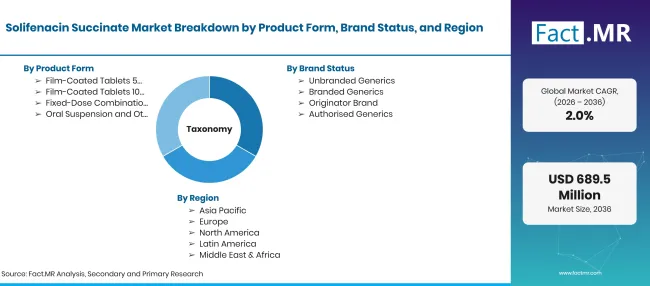
Solifenacin Succinate Market Taxonomy | Source: Fact.MR
| Items | Values |
|---|---|
| Quantitative Units (2026) | USD 565.6 Million |
| Product Form | Film-coated tablets 5 mg, Film-coated tablets 10 mg, Fixed-dose combination with tamsulosin, Oral suspension and other forms |
| Brand Status | Unbranded generics, Branded generics, Originator brand, Authorised generics |
| Indication | Overactive bladder with urgency incontinence, Overactive bladder with frequency and urgency, Neurogenic detrusor overactivity |
| Distribution Channel | Retail pharmacies, Hospital pharmacies, Online pharmacies, Mail-order and institutional |
| Regions Covered | North America, Latin America, Europe, Asia Pacific, Middle East & Africa |
| Countries Covered | China, South Korea, United States, United Kingdom, Germany, and other countries |
| Key Companies Profiled | Astellas Pharma, Teva Pharmaceutical Industries, Sandoz, Viatris, Zydus Lifesciences |
| Additional Attributes | Dollar revenue in the Solifenacin Succinate Market is segmented by product form, brand status, indication and distribution channel and region. |
Source: Fact.MR analysis.
Solifenacin Succinate Market by Segments
-
Product Form
- Film-coated tablets 5 mg
- Film-coated tablets 10 mg
- Fixed-dose combination with tamsulosin
- Oral suspension and other forms
-
Brand Status
- Unbranded generics
- Branded generics
- Originator brand
- Authorised generics
-
Indication
- Overactive bladder with urgency incontinence
- Overactive bladder with frequency and urgency
- Neurogenic detrusor overactivity
-
Distribution Channel
- Retail pharmacies
- Hospital pharmacies
- Online pharmacies
- Mail-order and institutional
-
Region:
- North America
- United States
- Canada
- Mexico
- Europe
- Germany
- United Kingdom
- France
- Italy
- Spain
- Rest of Europe
- Asia Pacific
- China
- India
- Japan
- South Korea
- Australia and New Zealand
- Rest of Asia Pacific
- Latin America
- Brazil
- Argentina
- Rest of Latin America
- Middle East & Africa
- GCC Countries
- South Africa
- Rest of Middle East & Africa
- North America
Table of Contents
Key Takeaways
- Market Size and CAGR
- Top Growth Driver
- Fastest Growing Segment
- Leading Region
- Key Companies
- Emerging Opportunities

