
- Market Value (2025): USD 119.8 Mn
- Estimated Value (2026): USD 130.0 Mn
- Forecast Value (2036): USD 293.9 Mn
- CAGR (2026-2036): 8.5%
Ready-to-Stir Medical Proteins Market Forecast and Outlook 2026 to 2036
According to the Fact.MR analysis, the ready-to-stir medical proteins market crossed a valuation of USD 119.8 million in 2025 and is projected to grow from USD 130.0 million in 2026 to USD 293.9 million by 2036. Demand for ready-to-stir medical proteins is likely to grow at a CAGR of 8.5% over the forecast period.
Demand for ready-to-stir medical proteins is rising as hospitals, care homes and home carers need protein powders that dissolve fully with a spoon in water, soup, yogurt or tube feed, without shakers, lumps, foam or a change in taste, so that patients with poor appetite or swallowing problems actually receive the protein prescribed. Manufacturers of ready-to-stir medical proteins are offering instantized whey, casein and plant proteins, hydrolysates and blended bases that are agglomerated and lecithinated for instant wetting. For example, in August 2026, Arla Foods Ingredients invested EUR 8.3 million at its Danmark Protein site in Videbæk, which makes specialized whey proteins. Similar investment is projected to drive sales of ready-to-stir medical proteins.
Key Takeaways from the Ready-to-Stir Medical Proteins Market
- Ready-to-Stir Medical Proteins Market Value (2025): USD 119.8 million
- Ready-to-Stir Medical Proteins Market Value (2026): USD 130.0 million
- Ready-to-Stir Medical Proteins Market Forecast Value (2036): USD 293.9 million
- Ready-to-Stir Medical Proteins Market Forecast CAGR (2026-2036): 8.5%
- Leading Product Type: Instantized plant medical protein (25.4%)
- Key Market Participants: Arla Foods Ingredients, FrieslandCampina Ingredients, Fonterra, Lactalis Ingredients, Glanbia Nutritionals, Hilmar Ingredients
- Key Growth Regions: Denmark, Germany, United States, Japan, United Kingdom
In June 2026, ASPEN issued recommendations for managing a shortage of enteral feeding sets, underlining how many patients now receive nutrition support at home. Demand for ready-to-stir medical proteins is growing as care moves out of hospitals and products must work in a kitchen with no special equipment. Manufacturers of ready-to-stir medical proteins are designing neutral-tasting modular proteins for carers. Similar care patterns are projected to drive sales of ready-to-stir medical proteins across Europe, the United States and Japan.
Ready-to-Stir Medical Proteins Market
| Metric | Value |
|---|---|
| Estimated Value in (2026) | USD 130.0 million |
| Forecast Value in (2036) | USD 293.9 million |
| Forecast CAGR (2026 to 2036) | 8.5% |
Source: Fact.MR analysis. Updated 18 Nov 2026
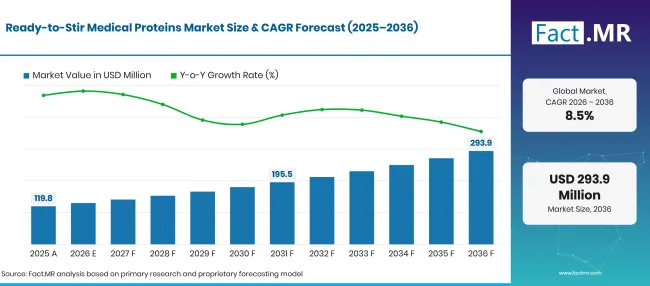
Ready To Stir Medical Proteins Forecast Global | Source: Fact.MR
Category
| Category | Segments |
|---|---|
| Product Type | Instantized plant medical protein, Hydrolyzed medical protein, Blended ready-to-stir base, Instantized whey medical protein, Instantized casein medical protein |
| Product Form | Granule and agglomerate, Dry powder, Liquid concentrate, Encapsulated, Custom premix |
| Application | Enteral tube feeding, Post-surgical recovery, Active aging nutrition, Oral nutritional supplements, Sarcopenia management |
| Buyer Type | Pharmacies, Contract manufacturers, Hospitals, Sports nutrition brands, Medical nutrition brands |
| Region | Denmark; Germany; United States; Japan; United Kingdom |
Source: Fact.MR analysis.
Segmental Analysis
Why do instantized plant medical proteins lead product demand in the Ready-to-Stir Medical Proteins Market?
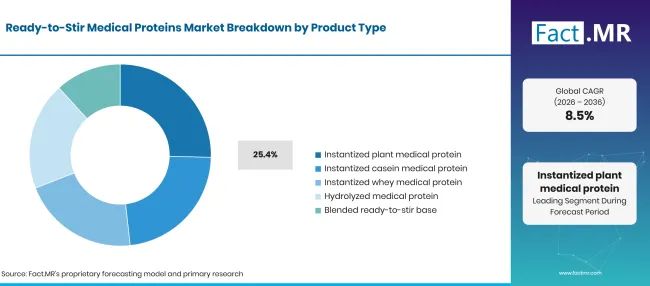
Ready To Stir Medical Proteins Breakdown Product Type | Source: Fact.MR
Demand for Instantized plant medical proteins account for 25.4% of the ready-to-stir medical proteins market in 2026, about USD 33.0 million, because pea and soy proteins made instant through agglomeration offer a dairy-free, lower-cost option at a time of record whey prices, and new studies support plant-dominant blends in tube feeding. They suit patients with milk allergy or lactose intolerance. Manufacturers of ready-to-stir medical proteins are improving taste and mouthfeel of plant grades. Similar cost and tolerance factors are projected to keep instantized plant proteins the leading product type.
How are granules and agglomerates leading form demand in the Ready-to-Stir Medical Proteins Market?
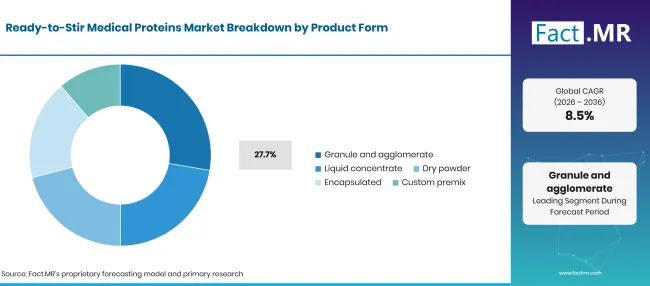
Ready To Stir Medical Proteins Breakdown Product Form | Source: Fact.MR
Sales of Granule and agglomerate formats account for 27.7% of ready-to-stir medical proteins revenue in 2026, about USD 36.0 million, because agglomeration creates porous granules that sink and wet in seconds, which is the physical basis of stir-in performance, and granules produce little dust when scooped at the bedside. Portion sachets rely on this flow. Manufacturers of ready-to-stir medical proteins are controlling granule size and wetting agents. Similar functional needs are projected to keep granules and agglomerates the leading product form.
Why does enteral tube feeding lead application demand in the Ready-to-Stir Medical Proteins Market?
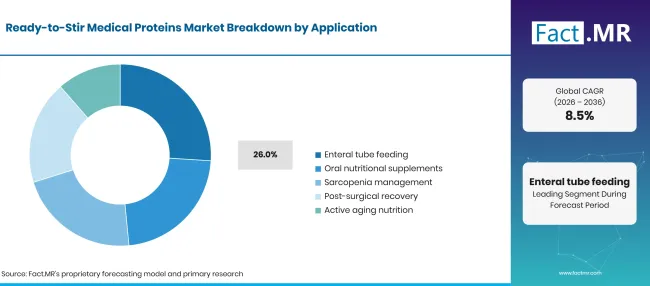
Ready To Stir Medical Proteins Breakdown Application | Source: Fact.MR
Demand for enteral tube feeding accounts for 26.0% of ready-to-stir medical proteins revenue in 2026, about USD 33.8 million, as dietitians add modular protein to standard tube feeds for patients with high protein needs, such as those in intensive care or with pressure injuries, and the powder must dissolve completely so that it does not block narrow tubes. Reliability is critical. Manufacturers of ready-to-stir medical proteins are testing flow through feeding tubes, in line with the enteral feeding formulas market. Similar clinical practice is projected to keep enteral tube feeding the leading application.
How are pharmacies leading buyer demand in the Ready-to-Stir Medical Proteins Market?
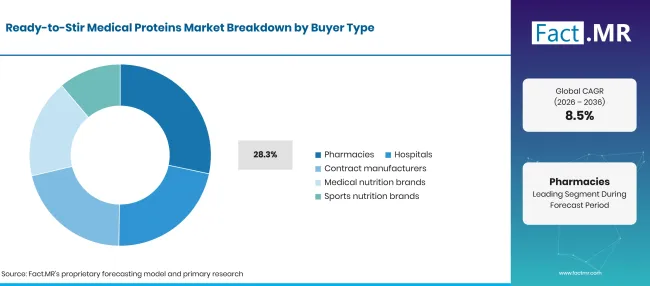
Ready To Stir Medical Proteins Breakdown Buyer Type | Source: Fact.MR
Pharmacies account for 28.3% of ready-to-stir medical proteins revenue in 2026, about USD 36.8 million, because modular protein powders for patients at home are dispensed through retail and homecare pharmacies, and pharmacists recommend them to older customers and carers. Repeat monthly supply is common. Manufacturers of ready-to-stir medical proteins are supplying pharmacy and medical nutrition brand owners. Similar home supply is projected to keep pharmacies the leading buyer type.
Ready-to-Stir Medical Proteins Market-Drivers, Restraints & Trends
Drivers:
Demand for ready-to-stir medical proteins is rising as aging increases the number of people who need protein support. For example, Japan reported in September 2026 that a record 29.6% of its population was aged 65 or over, and a global consensus report on nutritional therapy was published in October 2026. Manufacturers of ready-to-stir medical proteins are developing products for older adults with small appetites. Similar demographic and clinical trends are projected to drive sales of ready-to-stir medical proteins.
Restraints:
Demand for ready-to-stir medical proteins is constrained by protein raw material costs and prescribing controls. For example, Glanbia said in November 2026 that whey costs would remain high into early 2027 after driving a 26% rise in third-quarter pricing, and UK health bodies issued guidance in 2026 promoting food-first approaches. Similar pressures are projected to limit volumes in cost-controlled systems. Manufacturers of ready-to-stir medical proteins must show cost-effectiveness.
Opportunity: Clear, Neutral Whey Fractions
Demand for proteins that dissolve clear and tasteless in water, tea or juice is rising. Manufacturers are offering purified whey fractions such as beta-lactoglobulin. Arla Foods Ingredients presented whey solutions with partner wheyco at Fi Europe in November 2026. Similar innovation is projected to drive sales, as covered in the ready-to-stir BLG proteins market.
Trend: Texture-Modified Diets
In October 2026, a study in Clinical Nutrition ESPEN reported on plant- and food-based formulas in tube-fed children, reflecting wider interest in food-like medical nutrition. Demand for proteins that stir into thickened drinks and pureed meals without changing texture is rising. Similar needs are projected to drive sales of ready-to-stir medical proteins. Manufacturers of ready-to-stir medical proteins are also serving the enteral medical nutrition market.
Ready-to-Stir Medical Proteins Market by Analysis by Key Country
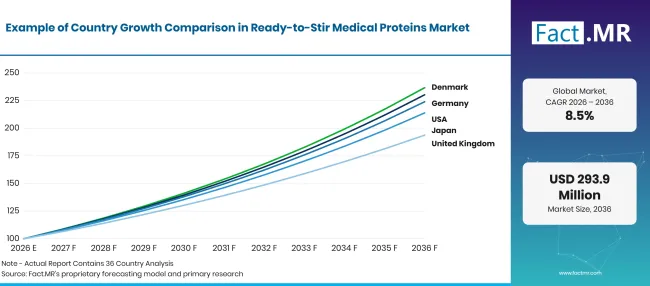
Ready To Stir Medical Proteins Growth Index | Source: Fact.MR
| Country | CAGR (2026-2036) |
|---|---|
| Denmark | 9.0% |
| Germany | 8.7% |
| United States | 8.4% |
| Japan | 7.9% |
| United Kingdom | 6.8% |
Source: Fact.MR analysis.
What is driving ready-to-stir medical proteins demand in Denmark?
In August 2026, Arla Foods Ingredients invested EUR 8.3 million at Danmark Protein in Videbæk, and in November 2026 it showed whey protein concepts at Fi Europe.
Demand for ready-to-stir medical proteins in Denmark is projected to grow at a 9.0% CAGR, the fastest among the five key countries, as the country is a center for specialized whey fractions and its municipalities provide nutrition support in elder care. Manufacturers of ready-to-stir medical proteins are developing new instant grades there. Similar expertise is projected to drive sales in Denmark.
How is clinical nutrition supporting ready-to-stir medical proteins sales in Germany?
Sales of ready-to-stir medical proteins in Germany are projected to grow at an 8.7% CAGR through 2036, supported by nutritional requirements in hospitals and long-term care facilities.
According to the German Nutrition Society (DGE), an analysis of 1,755 hospital patients found that 14% were underweight, while 24% had experienced unintentional weight loss exceeding 5%. Among 2,864 nursing home residents, 23% were underweight. These findings highlight the importance of nutritional intervention and protein enrichment in clinical settings. Germany's established medical nutrition industry, including Fresenius Kabi and B. Braun, creates opportunities for modular protein ingredients that can be incorporated into specialised dietary formulations.
What is shaping ready-to-stir medical proteins demand in the United States?
Demand for ready-to-stir medical proteins in the United States is projected to increase at an 8.4% CAGR through 2036, supported by home-based nutrition care, clinical protein supplementation and healthy-ageing products.
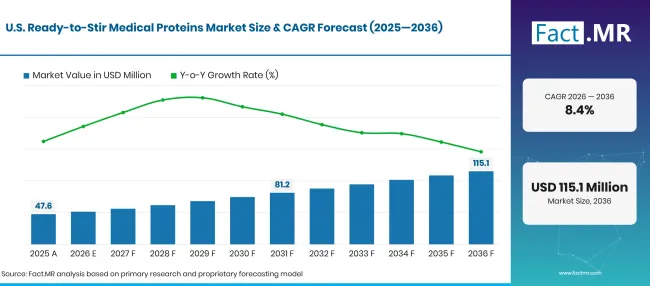
Ready To Stir Medical Proteins Forecast Usa | Source: Fact.MR
In June 2026, the American Society for Parenteral and Enteral Nutrition (ASPEN) issued recommendations addressing shortages of enteral gravity and pump feeding sets, highlighting the importance of maintaining continuity in specialised nutritional support. Glanbia's November 2026 trading update also reported 9.8% revenue growth in its Health and Nutrition segment, supported by strong end-market demand. These developments create opportunities for instant protein ingredients used in clinical nutrition, home-care formulations and specialised dietary products.
How is a record elderly population shaping ready-to-stir medical proteins sales in Japan?
Sales of ready-to-stir medical proteins in Japan are estimated to record a 7.9% CAGR through 2036, supported by population ageing and established demand for specialised elderly nutrition.
According to Japan's Statistics Bureau, the population aged 65 and above reached 36.24 million in September 2026, representing a record 29.6% of the national population. This demographic trend strengthens demand for nutritional products addressing age-related dietary challenges, including inadequate protein intake and swallowing difficulties. Japan's Consumer Affairs Agency also maintains a Foods with Function Claims framework requiring scientific evidence and pre-market notification. Manufacturers are exploring easily incorporated protein ingredients for porridge, soups, beverages and soft-textured nutritional products.
Why is growth slower for ready-to-stir medical proteins in the United Kingdom?
Demand for ready-to-stir medical proteins in the United Kingdom is projected to hold a 6.8% CAGR through 2036, reflecting the targeted use of specialised nutritional products in clinical settings.
NHS England's National Standards for Healthcare Food and Drink recommend a food-first approach, encouraging healthcare providers to improve patients' nutritional intake through food fortification before relying on specialised nutritional supplementation where clinically appropriate. However, patients with inadequate dietary intake or increased protein requirements may still require additional nutritional support following clinical assessment. This creates a more specialised purchasing environment for modular protein ingredients, with manufacturers concentrating on hospital nutrition, dietetic formulations and specialist healthcare applications rather than broad consumer adoption.
Competitive Landscape for Ready-to-Stir Medical Proteins Market
Competition in the ready-to-stir medical proteins market is led by dairy protein specialists. Arla Foods Ingredients competes with instant whey isolates and beta-lactoglobulin fractions, FrieslandCampina Ingredients competes with whey and casein-based medical proteins, Fonterra competes with functional dairy proteins, Lactalis Ingredients competes with native whey proteins, and Glanbia Nutritionals and Hilmar Ingredients compete with instantized proteins in the United States. Buyers select ready-to-stir medical proteins on dispersibility, taste neutrality, protein quality, tube compatibility and cost.
From 2025 onward, competition shifted toward clear, neutral and plant-based instant proteins. Arla invested in its Danish whey site in 2026, studies supported plant-dominant tube feeds, and whey prices reached records. Manufacturers that combine instant performance with secure, affordable supply are best placed to grow.
Recent Developments
- In November 2026, Arla Foods Ingredients presented whey protein solutions at Fi Europe.
- In October 2026, a global consensus report on nutritional therapy was published.
- In August 2026, Arla Foods Ingredients invested EUR 8.3 million at Danmark Protein.
- In June 2026, ASPEN issued shortage recommendations for enteral feeding sets.
Key Players in Ready-to-Stir Medical Proteins Market
Key companies operating in the market include Arla Foods Ingredients, FrieslandCampina Ingredients, Fonterra, Lactalis Ingredients, Glanbia Nutritionals, and Hilmar Ingredients.
- Arla Foods Ingredients
- FrieslandCampina Ingredients
- Fonterra
- Lactalis Ingredients
- Glanbia Nutritionals
- Hilmar Ingredients
Bibliography
- American Society for Parenteral and Enteral Nutrition. (2026). 2026 enteral nutrition shortage recommendation: Enteral gravity and pump feeding set shortage management.
- Arla Foods Ingredients. (2026, August 19). Arla Foods Ingredients reduces gas emissions through significant investment in Videbæk. Official Arla website.
- Klek, S., Barazzoni, R., Blaauw, R., Burgos, R., Cardenas, D., Cederholm, T., Compher, C., Sanchez-Corrales, P., Crane, R., Cuerda, C., Hartono, J., Genton, L., Gomez, O., Jager-Wittenaar, H., Jahit, S., Jain, A., Jaquez, A., Jensen, G., Kiss, N., ... Okugawa, Y. (2026). Global Leadership Initiative on Indications to Nutritional Therapy and Support (GLINTS): A consensus report from the global clinical nutrition community. Clinical Nutrition, 65, 106768.
- Glanbia plc. (2026, November 4). Third quarter 2026 interim management statement.
- Ministry of Internal Affairs and Communications, Statistics Bureau of Japan. (2026, September 20). Statistical topics No. 149: The elderly in Japan from the perspective of statistics.
- NHS Greater Manchester. (2026). Malnutrition prescriber guide for adults. Official NHS Greater Manchester website.
Segmentation
Scope of Report
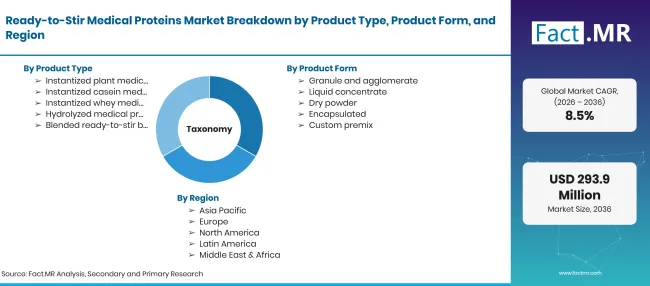
Ready To Stir Medical Proteins Taxonomy | Source: Fact.MR
| Items | Values |
|---|---|
| Quantitative Units (2026) | USD 130.0 Million |
| Product Type | Instantized plant medical protein, Hydrolyzed medical protein, Blended ready-to-stir base, Instantized whey medical protein, Instantized casein medical protein |
| Product Form | Granule and agglomerate, Dry powder, Liquid concentrate, Encapsulated, Custom premix |
| Application | Enteral tube feeding, Post-surgical recovery, Active aging nutrition, Oral nutritional supplements, Sarcopenia management |
| Buyer Type | Pharmacies, Contract manufacturers, Hospitals, Sports nutrition brands, Medical nutrition brands |
| Regions Covered | North America, Latin America, Europe, East Asia, South Asia and Pacific, Middle East & Africa |
| Countries Covered | Denmark, Germany, United States, Japan, United Kingdom, and other countries |
| Key Companies Profiled | Arla Foods Ingredients, FrieslandCampina Ingredients, Fonterra, Lactalis Ingredients, Glanbia Nutritionals, Hilmar Ingredients |
| Additional Attributes | Dollar revenue in the Ready-to-Stir Medical Proteins Market is segmented by product type (instantized plant, hydrolyzed, blended ready-to-stir base, instantized whey, instantized casein medical protein), product form, application, buyer type and region. |
Source: Fact.MR analysis.
Ready-to-Stir Medical Proteins Market by Segments
-
Product Type
- Instantized plant medical protein
- Hydrolyzed medical protein
- Blended ready-to-stir base
- Instantized whey medical protein
- Instantized casein medical protein
-
Product Form
- Granule and agglomerate
- Dry powder
- Liquid concentrate
- Encapsulated
- Custom premix
-
Application
- Enteral tube feeding
- Post-surgical recovery
- Active aging nutrition
- Oral nutritional supplements
- Sarcopenia management
-
Buyer Type
- Pharmacies
- Contract manufacturers
- Hospitals
- Sports nutrition brands
- Medical nutrition brands
-
Region:
- North America
- United States
- Canada
- Mexico
- Europe
- Germany
- United Kingdom
- France
- Italy
- Spain
- Rest of Europe
- Asia Pacific
- China
- India
- Japan
- South Korea
- Australia
- Rest of Asia Pacific
- Latin America
- Brazil
- Mexico
- Argentina
- Rest of Latin America
- Middle East & Africa
- GCC Countries
- South Africa
- Rest of Middle East & Africa
- North America
Table of Contents
Key Takeaways
- Market Size and CAGR
- Top Growth Driver
- Fastest Growing Segment
- Leading Region
- Key Companies
- Emerging Opportunities

