
- Market Value (2025): USD 650.0 Mn
- Estimated Value (2026): USD 685.8 Mn
- Forecast Value (2036): USD 1205.1 Mn
- CAGR (2026-2036): 5.8%
Autorefractor Market Forecast and Outlook 2026 to 2036
The autorefractor market is projected to expand from USD 685.8 million in 2026 to USD 1,205.1 million by 2036, registering a CAGR of 5.8% over the ten-year period. Demand is supported by the use of automated eye examination equipment in ophthalmology clinics, hospitals and optical centers for refractive error assessment and vision testing.
Demand for autorefractors is increasing as ophthalmology clinics, hospitals and optical practices seek faster objective refraction and combined eye examination capabilities. Manufacturers are developing instruments that integrate refractive measurements with corneal assessment and other diagnostic functions. On November 18, 2025, Topcon Healthcare announced FDA 510(k) clearance and the launch of OMNIA, a four-in-one automated pretesting system combining refraction, keratometry, tonometry and pachymetry.
Key Takeaways from Autorefractor Market
- Autorefractor Market Value (2025): USD 650.0 million
- Autorefractor Market Value (2026): USD 685.8 million
- Autorefractor Market Forecast Value (2036): USD 1,205.1 million
- Autorefractor Market Forecast CAGR (2026-2036): 5.8%
- Leading Product Type: Tabletop autorefractors (42.0%)
- Key Market Participants: Topcon, Nidek, Carl Zeiss Meditec, Huvitz
- Key Growth Countries: India, China, South Korea, United States, Germany
In January 2026, Topcon Healthcare announced a USD 3,500 trade-in credit for eye care practices upgrading a current-model Topcon autorefractor to its OMNIA four-in-one pretesting system, with the offer valid until March 31, 2026. Ophthalmology clinics and optometry practices are seeking equipment that combines objective refraction, corneal curvature measurement and additional eye examination functions.
Autorefractor Market
| Metric | Value |
|---|---|
| Estimated Value in (2026) | USD 685.8 million |
| Forecast Value in (2036) | USD 1,205.1 million |
| Forecast CAGR (2026 to 2036) | 5.8% |
Source: Fact.MR analysis.
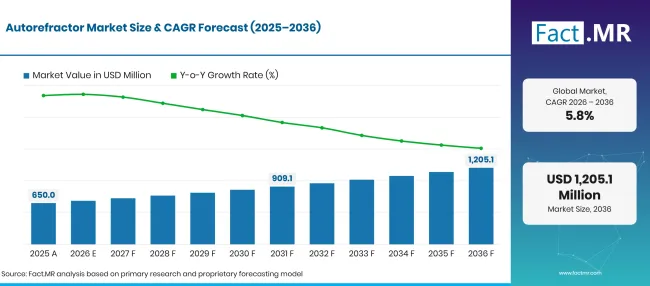
Autorefractor Market Forecast Global | Source: Fact.MR
Category
| Category | Segments |
|---|---|
| Product Type | Tabletop autorefractors, Autorefractor-keratometers, Handheld and portable units, Photorefractors for vision screening |
| Technology | Open-field autorefractors, Closed-field autorefractors, Wavefront-based systems, Photorefraction |
| End User | Hospitals and eye clinics, Optical retail chains, Independent optometry practices, Screening and community programs |
| Connectivity | Integrated with phoropter and chair units, Standalone units, EMR-networked units, Cloud-connected and AI-assisted units |
| Country | India; China; South Korea; United States; Germany |
Source: Fact.MR analysis.
Segmental Analysis
What makes tabletop autorefractors the leading product type segment in the Autorefractor Market?
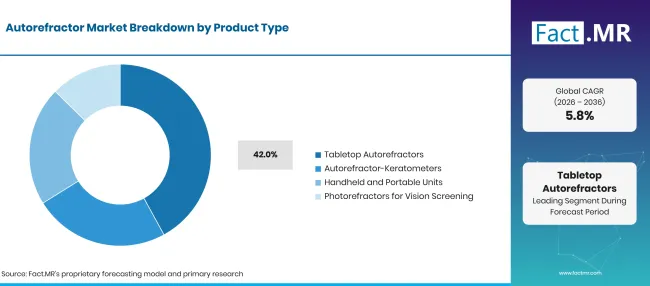
Autorefractor Market Breakdown Product Type | Source: Fact.MR
Tabletop autorefractors hold a 42.0% revenue share in 2026, with sales reaching approximately USD 288.0 million. Their fixed examination position supports consistent patient alignment during objective refraction testing. Topcon Healthcare offers the KR-800 tabletop auto kerato-refractometer with automated measurement functions, making it suitable for ophthalmology clinics and optometry practices conducting routine eye examinations.
Which factors support open-field autorefractors as the largest technology segment in the Autorefractor Market?
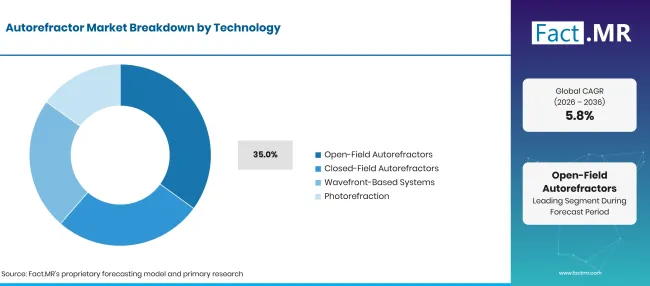
Autorefractor Market Breakdown Technology | Source: Fact.MR
Open-field autorefractors generate approximately USD 240.0 million in 2026, securing 35.0% of market revenue. These instruments allow patients to view external targets during refractive measurements, helping clinicians examine accommodation under different viewing conditions. Their design supports specialized vision assessments where natural fixation and changes in focusing response are important examination considerations.
What makes hospitals and eye clinics the leading end user segment in the Autorefractor Market?
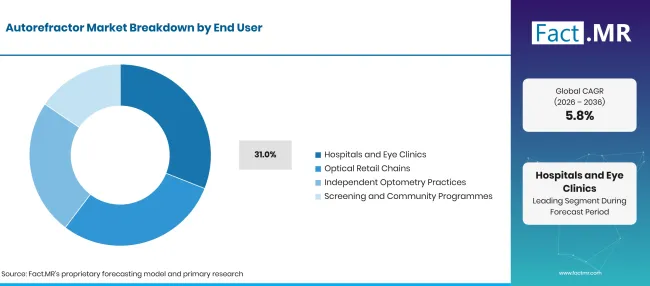
Autorefractor Market Breakdown End User | Source: Fact.MR
Hospitals and eye clinics contribute 31.0% of autorefractor revenue in 2026, approximately USD 212.6 million. Ophthalmologists use automated refraction measurements during routine eye examinations and assessments of refractive errors. Topcon Healthcare's OMNIA combines refraction, keratometry, tonometry and pachymetry, allowing clinical facilities to perform multiple pretesting procedures using one examination instrument.
Which factors support integrated with phoropter and chair units as the largest connectivity segment in the Autorefractor Market?
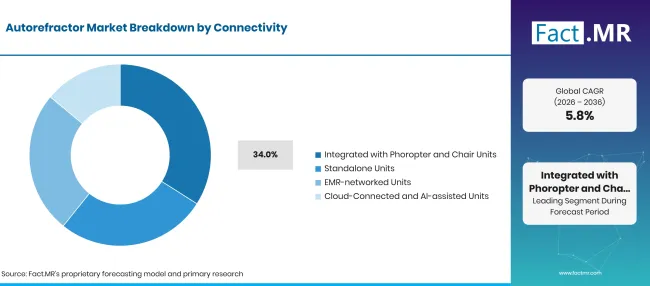
Autorefractor Market Breakdown Connectivity | Source: Fact.MR
Integrated autorefractors with phoropter and chair units represent 34.0% of market revenue in 2026, approximately USD 233.2 million. Connected examination equipment allows objective refraction results to move into subsequent vision testing stages. NIDEK offers compatible autorefractors and refractors with data transfer capabilities, helping practitioners manage examination procedures and reduce repeated manual entry.
Autorefractor Market: Drivers, Restraints & Trends
Drivers
Growing requirements for objective refraction and comprehensive eye examinations support purchases of autorefractors in hospitals and optometry practices. Combined instruments measure refractive errors and corneal curvature, helping clinicians conduct multiple assessments. Topcon Healthcare's OMNIA integrates four examination functions within one device.
Restraints
High equipment costs influence autorefractor purchases among smaller optical practices and independent clinics. Long instrument service lives can delay replacement decisions, while manual refraction remains part of routine examinations. Maintenance expenses, staff training requirements and compatibility with existing equipment also affect purchasing decisions.
Trend
Myopia Management: Increasing attention to myopia assessment is encouraging eye care providers to use objective refraction during routine examinations and follow-up visits. The World Health Organization’s August 2026 policy guidance on refractive error care calls for combining spectacle dispensing with screening programs and for raising awareness of myopia risk factors, supporting demand for refractive assessment.
Trend
Connected and Portable Units: Ophthalmic equipment manufacturers are offering handheld autorefractors and instruments with digital data transfer capabilities. NIDEK provides HandyRef portable devices and compatible refractors that exchange examination results.
Autorefractor Market Analysis by Key Country
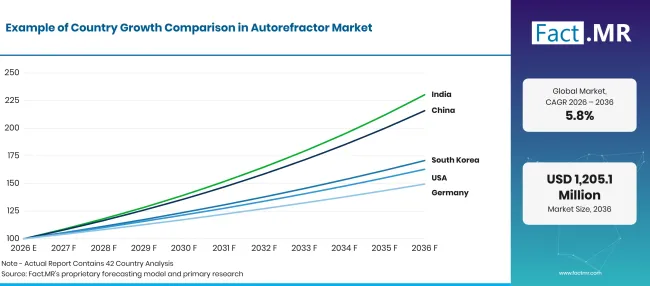
Autorefractor Market Growth Index | Source: Fact.MR
| Country | CAGR (2026-2036) |
|---|---|
| India | 8.7% |
| China | 8.0% |
| South Korea | 5.5% |
| United States | 5.0% |
| Germany | 4.1% |
Source: Fact.MR analysis.
Why is India the fastest-growing market for autorefractors?
Demand for autorefractors in India is anticipated to increase at an 8.7% CAGR over the forecast period.
Expansion of eye screening programs and ophthalmology services supports purchases of objective refraction equipment. Tamil Nadu's National Health Mission reported providing 282,961 free spectacles to schoolchildren during 2025–2026. Hospitals and vision centers require reliable instruments to assess refractive errors and support subsequent examinations.
What is driving autorefractors demand in China?
Sales of autorefractors in China are anticipated to expand at an 8.0% CAGR through 2036.
Childhood myopia prevention and regular vision assessments create opportunities for automated refractive measurement equipment. In March 2025, China’s Ministry of Education launched its tenth myopia prevention and control publicity and education month. Eye clinics and specialist examination centers use autorefractors to assess refractive errors, while screening initiatives encourage referrals for detailed assessment and corrective eyewear.
What is shaping autorefractors demand in South Korea?
Demand for autorefractors in South Korea is anticipated to grow at a 5.5% CAGR by 2036.
Ophthalmology clinics and optical practices use automated instruments for preliminary vision assessments and refractive error measurements. South Korea’s Health Insurance Review and Assessment Service reported 2,677 ophthalmology specialists working in clinics in its 2024 provider statistics. This indicates the scale of the clinical workforce rather than equipment purchases.
How is demand for autorefractors developing in the United States?
Sales of autorefractors in the United States are anticipated to rise at a 5.0% CAGR by 2036.
Established optometry practices and ophthalmology clinics purchase automated instruments for routine examinations and diagnostic assessments. The Centers for Disease Control and Prevention reported in 2026 that approximately 25.02 million Americans had uncorrected refractive errors in 2024. Manufacturers such as Topcon offer integrated examination systems combining refraction and corneal measurements, creating equipment replacement opportunities for clinics seeking improved examination efficiency.
Why is growth slower for autorefractors in Germany?
Demand for autorefractors in Germany is anticipated to increase at a 4.1% CAGR over the forecast period.
Established ophthalmology practices and specialist eye clinics provide applications for automated refraction equipment. The German Medical Association recorded 7,030 ophthalmologists working in outpatient care at the end of 2025. Eye care providers consider instrument accuracy, patient positioning and compatibility with existing examination equipment when replacing autorefractors.
Competitive Landscape for Autorefractor Market
Autorefractor manufacturers are advancing eye examination capabilities through automated measurements, combined diagnostic functions and improved instrument connectivity. Topcon Healthcare offers the KR-800 and OMNIA systems, while NIDEK supplies ARK-series autorefractor-keratometers for routine vision assessment. Carl Zeiss Meditec serves eye care professionals with VISUREF instruments featuring objective refraction and additional examination capabilities. Huvitz supplies the HRK-8100A auto ref-keratometer.
Recent developments highlight greater integration of diagnostic functions. In November 2025, Topcon announced FDA clearance and the launch of OMNIA, combining refraction, keratometry, tonometry and pachymetry. ZEISS also introduced its VISUREF 1000 multifunctional screening system in May 2025.
Recent Developments
- In January 2025, ZEISS introduced the VISUREF 600, combining a wavefront autorefractor and keratometer in one device. The equipment measures refractive errors and corneal curvature, helping eye care professionals conduct routine examinations.
- In 2026, Nidek and HOYA Vision Care extended their global strategic partnership, which now renews automatically each year. The companies plan to combine NIDEK’s diagnostic and measurement technology with HOYA’s lens technologies, helping eye care professionals provide more personalized, data-driven care.
Key Players in Autorefractor Market
Key companies operating in the market include Topcon, Nidek, Carl Zeiss Meditec, and Huvitz.
- Topcon
- Nidek
- Carl Zeiss Meditec
- Huvitz
Bibliography
- Centers for Disease Control and Prevention. (2026, August 12). VEHSS modeled estimates: Vision loss and blindness.
- Health Insurance Review & Assessment Service. (2025, January). Specialist workforce statistics.
- Huvitz Co., Ltd. (2025, January 20). HRK-8100A Auto Ref-Keratometer: Instructions for Use (Rev. C).
- German Medical Association. (2026). Physician statistics 2025 (Table 3).
- Ministry of Education of the People’s Republic of China. (2025). Notice on organizing the 10th myopia prevention and control publicity and education month (Jiaotiyiwei [2025] No. 75).National Health Mission Tamil Nadu. (2026). National Programme for Control of Blindness and Visual Impairment.
- Nidek Co., Ltd. (2026, August 4). NIDEK and HOYA Vision Care extend global strategic partnership to accelerate integrated vision care innovation.
- NIDEK Co., Ltd. (2026, January 26). NIDEK launches the PHANTOM™ Open-field Refraction System.
- Topcon Healthcare, Inc. (2025, November 18). Topcon Healthcare, Inc. receives 510(k) clearance and announces launch of OMNIA—a 4-in-1 automated pretesting solution.
- Topcon Healthcare, Inc. (2026, January 20). Start 2026 with limited-time offers from Topcon Healthcare.
- World Health Organization. (2026, August 28). Policy considerations to improve access to refractive error care.
- ZEISS Vision Care. (2025, January 31). ZEISS VISUREF 600 – One device, manifold applications.
- ZEISS Vision Care. (2025, May 27). Introducing ZEISS VISUREF 1000: A comprehensive solution for advanced eye care.
Segmentation
Scope of Report
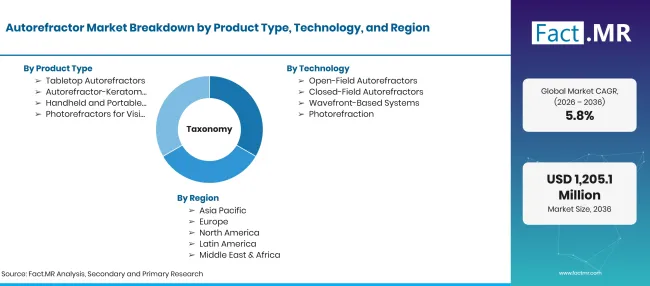
Autorefractor Market Taxonomy | Source: Fact.MR
| Items | Values |
|---|---|
| Quantitative Units (2026) | USD 685.8 Million |
| Product Type | Tabletop autorefractors, Autorefractor-keratometers, Handheld and portable units, Photorefractors for vision screening |
| Technology | Open-field autorefractors, Closed-field autorefractors, Wavefront-based systems, Photorefraction |
| End User | Hospitals and eye clinics, Optical retail chains, Independent optometry practices, Screening and community programs |
| Connectivity | Integrated with phoropter and chair units, Standalone units, EMR-networked units, Cloud-connected and AI-assisted units |
| Regions Covered | North America, Latin America, Europe, Asia Pacific, Middle East & Africa |
| Countries Covered | India, China, South Korea, United States, Germany, and other countries |
| Key Companies Profiled | Topcon, Nidek, Carl Zeiss Meditec, Huvitz |
| Additional Attributes | Dollar revenue in the Autorefractor Market is segmented by product type, technology, end user and connectivity and region. |
Source: Fact.MR analysis.
Autorefractor Market by Segments
-
Product Type
- Tabletop autorefractors
- Autorefractor-keratometers
- Handheld and portable units
- Photorefractors for vision screening
-
Technology
- Open-field autorefractors
- Closed-field autorefractors
- Wavefront-based systems
- Photorefraction
-
End User
- Hospitals and eye clinics
- Optical retail chains
- Independent optometry practices
- Screening and community programs
-
Connectivity
- Integrated with phoropter and chair units
- Standalone units
- EMR-networked units
- Cloud-connected and AI-assisted units
-
Region:
- North America
- United States
- Canada
- Mexico
- Europe
- Germany
- United Kingdom
- France
- Italy
- Spain
- Rest of Europe
- Asia Pacific
- China
- India
- Japan
- South Korea
- Australia and New Zealand
- Rest of Asia Pacific
- Latin America
- Brazil
- Argentina
- Rest of Latin America
- Middle East & Africa
- GCC Countries
- South Africa
- Rest of Middle East & Africa
- North America
Table of Contents
Key Takeaways
- Market Size and CAGR
- Top Growth Driver
- Fastest Growing Segment
- Leading Region
- Key Companies
- Emerging Opportunities

