
- Market Value (2025): USD 3.9 Bn
- Estimated Value (2026): USD 4.15 Bn
- Forecast Value (2036): USD 8.17 Bn
- CAGR (2026-2036): 7.0%
Disinfectors Market Forecast and Outlook 2026 to 2036
According to the Fact.MR analysis, the disinfector market surpassed a value of USD 3.9 billion in 2025 and is projected to grow from USD 4.15 billion in 2026 to USD 8.17 billion by 2036. Demand for disinfectors is likely to grow at a CAGR of 7.0% over the forecast period.
Demand for disinfectors is rising as hospitals, clinics, food plants and commercial buildings seek reliable equipment to disinfect instruments, rooms and surfaces and to reduce infection risk. Suppliers are offering thermal washer-disinfectors, ultraviolet systems, endoscope reprocessors, vapor and fogging systems and steam units for fixed, portable and robotic use.
Key Takeaways from the Disinfectors Market
- Disinfectors Market Value (2025): USD 3.9 billion
- Disinfectors Market Value (2026): USD 4.15 billion
- Disinfectors Market Forecast Value (2036): USD 8.17 billion
- Disinfectors Market Forecast CAGR (2026-2036): 7.0%
- Leading Technology: Thermal washer-disinfectors (25.5%)
- Key Market Participants: STERIS, Getinge, Belimed, Miele Professional, Olympus
- Key Growth Countries: China, South Korea, United States, United Kingdom, France
Infection-prevention programs, growth in endoscopy and surgical volumes and tighter hygiene standards in food and hospitality are expected to support equipment sales, with automation and documented cycle validation becoming standard requirements.
Disinfectors Market
| Metric | Value |
|---|---|
| Estimated Value in (2026) | USD 4.15 billion |
| Forecast Value in (2036) | USD 8.17 billion |
| Forecast CAGR (2026 to 2036) | 7.0% |
Source: Fact.MR analysis.
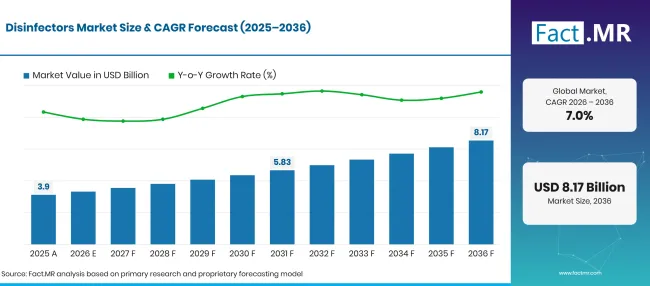
Disinfectors Market Forecast Global | Source: Fact.MR
Category
| Category | Segments |
|---|---|
| Technology | Thermal washer-disinfectors, UV disinfection systems, Automated endoscope reprocessors, Chemical vapour and fogging systems, Steam disinfectors |
| End Use | Hospitals, Clinics, dental and ambulatory care, Food and beverage processing, Hospitality and commercial buildings, Laboratories and pharmaceutical |
| Mobility | Fixed and built-in, Portable and cart-based, Robotic and autonomous, Cabinet and tabletop |
| Target | Instruments and medical devices, Rooms and surfaces, Food contact items and packaging, Air handling and ducts |
| Region | China; South Korea; United States; United Kingdom; France |
Source: Fact.MR analysis.
Segmental Analysis
WHAT is sustaining thermal washer-disinfectors as the leading technology segment in the Disinfectors Market?
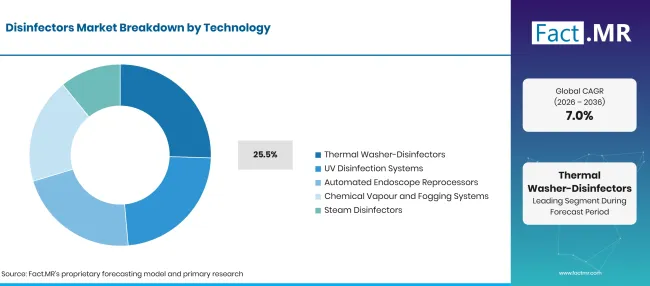
Disinfectors Market Breakdown Technology | Source: Fact.MR
Demand for thermal washer-disinfectors is supported by hospitals' need to clean and disinfect reusable surgical instruments through controlled, repeatable processing cycles. This segment accounts for 25.5% of market revenue in 2026, about USD 1.06 billion. India's Ministry of Health and Family Welfare reinforced medical-device reprocessing requirements through its August 2026 amendment to the Medical Devices Rules, 2017, simplifying licensing requirements for manufacturers outsourcing sterilization to licensed facilities. This regulatory change supports specialized reprocessing infrastructure and equipment demand. Hospitals continue to require validated thermal disinfection systems for reusable instruments, particularly in central sterile services departments.
Which healthcare requirements are increasing disinfectors demand across hospitals?
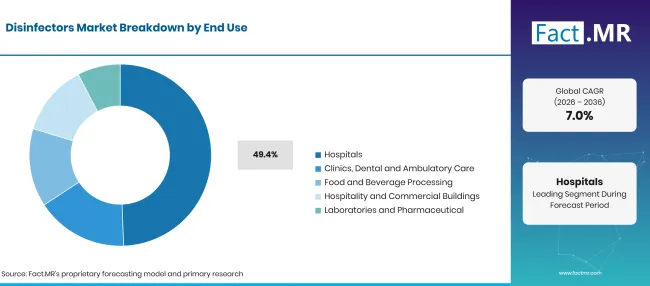
Disinfectors Market Breakdown End Use | Source: Fact.MR
Sales of disinfectors to hospitals are supported by infection-prevention programmes, surgical activity and requirements for maintaining hygienic clinical environments. Hospitals holds 49.4% of market revenue in 2026, about USD 2.05 billion. India's Ministry of Health and Family Welfare reported in June 2026 that 100% of public healthcare facilities had undergone assessment against Indian Public Health Standards, with 64% scoring above 50%. These assessments encourage improvements in healthcare infrastructure, equipment availability and infection-control practices. Hospitals consequently remain important purchasers of instrument washer-disinfectors, sterilization equipment and environmental disinfection systems.
How are installation requirements influencing fixed and built-in disinfectors adoption?
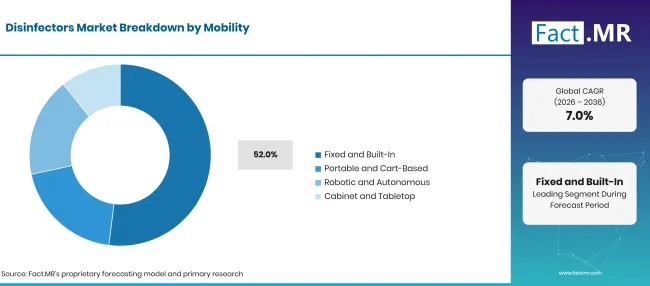
Disinfectors Market Breakdown Mobility | Source: Fact.MR
Adoption of fixed and built-in disinfectors remains strong because hospitals and healthcare facilities require permanently installed equipment for continuous instrument processing and routine disinfection. This segment accounts for 52.0% of market revenue in 2026, about USD 2.16 billion. India's Ministry of Health and Family Welfare reported that 2.77 lakh healthcare facilities were registered under its Health Management Information System, including 2.36 lakh public and 0.41 lakh private facilities, in its 2025–26 Annual Report. Expansion and monitoring of healthcare infrastructure support opportunities for permanently installed disinfection systems integrated with water supply, drainage and sterile-processing departments.
WHAT is keeping instruments and medical devices at the centre of disinfectors demand?
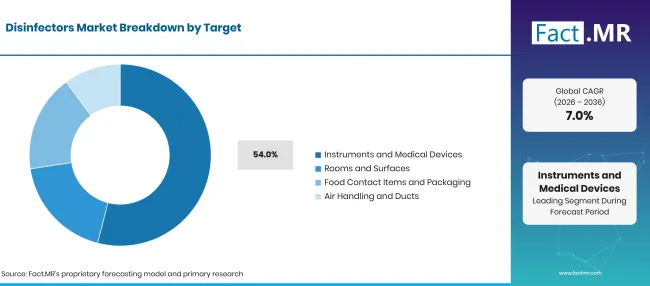
Disinfectors Market Breakdown Target | Source: Fact.MR
Demand for instrument and medical-device disinfection to represent 54.0% of market revenue in 2026, about USD 2.24 billion. Reusable surgical instruments, endoscopes and diagnostic devices require appropriate cleaning, disinfection or sterilization between patient uses to prevent cross-contamination. India's Ministry of Health and Family Welfare amended the Medical Devices Rules in August 2026, removing the separate loan-licensing requirement for manufacturers outsourcing sterilization to appropriately licensed facilities. This development supports specialized medical-device processing services and associated infrastructure. The regulatory emphasis on safe reprocessing reinforces demand for washer-disinfectors and other equipment used in healthcare instrument management.
Disinfectors Market-Drivers, Restraints & Trends
Drivers: Stronger Infection Prevention and Hygiene Standards
Demand for disinfectors is gaining support from stricter infection prevention requirements, hospital hygiene programmes and the need for validated equipment-cleaning procedures. India's Ministry of Health and Family Welfare reported in March 2026 that 100% of public healthcare facilities had been assessed against Indian Public Health Standards (IPHS), with 63% scoring above 50%. These assessments reflect the Government's continued emphasis on healthcare quality, infrastructure and service standards. Increasing attention to infection prevention, environmental cleaning and equipment hygiene supports procurement of washer-disinfectors, sterilization equipment and automated disinfection systems across healthcare facilities.
Restraints: High Equipment Costs and Operational Requirements
Disinfector adoption faces challenges from high initial equipment costs, trained-staff requirements and the need for regular validation and maintenance. Healthcare facilities must also ensure that chemical concentrations, exposure times and cleaning procedures meet the required disinfection standards. India's National Guidelines for Infection Prevention and Control emphasize staff training, monitoring, environmental cleaning and appropriate equipment management. The Government's 2026 IPHS assessment found that only 63% of assessed facilities scored above 50%, indicating continuing quality-improvement requirements across public healthcare infrastructure. These competing investment priorities can delay purchases of advanced automated disinfection systems, particularly in resource-constrained facilities.
Opportunity: Automated Endoscope Reprocessing
Increasing emphasis on endoscope hygiene and the prevention of device-associated infections creates opportunities for automated endoscope reprocessors. The US Centers for Disease Control and Prevention (CDC) identifies endoscopes as complex medical devices requiring meticulous cleaning and high-level disinfection after use. Its recommendations specifically address automated reprocessors, correct channel connections, leak testing and staff competency assessments. India's National Guidelines for Infection Prevention and Control also establish procedures for equipment decontamination and infection surveillance. These requirements create opportunities for manufacturers offering automated systems with process monitoring, traceability and leak-testing capabilities, particularly as hospitals expand advanced endoscopy services.
Trend: UV and Robotic Room Disinfection
Hospitals are increasingly exploring supplementary disinfection technologies, including ultraviolet germicidal irradiation and automated room-cleaning systems, to strengthen environmental hygiene. In October 2026, the US National Institute for Occupational Safety and Health (NIOSH) published updated guidance confirming that germicidal ultraviolet technology can inactivate viruses, bacteria and fungi in healthcare, commercial and educational environments. The guidance emphasizes using UV systems alongside ventilation and other infection-control measures rather than as replacements. This creates opportunities for UV-enabled disinfection equipment and robotic systems that support repeatable environmental cleaning in hospitals and other high-traffic facilities.
Disinfectors Market Analysis by Key Country
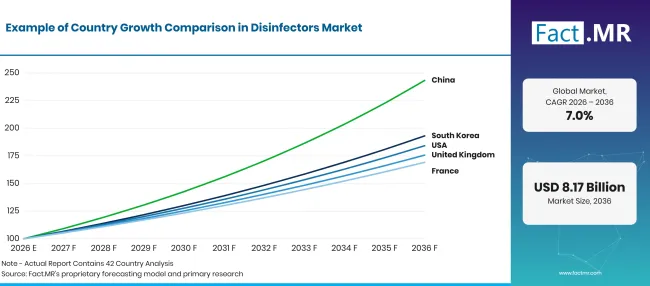
Disinfectors Market Growth Index | Source: Fact.MR
| Country | CAGR (2026-2036) |
|---|---|
| China | 9.3% |
| South Korea | 6.8% |
| United States | 6.3% |
| United Kingdom | 5.8% |
| France | 5.4% |
Source: Fact.MR analysis.
Why is China the fastest-growing market for disinfectors?
Demand for disinfectors in China is set to expand at a 9.3% CAGR through 2036, the fastest among the five countries.
Large investment in hospitals and a push to modernize hospital hygiene, together with food-safety needs, support strong demand for disinfection equipment. According to China's National Bureau of Statistics, the country had approximately 38,000 hospitals and 10.09 million medical beds at the end of 2025, with these figures reported in its February 2026 statistical communiqué. Healthcare institutions also recorded 10.58 billion medical visits during 2025. This substantial treatment volume creates recurring requirements for instrument cleaning, equipment disinfection and infection prevention. Expanding hospital infrastructure and growing demand for standardized reprocessing are expected to strengthen equipment procurement and replacement sales.
How is demand for disinfectors developing in South Korea?
Demand for disinfectors in South Korea is projected to grow at a 6.8% CAGR through 2036, below the global rate of 7.0%.
Advanced hospital infrastructure and high endoscopy volumes support demand for automated reprocessing and validated disinfection. According to the National Health Insurance Service, South Korea recorded 105,271 healthcare institutions in the second quarter of 2026, including 47 tertiary general hospitals, 337 general hospitals and 1,429 hospitals. The expanding institutional base provides opportunities for washer-disinfectors, automated endoscope reprocessors and specialized disinfection systems. Continued equipment modernization and demand for reliable sterilization workflows are likely to support recurring purchases across hospitals and outpatient facilities.
What is driving disinfectors demand in United States?
The United States disinfectors market is forecast to grow at a 6.3% CAGR from 2026 to 2036.
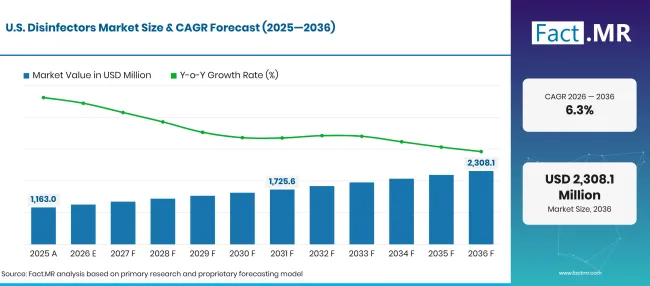
Disinfectors Market Forecast Usa | Source: Fact.MR
Hospital procurement, outpatient treatment expansion and infection-prevention requirements continue to influence equipment replacement decisions. According to the Centers for Disease Control and Prevention's first-quarter 2026 National Healthcare Safety Network newsletter, 4,125 general hospitals, 6,915 ambulatory surgery centers and 18,727 long-term care facilities were enrolled as of March 11, 2026. Separately, CMS reported 5,978 hospitals and 6,410 ambulatory surgical centers in its April 2026 Fast Facts publication, using 2024 provider data. These extensive care networks sustain demand for automated cleaning, validated disinfection and equipment upgrades.
What is shaping disinfectors demand in United Kingdom?
Demand for disinfectors in United Kingdom is likely to increase at a 5.8% CAGR through 2036, below the global rate of 7.0%.
Strong national infection-prevention requirements for hospitals and clinics sustain demand for validated washer-disinfectors and endoscope reprocessors. NHS England recorded 18.5 million finished admission episodes during the 2025-26 financial year in its official statistics published in September 2026. Its National Infection Prevention and Control Manual, updated in July 2026, also establishes mandatory guidance for NHS settings and addresses the decontamination of reusable invasive equipment, including surgical instruments and flexible endoscopes. These requirements support continued purchasing of washer-disinfectors and endoscope reprocessors, while replacement cycles and hospital budget constraints influence annual sales growth.
Why is growth slower for disinfectors in France?
France's disinfectors market is projected to register a 5.4% CAGR from 2026 to 2036, reflecting an established hospital infrastructure and comparatively mature equipment procurement environment.
However, modernization and increasing demand for efficient instrument reprocessing continue to generate replacement opportunities. The French Directorate for Research, Studies, Evaluation and Statistics (DREES), in its Health Establishments in 2024 – 2026 Edition, published in May 2026, reported 2,962 hospitals and clinics with 367,100 full-hospitalization beds and 91,000 partial-hospitalization places. It also recorded 13.6 million patients receiving hospital stays or treatment sessions during 2024. These substantial service volumes sustain demand for validated disinfection equipment, although established purchasing patterns moderate incremental sales growth.
Competitive Landscape for Disinfectors Market
The disinfector market is relatively concentrated, with STERIS, Getinge, Belimed, Miele Professional and Olympus together hold about 61% of 2026 revenue, based on Fact.MR estimates. Competition centers on cycle validation, throughput, connectivity with traceability systems, service networks and consumables supply. Infection-prevention specialists lead in hospital equipment, while smaller firms compete in UV, fogging and robotic room disinfection.
Recent Developments
- On November 13, 2025, Getting introduced the Aquadis 44, a utility-efficient washer-disinfector designed to reduce water, energy and detergent consumption. Its patent-pending adaptive water-filling technology automatically adjusts water and detergent quantities according to the load, supporting lower operating costs and reduced environmental impact.
- On December 19, 2025, Getinge unveiled Automatiq, a new range of automation solutions for central sterile supply departments. The portfolio combines mobile robotics, intelligent conveyor systems, automated loading and unloading modules, and software to improve instrument handling and sterile reprocessing workflows.
- On May 21, 2026, SteelcoBelimed expanded its endoscope reprocessing portfolio with Steri Case, a closed case designed for washing and liquid chemical sterilization of endoscopes while maintaining continuous leak monitoring. This development strengthens its offering for endoscope cleaning and reprocessing.
- On March 24, 2026, Miele Professional introduced the new ExpertLine PLW 8636 laboratory glassware washer. The system features a variable-speed pump that automatically adapts to the cleaning process, network connectivity and automatic drying. It is designed to deliver intensive cleaning and hygienic results even with shorter operating cycles.
Key Players in Disinfectors Market
Key companies operating in the market include STERIS, Getinge, Belimed, Miele Professional, and Olympus.
- STERIS
- Getinge
- Belimed
- Miele Professional
- Olympus
Bibliography
- Centers for Disease Control and Prevention. (2026). Q1 2026 NHSN newsletter. U.S. Department of Health and Human Services.
- Centers for Medicare & Medicaid Services. (2026, April). CMS fast facts. U.S. Department of Health and Human Services.
- Direction de la recherche, des études, de l'évaluation et des statistiques. (2026). Les établissements de santé en 2024: Édition 2026. Ministère de la Santé et de la Prévention.
- Ministry of Health and Family Welfare. (2026, August 4). Measures taken to strengthen 24×7 emergency services. Press Information Bureau, Government of India.
- Ministry of Health and Family Welfare. (2026, August 24). Union Ministry of Health and Family Welfare proposes amendments to Medical Devices Rules, 2017 to promote ease of doing business. Press Information Bureau, Government of India.
- Ministry of Health and Family Welfare. (2026). Annual report 2025–26. Government of India.
- National Bureau of Statistics of China. (2026, February 28). Statistical communiqué of the People's Republic of China on the 2025 national economic and social development.
- National Health Insurance Service. (2026). Healthcare institution statistics, second quarter 2026.
- NHS England. (2025, July 24). National infection prevention and control manual for England. https://www.england.nhs.uk/infection-prevention-and-control/nipcm-for-england/
- NHS England. (2026, September 24). Hospital admitted patient care activity, 2025–26.
- U.S. Food and Drug Administration. (n.d.). Reprocessing of reusable medical devices.
Segmentation
Scope of Report
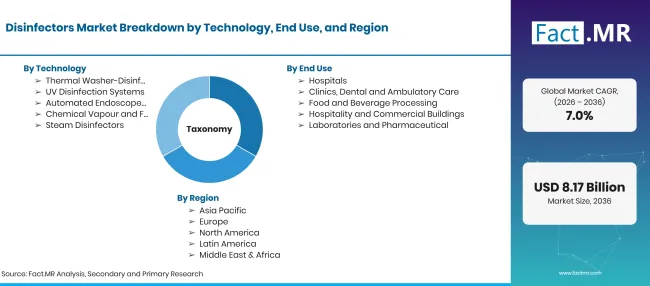
Disinfectors Market Taxonomy | Source: Fact.MR
| Items | Values |
|---|---|
| Quantitative Units (2026) | USD 4.15 Billion |
| Technology | Thermal washer-disinfectors, UV disinfection systems, Automated endoscope reprocessors, Chemical vapour and fogging systems, Steam disinfectors |
| End Use | Hospitals, Clinics, dental and ambulatory care, Food and beverage processing, Hospitality and commercial buildings, Laboratories and pharmaceutical |
| Mobility | Fixed and built-in, Portable and cart-based, Robotic and autonomous, Cabinet and tabletop |
| Target | Instruments and medical devices, Rooms and surfaces, Food contact items and packaging, Air handling and ducts |
| Regions Covered | North America, Latin America, Europe, Asia Pacific, Middle East & Africa |
| Countries Covered | China, South Korea, United States, United Kingdom, France, and other countries |
| Key Companies Profiled | STERIS, Getinge, Belimed, Miele Professional, Olympus |
| Additional Attributes | Dollar revenue in the Disinfectors Market is segmented by technology, end use, mobility and target and region. |
Source: Fact.MR analysis.
Disinfectors Market by Segments
-
Technology
- Thermal washer-disinfectors
- UV disinfection systems
- Automated endoscope reprocessors
- Chemical vapour and fogging systems
- Steam disinfectors
-
End Use
- Hospitals
- Clinics, dental and ambulatory care
- Food and beverage processing
- Hospitality and commercial buildings
- Laboratories and pharmaceutical
-
Mobility
- Fixed and built-in
- Portable and cart-based
- Robotic and autonomous
- Cabinet and tabletop
-
Target
- Instruments and medical devices
- Rooms and surfaces
- Food contact items and packaging
- Air handling and ducts
-
Region:
- North America
- United States
- Canada
- Mexico
- Europe
- Germany
- United Kingdom
- France
- Italy
- Spain
- Rest of Europe
- Asia Pacific
- China
- India
- Japan
- South Korea
- Australia and New Zealand
- Rest of Asia Pacific
- Latin America
- Brazil
- Argentina
- Rest of Latin America
- Middle East & Africa
- GCC Countries
- South Africa
- Rest of Middle East & Africa
- North America
Table of Contents
Key Takeaways
- Market Size and CAGR
- Top Growth Driver
- Fastest Growing Segment
- Leading Region
- Key Companies
- Emerging Opportunities

