- Market Value (2025): USD 2.6 Bn
- Estimated Value (2026): USD 3.0 Bn
- Forecast Value (2036): USD 10.4 Bn
- CAGR (2026-2036): 13.2%
What is the Crease-Resistant Bio Coatings Market forecast to be worth by 2036?
USD 3.0 billion in 2026 to USD 10.4 billion by 2036 at a 13.2% CAGR.
- The Crease-Resistant Bio Coatings Market was valued at USD 2.6 billion in 2025.
- Demand is projected to increase from USD 3.0 billion in 2026 to USD 10.4 billion by 2036.
- The market is forecast to record 13.2% CAGR from 2026 to 2036.
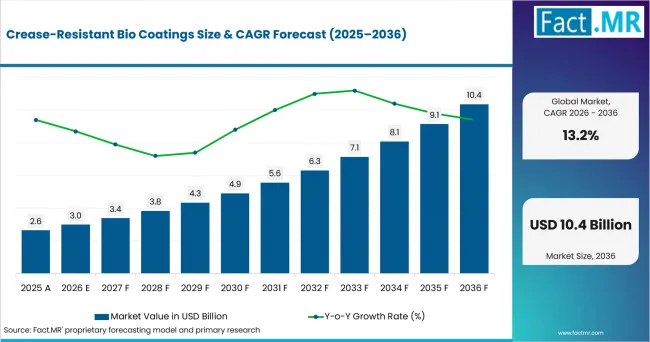
Crease Resistant Bio Coatings Value Analysis | Source: Fact.MR
What are the defining numbers behind Crease-Resistant Bio Coatings Market growth?
An absolute opportunity of USD 7.4 billion is expected between 2026 and 2036.
- Demand Drivers in the Market
- Foodservice converters need oil and moisture barriers that remain intact after folding. Crease durability is expected to shape finished-pack results during forming and sealing. Buyers are expected to favor coatings that give similar barrier results on fold lines and flat panels.
- Paper mills need aqueous systems that fit existing coating equipment. Direct use on fiber is expected to reduce extra converting steps where a coating supplies the required barrier. A familiar water-based process is expected to make trials easier to compare across paper grades and coat weights.
- Brand owners need PFAS-free food-contact paper. In January 2025, the U.S. Food and Drug Administration determined that the uses covered by 35 PFAS-related food contact notifications for grease-proofing coatings on paper and paperboard packaging had been abandoned. That change is expected to increase mix work around alternative grease barriers for food-contact fiber packs.
- Packaging designers need fiber packs that can move through existing recovery systems. Coating selection is expected to place more weight on repulpability and recycling results. Supplier data is expected to gain value when barrier tests are linked with recovery tests on the full coated pack.
- Flexible-pack producers need heat sealing together with grease or moisture resistance. Multi-function coatings are expected to reduce layer complexity when one mix supports sealing and barrier needs. This approach is expected to be most useful when converters can keep familiar paper handling and drying conditions.
- Key Segments Analyzed
- By Coating Chemistry: Aqueous biopolymer dispersion is expected to hold 31.0% share in 2026 because water-based use suits paper and board lines.
- By Performance: Heat seal is projected to account for 29.0% share in 2026 as coated packs need reliable closure after creasing and forming.
- By Substrate: Paper is anticipated to capture 36.0% share in 2026 owing to broad use across flexible packs and foodservice formats.
- By Application: Foodservice is estimated to represent 34.0% share in 2026 as takeaway packs combine food contact with folding and sealing.
- Analyst Opinion at Fact.MR
- Shambhu Nath Jha, Principal Consultant at Fact.MR, states, “Crease resistance becomes a commercial test when a coated fiber pack is folded. Demand is expected to favor coatings that keep barrier and sealing results at converted edges. Suppliers should link bio-based content to fold tests and food-contact records.”
- Strategic Implications
- Coating formulators should report barrier retention after folding and creasing so technical teams can compare finished-pack results with flat-sheet results. Clear fold-test methods are expected to make mix screening easier and reduce repeated trials during converter testing.
- Paper converters should qualify coat weight and sealing windows on the substrate grades used in production. This is expected to show line behavior before scale-up. The same trials should confirm drying stability and crease results at the temperatures used on the actual line.
- Foodservice packs producers should align grease and moisture results with food-contact needs before switching barrier chemistry across cups and wraps. Carton programs are expected to need a separate fold-results check because barrier stress concentrates at scored and formed edges.
China is forecast at 14.2% CAGR through 2036 as foodservice activity supports coated fiber demand. The USA and Japan are projected at 13.7% through different packs channels. Germany is estimated at 13.5% as recycling systems shape coated-paper design. France is forecast at 13.0% as packs recovery supports fiber-based barrier uses.
How does the Crease-Resistant Bio Coatings Market break down by segment?
Paper is projected to lead Substrate at 36.0% share in 2026; Foodservice leads Application at 34.0% share.
Which Coating Chemistry dominates?
Aqueous biopolymer dispersion is expected to hold 31.0% share in 2026.
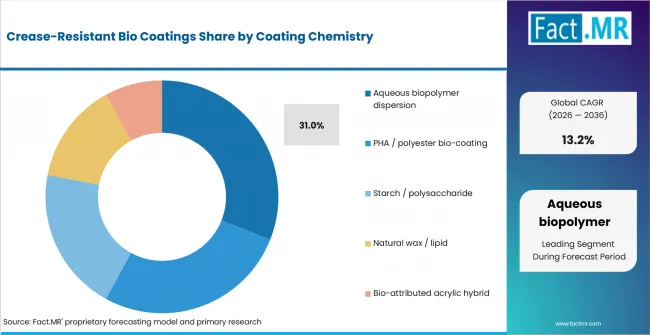
Crease Resistant Bio Coatings Analysis By Coating Chemistry | Source: Fact.MR
Aqueous biopolymer dispersions fit paper and board because converters can apply thin barrier layers directly. Bio-based barrier coatings give related context for renewable coatings on fiber packs. PHA and polyester systems suit compostable formats. Starch and natural wax systems suit paper-rich packs. Bio-attributed acrylic hybrids keep familiar water-based processing.
Solenis markets TopScreen biowax coatings derived from vegetable oils with up to 100% bio-based content. The coatings provide oil and grease resistance for paper and board. They also provide water resistance while supporting repulpability and recycling.
What leads the Performance segment?
Heat seal is projected to account for 29.0% share in 2026.
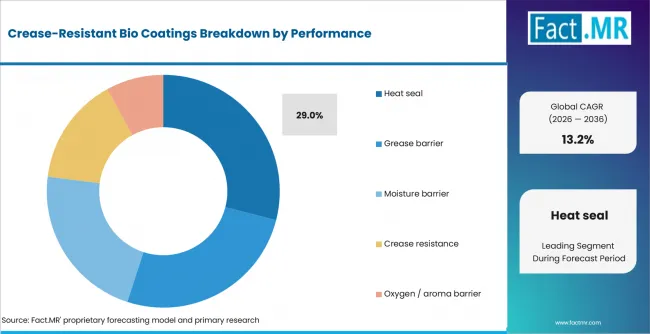
Crease Resistant Bio Coatings Analysis By Performance | Source: Fact.MR
Heat seal is projected to lead because coated food packs need dependable closure after printing and folding. Waterborne heat-seal coatings show how paper packs can combine sealing with barrier control. In April 2026, Michelman introduced Nuvita® Life 4002, a coating that is 100% bio-based in the dry film and provides heat-seal functionality along with oil and grease resistance.
How does Substrate shape demand?
Paper is anticipated to lead with 36.0% share in 2026.
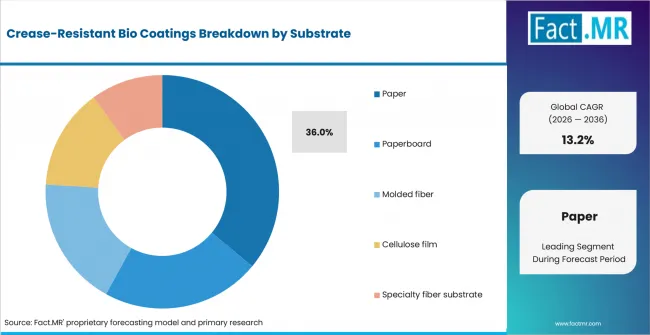
Crease Resistant Bio Coatings Analysis By Substrate | Source: Fact.MR
Paper is anticipated to lead because wraps and bags accept surface coatings with limited pack changes. Paper barrier coatings give related context for grease and moisture control on fiber. Paperboard adds fold lines. Molded fiber adds shaped surfaces and moisture exposure. Cellulose film serves thin flexible packs.
What supports Foodservice within Application?
Foodservice is estimated to represent 34.0% share in 2026.
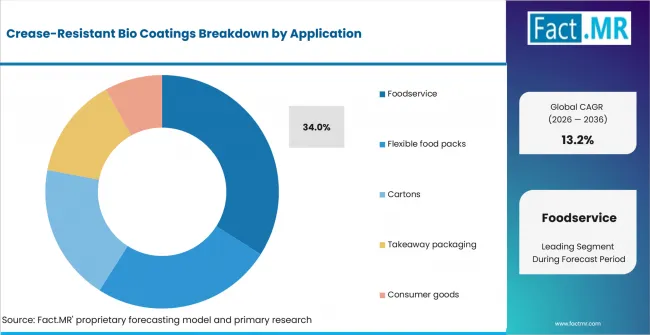
Crease Resistant Bio Coatings Analysis By Application | Source: Fact.MR
Foodservice packs are estimated to lead because short-use formats face grease and fold stress. Compostable cartonboard coatings are relevant where board packs combine barrier needs with disposal claims. Flexible food packs add sealing needs. Cartons place more weight on crease strength and surface life.
What is accelerating Crease-Resistant Bio Coatings Market adoption, and what is holding it back?
Fiber-packaging conversion and PFAS-free barrier needs drive adoption; coating qualification and cost pressure restrain it.
Drivers Impact Analysis
| DRIVER | (~) % IMPACT ON CAGR | GEOGRAPHIC RELEVANCE | IMPACT TIMELINE |
|---|---|---|---|
| PFAS-free grease-barrier substitution | +2.0% | North America, Europe | Short term (<= 2 years) |
| Foodservice fiber packaging conversion | +1.6% | Global | Short term (<= 2 years) |
| Recyclability requirements for coated paper | +1.2% | Europe, Japan | Medium term (2-4 years) |
| Heat-seal demand in flexible food packs | +0.9% | Global | Medium term (2-4 years) |
Opportunity Impact Analysis
| OPPORTUNITY | (~) % IMPACT ON CAGR | GEOGRAPHIC RELEVANCE | IMPACT TIMELINE |
|---|---|---|---|
| Aqueous coatings on existing paper lines | +1.3% | Global | Short term (<= 2 years) |
| Molded-fiber foodservice coatings | +1.0% | North America, East Asia | Medium term (2-4 years) |
| Bio-attributed acrylic hybrids | +0.8% | Europe, North America | Medium term (2-4 years) |
Restraints Impact Analysis
| RESTRAINT | (~) % IMPACT ON CAGR | GEOGRAPHIC RELEVANCE | IMPACT TIMELINE |
|---|---|---|---|
| Barrier loss at fold and crease lines | -0.7% | Global | Short term (<= 2 years) |
| Raw-material and coating-cost variability | -0.5% | Global | Medium term (2-4 years) |
| Food-contact and recycling qualification complexity | -0.4% | North America, Europe, East Asia | Medium term (2-4 years) |
Which countries are scaling the Crease-Resistant Bio Coatings Market through 2036?
- The country comparison spans 1.2 percentage points from China at 14.2% to France at 13.0%.
- China remains 0.5 percentage point above the USA as foodservice activity supports paper-based packs throughput.
- The USA and Japan both record 13.7%. Their outlooks reflect different mixes of e-commerce and food packs. Fiber recovery adds another local factor.
- Germany remains 0.2 percentage point below the USA and Japan as packs recovery needs shape coating testing.
- France reaches 13.0% as household packs recovery supports coated-fiber design and material selection.
Comparable CAGRs create different entry conditions because coating chemistry must fit local food-contact rules and recycling systems. Converting equipment adds another testing step. Full report coverage includes North America; Latin America; Western Europe; Eastern Europe; East Asia; South Asia & Pacific; and Middle East & Africa.
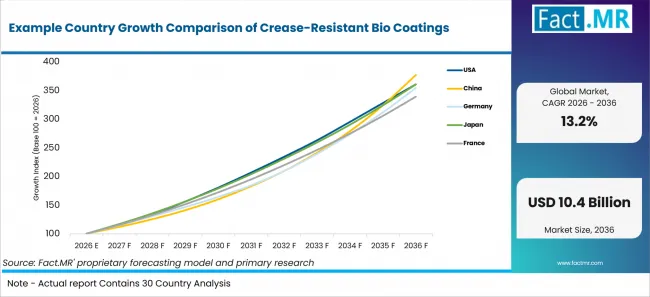
Example Country Growth Comparison Of Crease Resistant Bio Coatings | Source: Fact.MR
| Country | CAGR (2026-2036) |
|---|---|
| China | 14.2% |
| United States | 13.7% |
| Japan | 13.7% |
| Germany | 13.5% |
| France | 13.0% |
How is China scaling demand?
14.2% CAGR, supported by foodservice activity and coated-fiber packaging demand.
China is expected to expand coated-fiber use across foodservice formats where grease resistance and fold results are needed together. On January 20, 2026, China’s National Bureau of Statistics reported that catering revenue reached RMB 5,798.2 billion in 2025, up 3.2% year on year. That activity is expected to give paper converters a large base of cups and wraps to qualify. Cartons and takeaway formats add further volume. Aqueous biopolymer dispersions are expected to fit this setting because water-based use works with existing paper-coating equipment.
What supports USA adoption?
13.7% CAGR, backed by e-commerce shipping and PFAS-free paper-barrier needs.
U.S. converters are expected to focus on coatings that combine grease control with efficient paper processing. On March 10, 2026, the U.S. Census Bureau reported total U.S. retail e-commerce sales of USD 1,233.7 billion in 2025, up 5.4% from 2024. Higher shipment volumes are expected to expand fiber-pack use across retail and food-related channels. Bio-based waxes and dispersions can compete where paper packs need barrier performance and a clear recovery route.
How does Japan perform?
13.7% CAGR, supported by established fiber recovery and functional paper packaging.
Japan is anticipated to favor coatings that protect paper packs while fitting a mature collection system. On March 31 2026 the Ministry of the Environment reported 603,966 tonnes of corrugated containers collected separately in fiscal 2024. The collection covered 1,618 municipalities. That base is expected to support coating trials that preserve fiber recovery. Crease-resistant systems are expected to be relevant for cartons and formed packs where oil and moisture meet fold stress.
What is supporting Germany’s adoption?
13.5% CAGR, shaped by packaging recycling systems and coated-paper qualification.
Germany is estimated to place greater weight on coating results within existing recovery routes. On January 27 2026 the German Environment Agency reported that around 5.5 million tonnes of packaging waste collected by dual systems were recycled in 2024. Paper and cardboard met their statutory recycling targets. This setting is expected to favor water-based and bio-attributed coatings that preserve fiber recovery. Heat-seal results add value in formed food packs.
What supports France’s outlook?
13.0% CAGR, supported by household packaging recovery and fiber-based format development.
France is forecast to expand coated-fiber testing where brands need barrier results and existing recovery routes. In September 2026, ADEME published its English-language 2024 assessment reporting that 4,893 kt of household packaging and graphic papers were sorted for recycling, while household packaging achieved a recycling rate of 69.6%. That recovery base is expected to support packs that keep paper as the main structure. Water-based coatings are expected to suit cartons and molded fiber after forming.
Who leads the Crease-Resistant Bio Coatings Market?
Solenis supplies TopScreen™ biowax-based barrier coatings for paper and board, providing oil, grease, and water resistance. BASF offers ecovio® biopolymer grades for extrusion coating on paper and board, with options that provide grease, liquid, and other barrier properties. Michelman offers Nuvita® Life 4002 and Nuvita® Life 4605, both of which are 100% bio-based in the dry film. Nuvita Life 4002 combines heat-seal functionality with oil and grease resistance, while Nuvita Life 4605 provides oil and grease, water, and moisture barrier performance.
Archroma supplies Cartaseal® OGB F10, which contains bio-based raw materials and maintains oil and grease barrier performance when paper or board is folded or creased. These portfolios give converters several routes to manage barrier and sealing requirements in fiber-based packaging.Xampla supplies Morro™ Coating, a plant-based, plastic-free barrier for recyclable paper packaging. In March 2026, Xampla announced that Just Eat Takeaway was expanding Morro-coated takeaway boxes into 10 European markets, with the boxes manufactured by Huhtamaki.
Competition is expected to focus on barrier durability through folding and creasing, compatibility with converting equipment, and sealing performance. Food-contact compliance, recyclability, and repulpability are also expected to influence supplier selection for fiber-based food packaging applications.
Which companies are the key providers?
Key companies include Solenis; BASF; Michelman; Archroma; and Xampla.
- Solenis
- BASF
- Michelman
- Archroma
- Xampla
Bibliography
- U.S. Food and Drug Administration. (2025, January 3). FDA determines authorization for 35 food contact notifications related to PFAS are no longer effective.
- BASF. (2026, April 29). New ecovio® portfolio for flexible packaging: Multiple barrier options combined with organic or paper recycling.
- Michelman. (2026, April 30). Michelman introduces Nuvita® Life 4002 & Nuvita® Life 4605: Bio-based barrier coatings for paper packaging applications.
- National Bureau of Statistics of China. (2026, January 20). Total retail sales of consumer goods in December 2025.
- U.S. Census Bureau. (2026, March 10). Quarterly retail e-commerce sales: 4th quarter 2025. The actual PDF visibly states “Tuesday, March 10, 2026” and “Quarterly Retail E-Commerce Sales-4th Quarter 2025.”
- German Environment Agency, & Central Agency Packaging Register. (2026, January 27). Facts against myths: Packaging waste recycling in Germany is working.
- Van de Voorde, J. (2026, March). Household packaging and graphic papers: Data 2024. ADEME.
- Xampla. (2026, March 12). Just Eat Takeaway expands plastic-free Morro Coating range across Europe.
This Report Answers
- The report explains where crease-resistant bio coatings are used across Coating Chemistry and Performance. It also covers Substrate and Application together with regional demand.
- Segment analysis identifies the leading subsegments and the converting reasons buyers prioritize aqueous biopolymer dispersions, heat-seal performance, paper substrates, and foodservice applications.
- Country analysis examines China, the United States, Japan, Germany, and France together with the foodservice, packaging-recovery, e-commerce, and recycling conditions supporting coated-fiber demand.
- Competitive analysis reviews current providers across biowax coatings, biopolymer systems, bio-based barrier coatings, fold-resistant coating technologies, and plant-based paper barriers.
- Application analysis assesses how crease resistance, heat sealing, grease control, moisture protection, and food-contact requirements influence coating selection. It also considers repulpability, recycling performance, line fit, and barrier retention after folding.
What does the Crease-Resistant Bio Coatings Market cover?
The market covers bio-based and bio-attributed coatings for fiber packs. Bio barrier coatings give related context where coating chemistry controls grease and moisture. Oxygen and aroma control are also covered. Included coatings are expected to keep barrier or sealing results after folding.
Coverage includes paper and paperboard across foodservice and flexible food packs. Molded fiber and cellulose film are also included. Biobased PHA coatings give related context for renewable chemistry on paper and board. Cartons and takeaway packs stay within scope when barrier results are central.
What is included in the scope?
The defined scope covers heat seal and grease barrier. Moisture barrier and crease resistance are included. Oxygen or aroma barrier functions are also covered.
What is excluded from the scope?
The scope excludes conventional coatings with fully fossil-based chemistry. It also excludes uncoated paper and standalone plastic films. Printing inks used only for graphics sit outside the scope. Bonding-only adhesives and bulk biopolymers sold outside formulated packaging coatings are excluded too.
How Was the Analysis Built?
The analysis draws on 120+ sources, 35+ company portfolios, 25+ countries, and more than 20 industry interviews.
- Primary Research: Primary research includes discussions with manufacturers, service providers, technology developers, distributors, end users, and subject-matter experts. These conversations examine purchasing priorities, product adoption, operational challenges, approval requirements, competitive positioning, and the factors that influence wider market acceptance.
- Desk Research: Desk research covers government statistics, regulatory publications, company filings, trade data, technical studies, industry associations, standards, public policy, and other authoritative sources. Every source used in the analysis is documented in the bibliography.
- Market Sizing and Forecasting: Market estimates combine historical performance, demand indicators, pricing and volume trends, segment shares, company participation, country-level growth, adoption patterns, investment activity, and barriers to market expansion.
- Data Validation and Update Cycle: Findings are validated by comparing primary interviews with public data, company activity, regulatory changes, trade patterns, and industry developments. Regular updates review new product launches, capacity changes, partnerships, approvals, and shifts in commercial adoption.
What is the report’s scope and coverage?
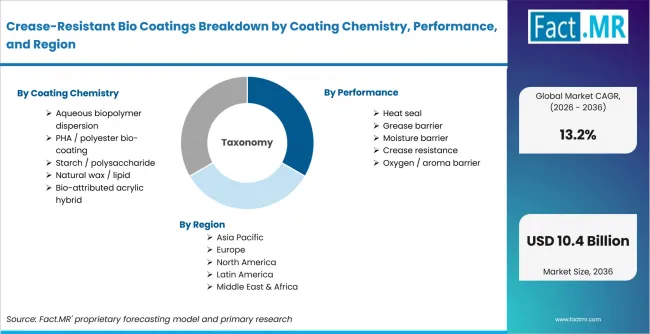
Crease Resistant Bio Coatings Breakdown By Coating Chemistry, Performance, And Region | Source: Fact.MR
| Attribute | Details |
|---|---|
| Quantitative Units | USD billion |
| Market Definition | Bio-based or bio-attributed coating systems applied to fiber packaging to provide functional barrier or sealing performance while retaining integrity at folds and crease lines. |
| Coating Chemistry | Aqueous biopolymer dispersion; PHA / polyester bio-coating; Starch / polysaccharide; Natural wax / lipid; Bio-attributed acrylic hybrid |
| Performance | Heat seal; Grease barrier; Moisture barrier; Crease resistance; Oxygen / aroma barrier |
| Substrate | Paper; Paperboard; Molded fiber; Cellulose film; Specialty fiber substrate |
| Application | Foodservice; Flexible food packs; Cartons; Takeaway packaging; Consumer goods |
| Regions Covered | North America; Latin America; Western Europe; Eastern Europe; East Asia; South Asia & Pacific; Middle East & Africa |
| Countries Covered | United States; China; Germany; Japan; France |
| Key Companies Profiled | Solenis; BASF; Michelman; Archroma; Xampla |
| Forecast Period | 2026 to 2036 |
| Approach | Hybrid top-down and bottom-up approach using coated-fiber demand, application mix, chemistry fit, country packaging activity, regulatory requirements, and provider portfolio review. |
How is the market segmented?
-
By Coating Chemistry
- Aqueous biopolymer dispersion
- PHA / polyester bio-coating
- Starch / polysaccharide
- Natural wax / lipid
- Bio-attributed acrylic hybrid
-
By Performance
- Heat seal
- Grease barrier
- Moisture barrier
- Crease resistance
- Oxygen / aroma barrier
-
By Substrate
- Paper
- Paperboard
- Molded fiber
- Cellulose film
- Specialty fiber substrate
-
By Application
- Foodservice
- Flexible food packs
- Cartons
- Takeaway packaging
- Consumer goods
-
By Region
- North America
- Latin America
- Western Europe
- Eastern Europe
- East Asia
- South Asia & Pacific
- Middle East & Africa