- Market Value (2025): USD 40.1 Mn
- Estimated Value (2026): USD 42.4 Mn
- Forecast Value (2036): USD 74.8 Mn
- CAGR (2026-2036): 5.8%
What is the 3,4-Dichlorobenzyl Chloride Market forecast to be worth by 2036?
USD 42.4 million in 2026 to USD 74.8 million by 2036 at a 5.8% CAGR.
- Fact.MR estimates that the 3,4-dichlorobenzyl chloride market was valued at USD 40.1 million in 2025.
- Demand is projected to increase from USD 42.4 million in 2026 to USD 74.8 million by 2036.
- The market is projected to expand at a 5.8% CAGR from 2026 to 2036, reflecting demand for specialty chlorinated intermediates across chemical synthesis and pharmaceutical-related applications.
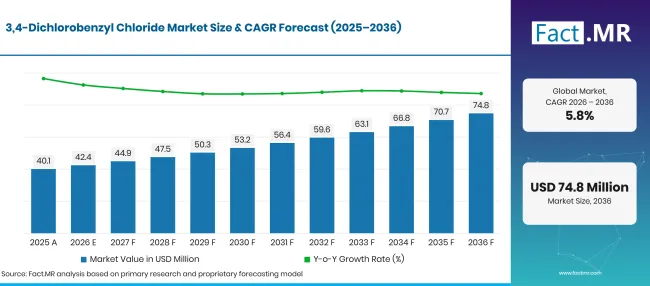
34 Dichlorobenzyl Chloride Market Forecast Global | Source: Fact.MR
| Year | Basis | Market Value (USD million) |
|---|---|---|
| 2025 | Actual | 40.1 |
| 2026 | Estimate | 42.4 |
| 2036 | Forecast | 74.8 |
| CAGR 2026 to 2036 | Forecast period | 5.8% |
Source: Fact.MR analysis. Updated Nov 3, 2026
What are the defining numbers behind 3,4-Dichlorobenzyl Chloride Market growth?
USD 32.4 million absolute opportunity between 2026 and 2036.
- Demand Drivers in the Market
- Pharmaceutical and specialty chemical synthesis requires intermediates with defined chemical identity and purity. 3,4-dichlorobenzyl chloride has been documented in the synthesis of a key sertraline intermediate, creating a specific downstream use case for the compound [1].
- Chemical manufacturers and research laboratories require reliable access to specialty reagents for multi-step organic synthesis. Thermo Fisher lists the compound at 98+% purity in several pack sizes, while Apollo Scientific provides a product-specific certificate of analysis [2].
- Buyers sourcing chlorinated aromatic intermediates must account for handling and transport requirements. Tokyo Chemical Industry classifies 3,4-dichlorobenzyl chloride (CAS 102-47-6) under H314, indicating severe skin burns and eye damage, and identifies it as UN3265, Class 8 for transport. Appropriate packaging, documentation and handling measures are therefore relevant [4].
- Key Segments Analyzed
- By Purity, Above 99% is projected to account for 58.7% of the 2026 market, reflecting demand for higher-assay material in specification-sensitive synthesis.
- By Application, Pharmaceuticals is projected to hold 38.5% of the market in 2026, supported by the compound's documented role in pharmaceutical intermediate synthesis.
- By End-User, Chemical Industry is estimated to account for 42.1% of the market in 2026, driven by its role in supplying and processing specialty chemical intermediates.
- Analyst Opinion at Fact.MR
- Shambhu Nath Jha, Principal Consultant at Fact.MR, states, “Demand for 3,4-dichlorobenzyl chloride will depend on the requirements of downstream synthesis routes. Suppliers that maintain reliable purity specifications and batch documentation can strengthen their position with pharmaceutical and specialty chemical buyers.”
- Strategic Implications
- Manufacturers should maintain consistent assay levels and provide batch-specific certificates of analysis.
- Suppliers need to make safety data sheets and transport documentation readily available to buyers.
- Pharmaceutical and chemical customers must qualify suppliers through identity, purity and impurity-profile checks.
- Distributors can distinguish research-grade pack sizes from bulk industrial supply and communicate the applicable specifications clearly.
Germany is forecast to record a 6.7% CAGR through 2036. Brazil is projected to post 6.1%, followed by the USA at 5.5%. The UK is estimated to advance at 4.9%, while Japan is forecast to register 4.4%.
How does the 3,4-Dichlorobenzyl Chloride Market break down by segment?
According to Fact.MR, Above 99% leads Purity at 58.7%; Pharmaceuticals leads Application at 38.5%; and Chemical Industry leads End-User at 42.1%.
Which Purity category dominates?
Above 99% is projected to hold 58.7% of the market in 2026.
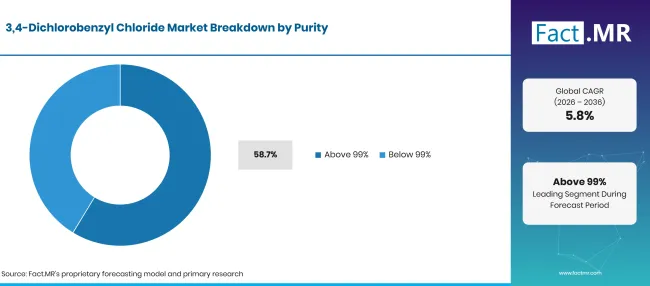
34 Dichlorobenzyl Chloride Market Breakdown Purity | Source: Fact.MR
| Purity | Share (2026) |
|---|---|
| Above 99% (Leading segment) | 58.7% |
| Below 99% | 41.3%* |
| Total | 100.0% |
Source: Fact.MR analysis. Updated Nov 3, 2026
Above 99% purity material is relevant where downstream synthesis requires tighter control over the starting material's assay and impurity profile. Buyers may specify additional tests according to their reaction route and quality requirements. Below 99% grades can serve applications with different technical specifications, subject to customer qualification and process suitability.
What leads the Application segment?
Pharmaceuticals is projected to represent 38.5% of the market in 2026.
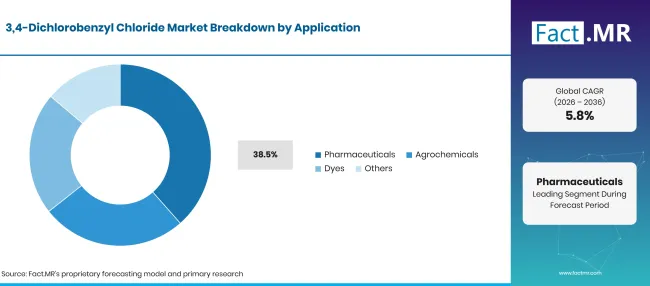
34 Dichlorobenzyl Chloride Market Breakdown Application | Source: Fact.MR
| Application | Share (2026) |
|---|---|
| Pharmaceuticals (Leading segment) | 38.5% |
| Other segments combined | 61.5%* |
| Total | 100.0% |
Source: Fact.MR analysis. Updated Nov 3, 2026
Pharmaceutical applications include the use of the compound as a starting material or intermediate in organic synthesis. Published chemical information documents its use in the preparation of a sertraline intermediate. Agrochemical and dye-related applications form other potential areas of demand under the supplied segmentation.
Which End-User accounts for the largest share?
Chemical Industry is expected to account for 42.1% of the market in 2026.
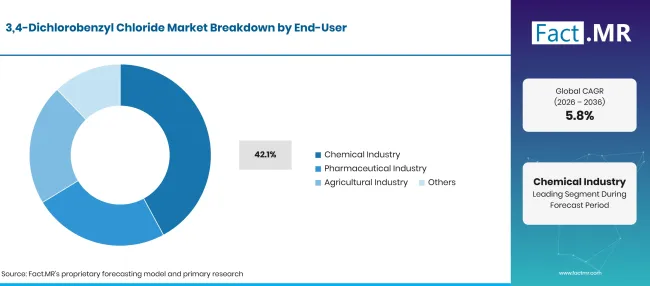
34 Dichlorobenzyl Chloride Market Breakdown End User | Source: Fact.MR
| End-User | Share (2026) |
|---|---|
| Chemical Industry (Leading segment) | 42.1% |
| Other segments combined | 57.9%* |
| Total | 100.0% |
Source: Fact.MR analysis. Updated Nov 3, 2026
Chemical industry buyers use specialty intermediates in synthesis, formulation and further chemical processing. Their purchasing decisions depend on assay, impurity limits, batch reproducibility and supply continuity. Pharmaceutical and agricultural industry buyers may apply additional quality and documentation requirements based on their downstream processes.
What is accelerating 3,4-Dichlorobenzyl Chloride Market adoption, and what is holding it back?
Specialty synthesis requirements and demand for documented high-purity intermediates support adoption, while hazardous handling and supplier qualification requirements can constrain market expansion.
Drivers Impact Analysis
| DRIVER | (~) % IMPACT ON CAGR | GEOGRAPHIC RELEVANCE | IMPACT TIMELINE |
|---|---|---|---|
| Demand for pharmaceutical synthesis intermediates | +0.9% | Global | Medium term (2–4 years) |
| Higher-purity starting material requirements | +0.8% | Europe, Asia | Medium term (2–4 years) |
| Specialty organic chemical synthesis | +0.7% | Global | Long term (≥ 4 years) |
| Batch documentation and quality traceability | +0.5% | Global | Short term (≤ 2 years) |
| Expansion of specialty chemical distribution | +0.4% | Asia, Americas | Medium term (2–4 years) |
Source: Fact.MR analysis. Updated Nov 3, 2026
Opportunity Impact Analysis
| OPPORTUNITY | (~) % IMPACT ON CAGR | GEOGRAPHIC RELEVANCE | IMPACT TIMELINE |
|---|---|---|---|
| Reliable supply of above 99% purity grades | +0.8% | Global | Medium term (2–4 years) |
| Custom synthesis and contract manufacturing | +0.7% | Asia, Europe | Long term (≥ 4 years) |
| Improved impurity profiling and batch testing | +0.6% | Global | Short term (≤ 2 years) |
| Bulk supply with consistent specifications | +0.5% | Global | Medium term (2–4 years) |
Source: Fact.MR analysis. Updated Nov 3, 2026
Restraints Impact Analysis
| RESTRAINT | (~) % IMPACT ON CAGR | GEOGRAPHIC RELEVANCE | IMPACT TIMELINE |
|---|---|---|---|
| Corrosive and hazardous handling requirements | -0.8% | Global | Short term (≤ 2 years) |
| Dependence on specialized chemical suppliers | -0.6% | Global | Medium term (2–4 years) |
| Batch purity and impurity variation | -0.5% | Global | Short term (≤ 2 years) |
| Regulatory and transport compliance costs | -0.4% | Global | Medium term (2–4 years) |
Source: Fact.MR analysis. Updated Nov 3, 2026
Which countries are scaling the 3,4-Dichlorobenzyl Chloride Market through 2036?
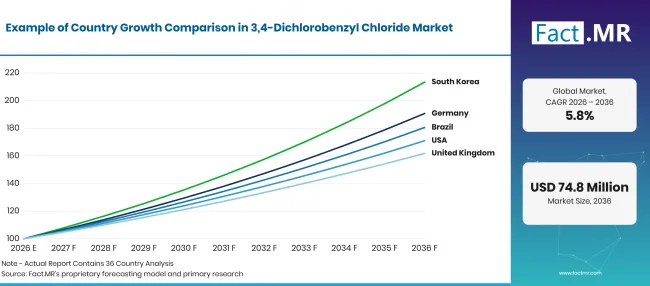
34 Dichlorobenzyl Chloride Market Growth Index | Source: Fact.MR
| Country | CAGR (2026–2036) |
|---|---|
| Germany | 6.7% |
| Brazil | 6.1% |
| USA | 5.5% |
| UK | 4.9% |
| Japan | 4.4% |
Source: Fact.MR analysis. Updated Nov 3, 2026
What supports Germany adoption?
6.7% CAGR, supported by demand for specialty chemical intermediates and specification-led industrial purchasing.
Germany's chemical industry uses a broad range of intermediates in the production of specialty chemicals and formulated products. Buyers of 3,4-dichlorobenzyl chloride require reliable purity data and traceable batch documentation. Suppliers serving this market need to meet applicable chemical handling and transport requirements.
How is Brazil developing 3,4-dichlorobenzyl chloride adoption?
6.1% CAGR, shaped by demand across chemical processing and downstream industrial supply chains.
Brazil's chemical industry serves pharmaceutical, agricultural and industrial customers. Demand for a specific intermediate depends on the production routes used by downstream manufacturers. Import availability, distributor coverage and the ability to provide consistent product specifications can influence purchasing.
What supports United States adoption?
5.5% CAGR, driven by specialty chemical sourcing and pharmaceutical intermediate requirements.
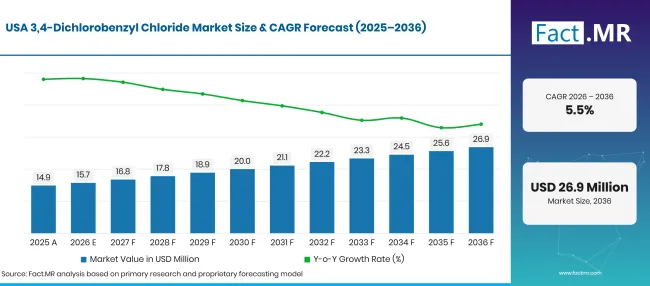
34 Dichlorobenzyl Chloride Market Forecast Usa | Source: Fact.MR
The US market includes research and industrial chemical buyers that source chlorinated aromatic intermediates for synthesis. Tokyo Chemical Industry identifies 3,4-dichlorobenzyl chloride as CAS 102-47-6 and specifies a minimum 98.0% gas-chromatography purity. These are product-identification and specification details, rather than evidence of US market size [5].
How is the United Kingdom building adoption?
4.9% CAGR, shaped by demand from specialty chemical suppliers and pharmaceutical research supply chains.
UK demand is supported by the presence of specialty chemical distributors and research reagent suppliers. Apollo Scientific currently provides a product-specific certificate of analysis for 3,4-dichlorobenzyl chloride, demonstrating active commercial listing and batch documentation.
What supports Japan adoption?
4.4% CAGR, supported by demand for high-specification chemical intermediates and research reagents.
Japan's chemical and pharmaceutical industries require intermediates with reliable identity and purity information. Thermo Fisher lists 3,4-dichlorobenzyl chloride in multiple pack sizes with a stated assay of at least 98%. Demand depends on the requirements of downstream synthesis and the availability of qualified suppliers.
Who leads the 3,4-Dichlorobenzyl Chloride Market?
The supplier landscape includes specialty chemical manufacturers, distributors and research reagent providers. Thermo Fisher Scientific and Tokyo Chemical Industry have product listings for 3,4-dichlorobenzyl chloride (CAS 102-47-6). Other companies named in the report require separate confirmation of their current exact-compound listings and manufacturing roles before being described as confirmed active producers [2] [5].
A reported listing for Wuxi High Mountain Hi-tech Development Co. Ltd. describes 3,4-dichlorobenzyl chloride (CAS 102-47-6) at 98% purity with a stated minimum order of 500 kg. This supplier-specific commercial claim requires direct confirmation on the company's official product page before use as verified manufacturing capacity.
Dayang Chem (Hangzhou) Co. Ltd. and Hangzhou Dingyan Chem Co. Ltd. are named as potential suppliers. Their current exact-compound listings and whether they manufacture or distribute CAS 102-47-6 require confirmation directly from company-controlled sources.
Thermo Fisher Scientific identifies 3,4-dichlorobenzyl chloride in its research-chemical catalogue at 98+% purity. Tokyo Chemical Industry also lists CAS 102-47-6 at minimum 98.0% purity [2] [5]. Statements regarding current stock, sample certificates and other companies' supply status should be checked against original product records before publication.
Which companies are the key providers?
Key companies include:
- Wuxi High Mountain Hi-tech Development Co. Ltd.
- Dayang Chem (Hangzhou) Co. Ltd.
- Hangzhou Dingyan Chem Co. Ltd.
- Danyang Wanlong Chemical Co. Ltd.
- Thermo Fisher Scientific
- Apollo Scientific
- Simson Pharma Limited
Bibliography
- [1] Sigma-Aldrich. (n.d.). 3,4-Dichlorobenzyl chloride, 97% (Product No. 259179).
- [2] Thermo Fisher Scientific. (n.d.). 3,4-Dichlorobenzyl chloride, 98+% (Catalog No. 279051000).
- [3] Apollo Scientific. (n.d.). Certificate of analysis: 3,4-Dichlorobenzyl chloride (Product No. OR28626) [Certificate of analysis].
- [4] Tokyo Chemical Industry. (2025, November 25). 3,4-Dichlorobenzyl chloride: Safety data sheet (T0401; Version 1.1). langSelector=en&productCode=T0401&selectedCountry=KR
- [5] Tokyo Chemical Industry. (n.d.). 3,4-Dichlorobenzyl chloride (Product No. T0401).
- [6] Tokyo Chemical Industry. (2025, November 25). 3,4-Dichlorobenzyl chloride: Safety data sheet (Product No. T0401, Version 1.1).
- [7] Simson Pharma Limited. (n.d.). 3,4-Dichlorobenzyl chloride (Catalog No. RC00110).
This Report Answers
- The report describes the commercial market for 3,4-dichlorobenzyl chloride across the specified purity categories.
- Application analysis examines pharmaceutical, agrochemical, dye and other synthesis-related uses.
- End-user analysis compares demand from chemical, pharmaceutical and agricultural industries.
- Country analysis discusses Germany, Brazil, USA, UK and Japan alongside their respective market growth estimates.
- The competitive overview profiles companies with verifiable product listings or supply evidence for CAS 102-47-6.
What does the 3,4-Dichlorobenzyl Chloride Market cover?
The market covers 3,4-dichlorobenzyl chloride, a chlorinated aromatic chemical intermediate identified by CAS number 102-47-6. It includes commercial supply across different purity grades for use in organic synthesis and specialty chemical applications. The market tracks demand according to purity, application and end-user requirements. Product specifications such as assay, impurity profile, batch consistency and packaging influence purchasing decisions.
What is included in the scope?
Included products comprise 3,4-dichlorobenzyl chloride supplied in above 99% and below 99% purity grades. The scope covers commercial sales for pharmaceutical-related synthesis, agrochemical applications, dyes and other chemical uses. It includes research-scale packs and bulk supply where the product is commercially offered.
What is excluded from the scope?
The analysis excludes other dichlorobenzyl chloride isomers and related compounds with different CAS numbers. Finished pharmaceutical products, agrochemical formulations and dyes are excluded from the direct product revenue boundary. General-purpose chlorinated solvents and unrelated aromatic intermediates are also outside the defined market. Custom synthesis services are excluded unless revenue is attributable to the sale of the specified compound.
How Was the Analysis Built?
The analysis draws on 120+ sources, 35+ company portfolios, 25+ countries, and more than 20 industry interviews.
- Primary Research: Primary research includes discussions with chemical manufacturers, specialty intermediate suppliers, distributors, pharmaceutical buyers, agrochemical companies and subject-matter experts. These conversations examine purchasing priorities, purity specifications, supply availability, handling requirements and competitive positioning.
- Desk Research: Desk research covers product catalogues, supplier documentation, safety data sheets, certificates of analysis, regulatory publications, chemical databases, company disclosures and technical literature. Every source used in the analysis is documented in the bibliography.
- Market Sizing and Forecasting: Market estimates combine historical performance, demand indicators, pricing and volume trends, segment shares, company participation, country-level growth, application patterns and barriers to market expansion.
- Data Validation and Update Cycle: Findings are validated by comparing primary interviews with product listings, batch documentation, supplier activity and chemical application references. Regular updates review new product listings, supply capabilities, purity specifications and changes in commercial availability.
Segmentation
What is the report’s scope and coverage?
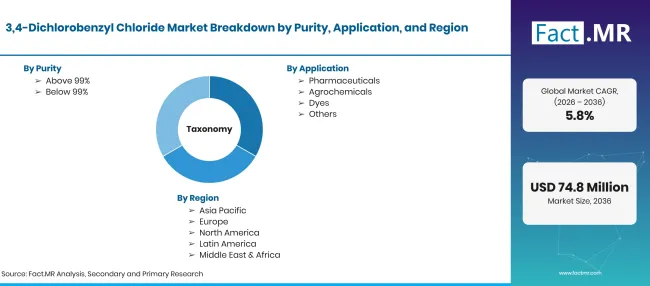
34 Dichlorobenzyl Chloride Market Taxonomy | Source: Fact.MR
| Attribute | Details |
|---|---|
| Quantitative Units | USD 42.4 million in 2026 to USD 74.8 million by 2036, at a stated CAGR of 5.8%. |
| Market Definition | The 3,4-dichlorobenzyl chloride market comprises the commercial supply of the chlorinated aromatic compound identified by CAS 102-47-6. It is primarily used as an intermediate in organic synthesis and specialty chemical manufacturing. Market scope includes different purity grades supplied to pharmaceutical manufacturers and chemical producers, as well as research laboratories. |
| Purity | Above 99%; Below 99% |
| Application | Pharmaceuticals; Agrochemicals; Dyes; Others |
| End-User | Chemical Industry; Pharmaceutical Industry; Agricultural Industry; Others |
| Regions Covered | North America; Latin America; Western Europe; Eastern Europe; East Asia; South Asia & Pacific; Middle East & Africa |
| Countries Covered | Germany; Brazil; USA; UK; Japan |
| Companies Profiled | Wuxi High Mountain Hi-tech Development Co. Ltd.; Dayang Chem (Hangzhou) Co. Ltd.; Hangzhou Dingyan Chem Co. Ltd.; Danyang Wanlong Chemical Co. Ltd.; Thermo Fisher Scientific; Apollo Scientific; Simson Pharma Limited |
| Forecast Period | 2026 to 2036 |
| Approach | Market segmentation and scenario-based analysis supported by product listings, supplier evidence and chemical application references |
Source: Fact.MR analysis. Updated Nov 3, 2026
How is the market segmented?
-
By Purity
- Above 99%
- Below 99%
-
By Application
- Pharmaceuticals
- Agrochemicals
- Dyes
- Others
-
By End-User
- Chemical Industry
- Pharmaceutical Industry
- Agricultural Industry
- Others
-
By Region
- North America
- Latin America
- Western Europe
- Eastern Europe
- East Asia
- South Asia & Pacific
- Middle East & Africa
Frequently Asked Questions
How big is the 3,4-Dichlorobenzyl Chloride Market in 2026?
What is the CAGR from 2026 to 2036?
Which purity category has the largest share?
Which application leads?
Which end-user accounts for the largest share?
Which companies are covered?
Who worked on this report


Preview the report firsthand - request a free sample
Free SampleGet the brochure for pricing and purchase details
Download PDF