- Market Value (2025): USD 52.8 Bn
- Estimated Value (2026): USD 64.7 Bn
- Forecast Value (2036): USD 497.0 Bn
- CAGR (2026-2036): 22.7%
What is the Custom Software Development Market forecast to be worth by 2036?
USD 64.7 billion in 2026 to USD 497.0 billion by 2036, at 22.6% CAGR.
- The custom software development market crossed a valuation of USD 52.8 billion in 2025 supported by modernization programs and product engineering demand.
- Demand is projected to increase from USD 64.7 billion in 2026 to USD 497.0 billion by 2036.
- The market is forecast to record a 22.6% CAGR from 2026 to 2036 as large enterprises and IT teams modernize legacy applications and build cloud products.
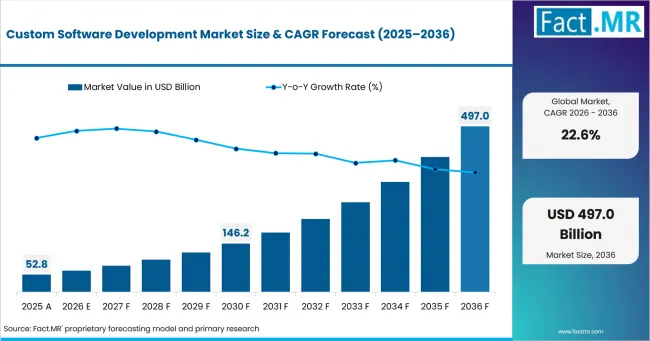
Custom Software Development Market Market Value Analysis | Source: Fact.MR
What are the defining numbers behind Custom Software Development Market growth?
USD 432.2 billion absolute opportunity by 2036, led by Enterprise Software and Cloud deployment alongside Large Enterprises.
- Demand Drivers in the Market
- CIOs need modernization paths that preserve business logic because large legacy estates often lack current documentation and specialist ownership across internal teams.
- Engineering leaders need reusable platform layers due to repeated release-pipeline and infrastructure work across separate product teams during cloud migration.
- Operations teams need integration controls shaped by distributed workflows and data movement across ERP systems and customer-facing applications used by separate business units.
- Procurement heads need measurable delivery governance owing to multi-vendor programs that coordinate internal engineering groups with external product development partners.
- Key Segments Analyzed
- By Type: Enterprise Software is expected to hold 60.0% share in 2026 supported by enterprise-wide process integration and modernization budgets.
- By Deployment: Cloud is projected to account for 57.0% share in 2026 owing to scalable release environments and faster access to managed platform services.
- By Enterprise Size: Large Enterprises are anticipated to capture 60.0% share in 2026 shaped by complex application estates and formal multi-year engineering programs.
- By Industry Vertical: IT & Telecom is estimated to represent 21.0% share in 2026 attributable to frequent platform changes and software-intensive service delivery.
- By Service Type: Custom Web Application Development is forecast to account for 53.0% share in 2026 driven by browser-based workflows and customer portal renewal.
- Analyst Opinion at Fact.MR
- Shambhu Nath Jha is Senior Analyst at Fact.MR and states: “Custom software development is drawing attention because enterprises are buying ongoing engineering capacity instead of isolated coding effort. Adoption is expected to favor providers that join domain context with modernization discipline and secure delivery controls. Providers seeking durable account access should combine architecture skills and product ownership with testing inside the client’s production environment.”
- Strategic Implications
- CIOs should map critical business rules before approving legacy conversion so new applications preserve process behavior that existing teams depend upon.
- Engineering directors should define reusable platform components before separate product teams commission overlapping cloud services and duplicate integration work.
- Procurement leaders should compare delivery governance and knowledge-transfer methods before using blended internal and external software engineering teams across long programs.
- Security heads should place architecture review inside the development lifecycle so compliance requirements are tested before release deadlines restrict remediation choices.
Tata Consultancy Services (TCS) released an updated GenAI and Agentic AI-enabled TCS MasterCraft in May 2025 for legacy application modernization and business-logic extraction. The release added automated conversion and knowledge-mining functions that shorten manual discovery work around older code estates. The move reflects demand for custom modernization services that preserve embedded process logic while moving applications toward current architectures.
India is anticipated to achieve a 24.5% CAGR during the forecast period, bolstered by its depth in export engineering and the growth of domestic application renewal. Japan is expected to see a 20.4% CAGR over the assessment period, driven by legacy renewal needs and investments in industrial software. China is projected to grow at a 19.4% CAGR by 2036, driven by the expansion of its software sector and enterprise adoption of domestic cloud platforms. Germany is estimated to experience an 18.8% CAGR throughout the forecast period, influenced by industrial digitization and wider cloud adoption among enterprise clients. The United Kingdom is forecasted to register a 16.5% CAGR over the next decade, propelled by digitized operations and data-intensive service workflows in regulated sectors.
How does the Custom Software Development Market break down by segment?
Enterprise Software to hold around 60.0%; Large Enterprises to record 60.0%.
Which type dominates?
Enterprise Software garners 60.0% share in 2026.
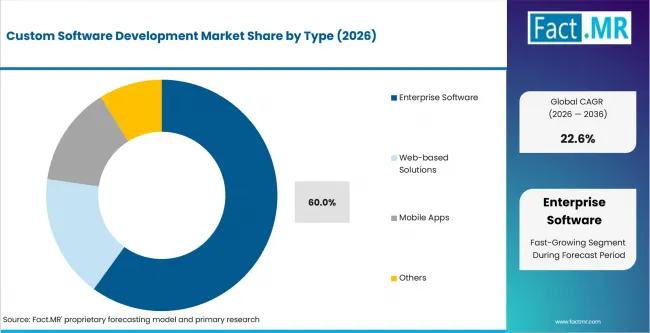
Custom Software Development Market Analysis By Type | Source: Fact.MR
Enterprise Software is expected to hold 60.0% share in 2026 supported by integration work across finance systems and operations workflows. Web-based Solutions remain widely used for customer portals and internal tools where browser delivery simplifies access across distributed teams. Mobile Apps serve field staff and customer programs that require device features or offline workflows. In June 2026, Eurostat reported that 46.45% of EU enterprises used ERP software applications during 2025. The installed software base keeps extension work and system integration central to custom enterprise development across many account portfolios.
What leads the Deployment segment?
Cloud leads with 57.0% share in 2026.
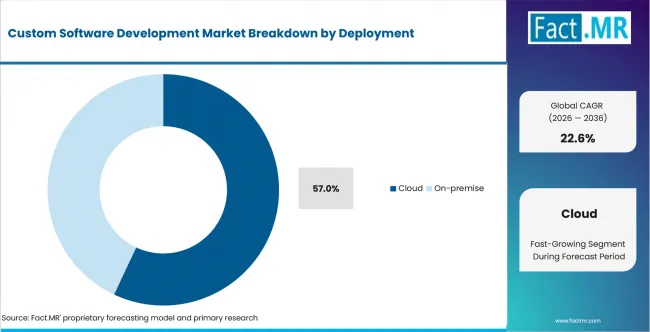
Custom Software Development Market Analysis By Deployment | Source: Fact.MR
Cloud is projected to account for 57.0% share in 2026 owing to elastic environments that support continuous delivery and distributed engineering teams. On-premise delivery remains relevant for regulated workloads and legacy estates where data location or operating controls restrict migration choices. Hybrid release patterns often keep sensitive systems local while shifting development pipelines toward cloud tooling. In June 2026, Eurostat reported that 52.7% of EU enterprises used paid cloud computing services during 2025. The installed base expands practical routes for custom application deployment and integration across enterprise accounts in several sectors.
How does Enterprise Size shape demand?
Large Enterprises hold 60.0% share in 2026.
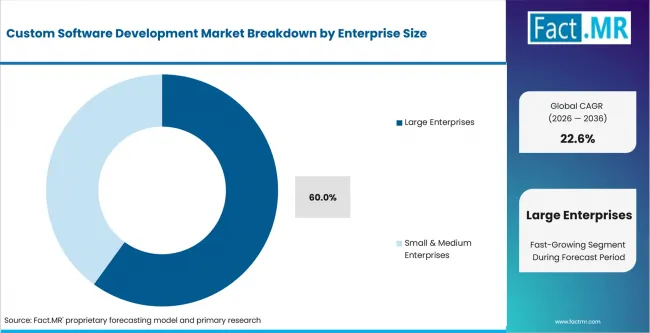
Custom Software Development Market Analysis By Enterprise Size | Source: Fact.MR
Large Enterprises are anticipated to capture 60.0% share in 2026 shaped by portfolio complexity and formal governance across multi-year application programs. Small & Medium Enterprises still commission focused systems for commerce operations and customer service where packaged tools leave workflow gaps. Larger accounts often require integration across identity systems and historical data while several engineering groups release changes together. In June 2026, Eurostat reported paid cloud use among 84.67% of large EU enterprises during 2025. Their technology breadth supports sustained custom development across modernization programs and new product work over several budget cycles.
What supports IT & Telecom within Industry Vertical?
IT & Telecom accounts for 21.0% share in 2026.
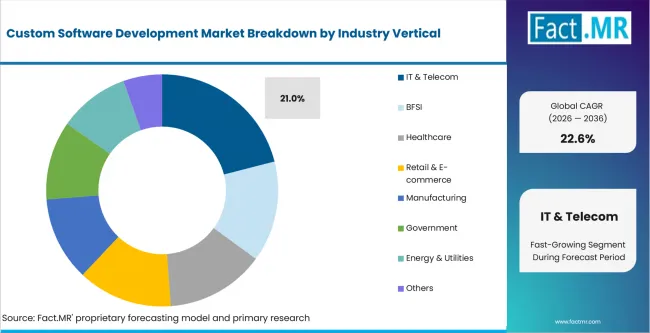
Custom Software Development Market Analysis By Industry Vertical | Source: Fact.MR
IT & Telecom is estimated to represent 21.0% share in 2026 attributable to frequent platform change and software-intensive service operations. BFSI remains a major account group where custom work supports process controls and customer journeys around complex core systems. Healthcare and manufacturing require domain-specific workflows that packaged products do not always fit without significant integration. In June 2026, Eurostat reported AI use among 62.5% of information and communication enterprises during 2025. High software intensity keeps engineering partners close to product roadmaps and platform renewal cycles throughout long delivery programs.
What leads the Service Type segment?
Custom Web Application Development holds 53.0% share in 2026.
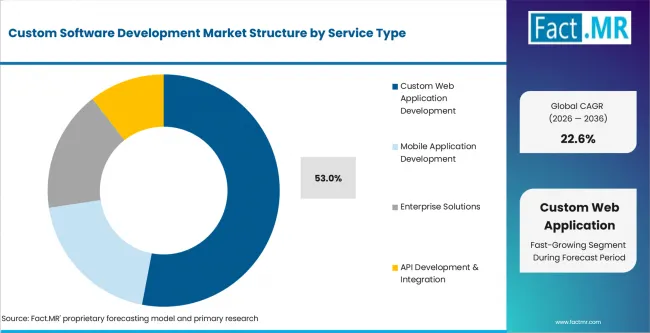
Custom Software Development Market Analysis By Service Type | Source: Fact.MR
Custom Web Application Development is forecast to account for 53.0% share in 2026 driven by browser-based workflows and portal modernization across enterprise accounts. Mobile Application Development serves field processes and customer interactions that depend on device access or location functions. Enterprise Solutions address cross-functional process needs while API Development & Integration connects newer applications with established systems. In June 2026, Eurostat reported that 26.08% of paid-cloud users used hosted development and deployment environments during 2025. Hosted development environments give web engineering teams repeatable release paths across recurring client programs and distributed delivery groups.
What is accelerating Custom Software Development Market adoption, and what is holding it back?
Legacy modernization and cloud product delivery drive it; security skills gaps and integration debt restrain it.
Drivers Impact Analysis
| DRIVER | (~) % IMPACT ON CAGR | GEOGRAPHIC RELEVANCE | IMPACT TIMELINE |
|---|---|---|---|
| Legacy modernization and technical-debt reduction | +4.5% | North America, Europe and Japan | Medium term (2-4 years) |
| Cloud-native product engineering | +3.8% | Global | Short to medium term |
| AI-assisted software engineering | +3.1% | North America, Europe and India | Short term (≤2 years) |
| API integration across enterprise systems | +2.4% | Global | Medium term (2-4 years) |
| Industry-specific workflow digitization | +1.8% | Asia Pacific and Europe | Long term (4 years) |
Source: Fact.MR analysis. Updated Jul 7, 2026
- Legacy modernization and technical debt: Enterprise accounts carry business rules inside older code that newer product teams still need to preserve during platform renewal. In May 2025, Capgemini launched an AI-assisted mainframe modernization offering that automates code analysis and business-rule extraction before refactoring. Adoption is expected to expand where engineering teams need traceable conversion and controlled testing before replacing critical systems.
- Cloud-native product engineering: Product teams need release practices that support frequent updates without rebuilding infrastructure for every application. In January 2026, the Cloud Native Computing Foundation reported production Kubernetes use among 82% of container users in its annual survey. Demand is projected to deepen where custom engineering partners combine application architecture with platform delivery and practical monitoring skills.
- AI-assisted software engineering: Engineering teams are using coding assistants and automated review tools to shorten routine development work while keeping human approval around architecture decisions. In January 2026, the OECD reported AI use among 20.2% of firms during 2025 across reporting member economies. Adoption is anticipated to broaden as delivery teams connect code generation with testing and secure review inside established development workflows.
- API integration across enterprise systems: Modern applications often need controlled access to ERP records and customer data that remain inside established systems. In June 2026, Eurostat reported that 53.47% of EU enterprises used at least one ERP or CRM or BI application during 2025. Integration work is estimated to remain a recurring custom development requirement as application portfolios become more connected.
- Industry-specific workflow digitization: Sector workflows create requirements around approval paths and data handling that generic software does not always cover. In June 2026, the UK Business Data Survey reported AI use among 41% of businesses handling digitized data during 2025 to 2026. Custom development is forecast to expand where engineering teams translate sector rules into software controls and usable operating screens.
Opportunity Impact Analysis
| OPPORTUNITY | (~) % IMPACT ON CAGR | GEOGRAPHIC RELEVANCE | IMPACT TIMELINE |
|---|---|---|---|
| Agent-assisted legacy discovery | +3.0% | Global enterprise accounts | Short term (≤2 years) |
| Secure cloud application engineering | +2.4% | Europe, United Kingdom and Japan | Medium term (2-4 years) |
| Export-oriented engineering delivery | +2.0% | India and Asia Pacific | Medium term (2-4 years) |
| Domestic cloud integration programs | +1.6% | China and East Asia | Medium term (2-4 years) |
Source: Fact.MR analysis. Updated Jul 7, 2026
- Agent-assisted legacy discovery: Older applications often hide process rules inside code and database logic that documentation no longer explains fully. In June 2026, Eurostat reported AI use among 55.03% of large EU enterprises during 2025. Opportunity is expected to widen for providers that pair automated code analysis with human validation and careful migration planning around critical business processes.
- Secure cloud application engineering: Regulated accounts need application teams that understand identity controls and secure deployment patterns before production release. In November 2024, ENISA reported that 89% of surveyed organizations expected to need additional cybersecurity staff for NIS2 compliance. Opportunity is projected to expand for engineering providers that place security expertise inside cloud application teams from the design stage onward.
- Export-oriented engineering delivery: India offers a deep services base for distributed software programs that require round-the-clock product support and specialized engineering skills. In January 2026, India’s Press Information Bureau reported 13.5% average software-services export growth during FY23 to FY25. Cross-border custom development is anticipated to benefit where providers combine global delivery scale with industry-specific account teams.
- Domestic cloud integration programs: China’s software economy creates integration work around domestic cloud environments and large enterprise application estates. In January 2026, China’s State Council reported significant revenue in cloud computing and big data service revenue during 2025. Custom integration demand is estimated to expand where local engineering teams connect industry workflows with cloud platforms and existing data systems.
Restraints Impact Analysis
| RESTRAINT | (~) % IMPACT ON CAGR | GEOGRAPHIC RELEVANCE | IMPACT TIMELINE |
|---|---|---|---|
| Security and compliance engineering capacity | -2.8% | Europe and regulated sectors | Short to medium term |
| Legacy code and data complexity | -2.2% | North America, Europe and Japan | Medium term (2-4 years) |
| Unclear legal consequences for AI use | -1.8% | Europe and United Kingdom | Short term (≤2 years) |
| Data protection and privacy concerns | -1.5% | Global regulated accounts | Medium term (2-4 years) |
Source: Fact.MR analysis. Updated Jul 7, 2026
- Security and compliance engineering capacity: Custom software programs need security architecture skills that are scarce across many enterprise technology functions. In November 2024, ENISA reported that 32% of surveyed organizations struggled to fill cybersecurity roles across Europe. Delivery is expected to slow where application teams cannot staff secure design and review work early enough for release schedules.
- Legacy code and data complexity: Conversion projects lose time when old systems hide business rules inside large code estates and inconsistent data models. In June 2025, Thoughtworks described a modernization case involving more than 15 million lines of legacy code that required automated reverse engineering. Modernization is projected to remain selective when discovery costs stay unclear before account teams map scope and system dependencies.
- Unclear legal consequences for AI use: Enterprise accounts pause automation choices when ownership and liability rules remain difficult to interpret across development workflows. In June 2026, Eurostat reported legal-consequence uncertainty among 52.52% of EU enterprises that considered AI but did not adopt it during 2025. Adoption is anticipated to progress more slowly where legal review cannot keep pace with engineering tool changes.
- Data protection and privacy concerns: Custom development teams often access operational records during testing and integration work across client environments. In June 2026, Eurostat reported privacy concerns among 48.83% of EU enterprises that considered AI but did not adopt it during 2025. Delivery is forecast to face longer approval cycles where data masking and access controls are added late in project design.
Which countries are scaling Custom Software Development Market fastest?
India 24.50%; Japan 20.40%; China 19.40%; Germany 18.80%; United Kingdom 16.50%.
Custom Software Development is segmented into North America, Europe, East Asia, South Asia and Pacific, and the Middle East and Africa.
| COUNTRY | CAGR |
|---|---|
| India | 24.5% |
| Japan | 20.4% |
| China | 19.4% |
| Germany | 18.8% |
| United Kingdom | 16.5% |
Source: Fact.MR analysis. Updated Jul 7, 2026
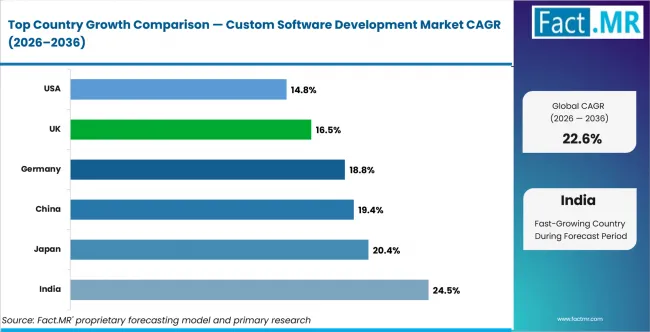
Custom Software Development Market Cagr Analysis By Country | Source: Fact.MR
What is powering India’s lead?
24.5% CAGR through 2036, driven by export engineering depth and expanding domestic application modernization programs.
India’s software services base gives development providers strong experience in distributed product engineering and multi-country application support across enterprise accounts. In January 2026, the Press Information Bureau reported that software services represented over 40% of India’s total services exports. The market is expected to record a 24.5% CAGR through 2036 as export delivery capabilities combine with rising domestic modernization requirements. Providers with reusable engineering practices and local account teams can address complex programs spanning application renewal and ongoing product development.
How is Japan scaling custom software development demand?
20.4% CAGR through 2036, supported by legacy system replacement and sustained industrial software investment cycles.
Japan’s long-lived enterprise systems are creating sustained demand for architecture renewal and carefully managed application replacement across complex operating environments. In June 2025, the Information-technology Promotion Agency reported that its 2024 software development trends survey received responses from about 800 companies. The market is projected to expand at a 20.4% CAGR through 2036 as enterprises renew legacy applications and industrial software estates. Providers that combine modernization expertise with disciplined open-source governance can gain stronger access to large transformation programs.
What supports China’s outlook?
19.4% CAGR by 2036, attributable to software sector expansion and deeper enterprise integration with domestic cloud platforms.
China’s expanding software economy is increasing demand for custom applications that connect established enterprise systems with domestic cloud environments. In January 2026, the State Council reported information technology services revenue of 10.64 trillion yuan during 2025. Demand is anticipated to advance at a 19.4% CAGR through 2036 as enterprises renew platforms and deepen integration across application portfolios. Local delivery teams can strengthen account positions by combining sector expertise with integration capabilities across existing data and software environments.
What underpins Germany’s growth?
18.8% CAGR through 2036, shaped by industrial digitization and broader cloud adoption across German enterprise accounts.
Germany’s industrial base creates substantial custom development demand where plant operations must connect securely with broader enterprise software environments. In June 2026, Eurostat reported that 60.66% of German enterprises used paid cloud computing services during 2025. The market is estimated to register an 18.8% CAGR through 2036 as industrial digitization accelerates application and portfolio modernization. Engineering providers can improve account access by connecting operational workflows with enterprise systems while meeting strict data and security expectations.
How is the United Kingdom developing custom software development demand?
16.5% CAGR through 2036, driven by digitized operations and data-intensive service workflows across regulated sectors.
United Kingdom enterprises generate sustained custom development work through data products and regulated customer journeys across finance and professional services. In June 2026, the UK Business Data Survey reported that 86% of businesses handled digitized data during 2025 to 2026. Demand is forecast to expand at a 16.5% CAGR through 2036 as application renewal supports deeper data use across business processes. Development providers with sector knowledge and strong integration skills can capture recurring work across regulated digital service environments.
Who leads the Custom Software Development Market?
Accenture and Capgemini lead broad custom development coverage, while TCS and Thoughtworks strengthen modernization and product engineering capabilities.
Accenture combines consulting and application engineering across large transformation programs where account teams need architecture decisions tied to business process change. Capgemini brings software engineering and cloud integration across complex enterprise programs that span several delivery locations. Cognizant supports application modernization and product engineering for clients that need domain context around regulated operations. Competition among these providers centers on delivery governance and architecture skills alongside the ability to retain client knowledge across long programs.
HCLTech and Infosys add broad modernization capacity across cloud engineering and application lifecycle work for global enterprise accounts. TCS adds large-scale application modernization and migration delivery while Thoughtworks emphasizes product engineering around evolving digital products. Competition through 2036 is expected to be shaped by domain knowledge and secure development controls alongside modernization automation. Providers that keep experienced engineers close to client teams are better placed to preserve delivery continuity during complex portfolio changes.
Which companies are the key providers?
Accenture and Capgemini are key providers. Cognizant and HCLTech are also profiled. Infosys, TCS and Thoughtworks complete the company set.
- Accenture
- Capgemini
- Cognizant
- HCLTech
- Infosys
- Tata Consultancy Services (TCS)
- Thoughtworks
Bibliography
- Capgemini. (2025, May 14). Capgemini leads paradigm shift in mainframe application modernization powered by gen AI and agentic AI. Capgemini.
- Cloud Native Computing Foundation. (2026, January 20). Kubernetes established as the de facto “operating system” for AI as production use hits 82% in 2025 CNCF Annual Cloud Native Survey. Cloud Native Computing Foundation.
- Department for Science, Innovation and Technology. (2026, June 18). UK Business Data Survey 2026. GOV.UK.
- European Commission, Eurostat. (2026, June 2). Cloud computing - statistics on the use by enterprises. Eurostat Statistics Explained.
- European Commission, Eurostat. (2026, June 2). Use of artificial intelligence in enterprises. Eurostat Statistics Explained.
- European Commission, Eurostat. (2026, June 2). E-business integration. Eurostat Statistics Explained.
- European Union Agency for Cybersecurity. (2024, November 22). Navigating cybersecurity investments in the time of NIS 2. ENISA.
- Information-technology Promotion Agency, Japan. (2025, June 18). Japan Open Source Hub. IPA.
- Organisation for Economic Co-operation and Development. (2026, January 28). AI use by individuals surges across the OECD as adoption by firms continues to expand. OECD.
- Press Information Bureau. (2026, January 29). From stability to new frontiers, India’s services exports growth more than doubled from 7.6% in the pre-pandemic period (FY16-FY20) to 14% during FY23-FY25. Government of India.
- State Council of the People’s Republic of China. (2026, January 31). China’s software industry revenues surge 13.2 pct in 2025. The State Council of the People’s Republic of China.
- Tata Consultancy Services. (2025, May 6). TCS launches GenAI and Agentic AI-powered TCS MasterCraft™ to help enterprises swiftly modernize legacy systems. TCS.
- Thoughtworks. (2025, June 3). Modernization, sustained: AI-driven operations in action. Thoughtworks.
This Report Addresses
- The report provides strategic intelligence on Custom Software Development across Type and Deployment choices that shape enterprise application programs.
- Segment analysis identifies Enterprise Software and Cloud as the leading segments within the 2026 market structure.
- Regional outlook evaluates India and Japan alongside China while Germany and the United Kingdom complete the country growth comparison.
- Competitive analysis profiles Accenture and Capgemini together with Cognizant and HCLTech while Infosys, TCS and Thoughtworks complete the provider set.
- Type assessment covers Enterprise Software and Web-based Solutions alongside Mobile Apps and Others across custom delivery needs.
- Service Type assessment covers Custom Web Application Development and Mobile Application Development alongside Enterprise Solutions and API Development & Integration.
- The forecast uses official statistics and provider checks alongside company portfolio review to interpret market values and segment positions.
What does the Custom Software Development Market cover?
Enterprise Software, Web-based Solutions, Mobile Apps, and custom web applications used for tailored workflows and digital products.
The Custom Software Development Market covers custom engineering services designed around an enterprise account’s process needs and existing technology environment. Coverage starts with discovery and architecture work before development teams move into coding and structured testing for the agreed application scope. Integration and legacy renewal also remain included when the enterprise account purchases defined software delivery outcomes from the development provider.
The market differs from packaged software because commercial value comes from account-specific design and engineering effort around defined workflows. Standard software licenses and general staff augmentation remain outside the boundary unless they are embedded inside a contracted custom development program.
What is included in the scope?
Custom software systems used across enterprise workflows and customer-facing digital products.
The scope includes Enterprise Software and Web-based Solutions together with Mobile Apps and other custom software types. Coverage spans Cloud and On-premise deployment across Large Enterprises and Small & Medium Enterprises using account-specific development services. Industry Vertical coverage includes BFSI and IT & Telecom alongside Healthcare and Retail & E-commerce accounts requiring tailored software delivery. Manufacturing and Government are included together with Energy & Utilities and other enterprise sectors that commission tailored application programs. Service Type coverage includes Custom Web Application Development and Mobile Application Development alongside Enterprise Solutions and API Development & Integration. Adjacent application transformation programs provide context for legacy modernization boundaries and rebuild decisions across complex enterprise portfolios. Coverage of cloud native technologies provides infrastructure context where custom teams build deployable applications without counting standalone platform subscriptions.
What is excluded from the scope?
Packaged software licenses and standalone infrastructure management services are outside the scope.
The scope excludes standardized licenses and standalone cloud managed services unless they are bundled into a custom application build and handover program. Consumer-facing mobile application portfolios sold as standardized products are excluded unless an enterprise account commissions custom design and engineering work. Pure staffing contracts also remain outside the boundary when the provider supplies personnel without owning defined software delivery outcomes.
How was the analysis built?
120+ sources, 40+ company portfolios, 25+ countries, 20+ interviews.
- Primary Research
- Primary research includes interviews with enterprise IT decision-makers, CIOs, software engineering leaders, digital transformation managers and technology procurement teams. It also includes input from custom software development providers, cloud consultants, solution architects and system integration specialists involved in enterprise application modernization projects.
- Desk Research
- Desk research reviews official ICT statistics, digital economy reports, enterprise technology adoption studies, software development service portfolios and company product announcements. Provider websites, cloud transformation case studies, industry publications and technology investment reports are also evaluated to assess market trends and competitive developments.
- Market-Sizing and Forecasting
- Forecasting uses enterprise software spending, digital transformation investments, application modernization activity, cloud migration trends, outsourcing demand and average project values across key engagement models. Analysis also considers industry-specific development requirements, adoption of emerging technologies and long-term enterprise IT modernization initiatives.
- Data Validation and Update Cycle
- Forecasts are validated through provider checks and industry interviews that test assumptions on project demand, outsourcing trends and technology adoption. Portfolio mapping, enterprise spending analysis and stakeholder feedback help confirm market direction, while ongoing reviews of provider capabilities, technology investments and market developments support forecast updates.
Segmentation
What is the report’s scope and coverage?
| Attribute | Details |
|---|---|
| Quantitative Units | USD Billion in 2026 to USD Billion by 2036 |
| Market Definition | Account-specific software engineering services designed around enterprise processes and existing technology environments across internal workflows and customer-facing digital products |
| Type | Enterprise Software; Web-based Solutions; Mobile Apps; Other Custom Software Types |
| Deployment | Cloud; On-premise; Hybrid |
| Enterprise Size | Large Enterprises; Small & Medium Enterprises |
| Industry Vertical | BFSI; IT & Telecom; Healthcare; Retail & E-commerce; Manufacturing; Government; Energy & Utilities; Other Verticals |
| Service Type | Custom Web Application Development; Mobile Application Development; Enterprise Solutions; API Development & Integration |
| Regions Covered | North America; Europe; East Asia; South Asia and Pacific; Latin America; Middle East and Africa |
| Countries Covered | India; Japan; China; Germany; United Kingdom |
| Key Companies Profiled | Accenture; Capgemini; Cognizant; HCLTech; Infosys; Tata Consultancy Services (TCS); Thoughtworks |
| Forecast Period | 2026 to 2036 |
| Approach | Hybrid top-down and bottom-up approach using enterprise software spending; digital transformation investment; modernization activity; cloud migration; outsourcing demand; average project values and provider portfolio validation |
Source: Fact.MR analysis. Updated Jul 7, 2026
How is the market segmented?
-
By Type :
- Enterprise Software
- Web-based Solutions
- Mobile Apps
- Others
-
By Deployment :
- Cloud
- On-premise
- Hybrid
-
By Enterprise Size :
- Large Enterprises
- Small & Medium Enterprises
-
By Industry Vertical :
- BFSI
- IT & Telecom
- Healthcare
- Retail & E-commerce
- Manufacturing
- Government
- Energy & Utilities
- Other Industry Verticals
-
By Service Type :
- Custom Web Application Development
- Mobile Application Development
- Enterprise Solutions
- API Development & Integration
-
Region :
- North America
- United States
- Canada
- Europe
- Germany
- United Kingdom
- France
- Netherlands
- Spain
- Asia Pacific
- India
- Japan
- China
- South Korea
- Singapore
- Australia
- Latin America
- Brazil
- Mexico
- Argentina
- Chile
- Middle East & Africa
- UAE
- Saudi Arabia
- South Africa
- North America
Frequently Asked Questions
Which Type leads the Custom Software Development Market?
Which Deployment leads the Custom Software Development Market?
Which Enterprise Size leads the Custom Software Development Market?
Which Industry Vertical leads the Custom Software Development Market?
Which Service Type leads the Custom Software Development Market?
Which country records the highest CAGR in the Custom Software Development Market?
How does Japan perform in the Custom Software Development Market?
How does China perform in the Custom Software Development Market?
How does Germany perform in the Custom Software Development Market?
How does the United Kingdom perform in the Custom Software Development Market?
What is the primary driver in the Custom Software Development Market?
What is the main restraint in the Custom Software Development Market?
Why is Enterprise Software important?
Who worked on this report


Preview the report firsthand - request a free sample
Free SampleGet the brochure for pricing and purchase details
Download PDF