- Base Value(2025): 5.4 Bn
- Estimated Value(2026): 6.2 Bn
- Forecast Value (2036): 25.2 Bn
- CAGR (2026 - 2036): 15.1%
PCB Design Software Market Forecast By Fact.MR
In 2025, the PCB design software market was valued at USD 5.4 billion. Based on Fact MR analysis, demand for PCB design software is estimated to grow to USD 6.2 billion in 2026 and USD 25.2 billion by 2036. FMR projects a CAGR of 15.1% during the forecast period.
The absolute dollar growth from 2026 to 2036 is USD 19.0 billion. This magnitude of expansion reflects a structural increase in electronic product development activity rather than incremental software adoption. Demand is rising as complex circuit architectures become standard across consumer electronics, automotive electronics, telecommunications equipment, and industrial automation systems. Engineers require advanced simulation, layout optimization, and signal integrity tools to manage multilayer boards and high speed data circuits. Growth remains supported by expanding semiconductor ecosystems and the proliferation of connected devices. Structural constraints remain present in the form of high licensing costs for professional engineering software, steep learning curves for advanced design platforms, and integration challenges with legacy electronic design automation toolchains.
South Korea records the fastest expansion with a projected CAGR of 9.9%, supported by strong semiconductor manufacturing capacity and a large consumer electronics production base. The United States follows with a CAGR of 9.8%, driven by demand from aerospace electronics, automotive electronics, and advanced computing hardware design. The United Kingdom shows a CAGR of 9.4% as engineering firms and electronics manufacturers expand digital circuit design capabilities. Japan records a CAGR of 9.3%, reflecting steady demand from precision electronics manufacturing and industrial control systems. Mature electronics markets such as the United States, Japan, and the United Kingdom generate a significant share of replacement demand as engineering teams upgrade to newer design software platforms. High software licensing costs and consolidation among electronic design automation vendors act as structural constraints in these established markets.
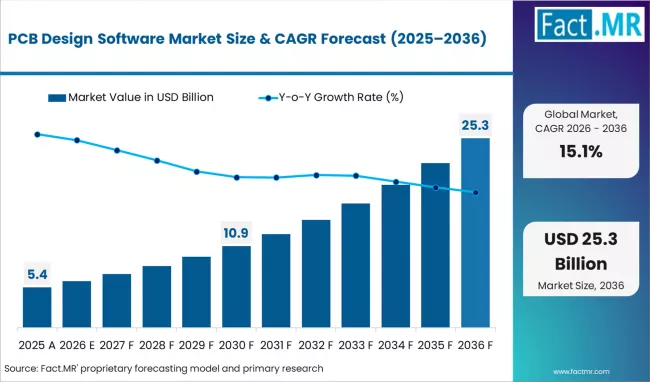
Pcb Design Software Market Market Value Analysis | Source: Fact.MR
PCB Design Software Market
| Metric | Details |
|---|---|
| Industry Size (2026E) | USD 6.2 billion |
| Industry Value (2036F) | USD 25.2 billion |
| CAGR (2026 to 2036) | 15.1% |
Source: Fact.MR analysis. Updated Mar 16, 2026
PCB Design Software Market Definition
The PCB Design Software Market covers computer software used to design and develop printed circuit boards for electronic devices. These tools allow engineers to create circuit layouts, place electronic components, route electrical connections, and verify board functionality before manufacturing. PCB design software supports schematic design, layout planning, and simulation of electronic circuits. It is widely used in electronics manufacturing, semiconductor development, telecommunications equipment, and consumer electronics production. The primary function of this software is to assist engineers in designing reliable and efficient circuit boards used in electronic products and industrial systems.
Market Inclusions
This report covers global and regional market sizes for PCB design software along with forecast analysis for the study period. The market is segmented by product type such as schematic design tools, layout design software, and simulation software. Application segments include consumer electronics, automotive electronics, telecommunications equipment, industrial electronics, and aerospace systems. End users include electronics manufacturers, semiconductor companies, and engineering design firms. The report also evaluates pricing structures, software licensing models, and selected trade flow analysis across major electronics markets.
Market Exclusions
The report excludes general computer aided design software used for mechanical or architectural design. Electronic manufacturing equipment used for PCB fabrication and assembly is not included. The scope also excludes semiconductor chip design software focused on integrated circuit development. Hardware products such as printed circuit boards, electronic components, and assembly systems are outside the defined market scope, as the study focuses strictly on software used for PCB layout and circuit board design.
Research Methodology
- Primary Research: Interviews were conducted with electronics design engineers, software developers, semiconductor companies, and engineering service providers.
- Desk Research: Public information was gathered from electronics industry publications, company reports, regulatory filings, and technology market databases.
- Market-Sizing and Forecasting: A hybrid model combining bottom up software revenue analysis with top down industry demand assessment was used.
- Data Validation and Update Cycle: Findings were cross verified using multiple industry sources and expert inputs, with periodic updates conducted as new market data becomes available.
Summary of the PCB Design Software Market
- Market Definition
- The market comprises software platforms used by engineers to design, simulate, and validate printed circuit boards used in electronic devices. These tools support schematic capture, component placement, signal routing, and circuit verification before board manufacturing across electronics development environments.
- Demand Drivers
- Rising complexity of electronic products requiring advanced design tools to manage multilayer circuit boards and high speed signal routing.
- Expansion of consumer electronics, telecommunications equipment, automotive electronics, and industrial automation systems.
- Increasing reliance on simulation and signal integrity analysis tools to detect design faults before manufacturing.
- Growth of semiconductor and electronics manufacturing ecosystems that require efficient electronic design automation platforms.
- Key Segments Analyzed
- Component: PCB design software accounts for about 70% share supported by widespread adoption of electronic design automation tools among engineering teams.
- Deployment: On premise PCB design software represents around 60% share as organizations maintain control over proprietary circuit designs and intellectual property.
- Application: Consumer electronics, telecommunications equipment, and automotive electronics represent major application sectors for PCB design software.
- Geography: South Korea records the fastest expansion supported by strong semiconductor manufacturing and consumer electronics production.
- Analyst Opinion at Fact MR
- Shambhu Nath Jha, Principal Consultant, Fact MR, opines, "In this updated edition of the PCB Design Software Market report, industry participants will observe that the market remains closely linked to global electronics manufacturing activity and semiconductor design ecosystems. As circuit complexity increases and product development cycles shorten, engineering teams require advanced design automation platforms capable of managing signal integrity, thermal performance, and manufacturing validation. Vendors that integrate simulation tools and collaborative engineering capabilities within comprehensive design environments will retain competitive advantages."
- Strategic Implications or Executive Takeaways
- Expand development of advanced simulation and signal integrity analysis tools integrated with PCB layout software.
- Strengthen integration between PCB design platforms and semiconductor design environments.
- Provide scalable licensing models that support engineering teams ranging from small design groups to enterprise electronics manufacturers.
- Invest in collaboration features and cloud enabled engineering workflows supporting distributed design teams.
- Methodology
- Primary interviews conducted with electronics design engineers, software developers, semiconductor companies, and engineering service providers.
- Desk research based on electronics industry publications, company reports, regulatory filings, and technology market databases.
- Market sizing developed using a hybrid approach combining bottom up software revenue analysis with top down demand assessment across electronics industries.
- Findings validated through multiple industry data sources and expert consultation following Fact MR internal modeling standards.
Segmental Analysis
PCB Design Software Market Analysis by Component
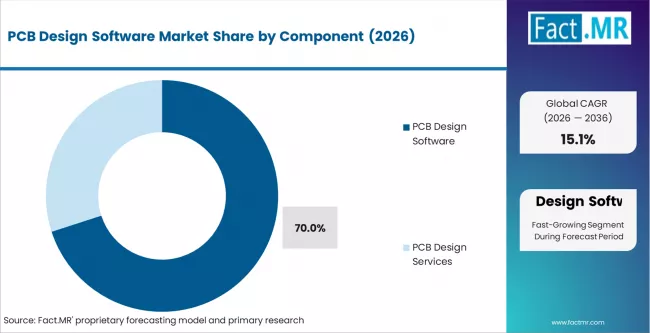
Pcb Design Software Market Analysis By Component | Source: Fact.MR
- Market Overview: PCB design software is projected to account for around 70% share of the PCB design software market by 2026. The segment includes electronic design automation tools used to design, simulate, and validate printed circuit boards before manufacturing. These software platforms allow engineers to create circuit layouts, test electrical performance, and detect design errors during the development phase. Growing complexity in electronic devices across consumer electronics, automotive systems, telecommunications equipment, and industrial machinery has increased the reliance on advanced PCB design software solutions. Manufacturers and design engineers continue to adopt specialized software tools to manage multilayer PCB structures, high speed signal routing, and component placement accuracy.
- Demand Drivers:
- Rising Electronics Complexity: Modern electronic devices incorporate dense circuitry and multilayer board architectures, requiring advanced design software to manage complex layouts.
- Design Accuracy and Simulation: PCB design software provides simulation capabilities that allow engineers to test electrical performance and detect potential design faults before manufacturing.
- Electronics Manufacturing Growth: Expansion in electronics production across industries such as telecommunications, automotive electronics, and industrial equipment increases the demand for PCB design platforms.
PCB Design Software Market Analysis by Deployment
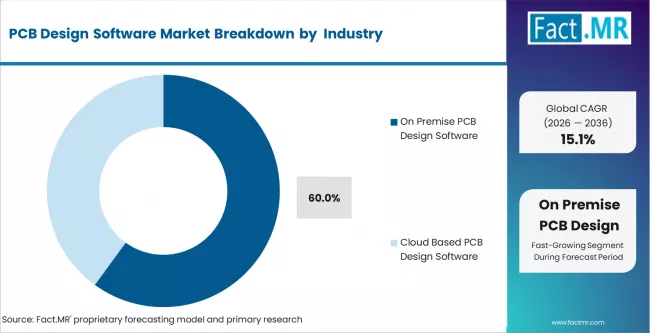
Pcb Design Software Market Analysis By Deployment | Source: Fact.MR
- Market Overview: On premise PCB design software is expected to represent about 60% share of the PCB design software market in 2026. Many electronics manufacturers and engineering firms continue to deploy PCB design tools on internal systems to maintain control over sensitive design data and intellectual property. On premise deployment enables organizations to manage large design files, integrate software with internal development environments, and maintain secure access within corporate networks. Large scale electronics manufacturers often prefer locally installed software to support high performance computing requirements for complex circuit simulations.
- Demand Drivers:
- Data Security Requirements: Electronics companies prefer on premise deployment to protect proprietary circuit designs and intellectual property within secure internal systems.
- High Performance Design Processing: Local software installations support intensive design simulations and large PCB layout files used in complex electronic systems.
- Integration with Engineering Infrastructure: On premise PCB design platforms can be integrated with internal product development workflows and engineering software environments used by electronics manufacturers.
PCB Design Software Market Drivers, Restraints, and Opportunities
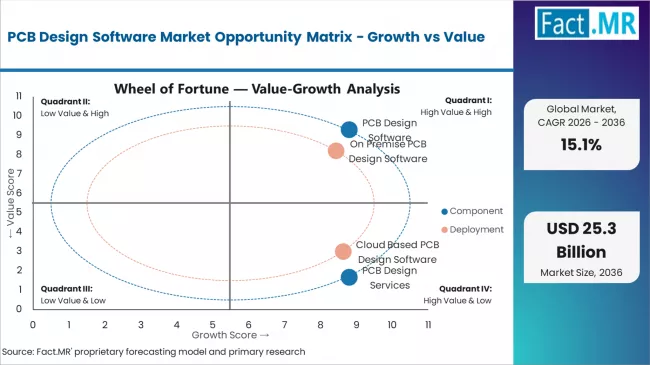
Pcb Design Software Market Opportunity Matrix Growth Vs Value | Source: Fact.MR
Fact MR analysis indicates that the PCB design software market developed alongside the expansion of the global electronics manufacturing industry. Printed circuit boards form the structural foundation of electronic devices where integrated circuits and electronic components are connected through conductive pathways. Early design processes relied on manual drafting and simple computer-aided design tools used by hardware engineers to create circuit layouts. The current market valuation reflects the transition toward complex electronic systems where multilayer boards, high-frequency circuits, and miniaturized components require advanced electronic design automation software.
A structural shift is occurring as conventional PCB layout tools gradually lose relevance in complex electronics development environments. Basic design software remains widely used in small engineering teams and low-complexity product development where circuit density and signal integrity challenges remain limited. Advanced PCB design platforms integrate simulation, thermal analysis, signal integrity modeling, and manufacturing validation tools within unified design environments. These comprehensive software suites command higher licensing costs even when the number of design seats grows gradually. Higher pricing associated with advanced design platforms contributes to steady value expansion in the market.
- Electronics System Complexity: Growth in high-density integrated circuits, multilayer circuit boards, and high-speed communication hardware increases reliance on advanced PCB design simulation and layout software.
- Design Compliance Standards: Engineering design practices follow standards such as IPC-2221 generic PCB design standards and IPC-6012 qualification requirements for rigid printed boards which influence software validation features.
- Asia Electronics Manufacturing: China, Taiwan, and South Korea host major electronics manufacturing ecosystems where PCB design software supports hardware development for consumer electronics, telecommunications equipment, and industrial devices.
Regional Analysis
The market analysis covers key global regions, including North America, Western Europe, and East Asia. It is segmented geographically, with specific market dynamics for each region. The full report provides a detailed market attractiveness analysis.
.webp "Top Country Growth Comparison Pcb Design Software Market Cagr (2026 2036)")
Top Country Growth Comparison Pcb Design Software Market Cagr (2026 2036) | Source: Fact.MR
| Country | CAGR (2026-2036) |
|---|---|
| USA | 9.8% |
| United Kingdom | 9.4% |
| Japan | 9.3% |
| South Korea | 9.9% |
Source: Fact.MR analysis. Updated Mar 16, 2026
Source: Fact MR (FMR) analysis, based on proprietary forecasting model and primary research
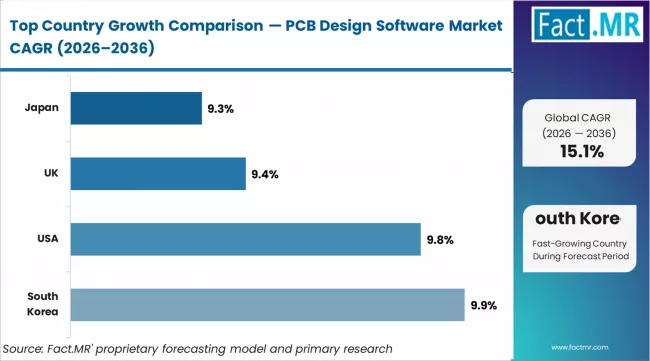
Pcb Design Software Market Cagr Analysis By Country | Source: Fact.MR
North America
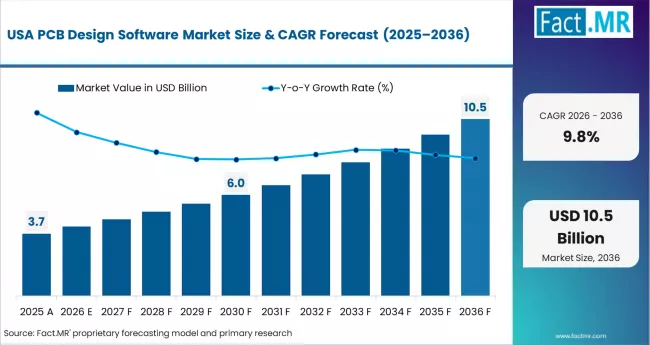
Pcb Design Software Market Country Value Analysis | Source: Fact.MR
The USA represents a major market supported by semiconductor design activity, electronics manufacturing, and demand for advanced circuit design tools. Key companies include Cadence Design Systems, Synopsys, and Altium Limited.
- USA: Demand for PCB design software in the U.S. is projected to rise at 9.8% CAGR through 2036. Growth is supported by semiconductor design initiatives promoted by the Department of Commerce (05-2025) and expansion of electronic design automation platforms by Cadence Design Systems (08-2025).
Western Europe
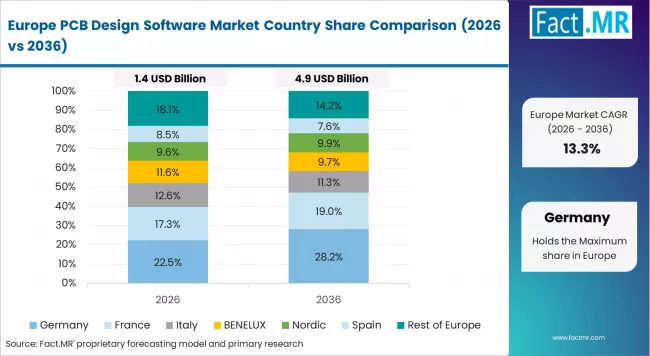
Pcb Design Software Market Europe Country Market Share Analysis, 2026 & 2036 | Source: Fact.MR
The United Kingdom represents a key market supported by electronics design services, research programs, and semiconductor engineering activities.
- United Kingdom: Demand for PCB design software in the UK is projected to rise at 9.4% CAGR through 2036. Growth is supported by digital electronics research initiatives promoted by UK Research and Innovation (03-2025) and deployment of design platforms by Altium Limited (07-2025).
East Asia
Japan and South Korea represent major markets supported by semiconductor manufacturing, electronics design, and industrial automation technologies.
- Japan: Demand for PCB design software in Japan is projected to rise at 9.3% CAGR through 2036. Growth is supported by semiconductor technology programs promoted by the Ministry of Economy, Trade and Industry (04-2025) and expansion of electronics design software adoption by Zuken Inc. (08-2025).
- South Korea: Demand for PCB design software in South Korea is projected to rise at 9.9% CAGR through 2036. Growth is supported by semiconductor manufacturing expansion programs (03-2025) and increased deployment of design automation platforms by Samsung Electronics (07-2025).
Fact MR's analysis of the PCB design software market in North America, Western Europe, and East Asia consists of country-wise assessments that include the USA, the United Kingdom, Japan, and South Korea. Readers can find detailed trends, regulatory updates, and company-specific investments shaping market growth in these countries.
Competitive Structure and Buyer Dynamics in the PCB Design Software Market
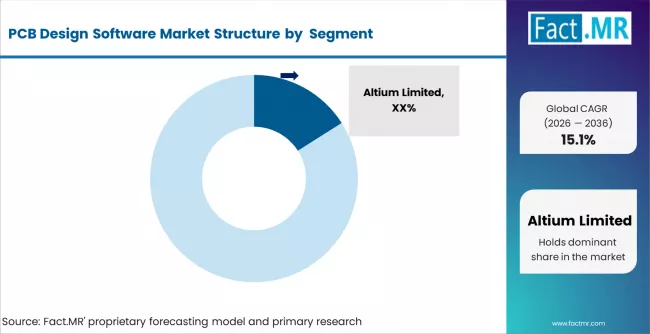
Pcb Design Software Market Analysis By Company | Source: Fact.MR
The competitive structure of the PCB Design Software Market is moderately concentrated, with several established electronic design automation providers controlling a substantial share of industry revenue. Leading vendors including Altium Limited, Cadence Design Systems, Inc., Siemens EDA (Siemens Digital Industries Software), Autodesk, Inc., Ansys, Inc., and Keysight Technologies, Inc. maintain strong market presence through comprehensive design platforms and integration with broader electronic engineering workflows. These companies supply advanced software environments used for circuit design, layout development, signal integrity analysis, and simulation across electronics manufacturing sectors. Additional participants such as Zuken Inc., Novarm Limited, and Labcenter Electronics Ltd. address specialized design requirements and smaller engineering teams through focused design tools and cost efficient licensing models. Competition in the market is primarily driven by software capability, design automation features, simulation accuracy, and compatibility with semiconductor and manufacturing processes. Vendor ecosystems, technical support services, and integration with engineering collaboration platforms also influence software adoption among electronics developers.
Several companies hold structural advantages through extensive research capabilities and integration with broader electronic design automation environments. Firms such as Cadence Design Systems, Inc. and Siemens EDA benefit from comprehensive engineering platforms that connect PCB design with semiconductor design, simulation, and manufacturing verification tools. Altium Limited maintains strong adoption among engineering teams through user friendly design interfaces and cloud enabled collaboration features. Companies such as Ansys, Inc. and Keysight Technologies, Inc. provide advanced simulation and signal analysis technologies that enhance PCB performance validation. Large electronics manufacturers typically manage supplier dependency by standardizing internal design workflows while maintaining access to multiple compatible software tools. Procurement teams evaluate licensing models, technical capability, and long term platform stability before committing to enterprise wide software deployments. This evaluation process moderates vendor pricing leverage, though vendors with deeply integrated engineering ecosystems retain stronger negotiating positions.
Key Players of the PCB Design Software Market
- Altium Limited
- Cadence Design Systems, Inc.
- Siemens EDA (Siemens Digital Industries Software)
- Autodesk, Inc.
- Keysight Technologies, Inc.
- Zuken Inc.
- Ansys, Inc.
- Novarm Limited
- Labcenter Electronics Ltd.
Report Scope
| Metric | Value |
|---|---|
| Quantitative Units | USD 6.2 billion (2026) to USD 25.2 billion (2036), at a CAGR of 15.1% |
| Market Definition | The PCB design software market includes development and deployment of software platforms and related services used for schematic capture, layout design, simulation, and validation of printed circuit boards across electronics manufacturing industries. |
| Component Segmentation | PCB Design Software (PCB Layout & Schematic Capture), PCB Design Services (Designing Services & Support & Maintenance) |
| Deployment | On-premise PCB Design Software, Cloud-based PCB Design Software |
| Application Coverage | IT & Computing, Consumer Electronics, Telecommunications, Healthcare, Automotive, Defense & Military, Others |
| Key Companies Profiled | Altium Limited, Cadence Design Systems, Inc., Siemens EDA, Autodesk, Inc., Keysight Technologies, Inc., Zuken Inc., Ansys, Inc., Novarm Limited, Labcenter Electronics Ltd. |
| Forecast Period | 2026 to 2036 |
| Approach | Hybrid top-down and bottom-up market modeling validated through interviews with electronic design automation software providers and electronics manufacturers, supported by license revenue benchmarking, user adoption analysis, and semiconductor industry demand assessment. |
Source: Fact.MR analysis. Updated Mar 16, 2026
Bibliographies
- [1] U.S. Department of Commerce. (2025). Semiconductor design initiatives.
- [2] UK Research and Innovation. (2025). Digital electronics research initiatives.
- [3] Ministry of Economy, Trade and Industry, Japan. (2025). Semiconductor technology programs.
- [4] Samsung Electronics. (2025). Design automation platforms deployment.
- [5] Cadence Design Systems, Inc. (2025). Electronic design automation platforms expansion.
- [6] Zuken Inc. (2025). Electronics design software adoption.
- [7] Altium Limited. (2025). Design platforms deployment.
- [8] IPC International. (2023). IPC-2221 generic PCB design standards.
- [9] IPC International. (2023). IPC-6012 qualification requirements for rigid printed boards.
This Report Addresses
- Market size estimation and revenue forecasts for the PCB Design Software Market from 2026 to 2036, supported by electronic design automation license benchmarks and electronics manufacturing demand indicators.
- Growth opportunity mapping across PCB layout design tools, schematic capture software, and PCB design services supporting circuit development and electronic product engineering.
- Segment and regional revenue forecasts covering IT and computing, consumer electronics, telecommunications, healthcare electronics, automotive electronics, and defense system applications across major electronics markets.
- Competition strategy assessment including electronic design automation platform integration, simulation capability benchmarking, and engineering workflow compatibility analysis among leading software providers.
- Regulatory and design standards impact analysis covering engineering practices aligned with IPC-2221 PCB design standards and IPC-6012 printed board qualification requirements used in electronics manufacturing.
- Market report delivery in PDF, Excel, PPT, and interactive dashboard formats designed for electronics engineering strategy planning, software procurement analysis, and product development management.
- Supply chain vulnerability assessments identifying semiconductor ecosystem dependencies, electronic design automation vendor concentration, and regional electronics manufacturing capacity risks affecting PCB design software adoption.
Segmentation
PCB Design Software Market Key Segments
-
Component :
- PCB Design Software
- PCB Layout
- Schematic Capture
- PCB Design Services
- Designing Services
- Support and Maintenance
- PCB Design Software
-
Deployment :
- On Premise PCB Design Software
- Cloud Based PCB Design Software
-
Application :
- IT and Computing
- Consumer Electronics
- Telecommunications
- Healthcare
- Automotive
- Defense and Military
- Others
-
Region :
- North America
- USA
- Canada
- Mexico
- Europe
- Germany
- UK
- France
- Italy
- Spain
- Nordic Countries
- BENELUX
- Rest of Europe
- Asia Pacific
- China
- Japan
- South Korea
- India
- Australia
- Rest of Asia Pacific
- Latin America
- Brazil
- Argentina
- Rest of Latin America
- Middle East and Africa
- Kingdom of Saudi Arabia
- United Arab Emirates
- South Africa
- Rest of Middle East and Africa
- Other Regions
- Oceania
- Central Asia
- Other Markets
- North America
Frequently Asked Questions
How large is the demand for PCB Design Software in the global market in 2026?
What will be the market size of PCB Design Software in the global market by 2036?
What is the expected demand growth for PCB Design Software in the global market between 2026 and 2036?
Which Component Segment is poised to lead global demand by 2026?
Which Company is Identified as a Leading Participant in the PCB Design Software Market?
What is Driving PCB Design Software Demand in the United States?
What is the United States Growth Outlook in this Report?
What Factors Support PCB Design Software Adoption in the United Kingdom?
What is the United Kingdom Growth Outlook in this Report?
Why is Japan an Important Market for PCB Design Software?
What is the Japan Growth Outlook in this Report?
Why is South Korea Considered a Key Market for PCB Design Software?
What is the South Korea Growth Outlook in this Report?
What is PCB Design Software and What is It Mainly Used For?
What does PCB Design Software Market Mean in this Report?
What is Included in the Scope of this PCB Design Software Market Report?
What is Excluded from the Scope of this Report?
What does Market Forecast Mean on this Page?
How is the PCB Design Software Market Forecast Developed in this Report?
Who worked on this report


Preview the report firsthand - request a free sample
Free SampleGet the brochure for pricing and purchase details
Download PDF