- Base Value(2026): 410.0 Mn
- Estimated Value(2026): 410.0 Mn
- Forecast Value (2036): 755.3 Mn
- CAGR (2026 - 2036): 6.3%
Decoking Control System Market Investment and Capital Allocation Forecast Outlook By Fact.MR
- The decoking control system market is expected treach USD 410 million in 2026 and grow to USD 755 million by 2036, with a CAGR of 6.3%.
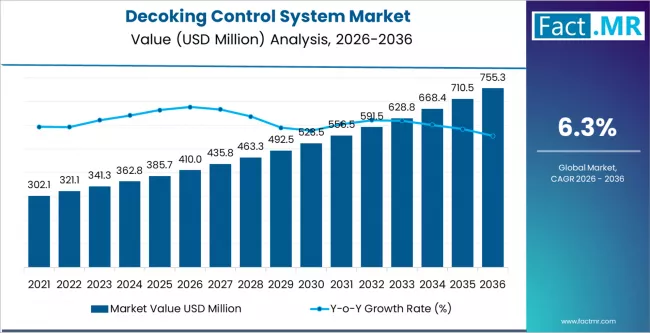
Decoking Control System Market Market Value Analysis | Source: Fact.MR
Summary of Decoking Control System Market
- Market Snapshot
- Global decoking control system market revenue stood at USD 410 million in 2026 and is forecast treach USD 755 million by 2036.
- At a 6.3% CAGR from 2026 t2036, this market is set texpand ~1.8x in value, adding USD 345 million in absolute opportunity.
- Growth is being driven by increasing refinery modernization, process optimization requirements, and expansion of petrochemical production infrastructure globally.
- Decoking control systems are increasingly adopted timprove furnace efficiency, operational safety, and coke removal process automation across refinery and steam cracker operations.
- Rising investments in industrial automation, advanced process control systems, and energy efficiency initiatives are reinforcing market expansion globally.
- Demand and Growth Drivers
- Increasing refinery and petrochemical plant modernization activities globally
- Rising demand for automated process optimization and furnace efficiency systems
- Growing adoption of APC, DCS, and SIS-based industrial control technologies
- Expansion of steam cracker and downstream hydrocarbon processing capacity
- Need for solutions that provide:
- Improved decoking process efficiency and operational reliability
- oReduced downtime and maintenance-related production losses
- Enhanced safety monitoring and process control integration
- Betterenergy efficiency and furnace performance optimization
- Product and Segment View
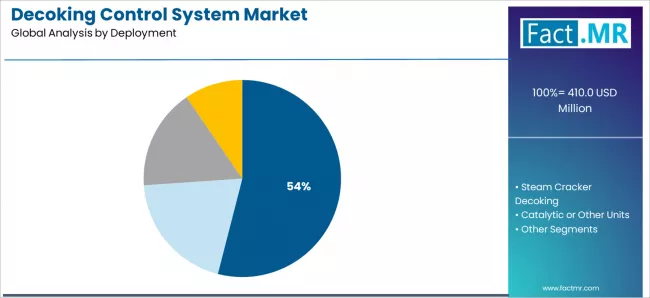
- Refinery furnace decoking holds 54% of deployment share in 2026,emergingas the leading segment.
- Key product categories include:
- Refinery furnace decoking
- Steam cracker decoking
- Catalytic or other unit decoking systems
- Other decoking control solutions
- Geography and Competitive Outlook
- Indiaemergesas the leading growth market for the decoking control system market with 7.4% CAGR.
- Key growth markets and CAGR: India 7.4%, China 6.9%, Saudi Arabia 6.6%, Vietnam 6.2%, USA 3.1%
- Market expansion is closely tied to:
- Increasing refinery digitalization and industrial automation investments
- Rising focus on predictive maintenance and process optimization technologies
- Growing expansion of petrochemical and refining infrastructure globally
- Key companies active in this market include Honeywell, Emerson, Yokogawa, ABB, Siemens, Schneider Electric, Rockwell Automation,AspenTech, KBC (Yokogawa), and L&T Technology Services.
Decoking Control System Market — At a Glance
| Attribute | Details |
|---|---|
| Market Value 2026 | USD 410 million |
| Market Value 2036 | USD 755 million |
| Absolute Dollar Opportunity 2026–2036 | USD 345 million |
| Total Growth 2026–2036 | 84.1% |
| CAGR 2026–2036 | 6.3% |
| Growth Multiple | ~1.8x |
| Key Demand Theme | Increasing adoption of automated refinery process optimization systems |
| Leading Segment by Deployment (2026) | Refinery Furnace Decoking |
| Segment Share (2026) | 54% |
| Key Growth Region | Asia Pacific |
| Leading Growth Country | India |
| Country CAGRs | India 7.4%, China 6.9%, Saudi Arabia 6.6%, Vietnam 6.2%, USA 3.1% |
| Top Companies | Honeywell, Emerson, Yokogawa, ABB, Siemens, Schneider Electric, Rockwell Automation,AspenTech, KBC (Yokogawa), L&T Technology Services |
| Segmentation by Deployment | Refinery Furnace Decoking, Steam Cracker Decoking, Catalytic or Other Units, Other |
| Segmentation by Control Layer | DCS or PLC Control Packages, Advanced Process Control (APC),Safetyor Interlocks (SIS), Other |
| Segmentation by Offering | Retrofit and Upgrades, New Unit Installations, Service and Optimization, Other |
| Segmentation by Region | North America, Europe, Asia Pacific, Latin America, Middle East & Africa |
Source: Fact.MR analysis. Updated May 21, 2026
Capital intensity is a key factor, as investment in advanced decoking technology requires substantial upfront capital for research, development, and infrastructure. The return timelines for these investments tend tbe longer due tthe specialized nature of the technology and the time required for systems tprove their operational value. Investors must balance these extended timelines with the promise of stable demand, particularly in the energy and petrochemical sectors. Investment selectivity becomes crucial as market leaders focus on high-margin projects that promise quicker adoption and quicker returns. As the market matures, the ability tefficiently allocate capital toward projects with high technological differentiation will drive competitive advantage and long-term expansion, ensuring that growth remains sustainable and aligned with industry demand patterns.
Category
| Category | Segments |
|---|---|
| Deployment | Refinery Furnace Decoking; Steam Cracker Decoking; Catalytic or Other Units; Other |
| Control Layer | DCS or PLC Control Packages; Advanced Process Control (APC); Safety or Interlocks (SIS); Other |
| Offering | Retrofit and Upgrades; New Unit Installations; Service and Optimization; Other |
| Region | North America; Europe; Asia Pacific; Latin America; Middle East & Africa |
Source: Fact.MR analysis. Updated May 21, 2026
Segmental Analysis
What Is the Impact of Deployment on the Decoking Control System Market?
Decoking Control System Market Analysis By Deployment | Source: Fact.MR
In the decoking control system market, deployment plays a significant role in determining the scope and application of control systems. Refinery furnace decoking leads the market with a 54% share, as this application is crucial for ensuring the effective and safe operation of refinery furnaces during the decoking process. The decoking control systems are designed to manage and optimize the decoking cycle, reducing downtime and increasing operational efficiency. As refineries aim to improve productivity and minimize maintenance costs, the demand for decoking control systems in refinery furnaces will continue to drive market growth.
How Does Control Layer Influence the Decoking Control System Market?
Decoking Control System Market Analysis By Control Layer | Source: Fact.MR
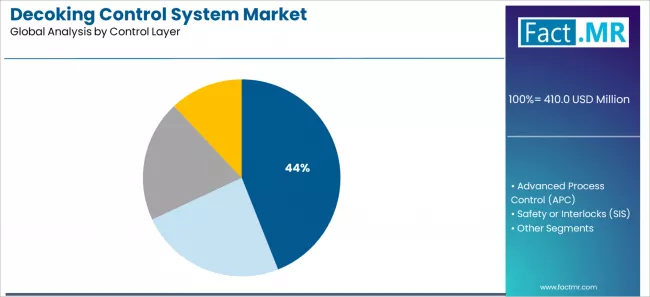
Control layer is a critical factor in enhancing the performance and reliability of decoking control systems, with DCS or PLC control packages holding a 44% share. Distributed Control Systems (DCS) or Programmable Logic Controllers (PLC) are commonly used in decoking processes to provide real-time monitoring, control, and automation, ensuring smooth operation and preventing equipment damage. These control packages enable operators to manage decoking cycles effectively and respond to potential issues proactively. As industries continue to focus on automation and improving operational efficiency, the use of DCS and PLC control packages will remain central to the market's development.
What are the Drivers, Restraints, and Key Trends of the Decoking Control System Market?
- Drivers: Demand for decoking control systems is shaped by operational requirements in refining and petrochemical facilities to remove coke deposits from heaters, furnaces, and reformers. Process engineers specify automated decoking systems to reduce unplanned downtime, improve thermal efficiency, and maintain throughput. Performance criteria for safety and repeatability influence selection of control logic, sensors, and actuation mechanisms.
- Restraints: High capital and integration costs constrain uptake in facilities with limited modernization budgets. Some operators face challenges retrofitting decoking control systems into existing process control architectures that lack standardized interfaces. Variability in coke formation rates and furnace designs requires system customization that increases engineering lead times.
- Trend 1: Adoption of predictive algorithms that estimate coke buildup and schedule decoking events with minimal impact on production.
- Trend 2: Integration of real time monitoring and control feedback that links decoking system performance with overall process efficiency metrics.
Analysis of the Decoking Control System Market by Key Country
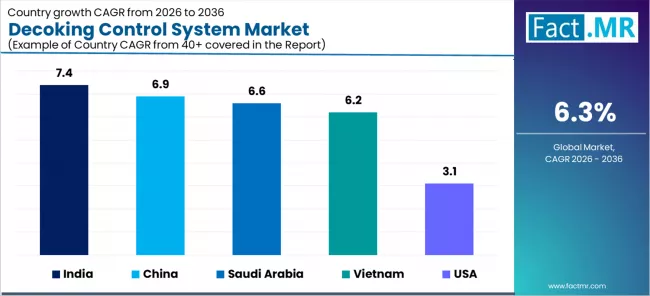
Decoking Control System Market Cagr Analysis By Country | Source: Fact.MR
| Country | CAGR (2026–2036) |
|---|---|
| India | 7.4% |
| China | 6.9% |
| Saudi Arabia | 6.6% |
| Vietnam | 6.2% |
| USA | 3.1% |
Source: Fact.MR analysis. Updated May 21, 2026
The report covers an in-depth analysis of 40+ countries; top-performing countries are highlighted below.
What is the Growth Outlook for Decoking Control System Market in India?
India’s decoking control system market is projected to grow at a CAGR of 7.4% from 2026 to 2036. As India’s industrial sectors, particularly oil refining and petrochemicals, continue to expand, the demand for decoking control systems is increasing. These systems play a critical role in managing the coke removal process from refinery equipment, ensuring efficient operations and reducing downtime. India’s growing emphasis on improving industrial performance and enhancing operational safety in the oil and gas sector is driving the market for decoking control systems. Additionally, with the government's push toward modernization and sustainability, the market will continue to expand at a steady pace.
How is the Decoking Control System Market Performing in China?
China’s decoking control system market is expected to grow at a CAGR of 6.9% from 2026 to 2036. As one of the largest global players in oil refining and petrochemicals, China’s demand for decoking control systems is steadily rising. These systems are vital for maintaining the efficiency and reliability of refinery operations by automating the coke removal process. With China’s industrial sector increasingly focusing on improving productivity and safety, coupled with environmental regulations pushing for cleaner and more efficient operations, the market for decoking control systems is set to grow steadily, driven by both regulatory pressures and industrial advancements.
What is the Market Outlook for Decoking Control System Market in Saudi Arabia?
Saudi Arabia’s decoking control system market is forecast to grow at a CAGR of 6.6% from 2026 to 2036. As a key player in the global oil industry, Saudi Arabia’s demand for decoking control systems remains strong. These systems are essential in ensuring that the coke removal process in refinery operations is both efficient and safe. Saudi Arabia's focus on improving the efficiency of its oil refineries and petrochemical plants, alongside its commitment to maintaining high environmental and safety standards, will continue to drive the market for decoking control systems. The ongoing investment in refinery modernization and expansion will further fuel demand for these systems.
What is the Growth Potential for Decoking Control System Market in Vietnam?
Vietnam’s decoking control system market is projected to grow at a CAGR of 6.2% from 2026 to 2036. As Vietnam’s industrial sector, particularly its oil refining and petrochemical industries, continues to develop, the demand for decoking control systems is rising. These systems help maintain the performance and safety of refinery operations by automating the coke removal process. Vietnam’s focus on improving the efficiency of its refining processes and increasing the use of modern technologies to reduce operational downtime is driving market growth. With the growing industrial base and demand for higher-quality products, the market for decoking control systems in Vietnam will continue to expand steadily.
What is the Demand for Decoking Control System Market in the USA?
The USA’s decoking control system market is set to grow at a CAGR of 3.1% from 2026 to 2036. While growth may be slower compared to other regions, the demand for decoking control systems remains steady due to their essential role in maintaining operational efficiency and safety in oil refining and petrochemical industries. The USA's continued focus on improving refinery performance, reducing downtime, and meeting stringent environmental regulations will drive moderate market growth. As the industry increasingly adopts advanced control systems to optimize processes, the market for decoking control systems in the USA will continue to grow, albeit at a slower pace.
How is Competition Structured in the Decoking Control System Market?
Competition in the decoking control system market is shaped by process automation capability, data analytics, and integration with refinery operations. Honeywell and Emerson compete with control systems that automate coke removal cycles and optimize heat balance in delayed coking units. Siemens and ABB focus on scalable automation suites that tie decoking control into broader plant control networks.
Yokogawa and KBC (a Yokogawa company) emphasize advanced process modeling and advisory systems that support operational decisions during decoking. Schneider Electric and Rockwell Automation position offerings with modular architectures that facilitate integration with distributed control systems. AspenTech and L&T Technology Services compete on digital twin and optimization software that simulate decoking scenarios to improve throughput and reduce unplanned downtime. Differentiation arises from analytics depth, ease of deployment, and compatibility with existing hardware infrastructures. Buyers evaluate suppliers on documented performance improvements, service support, and the ability to improve cycle time and thermal efficiency.
Key Players of the Decoking Control System Market?
- Honeywell
- Emerson
- Yokogawa
- ABB
- Siemens
- Schneider Electric
- Rockwell Automation
- AspenTech
- KBC (Yokogawa)
- L&T Technology Services
Bibliographies
- American Petroleum Institute. (2024). API RP 556: Instrumentation and control systems for fired heaters and critical refinery units. API Publishing.
- International Organization for Standardization. (2023). ISO 23251 (API 521): Pressure-relieving and depressuring systems. ISO.
- International Energy Agency. (2024). Refinery upgrading, residue conversion, and delayed coking capacity trends. IEA.
Segmentation
Scope of the Report
| Items | Values |
|---|---|
| Quantitative Units (2026) | USD Million |
| Deployment | Refinery Furnace Decoking, Steam Cracker Decoking, Catalytic or Other Units, Other |
| Control Layer | DCS or PLC Control Packages, Advanced Process Control (APC), Safety or Interlocks (SIS), Other |
| Offering | Retrofit and Upgrades, New Unit Installations, Service and Optimization, Other |
| Regions Covered | North America, Europe, Asia Pacific, Latin America, Middle East & Africa |
| Countries Covered | United States, Canada, Mexico, Brazil, Germany, United Kingdom, France, Italy, Spain, China, Japan, South Korea, India, Australia & New Zealand |
| Key Companies Profiled | Honeywell, Emerson, Yokogawa, ABB, Siemens, Schneider Electric, Rockwell Automation, AspenTech, KBC (Yokogawa), L&T Technology Services |
| Additional Attributes | Dollar revenue by deployment, control layer, and offering; regional demand trends, competitive landscape, technological advancements in decoking control systems, and innovations in retrofit and optimization solutions |
Source: Fact.MR analysis. Updated May 21, 2026
Decoking Control System Market Key Segments
-
Deployment :
- Refinery Furnace Decoking
- Steam Cracker Decoking
- Catalytic or Other Units
- Other
-
Control Layer :
- DCS or PLC Control Packages
- Advanced Process Control (APC)
- Safety or Interlocks (SIS)
- Other
-
Offering :
- Retrofit and Upgrades
- New Unit Installations
- Service and Optimization
- Other
-
Region :
- North America
- USA
- Canada
- Mexico
- Europe
- Germany
- UK
- France
- Italy
- Spain
- Nordic Countries
- BENELUX
- Rest of Europe
- Asia Pacific
- China
- Japan
- South Korea
- India
- Australia
- Rest of Asia Pacific
- Latin America
- Brazil
- Argentina
- Rest of Latin America
- Middle East and Africa
- Kingdom of Saudi Arabia
- United Arab Emirates
- South Africa
- Rest of Middle East and Africa
- Other Regions
- Oceania
- Central Asia
- Other Markets
- North America
Frequently Asked Questions
How big is the decoking control system market in 2026?
What will be the size of decoking control system market in 2036?
How much will be the decoking control system market growth between 2026 and 2036?
What are the key product types in the decoking control system market?
Which control layer segment to contribute significant share in the decoking control system market in 2026?
Who worked on this report


Preview the report firsthand - request a free sample
Free SampleGet the brochure for pricing and purchase details
Download PDF