- Base Value(2025): 1.1 Bn
- Estimated Value(2026): 1.1 Bn
- Forecast Value (2036): 1.8 Bn
- CAGR (2026 - 2036): 4.6%
Density Meter Market Size, Market Forecast and Outlook by Fact.MR
- The density meter market was valued at USD 1.1 billion in 2025.
- Demand is set to reach USD 1.1 billion in 2026 at a CAGR of 4.6% during the forecast period.
- Sustained industrial measurement demand takes the valuation to USD 1.8 billion through 2036 as process plants, fuel laboratories, and quality-control labs require faster density and concentration measurement.
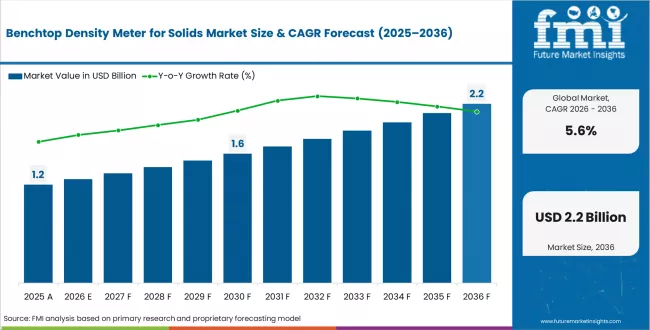
Benchtop Density Meter For Solids Market Market Value Analysis | Source: Fact.MR
| Metric | Details |
|---|---|
| Industry Size (2026) | USD 1.1 billion |
| Industry Value (2036) | USD 1.8 billion |
| CAGR (2026 to 2036) | 4.6% |
Source: Fact.MR analysis. Updated May 18, 2026
Summary of Density Meter Market
- Market Definition
- Density meters are instruments used to measure liquid, gas, or slurry density for process control, product testing, and quality verification. Scope is defined by measurement principle, installation format, sample handling, accuracy, and use across regulated or process-intensive industries.
- Demand Drivers in the Market
- Process engineers need inline density data to adjust concentration and product quality.
- Refinery laboratory managers need digital density meters for API gravity and product testing.
- Food and beverage producers require repeatable density checks for formulation and batch consistency.
- Key Segments Analyzed
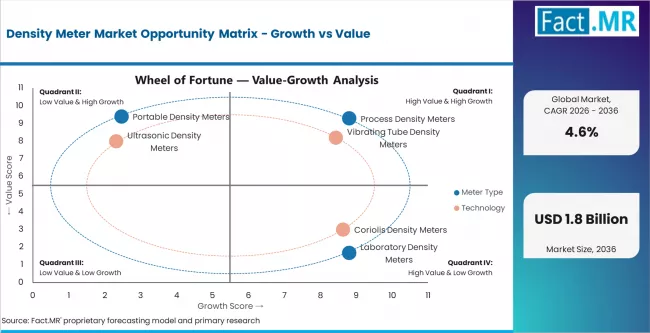
- Process Density Meters: Process density meters are expected to hold 67.0% share in 2026 because inline measurement supports continuous control in industrial plants.
- Vibrating Tube Density Meters: Vibrating tube density meters are projected to account for 36.0% share in 2026 due to broad use in laboratory and process applications.
- Concentration Measurement: Concentration measurement is estimated to capture 31.0% share in 2026 as density readings help control mixtures and solutions.
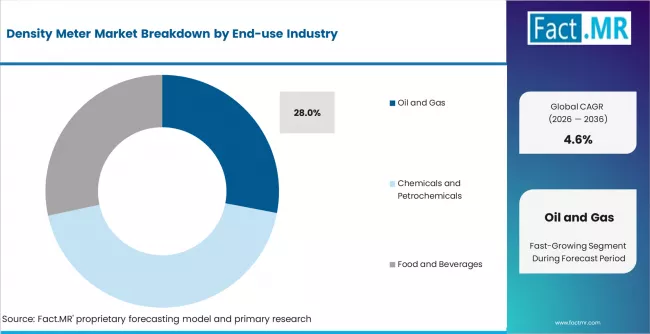
- Oil and Gas: Oil and gas is likely to hold 28.0% share in 2026 because custody transfer and fuel testing rely on accurate density values.
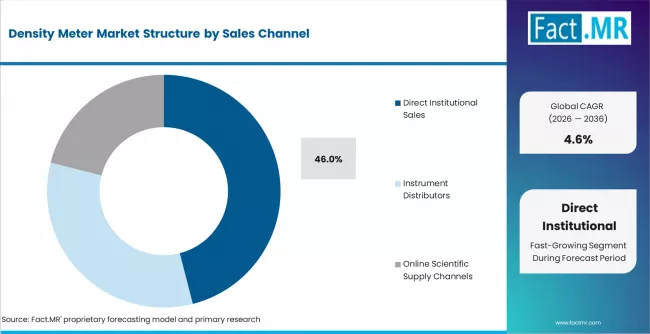
- Direct Institutional Sales: Direct institutional sales are projected to account for 46.0% share in 2026 because industrial buyers prefer supplier support for installation and calibration.
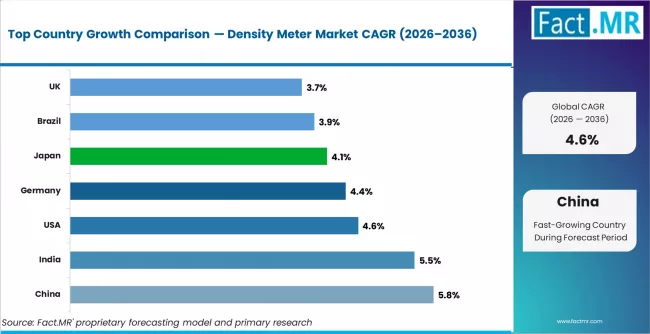
- Geography: China is forecast to grow at 5.8% CAGR through 2036, supported by chemical production and industrial automation.
- Analyst Opinion at Fact.MR
- Shambhu Nath Jha, Senior Analyst at Fact.MR, notes, “Density meters are becoming part of process assurance rather than basic lab measurement. Industrial users need instruments that reduce sample error, connect with plant systems, and support documented quality control. Suppliers will gain where they combine accuracy, calibration support, and application-specific integration.”
- Strategic Implications
- Process plants must evaluate density meters through accuracy, sample compatibility, and system integration.
- Instrument suppliers should strengthen calibration and application support to protect industrial accounts.
- Laboratory buyers need traceable methods and operator-friendly instruments to reduce testing variation.
- Methodology
- Fact.MR interviews process users, refinery labs, food quality managers, chemical plant engineers, and instrument distributors.
- Research reviews product portfolios, measurement standards, technical manuals, company disclosures, and industrial quality requirements.
- Estimates use process meter demand, laboratory replacement cycles, technology adoption, and regional industrial activity.
- Forecasts are validated through supplier checks, buyer interviews, distributor feedback, and application-level triangulation.
Plant managers are being pushed to decide between manual sampling and inline measurement that supports faster process correction. This shift is visible in oil and gas, chemicals, food processing, and pharmaceutical production. ASTM D4052 covers density, relative density, and API gravity measurement of petroleum distillates and viscous oils using a digital density meter. [1] A practical point often missed is that density measurement is not only a lab value. It affects batching, custody transfer, concentration control, and product release.
The main inflection point arrives when density data becomes part of continuous process control rather than periodic lab reporting. Industrial buyers trigger this shift by connecting density meters with PLCs, batch systems, and quality records. Once this happens, density meters move from standalone instruments to process assurance tools.
China is projected to record 5.8% CAGR through 2036 as chemical production and industrial automation support instrument demand. India is likely to grow at 5.5% CAGR through refinery, chemical, and food-processing investment. The United States is forecast to post 4.6% CAGR as custody transfer, lab automation, and process monitoring sustain replacement demand. Germany is projected to grow at 4.4% CAGR, Japan at 4.1% CAGR, Brazil at 3.9% CAGR, and the UK at 3.7% CAGR. Country variation depends on process industry depth, standards adoption, and plant automation maturity.
Segmental Analysis
Density Meter Market Analysis by Meter Type
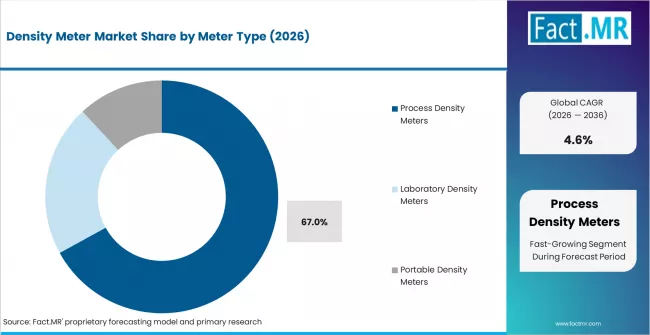
Density Meter Market Analysis By Meter Type | Source: Fact.MR
Process density meters are projected to hold 67.0% share in 2026 because industrial users need inline measurement for concentration control and product consistency. Refineries, chemical plants, and beverage lines use process units to reduce manual sampling delay. Fact.MR analysis suggests that process meters lead because density values can be used directly in control systems. Laboratory density meters remain essential for reference testing and product release. Portable meters serve field checks and production-area testing. Emerson’s compact density meter is designed to provide density and temperature for custody transfer and concentration measurement. [2]
- Inline Control: Process meters help operators correct quality shifts during production.
- Lab Verification: Benchtop systems support reference testing and product release.
- Field Flexibility: Portable meters help users test samples outside fixed laboratories.
Density Meter Market Analysis by Technology
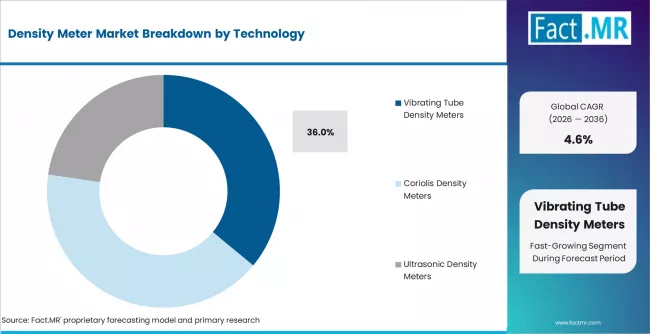
Density Meter Market Analysis By Technology | Source: Fact.MR
Vibrating tube density meters remain widely used because they support accurate liquid density measurement in laboratories and process settings. These systems measure density through oscillation behavior inside a sample tube. Vibrating tube density meters are projected to account for 36.0% share in 2026 due to their use in petroleum, chemicals, beverages, and pharmaceuticals. Coriolis density meters are important where users need flow and density in one instrument. Ultrasonic meters suit selected non-intrusive applications. Nuclear density meters support demanding slurry and mining processes. Mettler Toledo states that benchtop and portable density meters use oscillation tube technology to measure density and related values. [3]
- Measurement Accuracy: Vibrating tube systems support precise lab and process density testing.
- Flow Link: Coriolis meters combine mass flow and density measurement.
- Harsh Service: Nuclear meters serve slurry and heavy-duty process applications.
Density Meter Market Analysis by Application
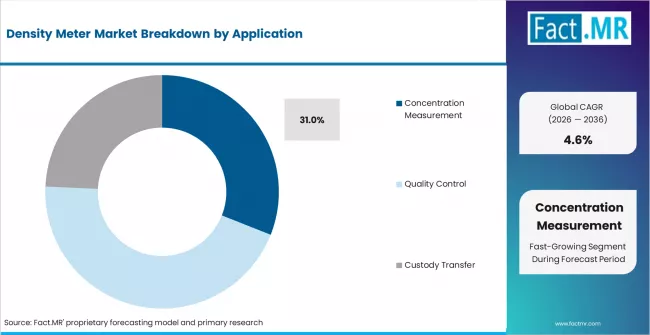
Density Meter Market Analysis By Application | Source: Fact.MR
Concentration measurement creates steady demand because many process users need density values to control mixtures and solution strength. Chemical, beverage, and pharmaceutical plants use density meters to monitor concentration shifts. Concentration measurement is estimated to capture 31.0% share in 2026 as density supports batch correction and product consistency. Quality control remains important in laboratories that release finished products. Custody transfer uses density for volume correction and commercial measurement. Process monitoring supports continuous control. Product formulation relies on density to verify recipes and specifications. API MPMS Chapter 9.4 covers continuous online determination and application of flowing liquid densities for custody transfer.
- Mixture Control: Density readings help operators keep solution strength within target range.
- Release Testing: Quality-control labs use density values before product approval.
- Commercial Accuracy: Custody transfer depends on reliable density correction.
Density Meter Market Analysis by End-use Industry
Density Meter Market Analysis By End Use Industry | Source: Fact.MR
Oil and gas remains a major end-use industry because density affects API gravity, custody transfer, and fuel quality testing. Refineries and terminals need reliable density data for crude, refined products, and process streams. Oil and gas is likely to hold 28.0% share in 2026 as petroleum testing and transfer measurement require traceable density methods. Chemicals and petrochemicals use density for concentration and reaction monitoring. Food and beverages use density to control sugar, alcohol, and formulation consistency. Pharmaceuticals require controlled measurement for solutions and intermediates. Mining uses density meters for slurry monitoring. ASTM D4052 supports petroleum liquid density testing with digital density meters.
- Petroleum Testing: Density supports API gravity and fuel quality measurement.
- Chemical Control: Process plants use density to manage concentration and reaction conditions.
- Beverage Quality: Food and beverage producers use density to protect formulation consistency.
Density Meter Market Analysis by Sales Channel
Density Meter Market Analysis By Sales Channel | Source: Fact.MR
Direct institutional sales lead because industrial density meters require configuration, calibration, installation support, and application guidance. Large plants prefer supplier contact when instruments are tied to process control or custody transfer. Direct institutional sales are projected to account for 46.0% share in 2026 because users need technical support before and after installation. Instrument distributors remain important for laboratories and smaller plants. Online scientific supply channels support portable meters and accessories. System integrators serve projects where density meters connect with broader automation systems. Emerson’s Coriolis meters are positioned for mass flow, volume flow, and density measurement needs, which often require process integration. [5]
- Technical Support: Direct sales help buyers manage configuration and calibration needs.
- Lab Access: Distributors support laboratories with smaller-volume instrument orders.
- System Fit: Integrators connect density meters with plant control architecture.
Density Meter Market Drivers, Restraints, and Opportunities
Density Meter Market Opportunity Matrix Growth Vs Value | Source: Fact.MR
Industrial automation and quality control are the main demand anchors for density meters. Process plants use density data to reduce manual testing and correct product variation faster. ASTM D4052 and API MPMS Chapter 9.4 show that density measurement is embedded in petroleum testing and custody transfer practices. [4] Food, chemical, and pharma users apply density readings to concentration control and formulation checks. These conditions support steady demand for process and laboratory density systems.
Cost and application complexity remain the main restraints. High-accuracy density meters require calibration, temperature control, and correct sample handling. Viscous, corrosive, or multiphase samples can create measurement difficulty. Smaller facilities may continue using hydrometers or lower-cost instruments where high automation is not needed. API guidance on continuous density measurement highlights sampling system design and field proving needs, which shows why correct installation matters. Suppliers that cannot support application setup may face slower adoption.
Opportunities in the Density Meter Market
- Inline Automation: Suppliers can expand through process meters linked with control systems.
- Portable Testing: Field-service teams need compact density meters for production-area checks.
- Custody Transfer: Oil and gas users need accurate density measurement for commercial transfer and inventory control.
Regional Analysis
Based on the regional analysis, the density meter market is segmented into North America, Latin America, Western Europe, Eastern Europe, East Asia, South Asia and Pacific, and Middle East and Africa across 40 plus countries.
.webp "Top Country Growth Comparison Density Meter Market Cagr (2026 2036)")
Top Country Growth Comparison Density Meter Market Cagr (2026 2036) | Source: Fact.MR
| Country | CAGR (2026 to 2036) |
|---|---|
| China | 5.8% |
| India | 5.5% |
| United States | 4.6% |
| Germany | 4.4% |
| Japan | 4.1% |
| Brazil | 3.9% |
| UK | 3.7% |
Source: Fact.MR analysis. Updated May 18, 2026
Source: Fact.MR analysis, based on proprietary forecasting model and primary research
Density Meter Market Cagr Analysis By Country | Source: Fact.MR
East Asia Density Meter Market Analysis
East Asia shows steady demand because chemical production, electronics materials, food processing, and industrial automation require accurate process measurement. China creates the largest regional opportunity through large-scale process industries and expanding laboratory quality systems. Japan has a more mature instrumentation base where replacement demand and high-accuracy measurement support adoption. Fact.MR analysis indicates that suppliers in this region compete through application support, service coverage, and integration with automated plants.
- China: China is projected to record 5.8% CAGR from 2026 to 2036 as chemical production and industrial automation support density meter demand. Process plants need inline meters for concentration and quality control. Laboratory users require benchtop instruments for release testing and formulation checks. Domestic instrument access is improving, but high-accuracy applications still favor suppliers with strong technical support.
- Japan: Japan has a mature industrial measurement base and high expectations for accuracy. Density meter demand in Japan is expected to post 4.1% CAGR through 2036. Chemical, pharmaceutical, and food producers use density measurement for quality control. Replacement demand supports sales where older systems need better digital output and documentation. Suppliers gain where they support calibration and long-term service.
South Asia and Pacific Density Meter Market Analysis
South Asia and Pacific benefits from refinery activity, chemical production, food processing, and pharmaceutical manufacturing. India is the key growth market because process industries and regulated labs are expanding. Buyers remain price-aware, but quality documentation and calibration support are becoming more important. Fact.MR analysis suggests that portable and laboratory density meters can gain as mid-sized plants formalize quality testing.
- India: India is likely to grow at 5.5% CAGR by 2036 as refinery, chemical, food, and pharmaceutical users expand density testing. Process plants need density meters for concentration control and product consistency. Laboratory users need instruments that support repeatable measurements and operator training. Suppliers with local service and distributor coverage can improve adoption.
North America Density Meter Market Analysis
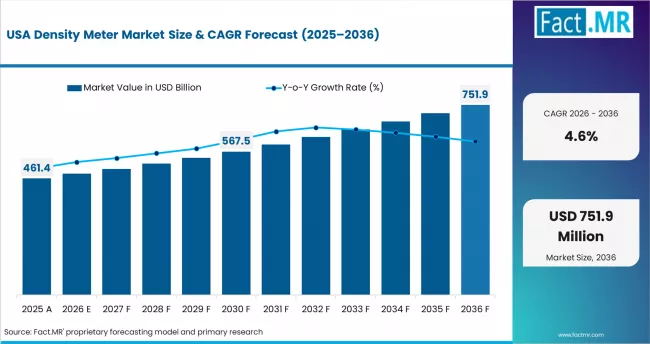
Density Meter Market Country Value Analysis | Source: Fact.MR
North America remains a major demand base because oil and gas, chemicals, food processing, and life science industries use density measurement in quality and process control. The United States has strong demand for custody transfer, petroleum testing, and automated process measurement.
- United States: The United States is forecast to post 4.6% CAGR over the assessment period, as custody transfer, lab automation, and process monitoring sustain demand. Refineries and terminals use density values for petroleum product measurement. Chemical and food plants use density meters for concentration control. Suppliers with service networks and standards-based application support can defend industrial accounts.
Western Europe Density Meter Market Analysis
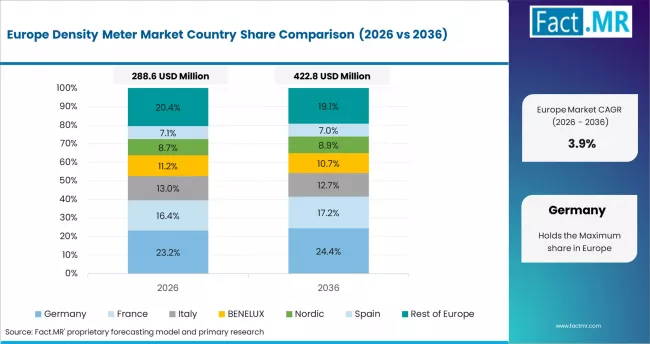
Density Meter Market Europe Country Market Share Analysis, 2026 & 2036 | Source: Fact.MR
Western Europe demand is shaped by advanced process industries, strict product quality expectations, and laboratory documentation needs. Germany leads the regional spread due to its chemical, pharmaceutical, and industrial base. The UK supports demand through energy, laboratory testing, and food manufacturing.
- Germany: Germany is projected to grow at 4.4% CAGR during 2026 to 2036 as chemical and pharmaceutical users invest in reliable measurement. Laboratories need density meters for formulation and quality-control workflows. Process plants use inline units to manage concentration and product consistency. Suppliers that provide calibration support and integration guidance can protect institutional accounts.
- UK: The UK is expected to expand at 3.7% CAGR by 2036. Energy, food, and laboratory testing users create steady demand for density meters. Buyers often prioritize accuracy, documentation, and service access over low upfront cost. Portable meters can gain in field checks and production-area testing. Growth remains steady because the installed base is already established.
Latin America Density Meter Market Analysis
Latin America demand is supported by oil and gas, mining, food processing, and chemical production. Brazil leads regional demand because it has a broad industrial base and large food and energy sectors. Cost sensitivity remains important, but process users still need dependable measurement where density affects product quality. Distributor availability and calibration support shape adoption outside major industrial centers.
- Brazil: Brazil is projected to record 3.9% CAGR over the study period. Oil and gas, mining, and beverage production support density meter demand. Process plants need density readings for concentration and slurry monitoring. Laboratories use digital instruments for product testing and quality control. Suppliers with service partners and spare-parts availability can build stronger repeat demand.
Competitive Aligners for Market Players
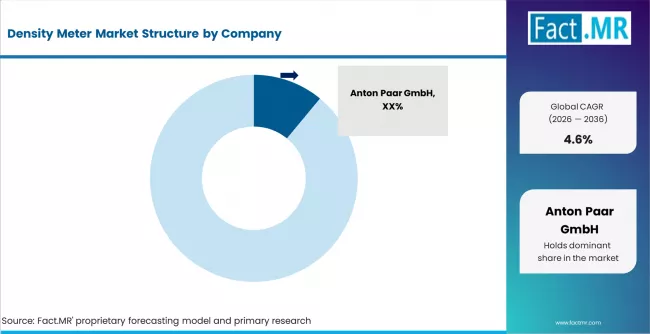
Density Meter Market Analysis By Company | Source: Fact.MR
The density meter market is moderately concentrated across global measurement companies and specialized laboratory instrument suppliers. Anton Paar, Mettler Toledo, Emerson, Endress+Hauser, Thermo Fisher Scientific, and Toshiba compete through accuracy, measurement principle, application coverage, and service depth. Buyers evaluate suppliers through calibration support, sample compatibility, integration, and long-term reliability.
Competitive advantage depends on matching instrument type with use conditions. Mettler Toledo offers benchtop and portable density meters based on oscillation tube technology. Emerson’s Micro Motion density meters target custody transfer and concentration measurement in process environments. These portfolios show why suppliers compete across laboratory and inline applications rather than one instrument class.
Process integration is becoming more important as users connect density values with automation systems. Emerson’s Coriolis portfolio supports mass flow, volume flow, and density measurement needs, which strengthens its position in process plants. Suppliers that combine accurate measurement, digital diagnostics, and service support are better placed through 2036. Low-cost providers can gain in basic testing, but high-value accounts will favor proven calibration and application support.
Key Players in Density Meter Market
- Anton Paar GmbH
- Mettler Toledo
- Emerson Electric Co.
- Endress+Hauser Group
- Thermo Fisher Scientific Inc.
- Toshiba Corporation
- Yokogawa Electric Corporation
- A.KRÜSS Optronic GmbH
- KEM Kyoto Electronics Manufacturing Co., Ltd.
- Rudolph Research Analytical
- Bopp & Reuther Messtechnik GmbH
- Berthold Technologies GmbH & Co. KG
- SensoTech GmbH
- LEMIS Baltic
Bibliography
- [1]. ASTM International. (2022). ASTM D4052-22: Standard test method for density, relative density, and API gravity of liquids by digital density meter. ASTM International.
- [2]. Emerson Electric Co. (2025). Micro Motion Compact Density Meter. Emerson.
- [3]. Mettler Toledo. (2025). Digital benchtop and portable density meters. Mettler Toledo.
- [4]. American Petroleum Institute. (2018). Manual of Petroleum Measurement Standards Chapter 9.4: Continuous density measurement under dynamic conditions. API.
- [5]. Emerson Electric Co. (2025). Coriolis flow meters. Emerson.
This Report Addresses
- Strategic intelligence on density meter demand across process measurement, laboratory testing, portable checks, custody transfer, and concentration control globally.
- Market forecast from USD 1.1 billion in 2026 to USD 1.8 billion by 2036 at a CAGR of 4.6%.
- Growth opportunity mapping across China process automation, India refinery and chemical investment, United States custody transfer demand, Germany chemical quality control, and Japan replacement demand.
- Segment analysis by meter type, technology, application, end-use industry, and sales channel.
- Regional outlook covering East Asia industrial automation, South Asia process investment, North America standards-based measurement, Western Europe quality-control discipline, and Latin America process industry demand.
- Competitive analysis of Anton Paar, Mettler Toledo, Emerson Electric, Endress+Hauser, Thermo Fisher Scientific, Toshiba, Yokogawa, KRÜSS, and KEM.
- Product assessment covering process density meters, laboratory density meters, portable meters, vibrating tube systems, Coriolis meters, and nuclear density meters.
- Report delivered through PDF, Excel datasets, and presentation formats, supported by primary interviews, standards review, supplier portfolio analysis, distributor checks, and process-user validation.
Density Meter Market Definition
The density meter market covers instruments used to measure the density, relative density, specific gravity, concentration, or API gravity of liquids, slurries, and gases. The market includes inline process instruments, laboratory benchtop systems, portable meters, and related accessories. It differs from general analytical instruments because density meters directly support product consistency, custody transfer, formulation, and concentration control.
Density Meter Market Inclusions
The scope includes process density meters, laboratory density meters, portable density meters, vibrating tube meters, Coriolis density meters, ultrasonic meters, nuclear density meters, microwave meters, hydrometers, pycnometers, sample handling accessories, and calibration support. Instruments used in oil and gas, chemicals, food and beverages, pharmaceuticals, mining, pulp and paper, and water treatment are included when density or concentration measurement is a core function.
Density Meter Market Exclusions
The scope excludes general flow meters without density output, weighing balances, moisture analyzers, refractometers sold without density measurement, process sensors unrelated to density, and laboratory glassware without measurement instrumentation. Standalone software is excluded unless bundled with density measurement hardware. Calibration services are excluded unless linked directly with density meter sales.
Density Meter Market Research Methodology
- Primary Research:Interviews with process engineers, refinery laboratory managers, quality-control heads, instrument distributors, system integrators, and density meter suppliers.
- Desk Research:Review of instrument catalogs, ASTM and API standards, company annual reports, product manuals, industrial automation documents, and application notes.
- Market-Sizing and Forecasting:Forecasting uses installed instrument base, replacement cycles, process industry investment, lab automation, and inline measurement adoption.
- Data Validation and Update Cycle:Forecasts are validated through supplier checks, distributor inputs, laboratory buyer interviews, and process plant instrumentation review.
Segmentation
Scope of the Report
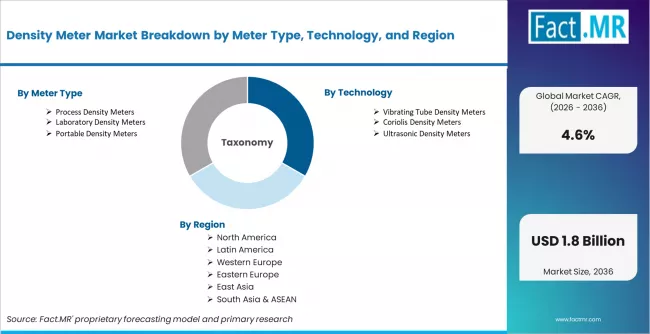
Density Meter Market Breakdown By Meter Type, Technology, And Region | Source: Fact.MR
| Attribute | Details |
|---|---|
| Quantitative Units | USD 1.1 billion in 2026 to USD 1.8 billion by 2036, at a CAGR of 4.6% |
| Market Definition | Instruments used to measure density, relative density, specific gravity, concentration, or API gravity of liquids, gases, and slurries across laboratory and process environments. |
| Meter Type | Process Density Meters, Laboratory Density Meters, Portable Density Meters |
| Technology | Vibrating Tube Density Meters, Coriolis Density Meters, Ultrasonic Density Meters, Nuclear Density Meters, Microwave Density Meters, Hydrometers and Pycnometers |
| Application | Concentration Measurement, Quality Control, Custody Transfer, Process Monitoring, Product Formulation |
| End-use Industry | Oil and Gas, Chemicals and Petrochemicals, Food and Beverages, Pharmaceuticals and Biotechnology, Water and Wastewater, Mining and Pulp and Paper |
| Sales Channel | Direct Institutional Sales, Instrument Distributors, Online Scientific Supply Channels, System Integrators |
| Regions Covered | North America, Latin America, Western Europe, Eastern Europe, East Asia, South Asia and Pacific, Middle East and Africa |
| Countries Covered | China, India, United States, Germany, Japan, Brazil, UK, and 40 plus countries |
| Key Companies Profiled | Anton Paar GmbH, Mettler Toledo, Emerson Electric Co., Endress+Hauser Group, Thermo Fisher Scientific Inc., Toshiba Corporation, Yokogawa Electric Corporation, A.KRÜSS Optronic GmbH, KEM Kyoto Electronics Manufacturing Co., Rudolph Research Analytical, Bopp & Reuther Messtechnik GmbH, Berthold Technologies GmbH & Co. KG, SensoTech GmbH, LEMIS Baltic |
| Forecast Period | 2026 to 2036 |
| Approach | Hybrid top-down and bottom-up model using installed instrument base, replacement cycles, process industry demand, laboratory automation, inline measurement adoption, and primary interviews with industrial buyers. |
Source: Fact.MR analysis. Updated May 18, 2026
Density Meter Market Analysis by Segments
-
By Meter Type:
- Process Density Meters
- Laboratory Density Meters
- Portable Density Meters
-
By Technology:
- Vibrating Tube Density Meters
- Coriolis Density Meters
- Ultrasonic Density Meters
- Nuclear Density Meters
- Microwave Density Meters
- Hydrometers and Pycnometers
-
By Application:
- Concentration Measurement
- Quality Control
- Custody Transfer
- Process Monitoring
- Product Formulation
-
By End-use Industry:
- Oil and Gas
- Chemicals and Petrochemicals
- Food and Beverages
- Pharmaceuticals and Biotechnology
- Water and Wastewater
- Mining and Pulp and Paper
-
By Sales Channel:
- Direct Institutional Sales
- Instrument Distributors
- Online Scientific Supply Channels
- System Integrators
-
By Region:
- North America
- United States
- Canada
- Latin America
- Brazil
- Mexico
- Western Europe
- Germany
- UK
- France
- Eastern Europe
- Poland
- Russia
- East Asia
- China
- Japan
- South Korea
- South Asia and Pacific
- India
- ASEAN
- Australia and New Zealand
- Middle East and Africa
- GCC
- South Africa
- North America
Frequently Asked Questions
How large is the density meter market in 2025?
What is the expected value in 2026?
What is the forecast value by 2036?
What CAGR is projected for 2026 to 2036?
Which meter type leads demand?
Which technology accounts for the highest share?
Which application drives the largest demand?
Which end-use industry leads the market?
Which sales channel accounts for the highest share?
Which country shows the fastest growth?
Why do process density meters lead demand?
Why are vibrating tube density meters widely used?
Why is density measurement important in oil and gas?
What is the main restraint in this market?
How does ASTM D4052 affect demand?
Why are portable density meters gaining demand?
What supports demand in China?
What supports demand in India?
What supports demand in the United States?
Why is calibration support important?
What defines competition in this market?
Who are the leading companies?
Who worked on this report


Preview the report firsthand - request a free sample
Free SampleGet the brochure for pricing and purchase details
Download PDF