- Base Value(2024): 32.6 Bn
- Forecast Value (2035): 310.1 Bn
- CAGR (2035): 22.8%
Nanoelectromechanical Resonators Market Outlook (2025 to 2035)
The global Nanoelectromechanical Resonators Market is expected to reach USD 310.1 billion by 2035, up from USD 32.6 billion in 2024. During the forecast period 2025 to 2035, the industry is projected to expand at a CAGR of 22.6%.
Growth drivers include the rollout of 5G/6G and RF front-ends, which demand ultra-stable, low-power frequency control. Rising requirements for miniaturized, high-Q sensing in wearables, medical diagnostics, and industrial IoT are also fueling adoption. Advances in nanomaterials, wafer-level packaging, and AI-driven design platforms are improving reliability, accelerating commercialization, and strengthening supply resilience for tier-one OEMs.
2025-to-2035.webp "Us Nanoelectromechanical Resonator Market Value(usd Million)2025 To 2035")
Us Nanoelectromechanical Resonator Market Value(usd Million)2025 To 2035 | Source: Fact.MR
Quick Stats for Nanoelectromechanical Resonators Market
- Industry Value (2025): USD 32.6 Billion
- Projected Value (2035): USD 310.1 Billion
- Forecast CAGR (2025 to 2035): 22.6%
- Leading Segment (2025): Graphene and Carbon Nanotubes (CNTs) (35% Market Share)
- Fastest Growing Country (2025-2035): Japan (22.0% CAGR)
- Top Key Players: Agilent Technologies, Nanocyl, Robert Bosch GmbH, STMicroelectronics, Bruker Corporation, SiTime Corporation.
What are the key factors driving growth in the Nanoelectromechanical Resonators Market?
Adoption of resonator technologies is rising as ultra-stable frequency control, high quality factor, and low phase noise enable precise timing and filtering in crowded bandwidths. Miniaturization requires low-power, small-footprint designs to support thinner devices and extended battery life. The convergence of communication, sensing, and edge computing heightens demand for accuracy.
Advances in nanomaterials, thin-film deposition, and lithography enhance repeatability and reliability. Ecosystem investments in design automation, multiphysics simulation, and reference designs reduce OEM risks. Additionally, policies promoting secure supply chains and energy efficiency are accelerating commercialization and boosting domestic production.
What are the key trends driving growth in the Nanoelectromechanical Resonators market?
Manufacturers are shifting to bi-modal architectures using piezoelectric thin films with carbon-based devices to balance sensitivity, linearity, and thermal stability. Co-integration with RF front-ends, controllers, and power systems is enabled by chiplet-ready packaging and wafer-level encapsulation. Reference platforms and modular timing subsystems shorten design cycles in consumer, automotive, and medical applications.
Qualification standards now emphasize mission-critical demands, with robust data on fatigue, drift, and environmental durability. Supply chain alliances among fabs, material suppliers, and AI-driven design firms refine process windows, while recycling, reduced solvents, and energy-efficient processing ensure performance, yield, and reliability across product life cycles.
What factors hinder the growth of the Nanoelectromechanical Resonators market?
Process variability at the nanoscale limits commercial scaling, affecting frequency stability, quality factor, and lot-to-lot consistency. Packaging must balance protection, parasitics, and recyclability, complicating standardization. Multiphysics complexity raises verification overheads and lengthens qualification cycles for safety-critical uses. Limited tooling supply, immature metrology, and restricted foundry capacity for non-standard materials constrain throughput.
Fragmented intellectual property in MEMS, BAW, and NEMR creates procurement and roadmap confusion. Additionally, risk-averse customers demand extensive lifetime data, robust application notes, and secure supply chains, which can slow design-in despite performance advantages, and often hinder adoption in programs requiring high assurance and long-term reliability.
What are the key regional trends driving the Nanoelectromechanical Resonators Market growth?
North America
Driven by the U.S., the demand is concentrated in 5G/6G infrastructure, aerospace-defense, medical devices and industrial IoT. Advanced timing/RF ecosystem (fabless design, specialty foundries and advanced packaging) to enable faster commercialization. NEMR modules The government procurement and security standards tend to favor long lifecycle support and low power and rugged NEMR modules.
East Asia
High-volume manufacturing and consumer electronics demand are anchored by China, Japan, South Korea and Taiwan. The strengths are RF front-end supply chains, wafer-level packaging, and materials innovation. Programs in smartphone, automotive and wearables lead to miniaturization, whereas programs by design-in and scale are propelled by policy support and ODM networks.
Western Europe
Germany, France, the United Kingdom and the Netherlands focus on automotive and industrial automation solutions, as well as medical technologies. NEMR qualification is supported by strength in precision manufacture, acoustics and reliability testing capabilities. The recyclable packaging and materials are driven by sustainability frameworks and circular-design requirements and cultivated by public-private initiatives to support pilot lines and supply-chain durability.
Country-wise Outlook
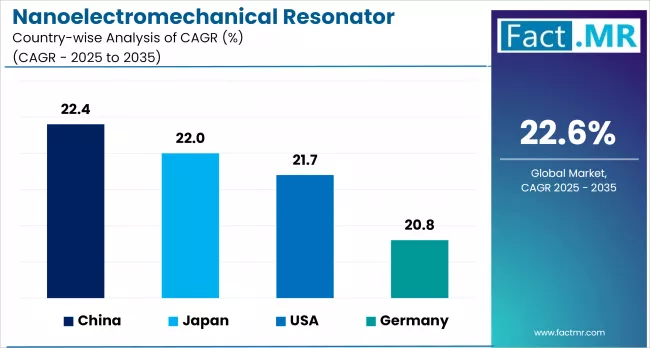
Nanoelectromechanical Resonator Market By Country | Source: Fact.MR
Sustainability Trends and Convenience Drive U.S. Nanoelectromechanical Resonators
A high market of Nanoelectromechanical Resonators is witnessed in the U.S. where there is a high demand of portable, energy-efficient and environmentally friendly electronic devices. Critical designs that save power, prolong battery life, and make an in-miniaturized device are the priorities of manufacturers in consumer electronics, automotive and medical systems.
2025-to-2035.webp "Us Nanoelectromechanical Resonator Market Country Value(usd Million)2025 To 2035")
Us Nanoelectromechanical Resonator Market Country Value(usd Million)2025 To 2035 | Source: Fact.MR
The high-end market is selling its products as reliable, well packaged, and with environmentally friendly materials. The needs to strike a balance between recyclability and secure domestic production as well as performance are markets that both established semiconductor players and new start-ups target. The distribution channels cut across large OEMs, and specialised component suppliers, similar to the national trends favouring sustainability, security in supply chains, and innovations in next-generation electronics.
Urbanization and E-Commerce Boost China’s Nanoelectromechanical Resonators
The Nanoelectromechanical Resonators market is being driven by rampant urbanization and the adoption of digital technology in China. There is increasing customer interest in integrated water- and energy-efficient devices in small, connected lifestyles and resource-sensitive areas. Domestic manufacturers take advantage of tradition-based engineering methods along with inclusion of the latest nanomaterials and carbon-structured design to enhance the thermal stability and sensitivity.
E-Commerce and digital technologies allow accessing components and national industry policy targets water and energy saving. Patriate NEMR suppliers offer dependable capabilities and state-of-the-art integration that chases not only Chinese needs but also integrating into semiconductor and telecom supply chains worldwide.
Minimalist Design and Precision Engineering Define Japan’s Market
Japan Nanoelectromechanical Resonators market is sustained by minimalist engineering, engineering-driven design, and material science of high level. Applications include high-frequency stability, and low phase noise, as well as solutions specific to automotive electronics, telecommunications or medical sensing. Nanotechnology overcomes the gap between nanotechnology and conventional Japanese engineering with the focus on algorithms since it is durable, efficient and long life cycle performance oriented. Wafer-level encapsulating and co-integration with RF front end is a common technology it is in favor of Japan leadership in high-reliability electronics. Domestic brands continue to hold major footholds in department level OEM alliances and consumer electronics with expanding reach to Southeast Asia, where the high demand lies with the precision technologies that have their origins in the Japanese quality and innovation.
Category-Wise Market Outlook
Graphene and CNTs Grow Fastest as Next-Gen Materials Enable Miniaturization
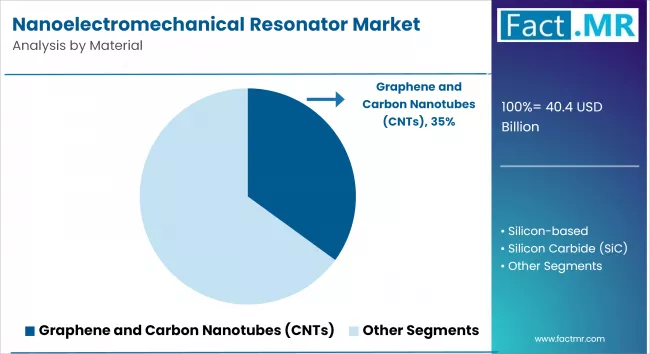
Nanoelectromechanical Resonator Market By Material | Source: Fact.MR
Graphene and Carbon Nanotubes (CNTs) are experiencing strong growth among materials, supported by their excellent electrical conductivity, extremely low mass, and superior mechanical strength. The properties make NEM resonators perfect candidates of ultra-sensitive sensing and high-frequency applications because they enable miniaturization and improvement in the performance of the resonators to unprecedented scales. The fact that they fit new semiconductor platforms and their popularity in researches into quantum devices increases their uptake even further.
Membrane Resonators Surge with Push for Ultra-High-Frequency Devices
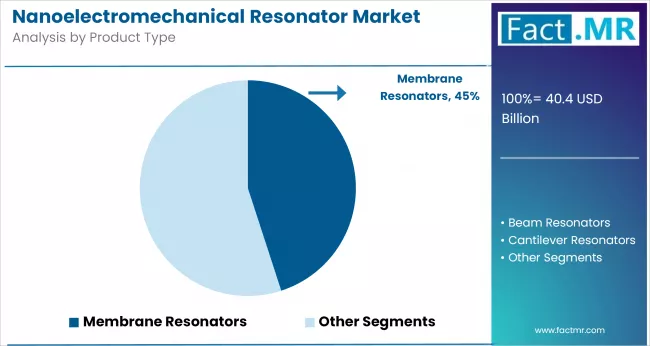
Nanoelectromechanical Resonator Market By Product Type | Source: Fact.MR
Membrane Resonators are an emerging product type, recognized for their ability to operate at ultra-high frequencies while offering mechanical flexibility and minimal energy dissipation. They use a thin-film form factor that facilitates complex signal processing and reference frequency in small communication modules. The popularity of 5G, internet of Things, and biomedical sensors is increasing the demand in these precision parts, and in particular in applications as limited concerning space.
Sensing & Detection Segment Expands Rapidly Due to Cross-Industry Adoption
On the application side, Sensing & Detection is experiencing strong growth as industries increasingly adopt NEM resonators for chemical, biological, and physical detection applications. They have a high sensitivity, are real-time responsive and have a nanoscale footprint making them an important tool in areas such as medical diagnostics, monitoring the environment and security. Wearable health monitors and lab-on-chips technologies are another driving force in the development in world R&D centers.
Competitive Analysis
Competitive Outlook: Nanoelectromechanical Resonators Market
The Nanoelectromechanical Resonators Market is influenced by a combination of precision instrumentation industry leaders and experts in the next generation semiconductor and sensor technologies. Agilent Technologies is one of the players that provides high-precision measurement solutions needed to test nano-sized devices. Nanocyl takes the field forward in the form of conductive nanomaterials being used to improve the resonator. Robert Bosch GmbH and STMicroelectronics are the two players that are making known integration of MEMS/NEMS into automotive and industrial usage because they have the scalable semiconductor manufacturing drive.
Bruker Corporation has an advanced material characterization product that leads materials innovation at a nanoscale. SiTime Corporation is the market leader in MEMS timing and provides the best quality consumer and industrial electronic resonators. Akoustis Technologies, Inc. is a company that is into RF filter technologies where the resonators are specifically designed high-frequency communication. Panasonic Corporation focuses on a multi-function sensor system and material efficiency and Texas Instruments (TI) on leveraging analog and embedded processing capabilities to drive sturdy NEMS-enabled platforms. Collectively, these firms enhance the trends in signal robustness, material design and integration density, and enable the growth of NEMS in communication, automotive, industrial, and medical applications.
Key players in the nanoelectromechanical resonators industry are Agilent Technologies, Nanocyl, Robert, Bosch GmbH, STMicroelectronics, Bruker Corporation, SiTime Corporation, Akoustis Technologies, Inc., Panasonic Corporation, and Texas Instruments (TI).
Recent Development:
- In July 2025, Murata began mass production of the world’s first high-frequency XBAR™ filter, combining Resonant Inc.’s XBAR with Murata’s SAW expertise to achieve low insertion loss and high attenuation for Wi-Fi 7/5G. This marks a commercial ramp of advanced piezoelectric BAW resonators.
- In April 2024, SiTime unveiled Chorus™, a MEMS clock-system-on-chip integrating clock, oscillator and resonator for AI datacenter timing—promising 10× performance in half the size to accelerate design cycles.
Fact.MR has provided detailed information about the price points of key manufacturers of the Nanoelectromechanical Resonators market positioned across regions, sales growth, production capacity, and speculative technological expansion in the recently published report.
Methodology and Industry Tracking Approach
The global report by Fact.MR on NEMRs markets puts forward a historical retrospective of product design, materials sourcing, and commercialization across consumer electronics, automotive, medical, and industrial sectors that are entangled in an innovation driven ecosystem. Leaning on survey data of 8,000+ stakeholders across 38 countries (350+ validated contacts per country) the research provides unparalleled visibility regarding the next-generation materials engineering, the use of AI in designing resonators and RF co-design, sustainable manufacturing, and scaling strategies that can drive the early adoption.
Maturing market trends identified as important as the mass introduction of AI/ML into the design of nanoscale resonators, oscillators, and RF front-ends; the increasing demand of recyclable and environment-friendly components as well as the adoption of digital-twin and advanced multiphysics simulation to enhance the frequency and Q-factor stability and long-term reliability of NEMR devices. It advances a multidimensional perspective of the shift toward sustainable, high-performance nanoelectronics based on insights supplied by 225 industry insidersIC designers, R&D managers, heads of innovation, supply-chain architects, regulatory officers, technology developers, investors, and policy advisors. With the time window of 20242025 as a reference, the report puts on the benchmark the improvements in substrate engineering (e.g., silicon, piezoelectric thin films, CNT/graphene), encapsulation and packaging and accelerated qualification (thermal cycling, mechanical fatigue, RF stress). Driven by 250+ confirmed data points, proprietary forecasting and adoption-elasticity models in key markets, the report identifies the next paradigm shift in NEMR innovation and market potential.
Segmentation
Segmentation of Nanoelectromechanical Resonators Market Research
-
By Material :
- Silicon-based
- Silicon Carbide (SiC)
- Gallium Arsenide (GaAs)
- Graphene and Carbon Nanotubes (CNTs)
- Others (e.g., Diamond-like Carbon, Advanced Alloys)
-
By Product Type :
- Beam Resonators
- Cantilever Resonators
- Membrane Resonators
- Tuning Fork Resonators
- Others
-
By Application :
- Sensing & Detection (Chemical, Biological, Physical)
- Signal Processing
- Oscillators & Frequency References
- RF Communication
- Others (Quantum Devices, Research Applications)
-
By End-User Industry :
- Consumer Electronics
- Automotive & Transportation
- Healthcare & Biomedical
- Telecommunications
- Defense & Aerospace
- Industrial & Research Institutions
-
By Region :
- North America
- Latin America
- Western Europe
- Eastern Europe
- East Asia
- South Asia & Pacific
- Middle East & Africa
Frequently Asked Questions
What was the Global Nanoelectromechanical Resonators Market Size Reported by Fact.MR for 2024?
Who are the Major Players Operating in the Nanoelectromechanical Resonators Market?
What is the Estimated Valuation of the Nanoelectromechanical Resonators Market in 2035?
What Value CAGR did the Nanoelectromechanical Resonators Market Exhibit Over the Last Five Years?
Who worked on this report


Preview the report firsthand - request a free sample
Free SampleGet the brochure for pricing and purchase details
Download PDF