- Base Value(2025): 2.7 Bn
- Estimated Value(2026): 2.8 Bn
- Forecast Value (2036): 5.1 Bn
- CAGR (2026 - 2036): 6.0%
Dental Diagnostic Imaging Equipment Market Analysis and Forecast by Fact.MR
The global market for dental diagnostic imaging equipment is estimated to be around USD 2.8 billion in 2026 and has been forecast to expand at a CAGR of 6.0% to end up at USD 5.1 billion by 2036. The Dental Diagnostic Imaging Equipment segment is led by Intraoral X-Ray Systems, which is anticipated to account for 38.0% of the product segment in 2026, while Dental Diagnostics is expected to remain the leading application with around 41.0% share. The market was valued at USD 2.7 billion in 2025 and is poised for steady growth driven by evolving industry dynamics and regional demand patterns.
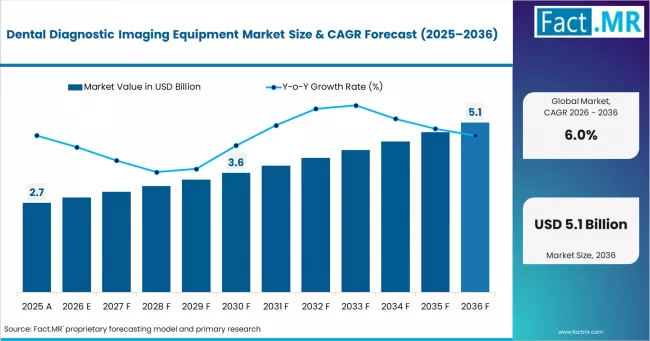
Dental Diagnostic Imaging Equipment Market Market Value Analysis | Source: Fact.MR
Summary of Dental Diagnostic Imaging Equipment Market
-
Market Snapshot
- In 2025, the global Dental Diagnostic Imaging Equipment Market was valued at approximately USD 2.7 billion.
- The market is estimated to reach USD 2.8 billion in 2026 and is projected to attain USD 5.1 billion by 2036
- The dental diagnostic imaging equipment market is likely to expand at a CAGR of 6.0% during the forecast period.
- The market is anticipated to create an absolute dollar opportunity of USD 2.3 billion between 2026 and 2036.
- Intraoral X-Ray Systems account for 38.0% of market share in 2026.
- India (7.5%) and Germany (6.9%) are the key growth markets during the forecast period
-
Demand and Growth Drivers
- Demand is shaped by the rising volume of dental procedures across restorative, orthodontic, and implant dentistry, each of which requires precise imaging for planning and follow-up.
- Growth reflects the broad shift from analog film-based X-ray systems to digital radiography, which delivers faster results, lower radiation doses, and better image quality.
- Adoption is increasing due to the expansion of implant dentistry and aligner-based orthodontics, both of which rely on cone beam computed tomography and 3D imaging for treatment planning.
-
Product and Segment View
- Intraoral X-ray systems lead the product segment with a 38% share in 2026, supported by their widespread use across routine dental examinations and cavity detection workflows.
- Dental diagnostics hold 41% of the application segment, anchored by standard diagnostic examination use across dental practices and hospital dental departments.
- Dental clinics account for 58% of end-use demand, while hospitals, diagnostic centers, and academic and research institutes form secondary channels.
-
Geography and Competitive Outlook
- North America remains the largest regional market, supported by high dental procedure volumes, broad implant and aligner adoption, and mature digital imaging infrastructure.
- Asia Pacific is the fastest-growing region, led by India where corporate dental chain expansion and rising disposable income are both supporting equipment adoption.
- The competitive field is led by Philips Healthcare, Hologic Inc., GE Healthcare, Carestream Health, and Planmeca Oy, with specialty dental imaging players such as Shimadzu and Canon Medical holding differentiated positions.
-
Analyst Opinion
- Dental diagnostic imaging has moved decisively into the digital era, with analog film-based systems now a legacy category. The commercial economics are shaped by the dual growth engines of routine intraoral imaging volumes and premium 3D CBCT adoption tied to implant and aligner treatment planning. The commercial lever that matters is software integration combined with training support, because dental practices increasingly choose equipment based on how well it plugs into practice management systems and digital workflows. Players that combine strong imaging hardware with intuitive software ecosystems and post-sale training will capture the bulk of forecast period growth, while commodity intraoral sensor vendors face margin pressure as the category matures.
Why is Dental Diagnostic Imaging Equipment Market Growing?
- Growth reflects the ongoing replacement of analog X-ray film systems with digital radiography across dental practices globally.
- Demand is shaped by the rapid expansion of dental implant procedures and clear aligner therapy, both of which rely on 3D CBCT imaging for treatment planning.
- Adoption is increasing due to corporate dental chain expansion, dental insurance coverage for diagnostic imaging, and rising patient expectations for digital treatment visualization.
The demand base rests on the broad digitization of dental practice workflows. Digital intraoral sensors, panoramic systems, and CBCT scanners have largely replaced analog film equivalents in developed markets, while emerging markets are progressing through the same transition at varying speeds. This substitution is not incremental but wholesale, and it supports equipment replacement demand across the installed base even in mature geographies.
Implant and aligner expansion is the second structural driver. Dental implant procedures require CBCT imaging for surgical planning, and clear aligner therapy relies on panoramic and intraoral imaging for treatment progress monitoring. The rapid growth of these high-value procedures has directly lifted imaging equipment demand, particularly for 3D CBCT systems that can cost USD 50,000 to USD 200,000 per unit and represent a meaningful capital investment for dental practices.
The third driver is dental practice consolidation. Corporate dental chains such as Heartland Dental, Aspen Dental, and Pacific Dental Services in the US, along with similar chains in Europe and Asia, are standardizing imaging equipment across their networks. This concentration of purchasing decisions favors scaled equipment manufacturers and supports brand consolidation across the category.
Segment-wise Analysis of Dental Diagnostic Imaging Equipment Market
- Intraoral X-ray systems lead the product segment with 38% share in 2026, anchored by routine use across dental diagnostic workflows.
- Cone beam computed tomography (CBCT) systems represent the fastest-growing product sub-segment, driven by implant and aligner treatment planning demand.
- Dental clinics hold 58% of end-use demand, while hospitals and diagnostic centers form secondary channels.
The segmentation view shows a category where routine intraoral imaging provides baseline demand while CBCT and advanced 3D systems drive incremental revenue growth. Competitive advantage sits in product portfolio breadth, software integration, and distribution reach rather than in any single modality strength. Growth over the forecast period is expected to tilt toward 3D and advanced imaging formats as implant and aligner volumes continue to expand.
Why Do Intraoral X-Ray Systems Lead the Product Segment?
Intraoral X-ray systems lead the product segment because they are the most widely used imaging modality across dental practice. Every general dentist, specialist practice, and hospital dental department uses intraoral X-rays for routine examinations, cavity detection, and periodontal assessment. The installed base is large, replacement cycles are predictable, and digital sensor technology has made the transition from film-based to digital radiography both clinically and economically compelling.
The segment leadership is reinforced by multiple buying triggers. New dental practices require intraoral imaging as core equipment, existing practices upgrade analog systems to digital as part of routine capital replacement, and practice acquisitions by corporate chains often trigger equipment standardization. These overlapping demand sources create stable baseline volume that other imaging modalities do not match.
Why is CBCT the Fastest-Growing Sub-Segment?
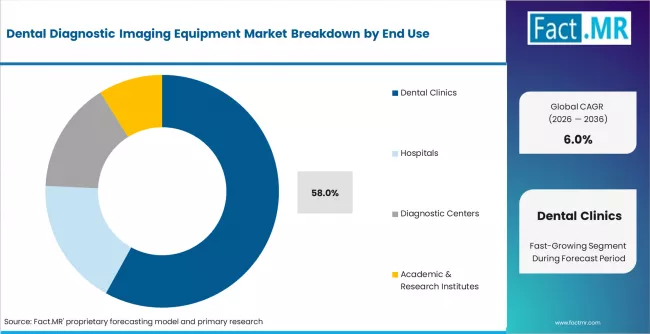
Dental Diagnostic Imaging Equipment Market Analysis By End Use | Source: Fact.MR
Cone beam computed tomography (CBCT) is the fastest-growing imaging sub-segment because it is essential for implant planning and provides meaningful clinical value across orthodontics, endodontics, and oral surgery. CBCT systems provide 3D volumetric imaging at radiation doses substantially lower than medical CT, which has expanded their clinical utility across general dental practice, not just specialty settings.
Growth within CBCT is being lifted by the expansion of dental implant procedures globally and by the adoption of digital smile design and guided surgery workflows that depend on 3D imaging inputs. CBCT systems also generate recurring revenue through service contracts, software upgrades, and training support, which makes them commercially attractive relative to commodity intraoral imaging hardware.
Key Growth Drivers, Constraints, and Market Scope
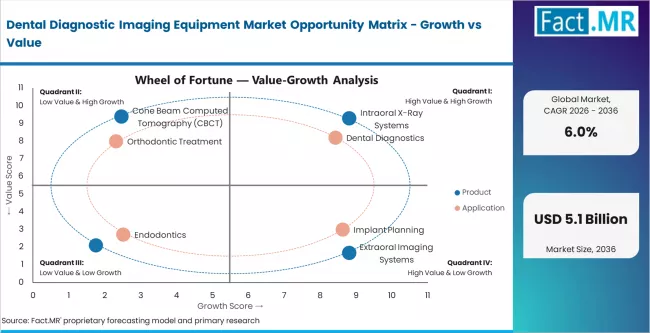
Dental Diagnostic Imaging Equipment Market Opportunity Matrix Growth Vs Value | Source: Fact.MR
- Digital radiography substitution and dental procedure volume growth are the structural demand foundations.
- Implant and aligner expansion is the key compositional shift driving premium CBCT adoption.
- Equipment cost, training requirements, and dental practice consolidation dynamics remain the leading constraints.
The market scope is shaped by the combination of steady replacement demand in intraoral imaging and premium growth in 3D CBCT tied to implant and aligner procedures. Competitive advantage sits in product portfolio breadth, software ecosystem depth, and distribution reach.
Growth Drivers
The primary driver is the transition from analog to digital radiography, which remains incomplete in emerging markets and creates sustained upgrade demand. A second driver is the rapid expansion of dental implant procedures and clear aligner therapy, both of which require CBCT or panoramic imaging for treatment planning. A third driver is corporate dental chain expansion, which concentrates equipment purchasing decisions with scaled manufacturers and supports brand consolidation. These three forces combine to deliver a steady mid-single-digit growth trajectory with premium uplift from 3D CBCT adoption.
Constraints
The leading constraint is equipment cost, particularly for CBCT systems where capital requirements can exceed USD 100,000 per unit. This limits adoption in smaller practices and in emerging markets where dental infrastructure investment remains uneven. A second constraint is training and operator skill requirements. CBCT interpretation requires dedicated radiology training that not all general dentists pursue, which limits clinical utilization. A third constraint is the consolidation of corporate dental chains, which can either accelerate adoption through standardization or slow it through pricing pressure on equipment vendors.
Opportunities
The strongest opportunity lies in CBCT portfolio expansion, where scaled manufacturers can capture premium revenue from implant and aligner treatment planning adoption. A second opportunity is digital workflow integration, where imaging equipment that connects natively to dental practice management software, CAD-CAM systems, and treatment planning platforms creates ecosystem stickiness. A third opportunity is emerging market penetration, particularly in India and Brazil, where corporate dental chain expansion and rising disposable income are both supporting equipment demand.
Regional Outlook Across Key Markets
.webp "Top Country Growth Comparison Dental Diagnostic Imaging Equipment Market Cagr (2026 2036)")
Top Country Growth Comparison Dental Diagnostic Imaging Equipment Market Cagr (2026 2036) | Source: Fact.MR
- India leads country-level growth at 7.5% CAGR, supported by corporate dental chain expansion, rising disposable income, and increasing awareness of advanced dental care.
- Germany follows at 6.9%, driven by mature digital dental infrastructure, statutory insurance coverage for diagnostic imaging, and active implant dentistry adoption.
- North America remains the largest regional pool by absolute value, with the USA at 5.7% supported by corporate dental chain consolidation and broad CBCT adoption.
- European demand is led by Germany at 6.9% and the UK at 5.1%, with both countries showing strong implant and aligner procedure growth.
Country CAGR Table
| Country | CAGR (%) |
|---|---|
| India | 7.5% |
| Germany | 6.9% |
| Brazil | 6.3% |
| USA | 5.7% |
| UK | 5.1% |
| Japan | 4.5% |
Source: Fact.MR analysis. Updated Apr 24, 2026
Source: Fact.MR analysis, based on proprietary forecasting model and primary research.
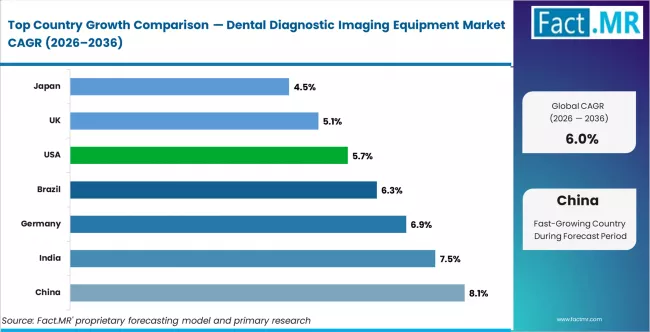
Dental Diagnostic Imaging Equipment Market Cagr Analysis By Country | Source: Fact.MR
Regional dynamics split into three profiles. Asia Pacific leads on growth rate, pulled by corporate dental chain expansion and rising disposable income. Europe grows at steady mid-single-digit rates driven by mature digital infrastructure and active implant and aligner procedure volumes. North America remains the largest dollar market, anchored by US dental practice density and corporate chain consolidation.
United States
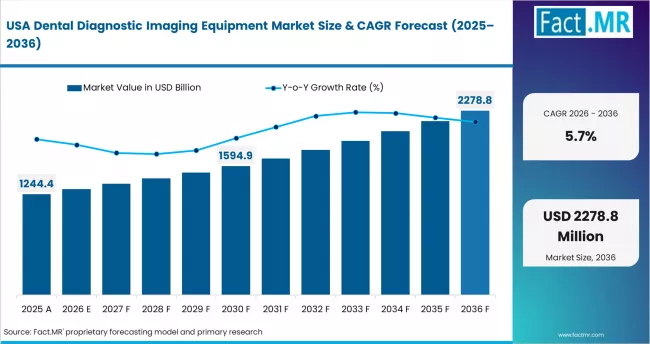
Dental Diagnostic Imaging Equipment Market Country Value Analysis | Source: Fact.MR
The United States anchors global demand through its large base of dental practices, corporate dental chain consolidation, and broad CBCT adoption for implant and aligner treatment planning. Heartland Dental, Aspen Dental, Pacific Dental Services, and other corporate groups are standardizing imaging equipment across their networks, which concentrates purchasing decisions with scaled manufacturers. Replacement demand across a large installed base of digital intraoral systems also sustains steady volumes.
- Corporate dental chain consolidation concentrates equipment purchasing decisions.
- CBCT adoption is supported by implant and aligner procedure volume growth.
- Digital intraoral system replacement demand sustains baseline volumes.
Canada
Canada represents a steady growth market shaped by provincial dental association standards, corporate dental chain expansion, and broad CBCT adoption in specialty practices. Cross-border equipment sourcing from US manufacturers sustains product availability, while domestic distributors support regional service networks.
- Provincial dental association standards guide equipment adoption decisions.
- Corporate dental chain expansion concentrates equipment purchasing decisions.
- Cross-border sourcing from US manufacturers supports product availability.
United Kingdom
The United Kingdom market is shaped by the mix of NHS and private dental practice imaging demand, with NHS dental departments and private clinics both driving digital equipment adoption. The expansion of clear aligner therapy through brands such as Invisalign and Smile Direct Club has lifted panoramic and CBCT imaging demand, while private dental groups such as BUPA Dental Care and Bupa Dental Plans have standardized imaging equipment across their networks.
- NHS and private dental practice imaging demand creates a dual channel structure.
- Clear aligner therapy expansion drives panoramic and CBCT imaging demand.
- Corporate dental groups standardize imaging equipment across practice networks.
Germany
Germany leads European growth on the strength of mature digital dental infrastructure, statutory insurance coverage for diagnostic imaging, and active implant dentistry adoption. German dental practices were among the earliest adopters of digital intraoral imaging and CBCT, which has created a large installed base and steady replacement demand. Dental equipment manufacturers such as Sirona Dental Systems have historically anchored the category, while international brands compete across specialty and corporate practice channels.
- Mature digital dental infrastructure creates steady replacement demand.
- Statutory insurance coverage supports predictable imaging volumes.
- Active implant dentistry adoption drives CBCT demand.
India
India is the fastest-growing country in the forecast, driven by corporate dental chain expansion, rising disposable income, and growing awareness of advanced dental care. Clove Dental, Dentzz, Apollo White Dental, and other corporate chains are standardizing imaging equipment across their networks, while metropolitan independent practices are upgrading from analog to digital systems. Implant and aligner procedure volumes are also expanding, driving CBCT adoption in tier-1 and tier-2 cities.
- Corporate dental chain expansion drives concentrated equipment procurement.
- Rising disposable income supports upgraded dental care demand.
- Implant and aligner procedure growth lifts CBCT adoption.
Brazil
Brazil represents a steady growth market shaped by expanding private dental practice infrastructure, rising middle-class spending on dental care, and progressive digital equipment adoption. Corporate dental chains such as OdontoPrev and SulAmerica dental networks are expanding their clinical footprints, while independent practices in major metropolitan areas are upgrading to digital intraoral and CBCT systems.
- Private dental practice infrastructure expansion drives equipment demand.
- Rising middle-class spending supports upgraded dental care access.
- Corporate dental chains are expanding clinical footprints across major cities.
Competitive Benchmarking and Company Positioning
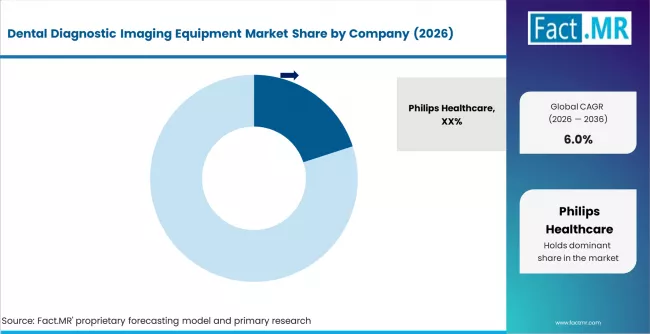
Dental Diagnostic Imaging Equipment Market Analysis By Company | Source: Fact.MR
- Philips Healthcare leads with an estimated 20% share, supported by its broad medical imaging portfolio, strong hospital relationships, and extending capability into dental imaging.
- Hologic Inc., GE Healthcare, Carestream Health, and Canon compete through established medical imaging portfolios and dedicated dental imaging platforms.
- Specialty dental imaging players such as Planmeca Oy, Shimadzu Corporation, and Fujifilm Holdings hold differentiated positions in panoramic, CBCT, and intraoral imaging.
The competitive field is moderately concentrated, with Philips Healthcare, Hologic Inc., and GE Healthcare leveraging broad medical imaging portfolios to extend into dental applications. Carestream Health has a dedicated dental imaging business with strong positions in intraoral sensors, panoramic systems, and CBCT platforms. Canon and Shimadzu Corporation anchor their positions through Japanese dental imaging heritage and extensive Asian market presence.
The specialty dental imaging layer is led by Planmeca Oy, Sirona Dental Systems (now Dentsply Sirona), Fujifilm Holdings, and Hitachi Medical Corporation. These companies compete through focused dental imaging product portfolios, specialized software ecosystems, and strong dental channel relationships. Samsung Medison and Siemens Healthcare also participate in specific segments through medical imaging capabilities extended into dental applications.
Strategic priorities across the field include expanding CBCT portfolios, deepening software ecosystem integration with practice management and treatment planning platforms, and investing in training and service networks. Scaled manufacturers with broad product portfolios and strong software ecosystems will capture the bulk of forecast period growth, while commodity intraoral sensor vendors face margin pressure as the category matures.
Competitive Analysis
Competitive positioning rests on three dimensions: product portfolio breadth, software ecosystem depth, and distribution and service reach. Philips Healthcare, GE Healthcare, and Hologic Inc. compete on medical imaging heritage extended into dental applications. Carestream Health, Planmeca Oy, and Dentsply Sirona compete as dental imaging specialists with dedicated dental channel relationships. Canon, Shimadzu Corporation, and Fujifilm Holdings hold strong positions in Asian markets.
Second-tier competitors maintain relevance through specialized product portfolios, regional channel strength, or differentiated software offerings. Emerging Chinese and Korean manufacturers are building positions in value-tier segments, particularly for intraoral sensors and panoramic systems. The gap between platform-level imaging companies with integrated software ecosystems and commodity hardware manufacturers is widening as dental practices prioritize workflow integration.
Benchmarking Table
| Company | Scale Reach | Product Breadth | Software Ecosystem | Dental Channel |
|---|---|---|---|---|
| Philips Healthcare | Global | Broad | Strong | Medium-Strong |
| GE Healthcare | Global | Broad | Strong | Medium |
| Carestream Health Inc. | Global | Broad | Strong | Strong |
| Planmeca Oy | Global | Broad | Strong | Strong |
| Hologic Inc. | Global | Medium | Medium | Medium |
| Canon | Global | Medium-Broad | Medium-Strong | Strong (Asia) |
| Shimadzu Corporation | Global | Medium | Medium | Strong (Asia) |
Source: Fact.MR analysis. Updated Apr 24, 2026
Recent Developments
- In 2025, Planmeca Oy continued expanding its CBCT product portfolio with upgraded 3D imaging platforms targeting implant and orthodontic treatment planning.
- In 2025, Carestream Health launched enhanced intraoral sensor and panoramic imaging systems with deeper practice management software integration.
- In 2026, Philips Healthcare advanced its dental imaging capability through product line extensions tied to its medical imaging heritage.
Leading Companies Shaping Dental Diagnostic Imaging Equipment Market
-
Major Players
- Philips Healthcare
- Hologic Inc.
- Canon
- Shimadzu Corporation
- Carestream Health Inc.
- GE Healthcare
- Planmeca Oy
- Siemens Healthcare
-
Emerging Players
- Toshiba Medical Systems Corporation
- Fujifilm Holdings Corporation
- Hitachi Medical Corporation
- Samsung Medison
- Dentsply Sirona
- Vatech Co. Ltd.
- Morita Corporation
- Acteon Group
Sources and Research References
- United States Food and Drug Administration (FDA) - 510(k) Clearance Database for Dental Imaging Systems
- American Dental Association (ADA) - Guidelines on Radiographic Examinations
- World Health Organization (WHO) - Radiation Protection in Dental Radiology Publications
- International Association of Dental Research (IADR) - Dental Imaging Research Publications
- Philips Healthcare - Annual Report and Imaging Segment Disclosures
- Carestream Health - Dental Imaging Product Portfolio and Platform Updates
- Primary interviews with dental practice owners, equipment manufacturers, and distribution partners
This bibliography is provided for reader reference and is not exhaustive. The full report contains the complete reference list and detailed citations.
Key Questions This Report Addresses
- What is the current and future size of the dental diagnostic imaging equipment market?
- How fast is the market expected to grow between 2026 and 2036?
- Which product segment is likely to lead the market by 2026?
- Which application segment will account for the highest demand by 2026?
- How is the shift from analog to digital radiography reshaping demand?
- Why are India and Germany emerging as key growth markets?
- Which countries are projected to show the fastest growth through 2036?
- Who are the key companies active in the dental diagnostic imaging equipment market?
- How is implant and aligner expansion driving CBCT adoption?
Dental Diagnostic Imaging Equipment Market Definition
The dental diagnostic imaging equipment market covers hardware systems used to capture radiographic, optical, and volumetric images of dental structures for diagnosis, treatment planning, and follow-up. This includes intraoral X-ray systems, extraoral imaging systems such as panoramic and cephalometric units, cone beam computed tomography (CBCT) scanners, and intraoral cameras used across general dentistry, specialty dentistry, and dental education settings.
Dental Diagnostic Imaging Equipment Market Inclusions
The scope includes intraoral X-ray systems with digital sensors, extraoral imaging systems including panoramic and cephalometric units, cone beam computed tomography (CBCT) scanners, and intraoral cameras. It covers applications across dental diagnostics, implant planning, orthodontic treatment, and endodontics. Coverage spans dental clinics, hospitals, diagnostic centers, and academic and research institutes from 2026 to 2036, along with supporting digital radiography technology, 3D imaging systems, and real-time imaging software.
Dental Diagnostic Imaging Equipment Market Exclusions
The scope excludes analog film-based X-ray systems that are being phased out, medical CT and MRI systems used for general radiology, dental laboratory imaging equipment used primarily for prosthesis fabrication, and dental chairside 3D printing systems. It also excludes consumable imaging supplies such as X-ray films, intraoral camera disposable sleeves, and software-only treatment planning platforms without hardware integration.
Dental Diagnostic Imaging Equipment Market Research Methodology
- Primary Research: Interviews with dental equipment manufacturers, dental practice owners, dental specialty association leaders, and distributor contacts to validate equipment adoption patterns, replacement cycles, and pricing dynamics.
- Desk Research: Review of FDA 510(k) clearances for dental imaging systems, CE mark filings, dental insurance coverage policies, and published financial disclosures of listed dental equipment companies.
- Market Sizing: Demand-side model built on dental practice counts, dental procedure volumes, implant and aligner case volumes, and equipment unit economics, triangulated with top-down shipment disclosures.
- Data Validation: Cross-validation across primary interviews, regulatory filings, and dental association data, with sensitivity checks on CBCT adoption rates and digital radiography replacement cycles.
Segmentation
Scope of Analysis
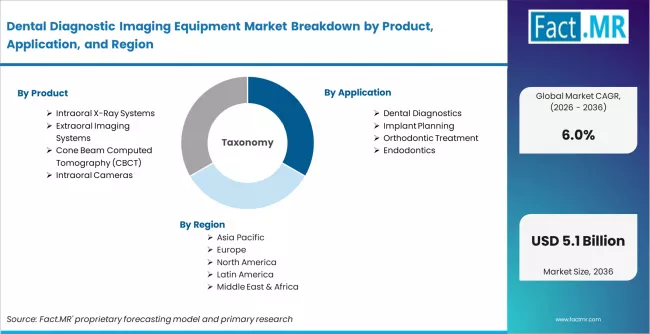
Dental Diagnostic Imaging Equipment Market Breakdown By Product, Application, And Region | Source: Fact.MR
| Parameter | Details |
|---|---|
| Quantitative Units | USD 2.84 billion to USD 5.08 billion, at a CAGR of 6.0% |
| Market Definition | The dental diagnostic imaging equipment market covers hardware systems used to capture radiographic, optical, and volumetric images of dental structures, including intraoral X-ray systems, extraoral imaging systems, CBCT scanners, and intraoral cameras. |
| Regions Covered | North America, Latin America, Europe, East Asia, South Asia and Pacific, Middle East and Africa |
| Countries Covered | USA, Canada, UK, Germany, India, Brazil, Japan, 30 plus countries |
| Key Companies | Philips Healthcare, Hologic Inc., Canon, Shimadzu Corporation, Carestream Health Inc., GE Healthcare, Planmeca Oy, Siemens Healthcare |
| Forecast Period | 2026 to 2036 |
| Approach | Hybrid demand-side and top-down methodology built on dental practice counts, dental procedure volumes, implant and aligner case volumes, equipment unit economics, and primary interviews across dental practice owners, manufacturers, and distribution partners |
Source: Fact.MR analysis. Updated Apr 24, 2026
Market Segmentation Analysis
-
Dental Diagnostic Imaging Equipment Market Market Segmented by Product:
- Intraoral X-Ray Systems
- Digital Intraoral Sensors
- Wireless Intraoral Sensors
- Digital Intraoral Sensors
- Extraoral Imaging Systems
- Panoramic X-Ray Systems
- Cephalometric Imaging Systems
- Panoramic X-Ray Systems
- Cone Beam Computed Tomography (CBCT)
- 3D Dental Imaging Systems
- High-Resolution CBCT Scanners
- 3D Dental Imaging Systems
- Intraoral Cameras
- Digital Visualization Devices
- Chairside Diagnostic Cameras
- Digital Visualization Devices
- Intraoral X-Ray Systems
-
Dental Diagnostic Imaging Equipment Market Market Segmented by Application:
- Dental Diagnostics
- Cavity Detection & Oral Examination
- Periodontal Disease Diagnosis
- Cavity Detection & Oral Examination
- Implant Planning
- Pre-Surgical Imaging
- Bone Structure Assessment
- Pre-Surgical Imaging
- Orthodontic Treatment
- Teeth Alignment Analysis
- Jaw & Bite Evaluation
- Teeth Alignment Analysis
- Endodontics
- Root Canal Assessment
- Pulp & Root Structure Imaging
- Root Canal Assessment
- Dental Diagnostics
-
Dental Diagnostic Imaging Equipment Market Market Segmented by End Use:
- Dental Clinics
- Private Dental Practices
- Multi-Specialty Dental Clinics
- Private Dental Practices
- Hospitals
- Dental Departments in Hospitals
- Multi-Specialty Hospitals
- Dental Departments in Hospitals
- Diagnostic Centers
- Independent Imaging Labs
- Dental Radiology Centers
- Independent Imaging Labs
- Academic & Research Institutes
- Dental Training Hospitals
- University Dental Schools
- Dental Training Hospitals
- Dental Clinics
-
Dental Diagnostic Imaging Equipment Market Market Segmented by Technology:
- Digital Radiography
- Direct Digital Sensors
- Low-Dose Imaging Systems
- Direct Digital Sensors
- Cone Beam Computed Tomography (CBCT)
- 3D Imaging Technology
- High-Resolution Reconstruction Systems
- 3D Imaging Technology
- Panoramic Imaging Technology
- Full Jaw Imaging Systems
- Extraoral Scanning Systems
- Full Jaw Imaging Systems
- Intraoral Imaging Technology
- Chairside Digital Capture Systems
- Real-Time Imaging Software
- Chairside Digital Capture Systems
- Digital Radiography
-
Dental Diagnostic Imaging Equipment Market Market Segmented by Distribution Channel:
- Direct Sales
- Medical Device Manufacturers
- Hospital Procurement Contracts
- Medical Device Manufacturers
- Specialty Dental Distributors
- Dental Equipment Suppliers
- Regional Healthcare Vendors
- Dental Equipment Suppliers
- Online Medical Supply
- B2B Dental Platforms
- Digital Procurement Portals
- B2B Dental Platforms
- Direct Sales
-
Dental Diagnostic Imaging Equipment Market Market Segmented by Packaging:
- Sterile Device Kits
- Pre-Assembled Imaging Systems
- Installation Ready Units
- Pre-Assembled Imaging Systems
- Protective Equipment Packaging
- Shock Resistant Device Cases
- Transport Safety Enclosures
- Shock Resistant Device Cases
- Bulk Hospital Packaging
- Institutional Supply Boxes
- Multi-Unit Dental Kits
- Institutional Supply Boxes
- Sterile Device Kits
-
Dental Diagnostic Imaging Equipment Market Market by Region:
- North America
- USA
- Canada
- Mexico
- Latin America
- Brazil
- Chile
- Rest of Latin America
- Western Europe
- Germany
- UK
- Italy
- Spain
- France
- Nordic
- BENELUX
- Rest of Western Europe
- Eastern Europe
- Russia
- Poland
- Hungary
- Balkan & Baltic
- Rest of Eastern Europe
- East Asia
- China
- Japan
- South Korea
- South Asia and Pacific
- India
- ASEAN
- Australia & New Zealand
- Rest of South Asia and Pacific
- Middle East & Africa
- Kingdom of Saudi Arabia
- Other GCC Countries
- Turkiye
- South Africa
- Other African Union
- Rest of Middle East & Africa
- North America
Frequently Asked Questions
How big is the dental diagnostic imaging equipment market in 2026?
What will be the size of the dental diagnostic imaging equipment market in 2036?
How much will the dental diagnostic imaging equipment market grow between 2026 and 2036?
Which product segment is expected to lead the market in 2026?
Which country is the fastest-growing market?
Why is Germany a key growth market?
What does the dental diagnostic imaging equipment market cover?
How is the market forecast estimated and validated?
Who worked on this report


Preview the report firsthand - request a free sample
Free SampleGet the brochure for pricing and purchase details
Download PDF