- Market Value (2025): USD 252.9 Mn
- Estimated Value (2026): USD 267.1 Mn
- Forecast Value (2036): USD 460.6 Mn
- CAGR (2026-2036): 5.6%
What is the Dental Instrument Handles Market forecast to be worth by 2036?
USD 267.08 million in 2026 to USD 460.55 million by 2036, at a 5.6% CAGR.
- As per Fact.MR analysis, the dental instrument handles market reached USD 252.9 million in 2025.
- Demand will increase from USD 267.1 million in 2026 to USD 460.6 million in 2036.
- The market is forecast to record a 5.6% CAGR during 2026 to 2036 as dental practitioners upgrade to ergonomic medical grade stainless steel handles.
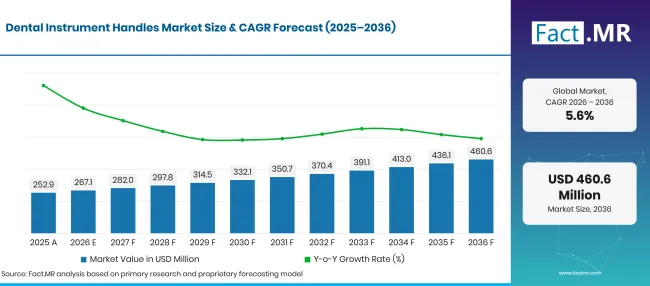
Factmr Dental Instrument Handles Market Forecast Global | Source: Fact.MR
| Year | Basis | Market Value (USD million) |
|---|---|---|
| 2025 | Actual | 252.9 |
| 2026 | Estimate | 267.1 |
| 2036 | Forecast | 460.6 |
| CAGR 2026 to 2036 | Forecast period | 5.6% |
Source: Fact.MR analysis. Updated Oct 15, 2026
What are the defining numbers behind Dental Instrument Handles Market growth?
USD 193.47 million absolute chance between 2026 and 2036, with stainless steel handles and periodontal scaling instruments forming the main purchasing base.
- Demand Drivers in the Market
- Dental practitioners increasingly choose wide-diameter hollow handles to reduce hand muscle fatigue during repetitive periodontal scaling. Ergonomic larger handle diameters distribute grip pinch pressure, protecting dental hygienists from developing carpal tunnel syndrome. Clinical practice managers favor knurled cross-hatch textures that maintain secure tactile control during delicate subgingival procedures.
- Infection control officers mandate instrument handles that withstand repeated thermal washer-disinfector and steam autoclave sterilization cycles. Medical-grade surgical steel prevents pitting and chemical corrosion caused by aggressive enzymatic detergents and high-pressure steam. Traceable instrument manufacturing standards simplify sterilization quality audits and ensure patient safety across busy multi-chair clinics.
- Dental equipment manufacturers develop color-coded silicone and resin rings integrated into metallic handles to streamline procedural tray setups. Visual identification rings allow dental assistants to identify specific diagnostic and surgical tips rapidly during complex procedures. Standardized tray management systems minimize instrument prep time and shorten patient turnover intervals between appointments.
- Orthodontic and endodontic specialists procure lightweight anodized aluminum and titanium handles to enhance tactile sensitivity during precision torque application. Reduced instrument mass provides fine tactile feedback when negotiating narrow curved root canals or bonding ceramic brackets. Validated sterilization longevity ensures that specialty handles retain dimensional stability across thousands of clinical uses.
- Key Segments Analyzed
- By Material Type: Stainless Steel holds 48.5% share in 2026, as dental practices mandate heavy-duty medical grade stainless steel that withstands daily autoclaving.
- By Application: Periodontics accounts for 34.7% share in 2026 because scaling and root planing procedures require ergonomic, high-tactile handles.
- By End-User: Dental Clinics represents 58.6% share in 2026, reflecting continuous instrument replacement and clinic expansion across private dental practices.
- By Distribution Channel: Distributors capture 47.3% share in 2026, reflecting bulk instrument kit purchases through authorized medical and dental supply merchants.
- Analyst Opinion at Fact.MR
- Shambhu Nath Jha, Principal Consultant at Fact.MR, states, “Dental instrument handle demand depends on clinician ergonomic comfort and metallurgical durability under repeated autoclave sterilization. Hygienists and surgeons look for lightweight hollow designs that alleviate hand strain during lengthy procedures. Manufacturers that combine corrosion-resistant stainless alloys with tactile knurling patterns are winning long-term supplier agreements with corporate dental support organizations.”
- Strategic Implications
- Dental instrument manufacturers are utilizing automated CNC machining to produce seamless hollow-core handles that reduce weight by up to thirty percent. Lighter instrument profiles reduce wrist strain while preserving the mechanical rigidity required for calculus removal.
- Corporate dental service organizations are standardizing instrument cassette setups across hundreds of clinic locations to streamline supply chains. Centralized equipment purchasing contracts favor manufacturers that offer modular replaceable working tips compatible with universal handle bodies.
- Specialized dental distributors are bundling ergonomic periodontal instruments with ultrasonic cleaning solutions and sterilization pouches. Turnkey clinical kits help newly established dental practices equip examination operatories with compliant instrument sets.
- Clinical directors are establishing ergonomic hand health training programs for dental staff to prevent career-ending occupational strain injuries. Investing in premium ergonomic instrument handles reduces clinician absenteeism and maintains high daily treatment efficiency.
Germany is poised to record a 7.1% CAGR, while Brazil reaches 6.5% as dental clinic modernization accelerates across private healthcare networks. The United States posts 5.9% growth, supported by high dental procedure volumes and investments in dental surgical instruments. The United Kingdom records 5.3%, while Japan reaches 4.7%, backed by extensive elderly periodontal care and strict autoclave sterilization equipment standards.
How does the Dental Instrument Handles Market break down by segment?
Stainless Steel 48.5%; Periodontics 34.7%; Dental Clinics 58.6%; Distributors 47.3% in 2026.
Which Material Type dominates?
Stainless Steel holds 48.5% share in 2026.
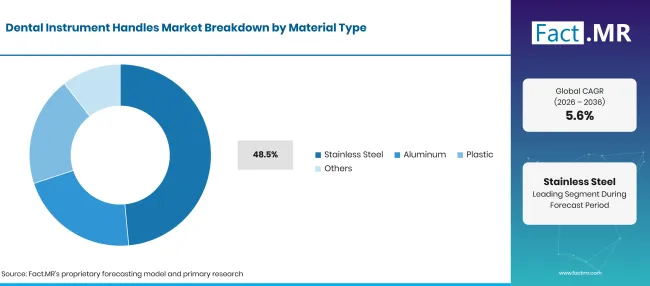
Factmr Dental Instrument Handles Market Breakdown Material Type | Source: Fact.MR
| Material Type | Share (2026) |
|---|---|
| Stainless Steel (Leading segment) | 48.5% |
| Other segments combined | 51.5%* |
| Total | 100.0% |
Source: Fact.MR analysis. Updated Oct 15, 2026
Stainless steel dominates dental instrument handles because it provides superior corrosion resistance and high mechanical strength during rigorous dental scaling. The alloy withstands thousands of steam sterilization cycles without tarnishing or losing knurl sharpness. Aluminum handles offer lightweight properties and vibrant color-anodized finishes for procedure coding. Medical-grade plastic handles supply disposable or lightweight options for basic diagnostic mirrors.
What leads the Application segment?
Periodontics accounts for 34.7% share in 2026.
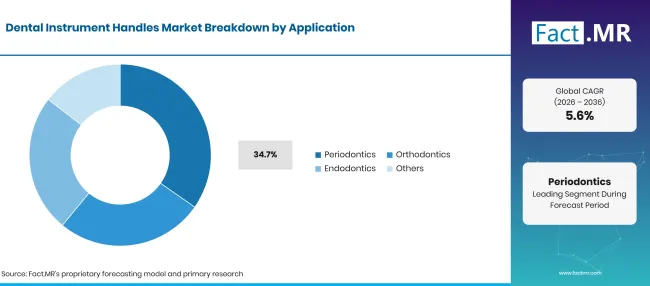
Factmr Dental Instrument Handles Market Breakdown Application | Source: Fact.MR
| Application | Share (2026) |
|---|---|
| Periodontics (Leading segment) | 34.7% |
| Other segments combined | 65.3%* |
| Total | 100.0% |
Source: Fact.MR analysis. Updated Oct 15, 2026
Periodontic procedures demand the highest volume of specialized handles because scaling and root planing require repetitive manual force against tooth surfaces. Ergonomic handle shapes provide essential tactile sensitivity to detect subgingival calculus deposits. Orthodontic applications utilize robust handles for band seating and ligature placement. Endodontic instruments use slim handles for micro-surgical root canal exploration.
How does End-User purchasing shape sales?
Dental Clinics represents 58.6% share in 2026.
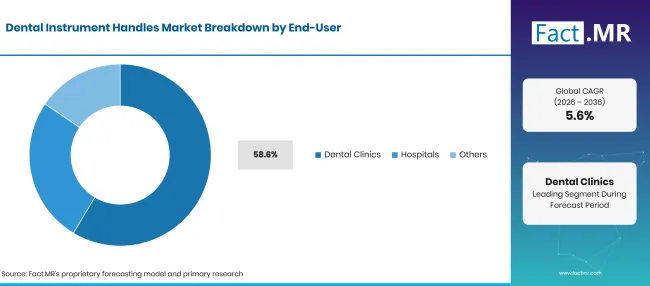
Factmr Dental Instrument Handles Market Breakdown End User | Source: Fact.MR
| End-User | Share (2026) |
|---|---|
| Dental Clinics (Leading segment) | 58.6% |
| Other segments combined | 41.4%* |
| Total | 100.0% |
Source: Fact.MR analysis. Updated Oct 15, 2026
Private dental practices and group clinics purchase the majority of instrument handles to furnish multiple operatory suites. Clinic owners regularly replace worn or tarnished instruments to maintain infection control and clinical efficiency. Hospital dental departments procure specialized surgical handles for maxillofacial trauma procedures. Dental academic institutions order large student kits for preclinical and clinical training.
Which Distribution Channel serves the largest share?
Distributors capture 47.3% share in 2026.
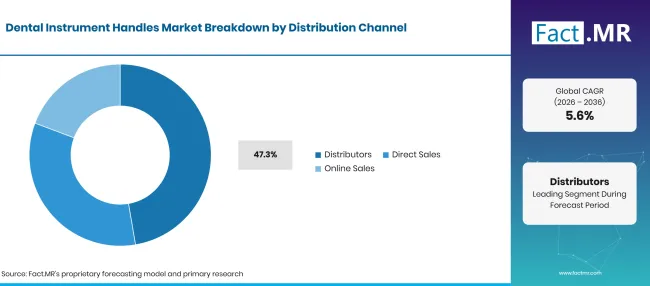
Factmr Dental Instrument Handles Market Breakdown Distribution Channel | Source: Fact.MR
| Distribution Channel | Share (2026) |
|---|---|
| Distributors (Leading segment) | 47.3% |
| Other segments combined | 52.7%* |
| Total | 100.0% |
Source: Fact.MR analysis. Updated Oct 15, 2026
Authorized dental distributors supply clinics with comprehensive product catalogs, credit terms, and consolidated delivery of instruments and consumables. Dedicated sales representatives provide sample handles for clinician ergonomic trials. Direct sales channels serve large hospital dental networks and corporate dental chains negotiating national volume pricing. Online retail channels capture steady re-orders for replacement handles and basic diagnostic tools.
What is accelerating Dental Instrument Handles Market adoption, and what is holding it back?
Rising prevalence of periodontal disease and clinician focus on musculoskeletal health accelerate ergonomic handle adoption. High procurement costs for premium titanium instruments and strict autoclave maintenance demands can slow clinic replacement cycles.
Drivers Impact Analysis
| DRIVER | (~) % IMPACT ON CAGR | GEOGRAPHIC RELEVANCE | IMPACT TIMELINE |
|---|---|---|---|
| Ergonomic design to prevent clinician RSI | +1.0% | North America, Europe | Short term (<= 2 years) |
| Periodontal disease treatment demand | +0.8% | Global | Medium term (2–4 years) |
| Strict dental sterilization compliance | +0.7% | North America, Europe | Short term (<= 2 years) |
| Multi-location corporate dental expansion | +0.5% | United States, Latin America | Medium term (2–4 years) |
| Color-coded procedural tray organization | +0.4% | Global | Long term (>= 4 years) |
Source: Fact.MR analysis. Updated Oct 15, 2026
Opportunity Impact Analysis
| OPPORTUNITY | (~) % IMPACT ON CAGR | GEOGRAPHIC RELEVANCE | IMPACT TIMELINE |
|---|---|---|---|
| Ultra-lightweight titanium and carbon composites | +0.8% | Europe, United States | Medium term (2–4 years) |
| Modular handles with quick-release tips | +0.6% | Global | Medium term (2–4 years) |
| Antimicrobial handle surface coatings | +0.5% | Europe, Japan | Short term (<= 2 years) |
| Direct digital supply platforms for clinics | +0.4% | Global | Medium term (2–4 years) |
Source: Fact.MR analysis. Updated Oct 15, 2026
Restraints Impact Analysis
| RESTRAINT | (~) % IMPACT ON CAGR | GEOGRAPHIC RELEVANCE | IMPACT TIMELINE |
|---|---|---|---|
| Premium pricing of ergonomic stainless sets | -0.8% | Latin America, Asia | Short term (<= 2 years) |
| Corrosion from improper chemical disinfectants | -0.6% | Global | Medium term (2–4 years) |
| Long replacement cycles of durable metal handles | -0.5% | Global | Medium term (2–4 years) |
| Competition from motorized scaling handpieces | -0.4% | North America, Europe | Long term (>= 4 years) |
Source: Fact.MR analysis. Updated Oct 15, 2026
Which countries are scaling the Dental Instrument Handles Market through 2036?
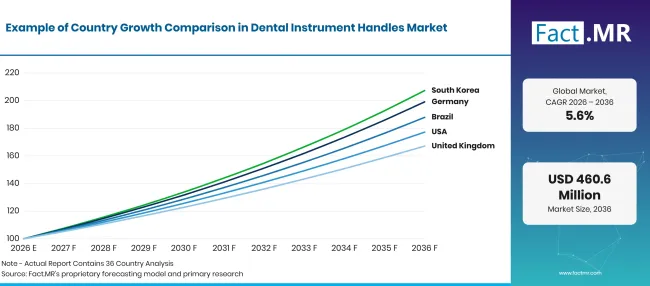
Factmr Dental Instrument Handles Market Growth Index | Source: Fact.MR
| Country | CAGR (2026–2036) |
|---|---|
| Germany | 7.1% |
| Brazil | 6.5% |
| United States | 5.9% |
| United Kingdom | 5.3% |
| Japan | 4.7% |
Source: Fact.MR analysis. Updated Oct 15, 2026
Why is Germany leading dental instrument handle growth?
7.1% CAGR, driven by strict medical device reprocessing standards and dental ergonomics.
German dental practices operate under national medical-device reprocessing recommendations issued jointly by the Robert Koch Institute’s KRINKO commission and BfArM. The guidance applies across outpatient and inpatient settings and emphasizes validated reprocessing procedures, including requirements for washer-disinfectors and small sterilizers [3]. This framework supports demand for durable, corrosion-resistant handles that can tolerate repeated cleaning, disinfection, and sterilization.
How is Brazil expanding dental instrument handle use?
6.5% CAGR, shaped by a vast network of dental practitioners and expanding cosmetic dentistry services.
Brazil’s large dental workforce creates a broad installed base for hand instruments used in periodontal, restorative, orthodontic, and surgical care. The Conselho Federal de Odontologia reported that the country reached 450,000 registered dentists in October 2025, with professionals registered through the 27 regional councils [4]. This extensive provider network supports recurring procurement and replacement of reusable dental instruments across public and private settings.
What is driving dental instrument handle sales in the United States?
5.9% CAGR, linked to high routine dental attendance, dental clinic operations, and hygiene ergonomics.
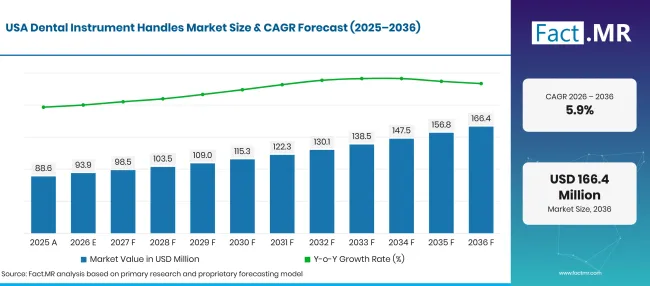
Factmr Dental Instrument Handles Market Forecast Usa | Source: Fact.MR
American dental practices use specialized ergonomic handles across periodontal and surgical workflows. CDC guidance classifies surgical instruments and periodontal scalers as critical items that should always be heat sterilized, while most heat-tolerant semicritical dental items should also undergo heat sterilization [1]. These reprocessing requirements favor reusable handles designed to withstand repeated thermal cycles without losing surface integrity or grip performance.
How is the United Kingdom developing dental instrument handle demand?
5.3% CAGR, influenced by NHS dental infection control standards and private clinic modernization.
British dental clinics maintain reusable instrument inventories within national decontamination and infection-control guidance. The UK government’s official collection covers dental equipment and benchtop steam sterilizers and states that staff responsible for sterilization or infection control should be trained to meet the required standards [2]. This operating environment supports demand for handles that combine ergonomic control with reliable performance through repeated decontamination cycles.
Why is Japan maintaining steady dental instrument handle growth?
4.7% CAGR, influenced by an aging population requiring periodontal care and strict clinic hygiene standards.
Japan’s periodontal-care burden supports continuing use of scaling and examination instruments. In the Ministry of Health, Labour and Welfare’s 2022 Survey of Dental Diseases, 47.9% of examined people had periodontal pockets of at least 4 mm, and prevalence increased with age [5]. The finding directly supports sustained demand for precision-balanced periodontal handles used in screening, scaling, and ongoing therapy.
Who leads the Dental Instrument Handles Market?
Dentsply Sirona and Danaher Corporation lead international dental instrument manufacturing, supplying comprehensive portfolios of diagnostic, periodontal, and surgical hand tools. Solventum Corporation and Henry Schein Inc. provide extensive distribution networks and clinical solutions for private practices and dental hospitals. Patterson Companies Inc. and Zimmer Biomet Holdings Inc. supply specialized orthodontic and implant surgical instruments designed for ergonomic control.
Straumann Group, GC Corporation, Ivoclar Vivadent AG, and Septodont Holding manufacture premium dental consumables and precision instruments for global dental professionals. Competition centers on alloy purity, knurling tactile design, autoclave corrosion resistance, and ergonomic weight distribution.
Which companies are the key providers?
Key companies include Dentsply Sirona; Danaher Corporation; Solventum Corporation; Henry Schein Inc.; Patterson Companies Inc.; Zimmer Biomet Holdings Inc.; Straumann Group; GC Corporation; Ivoclar Vivadent AG; and Septodont Holding.
- Dentsply Sirona
- Danaher Corporation
- Solventum Corporation
- Henry Schein Inc.
- Patterson Companies Inc.
- Zimmer Biomet Holdings Inc.
- Straumann Group
- GC Corporation
- Ivoclar Vivadent AG
- Septodont Holding
Bibliography
- [1] Centers for Disease Control and Prevention. (2024, May 15). Sterilization and disinfection.
- [2] Medicines and Healthcare products Regulatory Agency, & Department of Health and Social Care. (2014, December 18). Decontamination and infection control.
- [3] Commission for Hospital Hygiene and Infection Prevention at the Robert Koch Institute, & Federal Institute for Drugs and Medical Devices. (2012). Hygiene requirements for the reprocessing of medical devices. Robert Koch Institute.
- [4] Conselho Federal de Odontologia. (2025, October 25). Brasil alcança marca de 450 mil cirurgiões-dentistas.
- [5] Ministry of Health, Labour and Welfare. (2023, June 29). Results of the 2022 Survey of Dental Diseases.
This Report Answers
- The report assesses metallurgical selection across surgical stainless steel, anodized aluminum, and specialty polymer handles.
- Application analysis details why periodontal scaling tools represent the largest share of ergonomic handle procurement.
- The country comparison highlights how national dental infection control mandates influence instrument replacement intervals.
- Competitive benchmarking reviews handle balance, knurling textures, autoclave longevity, and distributor discount structures.
- Channel analysis explains why certified dental supply merchants dominate clinic procurement over general retail channels.
What does the Dental Instrument Handles Market cover?
The market covers manual hand instrument bodies, hollow handles, and modular handle components used in restorative, diagnostic, and surgical dental procedures. It evaluates equipment deployed across private clinics, hospital dental departments, and dental universities. The research links with related Fact.MR studies on periodontal instruments and dental handpieces.
What is included in the scope?
The scope includes fixed handles manufactured integrally with working tips and modular handles designed for interchangeable working ends. Handles made from surgical stainless steel, aluminum, and medical polymers are included. Sales represent wholesale and distributor transactions of finished dental instrument handles.
What is excluded from the scope?
The scope excludes motorized rotary dental drill handpieces, ultrasonic scaler electronic generator consoles, and single-use plastic impression trays. Standalone replacement dental bur tips, orthodontic bracket consumables, and instrument sterilization cassettes are outside the report boundary.
How Was the Analysis Built?
The analysis draws on 120+ sources, 35+ company portfolios, 25+ countries, and more than 20 industry interviews.
- Primary Research: Primary research includes discussions with manufacturers, service providers, technology developers, distributors, end users, and subject-matter experts. These conversations examine purchasing priorities, product adoption, operational challenges, approval requirements, competitive positioning, and the factors that influence wider market acceptance.
- Desk Research: Desk research covers government statistics, regulatory publications, company filings, trade data, technical studies, industry associations, standards, public policy, and other authoritative sources. Every source used in the analysis is documented in the bibliography.
- Market Sizing and Forecasting: Market estimates combine historical performance, demand indicators, pricing and volume trends, segment shares, company participation, country-level growth, adoption patterns, investment activity, and barriers to market expansion.
- Data Validation and Update Cycle: Findings are validated by comparing primary interviews with public data, company activity, regulatory changes, trade patterns, and industry developments. Regular updates review new product launches, capacity changes, partnerships, approvals, and shifts in commercial adoption.
Segmentation
What is the report’s scope and coverage?
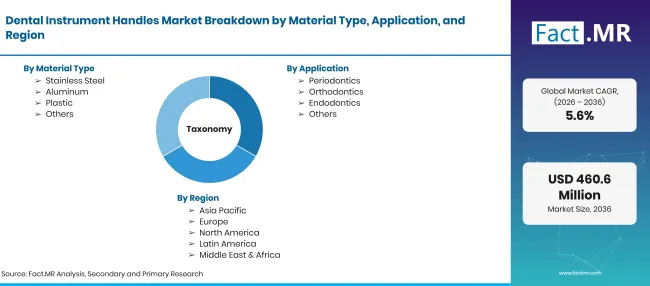
Factmr Dental Instrument Handles Market Taxonomy | Source: Fact.MR
| Attribute | Details |
|---|---|
| Quantitative Units | USD million in 2026 to USD million by 2036 at CAGR |
| Market Definition | Ergonomically designed metallic, resin, and composite handles utilized with dental probes, scalers, mirrors, and surgical instruments. |
| Material Type | Stainless Steel; Aluminum; Plastic; Others |
| Application | Periodontics; Orthodontics; Endodontics; Others |
| End-User | Dental Clinics; Hospitals; Others |
| Distribution Channel | Distributors; Direct Sales; Online Sales; Others |
| Regions Covered | North America; Latin America; Western Europe; Eastern Europe; East Asia; South Asia & Pacific; Middle East & Africa |
| Countries Covered | Germany; Brazil; United States; United Kingdom; Japan |
| Companies Profiled | Dentsply Sirona; Danaher; Solventum; Henry Schein; Patterson; Zimmer Biomet; Straumann; GC Corp; Ivoclar; Septodont |
| Forecast Period | 2026 to 2036 |
| Approach | Quantitative assessment of dental instrument manufacturing output, clinic operatory expansion, replacement cycles, and distributor sales data |
Source: Fact.MR analysis. Updated Oct 15, 2026
How is the market segmented?
-
By Material Type
- Stainless Steel
- Aluminum
- Plastic
- Others
-
By Application
- Periodontics
- Orthodontics
- Endodontics
- Others
-
By End-User
- Dental Clinics
- Hospitals
- Others
-
By Distribution Channel
- Distributors
- Direct Sales
- Online Sales
- Others
-
By Region
- North America
- Latin America
- Western Europe
- Eastern Europe
- East Asia
- South Asia & Pacific
- Middle East & Africa
Frequently Asked Questions
How big is the dental instrument handles market in 2026?
What is the CAGR from 2026 to 2036?
Which material type leads?
Which application leads?
Which companies participate in dental instrument handles?
Who worked on this report


Preview the report firsthand - request a free sample
Free SampleGet the brochure for pricing and purchase details
Download PDF