- Market Value (2025): USD 1.5 Bn
- Estimated Value (2026): USD 1.8 Bn
- Forecast Value (2036): USD 8.7 Bn
- CAGR (2026-2036): 17.1%
What is the Dental Practice Management Software AI Integration Market forecast to be worth by 2036?
USD 1.8 billion in 2026 to USD 8.7 billion by 2036, at 17.1% CAGR.
- The Dental Practice Management Software AI Integration Market crossed a valuation of USD 1.5 billion in 2025, supported by growing use of software across dental administration and clinical work.
- Demand is projected to increase from USD 1.8 billion in 2026 to USD 8.7 billion by 2036.
- The market is forecast to record a 17.1% CAGR from 2026 to 2036 as dental offices add AI-based tools to scheduling, documentation, billing and patient-care workflows.
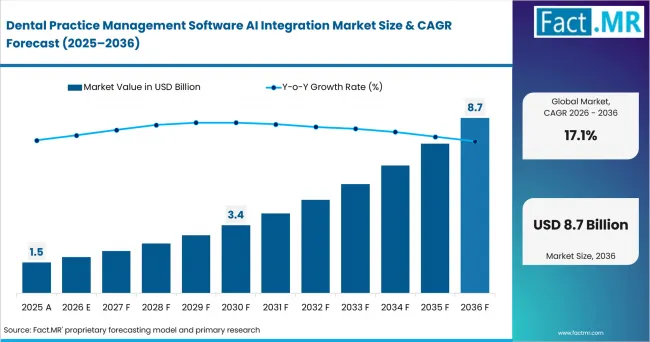
Dental Practice Management Software Ai Integration Market Value Analysis | Source: Fact.MR
What are the defining numbers behind Dental Practice Management Software AI Integration Market growth?
USD 6.9 billion absolute opportunity by 2036, led by Cloud-based Deployment and Direct Sales.
- Demand Drivers in the Market
- Dental offices use software to send reminders, confirm visits, fill open slots, and follow up with patients who miss appointments. This helps reduce empty chair time and protects daily income.
- Billing staff use these tools to check insurance coverage, review codes, prepare claims, follow up on rejected claims, and collect payments.
- Larger dental groups prefer systems that connect appointment booking with images, patient records, messages, and payments. Keeping these tasks in one system makes daily work easier.
- Dentists are more likely to use clinical AI when staff can review its work, track changes, protect patient information, and correct mistakes.
- Key Segments Analyzed
- By Deployment: Cloud-based is expected to hold 38.3% share in 2026 driven by easier software updates, remote access and lower dependence on local IT infrastructure.
- By AI Function: Appointment Scheduling & Automation is projected to account for 25.0% share in 2026 owing to demand for reminders, confirmations, waiting-list management and no-show recovery.
- By End User: Solo Dental Practices are anticipated to represent 30.0% share in 2026 due to the need for simpler tools that reduce routine administrative work with limited staff.
- By Application: Practice Management is estimated to capture 30.0% share in 2026 supported by broad use across scheduling, billing, patient records and daily office coordination.
- Analyst Opinion at Fact.MR
- Shambhu Nath Jha, Senior Analyst at Fact.MR, states, “Dental practices are using software to manage more of their everyday work instead of keeping it only for patient records. Systems that help reduce missed visits, speed up note writing, and make billing easier are likely to attract more users. Staff must also be able to check automated suggestions, fix mistakes, and understand what the software changed before using it for patient care and office work.”
- Strategic Implications
- Dental practices can separate tasks the software handles on its own from those that require staff review. A simple correction process helps staff fix wrong results.
- Dental Service Organizations can test the software at several locations before applying the same setup across a larger group.
- Customer agreements can explain data security, data ownership, service support, export options, and how staff can take control when needed.
Germany is projected to record a 23.1% CAGR through 2036, supported by appointment control and better chair use. Brazil is expected to post 21.4%, driven by billing automation and multi-site workflows. The USA is anticipated to grow at 19.7% owing to dental groups, insurance processing and cybersecurity needs. South Korea is estimated at 18.0%, supported by imaging-led care. The United Kingdom is forecast at 16.2% through cloud adoption, while Japan is projected at 14.5% as practices focus on data portability, service reliability and local support.
How does the Dental Practice Management Software AI Integration Market break down by segment?
Cloud-based leads Deployment at 38.3%; and Solo Dental Practices leads End User at 30.0% in 2026.
Which Deployment model dominates?
Cloud-based holds 38.3% share in 2026.
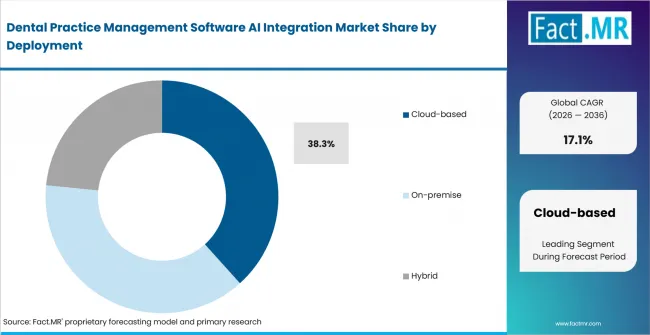
Dental Practice Management Software Ai Integration Market Analysis By Deployment | Source: Fact.MR
Cloud-based software holds 38.3% share in 2026, supported by browser access, automatic updates, and shared use across several locations. On-premise software still suits practices that store patient information on local servers and prefer direct control over their systems. Hybrid deployment keeps selected functions on local systems while using online services for storage, updates, or reporting. This gives practices a practical way to change software in stages.
What leads the AI Function segment?
Appointment Scheduling & Automation accounts for 25.0% share in 2026.
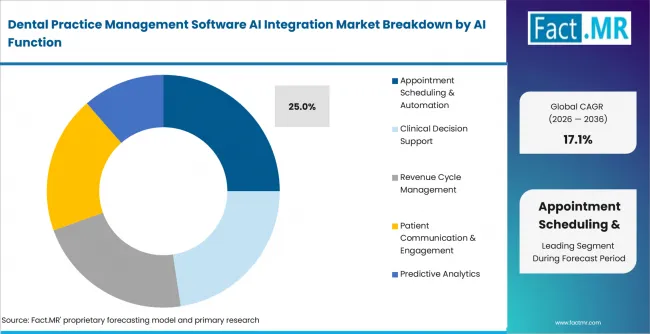
Dental Practice Management Software Ai Integration Market Analysis By Ai Function | Source: Fact.MR
Appointment Scheduling & Automation accounts for 25.0% share in 2026. Missed visits leave dental chairs empty and reduce daily income, so practices give priority to tools that help keep appointment slots filled. These tools send reminders, confirm visits, manage cancellations, update waiting lists, and offer open slots to other patients. Clinical Decision Support provides care-related suggestions. Revenue Cycle Management covers insurance checks and claims. Patient Communication & Engagement supports patient contact, while Predictive Analytics helps practices plan future demand and available appointment time.
Which End User segment is largest?
Solo Dental Practices hold 30.0% share in 2026.
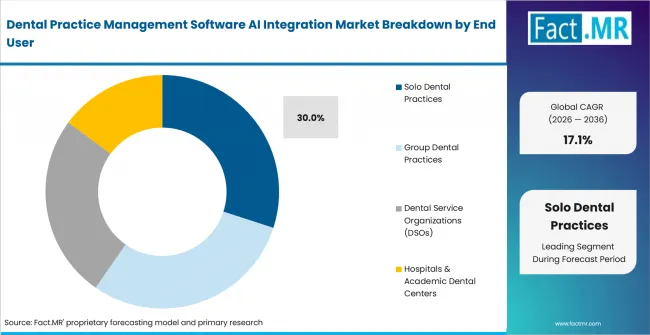
Dental Practice Management Software Ai Integration Market Analysis By End User | Source: Fact.MR
Solo Dental Practices represent 30.0% share in 2026, reflecting their limited front-desk staff and large amount of routine office work. Automation reduces repeated phone calls, manual appointment entry, and regular follow-up tasks. Group Dental Practices use shared systems across several dentists. Dental Service Organizations require tighter control across many locations and more detailed reports. Hospitals and Academic Dental Centers usually follow longer approval steps before software is used across several departments.
What supports Practice Management within Application?
Practice Management captures 30.0% share in 2026.
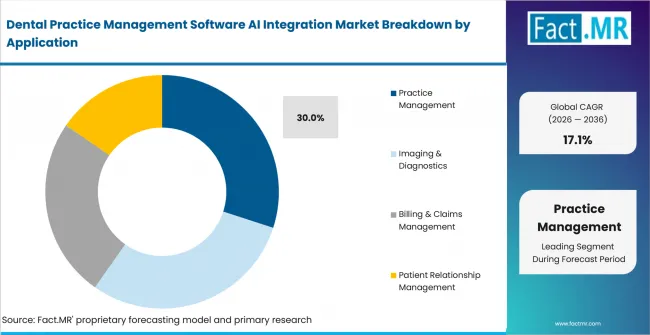
Dental Practice Management Software Ai Integration Market Analysis By Application | Source: Fact.MR
Practice Management captures 30.0% share in 2026 as it brings appointments, patient records, staff tasks, billing, and daily reports into one system. Imaging & Diagnostics supports the review of dental images. Billing & Claims Management handles insurance checks and payment follow-up. Patient Relationship Management manages reminders and patient communication. Since these tools rely on accurate practice records, Practice Management has the widest role in daily office work.
What is accelerating Dental Practice Management Software AI Integration Market adoption, and what is holding it back?
Administrative automation and connected cloud workflows are expected to support adoption. Clinical governance; cybersecurity; and integration work are anticipated to restrain deployment speed.
Drivers Impact Analysis
| DRIVER | (~) % IMPACT ON CAGR | GEOGRAPHIC RELEVANCE | IMPACT TIMELINE |
|---|---|---|---|
| Appointment scheduling and no-show recovery automation | +3.0% | Germany and chair-utilization-focused practice networks | Short term (<=2 years) |
| Cloud-based deployment consolidation | +2.4% | U.K. and Japan | Medium term (2-4 years) |
| Revenue-cycle and claims automation | +2.1% | Brazil and mixed public-private delivery markets | Medium term (2-4 years) |
| Governed patient communication tools | +1.6% | USA | Short term (<=2 years) |
| Radiographic AI assistance under dentist oversight | +1.3% | South Korea and academic dental imaging centers | Long term (>=4 years) |
Source: Fact.MR analysis. Updated Jul 20, 2026
- Appointment scheduling and missed-visit recovery: Dental practices are using software to send reminders, confirm visits, contact waiting-list patients, and fill open slots. A missed appointment leaves the chair empty and reduces daily income. These tools are easier to use when staff can check changes, control patient messages, and take over the schedule when required.
- Cloud-based systems: Dental groups with several locations can use the same software through a web browser without running a separate local server at each office. Security also affects the choice of provider. Practices look at login protection, regular security checks, and up-to-date system records before placing patient, insurance, and payment information in an online system.
- Billing and claim automation: Dental offices are using software to cut repeated work during insurance checks, code review, claim preparation, rejected-claim follow-up, and payment collection. The system works best when visit notes, treatment codes, insurance details, and dental images match before a claim is sent. Faster checks reduce extra work and help billing staff understand why a claim was approved, delayed, or rejected.
Opportunity Impact Analysis
| OPPORTUNITY | (~) % IMPACT ON CAGR | GEOGRAPHIC RELEVANCE | IMPACT TIMELINE |
|---|---|---|---|
| Dental Service Organization (DSO) multi-site rollouts | +0.9% | USA and Brazil | Medium term (2-4 years) |
| Predictive analytics for capacity and treatment forecasting | +0.7% | Germany and South Korea | Long term (>=4 years) |
| Value-added reseller and partner channel expansion | +0.5% | Japan and U.K. | Medium term (2-4 years) |
| Hospital and academic dental center imaging integration | +0.4% | South Korea and academic or hospital dental networks | Long term (>=4 years) |
Source: Fact.MR analysis. Updated Jul 20, 2026
- DSO use across several locations: Dental Service Organizations use the same coding rules, image systems, and patient messages across many offices. A shared platform gives the main office one place to review results while each location keeps control of its own work. Software providers have a stronger opportunity when they help groups use the same basic process without taking away local control. Wider use is more likely when changes are tested at a few locations before they are used across the full network.
- Future planning from practice data: Appointment, treatment, and staff records can help dental practices estimate future chair use and workload. These tools work better when records are complete and entered in the same way. Poor estimates can lead to too many staff, unused appointment time, or heavy scheduling pressure. Many practices may start slowly and check the results often before using them for hiring or daily planning.
- Growth through local partners: Local software partners can help dental practices in areas where direct support from the software company is limited. They assist with moving old records, training staff, choosing hardware, and providing ongoing help. This route is useful for practices that prefer support from a nearby company. Providers with strong local partner networks are better placed to help smaller offices during setup and regular use.
Restraints Impact Analysis
| RESTRAINT | (~) % IMPACT ON CAGR | GEOGRAPHIC RELEVANCE | IMPACT TIMELINE |
|---|---|---|---|
| Clinical-control and human-override requirements | -1.0% | Global | Short term (<=2 years) |
| Unreliable or poorly governed generative AI outputs | -0.8% | Global | Medium term (2-4 years) |
| Cybersecurity and data-protection compliance burden | -0.6% | USA | Medium term (2-4 years) |
| Vendor dependency and service-level uncertainty | -0.4% | Japan | Short term (<=2 years) |
Source: Fact.MR analysis. Updated Jul 20, 2026
- Dentist control over AI: Dental practices may avoid AI tools when dentists cannot see how a result was created or changed. Each system needs simple review steps and an easy way to reject or replace a suggestion. The ADA’s 2025 policy keeps the dentist responsible for the final decision. This may slow use of software that does not show its reasoning, correction history, or manual controls.
- Wrong or unclear AI results: Some AI systems can create inaccurate notes, patient messages, or treatment suggestions. Staff then have to check every result before using it. This reduces time savings and increases the chance that wrong information enters a patient record or message. Use may slow when software companies cannot explain how results are tested, corrected, and limited to approved tasks.
- Dependence on one software company: Cloud-based dental systems can leave a practice dependent on one company for access, updates, data storage, and technical help. Risk increases when support terms, data-export choices, or recovery steps are not explained properly. The problem is greater in areas with limited local support or when a system outage can stop appointments, billing, and access to patient records.
Which countries are scaling Dental Practice Management Software AI Integration Market fastest?
Germany 23.1%, Brazil 21.4%, USA 19.7%, South Korea 18.0%, United Kingdom 16.2%, Japan 14.5%.
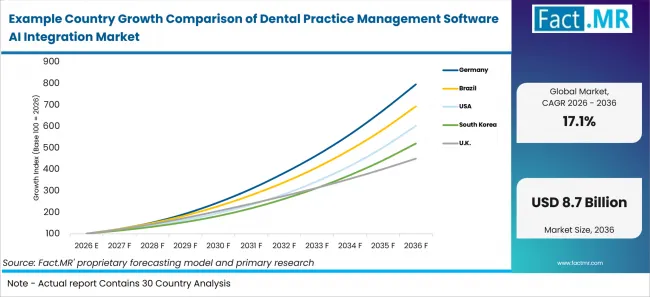
Example Country Growth Comparison Of Dental Practice Management Software Ai Integration Market | Source: Fact.MR
| COUNTRY | CAGR from 2026 to 2036 |
|---|---|
| Germany | 23.1% |
| Brazil | 21.4% |
| USA | 19.7% |
| South Korea | 18.0% |
| United Kingdom | 16.2% |
| Japan | 14.5% |
Source: Fact.MR analysis. Updated Jul 20, 2026
What is driving Germany’s growth through 2036?
23.1% CAGR, driven by better appointment control and more careful use of dental chairs.
In Germany, dental practices treat chair time as an important part of daily planning. Automated reminders, waiting lists, and tools that fill cancelled appointments help offices protect available treatment time. Staff can still control how and when patients are contacted. The market is projected to record a 23.1% CAGR from 2026 to 2036 as practices match appointments with staff availability and the time required for each treatment.
How is Brazil scaling demand?
21.4% CAGR, supported by complex billing work and the growth of dental groups with several locations.
Brazil’s mix of public and private dental care creates extra work around insurance checks, claim records, patient payments, and follow-up. Software is therefore useful for more than appointment booking. It helps move billing information between the front desk and the patient’s treatment record. Demand is expected to post a 21.4% CAGR through 2036 as dental groups look for shared billing rules and central reports while allowing each location to follow its own payment process.
What supports the USA outlook?
19.7% CAGR, owing to the growth of dental groups, insurance work, and stronger protection of patient data.
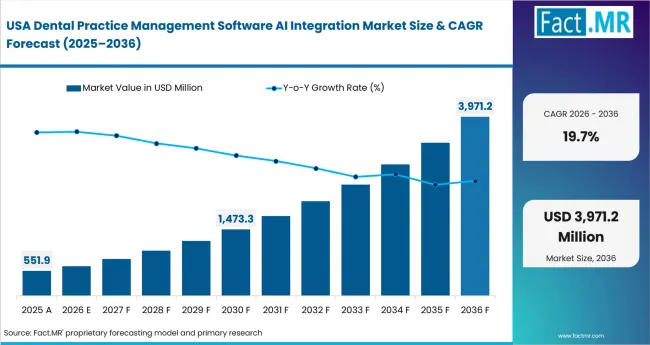
Dental Practice Management Software Ai Integration Market Country Value Analysis | Source: Fact.MR
The USA has many dental groups, insurance-based payment systems, and companies offering AI for dental images. The main test is whether these systems can work together. Appointment records, clinical notes, images, and claims must connect without putting private patient information at risk. The market is anticipated to advance at a 19.7% CAGR from 2026 to 2036 as practices compare the time savings from automation with security costs, dentist review requirements, and the extra work placed on smaller offices.
What underpins South Korea’s growth?
18.0% CAGR, driven by the heavy use of dental imaging and well-organized digital records.
In South Korea, demand is linked closely to clinical records and image-based dental care. Practices that use digital imaging can connect image review with charting, treatment planning, and follow-up records. The market is estimated to record an 18.0% CAGR through 2036 as dental offices adopt AI tools that keep the dentist involved and show how each automated finding was added to the patient record.
How is the U.K. developing demand?
16.2% CAGR, supported by online software and better control over digital patient messages.
Dental practices in the U.K. want online access, patient messages, and daily office work to stay within the same system. This reduces the risk of creating separate or conflicting records. Cloud software makes updates easier, but providers still have to meet rules for data sharing and system performance. The market is forecast to post a 16.2% CAGR from 2026 to 2036 as practices place more importance on controlled patient communication and reliable sharing of information.
What shapes Japan’s demand?
14.5% CAGR, tied to reliable support, easy data transfer, and careful software changes.
Japanese dental practices often review long-term support terms before moving more office or clinical work into AI-based software. Product features are only one part of the decision. Practices also check how records can be moved, how quickly local support responds, and how work continues during a system outage. Demand is projected to expand at a 14.5% CAGR through 2036 as software companies offer clearer data-transfer terms, recovery plans, and local setup support.
Who leads the Dental Practice Management Software AI Integration Market?
Henry Schein One and Planet DDS lead through their wide range of dental practice software. Pearl and VideaHealth add stronger AI support for dental images and clinical work.
Henry Schein One combines appointment booking, patient records, billing, and cloud-based office work in one software range. In November 2025, the company announced work with AWS to add generative AI to dental tasks. It also launched the VideaHealth Impact Panel during the same month. Planet DDS connects cloud practice software with imaging and patient communication. Its January 2025 work with Pearl added AI image review to the same dental software system. These companies mainly compete on how well different tasks work together, how easily dentists can review results, and whether automation keeps the dentist in control.
Curve Dental and Carestream Dental provide cloud software, imaging links, and support for daily office work. Denti.AI, Overjet, and Pearl focus more on AI for clinical work and dental images. Through 2036, competition is likely to depend on appointment automation, claims support, safe data sharing, and simple dentist review. Practices will also look for reliable data transfer, training, and customer support before using AI across more office and clinical tasks.
Which companies are the key providers?
The company landscape includes Henry Schein One; Carestream Dental; Planet DDS; Curve Dental; Patterson Dental; Denti.AI; VideaHealth; Pearl; and Overjet.
- Henry Schein One
- Carestream Dental
- Planet DDS
- Curve Dental
- Patterson Dental
- Denti.AI
- VideaHealth
- Pearl
- Overjet
Bibliography
- Henry Schein One. (2025, November 3). Henry Schein One and AWS collaborate to transform global dentistry with generative AI.
- Planet DDS. (2025, January 22). Planet DDS and Pearl redefine dental care standards with AI Assist.
- U.S. Department of Health and Human Services. (2024). Healthcare and Public Health Sector cybersecurity performance goals.
- Office of the National Coordinator for Health Information Technology. (2025). 2025 interoperability standards advisory reference edition.
- U.S. Food and Drug Administration. (2025, January 7). Artificial intelligence-enabled device software functions: Lifecycle management and marketing submission recommendations—Draft guidance for industry and Food and Drug Administration staff.
This Report Addresses
- The report provides strategic intelligence on Dental Practice Management Software AI Integration across Deployment and AI Function choices that shape daily administrative and clinical workflows.
- Segment analysis covers Cloud-based deployment and Appointment Scheduling & Automation as the share within the 2026.
- Regional outlook evaluates Germany and Brazil alongside the USA, South Korea, the United Kingdom and Japan, while wider regional coverage completes the growth comparison.
- Competitive analysis profiles Henry Schein One and Planet DDS alongside Carestream Dental and Curve Dental, followed by five additional active dental software and AI providers.
- Deployment assessment covers Cloud-based, On-premise and Hybrid systems across dental practices that require different levels of remote access, local control and software support.
- Use-case assessment covers Practice Management and Imaging & Diagnostics alongside Billing & Claims Management and Patient Relationship Management applications.
What does the Dental Practice Management Software AI Integration Market cover?
Cloud-based, On-premise and Hybrid dental practice software that integrates AI into administrative and clinical workflows.
The Dental Practice Management Software AI Integration Market covers platforms that use artificial intelligence within appointment scheduling, patient communication, documentation, billing support, imaging assistance and daily practice operations. Coverage includes Appointment Scheduling & Automation, Clinical Decision Support, Revenue Cycle Management, Patient Communication & Engagement and Predictive Analytics across solo practices, dental groups, DSOs and institutional dental settings.
The market differs from general dental software because commercial value comes from AI functions used inside or alongside practice-management workflows. Standalone imaging tools, electronic records and communication systems remain outside the boundary unless they connect directly with practice operations and provide a defined AI-supported function.
What is included in the scope?
AI-enabled dental practice software used across administrative, financial and clinical workflows.
The scope includes Cloud-based, On-premise and Hybrid deployment models across Solo Dental Practices, Group Dental Practices, Dental Service Organizations and Hospitals & Academic Dental Centers. Coverage spans Practice Management, Imaging & Diagnostics, Billing & Claims Management and Patient Relationship Management. Appointment reminders, waiting-list management, note support, insurance checks, claim preparation, image assistance, patient messaging and capacity planning are included when they operate within the dental software environment.
Direct Sales and Value-added Resellers or Partners are included because implementation, migration, training and local support influence purchasing across the segmentation framework. The scope also considers dentist review, data security, correction controls, service reliability and system integration where these requirements affect AI adoption.
What is excluded from the scope?
General dental equipment and standalone software without a practice-management AI connection are outside the scope.
The scope excludes dental chairs, imaging hardware, scanners, laboratory equipment and other products sold mainly for treatment or diagnosis. Consumer dental apps, laboratory-only systems and unrelated electronic health-record software are also excluded. Standalone AI imaging products remain outside the boundary unless they connect with scheduling, records, billing, patient communication or another defined practice-management workflow.
The market does not include unverified company share claims, general office software or AI tools used outside dental practice operations. Manual consulting, migration and support services are excluded when they are sold without an associated dental practice-management platform or integrated AI function.
How Was the Analysis Built?
The analysis draws on 120+ sources, 35+ company portfolios, 25+ countries, and more than 20 industry interviews.
- Primary Research: Primary research includes discussions with manufacturers, service providers, technology developers, distributors, end users, procurement teams, and subject-matter experts. These conversations examine purchasing priorities, product adoption, operational challenges, approval requirements, competitive positioning, and the factors that influence wider market acceptance.
- Desk Research: Desk research covers government statistics, regulatory publications, company filings, trade data, technical studies, industry associations, standards, public policy, and other authoritative sources. Every source used in the analysis is documented in the bibliography.
- Market Sizing and Forecasting: Market estimates combine historical performance, demand indicators, pricing and volume trends, segment shares, company participation, country-level growth, adoption patterns, investment activity, and barriers to market expansion.
- Data Validation and Update Cycle: Findings are validated by comparing primary interviews with public data, company activity, regulatory changes, trade patterns, and industry developments. Regular updates review new product launches, capacity changes, partnerships, approvals, procurement trends, and shifts in commercial adoption.
Segmentation
What is the report's scope and coverage?
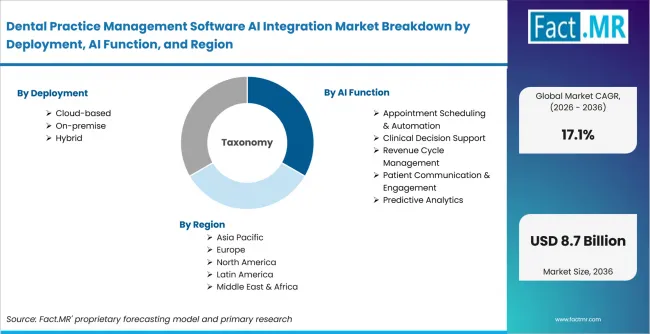
Dental Practice Management Software Ai Integration Market Breakdown By Deployment, Ai Function, And Region | Source: Fact.MR
| Attribute | Details |
|---|---|
| Quantitative Units | USD Billion in 2026 to USD Billion by 2036 at CAGR |
| Market Definition | Dental practice-management platforms that integrate artificial intelligence into appointment scheduling, patient communication, documentation, billing support, imaging assistance and daily administrative workflows |
| Deployment | Cloud-based; On-premise; Hybrid |
| AI Function | Appointment Scheduling & Automation; Clinical Decision Support; Revenue Cycle Management; Patient Communication & Engagement; Predictive Analytics |
| End User | Solo Dental Practices; Group Dental Practices; Dental Service Organizations (DSOs); Hospitals & Academic Dental Centers |
| Application | Practice Management; Imaging & Diagnostics; Billing & Claims Management; Patient Relationship Management |
| Sales Channel | Direct Sales; Value-added Resellers / Partners |
| Regions Covered | North America; Latin America; Western Europe; Eastern Europe; East Asia; South Asia and Pacific; Middle East and Africa |
| Countries Covered | Germany; Brazil; USA; South Korea; United Kingdom; Japan |
| Key Companies Profiled | Henry Schein One; Carestream Dental; Planet DDS; Curve Dental; Patterson Dental; Denti.AI; VideaHealth; Pearl; Overjet |
| Forecast Period | 2026 to 2036 |
| Approach | Hybrid top-down and bottom-up approach using dental software adoption; appointment and no-show automation; claims-processing activity; cloud deployment preferences; AI imaging integration; practice size; multi-site dental group expansion; cybersecurity requirements; country growth conditions and company participation |
Source: Fact.MR analysis. Updated Jul 20, 2026
How is the market segmented?
-
By Deployment
- Cloud-based
- On-premise
- Hybrid
-
By AI Function
- Appointment Scheduling & Automation
- Clinical Decision Support
- Revenue Cycle Management
- Patient Communication & Engagement
- Predictive Analytics
-
By End User
- Solo Dental Practices
- Group Dental Practices
- Dental Service Organizations (DSOs)
- Hospitals & Academic Dental Centers
-
By Application
- Practice Management
- Imaging & Diagnostics
- Billing & Claims Management
- Patient Relationship Management
-
By Sales Channel
- Direct Sales
- Value-added Resellers / Partners
-
By Region
- North America
- Latin America
- Western Europe
- Eastern Europe
- East Asia
- South Asia and Pacific
- Middle East and Africa
Frequently Asked Questions
Which Deployment leads the Dental Practice Management Software AI Integration Market?
Which AI Function leads the Dental Practice Management Software AI Integration Market?
Which End User leads the Dental Practice Management Software AI Integration Market?
Which Application leads the Dental Practice Management Software AI Integration Market?
Which country records the highest CAGR in the Dental Practice Management Software AI Integration Market?
How does Brazil perform in the Dental Practice Management Software AI Integration Market?
How does the USA perform in the Dental Practice Management Software AI Integration Market?
How does Japan perform in the Dental Practice Management Software AI Integration Market?
What is the primary driver in the Dental Practice Management Software AI Integration Market?
What is the main restraint in the Dental Practice Management Software AI Integration Market?
Why is dentist review central to this market?
Who worked on this report


Preview the report firsthand - request a free sample
Free SampleGet the brochure for pricing and purchase details
Download PDF