- Market Value (2025): USD 197.8 Mn
- Estimated Value (2026): USD 214.0 Mn
- Forecast Value (2036): USD 470.0 Mn
- CAGR (2026-2036): 8.2%
What is the Devolatilization Side Feeders Market forecast to be worth by 2036?
USD 214.0 million in 2026 to USD 470.0 million by 2036 at 8.2% CAGR.
- The devolatilization side feeders market crossed a valuation of USD 197.8 million in 2025 as demand increased for controlled material feeding and volatile removal across extrusion lines.
- Demand is projected to increase from USD 214.0 million in 2026 to USD 470.0 million by 2036.
- The market is forecast to record 8.2% CAGR from 2026 to 2036 owing to rising requirements for moisture removal, monomer stripping, degassing, and extrusion-line process control.
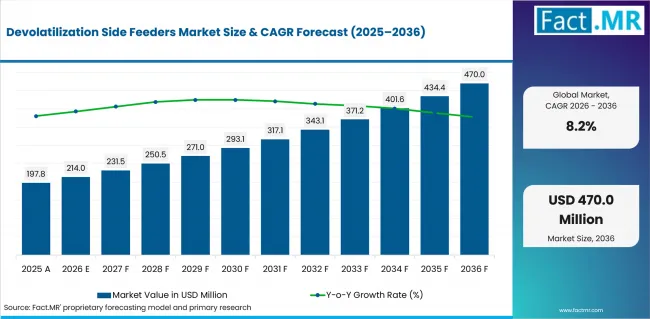
Devolatilization Side Feeders Market Value Analysis | Source: Fact.MR
What are the defining numbers behind Devolatilization Side Feeders Market growth?
USD 256.0 million absolute opportunity by 2036, led by Twin-screw side feeders and Co-rotating twin-screw compatibility alongside Devolatilization functions and Polymer producers.
- Demand Drivers in the Market
- Material streams that require controlled devolatilization create demand for equipment that can support steady feeding near the venting stage.
- Polymer producers and polymer compounders need feeder configurations suited to their extrusion architecture and processing sequence.
- Moisture removal, monomer stripping, and degassing requirements influence the choice of feeder type and connection point.
- Recyclers and engineering plastics processors must account for variable material behavior when selecting a side-feeding arrangement.
- Key Segments Analyzed
- By Feeder Type: Twin-screw side feeders are projected to hold 39.0% share in 2026 because their two-screw configuration supports steady material delivery into the extruder side port.
- By Function: Devolatilization is expected to account for 42.0% share in 2026 as volatile removal remains the principal operating purpose of these systems.
- By Extruder Compatibility: Co-rotating twin-screw systems are anticipated to represent 46.0% share in 2026 due to their broad use across polymer production and compounding lines.
- By End User: Polymer producers are estimated to hold 25.0% share in 2026 because they integrate side feeding and devolatilization directly into material-manufacturing processes.
- Analyst Opinion at Fact.MR
- Shambhu Nath Jha, Senior Analyst at Fact.MR, states, “Selection depends on how the feeder, venting point, and extruder work together under the intended material load. Buyers need to examine feed consistency, compatibility with the installed extruder, access for cleaning, and the function expected at the side port. Suppliers that translate these operating conditions into a clear configuration can reduce uncertainty during evaluation.”
- Strategic Implications
- Polymer producers can compare feeder options against the actual material stream, vent position, and throughput requirement.
- Equipment suppliers should specify compatibility with co-rotating twin-screw, counter-rotating twin-screw, single-screw, and ring extruder arrangements where relevant.
- Compounders, recyclers, and engineering plastics processors can evaluate whether the required duty is devolatilization, filler side feeding, moisture removal, monomer stripping, or degassing.
The United Kingdom is projected to record a 10.2% CAGR, followed by the USA at 9.3%. Japan is forecast to advance at 8.8%, while Italy is estimated at 8.5%. Germany is projected to grow at 8.1% through 2036.
How does the Devolatilization Side Feeders Market break down by segment?
Twin-screw side feeders lead Feeder Type with 39.0% share, while co-rotating twin-screw systems lead Extruder Compatibility with 46.0% share in 2026.
Why do twin-screw side feeders lead Feeder Type?
Twin-screw side feeders are projected to account for 39.0% share in 2026.
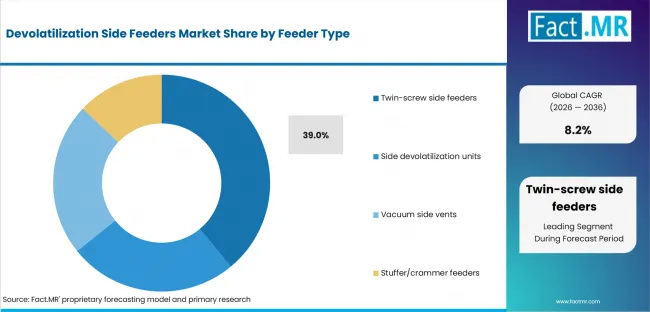
Devolatilization Side Feeders Market Analysis By Feeder Type | Source: Fact.MR
Their two-screw arrangement supports controlled movement of material toward the extruder side port. This makes the category relevant where the feed must remain steady while the main extrusion process handles mixing and volatile removal. Side devolatilization units and vacuum side vents address more specialized configurations, while stuffer or crammer feeders serve materials that need positive delivery. The leading position reflects the broad process fit of twin-screw side feeding across polymer production and compounding duties.
Why does devolatilization lead Function?
Devolatilization is projected to account for 42.0% share in 2026.
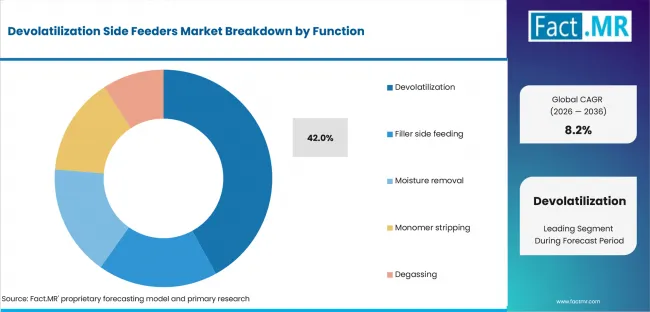
Devolatilization Side Feeders Market Analysis By Function | Source: Fact.MR
This function sits at the center of the market because the equipment is selected to support removal of unwanted volatile matter during extrusion. Filler side feeding focuses on adding material, while moisture removal, monomer stripping, and degassing address particular process conditions. The categories can overlap in an operating line, but devolatilization remains the principal functional reference for equipment selection and system layout.
Why do co-rotating twin-screw systems lead Extruder Compatibility?
Co-rotating twin-screw systems are projected to account for 46.0% share in 2026.
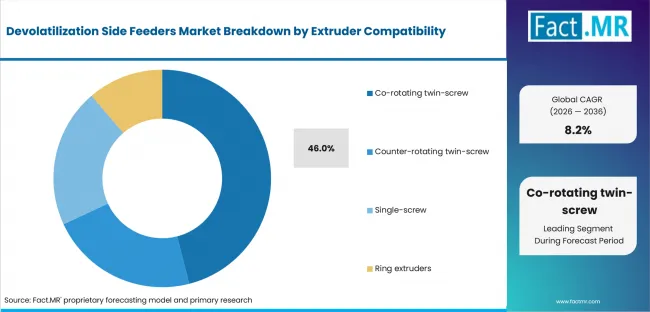
Devolatilization Side Feeders Market Analysis By Extruder Compatibility | Source: Fact.MR
Side feeders used with these extruders must fit the port geometry, screw arrangement, and material flow of the main process. Counter-rotating twin-screw, single-screw, and ring extruders require different integration choices. The leading share indicates that co-rotating twin-screw compatibility is the most common reference point in the market structure, making mechanical fit and process coordination central purchasing checks.
Why do polymer producers lead End User?
Polymer producers are projected to account for 25.0% share in 2026.
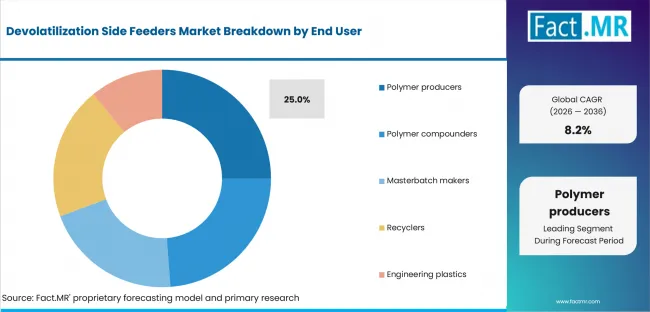
Devolatilization Side Feeders Market Analysis By End User | Source: Fact.MR
Polymer producers use extrusion equipment as part of material manufacturing and therefore assess side feeding at the process-design level. Polymer compounders place greater emphasis on formulation changes and additive handling. Masterbatch makers, recyclers, and engineering plastics processors bring different material consistency, cleaning, and changeover requirements. The relatively distributed end-user structure shows that no single buyer group controls a majority of demand.
What is accelerating Devolatilization Side Feeders Market adoption, and what is holding it back?
Demand is expected to be driven by controlled volatile removal, stable material feeding, and closer integration with extrusion systems. Adoption is expected to be held back by configuration complexity, cleaning requirements, and uncertainty around feeder-to-extruder compatibility.
Drivers Impact Analysis
| DRIVER | MARKET RELEVANCE | PRIMARY ADOPTION CONTEXT | RELEVANCE HORIZON |
|---|---|---|---|
| Extruder compatibility requirements | High | USA, Germany, Italy | Short term (<= 2 years) |
| Devolatilization and degassing demand | High | Global polymer-production clusters | Short term (<= 2 years) |
| Stable material-flow control | High | USA, Japan, UK | 2026 to 2036 |
| Growth in polymer compounding | High | Europe, North America, East Asia | 2026 to 2036 |
| Processing of recycled and engineered materials | High | Germany, UK, Japan | Long term (>= 4 years) |
Source: Fact.MR analysis. Updated Jul 23, 2026
- Extruder compatibility requirements: Feeder geometry, screw configuration, and operating behavior must align with the installed extrusion system. Buyers therefore prioritize mechanically compatible units that can maintain stable side-port performance.
- Devolatilization and degassing demand: Moisture, residual monomers, and other volatile substances must be removed during polymer processing. This increases demand for feeders designed to work near the venting stage.
- Stable material-flow control: Inconsistent feeding can affect venting efficiency and final material quality. Producers therefore place greater value on systems that deliver material steadily under changing process loads.
- Growth in polymer compounding: Compounders require controlled side feeding for additives, fillers, and formulation changes. Expanding compounding activity is expected to support demand for flexible feeder configurations.
- Processing of recycled and engineered materials: Recycled polymers and engineering plastics can show variable bulk density and flow behavior. This creates demand for feeders capable of handling less predictable material streams.
Opportunity Impact Analysis
| OPPORTUNITY | MARKET RELEVANCE | PRIMARY ADOPTION CONTEXT | RELEVANCE HORIZON |
|---|---|---|---|
| Application-specific feeder configurations | High | USA and Germany | 2026 to 2036 |
| Replacement and extrusion-line adaptation | High | UK, Italy, Japan | 2026 to 2036 |
| Recycled-material processing systems | High | Europe and East Asia | Long term (>= 4 years) |
| Modular and easier-to-clean feeder designs | High | Global compounding facilities | Long term (>= 4 years) |
Source: Fact.MR analysis. Updated Jul 23, 2026
- Application-specific feeder configurations: Suppliers can create more value by matching feeder type, side-port function, and screw arrangement to a defined material stream and extruder platform.
- Replacement and extrusion-line adaptation: Existing lines may require revised side-feeding systems when producers introduce new materials, increase throughput, or change devolatilization duties.
- Recycled-material processing systems: Wider use of recycled and engineered polymers is expected to create opportunities for feeders that can manage inconsistent density, moisture, and flow characteristics.
- Modular and easier-to-clean feeder designs: Systems that simplify cleaning, screw access, and product changeovers are expected to appeal to compounders running multiple formulations.
Restraints Impact Analysis
| RESTRAINT | MARKET RELEVANCE | PRIMARY ADOPTION CONTEXT | RELEVANCE HORIZON |
|---|---|---|---|
| Feeder-extruder integration complexity | High | Global | Short term (<= 2 years) |
| Cleaning and changeover requirements | High | Polymer and masterbatch facilities | Short term (<= 2 years) |
| Configuration uncertainty | High | Smaller processors and replacement projects | 2026 to 2036 |
| Variable material behavior | High | Recycling and engineering-plastics operations | Long term (>= 4 years) |
Source: Fact.MR analysis. Updated Jul 23, 2026
- Feeder-extruder integration complexity: A feeder that does not match the extruder, side-port geometry, vent position, or material behavior can disrupt flow and reduce devolatilization efficiency.
- Cleaning and changeover requirements: Residue buildup and frequent formulation changes can increase downtime. Buyers therefore assess access for cleaning and repeatable setup before equipment approval.
- Configuration uncertainty: Buyers may delay investment when the required feeder type, screw design, throughput level, or functional duty has not been clearly established.
- • Variable material behavior: Changes in moisture, particle size, bulk density, and flowability can make stable feeding difficult, particularly in recycling and engineered-material applications.
Which countries are scaling Devolatilization Side Feeders Market fastest?
The country comparison shows a wider separation between the leading and trailing markets than the global 8.2% CAGR suggests. The total spread between the United Kingdom and Germany is 2.1 percentage points. The United Kingdom and USA form the upper-growth pair, while Japan and Italy create a measured middle cluster. Germany remains close to the global benchmark but holds the lowest position among the listed countries. This pattern reflects differences in polymer-processing capacity, extrusion-line modernization, recycling activity, and access to feeder-integration expertise rather than market size alone.
- The United Kingdom shows the strongest position at 10.2% CAGR because polymer processors and compounders are expected to require flexible feeder configurations for material changes, recycling applications, and extrusion-line upgrades.
- The USA follows at 9.3% CAGR as its large polymer-production and compounding base supports demand for stable material feeding, devolatilization, and equipment replacement.
- Japan records 8.8% CAGR through demand for precise feeder-extruder coordination, controlled material flow, and processing systems suited to engineered polymers.
- Italy is projected to grow at 8.5% CAGR as plastics-processing and extrusion-equipment activity supports replacement demand and application-specific side-feeder configurations.
- Germany advances at 8.1% CAGR, remaining close to the global average as recycling, engineering-plastics processing, and established extrusion capacity sustain equipment demand.
Comparable CAGRs can therefore create different market-entry conditions across these countries. Deployment timing depends on extruder compatibility, material characteristics, cleaning requirements, and the availability of technical support, while commercial readiness also reflects replacement cycles and the ability to configure feeders for specific devolatilization duties. The full report provides country-level CAGR analysis across North America, Latin America, Europe, East Asia, South Asia, Oceania, and the Middle East and Africa.
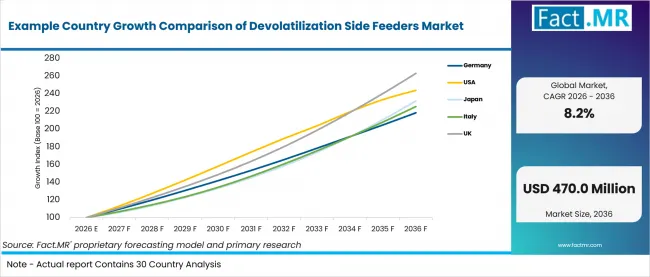
Example Country Growth Comparison Of Devolatilization Side Feeders Market | Source: Fact.MR
| Country | CAGR, 2026 to 2036 |
|---|---|
| UK | 10.2% |
| USA | 9.3% |
| Japan | 8.8% |
| Italy | 8.5% |
| Germany | 8.1% |
Source: Fact.MR analysis. Updated Jul 23, 2026
What supports the UK’s growth?
10.2% CAGR from 2026 to 2036. Local polymer-processing demand and extrusion-line modernization.
The United Kingdom’s growth reflects demand from polymer processors and compounders that require flexible side-feeding systems for material changes, recycled feedstocks, and upgraded extrusion lines. Buyers are expected to favor configurations that maintain stable feeding while supporting devolatilization, moisture removal, and degassing. Equipment suppliers that simplify cleaning and adaptation to existing extruders may gain stronger opportunities.
What supports USA adoption?
9.3% CAGR, driven by polymer production, compounding capacity, and equipment replacement.
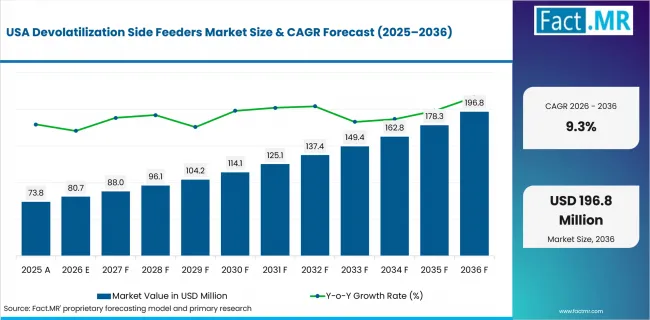
Devolatilization Side Feeders Market Country Value Analysis | Source: Fact.MR
The USA’s growth is tied to its broad polymer-manufacturing and compounding base. Producers require stable material delivery near extrusion venting points to protect process consistency and final material quality. Demand is also expected to come from replacement projects where older side-feeding systems must be adapted to new formulations, higher throughput, and changing devolatilization duties.
How is Japan scaling demand?
8.8% CAGR from 2026 to 2036. Local engineered-plastics processing and precise feeder-extruder coordination.
Japan’s growth reflects demand for controlled material flow across technically demanding polymer and engineering-plastics applications. Processors are expected to place strong emphasis on compatibility between feeder geometry, screw configuration, vent position, and the installed extruder. Local demand is therefore likely to favor systems that provide repeatable feeding, easier cleaning, and reliable technical support during line integration.
What is driving Italy’s growth from 2026 to 2036?
8.5% CAGR, backed by plastics processing and extrusion-equipment activity.
Italy’s growth is supported by an established plastics-processing base and demand for application-specific extrusion equipment. Processors may replace or modify side feeders when introducing new materials, adjusting production capacity, or changing moisture-removal and degassing requirements. Suppliers that offer adaptable configurations for co-rotating and other extruder systems are expected to benefit from these line-upgrade requirements.
How is Germany developing demand?
8.1% CAGR, driven by recycling, engineering plastics, and established extrusion capacity.
Germany’s growth is shaped by demand from recyclers, compounders, and engineering-plastics processors handling materials with variable moisture, particle size, and bulk density. These conditions increase the importance of stable side feeding and clearly matched feeder-extruder configurations. Adoption is expected to depend on cleaning access, changeover efficiency, and the ability to maintain consistent material flow across changing formulations.
Who leads the Devolatilization Side Feeders Market?
Coperion, Leistritz, and KraussMaffei show the clearest direct relevance. Farrel Pomini strengthen the wider extrusion and material-feeding landscape.
Coperion is strongly positioned through its integrated compounding and feeding portfolio, which allows side feeders to be matched with twin-screw extrusion lines handling fillers, recycled polymers, moisture-sensitive materials, and volatile removal duties. Leistritz brings direct relevance through twin-screw extruder design and side-feeding arrangements developed for demanding polymer formulations. KraussMaffei’s Berstorff business adds experience in complete extrusion systems where feeder geometry, screw design, vent placement, and throughput must be coordinated at the line level.
Which companies are the key providers?
Key companies include Coperion; Leistritz; KraussMaffei (Berstorff); and Farrel Pomini.
- Coperion
- Leistritz
- KraussMaffei (Berstorff)
- Farrel Pomini
Bibliography
- U.S. Bureau of Labor Statistics. (2026, July 17). Plastics and rubber products manufacturing: NAICS 326.
- Department for Environment, Food & Rural Affairs. (2025, July 23). UK statistics on waste.
- Department for Environment, Food & Rural Affairs, & Environment Agency. (2026, June 24). Packaging waste data reported by reprocessors and exporters.
- Italian National Institute of Statistics. (2025, December 10). Industrial production: October 2025.
This Report Answers
- The report provides strategic intelligence on the Devolatilization Side Feeders Market across Feeder Type and Function choices that shape material introduction and volatile-removal operations around extrusion lines.
- Segment analysis covers Twin-screw side feeders and Devolatilization as the share leaders within the 2026 market. Co-rotating twin-screw systems lead Extruder Compatibility, while Polymer producers represent the largest End User category.
- Country outlook evaluates the United Kingdom and USA alongside Japan and Italy. Germany completes the growth comparison across the profiled markets.
- Competitive analysis profiles Coperion and Leistritz alongside KraussMaffei (Berstorff) and Farrel Pomini.
- Process assessment covers moisture removal, monomer stripping, degassing, and filler side feeding. Feed consistency, vent placement, cleaning access, and extruder compatibility complete the operating view.
What does the Devolatilization Side Feeders Market cover?
Devolatilization side feeders are used with extrusion lines to introduce materials while supporting the removal of moisture, residual monomers, gases, and other volatile substances.
The Devolatilization Side Feeders Market covers equipment installed at the side port of an extruder for controlled feeding and devolatilization-related processing. Coverage extends to twin-screw side feeders, side devolatilization units, vacuum side vents, and stuffer or crammer feeders. The market includes equipment used for filler side feeding, moisture removal, monomer stripping, and degassing. It also covers configurations compatible with co-rotating twin-screw, counter-rotating twin-screw, single-screw, and ring extruders.
The market differs from general conveying and storage equipment because commercial value comes from coordinating material delivery with venting and extrusion behavior. Standalone upstream storage systems remain outside the boundary. Unrelated conveying equipment is excluded. The value of the main extrusion line and downstream equipment is also excluded unless the equipment performs a defined side-feeding or devolatilization function.
What is included in the scope?
Devolatilization side feeders are used by polymer producers, polymer compounders, masterbatch manufacturers, recyclers, and engineering-plastics processors.
The scope includes Feeder Type and Function alongside Extruder Compatibility and End User. Coverage spans twin-screw side feeders, side devolatilization units, vacuum side vents, and stuffer or crammer feeders. It includes devolatilization, filler side feeding, moisture removal, monomer stripping, and degassing. Co-rotating twin-screw, counter-rotating twin-screw, single-screw, and ring-extruder arrangements are included where the side feeder supports one of the defined process functions.
What is excluded from the scope?
General material-handling equipment and extrusion systems without a defined side-feeding or devolatilization function remain outside the scope of this market.
The scope excludes standalone silos, hoppers, upstream storage units, and unrelated conveying systems. The value of the primary extruder is not counted unless a specific side-feeding or devolatilization component is being assessed. Downstream pelletizing, cooling, cutting, and packaging systems are excluded unless they form part of the defined feeder function. Company revenue without a clear connection to extrusion side feeding, volatile removal, or feeder integration is also excluded.
How Was the Analysis Built?
The analysis draws on 120+ sources, 35+ company portfolios, 25+ countries, and more than 20 industry interviews.
- Primary Research: Primary research includes discussions with polymer producers, compounders, recyclers, equipment manufacturers, integrators, service providers, procurement teams, and technical specialists. These conversations examine material-flow requirements, feeder selection, extruder compatibility, cleaning demands, operating constraints, replacement behavior, and factors influencing equipment approval.
- Desk Research: Desk research covers company literature, technical publications, trade information, industry associations, standards, government data, regulatory material, and other authoritative sources. Every source used in the analysis is documented in the bibliography.
- Market Sizing and Forecasting: Market estimates combine historical demand, installed-base patterns, replacement cycles, feeder pricing, application intensity, segment shares, company participation, country-level growth, polymer-processing activity, and barriers to wider adoption.
- Data Validation and Update Cycle: Findings are validated by comparing primary interviews with company activity, public data, trade patterns, equipment launches, extrusion-capacity changes, recycling trends, and shifts in polymer-processing demand. Regular updates review new configurations, partnerships, production investments, service expansion, and changes in commercial adoption.
Segmentation
What is the report's scope and coverage?
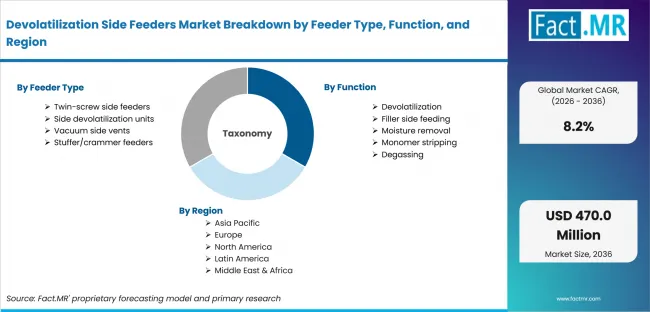
Devolatilization Side Feeders Market Breakdown By Feeder Type, Function, And Region | Source: Fact.MR
| Attribute | Details |
|---|---|
| Quantitative Units | USD million; |
| Market Definition | Equipment used at the side of an extrusion line to feed material and support devolatilization-related processing functions. |
| Feeder Type | Twin-screw side feeders; Side devolatilization units; Vacuum side vents; Stuffer/crammer feeders |
| Function | Devolatilization; Filler side feeding; Moisture removal; Monomer stripping; Degassing |
| Extruder Compatibility | Co-rotating twin-screw; Counter-rotating twin-screw; Single-screw; Ring extruders |
| End User | Polymer producers; Polymer compounders; Masterbatch makers; Recyclers; Engineering plastics |
| Regions Covered | North America; Latin America; Europe; East Asia; South Asia & Oceania; Middle East & Africa |
| Countries Covered | Germany; USA; Japan; Italy; UK |
| Key Companies Profiled | Coperion; Leistritz; KraussMaffei (Berstorff); Farrel Pomini |
| Forecast Period | 2026 to 2036 |
| Approach | Hybrid top-down and bottom-up approach using demand indicators across feeder type, function, extruder compatibility, end user, country growth, and company participation. |
Source: Fact.MR analysis. Updated Jul 23, 2026
How is the market segmented?
-
By Feeder Type
- Twin-screw side feeders
- Side devolatilization units
- Vacuum side vents
- Stuffer/crammer feeders
-
By Function
- Devolatilization
- Filler side feeding
- Moisture removal
- Monomer stripping
- Degassing
-
By Extruder Compatibility
- Co-rotating twin-screw
- Counter-rotating twin-screw
- Single-screw
- Ring extruders
-
By End User
- Polymer producers
- Polymer compounders
- Masterbatch makers
- Recyclers
- Engineering plastics
-
By Region
- North America
- Latin America
- Europe
- East Asia
- South Asia & Oceania
- Middle East & Africa
Frequently Asked Questions
Which Feeder Type leads the market?
Which Function leads the market?
Which Extruder Compatibility category leads the market?
Which End User leads the market?
Which country has the highest forecast CAGR?
Who worked on this report


Preview the report firsthand - request a free sample
Free SampleGet the brochure for pricing and purchase details
Download PDF