Diabetic Ketoacidosis Treatment Market
Diabetic Ketoacidosis Treatment Market Size and Share Forecast Outlook 2025 to 2035
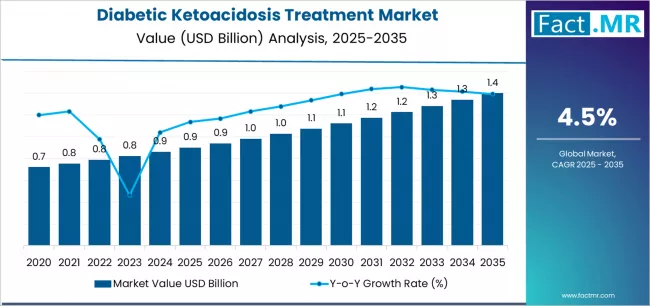
Diabetic ketoacidosis treatment market is projected to grow from USD 0.9 billion in 2025 to USD 1.4 billion by 2035, at a CAGR of 4.5%. Insulin Therapy will dominate with a 28.9% market share, while hospitals will lead the end-user segment with a 75.5% share.
Diabetic Ketoacidosis Treatment Market Forecast and Outlook 2025 to 2035
The global diabetic ketoacidosis treatment market is projected to reach USD 1.4 billion by 2035, recording an absolute increase of USD 0.5 billion over the forecast period. The market is valued at USD 0.9 billion in 2025 and is set to rise at a CAGR of 4.5% during the assessment period.
The overall market size is expected to grow by approximately 1.6 times during the same period, supported by increasing prevalence of type 1 diabetes across pediatric and adult populations worldwide, driving demand for emergency insulin therapy and rising investments in hospital emergency departments with proven acute care protocols across diverse healthcare systems globally.
Quick Stats for Diabetic Ketoacidosis Treatment Market
- Diabetic Ketoacidosis Treatment Market Value (2025): USD 0.9 billion
- Diabetic Ketoacidosis Treatment Market Forecast Value (2035): USD 1.4 billion
- Diabetic Ketoacidosis Treatment Market Forecast CAGR: 4.5%
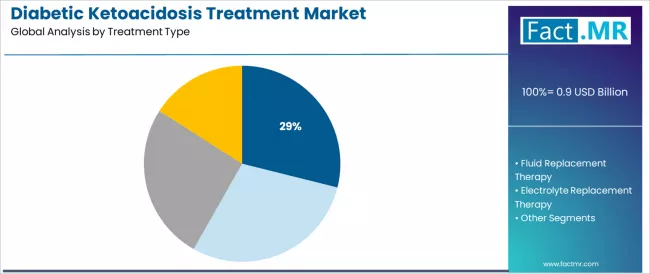
- Leading Treatment Type in Diabetic Ketoacidosis Treatment Market: Insulin Therapy (28.9%)
- Key Growth Regions in Diabetic Ketoacidosis Treatment Market: Asia Pacific, North America, and Europe
- Top Players in Diabetic Ketoacidosis Treatment Market: Novo Nordisk, Eli Lilly and Company, Sanofi, Pfizer Inc., Baxter International Inc., B. Braun Melsungen AG, Hikma Pharmaceuticals, Teva Pharmaceutical Industries Ltd., Fresenius Kabi, Biocon

Patients experiencing diabetic ketoacidosis face life-threatening metabolic emergencies requiring immediate medical intervention while addressing severe hyperglycemia and electrolyte imbalances, with modern DKA treatment protocols providing documented therapeutic benefits including rapid blood glucose normalization, effective acidosis correction, and electrolyte restoration compared to delayed or inadequate emergency interventions alone.
Rising awareness about diabetes management and expanding emergency healthcare infrastructure create substantial opportunities for pharmaceutical manufacturers and hospital systems. However, treatment cost barriers and limited access to emergency care in underserved regions may pose obstacles to optimal patient outcomes across resource-constrained healthcare settings.
The insulin therapy segment dominates market activity, driven by essential role in normalizing blood glucose levels and reversing ketone production addressing acute metabolic crisis across DKA patients worldwide. Healthcare providers increasingly recognize the critical importance of rapid-acting insulin protocols, with typical treatment regimens providing effective hyperglycemia management and metabolic stabilization at established dosing guidelines through hospital emergency departments and intensive care units.
The fluid replacement therapy segment demonstrates steady demand, supported by fundamental role in correcting severe dehydration and maintaining hemodynamic stability integrating comprehensive resuscitation protocols for DKA patient management. Hospitals emerge as the dominant end-user category, reflecting critical care requirements for continuous monitoring and intravenous therapy administration in emergency department and ICU settings. Healthcare facilities represent essential treatment locations, driven by specialized equipment needs and medical supervision requirements enabling optimal DKA patient outcomes.
Regional dynamics show North America maintaining market leadership, supported by high DKA hospitalization rates and established emergency care infrastructure across hospital networks. Asia Pacific demonstrates the fastest growth trajectory driven by rising diabetes prevalence and expanding acute care capabilities, while Europe emphasizes standardized treatment protocols and comprehensive emergency medical services.
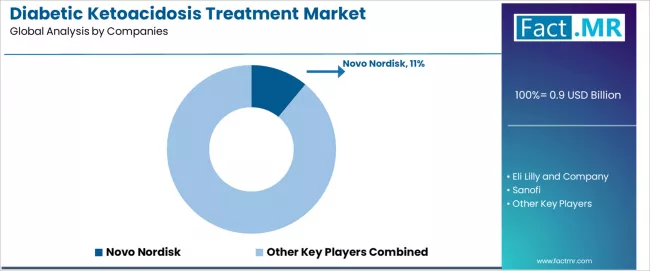
China leads country-level growth through extensive diabetes burden and major insulin manufacturing expansion, followed by India supported by fastest rise in type 1 diabetes incidence and improving acute care access. The competitive landscape features moderate concentration with Novo Nordisk maintaining market leadership position, while specialized players including Eli Lilly and Company, Sanofi, Pfizer Inc., and Baxter International Inc. compete through insulin formulations and intravenous fluid solutions across diverse emergency care applications.
Diabetic Ketoacidosis Treatment Market Year-over-Year Forecast 2025 to 2035
Between 2025 and 2029, the diabetic ketoacidosis treatment market is projected to expand from USD 0.9 billion to USD 1.1 billion, resulting in a value increase of USD 0.2 billion, which represents 40.0% of the total forecast growth for the period. This phase of development will be shaped by rising prevalence of type 1 diabetes among pediatric populations and young adults requiring emergency DKA interventions, improved emergency department protocols with standardized insulin infusion guidelines enhancing treatment consistency and patient outcomes, as well as expanding hospital emergency care capacity and intensive care infrastructure enabling comprehensive acute metabolic crisis management. Healthcare systems are establishing enhanced capabilities through investment in emergency medicine training programs, continuous glucose monitoring technologies, and strategic capacity expansion across emergency departments, critical care units, and diabetes specialty centers.
From 2029 to 2035, the market is forecast to grow from USD 1.1 billion to USD 1.4 billion, adding another USD 0.3 billion, which constitutes 60.0% of the overall expansion. This period is expected to be characterized by the expansion of specialized treatment approaches, including rapid-acting insulin analogs and concentrated electrolyte formulations tailored for accelerated DKA resolution, strategic collaborations between pharmaceutical manufacturers and hospital systems, and an enhanced focus on prevention programs and outpatient diabetes management reducing DKA incidence rates. The growing emphasis on diabetes education and rising adoption of continuous glucose monitoring systems will drive reduced emergency admissions while maintaining stable treatment demand for unavoidable DKA episodes across diverse patient populations requiring acute metabolic intervention and comprehensive hospital-based care.
Diabetic Ketoacidosis Treatment Market Key Takeaways
| Metric | Value |
|---|---|
| Market Value (2025) | USD 0.9 billion |
| Market Forecast Value (2035) | USD 1.4 billion |
| Forecast CAGR (2025-2035) | 4.5% |
Why is the Diabetic Ketoacidosis Treatment Market Growing?
The diabetic ketoacidosis treatment market grows by enabling emergency medical providers to deliver life-saving interventions for patients experiencing acute metabolic crisis while addressing severe hyperglycemia and life-threatening complications without delay in treatment initiation.
Patients with type 1 diabetes and insulin-dependent type 2 diabetes face critical risks during DKA episodes requiring immediate hospitalization and intensive medical management while managing profound metabolic derangements, severe dehydration, and electrolyte disturbances, with modern treatment protocols typically providing rapid insulin infusion, aggressive fluid resuscitation, and careful electrolyte replacement compared to inadequate or delayed interventions that risk fatal outcomes, making comprehensive DKA treatment essential for emergency medicine and critical care practice.
The healthcare system's need for standardized emergency protocols and hospital capacity to manage acute diabetes complications creates demand for DKA treatment solutions that can provide predictable therapeutic outcomes, support hemodynamic stability, and prevent mortality without compromising patient safety through treatment-related complications.
Hospital emergency department utilization and diabetes prevalence trends supporting DKA admission rates drive market stability in tertiary care hospitals, diabetes specialty centers, and intensive care units, where treatment quality has direct impact on patient survival and recovery outcomes.
The increasing global diabetes burden affecting over 500 million people creates expanding at-risk populations susceptible to DKA episodes during illness, insulin omission, or new diabetes diagnosis. Rising awareness among healthcare providers about optimal DKA management protocols enables standardized care delivery and improved outcomes. However, healthcare access disparities and treatment cost barriers may limit timely intervention among underserved populations with inadequate insurance coverage or geographic distance from emergency care facilities.
Segmental Analysis
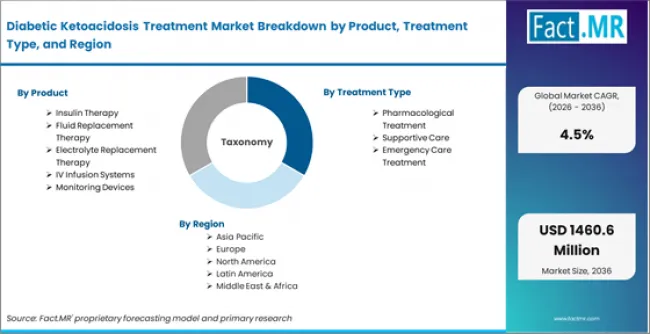
The market is segmented by treatment type, end-user, and region. By treatment type, the market is divided into insulin therapy, fluid replacement therapy, electrolyte replacement therapy, and others. Based on end-user, the market is categorized into hospitals, ambulatory surgical centers, and homecare settings. Regionally, the market is divided into Asia Pacific, Europe, North America, Latin America, and Middle East & Africa.
By Treatment Type, Which Segment Accounts for the Dominant Market Share?

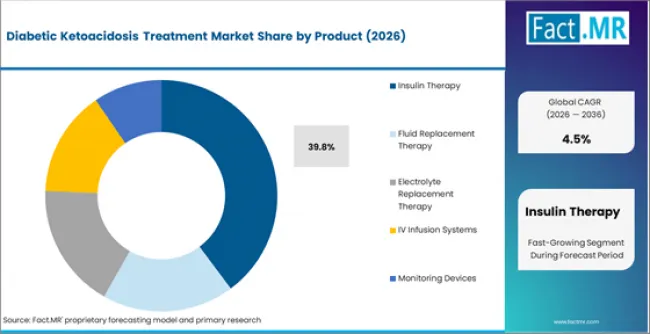
The insulin therapy segment represents the dominant force in the diabetic ketoacidosis treatment market, capturing approximately 28.9% of total market share in 2025. This established treatment category encompasses solutions featuring rapid-acting insulin formulations and continuous intravenous insulin infusion protocols, including advanced regular insulin preparations and standardized dosing algorithms that enable superior blood glucose normalization and ketone clearance across pediatric and adult DKA patients worldwide.
The insulin therapy segment's market leadership stems from its essential therapeutic role, with protocols capable of reversing ketoacidosis pathophysiology, restoring normal carbohydrate metabolism, and preventing life-threatening complications while maintaining dosing flexibility and titration capabilities across varied patient presentations and severity levels.
Within the insulin therapy category, regular human insulin represents the primary formulation utilized in DKA management through continuous intravenous infusion, addressing acute hyperglycemia correction and ketone suppression where predictable pharmacokinetics enable precise dose adjustments based on hourly blood glucose monitoring and clinical response assessment.
Rapid-acting insulin analogs demonstrate growing adoption in select protocols where specific patient populations or institutional preferences support alternative formulation selection. These products benefit from established safety profiles and clinical experience supporting their utilization in specialized DKA management approaches.
The fluid replacement therapy segment maintains substantial market importance, serving DKA patients who require aggressive volume resuscitation addressing profound dehydration and circulatory compromise through large-volume isotonic saline administration. These interventions provide essential hemodynamic support for patients managing severe fluid deficits while providing sufficient plasma volume expansion to support renal perfusion and metabolic waste elimination.
The fluid replacement therapy segment demonstrates consistent utilization, driven by fundamental role in DKA resuscitation protocols and universal requirement across all DKA severity levels.
Within fluid replacement applications, isotonic saline represents the standard initial resuscitation fluid, accounting for substantial volume administration during the first hours of DKA treatment where rapid intravascular volume restoration supports blood pressure maintenance and tissue perfusion optimization.
Within the treatment category, electrolyte replacement therapy demonstrates critical importance through potassium supplementation protocols addressing total body potassium depletion and preventing life-threatening cardiac arrhythmias during insulin therapy. Phosphate and bicarbonate replacement serves specialized indications in selected patient populations with severe deficiencies or profound acidosis.
Key treatment advantages driving the insulin therapy segment include:
- Essential therapeutic mechanism with proven ability to reverse ketoacidosis pathophysiology through suppression of lipolysis and ketone production
- Established dosing protocols allowing standardized treatment approaches with well-defined titration guidelines based on hourly glucose monitoring
- Comprehensive clinical experience features enabling confident application across diverse patient populations with varied DKA presentations
- Superior safety profile when administered with appropriate monitoring providing optimal therapeutic outcomes with manageable complication risks
By End-User, Which Segment Accounts for the Largest Market Share?

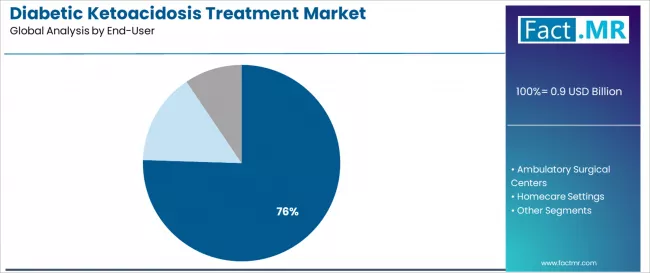
Hospitals dominate the diabetic ketoacidosis treatment end-user landscape with approximately 75.5% market share in 2025, reflecting the critical role of acute care facilities in supporting intensive monitoring, intravenous therapy administration, and multidisciplinary care coordination across DKA patient management worldwide. The hospitals segment's market leadership is reinforced by DKA treatment requirements for continuous vital sign monitoring, hourly laboratory testing, and specialized nursing care that necessitate hospital-based care delivery in emergency department and intensive care unit settings.
Within this segment, emergency departments represent the primary entry point for DKA patients requiring immediate assessment, diagnostic confirmation, and treatment initiation. These facilities provide comprehensive triage capabilities, rapid laboratory testing, and emergency physician expertise supporting initial stabilization and treatment protocol implementation.
Intensive care units account for substantial DKA patient volume through severe case management and complicated presentations requiring advanced hemodynamic monitoring, mechanical ventilation support, and specialized critical care interventions. ICU admission provides enhanced surveillance capabilities for patients with altered mental status, hemodynamic instability, or significant comorbidities requiring intensive medical management.
General medical wards serve DKA patients during recovery phases following initial stabilization, where continued insulin infusion, electrolyte monitoring, and transition to subcutaneous insulin regimens require ongoing hospital-based care with medical supervision and nursing support.
The ambulatory surgical centers segment maintains minimal presence in DKA management, as the acute nature and monitoring requirements of diabetic ketoacidosis exceed ASC capabilities and necessitate full hospital-based care with emergency and critical care infrastructure.
The homecare settings segment demonstrates limited application in DKA treatment, restricted to prevention strategies, post-discharge diabetes education, and outpatient insulin management that reduce future DKA risk but do not address acute episode treatment which requires hospital admission.
Key market dynamics supporting end-user distribution include:
- Hospital emergency department utilization driven by acute presentation patterns and need for immediate laboratory evaluation and treatment initiation
- ICU admission requirements reflecting severe case complexity and monitoring needs exceeding general ward capabilities
- Integration of endocrinology consultation services enabling specialized diabetes expertise and treatment optimization
- Growing emphasis on DKA prevention programs and discharge planning supporting reduced readmission rates without acute treatment setting changes
What are the Drivers, Restraints, and Key Trends of the Diabetic Ketoacidosis Treatment Market?
The market is driven by three concrete demand factors tied to diabetes prevalence and emergency care utilization. First, rising global diabetes burden and increasing type 1 diabetes incidence create expanding patient populations at risk for DKA episodes, with acute metabolic crisis representing a critical complication requiring emergency hospitalization, demanding consistent hospital preparedness and treatment availability. Second, improving emergency care infrastructure and expanding hospital capacity in emerging markets drive enhanced DKA treatment access, with healthcare system development demonstrating significant progress in establishing emergency departments and intensive care capabilities supporting acute diabetes complication management by 2030. Third, increasing awareness among healthcare providers about standardized DKA protocols and evidence-based treatment guidelines enables more consistent care delivery and improved patient outcomes that reduce mortality rates while supporting optimal resource utilization in emergency medicine and critical care settings.
Market restraints include significant treatment costs and hospitalization expenses that can create financial barriers for uninsured patients and healthcare systems with limited resources, particularly in regions where emergency care funding remains inadequate and out-of-pocket costs prove prohibitive for vulnerable populations. Healthcare access disparities and geographic distance to emergency facilities pose another significant obstacle, as DKA treatment requires immediate hospitalization and specialized care capabilities that may be unavailable in rural areas or underserved communities, potentially affecting treatment timeliness and patient outcomes. Insurance coverage limitations and reimbursement challenges for emergency diabetes care create additional pressure for healthcare facilities managing DKA patients, demanding advocacy for adequate coverage policies and payment models supporting comprehensive acute care delivery.
Key trends indicate accelerated prevention program adoption in developed markets, particularly North America and Europe, where healthcare systems demonstrate increasing willingness to invest in diabetes education, continuous glucose monitoring access, and outpatient insulin management support reducing preventable DKA admissions. Treatment protocol standardization trends toward evidence-based guidelines, electronic order sets, and quality improvement initiatives enable consistent care delivery that optimizes patient outcomes and resource efficiency across emergency departments. However, the market thesis could face disruption if major advances in diabetes technology including closed-loop insulin delivery systems or significant improvements in diabetes management education dramatically reduce DKA incidence rates among type 1 diabetes populations.
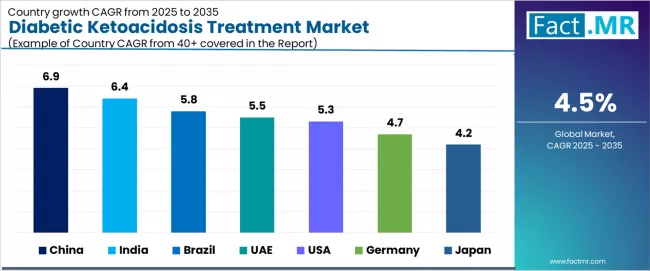
Analysis of the Diabetic Ketoacidosis Treatment Market by Key Countries

| Country | CAGR (2025 to 2035) |
|---|---|
| China | 6.9% |
| India | 6.4% |
| Brazil | 5.8% |
| UAE | 5.5% |
| USA | 5.3% |
| Germany | 4.7% |
| Japan | 4.2% |
The global diabetic ketoacidosis treatment market is expanding steadily, with China leading at a 6.9% CAGR through 2035, driven by rising diabetes burden and major insulin manufacturing expansion supporting domestic supply capabilities. India follows at 6.4%, supported by fastest rise in type 1 diabetes incidence and improving acute care access across urban hospital networks. Brazil records 5.8%, reflecting healthcare investment and high uncontrolled diabetes prevalence.
UAE advances at 5.5%, leveraging strong diabetes initiatives and advanced acute care infrastructure. USA posts 5.3%, focusing on high DKA hospitalization volume and strong adoption of rapid-acting insulins, while Germany grows at 4.7%, emphasizing mature market dynamics with stable adoption due to strict hospital protocols. Japan demonstrates 4.2% growth, anchored by aging population and strong emergency care system.
How is China Leading Global Market Expansion?
China demonstrates the strongest growth potential in the diabetic ketoacidosis treatment market with a CAGR of 6.9% through 2035. The country's leadership position stems from rapidly increasing diabetes prevalence affecting over 140 million people, expanding hospital emergency department infrastructure, and major domestic insulin manufacturing capabilities supporting treatment availability and affordability.
Growth is concentrated in major urban hospital systems and tertiary medical centers, including facilities in Beijing, Shanghai, Guangzhou, and Chengdu, where emergency departments and endocrinology departments are managing increasing DKA admission volumes among newly diagnosed type 1 diabetes patients and poorly controlled type 2 diabetes populations.
Healthcare delivery systems through public hospital networks, emergency medical services, and intensive care expansion programs improve DKA treatment access across urban populations and regional medical hubs. The country's comprehensive healthcare reform initiatives provide strong momentum for emergency care capability development, including extensive investment in hospital infrastructure modernization and medical training programs supporting standardized DKA management protocols.
Key market factors:
- Diabetes population concentrated in urban areas with rising type 1 diabetes incidence among children and young adults
- Hospital infrastructure expansion through emergency department modernization and ICU capacity additions supporting acute care delivery
- Comprehensive insulin manufacturing ecosystem, including domestic producers offering affordable regular insulin and biosimilar products
- Healthcare policy emphasis on diabetes management and complication prevention driving awareness and treatment access improvements
Why is India Emerging as a High-Growth Market?
In major metropolitan hospital systems including Mumbai, Delhi, Bangalore, Chennai, and Hyderabad, the management of diabetic ketoacidosis cases is accelerating across emergency departments and intensive care units, driven by fastest rising type 1 diabetes incidence globally and improving recognition of DKA as medical emergency requiring immediate hospitalization.
The market demonstrates strong growth momentum with a CAGR of 6.4% through 2035, linked to healthcare infrastructure development trends and increasing emergency care capacity supporting acute diabetes complication management. Indian hospitals are implementing standardized DKA treatment protocols integrated with emergency medicine training to enhance patient outcomes while meeting growing demand for acute diabetes care in urban tertiary hospitals and specialty diabetes centers. The country's expanding private hospital sector creates ongoing opportunities for DKA treatment optimization through protocol standardization and quality improvement initiatives.
Key development areas:
- Type 1 diabetes population growth leading DKA admission increases with emphasis on pediatric and young adult patient populations
- Emergency care capacity expansion providing growth opportunities through emergency department and ICU infrastructure development
- Healthcare professional training initiatives supporting improved DKA recognition and standardized treatment protocol implementation
- Growing insurance coverage and government health schemes improving treatment access and reducing financial barriers
What Drives Brazil’s Market Development?
Brazil’s market expansion is driven by substantial uncontrolled diabetes prevalence and expanding emergency healthcare infrastructure supporting acute complication management. The country demonstrates solid growth potential with a CAGR of 5.8% through 2035, supported by healthcare system investments and increasing recognition of DKA as preventable emergency requiring comprehensive diabetes management support.
Brazilian hospitals face implementation challenges related to healthcare access disparities between urban and rural regions and socioeconomic barriers affecting diabetes control, requiring system-level approaches to improve outpatient diabetes management and reduce preventable DKA admissions.
However, growing emergency medicine capabilities and hospital network expansion create expanding treatment capacity for DKA patients, particularly in major cities where tertiary hospitals provide specialized endocrinology support and intensive care capabilities enabling optimal patient management.
Market characteristics:
- Public hospital systems managing substantial DKA admission volumes with emphasis on emergency department protocols
- Regional variation between well-equipped urban centers and resource-limited facilities in underserved areas
- Future projections indicate continued emphasis on diabetes prevention programs and outpatient management supporting DKA reduction
- Growing pharmaceutical access initiatives supporting insulin availability and affordability for diabetes populations
How does UAE Demonstrate Healthcare Excellence Leadership?
The UAE’s market leads in acute care infrastructure quality based on advanced hospital systems and comprehensive emergency medical services supporting rapid DKA identification and treatment. The country shows strong growth potential with a CAGR of 5.5% through 2035, driven by high diabetes prevalence affecting approximately 16% of adult population and mandatory health insurance coverage ensuring treatment access in major emirates including Dubai and Abu Dhabi.
UAE healthcare facilities are adopting international best practice protocols through comprehensive emergency medicine programs and endocrinology specialty services for DKA management excellence, particularly in accredited hospitals and medical cities implementing evidence-based treatment guidelines. Healthcare delivery systems through integrated hospital networks and emergency medical services expand coverage across expatriate and national populations requiring acute diabetes care.
Leading market segments:
- Private hospital systems in Dubai and Abu Dhabi implementing premium emergency care services with advanced monitoring capabilities
- Government healthcare initiatives driving diabetes awareness and prevention programs supporting DKA reduction strategies
- Strategic investments in healthcare infrastructure expanding emergency department capacity and intensive care resources
- Focus on healthcare quality accreditation and international standard compliance ensuring optimal DKA treatment outcomes
What Positions USA for Volume Leadership?

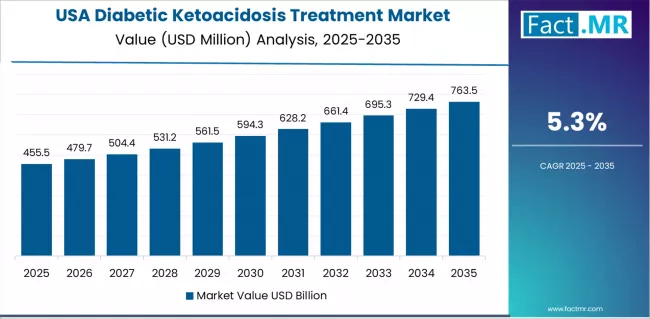
In major hospital systems including academic medical centers, community hospitals, and children's hospitals across metropolitan areas, the management of DKA cases represents substantial emergency department utilization, with documented admission patterns showing significant volume among type 1 diabetes patients experiencing insulin omission, illness-related episodes, and new diagnosis presentations. The market shows steady growth potential with a CAGR of 5.3% through 2035, linked to high baseline DKA hospitalization rates, strong adoption of evidence-based treatment protocols, and comprehensive insurance coverage supporting emergency care access.
Hospitals are implementing quality improvement programs and standardized order sets to optimize DKA management while maintaining guidelines established by American Diabetes Association and Pediatric Endocrine Society supporting consistent care delivery. The country's extensive hospital infrastructure creates stable demand for DKA treatment products while prevention initiatives aim to reduce avoidable admissions through improved outpatient diabetes management.
Market development factors:
- High DKA admission volumes concentrated in pediatric hospitals and tertiary medical centers managing type 1 diabetes populations
- Emergency medicine protocol standardization providing consistency through evidence-based guidelines and electronic order sets
- Strategic emphasis on continuous glucose monitoring adoption and diabetes technology integration supporting DKA prevention
- Insurance coverage ensuring treatment access while value-based care models incentivize prevention and readmission reduction
How does Germany Demonstrate Protocol Standardization Leadership?
The market in Germany leads in treatment protocol consistency based on strict adherence to evidence-based guidelines and comprehensive training programs for emergency physicians and intensive care specialists. The country shows steady potential with a CAGR of 4.7% through 2035, driven by mature healthcare system with established DKA management capabilities and consistent treatment quality across hospital networks in major regions including North Rhine-Westphalia, Bavaria, Baden-Württemberg, and Hesse.
German hospitals are maintaining high-quality DKA care through guideline-based protocols and multidisciplinary teams including emergency physicians, endocrinologists, and intensive care specialists ensuring optimal patient management, particularly in university hospitals and specialized diabetes centers implementing research-informed practices. Healthcare delivery through comprehensive hospital coverage and emergency medical services ensures timely DKA treatment access across urban and rural populations.
Leading market segments:
- University hospital systems implementing research-based protocols and training programs for emergency medicine residents
- Pediatric diabetes centers managing substantial type 1 diabetes populations with specialized DKA protocols
- Strategic quality assurance programs monitoring treatment outcomes and protocol adherence across hospital networks
- Focus on diabetes education and technology adoption supporting DKA prevention among established type 1 diabetes populations
What Characterizes Japan's Market Stability?

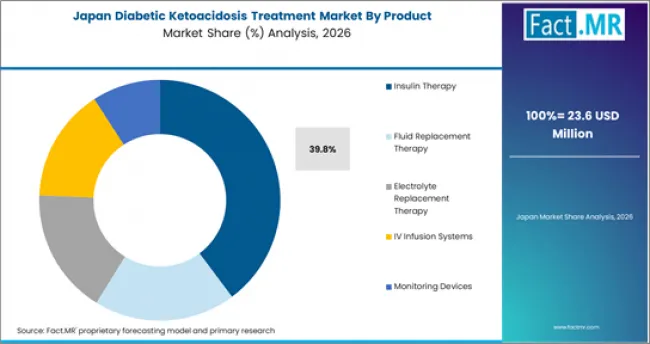
In major urban hospital systems including Tokyo, Osaka, Nagoya, and Fukuoka, the management of DKA cases demonstrates consistent protocols and established emergency care pathways, driven by aging diabetes population and strong emergency medical system ensuring rapid hospital transport and treatment initiation. The market demonstrates steady growth potential with a CAGR of 4.2% through 2035, linked to mature healthcare infrastructure with universal coverage and tightening diabetes management standards supporting complication prevention.
Japanese hospitals are maintaining quality DKA care through experienced emergency departments and utilizing comprehensive monitoring protocols ensuring patient safety while addressing demographic shifts toward elderly diabetes patients with complex comorbidities. The country's emphasis on healthcare quality creates stable demand for DKA treatment products with focus on established insulin formulations and standardized fluid therapy protocols.
Key development areas:
- Emergency department systems managing consistent DKA admission volumes with emphasis on protocol adherence and quality outcomes
- Aging diabetes population creating shifting patient demographics with increased comorbidity complexity
- Healthcare technology integration featuring electronic medical records and clinical decision support enhancing treatment consistency
- Emphasis on diabetes complication prevention through outpatient specialty care and patient education programs
Europe Market Split by Country

The diabetic ketoacidosis treatment market in Europe is projected to grow from USD 0.22 billion in 2025 to USD 0.33 billion by 2035, registering a CAGR of 4.2% over the forecast period. Germany is expected to maintain its leadership position with a 28.0% market share in 2025, adjusting to 27.5% by 2035, supported by its comprehensive emergency care infrastructure, standardized treatment protocols, and extensive hospital network serving major European diabetes populations.
UK follows with a 24.5% share in 2025, projected to reach 25.0% by 2035, driven by National Health Service emergency department coverage and established DKA management pathways across hospital trusts. France holds a 21.0% share in 2025, expected to maintain 21.3% by 2035 through comprehensive hospital emergency services and endocrinology specialty care.
Italy commands a 15.5% share, while Spain accounts for 9.0% in 2025. The Rest of Europe region is anticipated to maintain its collective share at 2.0% through 2035, with increasing DKA management capabilities in Nordic countries and Eastern European markets implementing modern emergency care protocols and diabetes specialty services.
Competitive Landscape of the Diabetic Ketoacidosis Treatment Market

The diabetic ketoacidosis treatment market features approximately 10-15 meaningful players with moderate concentration, where the top three companies control roughly 35-45% of global market share through established insulin manufacturing capabilities, hospital distribution networks, and intravenous solution portfolios. Competition centers on product availability, formulation consistency, and hospital contract relationships rather than differentiated therapeutic approaches.
Market leaders include Novo Nordisk, Eli Lilly and Company, and Sanofi, which maintain competitive advantages through comprehensive insulin product portfolios, global manufacturing scale, and deep expertise in diabetes therapeutics, creating reliable supply capabilities among hospital pharmacy departments and emergency care systems. These companies leverage established hospital relationships and regulatory experience to defend market positions while maintaining product quality standards and supply chain reliability.
Challengers encompass diversified pharmaceutical manufacturers including Pfizer Inc., Baxter International Inc., and B. Braun Melsungen AG, which compete through intravenous fluid solutions, electrolyte replacement products, and contract manufacturing capabilities serving hospital emergency departments.
Generic insulin manufacturers, including Hikma Pharmaceuticals, Teva Pharmaceutical Industries Ltd., Fresenius Kabi, and Biocon, focus on affordable insulin access and biosimilar development, offering cost-effective alternatives supporting healthcare system sustainability and patient access in price-sensitive markets.
Hospital pharmacy procurement and group purchasing organizations create competitive pressure through formulary management and contract negotiations, particularly in developed markets where standardized protocols and established guidelines reduce product differentiation and emphasize supply reliability and cost efficiency.
Market dynamics favor companies that combine manufacturing quality with regulatory compliance and distribution reliability that address hospital pharmacy requirements from product availability through technical support. Strategic emphasis on biosimilar development, supply chain resilience, and emerging market expansion enables market access in increasingly cost-conscious healthcare environments across developed and developing regions.
Global Diabetic Ketoacidosis Treatment Market - Stakeholder Contribution Framework
Diabetic ketoacidosis treatment represents a critical emergency medical intervention that enables healthcare providers to deliver life-saving care for patients experiencing acute metabolic crisis while addressing severe hyperglycemia and life-threatening complications without treatment delays, typically providing rapid insulin administration, aggressive fluid resuscitation, and electrolyte replacement compared to inadequate interventions alone while ensuring hemodynamic stability and comprehensive metabolic correction.
With the market projected to grow from USD 0.9 billion in 2025 to USD 1.4 billion by 2035 at a 4.5% CAGR, these interventions offer critical importance for hospital emergency care, intensive care management, and diverse patient populations requiring acute diabetes complication treatment. Improving patient outcomes and reducing DKA mortality requires coordinated action across public health policies, clinical guidelines, pharmaceutical manufacturers, hospital systems, and diabetes education programs.
How Could Governments Spur Local Development and Adoption?
- Emergency Care Infrastructure: Include DKA management capabilities in essential emergency services, providing funding for emergency department expansion and supporting hospital systems through capacity development grants and equipment subsidies.
- Healthcare Coverage & Access: Implement universal coverage for emergency diabetes care, provide subsidies for insulin and intravenous solutions ensuring treatment accessibility, and establish emergency transport systems connecting patients to capable facilities.
- Clinical Protocol Development: Create standardized national treatment guidelines for DKA management, establish quality indicators and outcome reporting requirements, and develop training programs for emergency physicians and intensive care specialists.
- Prevention Program Support: Fund diabetes education initiatives reducing DKA incidence, invest in continuous glucose monitoring access for high-risk populations, and establish outpatient diabetes specialty care supporting optimal disease management.
- Research & Quality Improvement: Establish public-private partnerships for DKA outcome research, support academic-industry collaborations investigating treatment optimization, and create data registries tracking incidence trends and treatment outcomes.
How Could Industry Bodies Support Market Development?
- Clinical Guidelines & Standards: Define evidence-based treatment protocols for DKA management across patient populations, establish quality metrics and outcome benchmarks, and create training curricula supporting emergency medicine and endocrinology education.
- Professional Education: Lead continuing medical education emphasizing DKA recognition, treatment protocols, and complication prevention, supporting emergency department and ICU staff competency.
- Quality Assurance Programs: Develop audit tools for protocol adherence monitoring, establish peer review processes supporting treatment quality improvement, and create certification programs for diabetes emergency care.
- Prevention Advocacy: Promote diabetes education programs, support patient access to insulin and monitoring supplies, and advocate for policies reducing preventable DKA admissions.
How Could Manufacturers and Pharmaceutical Companies Strengthen the Ecosystem?
- Product Availability: Ensure reliable insulin supply chains, maintain consistent product quality, and develop packaging formats supporting hospital emergency department and ICU utilization requirements.
- Affordability Initiatives: Provide patient assistance programs, support generic and biosimilar development expanding access, and implement tiered pricing strategies addressing resource-limited healthcare systems.
- Clinical Support Programs: Offer healthcare provider education on product utilization, provide technical resources supporting protocol implementation, and fund quality improvement research advancing DKA treatment outcomes.
- Emergency Preparedness: Build inventory systems supporting surge capacity, maintain strategic stockpiles for disaster preparedness, and establish rapid response capabilities for supply disruptions.
How Could Hospitals and Emergency Care Providers Navigate the Market?
- Protocol Implementation: Adopt evidence-based DKA treatment guidelines, implement electronic order sets supporting standardized care, and establish multidisciplinary teams coordinating emergency and endocrinology services.
- Quality Monitoring: Track DKA treatment outcomes including resolution time, complication rates, and mortality, use data for continuous improvement, and benchmark performance against national standards.
- Prevention Integration: Develop discharge planning programs connecting patients to outpatient diabetes care, provide diabetes education during hospitalization, and establish follow-up systems reducing readmissions.
- Resource Optimization: Implement efficient care pathways balancing ICU utilization with general ward management, standardize laboratory monitoring protocols, and optimize insulin infusion practices.
How Could Investors and Financial Enablers Unlock Value?
- Biosimilar Development: Finance insulin biosimilar development expanding affordable access, support manufacturing capacity for generic formulations, and enable regulatory pathway navigation.
- Healthcare Infrastructure: Invest in emergency department expansion in underserved regions, support telemedicine capabilities connecting rural facilities to specialist consultation, and fund hospital capacity development.
- Prevention Technology: Back diabetes technology companies developing continuous glucose monitoring and insulin delivery systems, support digital health platforms improving diabetes management, and enable patient education technology.
- Access Programs: Finance patient assistance initiatives ensuring insulin affordability, support nonprofit organizations addressing healthcare disparities, and enable innovative payment models supporting comprehensive diabetes care.
Key Players in the Diabetic Ketoacidosis Treatment Market
- Novo Nordisk
- Eli Lilly and Company
- Sanofi
- Pfizer Inc.
- Baxter International Inc.
- B. Braun Melsungen AG
- Hikma Pharmaceuticals
- Teva Pharmaceutical Industries Ltd.
- Fresenius Kabi
- Biocon
Scope of the Report
| Items | Values |
|---|---|
| Quantitative Units | USD 0.9 Billion |
| Treatment Type | Insulin Therapy, Fluid Replacement Therapy, Electrolyte Replacement Therapy, Others |
| End-User | Hospitals, Ambulatory Surgical Centers, Homecare Settings |
| Regions Covered | Asia Pacific, Europe, North America, Latin America, Middle East & Africa |
| Country Covered | China, India, Brazil, UAE, USA, Germany, Japan, and 40+ countries |
| Key Companies Profiled | Novo Nordisk, Eli Lilly and Company, Sanofi, Pfizer Inc., Baxter International Inc., B. Braun Melsungen AG, Hikma Pharmaceuticals, Teva Pharmaceutical Industries Ltd., Fresenius Kabi, Biocon |
| Additional Attributes | Dollar sales by treatment type and end-user categories, regional adoption trends across Asia Pacific, Europe, and North America, competitive landscape with pharmaceutical manufacturers and hospital suppliers, treatment protocol specifications and clinical guidelines, integration with emergency department pathways and intensive care protocols, innovations in insulin formulations and fluid management systems, and development of prevention strategies with patient education and continuous glucose monitoring capabilities. |
Diabetic Ketoacidosis Treatment Market by Segments
-
Treatment Type :
- Insulin Therapy
- Fluid Replacement Therapy
- Electrolyte Replacement Therapy
- Others
-
End-User :
- Hospitals
- Ambulatory Surgical Centers
- Homecare Settings
-
Region :
- Asia Pacific
- China
- Japan
- India
- Australia
- Thailand
- Rest of Asia Pacific
- Europe
- Germany
- UK
- France
- Italy
- Spain
- Denmark
- Sweden
- Norway
- Rest of Europe
- North America
- USA
- Canada
- Mexico
- Latin America
- Brazil
- Argentina
- Rest of Latin America
- Middle East & Africa
- South Africa
- Saudi Arabia
- UAE
- Kuwait
- Rest of Middle East & Africa
- Asia Pacific
Table of Content
- Executive Summary
- Global Market Outlook
- Demand to side Trends
- Supply to side Trends
- Technology Roadmap Analysis
- Analysis and Recommendations
- Market Overview
- Market Coverage / Taxonomy
- Market Definition / Scope / Limitations
- Market Background
- Market Dynamics
- Drivers
- Restraints
- Opportunity
- Trends
- Scenario Forecast
- Demand in Optimistic Scenario
- Demand in Likely Scenario
- Demand in Conservative Scenario
- Opportunity Map Analysis
- Product Life Cycle Analysis
- Supply Chain Analysis
- Investment Feasibility Matrix
- Value Chain Analysis
- PESTLE and Porter’s Analysis
- Regulatory Landscape
- Regional Parent Market Outlook
- Production and Consumption Statistics
- Import and Export Statistics
- Market Dynamics
- Global Market Analysis 2020 to 2024 and Forecast, 2025 to 2035
- Historical Market Size Value (USD Million) Analysis, 2020 to 2024
- Current and Future Market Size Value (USD Million) Projections, 2025 to 2035
- Y to o to Y Growth Trend Analysis
- Absolute $ Opportunity Analysis
- Global Market Pricing Analysis 2020 to 2024 and Forecast 2025 to 2035
- Global Market Analysis 2020 to 2024 and Forecast 2025 to 2035, By Treatment Type
- Introduction / Key Findings
- Historical Market Size Value (USD Million) Analysis By Treatment Type, 2020 to 2024
- Current and Future Market Size Value (USD Million) Analysis and Forecast By Treatment Type, 2025 to 2035
- Insulin Therapy
- Fluid Replacement Therapy
- Electrolyte Replacement Therapy
- Others
- Y to o to Y Growth Trend Analysis By Treatment Type, 2020 to 2024
- Absolute $ Opportunity Analysis By Treatment Type, 2025 to 2035
- Global Market Analysis 2020 to 2024 and Forecast 2025 to 2035, By End-User
- Introduction / Key Findings
- Historical Market Size Value (USD Million) Analysis By End-User, 2020 to 2024
- Current and Future Market Size Value (USD Million) Analysis and Forecast By End-User, 2025 to 2035
- Hospitals
- Ambulatory Surgical Centers
- Homecare Settings
- Y to o to Y Growth Trend Analysis By End-User, 2020 to 2024
- Absolute $ Opportunity Analysis By End-User, 2025 to 2035
- Global Market Analysis 2020 to 2024 and Forecast 2025 to 2035, By Region
- Introduction
- Historical Market Size Value (USD Million) Analysis By Region, 2020 to 2024
- Current Market Size Value (USD Million) Analysis and Forecast By Region, 2025 to 2035
- North America
- Latin America
- Western Europe
- Eastern Europe
- East Asia
- South Asia and Pacific
- Middle East & Africa
- Market Attractiveness Analysis By Region
- North America Market Analysis 2020 to 2024 and Forecast 2025 to 2035, By Country
- Historical Market Size Value (USD Million) Trend Analysis By Market Taxonomy, 2020 to 2024
- Market Size Value (USD Million) Forecast By Market Taxonomy, 2025 to 2035
- By Country
- USA
- Canada
- Mexico
- By Treatment Type
- By End-User
- By Country
- Market Attractiveness Analysis
- By Country
- By Treatment Type
- By End-User
- Key Takeaways
- Latin America Market Analysis 2020 to 2024 and Forecast 2025 to 2035, By Country
- Historical Market Size Value (USD Million) Trend Analysis By Market Taxonomy, 2020 to 2024
- Market Size Value (USD Million) Forecast By Market Taxonomy, 2025 to 2035
- By Country
- Brazil
- Chile
- Rest of Latin America
- By Treatment Type
- By End-User
- By Country
- Market Attractiveness Analysis
- By Country
- By Treatment Type
- By End-User
- Key Takeaways
- Western Europe Market Analysis 2020 to 2024 and Forecast 2025 to 2035, By Country
- Historical Market Size Value (USD Million) Trend Analysis By Market Taxonomy, 2020 to 2024
- Market Size Value (USD Million) Forecast By Market Taxonomy, 2025 to 2035
- By Country
- Germany
- UK
- Italy
- Spain
- France
- Nordic
- BENELUX
- Rest of Western Europe
- By Treatment Type
- By End-User
- By Country
- Market Attractiveness Analysis
- By Country
- By Treatment Type
- By End-User
- Key Takeaways
- Eastern Europe Market Analysis 2020 to 2024 and Forecast 2025 to 2035, By Country
- Historical Market Size Value (USD Million) Trend Analysis By Market Taxonomy, 2020 to 2024
- Market Size Value (USD Million) Forecast By Market Taxonomy, 2025 to 2035
- By Country
- Russia
- Poland
- Hungary
- Balkan & Baltic
- Rest of Eastern Europe
- By Treatment Type
- By End-User
- By Country
- Market Attractiveness Analysis
- By Country
- By Treatment Type
- By End-User
- Key Takeaways
- East Asia Market Analysis 2020 to 2024 and Forecast 2025 to 2035, By Country
- Historical Market Size Value (USD Million) Trend Analysis By Market Taxonomy, 2020 to 2024
- Market Size Value (USD Million) Forecast By Market Taxonomy, 2025 to 2035
- By Country
- China
- Japan
- South Korea
- By Treatment Type
- By End-User
- By Country
- Market Attractiveness Analysis
- By Country
- By Treatment Type
- By End-User
- Key Takeaways
- South Asia and Pacific Market Analysis 2020 to 2024 and Forecast 2025 to 2035, By Country
- Historical Market Size Value (USD Million) Trend Analysis By Market Taxonomy, 2020 to 2024
- Market Size Value (USD Million) Forecast By Market Taxonomy, 2025 to 2035
- By Country
- India
- ASEAN
- Australia & New Zealand
- Rest of South Asia and Pacific
- By Treatment Type
- By End-User
- By Country
- Market Attractiveness Analysis
- By Country
- By Treatment Type
- By End-User
- Key Takeaways
- Middle East & Africa Market Analysis 2020 to 2024 and Forecast 2025 to 2035, By Country
- Historical Market Size Value (USD Million) Trend Analysis By Market Taxonomy, 2020 to 2024
- Market Size Value (USD Million) Forecast By Market Taxonomy, 2025 to 2035
- By Country
- Kingdom of Saudi Arabia
- Other GCC Countries
- Turkiye
- South Africa
- Other African Union
- Rest of Middle East & Africa
- By Treatment Type
- By End-User
- By Country
- Market Attractiveness Analysis
- By Country
- By Treatment Type
- By End-User
- Key Takeaways
- Key Countries Market Analysis
- USA
- Pricing Analysis
- Market Share Analysis, 2024
- By Treatment Type
- By End-User
- Canada
- Pricing Analysis
- Market Share Analysis, 2024
- By Treatment Type
- By End-User
- Mexico
- Pricing Analysis
- Market Share Analysis, 2024
- By Treatment Type
- By End-User
- Brazil
- Pricing Analysis
- Market Share Analysis, 2024
- By Treatment Type
- By End-User
- Chile
- Pricing Analysis
- Market Share Analysis, 2024
- By Treatment Type
- By End-User
- Germany
- Pricing Analysis
- Market Share Analysis, 2024
- By Treatment Type
- By End-User
- UK
- Pricing Analysis
- Market Share Analysis, 2024
- By Treatment Type
- By End-User
- Italy
- Pricing Analysis
- Market Share Analysis, 2024
- By Treatment Type
- By End-User
- Spain
- Pricing Analysis
- Market Share Analysis, 2024
- By Treatment Type
- By End-User
- France
- Pricing Analysis
- Market Share Analysis, 2024
- By Treatment Type
- By End-User
- India
- Pricing Analysis
- Market Share Analysis, 2024
- By Treatment Type
- By End-User
- ASEAN
- Pricing Analysis
- Market Share Analysis, 2024
- By Treatment Type
- By End-User
- Australia & New Zealand
- Pricing Analysis
- Market Share Analysis, 2024
- By Treatment Type
- By End-User
- China
- Pricing Analysis
- Market Share Analysis, 2024
- By Treatment Type
- By End-User
- Japan
- Pricing Analysis
- Market Share Analysis, 2024
- By Treatment Type
- By End-User
- South Korea
- Pricing Analysis
- Market Share Analysis, 2024
- By Treatment Type
- By End-User
- Russia
- Pricing Analysis
- Market Share Analysis, 2024
- By Treatment Type
- By End-User
- Poland
- Pricing Analysis
- Market Share Analysis, 2024
- By Treatment Type
- By End-User
- Hungary
- Pricing Analysis
- Market Share Analysis, 2024
- By Treatment Type
- By End-User
- Kingdom of Saudi Arabia
- Pricing Analysis
- Market Share Analysis, 2024
- By Treatment Type
- By End-User
- Turkiye
- Pricing Analysis
- Market Share Analysis, 2024
- By Treatment Type
- By End-User
- South Africa
- Pricing Analysis
- Market Share Analysis, 2024
- By Treatment Type
- By End-User
- USA
- Market Structure Analysis
- Competition Dashboard
- Competition Benchmarking
- Market Share Analysis of Top Players
- By Regional
- By Treatment Type
- By End-User
- Competition Analysis
- Competition Deep Dive
- Novo Nordisk
- Overview
- Product Portfolio
- Profitability by Market Segments (Product/Age /Sales Channel/Region)
- Sales Footprint
- Strategy Overview
- Marketing Strategy
- Product Strategy
- Channel Strategy
- Eli Lilly and Company
- Sanofi
- Pfizer Inc.
- Baxter International Inc.
- B. Braun Melsungen AG
- Hikma Pharmaceuticals
- Teva Pharmaceutical Industries Ltd.
- Fresenius Kabi
- Biocon
- Novo Nordisk
- Competition Deep Dive
- Assumptions & Acronyms Used
- Research Methodology
List Of Table
- Table 1: Global Market Value (USD Million) Forecast by Region, 2020 to 2035
- Table 2: Global Market Value (USD Million) Forecast by Treatment Type, 2020 to 2035
- Table 3: Global Market Value (USD Million) Forecast by End-User, 2020 to 2035
- Table 4: North America Market Value (USD Million) Forecast by Country, 2020 to 2035
- Table 5: North America Market Value (USD Million) Forecast by Treatment Type, 2020 to 2035
- Table 6: North America Market Value (USD Million) Forecast by End-User, 2020 to 2035
- Table 7: Latin America Market Value (USD Million) Forecast by Country, 2020 to 2035
- Table 8: Latin America Market Value (USD Million) Forecast by Treatment Type, 2020 to 2035
- Table 9: Latin America Market Value (USD Million) Forecast by End-User, 2020 to 2035
- Table 10: Western Europe Market Value (USD Million) Forecast by Country, 2020 to 2035
- Table 11: Western Europe Market Value (USD Million) Forecast by Treatment Type, 2020 to 2035
- Table 12: Western Europe Market Value (USD Million) Forecast by End-User, 2020 to 2035
- Table 13: Eastern Europe Market Value (USD Million) Forecast by Country, 2020 to 2035
- Table 14: Eastern Europe Market Value (USD Million) Forecast by Treatment Type, 2020 to 2035
- Table 15: Eastern Europe Market Value (USD Million) Forecast by End-User, 2020 to 2035
- Table 16: East Asia Market Value (USD Million) Forecast by Country, 2020 to 2035
- Table 17: East Asia Market Value (USD Million) Forecast by Treatment Type, 2020 to 2035
- Table 18: East Asia Market Value (USD Million) Forecast by End-User, 2020 to 2035
- Table 19: South Asia and Pacific Market Value (USD Million) Forecast by Country, 2020 to 2035
- Table 20: South Asia and Pacific Market Value (USD Million) Forecast by Treatment Type, 2020 to 2035
- Table 21: South Asia and Pacific Market Value (USD Million) Forecast by End-User, 2020 to 2035
- Table 22: Middle East & Africa Market Value (USD Million) Forecast by Country, 2020 to 2035
- Table 23: Middle East & Africa Market Value (USD Million) Forecast by Treatment Type, 2020 to 2035
- Table 24: Middle East & Africa Market Value (USD Million) Forecast by End-User, 2020 to 2035
List Of Figures
- Figure 1: Global Market Pricing Analysis
- Figure 2: Global Market Value (USD Million) Forecast 2020 to 2035
- Figure 3: Global Market Value Share and BPS Analysis by Treatment Type, 2025 and 2035
- Figure 4: Global Market Y to o to Y Growth Comparison by Treatment Type, 2025 to 2035
- Figure 5: Global Market Attractiveness Analysis by Treatment Type
- Figure 6: Global Market Value Share and BPS Analysis by End-User, 2025 and 2035
- Figure 7: Global Market Y to o to Y Growth Comparison by End-User, 2025 to 2035
- Figure 8: Global Market Attractiveness Analysis by End-User
- Figure 9: Global Market Value (USD Million) Share and BPS Analysis by Region, 2025 and 2035
- Figure 10: Global Market Y to o to Y Growth Comparison by Region, 2025 to 2035
- Figure 11: Global Market Attractiveness Analysis by Region
- Figure 12: North America Market Incremental Dollar Opportunity, 2025 to 2035
- Figure 13: Latin America Market Incremental Dollar Opportunity, 2025 to 2035
- Figure 14: Western Europe Market Incremental Dollar Opportunity, 2025 to 2035
- Figure 15: Eastern Europe Market Incremental Dollar Opportunity, 2025 to 2035
- Figure 16: East Asia Market Incremental Dollar Opportunity, 2025 to 2035
- Figure 17: South Asia and Pacific Market Incremental Dollar Opportunity, 2025 to 2035
- Figure 18: Middle East & Africa Market Incremental Dollar Opportunity, 2025 to 2035
- Figure 19: North America Market Value Share and BPS Analysis by Country, 2025 and 2035
- Figure 20: North America Market Value Share and BPS Analysis by Treatment Type, 2025 and 2035
- Figure 21: North America Market Y to o to Y Growth Comparison by Treatment Type, 2025 to 2035
- Figure 22: North America Market Attractiveness Analysis by Treatment Type
- Figure 23: North America Market Value Share and BPS Analysis by End-User, 2025 and 2035
- Figure 24: North America Market Y to o to Y Growth Comparison by End-User, 2025 to 2035
- Figure 25: North America Market Attractiveness Analysis by End-User
- Figure 26: Latin America Market Value Share and BPS Analysis by Country, 2025 and 2035
- Figure 27: Latin America Market Value Share and BPS Analysis by Treatment Type, 2025 and 2035
- Figure 28: Latin America Market Y to o to Y Growth Comparison by Treatment Type, 2025 to 2035
- Figure 29: Latin America Market Attractiveness Analysis by Treatment Type
- Figure 30: Latin America Market Value Share and BPS Analysis by End-User, 2025 and 2035
- Figure 31: Latin America Market Y to o to Y Growth Comparison by End-User, 2025 to 2035
- Figure 32: Latin America Market Attractiveness Analysis by End-User
- Figure 33: Western Europe Market Value Share and BPS Analysis by Country, 2025 and 2035
- Figure 34: Western Europe Market Value Share and BPS Analysis by Treatment Type, 2025 and 2035
- Figure 35: Western Europe Market Y to o to Y Growth Comparison by Treatment Type, 2025 to 2035
- Figure 36: Western Europe Market Attractiveness Analysis by Treatment Type
- Figure 37: Western Europe Market Value Share and BPS Analysis by End-User, 2025 and 2035
- Figure 38: Western Europe Market Y to o to Y Growth Comparison by End-User, 2025 to 2035
- Figure 39: Western Europe Market Attractiveness Analysis by End-User
- Figure 40: Eastern Europe Market Value Share and BPS Analysis by Country, 2025 and 2035
- Figure 41: Eastern Europe Market Value Share and BPS Analysis by Treatment Type, 2025 and 2035
- Figure 42: Eastern Europe Market Y to o to Y Growth Comparison by Treatment Type, 2025 to 2035
- Figure 43: Eastern Europe Market Attractiveness Analysis by Treatment Type
- Figure 44: Eastern Europe Market Value Share and BPS Analysis by End-User, 2025 and 2035
- Figure 45: Eastern Europe Market Y to o to Y Growth Comparison by End-User, 2025 to 2035
- Figure 46: Eastern Europe Market Attractiveness Analysis by End-User
- Figure 47: East Asia Market Value Share and BPS Analysis by Country, 2025 and 2035
- Figure 48: East Asia Market Value Share and BPS Analysis by Treatment Type, 2025 and 2035
- Figure 49: East Asia Market Y to o to Y Growth Comparison by Treatment Type, 2025 to 2035
- Figure 50: East Asia Market Attractiveness Analysis by Treatment Type
- Figure 51: East Asia Market Value Share and BPS Analysis by End-User, 2025 and 2035
- Figure 52: East Asia Market Y to o to Y Growth Comparison by End-User, 2025 to 2035
- Figure 53: East Asia Market Attractiveness Analysis by End-User
- Figure 54: South Asia and Pacific Market Value Share and BPS Analysis by Country, 2025 and 2035
- Figure 55: South Asia and Pacific Market Value Share and BPS Analysis by Treatment Type, 2025 and 2035
- Figure 56: South Asia and Pacific Market Y to o to Y Growth Comparison by Treatment Type, 2025 to 2035
- Figure 57: South Asia and Pacific Market Attractiveness Analysis by Treatment Type
- Figure 58: South Asia and Pacific Market Value Share and BPS Analysis by End-User, 2025 and 2035
- Figure 59: South Asia and Pacific Market Y to o to Y Growth Comparison by End-User, 2025 to 2035
- Figure 60: South Asia and Pacific Market Attractiveness Analysis by End-User
- Figure 61: Middle East & Africa Market Value Share and BPS Analysis by Country, 2025 and 2035
- Figure 62: Middle East & Africa Market Value Share and BPS Analysis by Treatment Type, 2025 and 2035
- Figure 63: Middle East & Africa Market Y to o to Y Growth Comparison by Treatment Type, 2025 to 2035
- Figure 64: Middle East & Africa Market Attractiveness Analysis by Treatment Type
- Figure 65: Middle East & Africa Market Value Share and BPS Analysis by End-User, 2025 and 2035
- Figure 66: Middle East & Africa Market Y to o to Y Growth Comparison by End-User, 2025 to 2035
- Figure 67: Middle East & Africa Market Attractiveness Analysis by End-User
- Figure 68: Global Market - Tier Structure Analysis
- Figure 69: Global Market - Company Share Analysis
- FAQs -
How big is the diabetic ketoacidosis treatment market in 2025?
The global diabetic ketoacidosis treatment market is estimated to be valued at USD 0.9 billion in 2025.
What will be the size of diabetic ketoacidosis treatment market in 2035?
The market size for the diabetic ketoacidosis treatment market is projected to reach USD 1.4 billion by 2035.
How much will be the diabetic ketoacidosis treatment market growth between 2025 and 2035?
The diabetic ketoacidosis treatment market is expected to grow at a 4.5% CAGR between 2025 and 2035.
What are the key product types in the diabetic ketoacidosis treatment market?
The key product types in diabetic ketoacidosis treatment market are insulin therapy, fluid replacement therapy, electrolyte replacement therapy and others.
Which end-user segment to contribute significant share in the diabetic ketoacidosis treatment market in 2025?
In terms of end-user, hospitals segment to command 75.5% share in the diabetic ketoacidosis treatment market in 2025.