- Base Value(2025): 481.2 Mn
- Estimated Value(2026): 512.5 Mn
- Forecast Value (2036): 962.0 Mn
- CAGR (2026 - 2036): 6.5%
Die Cut Support Pads Market Forecast and Outlook 2026 to 2036
In 2025, the die cut support pads market was valued at USD 481.2 million. Based on Fact.MR analysis, demand is estimated to grow to USD 512.5 million in 2026 and USD 962.0 million by 2036. FACT.MR projects a CAGR of 6.5% during the forecast period.
Between 2026 and 2036, the market is projected to generate an absolute dollar opportunity of USD 480.8 million. This reflects steady, industrially anchored growth supported by electronics manufacturing expansion, automotive component logistics, and rising e-commerce protective packaging demand, while moderated by raw material cost volatility.
Frank Lowe Rubber & Gasket Co, CEO said, "Regardless of how you intend on using the die cut foam, [manufacturers] can manufacture foam gaskets in an array of appearances, tolerances, finishes, and materials that are perfectly tailored for specific manufacturing needs... from best-in-class materials to customizable products."
Country growth reflects manufacturing output, export packaging demand, and sustainability compliance intensity. China leads at 9.0% CAGR, driven by electronics and automotive exports. India follows at 8.7%, supported by expanding domestic manufacturing and e-commerce growth. Germany posts 7.6% due to automotive logistics and EU packaging compliance. Brazil registers 7.1% from industrial and consumer goods distribution demand. The United States grows at 6.8%, anchored by parcel shipments and ESG-driven fiber substitution, while the United Kingdom advances at 5.9% under Extended Producer Responsibility reforms.
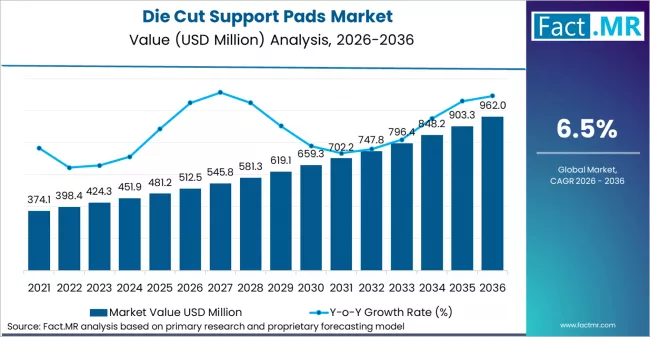
Die Cut Support Pads Market Market Value Analysis | Source: Fact.MR
| Metric | Value |
|---|---|
| Estimated Value in 2026 | USD 512.5 million |
| Forecast Value in 2036 | USD 962.0 million |
| Forecast CAGR (2026 to 2036) | 6.5% |
Source: Fact.MR analysis. Updated Mar 5, 2026
Market Definition
Die cut support pads are precision-engineered corrugated board inserts used to stabilize, cushion, and protect products within secondary and tertiary packaging. These pads are manufactured by cutting corrugated sheets into customized structural shapes that secure electronics, automotive components, cosmetic products, and industrial goods during storage and transit. They serve as load-distribution and shock-absorption solutions in modern supply chains.
Market Inclusions
The report covers global and regional market size, 2026-2036 forecast, segment-level share analysis by board type, flute type, and end use, as well as country-wise CAGR assessment. Sustainability trends, material cost analysis, and industrial demand mapping are included.
Market Exclusions
The scope excludes molded pulp inserts, foam packaging, plastic cushioning solutions, and finished retail cartons. Standalone corrugated sheets without die-cut shaping are excluded unless used as structural support pads.
Research Methodology
- Primary Research: Interviews were conducted with packaging converters, corrugated board manufacturers, logistics providers, and procurement managers across electronics and automotive sectors.
- Desk Research: Sources included company annual reports, sustainability disclosures, packaging regulations, and industrial production data.
- Market-Sizing and Forecasting: A hybrid top-down and bottom-up model was applied using corrugated board consumption data and end-use demand mapping.
- Data Validation and Update Cycle: Outputs were validated against industrial production trends and updated annually for regulatory and raw material shifts.
Summary
- Market Definition
- Die cut support pads are precision-cut corrugated inserts designed to protect products during storage and transit. They provide structural stability and cushioning to minimize movement, compression damage, and impact within packaging systems.
- Demand Drivers
- Rising cross-border shipments of semiconductors, consumer electronics, and precision components increase the need for structurally stable internal packaging. Die cut support pads reduce vibration, compression damage, and product returns during long-haul transport.
- Automotive OEMs and Tier-1 suppliers are streamlining packaging to minimize in-transit damage and warehouse handling inefficiencies. Custom die-cut corrugated inserts provide stack strength and part immobilization while supporting reusable and returnable packaging systems.
- Extended Producer Responsibility (EPR) frameworks and packaging waste regulations are pushing companies toward fiber-based protective solutions. Corrugated die-cut pads offer high recyclability and plastic substitution benefits, aligning with corporate ESG and compliance targets.
- Key Segments Analyzed
- Board Type: Single Wall holds 47.2% share in 2026, driven by its cost-efficiency and adequate compression strength for mid-weight electronics and consumer goods packaging.
- Flute Type: A (Highest) Flute accounts for 34% share, supported by superior cushioning and vertical stacking strength required for fragile product shipments.
- End Use: Electrical & Electronics commands 40% share, due to high export volumes of delicate components that require precision-fitted internal structural support.
- Geography: Asia Pacific leads the market, with China recording the highest CAGR at 9.0%, driven by strong manufacturing output and export-oriented packaging demand.
- Analyst Opinion at FACT.MR
- Shambhu Nath Jha, Principal Consultant at Fact.MR, opines, ‘CXOs will find this report critical for navigating the margin divergence between commoditized corrugated inserts and precision-engineered structural support pads, where lightweighting mandates, EPR compliance, and high-value electronics logistics are shifting revenue toward customized die-cut configurations with higher per-unit realization.’
- Strategic Implications
- Corrugated converters should invest in automated die-cutting and digital prototyping capabilities to serve electronics and automotive OEMs demanding precision-fit inserts that reduce transit damage and return rates.
- Manufacturers should prioritize high-performance flute optimization in Asia Pacific, where export-led production and packaging efficiency mandates are driving consistent structural packaging upgrades.
- Suppliers should align portfolios with recyclability and EPR compliance frameworks in Europe and the UK, where fiber-based protective packaging is increasingly preferred over foam and plastic cushioning alternatives.
- Methodology
- Market sizing combined corrugated board production data with estimated die-cut conversion ratios, average unit pricing by board type and flute configuration, and end-use demand intensity across electronics, automotive, and FMCG sectors.
- Regulatory adoption timelines were benchmarked against EU Packaging and Packaging Waste Regulation (2024), UK Extended Producer Responsibility implementation (2024-2025), and national sustainability compliance disclosures.
- Regional forecasts incorporated manufacturing output statistics, export packaging intensity trends, linerboard price benchmarks, and primary interviews with packaging converters, procurement managers, and logistics providers.
Segmental Analysis
Die Cut Support Pads Market Analysis by Board Type
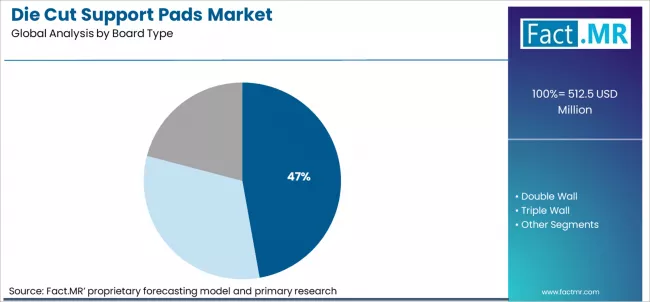
Die Cut Support Pads Market Analysis By Board Type | Source: Fact.MR
Based on FACT.MR's die cut support pads market report, consumption of Single Wall boards is estimated to hold 47.2% share in 2026. Single Wall configurations dominate due to optimal strength-to-weight ratio, cost efficiency, and compatibility with automated high-volume packaging lines. They provide sufficient compression resistance for electronics, cosmetics, and FMCG shipments without the added material cost of double or triple wall structures.
- International Paper Corrugated Optimization Initiative: In 2024, International Paper highlighted continued investments in lightweight linerboard and performance packaging solutions within its earnings disclosures, emphasizing material efficiency and structural design optimization for protective packaging applications. [1]
- Smurfit Westrock Integration Expansion: Following the 2024 Smurfit Kappa-WestRock merger, the combined entity expanded its performance packaging portfolio, reinforcing structural corrugated design capabilities for protective inserts across industrial supply chains. [2]
- Amazon Packaging Certification Standards: Amazon’s Frustration-Free Packaging program continues to prioritize recyclable fiber-based internal protection, encouraging suppliers to adopt corrugated structural inserts over plastic cushioning alternatives. [3]
Die Cut Support Pads Market Analysis by End Use
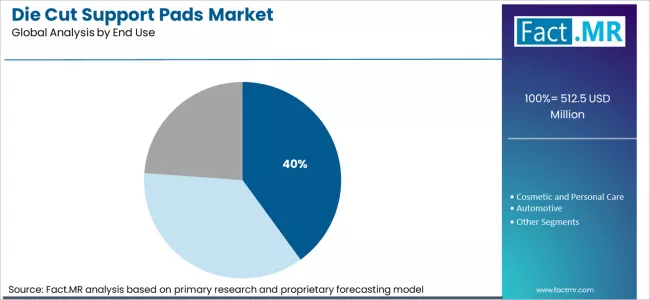
Die Cut Support Pads Market Analysis By End Use | Source: Fact.MR
Based on FACT.MR's die cut support pads market report, consumption across the Electrical & Electronics segment is estimated to hold 40% share in 2026. Electronics lead due to high export intensity, fragility of semiconductor and component assemblies, and strict in-transit damage tolerances. Precision die-cut corrugated inserts reduce vibration, movement, and compression damage during long-haul global shipments.
- Apple Supplier Packaging Standards: Apple’s Supplier Responsibility guidelines continue to mandate sustainable and protective packaging design improvements, encouraging recyclable fiber-based cushioning solutions across electronics supply chains. [4]
- Automotive Tier-1 Export Growth: In 2024, Germany’s automotive export performance supported demand for reinforced secondary packaging inserts for high-value components, reinforcing structural corrugated adoption. [5]
- E-commerce Electronics Surge: Global e-commerce growth in consumer electronics shipments continues to increase demand for protective internal packaging that reduces return rates and reverse logistics costs. [6]
Drivers, Restraints, and Opportunities
FACT.MR analysts observe that the die cut support pads market has evolved from generic corrugated inserts toward precision-engineered structural packaging driven by export manufacturing and e-commerce expansion. The USD 481.2 million valuation reflects its integral role in modern logistics systems rather than discretionary packaging upgrades.
The market is shifting toward optimized flute engineering and lightweight strength enhancement. While raw material price volatility in kraft linerboard moderates margin expansion, substitution away from plastic cushioning toward recyclable corrugated formats strengthens long-term structural demand.
- Regulatory Packaging Reform: Implementation of the EU Packaging and Packaging Waste Regulation (PPWR) in 2024 accelerates transition toward recyclable fiber-based protective materials. This regulatory environment favors corrugated die-cut inserts over foam or plastic cushioning alternatives.
- Asia Pacific Export Manufacturing Expansion: Rapid electronics and automotive export growth in China and India structurally supports demand for high-volume structural packaging components. Manufacturing-led growth underpins sustained die-cut insert consumption.
- Automation and Light Weighting Innovation: Investment in automated die-cutting systems and performance linerboard technology improves production efficiency and compression strength per gram of fiber, enabling cost optimization without compromising structural integrity.
Regional Analysis
The die cut support pads market is analysed across Asia Pacific, Europe, North America, and Latin America, spanning major manufacturing and export-driven economies with varying sustainability enforcement intensity and industrial packaging demand structures. The full report offers market attractiveness analysis based on manufacturing output intensity, export packaging volumes, linerboard price exposure, and regulatory compliance enforcement timelines by region.
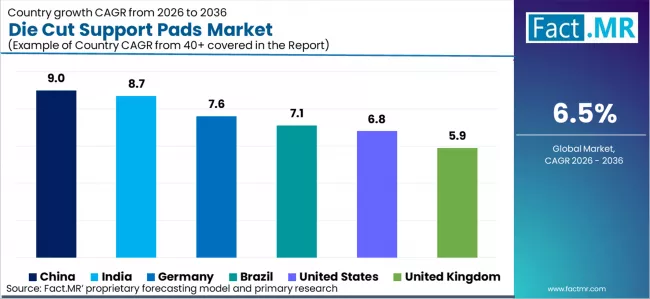
Die Cut Support Pads Market Cagr Analysis By Country | Source: Fact.MR
| Country | CAGR (2026-2036) |
|---|---|
| China | 9.0% |
| India | 8.7% |
| Germany | 7.6% |
| Brazil | 7.1% |
| United States | 6.8% |
| United Kingdom | 5.9% |
Source: Fact.MR analysis. Updated Mar 5, 2026
Source: Fact.MR (FACT.MR) analysis, based on proprietary forecasting model and primary research
Asia Pacific Die Cut Support Pads Market Analysis
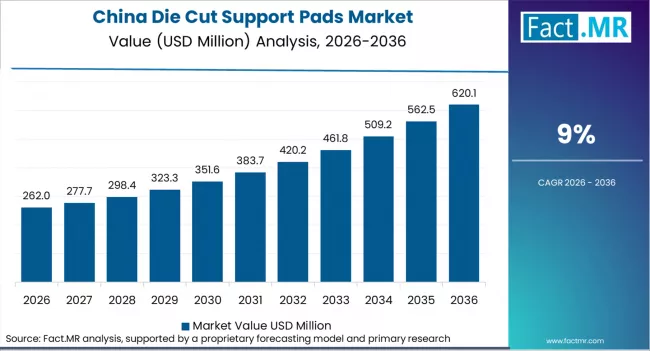
Die Cut Support Pads Market Country Value Analysis | Source: Fact.MR
Asia Pacific remains the production epicenter and fastest expanding region for die cut support pads, supported by electronics exports, automotive manufacturing expansion, and increasing substitution of plastic cushioning materials with recyclable corrugated solutions.
- China: China’s die cut support pads market is projected to expand at 9.0% CAGR through 2036. Electronics manufacturing clusters and export-driven industrial production sustain structural packaging demand. Strengthened compliance under China’s solid waste reduction and circular economy initiatives continues to favor recyclable fiber-based packaging solutions across logistics networks.
- India: India is projected to register 8.7% CAGR through 2036. Growth is driven by electronics assembly expansion under production-linked incentive (PLI) schemes and rising e-commerce penetration. Increased domestic manufacturing intensity strengthens demand for protective corrugated inserts across Tier 1 and Tier 2 industrial corridors.
FACT.MR's Asia Pacific analysis of the die cut support pads market covers China, India, Japan, South Korea, ASEAN, Australia and New Zealand, and Rest of Asia Pacific. Readers can find country-level CAGR projections, manufacturing output benchmarks, export packaging demand intensity, and sustainability compliance trends.
Europe Die Cut Support Pads Market Analysis
Europe remains regulation-led, with strict packaging waste compliance frameworks encouraging fiber-based protective packaging adoption. Corrugated structural inserts benefit from recyclability positioning and EPR enforcement.
- Germany: Germany is anticipated to record 7.6% CAGR through 2036. Automotive export strength and precision component logistics underpin demand. Enforcement of EU packaging waste directives strengthens preference for recyclable corrugated structural solutions.
- United Kingdom: The UK market is projected to expand at 5.9% CAGR through 2036. Implementation of Extended Producer Responsibility (EPR) reforms in 2024-2025 increases cost accountability for packaging waste, encouraging adoption of recyclable corrugated support structures.
FACT.MR's European analysis of the die cut support pads market covers Germany, France, the United Kingdom, Italy, Spain, the Nordics, and Rest of Europe. Readers can find compliance enforcement timelines, automotive export intensity, industrial packaging demand benchmarks, and country-level CAGR projections.
North America Die Cut Support Pads Market Analysis
North America remains logistics-driven, supported by strong e-commerce penetration and electronics distribution networks. Structural packaging performance and damage reduction economics underpin steady market expansion.
- United States: The U.S. die cut support pads market is projected to expand at 6.8% CAGR through 2036. E-commerce shipment volumes and electronics distribution centers generate sustained demand for internal structural packaging. Sustainability initiatives and corporate ESG commitments increasingly favor recyclable corrugated inserts over plastic cushioning materials.
FACT.MR's North American analysis of the die cut support pads market covers the United States and Canada. Readers can find e-commerce packaging benchmarks, linerboard price exposure analysis, logistics demand trends, and country-level CAGR projections.
Competitive Aligners for Market Players
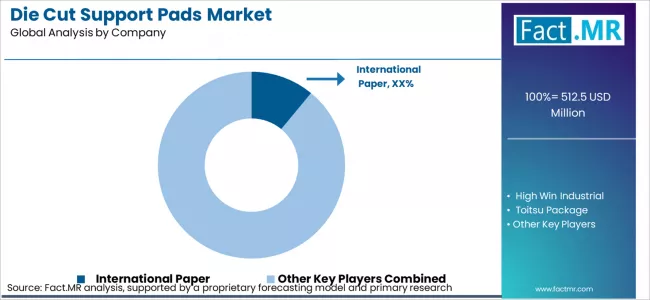
Die Cut Support Pads Market Analysis By Company | Source: Fact.MR
The die cut support pads market is moderately fragmented, characterized by a mix of large integrated corrugated manufacturers and regional specialty converters. Global packaging majors such as International Paper and Smurfit Westrock benefit from vertical integration in linerboard production, providing cost control, material security, and scale advantages. Their ability to offer end-to-end packaging solutions, including structural design, testing, and logistics support, strengthens relationships with large electronics and automotive OEMs.
Regional converters compete primarily on customization flexibility, lead times, and localized supply reliability. Precision die-cut capabilities, automated CAD-based structural design, and rapid prototyping services increasingly differentiate suppliers in high-value applications such as semiconductor and automotive component packaging. Pricing remains competitive in commodity-grade inserts; however, value-added structural engineering and lightweight performance optimization enable margin expansion. Buyer leverage is moderate to high, especially among multinational electronics manufacturers that conduct centralized procurement and demand sustainability compliance. As Extended Producer Responsibility frameworks expand globally, suppliers with recyclable certifications and documented environmental performance are positioned to gain preferential contracts, consolidating competitive advantage around compliance capability and operational scale.
Recent Developments
- In July 2025, JK Paper announced the acquisition of a majority stake in Borkar Packaging, a prominent Indian corrugated box and folding carton manufacturer, to strengthen its presence in corrugated and die-cut structural packaging sectors in India.
- In February 2025, International Paper completed its acquisition of DS Smith, a major British packaging business, in a takeover valued at approximately £5.8 billion. This transaction significantly expanded International Paper’s corrugated and die-cut packaging capabilities across Europe and North America.
Key Players
- International Paper
- High Win Industrial
- Toitsu Package
- Innerpak of Wisconsin
- Progressive Packaging
- United Packaging Industries
- Premier Packaging Products
- Wall Family Enterprise
- Box Captain
Bibliography
- [1] International Paper Company. 2024. Form 10-K Annual Report 2024. Memphis (TN): International Paper.
- [2] Smurfit Westrock plc. 2024. Smurfit Kappa and WestRock Complete Merger to Create Smurfit Westrock. Press Release; 2024 Jul. Dublin (IE): Smurfit Westrock.
- [3] Amazon.com Inc. 2024. Frustration-Free Packaging Program Requirements and Sustainability Guidelines. Seattle (WA):
- [4] Apple Inc. 2024. Apple Supplier Responsibility Progress Report 2024. Cupertino (CA): Apple Inc.
- [5] German Federal Statistical Office (Destatis). 2024. Foreign Trade: Automotive Exports 2024 Statistical Release. Wiesbaden (DE): Destatis.
- [6] United Nations Conference on Trade and Development (UNCTAD). 2024. E-commerce and Digital Economy Report 2024. Geneva (CH): UNCTAD.
This Report Addresses
- Strategic intelligence on electronics export packaging demand in China, automotive logistics optimization in Germany, EPR-driven fiber substitution in the UK and EU, and e-commerce protective packaging expansion in the United States and India.
- Market size and forecast: valued at USD 512.5 million in 2026, projected to reach USD 962.0 million by 2036 at a 6.5% CAGR, segmented by board type, flute type, end use, and region.
- Growth opportunity mapping across lightweight single wall optimization, high-cushion A flute adoption, precision die-cut automation, and recyclable insert substitution in high-growth export markets.
- Country CAGR outlook: China (9.0%), India (8.7%), Germany (7.6%), Brazil (7.1%), United States (6.8%), and United Kingdom (5.9%) with detailed segment splits by board type and end use.
- Competitive analysis of International Paper, Smurfit Westrock, Innerpak of Wisconsin, Progressive Packaging, and regional converters covering customization capability, linerboard integration, automation depth, and supply chain reach.
- Product and technology tracking including lightweight linerboard innovations, automated CAD-based die-cut design systems, compression-strength optimization, and recyclable mono-material protective insert development.
- Regulatory impact analysis covering EU Packaging and Packaging Waste Regulation (2024), UK Extended Producer Responsibility reforms (2024-2025), corporate ESG packaging targets, and circular economy compliance frameworks.
- Report delivered in Excel datasets, PowerPoint summary, and detailed PDF supported by manufacturing output data, packaging regulation records, company disclosures, and primary research interviews.
Segmentation
Scope of Report
| Items | Values |
|---|---|
| Quantitative Units | USD 512.5 million (2026) to USD 962.0 million (2036), at a CAGR of 6.5% |
| Market Definition | Die cut support pads are precision-engineered corrugated board inserts used to stabilize, cushion, and protect products during storage and transportation. They are custom-cut structural components integrated into secondary and tertiary packaging systems across electronics, automotive, cosmetic, industrial, and e-commerce logistics supply chains. |
| Board Type | Single Wall, Double Wall, Triple Wall |
| Flute Type | A (Highest) Flute, B (Standard) Flute, C (Between A and B) Flute, E (Thin) Flute, Others (Extra 125G B-Flute) |
| End Use | Electrical & Electronics, Cosmetic And Personal Care, Automotive, Shipping And Transportation, Others |
| Application Coverage | Structural inserts for electronics export packaging, automotive component stabilization, cosmetic product reinforcement, industrial machinery cushioning, e-commerce parcel damage reduction, and secondary packaging load distribution applications. |
| Regions Covered | Asia Pacific, Europe, North America, Latin America |
| Countries Covered | China, India, Germany, Brazil, United States, United Kingdom, Rest of Asia Pacific, Rest of Europe, Rest of North America, Rest of Latin America |
| Key Companies Profiled | International Paper, High Win Industrial, Toitsu Package, Innerpak of Wisconsin, Progressive Packaging, United Packaging Industries, Premier Packaging Products, Wall Family Enterprise, Box Captain |
| Forecast Period | 2026 to 2036 |
| Approach | A hybrid top down and bottom up model was used. Top down inputs covered corrugated board production forecasts, manufacturing output projections, export shipment volumes, and packaging regulation timelines. Bottom up analysis included average die-cut pricing by board and flute type, usage intensity per shipment category, replacement cycles, and primary interviews with converters, distributors, and procurement managers. |
Source: Fact.MR analysis. Updated Mar 5, 2026
Die Cut Support Pads Market by Segments
-
Board Type :
- Single Wall
- Double Wall
- Triple Wall
-
Flute Type :
- A (Highest) Flute
- B (Standard) Flute
- C (Between A and B) Flute
- E (Thin) Flute
- Others (Extra 125G B-Flute)
-
End Use :
- Electrical & Electronics
- Cosmetic and Personal Care
- Automotive
- Shipping and Transportation
- Others
-
Region :
- North America
- USA
- Canada
- Mexico
- Latin America
- Brazil
- Chile
- Rest of Latin America
- Western Europe
- Germany
- UK
- Italy
- Spain
- France
- Nordic
- BENELUX
- Rest of Western Europe
- Eastern Europe
- Russia
- Poland
- Hungary
- Balkan & Baltic
- Rest of Eastern Europe
- East Asia
- China
- Japan
- South Korea
- South Asia and Pacific
- India
- ASEAN
- Australia & New Zealand
- Rest of South Asia and Pacific
- Middle East & Africa
- Kingdom of Saudi Arabia
- Other GCC Countries
- Turkiye
- South Africa
- Other African Union
- Rest of Middle East & Africa
- North America
Frequently Asked Questions
How large is the market in 2025?
What will the market size be in 2026?
What is the projected value by 2036?
What is the expected CAGR?
Who worked on this report


Preview the report firsthand - request a free sample
Free SampleGet the brochure for pricing and purchase details
Download PDF