- Market Value (2025): USD 8.7 Bn
- Estimated Value (2026): USD 9.6 Bn
- Forecast Value (2036): USD 24.9 Bn
- CAGR (2026-2036): 10.0%
What is the Digital Cold Chain Management Market forecast to be worth by 2036?
USD 9.6 billion in 2026 to USD 24.9 billion by 2036 at 10.0% CAGR.
- The digital cold chain management market reached USD 8.7 billion in 2025 as cold storage visibility and shipment documentation gained more weight in buyer evaluation.
- Demand is projected to increase from USD 9.6 billion in 2026 to USD 24.9 billion by 2036.
- The market is forecast to record a 10.0% CAGR from 2026 to 2036.
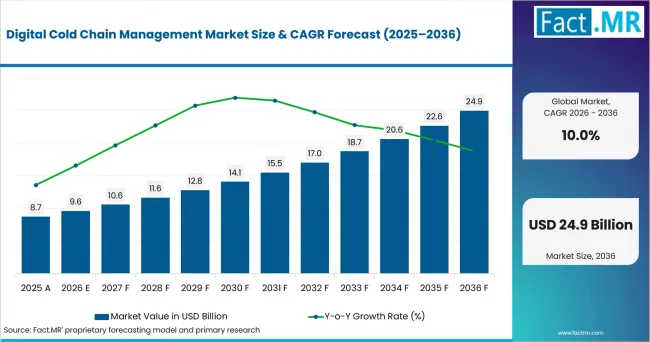
Digital Cold Chain Management Market Value Analysis | Source: Fact.MR
What are the defining numbers behind Digital Cold Chain Management Market growth?
USD 15.2 billion absolute opportunity by 2036, led by cloud-based cold chain software and pharmaceutical cold chain.
- Demand Drivers in the Market
- Temperature-sensitive shipments require temperature monitoring devices that record conditions across storage and transport.
- Pharmaceutical producers use pharmaceutical logistics workflows to protect product quality when release depends on temperature history.
- Food logistics users depend on alerts and route visibility when chilled products move through several handoff points.
- Cold chain packaging demand reinforces monitoring needs because packaging performance has to be checked during transport.
- Key Segments Analyzed
- By Solution Type: Cloud-based Cold Chain Software is expected to hold 41.0% share in 2026 because buyers want centralized monitoring without heavy local IT setup.
- By Application Area: Pharmaceutical Cold Chain is projected to account for 43.0% share in 2026 as temperature records shape product release and compliance review.
- By End-use Industry: Healthcare & Pharmaceuticals is anticipated to capture 45.0% share in 2026 due to strict handling requirements for medicines and biologics.
- By User Category: Pharmaceutical Manufacturers are estimated to represent 42.0% share in 2026 since batch value and release risk make shipment documentation essential.
- By Technology Platform: IoT-enabled Monitoring Platform is forecast to hold 39.0% share in 2026 as sensor-led visibility supports alerts and route decisions.
- Analyst Opinion at Fact.MR
- Shambhu Nath Jha, Principal Consultant at Fact.MR, states, “Digital Cold Chain Management companies need to prove use-case fit through route evidence and alert quality. Buyers are expected to reward suppliers that can show reliable performance during storage and transport.”
- Strategic Implications
- Brand owners can position offerings by shipment risk and release need instead of broad platform capability.
- Suppliers improve retention when sensor data is translated into simple compliance records for buyers.
- Fleet management platforms can gain account depth when route visibility is paired with temperature alerts.
- Pricing teams need value arguments that connect uptime and service response with lower rejection risk.
The USA leads at 10.9% CAGR through pharmaceutical distribution depth and supplier access. Germany follows at 10.4% as regulated healthcare logistics supports monitoring adoption. Japan reaches 9.8% through quality-focused handling. The UK records 9.3% through healthcare logistics needs. Canada reaches 8.9% through broad regional routes. Australia records 8.5% through dispersed chilled distribution. Singapore reaches 8.1% through hub-based logistics activity.
How does the Digital Cold Chain Management Market break down by segment?
Cloud-based Cold Chain Software leads Solution Type at 41.0% share in 2026. Pharmaceutical Cold Chain leads Application Area at 43.0%.
Why does Cloud-based Cold Chain Software lead Solution Type?
Cloud-based Cold Chain Software is projected to account for 41.0% share in 2026.
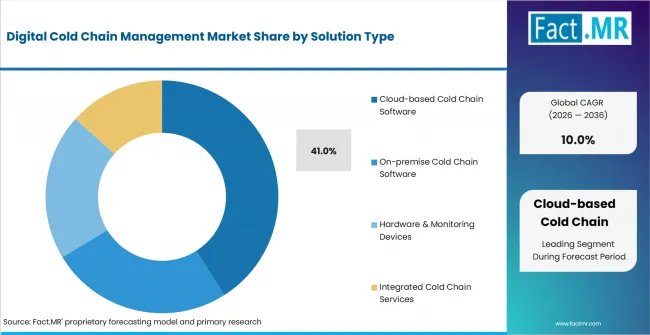
Digital Cold Chain Management Market Analysis By Solution Type | Source: Fact.MR
Cloud deployment gives buyers central control over cold rooms and transport lanes. Teams can review alerts without building large local IT systems. On-premise software still fits users that keep data inside internal networks.
What supports Pharmaceutical Cold Chain within Application Area?
With 43.0% share in 2026, Pharmaceutical Cold Chain is expected to lead Application Area.
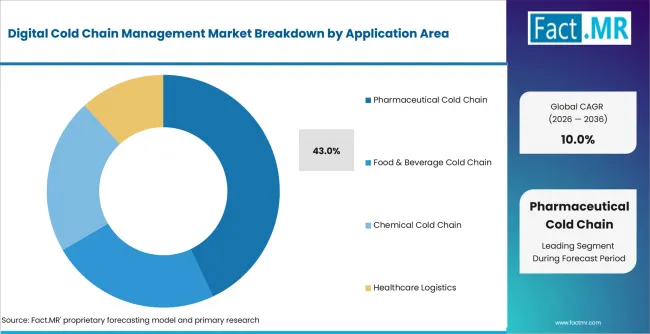
Digital Cold Chain Management Market Analysis By Application Area | Source: Fact.MR
Medicines and biologics lose value when temperature history is unclear. The segment depends on platforms that show where an excursion happened and how quickly it was handled. Food & Beverage Cold Chain remains broad but often faces tighter cost limits.
Why does Healthcare & Pharmaceuticals lead End-use Industry?
Healthcare & Pharmaceuticals is anticipated to capture 45.0% share in 2026.
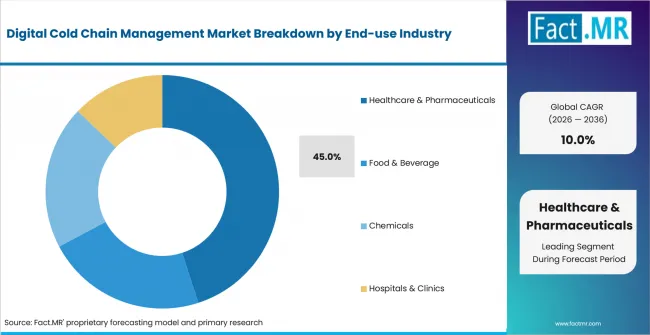
Digital Cold Chain Management Market Analysis By End Use Industry | Source: Fact.MR
This end-use area carries high product value and strict release routines. Buyers usually ask for clean logs before products reach clinics or distributors.
What supports Pharmaceutical Manufacturers within User Category?
Pharmaceutical Manufacturers are estimated to represent 42.0% share in 2026.
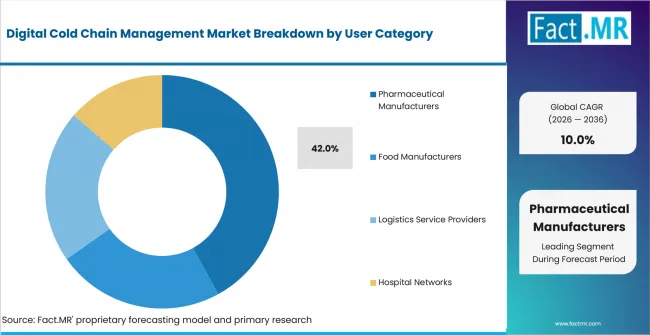
Digital Cold Chain Management Market Analysis By User Category | Source: Fact.MR
Manufacturers face direct batch loss when shipment records are missing. This makes platform selection closer to quality assurance than simple logistics spending. Logistics Providers use similar tools but buy around lane coverage and service contracts.
Why does IoT-enabled Monitoring Platform lead Technology Platform?
IoT-enabled Monitoring Platform is forecast to hold 39.0% share in 2026.
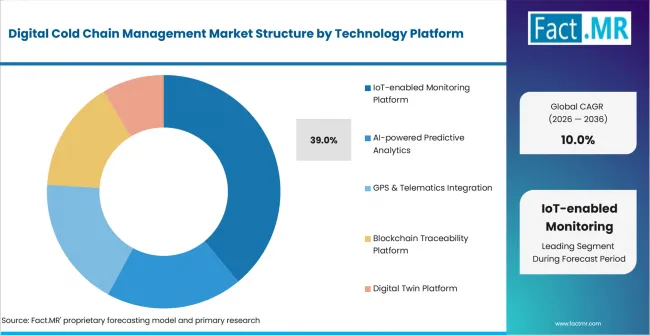
Digital Cold Chain Management Market Analysis By Technology Platform | Source: Fact.MR
IoT sensors give operations teams live temperature data before a shipment arrives. Buyers use alerts to decide whether to intervene or release the product. Data logging and compliance platforms remain necessary when buyers need audit records after delivery.
What is accelerating Digital Cold Chain Management Market adoption, and what is holding it back?
Demand is expected to rise through documented temperature control and wider shipment visibility. Growth may be limited by integration cost and supplier qualification work.
Drivers Impact Analysis
| DRIVER | (~) % IMPACT ON CAGR | GEOGRAPHIC RELEVANCE | IMPACT TIMELINE |
|---|---|---|---|
| Adoption and integration | +1.6% | Global | Short term (<= 2 years) |
| Regulatory and compliance support | +1.4% | USA, Germany, UK | Short term (<= 2 years) |
| Channel and access expansion | +1.1% | Global | Medium term (2-4 years) |
| Clear specification and documentation | +0.9% | USA, UK, Canada | Medium term (2-4 years) |
| Cost and efficiency gains | +0.6% | Global | Long term (>= 4 years) |
Source: Fact.MR analysis. Updated Aug 6, 2026
- Adoption and integration: Buyers are expected to prioritize tools that fit cold rooms and vehicles without disrupting daily logistics.
- Regulatory and compliance support: Temperature records are expected to carry more weight when pharmaceutical shipments need clear release evidence.
- Data logging and documentation: Supplier selection is expected to favor platforms that explain sensor accuracy and audit exports in simple terms.
Opportunity Impact Analysis
| OPPORTUNITY | (~) % IMPACT ON CAGR | GEOGRAPHIC RELEVANCE | IMPACT TIMELINE |
|---|---|---|---|
| Emerging application expansion | +1.0% | Global | Medium term (2-4 years) |
| Premium and specialist positioning | +0.8% | USA, UK, Germany | Medium term (2-4 years) |
| Channel and partner expansion | +0.7% | Global | Long term (>= 4 years) |
| Standards and compliance alignment | +0.5% | USA, Canada, Singapore | Long term (>= 4 years) |
Source: Fact.MR analysis. Updated Aug 6, 2026
- Emerging application expansion: New cold chain use cases are expected to create demand where product value depends on stable temperature evidence.
- Premium and specialist positioning: Suppliers are expected to gain attention when they explain alert quality and service response clearly.
- Smart logistics partners are expected to extend platform reach where customers lack internal monitoring staff.
Restraints Impact Analysis
| RESTRAINT | (~) % IMPACT ON CAGR | GEOGRAPHIC RELEVANCE | IMPACT TIMELINE |
|---|---|---|---|
| Cost and complexity | -1.1% | Global | Short term (<= 2 years) |
| Specification and compliance checks | -0.9% | USA, UK, Germany | Short term (<= 2 years) |
| Substitution by lower-cost alternatives | -0.7% | Import-dependent markets | Medium term (2-4 years) |
| Supply chain and pricing pressure | -0.5% | Global | Long term (>= 4 years) |
Source: Fact.MR analysis. Updated Aug 6, 2026
- Cost and complexity: Smaller buyers may delay adoption when software and sensors must be approved together.
- Specification and compliance checks: Qualification work can extend purchasing cycles when buyers need proof for alerts and calibration.
Which countries are scaling the Digital Cold Chain Management Market fastest?
- The country comparison spans 2.8 percentage points and forms a clear lead group led by the USA and Germany.
- The USA remains 0.5 percentage point above Germany through deeper pharmaceutical distribution and wider supplier access.
- Germany remains 0.6 percentage point above Japan as regulated healthcare logistics supports monitoring adoption.
- Japan remains 0.5 percentage point above the UK through quality-focused handling and cold chain discipline.
- The UK remains 0.4 percentage point above Canada as healthcare logistics sustains digital documentation needs.
- Canada remains 0.4 percentage point above Australia through controlled distribution across broad regional routes.
- Australia remains 0.4 percentage point above Singapore as chilled distribution and healthcare access support adoption.
Comparable CAGRs can create different entry conditions due to cold chain density and supplier service coverage. Coverage includes North America and Latin America. Europe and East Asia are included with South Asia and Pacific. Middle East and Africa completes the regional view.
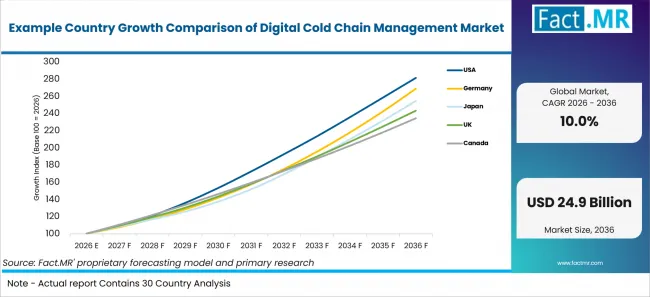
Example Country Growth Comparison Of Digital Cold Chain Management Market | Source: Fact.MR
| Country | CAGR (2026-2036) |
|---|---|
| USA | 10.9% |
| Germany | 10.4% |
| Japan | 9.8% |
| UK | 9.3% |
| Canada | 8.9% |
| Australia | 8.5% |
| Singapore | 8.1% |
Source: Fact.MR analysis. Updated Aug 6, 2026
What supports USA adoption?
10.9% CAGR, supported by pharmaceutical distribution depth and compliance-led documentation.
USA healthcare logistics teams evaluate temperature evidence before approving new monitoring platforms. Buyers are expected to compare alert quality and service response before scaling across lanes.
How is Germany scaling demand?
10.4% CAGR, driven by regulated healthcare logistics and supplier documentation requirements.
Germany’s regulated distribution base places stronger value on validated handling records. Distributors usually need logs that can survive audits and customer checks.
What is driving Japan’s growth from 2026 to 2036?
9.8% CAGR, backed by quality-focused handling and controlled logistics practices.
Japan’s quality-focused handling culture gives monitoring accuracy more weight during supplier review. Healthcare buyers are expected to test platform reliability before wider adoption.
How is the UK developing demand?
9.3% CAGR, supported by healthcare logistics needs and digital documentation requirements.
The UK is likely to favor tools that make release documentation easier for healthcare and food shipments. Buyers often need simple records that can move across providers.
What supports Canada adoption?
8.9% CAGR, led by regional distribution needs and cold chain service coverage.
Canada’s long routes make visibility valuable when products pass through broad regional networks. Integrated Cold Chain Services may appeal to customers with limited internal monitoring capacity.
How is Australia scaling demand?
8.5% CAGR, driven by controlled logistics needs across healthcare and food distribution.
Australia’s dispersed service geography creates demand for simple alerts across chilled transport. Food & Beverage Cold Chain users are expected to value monitoring across longer routes.
What supports Singapore’s growth?
8.1% CAGR, backed by regional distribution activity and high-value logistics requirements.
Singapore’s hub role favors systems that combine route status with temperature evidence. Logistics Providers are expected to value platforms that support fast handoffs.
Who leads the Digital Cold Chain Management Market?
Carrier Global Corporation – Sensitech and Carrier Transicold shows the direct relevance through cold chain monitoring and shipment visibility. Copeland LP strengthen the wider field through automation and connected refrigeration exposure.
Competition is expected to depend on sensor reliability and documentation clarity. Companies that explain product fit in simple terms are likely to earn stronger attention from buyers.
Which companies are the key providers?
Key companies include Carrier Global Corporation – Sensitech and Carrier Transicold; Copeland LP; ORBCOMM Inc.; Zebra Technologies Corporation; Controlant ehf.; Honeywell International Inc.; Berlinger & Co. AG; Monnit Corporation; and Trane Technologies plc – Thermo King.
- Carrier Global Corporation – Sensitech and Carrier Transicold
- Copeland LP
- ORBCOMM Inc.
- Zebra Technologies Corporation
- Controlant ehf.
- Honeywell International Inc.
- Berlinger & Co. AG
- Monnit Corporation
- Trane Technologies plc – Thermo King
What is the report’s scope and coverage?
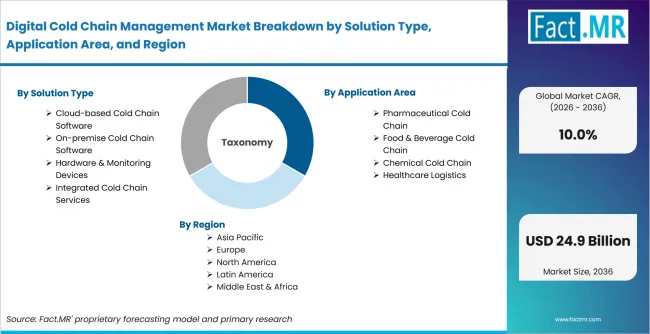
Digital Cold Chain Management Market Breakdown By Solution Type, Application Area, And Region | Source: Fact.MR
| Attribute | Details |
|---|---|
| Quantitative Units | USD billion |
| Market Definition | Digital cold chain management tools, platforms and services used to monitor temperature-sensitive products through storage and transport. The scope covers software, monitoring hardware, data logging and connected services that help buyers review shipment condition and product release evidence. |
| Solution Type | Cloud-based Cold Chain Software; On-premise Cold Chain Software; Integrated Cold Chain Services; Temperature Monitoring Hardware; Data Loggers & Sensors |
| Application Area | Pharmaceutical Cold Chain; Food & Beverage Cold Chain; Biologics & Vaccines; Chemicals & Specialty Materials; Retail & E-commerce Cold Chain |
| End-use Industry | Healthcare & Pharmaceuticals; Food & Beverage; Chemicals; Logistics & Warehousing; Retail & Grocery |
| User Category | Pharmaceutical Manufacturers; Food Producers; Logistics Providers; Distributors & Wholesalers; Retailers |
| Technology Platform | IoT-enabled Monitoring Platform; Fleet Telematics; Remote Monitoring; Data Logging and Compliance; Route Planning and Video Telematics |
| Regions Covered | North America; Latin America; Europe; East Asia; South Asia and Pacific; Middle East and Africa |
| Countries Covered | USA; Germany; Japan; UK; Canada; Australia; Singapore |
| Key Companies Profiled | Carrier Global Corporation – Sensitech and Carrier Transicold; Copeland LP; ORBCOMM Inc.; Zebra Technologies Corporation; Controlant ehf.; Honeywell International Inc.; Berlinger & Co. AG; Monnit Corporation; Trane Technologies plc – Thermo King |
| Forecast Period | 2026 to 2036 |
| Approach | Hybrid top-down and bottom-up approach using cold chain service demand; pharmaceutical shipment requirements; food and beverage distribution needs; temperature monitoring adoption; sensor and data-logging use; fleet visibility; compliance documentation; country adoption patterns and company portfolio review |
Source: Fact.MR analysis. Updated Aug 6, 2026
Bibliography
- Centers for Disease Control and Prevention. (2025, May 29). Vaccine storage and handling.
- United Nations Children’s Fund. (2025, October 7). From cold chain to care: Delivering vaccines safely to every mother and child.
- World Health Organization. (2026, March 19). Temperature monitoring study tool.
This Report Answers
- The report provides strategic intelligence on the Digital Cold Chain Management Market across Solution Type and Application Area choices that shape supply chain management decisions.
- Segment analysis covers Cloud-based Cold Chain Software and Pharmaceutical Cold Chain as the share leaders within the 2026 market.
- Country outlook evaluates the USA and Germany alongside Japan and the UK. Canada, Australia and Singapore complete the growth comparison across the profiled markets.
- Competitive analysis profiles Carrier Global Corporation – Sensitech and Carrier Transicold and Copeland LP alongside ORBCOMM Inc.
- Technology assessment covers IoT-enabled Monitoring Platform and Fleet Telematics.
What does the Digital Cold Chain Management Market cover?
Digital cold chain management tools are used to monitor temperature-sensitive products where storage and shipment records affect product release.
The Digital Cold Chain Management Market covers software, hardware and connected services used during cold storage and transport. Coverage extends to pharmaceutical shipments and food distribution. Biologics and vaccines are included when digital records support temperature control.
What is included in the scope?
Digital cold chain management is used across healthcare, food distribution and logistics networks. Pharmaceutical manufacturers, food producers and logistics providers are included.
The scope includes Solution Type and Application Area alongside End-use Industry, User Category and Technology Platform. Coverage spans cloud-based software and on-premise software. Integrated services, monitoring hardware and data loggers complete the solution scope. The platform view includes IoT-enabled monitoring and fleet telematics.
What is excluded from the scope?
General logistics software and unrelated refrigeration equipment remain outside the scope of this market.
The scope excludes products that do not record or support temperature-sensitive storage and transport. Standard warehouse software is excluded unless cold chain monitoring is part of the use case. Refrigeration hardware is excluded when it is sold without digital monitoring capability. General food retail systems and broad transportation platforms remain outside the scope unless they directly support cold chain visibility.
How Was the Analysis Built?
The analysis draws on 120+ sources, 35+ company portfolios, 25+ countries, and more than 20 industry interviews.
- Primary Research: Primary research includes discussions with manufacturers, service providers, technology developers, distributors, end users, procurement teams, and subject-matter experts. These conversations examine purchasing priorities, product adoption, operational challenges, approval requirements, competitive positioning, and the factors that influence wider market acceptance.
- Desk Research: Desk research covers government statistics, regulatory publications, company filings, trade data, technical studies, industry associations, standards, public policy, and other authoritative sources. Every source used in the analysis is documented in the bibliography.
- Market Sizing and Forecasting: Market estimates combine historical performance, demand indicators, pricing and volume trends, segment shares, company participation, country-level growth, adoption patterns, investment activity, and barriers to market expansion.
- Data Validation and Update Cycle: Findings are validated by comparing primary interviews with public data, company activity, regulatory changes, trade patterns, and industry developments. Regular updates review new product launches, capacity changes, partnerships, approvals, procurement trends, and shifts in commercial adoption.
Segmentation
How is the market segmented?
-
By Solution Type:
- Cloud-based Cold Chain Software
- Temperature Monitoring Software
- Logistics Visibility Platform
- On-premise Cold Chain Software
- Distribution Management Software
- Compliance Management Software
- Hardware & Monitoring Devices
- Wireless Data Loggers
- Gateway Devices
- Integrated Cold Chain Services
- Remote Asset Monitoring
- Risk & Compliance Management
- Cloud-based Cold Chain Software
-
By Application Area:
- Pharmaceutical Cold Chain
- Vaccine Distribution
- Biologic Drug Logistics
- Food & Beverage Cold Chain
- Frozen Food Distribution
- Fresh Produce Logistics
- Chemical Cold Chain
- Specialty Chemicals
- Laboratory Samples
- Healthcare Logistics
- Blood & Plasma Transport
- Organ Transport
- Pharmaceutical Cold Chain
-
By End-use Industry:
- Healthcare & Pharmaceuticals
- Biopharmaceutical Companies
- Clinical Research Organizations
- Food & Beverage
- Dairy & Frozen Foods
- Agriculture & Seafood
- Chemicals
- Chemical Manufacturers
- Diagnostic Laboratories
- Hospitals & Clinics
- Blood Banks
- Research Institutes
- Healthcare & Pharmaceuticals
-
By User Category:
- Pharmaceutical Manufacturers
- Vaccine Manufacturers
- Contract Logistics Providers
- Food Manufacturers
- Food Distributors
- Cold Storage Operators
- Logistics Service Providers
- Third-party Logistics Providers
- Distributors
- Hospital Networks
- Public Health Agencies
- Government Healthcare
- Pharmaceutical Manufacturers
-
By Technology Platform:
- IoT-enabled Monitoring Platform
- Real-time IoT Sensors
- Cloud Analytics Platform
- AI-powered Predictive Analytics
- Edge Computing Platform
- GPS & Telematics Integration
- Blockchain Traceability Platform
- Smart Contracts
- Digital Ledger Integration
- Digital Twin Platform
- Predictive Maintenance
- Remote Diagnostics
- IoT-enabled Monitoring Platform
-
By Region:
- North America
- Latin America
- Europe
- East Asia
- South Asia and Oceania
- Middle East and Africa
Frequently Asked Questions
How big is the digital cold chain management market in 2026?
What is the CAGR of the digital cold chain management market from 2026 to 2036?
Which solution type leads the digital cold chain management market?
Which application area leads the digital cold chain management market?
Who are the leading companies in the digital cold chain management market?
Who worked on this report


Preview the report firsthand - request a free sample
Free SampleGet the brochure for pricing and purchase details
Download PDF