- Market Value (2025): USD 588.7 Mn
- Estimated Value (2026): USD 730.0 Mn
- Forecast Value (2036): USD 6274.0 Mn
- CAGR (2026-2036): 24.0%
What is the Digital Twin Sensors Market forecast to be worth by 2036?
USD 730.0 million in 2026 to USD 6,274.0 million by 2036, at 24.0% CAGR.
- The digital twin sensors market reached USD 588.7 million in 2025.
- Demand is projected to increase from USD 730.0 million in 2026 to USD 6,274.0 million by 2036.
- The market is forecast to record 24.0% CAGR from 2026 to 2036 as industrial teams connect physical assets with continuously updated virtual models.
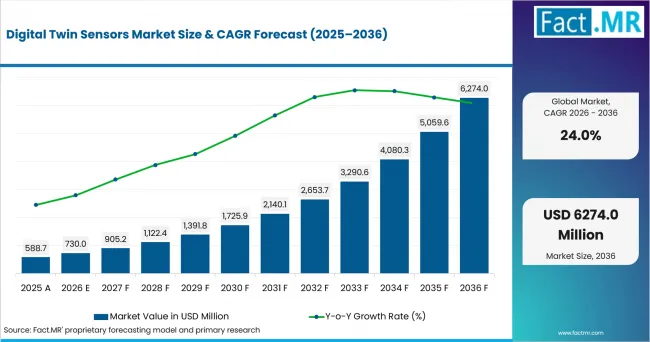
Digital Twin Sensors Market Value Analysis | Source: Fact.MR
What are the defining numbers behind Digital Twin Sensors Market growth?
USD 5,544.0 million absolute opportunity is expected between 2026 and 2036.
- Demand Drivers in the Market
- Maintenance teams need vibration, temperature and position data that updates a twin before a fault reaches production stoppage.
- Automation engineers require cleaner machine signals as robot cells and conveyors move from scheduled checks to condition-based decisions. The International Federation of Robotics reported in September 2025 that 542,000 industrial robots were installed in factories in 2024.
- Quality teams rely on optical and machine vision sensors where a digital twin must compare a physical part with a verified process model.
- Factory IT teams need connected sensing that works with industrial networks because live twins lose value when equipment data remains trapped at the machine.
- Key Segments Analyzed
- By Sensor Type: Optical is expected to hold 41.0% share in 2026 because non-contact measurement supports inspection and position feedback loops.
- By Connectivity: Industrial Ethernet is projected to account for 44.0% share in 2026 as deterministic plant networks carry sensor data into twin systems.
- By Function: Condition monitoring is anticipated to represent 44.0% share in 2026 owing to its direct use in motor and conveyor health tracking.
- By End Use: Automotive is estimated to capture 34.0% share in 2026 due to sensor-rich inspection workflows across body and powertrain lines.
- Analyst Opinion at Fact.MR
- Shambhu Nath Jha, Principal Consultant at Fact.MR, states, “Digital twin sensors draw attention at the boundary between the physical asset and the live model. Demand is expected to move toward sensors that bring signal quality, network compatibility and diagnostics into one purchase decision. Suppliers that combine rugged hardware with clear integration paths should gain preference among plant and mobility customers.”
- Strategic Implications
- Sensor manufacturers should document signal accuracy under real production conditions because digital twins need repeatable inputs over long operating cycles.
- Automation vendors should package sensors with gateways and diagnostics so brownfield plants avoid custom integration work at every asset.
- Industrial software providers should align data models with sensor metadata, calibration history and maintenance events. NIST released IR 8356 in February 2025 to frame security and trust considerations for digital twin technology.
- System integrators should prioritize cybersecurity and validation evidence before scaling connected sensors across production lines that exchange operational data.
The United Kingdom is projected to post 28.3% CAGR through 2036, supported by factory modernization and automotive data needs. The USA is expected to record 25.1% CAGR through electronics orders and discrete manufacturing scale. South Korea is forecast to advance at 24.0% CAGR as electronics production and automobile exports keep plants data-intensive. Germany is anticipated to hold 23.2% CAGR through industrial orders and electric-vehicle production. Japan is estimated to reach 17.6% CAGR as machinery orders sustain demand for verified machine data.
How does the Digital Twin Sensors Market break down by segment?
Optical leads Sensor Type at 41.0% share; Industrial Ethernet leads Connectivity at 44.0% share.
Which Sensor Type dominates?
Optical is expected to hold 41.0% share in 2026.
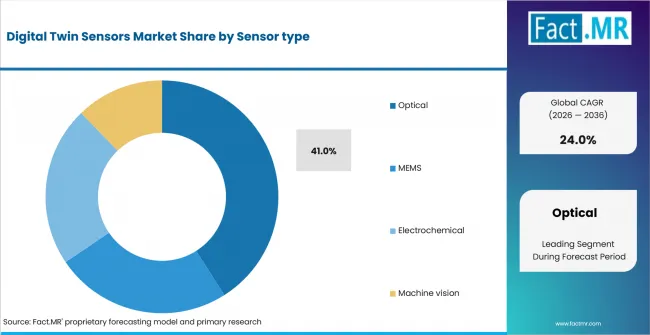
Digital Twin Sensors Market Analysis By Sensor Type | Source: Fact.MR
Optical sensors account for the visible side of digital twin measurement. They support dimensional checks, surface inspection and position feedback without touching the asset. This makes them useful where a twin compares live machine behavior with a virtual production model.
What leads the Connectivity segment?
Industrial Ethernet is projected to account for 44.0% share in 2026.
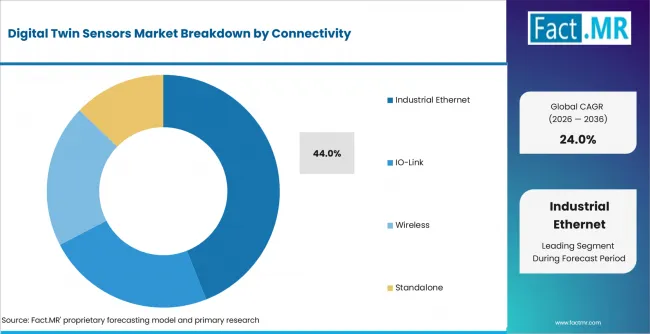
Digital Twin Sensors Market Analysis By Connectivity | Source: Fact.MR
Industrial Ethernet leads because digital twin sensors must feed control systems and analytics platforms with reliable timing. Deterministic networking gives plant teams a cleaner route from sensor readings to usable twin data.
How does Function shape demand?
Condition monitoring is anticipated to represent 44.0% share in 2026.
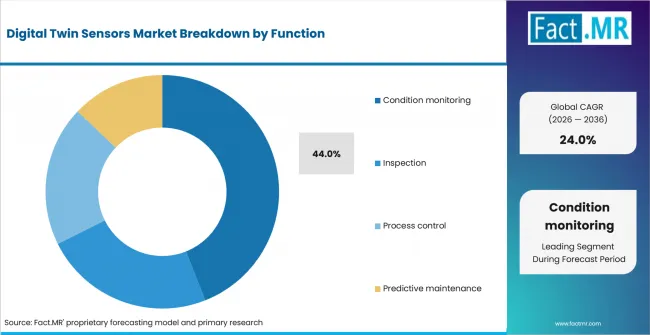
Digital Twin Sensors Market Analysis By Function | Source: Fact.MR
Condition monitoring is the clearest commercial route for sensor-fed digital twins. Operators track vibration, current, temperature and process behavior while comparing the live asset with a normal operating model.
What supports Automotive within End Use?
Automotive is estimated to capture 34.0% share in 2026.
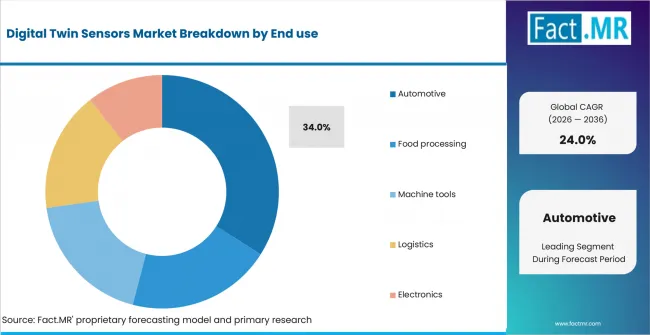
Digital Twin Sensors Market Analysis By End Use | Source: Fact.MR
Automotive plants use digital twin sensors across body shops, painting, powertrain, battery handling and end-of-line inspection. OICA reported in April 2026 that the United States produced 10.24 million vehicles in 2025 and Japan produced 8.41 million, providing a large automotive manufacturing base across which sensing and automation technologies can be deployed.
What is accelerating Digital Twin Sensors Market adoption, and what is holding it back?
Demand is expected to rise through sensor-level visibility and industrial automation. Growth may be limited by integration effort, cybersecurity exposure and validation work.
Drivers Impact Analysis
| DRIVER | (~) % IMPACT ON CAGR | GEOGRAPHIC RELEVANCE | IMPACT TIMELINE |
|---|---|---|---|
| Digital-twin accuracy requirements in automated factories | +2.4% | Global | Short term (<= 2 years) |
| Condition monitoring in drivetrain and process assets | +1.8% | North America, Europe, East Asia | Medium term (2-4 years) |
| Industrial Ethernet and IO-Link integration | +1.3% | Global | Medium term (2-4 years) |
| Automotive and electronics automation | +1.0% | USA, Germany, Japan, South Korea | Long term (>= 4 years) |
Source: Fact.MR analysis. Updated Aug 26, 2026
- Digital-twin accuracy requirements: A twin is useful only when the physical asset sends clean and frequent measurements. Sensor density is therefore expected to rise in lines where operators compare live behavior with a model.
- Condition monitoring: Siemens AG DTA Onsite shows how drivetrain monitoring is moving into local analytics. Sensor streams help detect changing machine behavior before failure.
- Industrial networking: Industrial Ethernet and IO-Link reduce the integration gap between measurement devices and control systems. They make sensor data easier to use in twin environments.
Opportunity Impact Analysis
| OPPORTUNITY | (~) % IMPACT ON CAGR | GEOGRAPHIC RELEVANCE | IMPACT TIMELINE |
|---|---|---|---|
| Brownfield sensor retrofits for existing assets | +1.5% | Global | Medium term (2-4 years) |
| Edge analytics for machine-level twins | +1.2% | Global | Long term (>= 4 years) |
| Optical and machine-vision inspection | +0.9% | USA, Germany, Japan, South Korea | Short term (<= 2 years) |
Source: Fact.MR analysis. Updated Aug 26, 2026
- Brownfield retrofits give suppliers a practical entry point because many plants need live twin data without replacing full production assets.
- Edge analytics creates room for sensors that preprocess signals near the machine and send more useful information to a digital twin.
- Optical inspection is a visible opportunity where plants need surface, geometry and alignment data to keep quality models current.
Restraints Impact Analysis
| RESTRAINT | (~) % IMPACT ON CAGR | GEOGRAPHIC RELEVANCE | IMPACT TIMELINE |
|---|---|---|---|
| Sensor interoperability and data-model inconsistency | -0.8% | Global | Short term (<= 2 years) |
| Cybersecurity and trust requirements for connected twins | -0.6% | USA, UK, Germany | Medium term (2-4 years) |
| Cost of high-density sensor retrofits | -0.4% | Global | Long term (>= 4 years) |
Source: Fact.MR analysis. Updated Aug 26, 2026
- Interoperability issues slow deployment when sensors, PLCs and analytics software describe asset data differently. Integration work then becomes a budget item.
- Cybersecurity requirements add review cycles because digital twins connect operational data with enterprise systems.
- Retrofit cost remains a barrier where older equipment needs cabling, gateways and calibration before it can feed a reliable twin.
Which countries are scaling the Digital Twin Sensors Market through 2036?
- The displayed country range spans 10.7 percentage points and creates two practical growth bands across the forecast period.
- The United Kingdom stays 3.2 percentage points above the USA as factory modernization and electronics output support connected inspection demand.
- The USA remains 1.1 percentage points above South Korea through computer and electronic product orders and a broad discrete-manufacturing base.
- South Korea remains 0.8 percentage point above Germany as electronics production and automobile exports keep sensor networks central to factory performance.
- Germany remains 5.6 percentage points above Japan through industrial orders and electric-vehicle production programs.
Comparable CAGRs can create different entry conditions because sensor approval depends on installed equipment, industrial networks, cybersecurity review and calibration discipline. Full report coverage includes North America, Latin America, Western Europe, Eastern Europe, East Asia, South Asia & Pacific, Middle East & Africa.
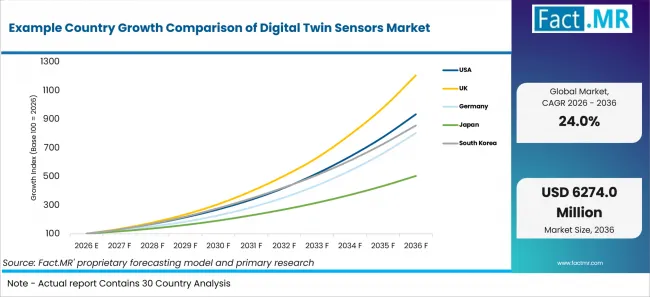
Example Country Growth Comparison Of Digital Twin Sensors Market | Source: Fact.MR
| Country | CAGR (2026-2036) |
|---|---|
| United Kingdom | 28.3% |
| USA | 25.1% |
| South Korea | 24.0% |
| Germany | 23.2% |
| Japan | 17.6% |
Source: Fact.MR analysis. Updated Aug 26, 2026
What supports the United Kingdom’s growth?
28.3% CAGR, backed by electronics output and automotive manufacturing.
The United Kingdom links sensor demand to electronics output and vehicle-plant modernization. ONS reported in August 2026 that computer, electronic and optical products output rose 3.0% in Quarter 2 2026, while SMMT’s 2026 facts book placed automotive-related manufacturing turnover at GBP 85 billion.
What supports USA adoption?
25.1% CAGR, supported by electronics orders and automotive production scale.
The USA has a wide industrial base for optical and condition-monitoring sensors. The U.S. Census Bureau reported in July 2026 that June computer and electronic product orders rose 3.1% to USD 31.1 billion. OICA’s April 2026 review placed U.S. vehicle production at 10.24 million units in 2025.
How is South Korea scaling demand?
24.0% CAGR, supported by electronics manufacturing and vehicle exports.
South Korea pairs electronics manufacturing with export-led automotive production. The Ministry of Data and Statistics reported in July 2026 that manufacturing production rose 6.8% month over month and 6.1% year over year in June. MOTIR reported in January 2026 that automobile exports reached USD 72.0 billion in 2025.
What is supporting Germany’s adoption?
23.2% CAGR, supported by industrial orders and electric-vehicle production.
Germany’s market is shaped by machinery, vehicle production and automation suppliers. Destatis reported in August 2026 that real manufacturing new orders rose 3.1% in June after seasonal and calendar adjustment. VDA reported in February 2026 that German battery-electric passenger car production rose 15% to 1.22 million vehicles in 2025.
How does Japan perform?
17.6% CAGR, led by machinery orders and established manufacturing capacity.
Japan uses digital twin sensors in machine tools, robotics, automotive manufacturing and electronics operations. The Cabinet Office reported in July 2026 that total machinery orders received by 280 manufacturers rose 9.5% month over month in May. OICA’s April 2026 review placed Japan’s 2025 vehicle production at 8.41 million units.
Who leads the Digital Twin Sensors Market?
Siemens AG provides drivetrain monitoring and industrial automation software that converts sensor and drive data into condition-monitoring and diagnostic views. Its March 2026 Drivetrain Analyzer Onsite release processes drive data within the user’s own infrastructure and captures synchronized vibration and analog signals for local condition monitoring.
Honeywell International Inc., Emerson Electric Co. and Schneider Electric SE provide industrial sensing, automation and monitoring technologies. Emerson Electric Co. launched NI LabVIEW+ Suite for HIL in March 2025 for hardware-in-the-loop engineers, while Schneider Electric SE highlighted its SpaceLogic Duct and Plant Room Air Quality sensors in February 2025.
ABB LTD. provides industrial automation and condition-monitoring technologies, while Bosch Rexroth AG operates across automation, electric drives, motion systems and condition monitoring. Bosch Rexroth AG reported in April 2026 that its 2025 order intake increased approximately 9%, while its ctrlX AUTOMATION platform was enhanced with AI functions and increased computing power for the ctrlX COREplus controller.
Which companies are the key providers?
Key companies include Siemens AG, Honeywell International Inc., Emerson Electric Co., Schneider Electric SE, ABB LTD. and Bosch Rexroth AG.
- Siemens AG
- Honeywell International Inc.
- Emerson Electric Co.
- Schneider Electric SE
- ABB LTD.
- Bosch Rexroth AG
Bibliography
- Bosch Rexroth AG. (2026, April 21). Bosch Rexroth keeps sales stable in 2025 and sees growth prospects in 2026.
- Cabinet Office, Economic and Social Research Institute. (2026, July 15). Machinery orders in May, 2026.
- Emerson. (2025, March 4). Emerson streamlines embedded software test for hardware-in-the-loop engineers.
- Federal Statistical Office. (2026, August 6). New orders in manufacturing in June 2026: +3.1% on the previous month.
- International Federation of Robotics. (2025, September 25). World Robotics 2025: Industrial Robots.
- International Organization of Motor Vehicle Manufacturers. (2026, April 23). Auto industry growth shifted east in 2025 amid global repositioning.
- Ministry of Data and Statistics. (2026, July 31). Monthly industrial statistics, June 2026.
- Ministry of Trade, Industry and Resources. (2026, January 15). Automobile exports hit record high of $72 billion in 2025.
- Office for National Statistics. (2026, August 13). Index of Production, UK: June 2026.
- Schneider Electric. (2025, February 18). Schneider Electric offers a comprehensive range of sensors to enhance building air quality and energy efficiency.
- Siemens AG. (2025, March 26). Siemens acquires Altair to create most complete AI-powered portfolio of industrial software.
- Siemens AG. (2026, March 26). Drivetrain Analyzer Onsite: Siemens introduces new AI-powered on-premises analytics for industrial drives.
- Society of Motor Manufacturers and Traders. (2026, February 20). SMMT Motor Industry Facts 2026.
- U.S. Census Bureau. (2026, July 27). Monthly advance report on durable goods manufacturers’ shipments, inventories and orders: June 2026.
- Verband der Automobilindustrie. (2026, February 3). New record: 40% electric share of passenger car production in 2025.
This Report Answers
- The report explains where digital twin sensors are used across sensor type, connectivity, function and end use.
- Segment analysis identifies the leading subsegments and the operational reasons users prioritize them.
- Country analysis examines the listed markets and the manufacturing mechanisms supporting sensor deployment.
- Competitive analysis reviews current providers across industrial sensing, automation and condition monitoring.
- Application analysis assesses how live measurement quality influences digital twin purchase decisions.
What does the Digital Twin Sensors Market cover?
The Digital Twin Sensors Market covers physical sensors used to keep virtual asset models current. It includes optical sensors, MEMS devices, electrochemical sensors and machine vision systems used in industrial digital twins. Related coverage includes digital twin devices.
Service-side deployment is tracked through digital twin service models where sensor feeds connect with simulation and analytics layers.
What is included in the scope?
The scope includes sensor modules, measurement devices, connected sensing nodes and sensor-level hardware used to provide data to digital twin systems. It also includes IoT sensor systems when those devices feed industrial twin workflows.
Included use cases span automotive production, machine tools, logistics, electronics and food processing. The analysis also considers IoT-enabled maintenance systems where sensor data supports uptime and work prioritization.
What is excluded from the scope?
The scope excludes digital twin software sold separately from dedicated sensing hardware, general PLC systems and cloud platforms outside sensor-level measurement. Wider digital twin platforms are covered only when the sensor layer is central to deployment.
The scope also excludes standalone safety products unless they feed a digital twin. Separate coverage includes safety sensor applications.
How Was the Analysis Built?
The analysis draws on 120+ sources, 35+ company portfolios, 25+ countries, and more than 20 industry interviews.
- Primary Research: Primary research includes discussions with manufacturers, service providers, technology developers, distributors, end users, procurement teams, and subject-matter experts. These conversations examine purchasing priorities, product adoption, operational challenges, approval requirements, competitive positioning, and the factors that influence wider market acceptance.
- Desk Research: Desk research covers government statistics, regulatory publications, company filings, trade data, technical studies, industry associations, standards, public policy, and other authoritative sources. Every source used in the analysis is documented in the bibliography.
- Market Sizing and Forecasting: Market estimates combine historical performance, demand indicators, pricing and volume trends, segment shares, company participation, country-level growth, adoption patterns, investment activity, and barriers to market expansion.
- Data Validation and Update Cycle: Findings are validated by comparing primary interviews with public data, company activity, regulatory changes, trade patterns, and industry developments. Regular updates review new product launches, capacity changes, partnerships, approvals, procurement trends, and shifts in commercial adoption.
Segmentation
What is the report’s scope and coverage?
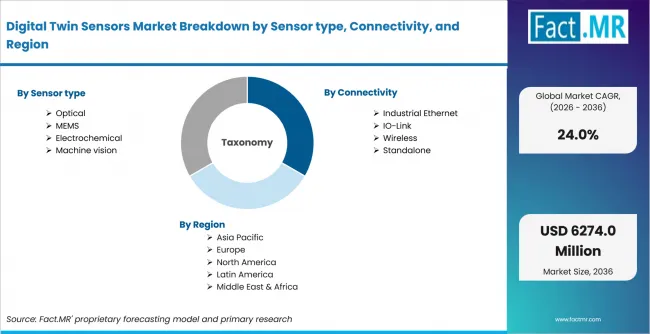
Digital Twin Sensors Market Breakdown By Sensor Type, Connectivity, And Region | Source: Fact.MR
| Attribute | Details |
|---|---|
| Quantitative Units | USD million |
| Market Definition | Sensors that collect physical, operational and environmental data for digital twin systems across industrial and mobility assets. |
| Sensor Type | Optical; MEMS; Electrochemical; Machine vision |
| Connectivity | Industrial Ethernet; IO-Link; Wireless; Standalone |
| Function | Condition monitoring; Inspection; Process control; Predictive maintenance |
| End Use | Automotive; Food processing; Machine tools; Logistics; Electronics |
| Regions Covered | North America; Latin America; Western Europe; Eastern Europe; East Asia; South Asia & Pacific; Middle East & Africa |
| Countries Covered | USA; UK; Germany; Japan; South Korea |
| Key Companies Profiled | Siemens AG; Honeywell International Inc.; Emerson Electric Co.; Schneider Electric SE; ABB LTD.; Bosch Rexroth AG |
| Forecast Period | 2026 to 2036 |
| Approach | Hybrid top-down and bottom-up approach using sensor deployment points, connectivity mix, function demand, end-use intensity, country adoption and provider portfolio review. |
Source: Fact.MR analysis. Updated Aug 26, 2026
How is the market segmented?
-
By Sensor Type:
- Optical
- MEMS
- Electrochemical
- Machine vision
-
By Connectivity:
- Industrial Ethernet
- IO-Link
- Wireless
- Standalone
-
By Function:
- Condition monitoring
- Inspection
- Process control
- Predictive maintenance
-
By End Use:
- Automotive
- Food processing
- Machine tools
- Logistics
- Electronics
-
By Region:
- North America
- Latin America
- Western Europe
- Eastern Europe
- East Asia
- South Asia & Pacific
- Middle East & Africa
Frequently Asked Questions
How big is the digital twin sensors market in 2026?
What is the CAGR of the digital twin sensors market from 2026 to 2036?
Which sensor type leads the digital twin sensors market?
Which connectivity segment leads the digital twin sensors market?
Who are the leading companies in the digital twin sensors market?
Who worked on this report


Preview the report firsthand - request a free sample
Free SampleGet the brochure for pricing and purchase details
Download PDF