- Market Value (2025): USD 6.49 Bn
- Estimated Value (2026): USD 6.59 Bn
- Forecast Value (2036): USD 7.63 Bn
- CAGR (2026-2036): 1.5%
What is the Digital Still Camera (DSC) Market forecast to be worth by 2036?
USD 6.59 billion in 2026 to USD 7.63 billion by 2036, at a 1.48% CAGR.
- The Digital Still Camera (DSC) Market was worth USD 6.49 billion in 2025.
- Fact.MR estimates USD 6.59 billion in 2026 and forecasts USD 7.63 billion by 2036.
- Growth is modest at a 1.5% CAGR over 2026–2036. Renewed interest in selected compact models and upgrades within existing camera systems are supporting sales.
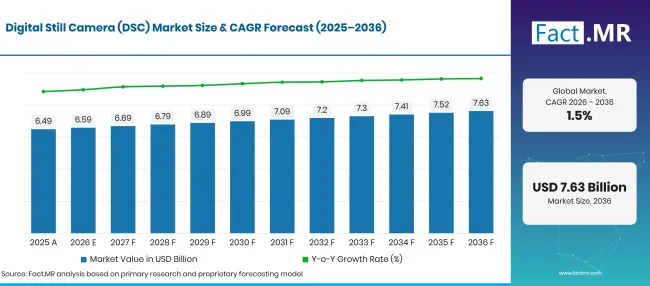
Factmr Digital Still Camera Dsc Market Forecast Global | Source: Fact.MR
| Year | Basis | Market Value (USD billion) |
|---|---|---|
| 2025 | Historical estimate | 6.49 |
| 2026 | Estimate | 6.59 |
| 2036 | Forecast | 7.63 |
| CAGR 2026 to 2036 | Forecast period | 1.5% |
Source: Fact.MR analysis. Updated Oct 21, 2026
What are the defining numbers behind Digital Still Camera (DSC) Market growth?
The forecast adds USD 1.04 billion in annual revenue by 2036. Buyers are not replacing dedicated cameras on a fixed cycle. Manufacturers need products with a clear use case, enough differentiation from a phone and a service proposition that makes the investment worthwhile.
- Demand Drivers in the Market
- Fixed-lens cameras have regained a clearer buying purpose. CIPA recorded 2,436,911 built-in-lens camera shipments in 2025, up 29.6% from 2024. Portability and a complete optical package let buyers start shooting without choosing a separate lens. The opportunity is to offer a camera with a recognizable use case and dependable availability. Compactness also changes the associated camera bag market because buyers can carry a smaller kit on everyday outings. [2]
- One purchase can support photographs and short-form video. Canon's PowerShot V1 entered the market in April 2025 with a 1.4-inch CMOS sensor and an internal cooling fan. Its design illustrates how manufacturers can put meaningful capture capability into a fixed-lens body. The sales case is a complete tool for a particular creator. Retailers should demonstrate its practical shooting advantages before adding optional accessories that lift the total purchase price. [5]
- Camera-system ownership creates reasons to stay with a brand. A photographer who already owns compatible lenses can change a body while retaining much of the kit. Nikon's 2025 integrated report describes plans to broaden its mirrorless lens range and bring advanced functions to more models. That approach can support repeat body purchases. The commercial task is to make an upgrade useful enough to justify payment when the existing camera remains serviceable. [8]
- Authenticity creates a specialist reason to retain dedicated capture equipment. CIPA's June 2026 statement describes Exif 3.1 mechanisms for retaining original-image information and its work with C2PA on tamper detection. These developments can matter to organizations that must establish where a photograph came from. Their value depends on the receiving workflow recognizing the record. Suppliers have an opportunity to sell dependable capture and file handling to these buyers alongside ordinary image quality. [3]
- Key Segments Analyzed
- Mirrorless Cameras account for 38.5% of estimated 2026 revenue. The purchasing decision includes the lenses and accessories already owned by the customer.
- Consumer Photography represents 42.1% in 2026. Personal enjoyment and the desired photographic result shape equipment choice.
- Offline Stores hold 68.8% of 2026 sales. Handling the camera and discussing the complete kit can resolve questions that specifications leave open.
- CMOS accounts for 87.4% of the 2026 sensor-type allocation. Readout performance and camera processing influence the capabilities available to buyers.
- Analyst Opinion at Fact.MR
- Shambhu Nath Jha, Lead Consultant, Fact.MR
- The category works better when camera makers recognise how different its buyers have become. A street photographer may value a small fixed-lens body. A working studio may prefer another familiar body that fits its existing lenses and lighting. For a first-time hobbyist, the appeal can be the experience of taking pictures rather than a specification sheet. Stocking and marketing the same way for all three wastes money. Product ranges should be built around recognisable needs, with sensible accessories and after-sales support behind them.
- Strategic Implications
- Make the first purchase understandable. A customer should be able to handle the camera, see what the lens can do and know which essentials are included. Comfortable camera straps belong in that discussion for people who shoot for hours. Dealers gain little by pushing a bundle of accessories that is expensive but poorly suited to the buyer.
- Explain the limits of hybrid video features. A still camera with a video mode is not automatically suitable for long recording sessions. Canon's cooling approach shows why sustained use can depend on the complete recording setup. Buyers comparing cinema lenses and hybrid cameras need a realistic account of handling, heat and compatible optics before committing. [5]
- Use shipment value and units together when planning inventory. CIPA recorded 5,703,512 camera shipments through August 2026 worth JPY 571.81 billion. Its year-on-year indices were 96.8 for units and 103.7 for value, with an additional reporting company joining in January. [4] A rising average shipment value should not be mistaken for growing sales of every camera category. Dealers need separate stock plans for compact, mirrorless and other models.
- Keep the original image useful after capture. For professional and institutional buyers, files may be transferred, edited and published long after the photograph is taken. CIPA's work on authenticity speaks to this need. [3] Brands can make provenance information and simple transfer workflows part of the practical sales discussion, not an obscure feature on the specifications page.
Japan has the highest forecast CAGR in the five-country comparison at 2.24%. The United States combines a sizable camera market with ongoing professional replacement demand. Germany and the United Kingdom reward a supported regional offer. In Brazil the quality of the import and service arrangement shapes whether a specialist camera becomes a practical purchase.
How does the Digital Still Camera (DSC) Market break down by segment?
Product type describes the camera body and optical arrangement. Application identifies the purchaser's principal use. The distribution and sensor views allocate the same market revenue through different lenses. CIPA shipment counts provide operating context and are distinct from Fact.MR's revenue-share estimates.
Why do Mirrorless Cameras hold the largest product share?
Mirrorless Cameras hold a 38.5% share of estimated 2026 revenue.
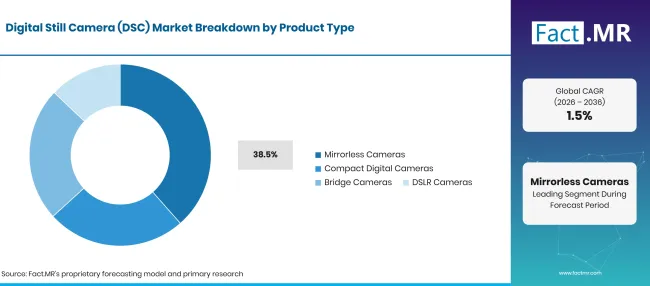
Factmr Digital Still Camera Dsc Market Breakdown Product Type | Source: Fact.MR
| Product Type | Share (2026) |
|---|---|
| Mirrorless Cameras | 38.5% |
| Other segments combined | 61.5% |
| Total | 100.0% |
Source: Fact.MR analysis. Updated Oct 21, 2026
The mirrorless proposition is strongest when buyers want a body they can build around. Different lenses extend the useful range of an existing camera and give the owner reasons to remain within a mount system. Compact Digital Cameras serve buyers seeking a simpler complete package. Bridge Cameras are assigned to the integrated long-zoom category. DSLR Cameras retain a separate position for customers whose working kit and handling preferences still favor that design. For a manufacturer the important distinction is the expected relationship after the first sale. A compact buyer may return for another small camera several years later. A system buyer can bring repeated conversations about bodies and compatible equipment. Each relationship needs its own stock depth and support offer.
What gives Consumer Photography its 42.1% share?
Consumer Photography accounts for 42.1% of estimated market revenue in 2026.
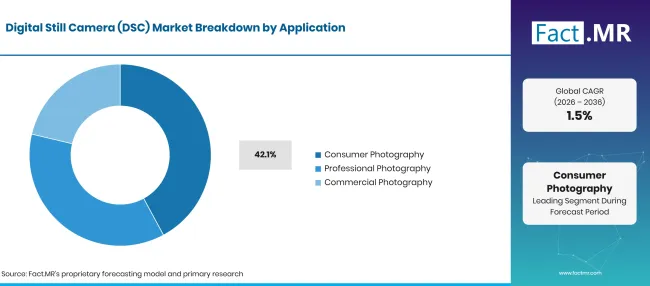
Factmr Digital Still Camera Dsc Market Breakdown Application | Source: Fact.MR
| Application | Share (2026) |
|---|---|
| Consumer Photography | 42.1% |
| Other segments combined | 57.9% |
| Total | 100.0% |
Source: Fact.MR analysis. Updated Oct 21, 2026
Consumer purchases depend on whether the camera makes a hobby or family activity more rewarding. A product must therefore offer a noticeable reason to be carried and used. Professional Photography covers photographers and studios purchasing for commissioned work. Commercial Photography covers in-house business and institutional teams. That distinction keeps a studio's equipment purchase separate from a retailer buying cameras for its own merchandise images. Professional demand should not be read as a guarantee of rapid workforce expansion. The U.S. Bureau of Labor Statistics projects photographer employment to decline 1% from 2025 to 2035. Equipment renewal can continue within an established workforce even when the number of jobs does not rise. [12]
Why do Offline Stores retain most camera revenue?
Offline Stores represent 68.8% of 2026 sales, with Online Stores accounting for 31.2%.
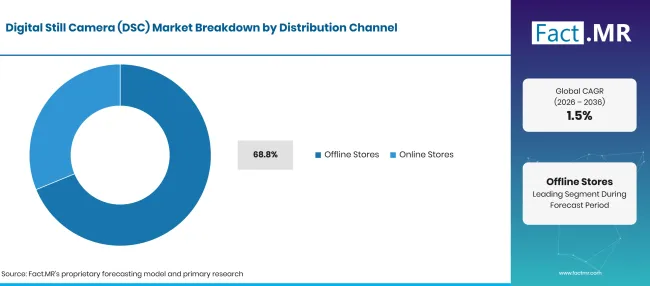
Factmr Digital Still Camera Dsc Market Breakdown Distribution Channel | Source: Fact.MR
| Distribution Channel | Share (2026) |
|---|---|
| Offline Stores | 68.8% |
| Online Stores | 31.2% |
| Total | 100.0% |
Source: Fact.MR analysis. Updated Oct 21, 2026
A camera feels different in the hand from how it appears in a specification table. Viewfinder comfort and menu operation can determine whether a buyer uses it regularly. Stores also help customers compare an entire shooting kit at one visit. This is valuable when changing systems would affect lenses and other existing equipment. A specialist retailer can justify its role by reducing the chance of an expensive unsuitable purchase. Online sellers are well placed for a known replacement body or a model the customer has already tested. Their strongest offer combines clear regional product identification with a dependable returns process. Channel strategy should follow the amount of advice a transaction requires.
How does CMOS shape camera differentiation?
CMOS holds 87.4% of the estimated 2026 sensor-type allocation; CCD represents 12.6%.
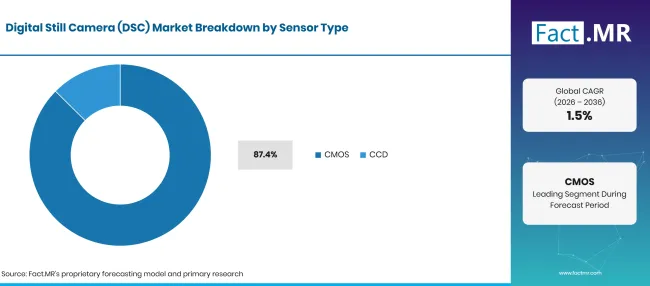
Factmr Digital Still Camera Dsc Market Breakdown Sensor Type | Source: Fact.MR
| Sensor Type | Share (2026) |
|---|---|
| CMOS | 87.4% |
| CCD | 12.6% |
| Total | 100.0% |
Source: Fact.MR analysis. Updated Oct 21, 2026
Sensor choice influences the image a camera can capture and the speed at which the system can process it. Buyers still experience the result through the finished body and lens. The CMOS image sensor market forms part of that wider supply chain. A sensor label alone does not establish low-light performance or a suitable shooting experience. Exposure control and processing remain part of the product comparison. CCD is retained as its own technology allocation. Manufacturers and distributors should identify the sensor in the actual camera being sold. Advertising a characteristic image appearance is different from establishing which sensor technology a product contains.
What is accelerating Digital Still Camera (DSC) Market adoption, and what is holding it back?
happy with a body bought years ago, even when a newer one is technically better. Nikon's year-ended March 2026 results show that individual manufacturers can face pressure despite continued product development. The market will reward worthwhile upgrades, distinctive fixed-lens models and dependable service rather than a constant stream of minor revisions. [9]
Drivers Impact Analysis
| DRIVER | (~) % IMPACT ON CAGR | GEOGRAPHIC RELEVANCE | IMPACT TIMELINE |
|---|---|---|---|
| Renewed demand for purposeful fixed-lens cameras | +0.9% | Japan; Europe; Americas | Short term (up to 2 years) |
| Body upgrades within established lens systems | +0.4% | United States; Japan; Germany | Medium term (2 to 4 years) |
| Shared still-image and video capture needs | +0.3% | Global creator equipment channels | Medium term (2 to 4 years) |
| Replacement purchases by working photographers | +0.2% | United States; United Kingdom | Short term (up to 2 years) |
| Specialist retail support for first-camera buyers | +0.3% | Brazil; regional urban markets | Medium term (2 to 4 years) |
Source: Fact.MR analysis. Updated Oct 21, 2026
Opportunity Impact Analysis
| OPPORTUNITY | (~) % IMPACT ON CAGR | GEOGRAPHIC RELEVANCE | IMPACT TIMELINE |
|---|---|---|---|
| Premium compact products with clear optical purpose | +0.5% | Japan; Western Europe | Short term (up to 2 years) |
| Verified capture and provenance workflows | +0.2% | Institutional and commissioned photography | Long term (4 years or more) |
| Dependable local service for imported models | +0.3% | Brazil; developing specialist channels | Medium term (2 to 4 years) |
| Simpler entry packages for mirrorless ownership | +0.4% | Americas; Europe; Japan | Medium term (2 to 4 years) |
Source: Fact.MR analysis. Updated Oct 21, 2026
Restraints Impact Analysis
| RESTRAINT | (~) % IMPACT ON CAGR | GEOGRAPHIC RELEVANCE | IMPACT TIMELINE |
|---|---|---|---|
| Adequate smartphone capture for routine use | -1.1% | Global consumer buyers | Long term (4 years or more) |
| Long replacement cycles for functioning cameras | -0.6% | Established installed markets | Medium term (2 to 4 years) |
| Promotional pressure on older camera bodies | -0.4% | Global multi-brand retail | Short term (up to 2 years) |
| Reduced commissioned-image budgets | -0.2% | Professional and commercial accounts | Medium term (2 to 4 years) |
Source: Fact.MR analysis. Updated Oct 21, 2026
Which countries are scaling the Digital Still Camera (DSC) Market through 2036?
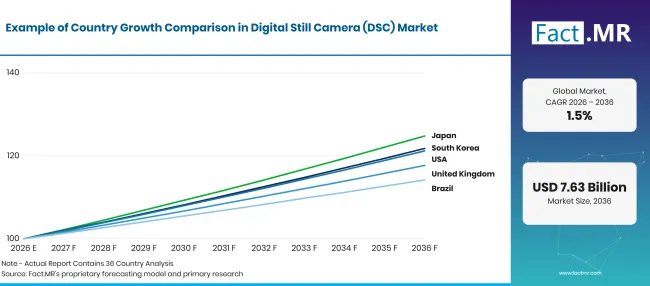
Factmr Digital Still Camera Dsc Market Growth Index | Source: Fact.MR
| Country | CAGR (2026 to 2036) |
|---|---|
| Germany | 1.04% |
| Brazil | 1.34% |
| United States | 1.9% |
| United Kingdom | 1.64% |
| Japan | 2.24% |
Source: Fact.MR analysis. Updated Oct 21, 2026
How can camera brands compete in Germany's slow-growth outlook?
1.04% CAGR. A coherent regional product offer matters more than a wide catalogue.
Germany's forecast is only 1.04% a year. Dealers therefore have to explain why a particular model merits replacing a working camera. For covered cameras, EU USB-C and charger-choice rules have applied since 28 December 2024, so charging arrangements and box contents must also be described accurately. [6] Those rules concern selling a compliant product; they do not prove stronger camera demand.
A smaller, well-explained range can work better than shelves crowded with minor variations. German buyers considering a long-lived camera will pay attention to handling, repair support and compatible lenses. A retailer that helps them make the right choice has a better chance of retaining the customer for later equipment purchases.
What makes a camera purchase workable in Brazil?
1.34% CAGR. Supported import channels can lower uncertainty around expensive equipment.
Brazilian camera buyers need to know who will honour the warranty and service an imported model. Anatel requires homologation for telecommunications equipment within its scope. Cameras with wireless functions therefore need a model-specific check rather than an assumption that every camera follows the same rule. [1]
The Brazilian market is projected to rise 1.34% a year. A distributor is better off carrying fewer proven models with spare batteries and reliable support than tying up cash in several near-identical imports. Transparent local pricing matters because the cost to the customer extends beyond the manufacturer's overseas list price.
Where does the United States create repeat camera demand?
1.9% CAGR. The 2026 market is valued at USD 2.49 billion.
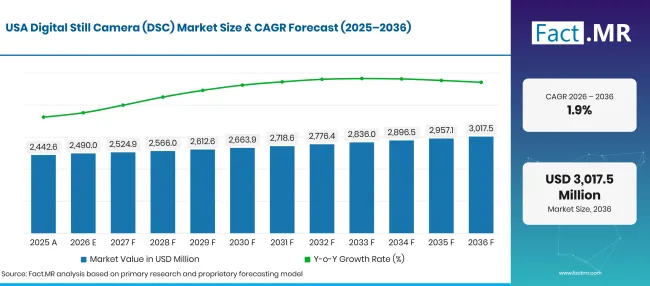
Factmr Digital Still Camera Dsc Market Forecast Usa | Source: Fact.MR
The United States has an established professional photography base as well as hobbyists. BLS counted about 145,000 photographer jobs in 2025 and projected roughly 10,700 openings annually during 2025–2035. [12] Most openings reflect people leaving jobs, not new cameras purchased. The figures are useful for understanding the working market, not sizing equipment demand directly.
At a 1.94% forecast CAGR, U.S. sales will benefit from photographers adding a compatible body or replacing unreliable equipment. A repairable kit can matter more to a working photographer than a headline specification. Consumers provide another market when a new compact or mirrorless camera offers a photographic experience they cannot get from a phone.
Why is post-purchase support part of the UK camera proposition?
1.64% CAGR. Networked functions bring continuing supplier responsibilities.
UK rules on consumer connectable products, clarified in March 2025 guidance, create obligations for manufacturers, importers and distributors of covered equipment. [10] Network-enabled cameras can bring software-security responsibilities alongside conventional warranties, depending on the product's scope under the rules.
For a buyer using wireless image transfer, long-term support is part of the purchase. The UK market's 1.64% CAGR will be difficult to sustain through hardware specifications alone. Specialist dealers can make a difference by explaining support periods, repair arrangements and the practical cost of keeping a camera working.
What underpins Japan's 2.24% forecast CAGR?
2.24% CAGR. Product-specific renewal supports a USD 0.27 billion market in 2026.
CIPA recorded 707,830 camera units shipped to Japan from January through August 2026. The series measures shipments to the destination rather than purchases by Japanese consumers, and an additional company joined its reporting group that January. [4] Japan's forecast CAGR of 2.24% should be read alongside these distinctions.
Japan's buyers already have wide experience with dedicated cameras. A compact model with a distinctive shooting experience may appeal more than a lightly updated body. Demonstrations, dependable stock and compatibility with existing equipment remain useful ways for retailers to turn interest into sales.
Who leads the Digital Still Camera (DSC) Market?
Competitive position depends on the usefulness of the whole camera offer and the owner's reasons to remain with it. A brand that supports familiar operation across multiple bodies can make replacement easier. Smaller suppliers can compete by serving a shooting preference precisely. The commercial question is whether that distinction supports adequate selling prices after retailer support and the cost of maintaining the model are included.
Recent company activity shows several routes to that result. Fujifilm's May 2026 results identify the GFX100RF and X half among models supporting its Professional Imaging performance. Nikon's Imaging Products results for the year ended March 2026 show that product-mix pressure and promotion costs can still reduce returns. These are company-specific outcomes within wider imaging businesses. They underline the need to assess a camera range by its economics as well as its launch reception. [7] [9]
The active camera comparison covers the body manufacturers listed below. Samsung Electronics is included separately as an adjacent image-sensor participant. Its current semiconductor range spans mobile and automotive imaging among other applications. That position should be assessed at component level. [11]
Which companies are the key providers?
- Sony Corporation
- Canon Inc.
- Nikon Corporation
- Fujifilm Holdings Corporation
- OM Digital Solutions
- Panasonic Corporation
- Leica Camera AG
- Ricoh Company Ltd.
- Samsung Electronics Co. Ltd.: Adjacent image-sensor participant; outside the active DSC camera-body comparison.
Bibliography
- [1] Agência Nacional de Telecomunicações. (2026, September 29). Homologar produtos de telecomunicações.
- [2] Camera & Imaging Products Association. (2026, February 26). 2026 outlook on the shipment by product-type concerning cameras and related goods.
- [3] Camera & Imaging Products Association. (2026, June 10). Toward improving trustworthiness in the use of artificial intelligence (AI) technology in digital cameras.
- [4] Camera & Imaging Products Association. (2026, October 1). Production, shipment of digital still camera: August, January-August, in 2026.
- [5] Canon Inc. (n.d.). PowerShot V1. Canon Camera Museum.
- [6] European Commission. (n.d.). The EU common charger.
- [7] FUJIFILM Holdings Corporation. (2026, May 12). Fujifilm announces financial results for the fiscal year ended March 31, 2026.
- [8] Nikon Corporation. (2025). Nikon report 2025.
- [9] Nikon Corporation. (2026). Financial highlights: Year ended March 31, 2026.
- [10] Office for Product Safety and Standards. (2025, March 17). Regulations: Consumer connectable product security.
- [11] Samsung Electronics. (n.d.). Image sensor. Samsung Semiconductor.
- [12] U.S. Bureau of Labor Statistics. (2026, August 27). Photographers. Occupational Outlook Handbook.
This Report Answers
- Where does compact-camera renewal create a viable product opportunity?
- How does lens ownership influence a customer's next body purchase?
- Why do offline stores retain a large role in equipment sales?
- Which professional uses can value documented image provenance?
- How do regional service and connectivity obligations affect a camera offer?
- What can preserve manufacturer returns when capable older cameras remain in use?
What does the Digital Still Camera (DSC) Market cover?
The report assesses the Digital Still Camera (DSC) Market across product type and principal application. Distribution-channel and sensor-type allocations describe the same camera revenue. It examines consumer ownership alongside commissioned photography and in-house commercial capture. Five country forecasts connect the global outlook with local purchasing and supply conditions.
What is included in the scope?
Included products are newly sold standalone digital still cameras and video-capable camera bodies whose principal product class remains a still camera. Compact and bridge products include their integral lenses. Camera kits are assessed within the camera sale. Application is assigned by the principal purchasing use so a transaction appears in one application category.
What is excluded from the scope?
Smartphone cameras and embedded imaging modules are excluded. Dedicated cinema cameras and surveillance cameras are outside the product boundary. Separately sold lenses and accessories do not add to camera revenue. Used-camera transactions and repair fees are excluded. Component supplier participation is considered only as competitive context where the business does not sell standalone camera bodies.
How Was the Analysis Built?
The analysis draws on 120+ sources, 35+ company portfolios, 25+ countries, and more than 20 industry interviews.
- Primary Research: Primary research includes discussions with manufacturers, service providers, technology developers, distributors, end users, and subject-matter experts. These conversations examine purchasing priorities, product adoption, operational challenges, approval requirements, competitive positioning, and the factors that influence wider market acceptance.
- Desk Research: Desk research covers government statistics, regulatory publications, company filings, trade data, technical studies, industry associations, standards, public policy, and other authoritative sources. Every source used in the analysis is documented in the bibliography.
- Market Sizing and Forecasting: Market estimates combine historical performance, demand indicators, pricing and volume trends, segment shares, company participation, country-level growth, adoption patterns, investment activity, and barriers to market expansion.
- Data Validation and Update Cycle: Findings are validated by comparing primary interviews with public data, company activity, regulatory changes, trade patterns, and industry developments. Regular updates review new product launches, capacity changes, partnerships, approvals, and shifts in commercial adoption.
Segmentation
What is the report’s scope and coverage?
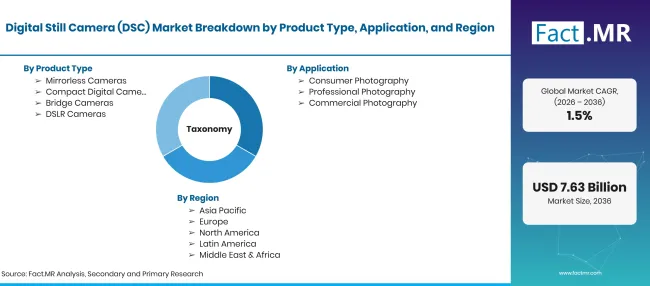
Factmr Digital Still Camera Dsc Market Taxonomy | Source: Fact.MR
| Attribute | Details |
|---|---|
| Quantitative Units | USD billion in 2025, 2026 and 2036; CAGR for 2026 to 2036 |
| Market Definition | Standalone digital cameras purchased primarily for still-image capture, including video-capable still cameras. Product categories distinguish mirrorless bodies from DSLRs and separate integrated long-zoom bridge cameras from other compact fixed-lens models. |
| Product Type | Mirrorless Cameras; Compact Digital Cameras; Bridge Cameras; DSLR Cameras |
| Application | Consumer Photography; Professional Photography; Commercial Photography |
| Distribution Channel | Offline Stores; Online Stores |
| Sensor Type | CMOS; CCD |
| Regions Covered | North America; Latin America; Western Europe; Eastern Europe; East Asia; South Asia & Pacific; Middle East & Africa |
| Countries Covered | Germany; Brazil; United States; United Kingdom; Japan |
| Companies Profiled | Sony Corporation; Canon Inc.; Nikon Corporation; Fujifilm Holdings Corporation; OM Digital Solutions; Panasonic Corporation; Leica Camera AG; Ricoh Company Ltd.; Samsung Electronics Co. Ltd. |
| Forecast Period | 2026 to 2036 |
| Approach | Assessment of dedicated-camera purchase decisions through product purpose, system ownership, channel support and replacement behavior. Shipment evidence supplies industry context alongside the revenue forecasts and segment allocations. |
Source: Fact.MR analysis. Updated Oct 21, 2026
How is the market segmented?
-
By Product Type
- Mirrorless Cameras
- Compact Digital Cameras
- Bridge Cameras
- DSLR Cameras
-
By Application
- Consumer Photography
- Professional Photography
- Commercial Photography
-
By Distribution Channel
- Offline Stores
- Online Stores
-
By Sensor Type
- CMOS
- CCD
-
By Region
- North America
- Latin America
- Western Europe
- Eastern Europe
- East Asia
- South Asia & Pacific
- Middle East & Africa
Frequently Asked Questions
How large is the Digital Still Camera (DSC) Market in 2026?
What is the forecast CAGR for 2026 to 2036?
Which camera type leads the 2026 revenue allocation?
Which sales channel accounts for most camera purchases?
Which country has the highest CAGR among the five assessed markets?
Who worked on this report


Preview the report firsthand - request a free sample
Free SampleGet the brochure for pricing and purchase details
Download PDF