- Market Value (2025): USD 62.4 Bn
- Estimated Value (2026): USD 66.0 Bn
- Forecast Value (2036): USD 114.9 Bn
- CAGR (2026-2036): 5.7%
What is the Personal Hygiene Market forecast to be worth by 2036?
USD 66.0 billion in 2026 to USD 114.9 billion by 2036 at a 5.7% CAGR.
- According to Fact.MR, the personal hygiene market reached USD 62.4 billion in 2025, with feminine care and disposable formats taking much of the spend.
- By 2036, revenue will rise from USD 66.0 billion in 2026 to USD 114.9 billion as ageing populations lift incontinence care and institutions widen infection control.
- Annual growth will average 5.7% CAGR from 2026 to 2036, since hand hygiene policy and repeat consumer purchases keep volumes moving in both mature and emerging economies.
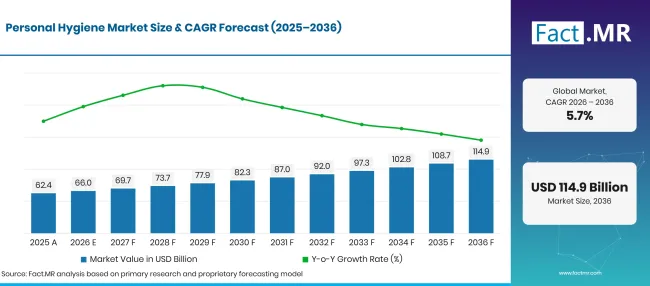
Factmr Personal Hygiene Market Forecast Global | Source: Fact.MR
| Year | Basis | Market Value (USD billion) |
|---|---|---|
| 2025 | Actual | 62.4 |
| 2026 | Estimate | 66.0 |
| 2036 | Forecast | 114.9 |
| CAGR 2026 to 2036 | Forecast period | 5.7% |
Source: Fact.MR analysis. Updated Oct 21, 2026
What are the defining numbers behind Personal Hygiene Market growth?
The 2026 to 2036 period adds USD 48.9 billion in new value, led by feminine care, incontinence care and infection control.
- Demand Drivers in the Market
- Infection prevention remains a global health priority. The World Health Organization (WHO) marked World Hand Hygiene Day on 5 May 2026 under the theme “Action saves lives” and called for hand hygiene compliance monitoring and feedback to be in place, at least in all reference hospitals, by 2026 [1]. Hospital programs of this kind keep orders flowing for hand sanitizers, medical gloves, surgical masks and disinfectants.
- Population ageing is widening the user base for incontinence care. According to WHO, 1 in 6 people in the world will be aged 60 years or over by 2030, and this age group will grow from 1 billion in 2020 to 1.4 billion [2]. Older adults and their caregivers need incontinence garments and gentle cleansing products every day.
- Community hand hygiene now has its own global guidance. In October 2025, WHO and UNICEF issued their first guidelines on hand hygiene in community settings and noted that 1.7 billion people still lacked basic hand hygiene services at home in 2024 [3]. The guidelines ask governments to set clear roles, financing and monitoring. This guidance supports wider use of soap, hand rub and wipes in homes and schools.
- Modern retail is reaching more shoppers in emerging economies. Supermarket chains, pharmacy networks and online stores bring branded pads, wipes and sanitizers to households that once relied on small local shops.
- Open conversation about menstrual health is changing how women shop for period care. Schools, health services and brands now discuss menstruation more openly. New users enter the category and try thinner pads, tampons and period underwear.
- Key Segments Analyzed
- By Products: Feminine Hygiene Products will hold 22.8% share in 2026, as monthly use by a large share of women and girls creates steady repeat purchases.
- By Usabilities: Disposable will account for 68.3% share in 2026, supported by single-use hygiene that suits homes, hospitals and care settings alike.
- By Distribution Channels: Supermarkets/Hypermarkets will capture 34.6% share in 2026 owing to wide assortments and the routine weekly grocery trip.
- Analyst Opinion at Fact.MR
- Shambhu Nath Jha, Principal Consultant at Fact.MR, states, “Households and elderly care homes now treat personal hygiene products as essential purchases. Buyers will stay with trusted brands that offer consistent quality, convenient formats and reliable availability in every channel. Manufacturers that keep improving products, extend their retail and online reach, and serve the hygiene needs of each age group will capture the most growth through 2036.”
- Strategic Implications
- Product manufacturers should build portfolios that span feminine care, incontinence care and infection control, so a single brand family can serve both consumers and institutional buyers.
- Brands should secure shelf space in supermarkets and hypermarkets while building pharmacy and online presence, given that shoppers pick channels on convenience and trust.
- Suppliers should focus on comfort, absorbency and skin-friendly materials, and develop reliable reusable lines next to disposable ranges for buyers who want both.
- Institutional distributors should bundle gloves, masks, caps and hand rub into supply contracts that help hospitals meet WHO hand hygiene monitoring goals.
Germany heads the group at 6.6% CAGR, helped by strong hygiene awareness and an older population that buys care products every week. Brazil follows at 6.0% as a large consumer base gains access to branded products. A 5.4% pace in the United States rests on wide retail access and high per capita use. The United Kingdom will post 4.8% on settled category habits, while Japan closes at 4.3%, where a mature market serves a fast-ageing society.
How does the Personal Hygiene Market break down by segment?
Feminine Hygiene Products will lead Products at 22.8%; Disposable will top Usabilities at 68.3%; Supermarkets/Hypermarkets will head Distribution Channels at 34.6%.
What leads the Products segment?
Feminine Hygiene Products take 22.8% of 2026 sales.
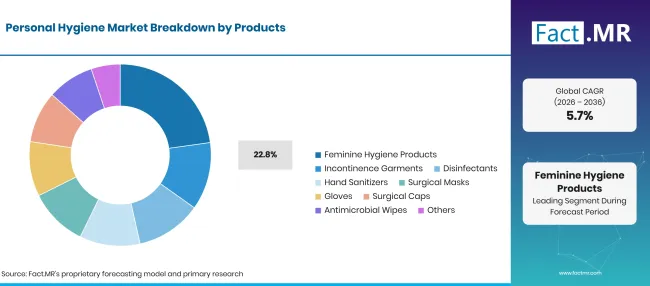
Factmr Personal Hygiene Market Breakdown Products | Source: Fact.MR
| Products | Share (2026) |
|---|---|
| Feminine Hygiene Products (Leading segment) | 22.8% |
| Other segments combined | 77.2%* |
| Total | 100.0% |
Source: Fact.MR analysis. Updated Oct 21, 2026
Pads, tampons and liners are bought every month by women and girls across every income group, so volumes stay steady and brand loyalty runs deep. Buyers of feminine hygiene products also trade up to thinner and more absorbent formats. WHO and UNICEF data from 70 countries, released in August 2025, show that most women and adolescent girls have menstrual materials but many lack enough to change as often as needed [4]. Incontinence garments serve a growing older population and the caregivers who need dependable protection, and incontinence care products now range from light pads to full briefs. Disinfectants, hand sanitizers and antimicrobial wipes support daily cleanliness at home, at work and in public places. Surgical masks, gloves and surgical caps serve health care, laboratory and food-handling settings.
What supports Disposable within Usabilities?
Disposable formats represent 68.3% of 2026 sales.
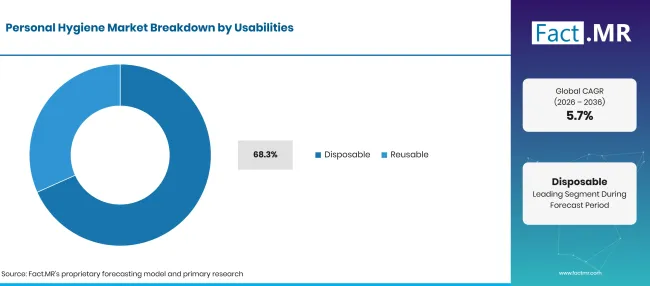
Factmr Personal Hygiene Market Breakdown Usabilities | Source: Fact.MR
| Usabilities | Share (2026) |
|---|---|
| Disposable (Leading segment) | 68.3% |
| Other segments combined | 31.7%* |
| Total | 100.0% |
Source: Fact.MR analysis. Updated Oct 21, 2026
Hospitals, care homes and busy households want products they can use once and throw away, which removes cleaning steps and lowers the risk of cross-infection. Single-use pads, gloves and wipes are stocked in every channel, so buyers can restock quickly. Clinics that buy medical gloves by the case are steady users of disposable formats. Reusable products serve buyers who value long-term use and lower waste. Washable period underwear, cloth incontinence pads and washable and reusable masks are gaining attention through better fabrics and sustainable designs.
How do Distribution Channels shape demand?
Supermarkets/Hypermarkets make up 34.6% of 2026 sales.
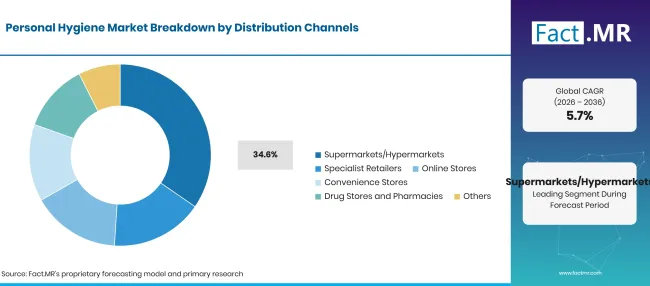
Factmr Personal Hygiene Market Breakdown Distribution Channels | Source: Fact.MR
| Distribution Channels | Share (2026) |
|---|---|
| Supermarkets/Hypermarkets (Leading segment) | 34.6% |
| Other segments combined | 65.4%* |
| Total | 100.0% |
Source: Fact.MR analysis. Updated Oct 21, 2026
Shoppers add pads, sanitizers and wipes to their regular grocery basket and can compare many brands and pack sizes in one aisle. Promotions and wide shelf space keep repeat purchases high. Online stores serve repeat buyers who value home delivery and easy price comparison. The U.S. Census Bureau reported that e-commerce made up 17.1% of total U.S. retail sales in the second quarter of 2026 [5]. Specialist retailers offer guidance on product choice, and convenience stores handle quick top-up purchases. Drug stores and pharmacies are trusted for incontinence garments, hand sanitizers and disinfectants.
What is accelerating Personal Hygiene Market adoption, and what is holding it back?
Adoption will climb with infection control programs, older populations and modern retail in emerging economies. Rules on single-use plastics, volatile pulp and polymer costs and private-label price pressure will slow the pace in some regions.
Drivers Impact Analysis
| DRIVER | (~) % IMPACT ON CAGR | GEOGRAPHIC RELEVANCE | IMPACT TIMELINE |
|---|---|---|---|
| Sustained focus on hand hygiene and infection prevention | +1.2% | Global | Short term (<= 2 years) |
| Ageing populations raising demand for incontinence care | +1.2% | Western Europe, East Asia | Long term (>= 4 years) |
| Rising incomes and expanding modern retail in emerging economies | +0.8% | Latin America, South Asia & Pacific | Medium term (2-4 years) |
| Growing awareness of menstrual and personal care needs | +0.8% | Global | Medium term (2-4 years) |
Source: Fact.MR analysis. Updated Oct 21, 2026
Opportunity Impact Analysis
| OPPORTUNITY | (~) % IMPACT ON CAGR | GEOGRAPHIC RELEVANCE | IMPACT TIMELINE |
|---|---|---|---|
| Online and subscription purchasing of hygiene products | +0.9% | North America, Western Europe | Short term (<= 2 years) |
| Antimicrobial wipe and sanitizer formats for on-the-go use | +0.6% | Global | Short term (<= 2 years) |
| Sustainable and reusable product ranges | +0.6% | Western Europe, North America | Medium term (2-4 years) |
| Premium, skin-friendly and comfort-focused product innovation | +0.6% | Western Europe, East Asia | Long term (>= 4 years) |
Source: Fact.MR analysis. Updated Oct 21, 2026
Restraints Impact Analysis
| RESTRAINT | (~) % IMPACT ON CAGR | GEOGRAPHIC RELEVANCE | IMPACT TIMELINE |
|---|---|---|---|
| Environmental concerns and regulation on single-use, non-biodegradable products | -0.4% | Western Europe, North America | Medium term (2-4 years) |
| Volatility in raw material prices for pulp, polymers and nonwovens | -0.2% | Global | Short term (<= 2 years) |
| Price sensitivity and private-label competition in emerging economies | -0.2% | Latin America, South Asia & Pacific | Medium term (2-4 years) |
| Market saturation and declining birth rates in mature economies | -0.2% | East Asia, Western Europe | Long term (>= 4 years) |
Source: Fact.MR analysis. Updated Oct 21, 2026
Which countries are scaling the Personal Hygiene Market through 2036?
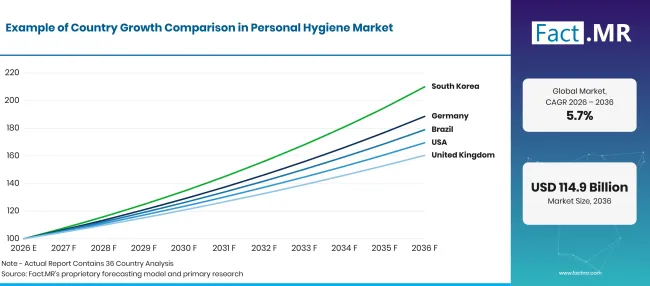
Factmr Personal Hygiene Market Growth Index | Source: Fact.MR
| Country | CAGR (2026–2036) |
|---|---|
| Germany | 6.6% |
| Brazil | 6.0% |
| United States | 5.4% |
| United Kingdom | 4.8% |
| Japan | 4.3% |
Source: Fact.MR analysis. Updated Oct 21, 2026
What supports Germany’s adoption?
6.6% CAGR, backed by strong hygiene awareness, established retail networks and an ageing population.
An older population shapes German demand for hygiene products. Destatis reported that the population fell by 0.1% to 83.5 million at the end of 2025, while people aged 60 and over rose by 387,000 to 31% of the total [6]. German shoppers find feminine hygiene products, sanitizers and incontinence garments in dense drug store chains and on online platforms. A well-developed care sector also buys infection-control supplies in steady volume.
How is Brazil scaling demand?
6.0% CAGR, driven by a large consumer market and expanding retail access.
Brazil’s personal hygiene market draws on a large and still growing population. IBGE estimated the population at 213.4 million on 1 July 2025, up 0.39% from the previous year [7]. Supermarkets, pharmacies and e-commerce platforms offer several ways to buy pads, sanitizers and wipes. Brands that pair accessible pricing with menstrual health education can widen their customer base in urban and developing retail areas.
What supports United States adoption?
5.4% CAGR, helped by extensive retail availability and demand from health care settings.
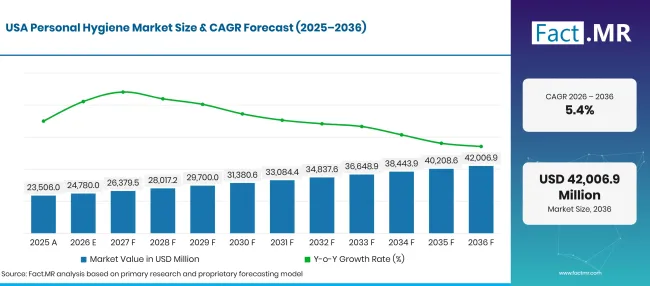
Factmr Personal Hygiene Market Forecast Usa | Source: Fact.MR
An ageing population adds to steady demand across U.S. hygiene categories. The U.S. Census Bureau reported that the population aged 65 and older rose 3.1% to 61.2 million in 2024, and older adults outnumbered children in 11 states [8]. Mass retailers and online platforms carry feminine hygiene products, hand sanitizers and wipes at many price points. Hospitals and long-term care facilities add institutional volume for gloves and masks.
How does the United Kingdom perform?
4.8% CAGR, on the back of settled purchasing habits and a fast-growing group of people aged 90 and over.
Most UK households buy personal hygiene products as routine items through supermarkets, pharmacies and online stores. The Office for National Statistics estimated that 625,000 people in the UK were aged 90 or over in 2024, an increase of 53.7% since 2004 [9]. This group, and the people who care for them, need incontinence garments and gentle cleansing products every day.
How is Japan developing demand?
4.3% CAGR, reflecting a mature market with high cleanliness standards and an aged population.
Japan’s personal hygiene market is shaped by population ageing and high expectations for cleanliness and product quality. The Statistics Bureau of Japan estimated 36.24 million people aged 65 and over as of 15 September 2026, or 29.6% of the population, with 21.68 million aged 75 and over [10]. Adult incontinence products and absorbent care items serve this group and its caregivers. Compact sanitizers and wipes suit daily commuting and travel.
Who leads the Personal Hygiene Market?
Competition runs across three supplier groups.
Absorbent hygiene makers Procter & Gamble, Kimberly-Clark Corporation, Essity AB and Unicharm Corporation compete on comfort and absorbency in pads and incontinence briefs. P&G introduced Always Pocket Flexfoam in November 2025, a full-sized pad that fits into a small resealable pouch [11]. Unicharm began developing a dry cleaning method for recycling used diapers in December 2025, with plant operations planned for 2029 [12]. Germ-protection brands form the second group. Reckitt reported in March 2026 that its Dettol Activ Botany antiseptic liquid, first launched in China, would roll out to the UK and ASEAN [13]. Unilever PLC sells Lifebuoy hand washes, and Edgewell Personal Care offers Wet Ones antibacterial hand wipes. Institutional suppliers complete the field, with 3M Company making health care respirators and surgical masks and S.C. Johnson & Son, Inc. selling workplace hand hygiene systems. Through 2036, the edge will go to suppliers that pair brand trust with retail partnerships and lower-waste design.
Which companies are the key providers?
Key companies include Procter & Gamble; Kimberly-Clark Corporation; Essity AB; Unicharm Corporation; Reckitt; Unilever PLC; Edgewell Personal Care; 3M Company; and S.C. Johnson & Son, Inc.
- Procter & Gamble
- Kimberly-Clark Corporation
- Essity AB
- Unicharm Corporation
- Reckitt
- Unilever PLC
- Edgewell Personal Care
- 3M Company
- S.C. Johnson & Son, Inc.
Bibliography
- [1] World Health Organization. (2026, May 5). World Hand Hygiene Day 2026.
- [2] World Health Organization. (2025, October 1). Ageing and health.
- [3] World Health Organization. (2025, October 15). New guidelines on community hand hygiene to help governments reduce the spread of infectious diseases.
- [4] World Health Organization. (2025, August 26). 1 in 4 people globally still lack access to safe drinking water: WHO, UNICEF.
- [5] U.S. Census Bureau. (2026, August 18). Quarterly Retail E-Commerce Sales: 2nd Quarter 2026.
- [6] Statistisches Bundesamt (Destatis). (2026, June 16). Bevölkerung Deutschlands sinkt im Jahr 2025 um 0,1 % [Germany’s population falls by 0.1% in 2025].
- [7] Instituto Brasileiro de Geografia e Estatística (IBGE). (2025, August 28). População estimada do país chega a 213,4 milhões de habitantes em 2025 [Estimated population of the country reaches 213.4 million in 2025].
- [8] U.S. Census Bureau. (2025, June 26). Older Adults Outnumber Children in 11 States and Nearly Half of U.S. Counties.
- [9] Office for National Statistics. (2025, October 21). Estimates of the very old, including centenarians, UK: 2002 to 2024.
- [10] Statistics Bureau of Japan, Ministry of Internal Affairs and Communications. (2026, September 20). 統計からみた我が国の高齢者:「敬老の日」にちなんで [Statistical Topics No. 149: Japan’s elderly in statistics, for Respect for the Aged Day].
- [11] Procter & Gamble. (2025, November 25). Always Pocket Flexfoam Redefines On-the-Go Period Protection.
- [12] Unicharm Corporation. (2025, December 9). Unicharm Begins Development of New "Dry Cleaning Method" for Recycling Used Disposable Diapers.
- [13] Reckitt. (2026, March 8). Local to global: How regional innovation redefined Dettol as TikTok’s leading hygiene brand.
This Report Answers
- Personal hygiene sales are broken down by product, usability and distribution channel.
- For each segment, readers learn which subsegment leads and the buyer needs behind its 2026 share.
- Germany, Brazil, the United States, the United Kingdom and Japan are set side by side on ageing, retail access and hygiene habits.
- Profiles group the main suppliers into absorbent hygiene, germ-protection and institutional roles.
- Policy moves such as WHO hand hygiene targets are linked to demand for sanitizers, gloves and masks.
What does the Personal Hygiene Market cover?
This market takes in products that keep people clean, healthy and comfortable at home, at work and in care settings. Feminine hygiene products and incontinence garments meet personal care needs, while disinfectants, hand sanitizers and antimicrobial wipes support everyday cleanliness.
Surgical masks, gloves and surgical caps provide protective hygiene in health care and related settings. The assessment tracks disposable and reusable formats across all five listed retail channels, from supermarkets to drug stores and pharmacies.
What is included in the scope?
All eight product types count in both disposable and reusable formats, including disinfecting wipes sold for hands and personal use.
Sales through every listed channel are counted. Household and institutional purchases are in scope when the product serves personal hygiene or infection prevention.
What is excluded from the scope?
Cosmetics, hair care and fragrances are left out, since they serve appearance more than hygiene. Industrial cleaning chemicals and laundry products are also excluded.
Medical devices, surgical instruments, pharmaceuticals and prescription treatments are not counted in market value.
How Was the Analysis Built?
The analysis draws on 120+ sources, 35+ company portfolios, 25+ countries, and more than 20 industry interviews.
- Primary Research: Primary research includes discussions with manufacturers, service providers, technology developers, distributors, end users, and subject-matter experts. These conversations examine purchasing priorities, product adoption, operational challenges, approval requirements, competitive positioning, and the factors that influence wider market acceptance.
- Desk Research: Desk research covers government statistics, regulatory publications, company filings, trade data, technical studies, industry associations, standards, public policy, and other authoritative sources. Every source used in the analysis is documented in the bibliography.
- Market Sizing and Forecasting: Market estimates combine historical performance, demand indicators, pricing and volume trends, segment shares, company participation, country-level growth, adoption patterns, investment activity, and barriers to market expansion.
- Data Validation and Update Cycle: Findings are validated by comparing primary interviews with public data, company activity, regulatory changes, trade patterns, and industry developments. Regular updates review new product launches, capacity changes, partnerships, approvals, and shifts in commercial adoption.
Segmentation
What is the report’s scope and coverage?
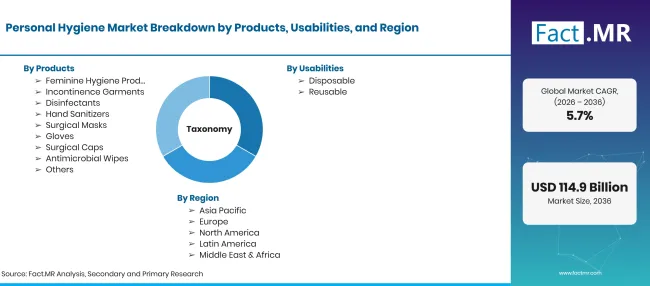
Factmr Personal Hygiene Market Taxonomy | Source: Fact.MR
| Attribute | Details |
|---|---|
| Quantitative Units | USD billion in 2026 to USD billion by 2036 at CAGR |
| Market Definition | Personal hygiene products that support cleanliness, health and comfort, including feminine hygiene products, incontinence garments, disinfectants, hand sanitizers, antimicrobial wipes, surgical masks, gloves and surgical caps. Sales to households and institutions are covered in disposable and reusable formats. |
| Products | Feminine Hygiene Products; Incontinence Garments; Disinfectants; Hand Sanitizers; Surgical Masks; Gloves; Surgical Caps; Antimicrobial Wipes |
| Usabilities | Disposable; Reusable |
| Distribution Channels | Supermarkets/Hypermarkets; Specialist Retailers; Online Stores; Convenience Stores; Drug Stores and Pharmacies |
| Regions Covered | North America; Latin America; Western Europe; Eastern Europe; East Asia; South Asia & Pacific; Middle East & Africa |
| Countries Covered | Germany; Brazil; United States; United Kingdom; Japan |
| Companies Profiled | Procter & Gamble; Kimberly-Clark Corporation; Essity AB; Unicharm Corporation; Reckitt; Unilever PLC; Edgewell Personal Care; 3M Company; S.C. Johnson & Son, Inc. |
| Forecast Period | 2026 to 2036 |
| Approach | Hybrid top-down and bottom-up approach using product volumes by category; usability mix; distribution channel mix; country growth; and portfolio review. |
Source: Fact.MR analysis. Updated Oct 21, 2026
How is the market segmented?
-
By Products
- Feminine Hygiene Products
- Incontinence Garments
- Disinfectants
- Hand Sanitizers
- Surgical Masks
- Gloves
- Surgical Caps
- Antimicrobial Wipes
-
By Usabilities
- Disposable
- Reusable
-
By Distribution Channels
- Supermarkets/Hypermarkets
- Specialist Retailers
- Online Stores
- Convenience Stores
- Drug Stores and Pharmacies
-
By Region
- North America
- Latin America
- Western Europe
- Eastern Europe
- East Asia
- South Asia & Pacific
- Middle East & Africa
Frequently Asked Questions
How big is the personal hygiene market in 2026?
What is the CAGR of the personal hygiene market from 2026 to 2036?
Which product segment leads the personal hygiene market?
Which usability segment leads the personal hygiene market?
Which distribution channel leads the personal hygiene market?
Which country will grow the most in the personal hygiene market?
Who are the main companies in the personal hygiene market?
Who worked on this report


Preview the report firsthand - request a free sample
Free SampleGet the brochure for pricing and purchase details
Download PDF