- Market Value (2025): USD 131.8 Bn
- Estimated Value (2026): USD 142.7 Bn
- Forecast Value (2036): USD 315.2 Bn
- CAGR (2026-2036): 8.2%
What is the PEOs (Professional Employer Organizations) Market forecast to be worth by 2036?
USD 142.7 billion in 2026 to USD 315.2 billion by 2036 at an 8.2% CAGR.
- Small and medium enterprise clients made up most of the base when the market reached USD 131.8 billion in 2025, according to Fact.MR.
- Market value will rise from USD 142.7 billion in 2026 to USD 315.2 billion by 2036 as payroll, benefits and risk services are bundled into wider co-employment contracts.
- An 8.2% CAGR will carry the market through 2026 to 2036, since small employers keep moving from in-house payroll to full-service co-employment.
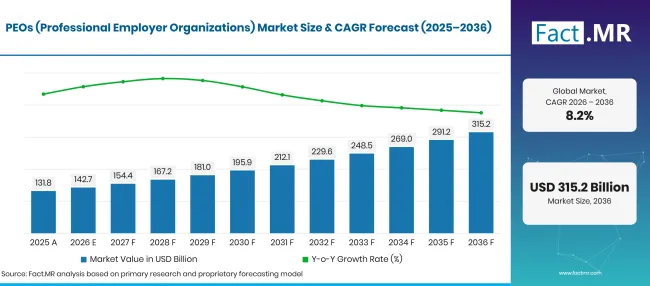
Factmr Peos Professional Employer Organizations Market Forecast Global | Source: Fact.MR
| Year | Basis | Market Value (USD billion) |
|---|---|---|
| 2025 | Actual | 131.80 |
| 2026 | Estimate | 142.7 |
| 2036 | Forecast | 315.2 |
| CAGR 2026 to 2036 | Forecast period | 8.2% |
Source: Fact.MR analysis. Updated Oct 21, 2026
What are the defining numbers behind PEOs (Professional Employer Organizations) Market growth?
The 2026 to 2036 period adds USD 172.5 billion in new value, most of it from small and medium enterprise clients.
- Demand Drivers in the Market
- A deep pool of small businesses keeps widening the client base. The U.S. Small Business Administration counted 36.2 million small businesses in its June 2025 report [1]. Few of these firms can afford a full HR department, so co-employment fills the gap.
- Benefit costs push owners toward pooled plans. U.S. private employers paid $14.07 per hour worked in benefit costs in June 2026, or 30.0% of total compensation [2]. A PEO spreads that cost across thousands of worksite employees and gives a ten-person firm plan terms it could not negotiate alone.
- Healthcare hiring brings a steady flow of new clients. U.S. health care employment rose by an average of 34,000 jobs per month in 2025 [3], and each new clinic or care home needs payroll, credential tracking and benefits from the first pay cycle.
- Workplace risk sustains demand for safety and claims support. Private U.S. employers reported 2.5 million nonfatal injuries and illnesses in 2024 [4], and providers that run workers’ compensation programs take that exposure off the owner’s desk.
- Tighter labor rules raise the cost of getting HR wrong. Wage and hour law, leave mandates and multi-state tax filing change often, so owners prefer a partner that tracks the updates for them.
- Key Segments Analyzed
- By Service Type: Payroll Administration will hold 32.5% share in 2026, since every co-employed worker needs accurate wage, tax and withholding processing from the first pay period.
- By Industry Vertical: Healthcare will account for 31.6% share in 2026, as clinics, care homes and provider groups hire through the year and carry heavy compliance duties.
- By Enterprise Size: Small and Medium Enterprises will command 64.1% share in 2026 through firms that are too small to run a full HR department of their own.
- Analyst Opinion at Fact.MR
- Shambhu Nath Jha, Principal Consultant at Fact.MR, states, “Owners now judge a PEO by its benefit plans and risk cover first, and by its payroll fee second. Providers that show plan options, carrier networks and exit terms up front will win small business buyers. The next gains will come from healthcare and technology clients, and from Germany and Brazil, where labor complexity keeps raising the cost of in-house HR.”
- Strategic Implications
- PEO providers should put benefit plan options, compliance coverage and fee structures side by side in every proposal, since small business owners weigh these terms ahead of headline pricing.
- HR technology suppliers should build open links across payroll, time tracking and benefits platforms, given that clients want one employee record in place of several separate tools.
- Growth-focused providers should set up dedicated service teams for healthcare and IT clients, because each vertical brings its own hiring rhythm, credentialing needs and compliance load.
- Employers weighing a contract should check the provider’s carrier network, workers’ compensation capability and exit terms first, as a co-employment agreement shapes cost and risk for several years.
At 9.4% CAGR, Germany will stay ahead, where a shrinking labor supply pushes mid-sized firms toward outsourced HR. Brazil comes next at 8.6%, helped by record employment and a growing formal workforce. Growth in the United States will reach 7.8% on a small-business base of more than 36 million firms. For the United Kingdom, a 7.0% pace rests on a business population that is still expanding. Japan closes the set at 6.2%, with a growing workforce adding steady HR administration work.
How does the PEOs (Professional Employer Organizations) Market break down by segment?
Payroll Administration will lead Service Type at 32.5%; Healthcare will head Industry Vertical at 31.6%; Small and Medium Enterprises will take first place in Enterprise Size at 64.1%.
Which Service Type dominates?
Payroll Administration takes 32.5% of 2026 revenue.
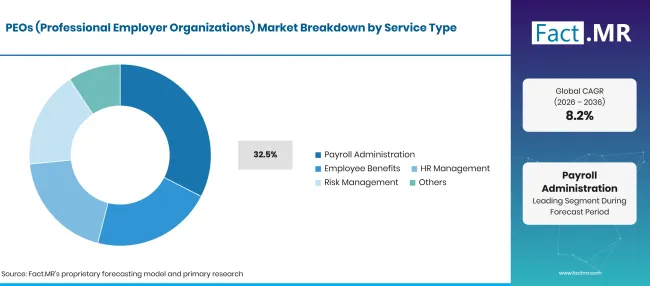
Factmr Peos Professional Employer Organizations Market Breakdown Service Type | Source: Fact.MR
| Service Type | Share (2026) |
| Payroll Administration (Leading segment) | 32.5% |
| Other segments combined | 67.5%* |
| Total | 100.0% |
Source: Fact.MR analysis. Updated Oct 21, 2026
Wage runs, tax withholding and employment tax filings are the first tasks an owner hands over, so payroll anchors nearly every co-employment contract. Many firms first meet a PEO after outgrowing payroll outsourcing services that handled pay but not benefits or compliance. Employee benefits rank next and give small-business staff retirement, health, dental, life and dependent care plans usually found at larger employers. HR management spans onboarding, handbooks, employee relations and labor-law guidance. Risk management covers workers’ compensation, safety programs and claims support, and buyers often compare it with advice from insurance consulting services.
What supports Healthcare within Industry Vertical?
Healthcare accounts for 21.6% of 2026 demand.
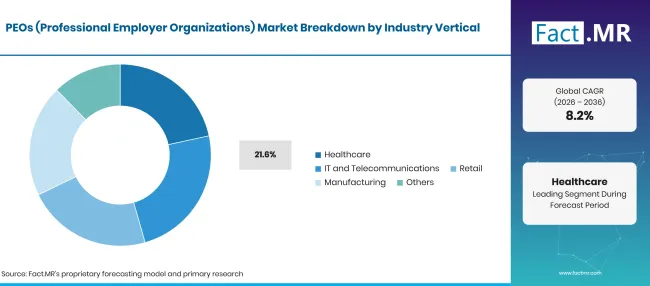
Factmr Peos Professional Employer Organizations Market Breakdown Industry Vertical | Source: Fact.MR
| Industry Vertical | Share (2026) |
| Healthcare (Leading segment) | 31.6% |
| Other segments combined | 68.4%* |
| Total | 100.0% |
Source: Fact.MR analysis. Updated Oct 21, 2026
Clinics and care homes run shift-based pay, many job classes and strict licensing checks, which makes payroll and compliance errors costly. New practice groups and home care agencies often sign with a PEO before they hire their first office manager, and many also add corporate wellness programs to hold on to nurses. IT and telecommunications firms use PEOs to onboard skilled staff quickly across states and to offer benefits that compete with large tech employers. Retail clients seek help with seasonal hiring and turnover, while manufacturers put safety programs and workers’ compensation first. Other verticals include professional services, construction and hospitality.
How does Enterprise Size shape demand?
Small and Medium Enterprises represent 64.1% of 2026 sales.
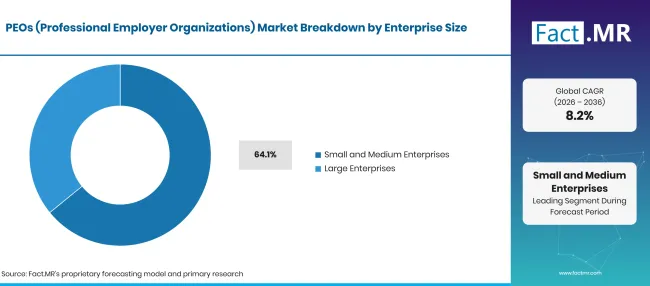
Factmr Peos Professional Employer Organizations Market Breakdown Enterprise Size | Source: Fact.MR
| Enterprise Size | Share (2026) |
| Small and Medium Enterprises (Leading segment) | 64.1% |
| Other segments combined | 35.9%* |
| Total | 100.0% |
Source: Fact.MR analysis. Updated Oct 21, 2026
An owner with twenty staff carries the same payroll tax, leave and labor-law duties as a large employer, yet seldom has an HR specialist. Pooling those duties with a PEO also pools purchasing power for benefits. Firms that once bought only HR and recruitment services for hiring now move to full co-employment as headcount grows. Large enterprises buy more selectively, typically for a single business unit, an acquired company or a new location with thin local HR capacity. They also use human resources consulting for policy design and keep core HR in house.
What is accelerating PEOs (Professional Employer Organizations) Market adoption, and what is holding it back?
Small and mid-sized employers will keep moving payroll, benefits and compliance work to PEOs as rules grow more complex and benefit costs climb. Regulatory scrutiny of co-employment and price pressure from low-cost payroll software will slow value growth in some client groups.
Drivers Impact Analysis
| DRIVER | (~) % IMPACT ON CAGR | GEOGRAPHIC RELEVANCE | IMPACT TIMELINE |
|---|---|---|---|
| Growing payroll, tax and labor-compliance obligations for small employers | +2.4% | Global | Short term (<= 2 years) |
| Rising employer benefit costs and demand for pooled plans | +1.9% | North America, Western Europe | Short term (<= 2 years) |
| Expansion of the small-business base with limited in-house HR capacity | +1.5% | Global | Medium term (2-4 years) |
| Tight labor markets and competition for talent | +1.2% | Western Europe, East Asia, North America | Medium term (2-4 years) |
| Workplace safety and workers’ compensation management needs | +0.7% | North America, Latin America | Long term (>= 4 years) |
Source: Fact.MR analysis. Updated Oct 21, 2026
Opportunity Impact Analysis
| OPPORTUNITY | (~) % IMPACT ON CAGR | GEOGRAPHIC RELEVANCE | IMPACT TIMELINE |
|---|---|---|---|
| Cloud HR platforms with built-in payroll, analytics and employee self-service | +1.1% | Global | Short term (<= 2 years) |
| Formal-employment gains and compliance outsourcing in emerging and mature markets | +0.8% | Latin America, Western Europe | Medium term (2-4 years) |
| Industry-focused PEO offerings for healthcare and IT clients | +0.5% | North America, Western Europe, East Asia | Long term (>= 4 years) |
Source: Fact.MR analysis. Updated Oct 21, 2026
Restraints Impact Analysis
| RESTRAINT | (~) % IMPACT ON CAGR | GEOGRAPHIC RELEVANCE | IMPACT TIMELINE |
|---|---|---|---|
| Regulatory scrutiny of co-employment and certification requirements | -0.9% | North America, Western Europe | Short term (<= 2 years) |
| Price competition from low-cost payroll software and in-house HR tools | -0.6% | Global | Medium term (2-4 years) |
| Switching costs and data-integration concerns during platform migration | -0.4% | Global | Long term (>= 4 years) |
Source: Fact.MR analysis. Updated Oct 21, 2026
Which countries are scaling the PEOs (Professional Employer Organizations) Market through 2036?
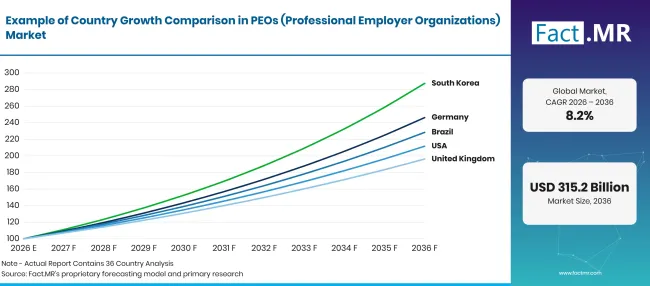
Factmr Peos Professional Employer Organizations Market Growth Index | Source: Fact.MR
| Country | CAGR (2026 to 2036) |
|---|---|
| Germany | 9.4% |
| Brazil | 8.6% |
| United States | 7.8% |
| United Kingdom | 7.0% |
| Japan | 6.2% |
Source: Fact.MR analysis. Updated Oct 21, 2026
What supports Germany’s adoption?
9.4% CAGR, driven by demographic pressure on labor supply and rising demand for outsourced HR support.
Germany had roughly 46.0 million persons in employment in November 2025, about 51,000 fewer than a year earlier [5]. Destatis counted almost 4.9 million non-employed people aged 15 to 74 who wanted work, 5.2% more than in 2024 [6]. Bringing that reserve into jobs adds onboarding, payroll and social insurance work, which favors outsourced HR among mid-sized firms without large internal teams.
How is Brazil scaling demand?
8.6% CAGR, reflecting record employment and a growing formal workforce.
IBGE reported about 103 million employed people in Brazil in 2025, a series record, while annual unemployment fell to 5.6% [7]. Private-sector workers with a signed contract rose 2.8% to 38.9 million, and informality eased from 39.0% to 38.1% [7]. Each formal job brings payroll, tax and benefit duties, which widens the employer base for co-employment and administration services.
What supports the United States’ growth?
7.8% CAGR, backed by a deep small-business base and rising benefit costs.
The United States is home to the most established PEO model, with federal certification for providers through the IRS. Small businesses account for almost 46% of private sector employment, according to the SBA Office of Advocacy [1]. Owners of these firms face state-by-state tax and leave rules, so many hand payroll and benefits to a co-employer. Healthcare practices and technology start-ups form the most active client groups.
How is the United Kingdom developing demand?
7.0% CAGR, helped by a growing population of private sector businesses.
The Department for Business and Trade reported that the UK private sector business population rose 3.5%, or 191,000 businesses, at the start of 2025 [8]. Non-employing firms accounted for 84% of total business growth since 2010 [8]. Growth in the market will come from firms crossing the threshold to their first hires, when payroll, pension enrolment and right-to-work checks begin.
How does Japan perform?
6.2% CAGR, as a larger workforce adds HR administration work.
Japan’s Labour Force Survey recorded 68.28 million employed people in 2025, up 470,000 and the fifth consecutive annual rise [9]. Employed women reached 31.26 million, up 440,000 [9]. More workers mean more payroll, social insurance and benefit work, although many Japanese employers keep HR in house and outsource only routine processing through business process outsourcing contracts.
Who leads the PEOs (Professional Employer Organizations) Market?
Competition runs across three groups. National platforms such as ADP TotalSource, Insperity, TriNet and Paychex compete on benefit breadth, service depth and their own HR software. In October 2026, Insperity said it is rolling out an AI agent within its HR360 solution to give clients faster, policy-based HR answers [10].
Mid-market specialists such as G&A Partners, Vensure Employer Solutions and BBSI win on local service and risk management. In June 2026, G&A Partners launched a co-employment program for youth sports organizations and small businesses with Signature Media [11]. Technology-led providers, including Justworks and Sequoia One, sell software-first service to start-ups and small teams. Justworks added an ICHRA health reimbursement option with Thatch in July 2026, so it now offers individual plans next to small group and large group cover [12]. Benefit plan choice, claims handling and client retention will separate the stronger providers from the rest.
Which companies are the key providers?
Key companies include ADP TotalSource; Insperity; TriNet; Paychex; G&A Partners; Justworks; Vensure Employer Solutions; BBSI; and Sequoia One (Sequoia Consulting Group).
- ADP TotalSource
- Insperity
- TriNet
- Paychex
- G&A Partners
- Justworks
- Vensure Employer Solutions
- BBSI
- Sequoia One (Sequoia Consulting Group)
Bibliography
- [1] U.S. Small Business Administration, Office of Advocacy. (2025, June 30). New Advocacy Report Shows the Number of Small Businesses in the U.S. Exceeds 36 million.
- [2] U.S. Bureau of Labor Statistics. (2026, September 9). Employer Costs for Employee Compensation: June 2026.
- [3] U.S. Bureau of Labor Statistics. (2026, January 9). The Employment Situation: December 2025.
- [4] U.S. Bureau of Labor Statistics. (2026, January 22). Employer-Reported Workplace Injuries and Illnesses, 2023 to 2024.
- [5] Federal Statistical Office (Destatis). (2026, January 7). Employment in November 2025 virtually unchanged from October.
- [6] Statistisches Bundesamt (Destatis). (2026, May 6). Ungenutztes Arbeitskräftepotenzial 2025: 1,7 Millionen Erwerbslose und 3,2 Millionen Personen in Stiller Reserve [Unused labour potential 2025: 1.7 million unemployed and 3.2 million people in the hidden labour force].
- [7] Brazilian Institute of Geography and Statistics (IBGE). (2026, January 30). Continuous PNAD: In 2025, annual unemployment rate was 5.6% whereas underutilization rate hit 14.5%.
- [8] Department for Business and Trade. (2025, October 2). Business population estimates for the UK and regions 2025: statistical release.
- [9] Statistics Bureau of Japan. (2026, January 30). [Labour Force Survey (Basic Tabulation): Summary of 2025 annual average results].
- [10] Insperity. (2026, October 15). Insperity Unveils Its AI Capabilities for the Future of HR Highlighting New Insperity HR360 AI Agent.
- [11] G&A Partners. (2026, June 15). Signature Media and G&A Partners Launch First-of-Its-Kind PEO Partnership for Youth Sports Organizations.
- [12] Justworks. (2026, July 28). Justworks Partners with Thatch on Health Insurance Reimbursement Offering, Giving Small Businesses More Cost Certainty and Employees More Choice
This Report Answers
- Market sizing for 2026 and 2036 is split by service type, industry vertical and enterprise size.
- For each segment, the leading sub-segment in 2026 is named together with the buyer needs behind its position.
- Five countries are compared through labor market conditions, small-business counts and benefit cost trends.
- Provider profiles group national platforms, mid-market specialists and technology-led firms by how each one competes.
- Rising compliance and benefit burdens are traced to show how they change demand for co-employment.
What does the PEOs (Professional Employer Organizations) Market cover?
This market tracks the services that professional employer organizations deliver to client businesses under a co-employment agreement. These services span payroll administration, employee benefits, HR management, risk management and related support.
Revenue is counted at the level of each PEO service contract in the year of delivery. Shares by service type, industry vertical and enterprise size all come from this same revenue base.
What is included in the scope?
Full-service and modular co-employment arrangements are in scope, covering payroll administration, benefit plan access and administration, HR advisory and compliance support, and workers’ compensation and safety programs.
Services sold to small and medium enterprises and to large enterprises are both counted, across healthcare, IT and telecommunications, retail, manufacturing and other client industries.
What is excluded from the scope?
Temporary staffing and recruitment services are left out, as are standalone payroll software licenses and administrative-services-only arrangements that do not involve co-employment.
In-house HR department costs and general management consulting not tied to a co-employment contract are also excluded.
How Was the Analysis Built?
The analysis draws on 120+ sources, 35+ company portfolios, 25+ countries, and more than 20 industry interviews.
- Primary Research: Primary research includes discussions with manufacturers, service providers, technology developers, distributors, end users, and subject-matter experts. These conversations examine purchasing priorities, product adoption, operational challenges, approval requirements, competitive positioning, and the factors that influence wider market acceptance.
- Desk Research: Desk research covers government statistics, regulatory publications, company filings, trade data, technical studies, industry associations, standards, public policy, and other authoritative sources. Every source used in the analysis is documented in the bibliography.
- Market Sizing and Forecasting: Market estimates combine historical performance, demand indicators, pricing and volume trends, segment shares, company participation, country-level growth, adoption patterns, investment activity, and barriers to market expansion.
- Data Validation and Update Cycle: Findings are validated by comparing primary interviews with public data, company activity, regulatory changes, trade patterns, and industry developments. Regular updates review new product launches, capacity changes, partnerships, approvals, and shifts in commercial adoption.
Segmentation
What is the report’s scope and coverage?
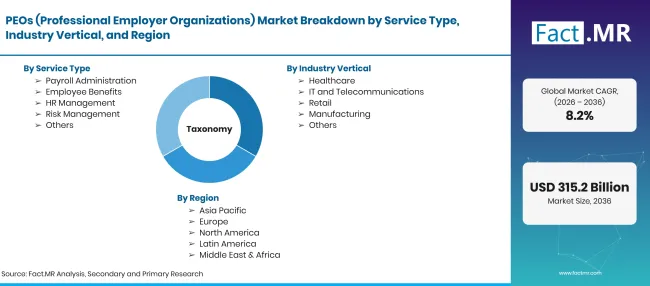
Factmr Peos Professional Employer Organizations Market Taxonomy | Source: Fact.MR
| Attribute | Details |
|---|---|
| Quantitative Units | USD billion in 2026 to USD billion by 2036 at CAGR |
| Market Definition | Services delivered by professional employer organizations under a co-employment agreement, in which the provider shares employer duties for payroll, benefits, HR management and risk management. Coverage spans small, mid-sized and large client businesses across industry verticals. |
| Service Type | Payroll Administration; Employee Benefits; HR Management; Risk Management; Others |
| Industry Vertical | Healthcare; IT and Telecommunications; Retail; Manufacturing; Others |
| Enterprise Size | Small and Medium Enterprises; Large Enterprises |
| Regions Covered | North America; Latin America; Western Europe; Eastern Europe; East Asia; South Asia & Pacific; Middle East & Africa |
| Countries Covered | Germany; Brazil; United States; United Kingdom; Japan |
| Companies Profiled | ADP TotalSource; Insperity; TriNet; Paychex; G&A Partners; Justworks; Vensure Employer Solutions; BBSI; Sequoia One (Sequoia Consulting Group) |
| Forecast Period | 2026 to 2036 |
| Approach | Hybrid top-down and bottom-up approach using employer and worksite employee counts; service fees by service type; client penetration and retention among small and mid-sized businesses; and provider portfolio review. |
Source: Fact.MR analysis. Updated Oct 21, 2026
How is the market segmented?
-
By Service Type
- Payroll Administration
- Employee Benefits
- HR Management
- Risk Management
- Others
-
By Industry Vertical
- Healthcare
- IT and Telecommunications
- Retail
- Manufacturing
- Others
-
By Enterprise Size
- Small and Medium Enterprises
- Large Enterprises
-
By Region
- North America
- Latin America
- Western Europe
- Eastern Europe
- East Asia
- South Asia & Pacific
- Middle East & Africa
Frequently Asked Questions
What is the size of the PEOs market in 2026?
What is the CAGR of the PEOs market from 2026 to 2036?
Which service type leads the PEOs market?
Which industry vertical leads the PEOs market?
Which enterprise size leads the PEOs market?
Which country will grow the most in the PEOs market?
Who are the main companies in the PEOs market?
Who worked on this report


Preview the report firsthand - request a free sample
Free SampleGet the brochure for pricing and purchase details
Download PDF