- Base Value(2025): 7.4 Bn
- Estimated Value(2026): 8.9 Bn
- Forecast Value (2036): 53.6 Bn
- CAGR (2026 - 2036): 19.7%
Direct-Synthesized NMC Hydroxide pCAM Market Forecast and Outlook 2026 to 2036
In 2025, the direct-synthesized NMC hydroxide pCAM market was valued at USD 7.4 billion. Based on Fact.MR analysis, demand for direct-synthesized NMC hydroxide pCAM is estimated to grow to USD 8.9 billion in 2026 and USD 53.6 billion by 2036. FACT.MR projects a CAGR of 19.7% during the forecast period.
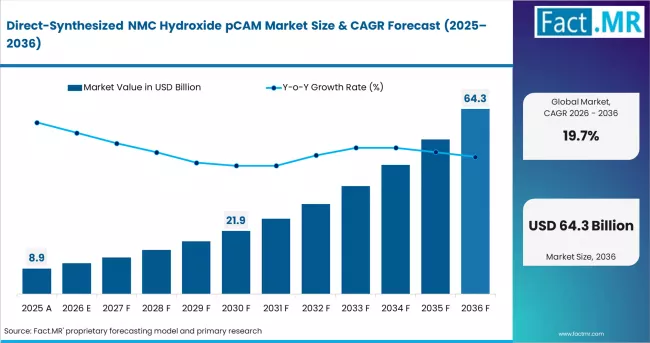
Direct Synthesized Nmc Hydroxide Pcam Market Market Value Analysis | Source: Fact.MR
Summary of Direct-Synthesized NMC Hydroxide pCAM Market
- Market Definition
- Covers direct-synthesized NMC hydroxide pCAM grades used in EV battery cathodes, grid ESS, and consumer electronics globally across NMC 111, 532, 622, and 811 chemistries.
- Demand Drivers
- Global EV gigafactory expansion is driving NMC 811 high-nickel pCAM procurement at scale, with producers requiring direct-synthesis routes for stoichiometric consistency.
- IRA Section 30D battery material incentives in the U.S. are accelerating domestic pCAM qualification programmes at greenfield gigafactory sites.
- EU Battery Regulation carbon footprint mandates are compelling European cell manufacturers to onboard direct-synthesis pCAM with traceable, low-emission precursor documentation.
- Key Segments Analyzed
- By Chemistry: NMC 622 leads with approximately 35% share in 2026 due to its balanced energy density and thermal stability for mainstream EV battery qualification.
- By Process Type: Direct-synthesized hydroxide pCAM leads as the primary segment, serving high-nickel cell lines at major gigafactories globally.
- By Application: Electric Vehicles holds 62% share in 2026, anchored by NMC 622 and 811 cell qualification programmes at Tier 1 EV OEM battery supply chains.
- By Geography: China grows fastest at 20.0% CAGR, driven by CATL and BYD integrated pCAM-to-cell capacity expansion at domestic gigafactory sites.
- Analyst Opinion at Fact.MR
- Shambhu Nath Jha, Principal Consultant at Fact.MR, opines, 'CXOs will find that the shift to direct-synthesized pCAM is not incremental but structural, as NMC 811 gigafactory procurement mandates are making co-precipitation routes commercially unviable at high-nickel cell lines.'
- Strategic Implications
- Producers should invest in direct-synthesis reactor capacity aligned with NMC 811 and high-nickel gigafactory pipelines in China, South Korea, and the U.S.
- Long-term off-take agreements with EV OEMs and Tier 1 cell manufacturers are critical given 12 to 24 month qualification cycles for new pCAM grades.
- Traceability infrastructure and EU Battery Regulation-compliant documentation must be embedded into supply chain operations to retain European cell manufacturer approvals.
- Methodology
- Market sizing uses gigafactory capacity data, NMC chemistry adoption benchmarks, and pCAM yield efficiency assumptions by process route.
- Supported by IRA filings, EU Battery Regulation guidance, and POSCO Future M, CNGR, and Huayou Cobalt corporate disclosures.
- Forecasts incorporate EV penetration trajectories, high-nickel adoption timelines, ESS deployment rates, and expert inputs from pCAM producers.
| Metric | Value |
|---|---|
| Estimated Value in 2026 | USD 8.9 billion |
| Forecast Value in 2036 | USD 53.6 billion |
| Forecast CAGR (2026 to 2036) | 19.7% |
Source: Fact.MR analysis. Updated Apr 11, 2026
The market is projected to generate approximately USD 44.7 billion in incremental revenue during the forecast period, reflecting a transformational expansion rather than incremental growth. This growth is driven by rising EV penetration targets, rapid gigafactory capacity additions across China, South Korea, and the United States, and the shift toward direct-synthesized pCAM processes that improve yield and reduce cobalt dependence.
Growth remains constrained by high capital requirements for process adoption and limited availability of direct-synthesis equipment suppliers. Raw material traceability requirements under the EU Battery Regulation add compliance complexity. Nickel and cobalt price volatility creates margin pressure for producers without integrated feedstock supply. Qualification cycles of 12 to 24 months at OEM cell lines further delay volume ramp-up.
Country-level growth reflects gigafactory investment density, policy support, and supply chain integration. China leads at 20.0% CAGR, supported by integrated supply chains of CATL, BYD, and CNGR. South Korea follows at 19.4%, driven by POSCO Future M and LG Chem’s high-nickel programmes. Japan grows at 18.8%, supported by Panasonic and material partnerships. The United States records 18.0% CAGR, driven by IRA incentives and domestic sourcing. Germany expands at 17.7%, supported by Volkswagen and BMW localization strategies under EU regulations.
Segmental Analysis
Direct-Synthesized NMC Hydroxide pCAM Market Analysis by Chemistry
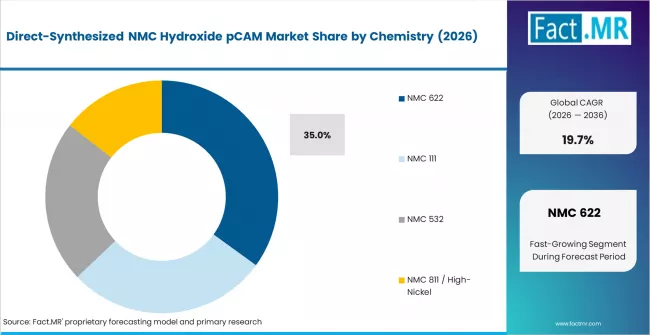
Direct Synthesized Nmc Hydroxide Pcam Market Analysis By Chemistry | Source: Fact.MR
Based on FACT.MR analysis, NMC 622 holds 35% share in 2026. It offers a balance of energy density, safety, and lifecycle. It remains the primary chemistry for mass-market EV programmes. NMC 811 adoption is rising but faces cost and validation constraints.
- POSCO Future M NMC 811 Expansion: POSCO announced a KRW 1.2 trillion investment in 2024. The project targets NMC 811 direct-synthesis pCAM supply for LG Energy Solution and Samsung SDI. Commercial supply is planned from 2026. [4]
- Ronbay Technology Product Development: Ronbay launched a high-nickel NMC 9-series pCAM in 2025. The product improves single-crystal stability and reduces cracking. It targets Chinese EV OEM qualification programmes. [5]
- High-Nickel Adoption Trajectory: Global NMC 811 capacity reached 450 GWh in 2024. Over 75% of programmes specify direct-synthesis pCAM. This reflects growing preference for high-performance precursor routes. [3]
Direct-Synthesized NMC Hydroxide pCAM Market Analysis by Application
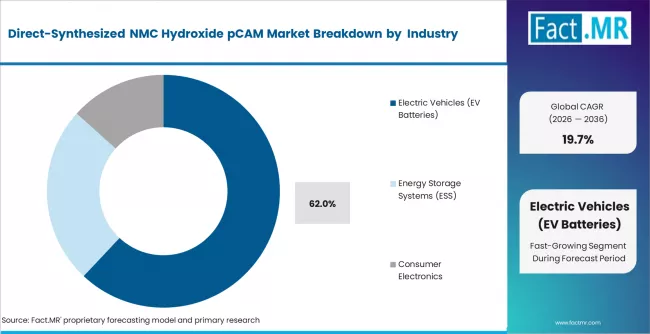
Direct Synthesized Nmc Hydroxide Pcam Market Analysis By Application | Source: Fact.MR
EVs account for 62% share in 2026. This is driven by gigafactory scale and high-energy-density cell requirements. OEMs lock in pCAM specifications through long-term contracts. Direct-synthesis routes are preferred for NMC 622 and 811 applications.
- LG Chem EV Cell Supply Agreement: LG Chem signed a USD 2.3 billion agreement with POSCO Future M in 2024. The deal covers supply for U.S. gigafactories serving GM and Stellantis. [8]
- Umicore ESS pCAM Development: Umicore introduced NMC 622 pCAM for ESS in 2025. The product improves cycle life and structural stability. It targets European grid storage demand. [9]
- Consumer Electronics NMC Demand: Consumer electronics demand grew 18% in 2024. OEMs are adopting NMC 622 cells for higher energy density. Direct-synthesis pCAM is used in Sony, Samsung SDI, and Panasonic supply chains.
Drivers, Restraints, and Opportunities
FACT.MR analysts observe that the direct-synthesized NMC hydroxide pCAM market has shifted from a supplementary role to a primary procurement target for high-nickel EV gigafactories. Current valuation reflects strong demand from NMC 622 and 811 qualification programmes.
The market is moving toward chemistry-specific and process-qualified supply agreements. EV OEMs and cell manufacturers require direct-synthesis pCAM with consistent particle size and low sulphate residuals. Carbon footprint documentation is also becoming mandatory.
- EU Battery Regulation Carbon Mandate: The EU Battery Regulation (EU) 2023/1542 requires carbon footprint disclosure from 2025. European cell manufacturers must qualify pCAM with emission data. This benefits direct-synthesis producers with cleaner processing. It expands qualification pipelines across Germany, France, and the Nordics. [1]
- IRA Section 45X Advanced Manufacturing Credit: The U.S. IRA Section 45X provides incentives for domestic battery material production. It is driving new direct-synthesis pCAM investments in Tennessee, Ohio, and Georgia. POSCO Future M and CNGR projects are targeting 2025–2026 operations. [2]
- China Gigafactory Volume Pressure: CATL and BYD expanded capacity by over 300 GWh in 2024. This increased demand for direct-synthesis pCAM. Co-precipitated producers face margin pressure due to performance limitations. Integrated Chinese players such as Huayou Cobalt and GEM gain procurement advantages. [3]
Regional Analysis
The direct-synthesized NMC hydroxide pCAM market is assessed across North America, Asia Pacific, Europe, Latin America, and Middle East and Africa, covering 40+ countries with distinct demand profiles shaped by gigafactory investment density, battery material policy frameworks, integrated precursor supply proximity, and EV adoption trajectories. The full report provides market attractiveness analysis by region and country.
.webp "Top Country Growth Comparison Direct Synthesized Nmc Hydroxide Pcam Market Cagr (2026 2036)")
Top Country Growth Comparison Direct Synthesized Nmc Hydroxide Pcam Market Cagr (2026 2036) | Source: Fact.MR
| Country | CAGR (2026 to 2036) |
|---|---|
| China | 20.0% |
| South Korea | 19.4% |
| Japan | 18.8% |
| United States | 18.0% |
| Germany | 17.7% |
Source: Fact.MR analysis. Updated Apr 11, 2026
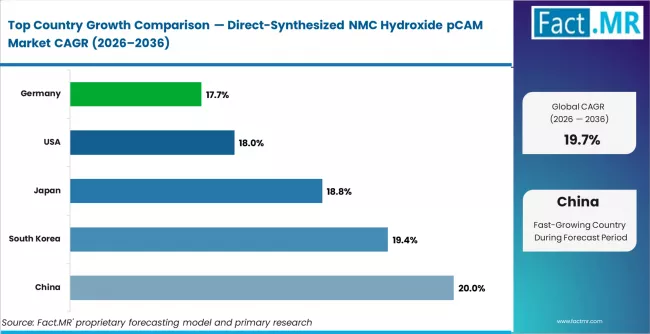
Direct Synthesized Nmc Hydroxide Pcam Market Cagr Analysis By Country | Source: Fact.MR
Source: Fact.MR (FACT.MR) analysis, based on proprietary forecasting model and primary research
Asia Pacific Direct-Synthesized NMC Hydroxide pCAM Market Analysis
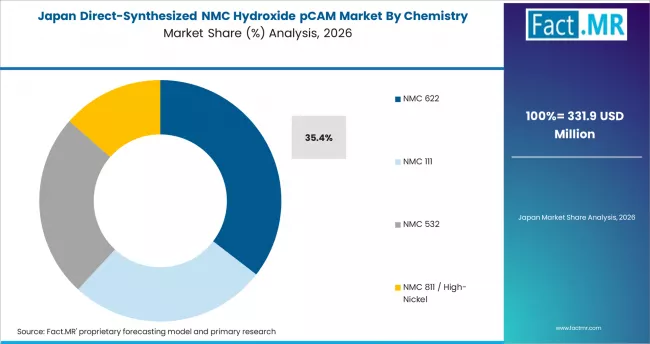
Direct Synthesized Nmc Hydroxide Pcam Market Japan Market Share Analysis By Chemistry | Source: Fact.MR
Asia Pacific dominates global pCAM production and consumption, supported by integrated supply chains and large-scale gigafactory demand across China, South Korea, and Japan.
- China: China leads global pCAM demand growth at 20.0% CAGR through 2036. Growth is anchored by CATL’s large-scale capacity and BYD’s vertical integration into pCAM procurement. Direct-synthesis routes are required for NMC 622 and 811 cell production. Huayou Cobalt expanded capacity in 2024 to support OEM supply agreements. GEM introduced recycled-content pCAM aligned with EU compliance requirements. Integrated refining capabilities help reduce feedstock risk and improve cost stability.
- South Korea: South Korea is driven by high-nickel battery innovation and OEM-linked supply chains, growing at 19.4% CAGR. POSCO Future M’s 2024 investment supports NMC 811 direct-synthesis production for LG Energy Solution and Samsung SDI. Competitive advantage comes from process know-how and close OEM collaboration. Government-backed R&D programmes are accelerating advanced pCAM development.
- Japan: Japan’s growth is supported by advanced battery programs and OEM partnerships, expanding at 18.8% CAGR. Panasonic’s gigafactory ramp and Toyota’s battery programmes are increasing demand for high-purity pCAM. Sumitomo Metal Mining is advancing direct-synthesis precursor development for commercial qualification. Focus remains on precision morphology and high-performance materials.
FACT.MR's Asia Pacific analysis covers China, South Korea, Japan, India, ASEAN, and ANZ, including capacity and procurement trends.
North America Direct-Synthesized NMC Hydroxide pCAM Market Analysis
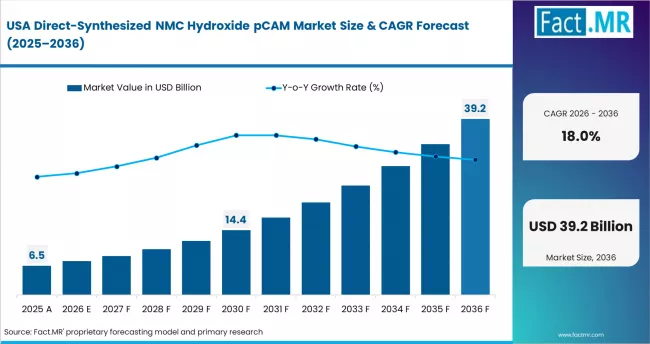
Direct Synthesized Nmc Hydroxide Pcam Market Country Value Analysis | Source: Fact.MR
North America is a policy-driven growth market, supported by IRA incentives and localization of battery material supply chains.
United States: The United States is expanding at 18.0% CAGR through 2036, driven by IRA incentives and gigafactory investments. Section 45X credits are encouraging domestic pCAM production. POSCO Future M announced a Georgia facility targeting EV OEM supply. DOE funding is supporting capacity expansion and qualification timelines for U.S. producers.
Mexico: Mexico is benefiting from nearshoring trends and automotive EV investments, with steady growth through 2036. EV assembly expansion by global OEMs is increasing intermediate material demand. USMCA eligibility supports IRA-compliant sourcing strategies. The country is emerging as a key regional supply chain node.
FACT.MR's North America analysis covers the United States, Canada, and Mexico, including policy and qualification insights.
Europe Direct-Synthesized NMC Hydroxide pCAM Market Analysis
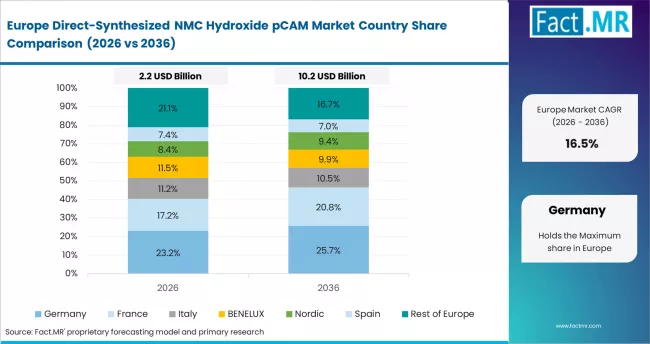
Direct Synthesized Nmc Hydroxide Pcam Market Europe Country Market Share Analysis, 2026 & 2036 | Source: Fact.MR
Europe is a compliance-driven market where sustainability regulations directly influence pCAM sourcing and qualification.
- Germany: Germany is growing at 17.7% CAGR through 2036, supported by EV localization and regulatory mandates. Volkswagen and BMW are driving demand for compliant pCAM supply. EU Battery Regulation requirements are shaping procurement criteria. BASF is expanding qualification programmes to support regional OEM supply. Germany remains the key hub for pCAM validation in Europe.
FACT.MR's Europe analysis covers Germany, France, the UK, Italy, Spain, Nordics, BENELUX, and wider Europe, including compliance and demand forecasts.
Competitive Aligners for Market Players
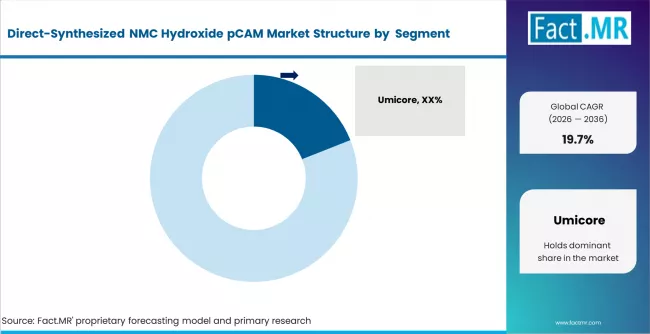
Direct Synthesized Nmc Hydroxide Pcam Market Analysis By Company | Source: Fact.MR
The direct-synthesized NMC hydroxide pCAM market is moderately consolidated at the technology leadership level but remains fragmented in terms of global capacity distribution. A limited number of players control advanced direct-synthesis capabilities, while a broader base of regional producers continues to rely on conventional co-precipitation routes. Competitive positioning is increasingly defined by process innovation, feedstock integration, and OEM qualification rather than pure production scale.
Leading companies such as POSCO Future M, CNGR Advanced Materials, Huayou Cobalt, GEM Co., and Ronbay Technology dominate high-volume supply through vertically integrated operations spanning refining, precursor production, and cathode materials. These players benefit from proximity to battery gigafactories and access to nickel, cobalt, and manganese feedstocks, which account for a major share of production costs and margin variability. Their ability to deliver consistent particle morphology and purity is critical, as pCAM properties directly influence battery performance and lifecycle.
Technology differentiation is becoming the primary competitive lever. Companies such as Ascend Elements are commercializing direct-synthesis processes that eliminate intermediate steps, improving cost efficiency and reducing emissions compared to traditional routes. This shift is accelerating the transition toward closed-loop and low-carbon pCAM production models, particularly in North America and Europe. Strategic partnerships and long-term supply agreements with battery cell manufacturers are central to market access. Qualification cycles remain lengthy, creating high entry barriers and reinforcing incumbent advantages. At the same time, regional policy frameworks such as the U.S. IRA and EU Battery Regulation are driving localization strategies, prompting both Asian incumbents and Western entrants to establish new capacity closer to end markets.
Key Players
- Umicore
- BASF SE
- LG Chem
- POSCO Future M
- Huayou Cobalt
- Ronbay Technology
- GEM Co., Ltd.
- CNGR Advanced Material Co., Ltd.
- Sumitomo Metal Mining Co., Ltd.
- Zhejiang Brunp Recycling Technology
Bibliography
- [1] European Commission. (2024). EU Battery Regulation (EU) 2023/1542 Implementation Guidance: Carbon Footprint Declaration Requirements for EV and Industrial Batteries Including pCAM Supply Chain Documentation Standards. February 2024. ec.europa.eu/environment/batteries
- [2] U.S. Department of Energy. (2024). Inflation Reduction Act Section 45X Advanced Manufacturing Credit: Eligible Battery Materials Including pCAM Per-Kilogram Incentive Schedule and Domestic Qualification Requirements. 2024. energy.gov/ira
- [3] International Energy Agency. (2024). Global EV Outlook 2024: NMC Cell Chemistry Adoption Benchmarks, Gigafactory Capacity Data, and pCAM Precursor Process Route Specification Trends. June 2024. iea.org/reports/global-ev-outlook-2024
- [4] POSCO Future M. (2024). Investor Announcement: KRW 1.2 Trillion NMC 811 Direct-Synthesis pCAM Capacity Expansion at Gwangyang Facility Targeting LG Energy Solution and Samsung SDI EV Cell Supply Programmes. Q3 2024. poscofuturem.com/investor-relations
- [5] Ronbay Technology. (2025). Product Launch Announcement: High-Nickel NMC 9-Series Single-Crystal Direct-Synthesis pCAM Grade with Improved Cracking Resistance for Passenger EV Cell OEM Qualification. January 2025. ronbay.com/news
- [8] LG Chem. (2024). Investor Disclosure: Multi-Year Direct-Synthesis NMC 811 pCAM Supply Agreement with POSCO Future M Valued at USD 2.3 Billion Covering Michigan and Ohio Gigafactory EV Cell Programmes. Q4 2024. lgchem.com/investor-relations
- [9] Umicore. (2025). Product Portfolio Announcement: Direct-Synthesis NMC 622 pCAM Grade Optimised for Long-Cycle ESS Applications Targeting European Grid Storage Operators Under EU Energy Storage Deployment Mandates. January 2025. umicore.com/newsroom
This Report Addresses
- Strategic insights on direct-synthesized NMC hydroxide pCAM demand across China gigafactory-integrated supply chains, IRA-backed U.S. greenfield pCAM investments, South Korean NMC 811 qualification programmes, German EU Battery Regulation compliance-led procurement, and Japan's solid-state battery precursor development pipeline.
- Market forecast from USD 8.9 billion in 2026 to USD 53.6 billion by 2036 at a CAGR of 19.7%.
- Growth opportunity mapping across high-nickel NMC 811 direct-synthesis pCAM expansion, ESS NMC cell procurement growth, and consumer electronics premium cell supply chain upgrading.
- Segment analysis by chemistry (NMC 111, 532, 622, 811), process type (direct-synthesized, co-precipitated, recycled), and application (EVs, ESS, consumer electronics).
- Regional outlook covering Asia Pacific gigafactory-volume-driven pCAM demand leadership, North America IRA incentive-backed domestic direct-synthesis investment, and Europe EU Battery Regulation compliance-led procurement criteria.
- Competitive analysis of Umicore, BASF SE, LG Chem, POSCO Future M, Huayou Cobalt, Ronbay Technology, GEM Co., CNGR, Sumitomo Metal Mining, and Zhejiang Brunp covering direct-synthesis capacity strategy, chemistry portfolio, and gigafactory customer qualification positioning.
- Regulatory impact analysis covering EU Battery Regulation (EU) 2023/1542 carbon footprint and recycled content requirements, U.S. IRA Section 45X Advanced Manufacturing Credit eligibility, South Korea KEIT battery material programme funding, and China MIIT battery quality standards for NMC cell producers.
- Report available in PDF, Excel datasets, and presentation formats supported by primary pCAM producer interviews, gigafactory capacity data, government IRA and EU regulatory filings, and corporate investor disclosures.
Market Definition
The direct-synthesized NMC hydroxide pCAM market covers precursor cathode active materials produced via direct co-precipitation of nickel, manganese, and cobalt hydroxide particles without intermediate sulphate conversion.
Market Inclusions
Covers global and regional market sizes from 2026 to 2036 by chemistry, process type, and application. Includes NMC 111, 532, 622, and 811 grades produced via direct-synthesis hydroxide routes. End applications span EV batteries, grid ESS, and consumer electronics across key geographies.
Market Exclusions
Excludes co-precipitated pCAM unless produced via direct-synthesis process routes. Finished cathode active material (CAM), fully fabricated battery cells, and module-level battery components are excluded. Recycled pCAM is tracked separately and excluded from primary direct-synthesis volume data.
Research Methodology
- Primary Research: Includes interviews with pCAM producers, NMC cathode manufacturers, EV OEM procurement teams, battery material traders, and government energy programme officers across China, South Korea, Japan, the U.S., and Europe.
- Desk Research: Includes analysis of gigafactory capacity announcements, trade data, government IRA and EU Battery Regulation filings, and producer disclosures from 2024 to 2025.
- Market Sizing and Forecasting: Uses a hybrid top-down and bottom-up model based on battery demand indices, NMC cell chemistry adoption rates, gigafactory procurement benchmarks, and pCAM yield assumptions by process type.
- Data Validation and Update Cycle: Validated using capacity filings, corporate investor disclosures, trade statistics, and expert interviews with periodic update cycles aligned to gigafactory announcement timelines.
Segmentation
Scope of Report
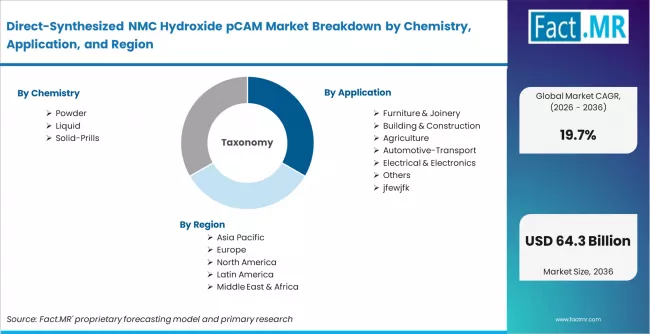
Direct Synthesized Nmc Hydroxide Pcam Market Breakdown By Chemistry, Application, And Region | Source: Fact.MR
| Attribute | Details |
|---|---|
| Quantitative Units | USD 8.9 billion (2026) to USD 53.6 billion (2036), at a CAGR of 19.7% |
| Market Definition | NMC hydroxide precursor cathode active materials produced via direct-synthesis routes serving EV batteries, ESS, and consumer electronics globally. |
| Chemistry Segmentation | NMC 111, NMC 532, NMC 622, NMC 811/High-Nickel |
| Process Type Segmentation | Direct-Synthesized Hydroxide pCAM, Co-Precipitated Conventional pCAM, Recycled pCAM |
| Application Segmentation | Electric Vehicles, Energy Storage Systems, Consumer Electronics |
| Application Coverage | EV NMC lithium-ion battery cathode precursor, grid and utility ESS NMC cell supply, consumer electronics premium NMC cell supply, solid-state battery precursor pilot programmes. |
| Regions Covered | North America, Europe, Asia Pacific, Latin America, Middle East and Africa |
| Countries Covered | USA, Canada, Mexico, Germany, UK, France, Italy, Spain, Nordic, BENELUX, China, Japan, South Korea, India, ASEAN, Australia and New Zealand, Brazil, Argentina, Chile, Saudi Arabia, GCC, Turkey, South Africa, Rest of MEA |
| Key Companies Profiled | Umicore, BASF SE, LG Chem, POSCO Future M, Huayou Cobalt, Ronbay Technology, GEM Co., CNGR Advanced Material, Sumitomo Metal Mining, Zhejiang Brunp |
| Forecast Period | 2026 to 2036 |
| Approach | Hybrid top-down and bottom-up model using gigafactory capacity data, NMC cell chemistry adoption rates, pCAM yield benchmarks, IRA and EU regulatory filings, and primary interviews with pCAM producers and cell manufacturers. |
Source: Fact.MR analysis. Updated Apr 11, 2026
Direct-Synthesized NMC Hydroxide pCAM Market by Segments
-
By Chemistry (Nickel Content):
- NMC 111
- NMC 532
- NMC 622 (leading segment
- NMC 811 / High-Nickel
-
By Process Type:
- Direct-Synthesized Hydroxide pCAM
- Co-Precipitated Conventional pCAM
- Recycled pCAM
-
By Application:
- Electric Vehicles (EV Batteries)
- Energy Storage Systems (ESS)
- Consumer Electronics
-
By Region:
- North America
- United States
- Canada
- Mexico
- Latin America
- Brazil
- Mexico
- Argentina
- Chile
- Rest of Latin America
- Western Europe
- Germany
- United Kingdom
- France
- Italy
- Spain
- Nordic Countries
- BENELUX
- Rest of Western Europe
- Eastern Europe
- Russia
- Poland
- Hungary
- Balkan and Baltic
- Rest of Eastern Europe
- East Asia
- China
- Japan
- South Korea
- South Asia and Pacific
- India
- ASEAN
- Australia and New Zealand
- Rest of South Asia and Pacific
- Middle East and Africa
- Kingdom of Saudi Arabia
- Other GCC Countries
- Turkey
- South Africa
- Rest of Middle East and Africa
- North America
Frequently Asked Questions
How large is the direct-synthesized NMC hydroxide pCAM market in 2025?
What will the market size be in 2026?
What is the projected market size by 2036?
What is the expected CAGR of the direct-synthesized NMC hydroxide pCAM market?
What is the absolute dollar opportunity in this market?
Which chemistry segment leads the direct-synthesized NMC hydroxide pCAM market?
Which application segment holds the largest share?
Which country shows the fastest growth?
Who are the key players?
What makes direct-synthesized pCAM different from co-precipitated pCAM?
Why is NMC 622 the leading chemistry in 2026?
What is driving demand for pCAM materials?
Why are OEM qualification cycles important in this market?
How does vertical integration impact competitiveness?
Who worked on this report


Preview the report firsthand - request a free sample
Free SampleGet the brochure for pricing and purchase details
Download PDF