- Base Value(2025): 691.6 Bn
- Estimated Value(2026): 740 Bn
- Forecast Value (2036): 1455.6 Bn
- CAGR (2026 - 2036): 7.0%
Consumer Electronics Market Forecast and Outlook By Fact.MR
In 2025, the consumer electronics market was valued at USD 691.6 billion. Based on Fact.MR analysis, demand for consumer electronics is estimated to grow to USD 740 billion in 2026 and USD 1,455.6 billion by 2036. FACT.MR projects a CAGR of 7.0% during the forecast period.
The global consumer electronics market is expected to generate an absolute dollar opportunity of around USD 715.6 billion during the 2026 to 2036 period. Growth is supported by smartphone replacement cycles shortening due to AI feature upgrades, premium television and audio device adoption in Asia Pacific middle-class households, and wearable health device adoption driven by insurance reimbursement. Growth is moderated by prolonged replacement cycles in mature laptop and tablet markets, consumer electronics trade tariff uncertainty between the United States and China, and component cost inflation in OLED display and advanced semiconductor supply chains.
Country growth reflects smartphone penetration, middle-class income expansion, and AI device adoption. China leads at 8.2% CAGR driven by premium smartphone and smart home device demand and domestic OEM AI feature integration. India follows at 7.5% supported by rising smartphone replacement activity and expanding electronics retail infrastructure. The United States posts 6.5% driven by AI PC and premium wearable adoption. Germany grows at 6.0% through smart home appliance and premium audio device demand. The United Kingdom grows at 5.7%, supported by replacement smartphone and wearable health device adoption, with mature television and laptop markets generating replacement rather than growth demand constrained by household spending pressure.
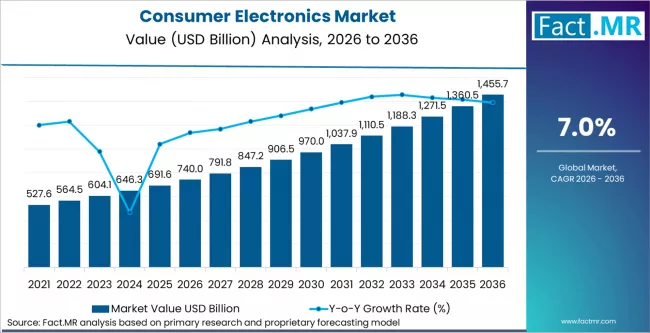
Consumer Electronics Market Market Value Analysis | Source: Fact.MR
| Metric | Value |
|---|---|
| Estimated Value in 2026 | USD 740 billion |
| Forecast Value in 2036 | USD 1,455.6 billion |
| Forecast CAGR (2026 to 2036) | 7.0% |
Source: Fact.MR analysis. Updated Mar 12, 2026
Market Definition
The consumer electronics market includes electronic devices used by individuals and households such as smartphones, laptops, TVs, audio devices, wearables, and smart home appliances.
Market Inclusions
Includes global forecasts from 2026 to 2036 by product type and sales channel covering smartphones, computing devices, displays, audio products, wearables, and smart home appliances.
Market Exclusions
Excludes enterprise electronics procurement, industrial electronics, professional AV equipment, component manufacturing, spare parts, and repair services.
Research Methodology
- Primary Research: Interviews with retail buyers, OEM product managers, distributors, e-commerce managers, and technology analysts.
- Desk Research: Sources include IDC shipment tracker, GfK retail data, OEM earnings reports, trade statistics, and government digital economy reports.
- Market Sizing and Forecasting: Hybrid model using device shipment volumes, average selling prices, channel revenue share, and consumer spending forecasts.
- Data Validation and Update Cycle: Forecasts validated using OEM revenue disclosures, IDC shipment data, GfK retail reports, and expert interviews.
Summary of Consumer Electronics Market
- Market Definition
- The market covers smartphones, laptops, tablets, televisions, audio devices, wearables, and smart home appliances sold through retail and online channels for communication, entertainment, and home automation.
- Demand Drivers
- AI-enabled smartphone features are accelerating premium device upgrades in major markets.
- Smart home appliance adoption is rising due to energy efficiency rules and home automation platforms.
- Wearable health monitoring devices are growing with support from insurers and employer wellness programs.
- Key Segments Analyzed
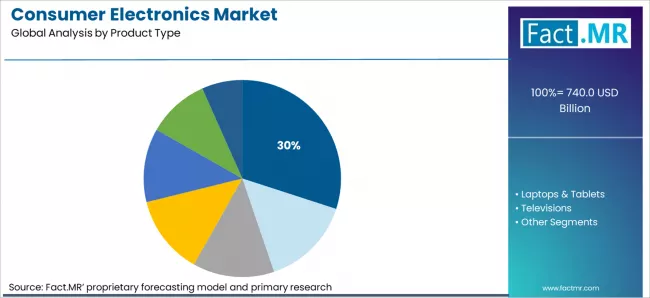
- By Product Type: Smartphones hold about 30% share in 2026 due to frequent replacement cycles and AI feature upgrades.
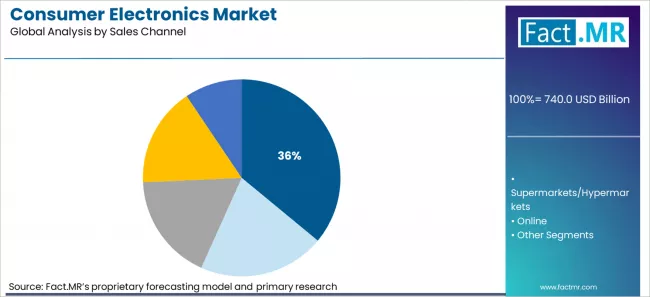
- By Sales Channel: Specialty Stores lead with about 36% share in 2026 due to product demonstrations and trade-in services.
- By Geography: China shows the fastest growth at about 8.2% CAGR through 2036 driven by domestic OEM innovation and smart home demand.
- Analyst Opinion at FACT.MR
- Shambhu Nath Jha, Principal Consultant at Fact.MR opines, that CXOs will find this report helpful in understanding how AI-embedded smartphones, smart home ecosystem expansion, wearable health monitoring adoption, and energy-efficient connected appliances are shaping long-term growth and competitive positioning in the consumer electronics market.
- Strategic Implications
- OEMs should expand on-device AI features across smartphones and smart appliances to drive premium upgrades.
- Companies should pursue FDA and EU MDR certification for health wearables to access insurance and wellness programs.
- Manufacturers should develop energy-efficient smart home appliances meeting EU energy labeling standards.
- Methodology
- Market sizing used shipment volumes and ASP data validated with IDC reports and OEM financial disclosures.
- Consumer spending surveys, retail sales data, and government digital economy statistics supported demand analysis.
- Forecasts incorporated product replacement cycle modelling, AI feature adoption rates, smart home penetration projections, and primary interviews with electronics retail category managers.
- The market covers smartphones, laptops, tablets, televisions, audio devices, wearables, and smart home appliances sold through retail and online channels for communication, entertainment, and home automation.
- Demand Drivers
- AI-enabled smartphone features are accelerating premium device upgrades in major markets.
- Smart home appliance adoption is rising due to energy efficiency rules and home automation platforms.
- Wearable health monitoring devices are growing with support from insurers and employer wellness programs.
- Key Segments Analyzed
- By Product Type: Smartphones hold about 30% share in 2026 due to frequent replacement cycles and AI feature upgrades.
- By Sales Channel: Specialty Stores lead with about 36% share in 2026 due to product demonstrations and trade-in services.
- By Geography: China shows the fastest growth at about 8.2% CAGR through 2036 driven by domestic OEM innovation and smart home demand.
- Analyst Opinion at FACT.MR
- Shambhu Nath Jha, Principal Consultant at Fact.MR opines, that CXOs will find this report helpful in understanding how AI-embedded smartphones, smart home ecosystem expansion, wearable health monitoring adoption, and energy-efficient connected appliances are shaping long-term growth and competitive positioning in the consumer electronics market.
- Strategic Implications
- OEMs should expand on-device AI features across smartphones and smart appliances to drive premium upgrades.
- Companies should pursue FDA and EU MDR certification for health wearables to access insurance and wellness programs.
- Manufacturers should develop energy-efficient smart home appliances meeting EU energy labeling standards.
- Methodology
- Market sizing used shipment volumes and ASP data validated with IDC reports and OEM financial disclosures.
- Consumer spending surveys, retail sales data, and government digital economy statistics supported demand analysis.
- Forecasts incorporated product replacement cycle modelling, AI feature adoption rates, smart home penetration projections, and primary interviews with electronics retail category managers.
Segmental Analysis
Consumer Electronics Market Analysis by Product Type
Consumer Electronics Market Analysis By Product Type | Source: Fact.MR
Based on FACT.MR analysis, smartphones are expected to hold about 30% share in 2026 due to frequent upgrade cycles and strong AI feature adoption.
- Samsung Galaxy AI Investment: Samsung launched the Galaxy S25 series in January 2025 with enhanced Galaxy AI features. The company reported a 12% higher average selling price for AI-enabled models. [5]
- Apple AI PC Technology Development: Apple introduced MacBook Pro and MacBook Air models with M4 chips and integrated Apple Intelligence features in October 2024, positioning AI PCs as a premium computing category. [6]
- Global Smartphone Shipment Trend: IDC reported global smartphone shipments grew 4% year-on-year in Q3 2024, with devices priced above USD 800 growing twice as fast as the overall market. [7]
Consumer Electronics Market Analysis by Sales Channel
Consumer Electronics Market Analysis By Sales Channel | Source: Fact.MR
Based on FACT.MR analysis, specialty stores are projected to hold about 36% share in 2026 as consumers prefer in-store product testing and service support for high-value electronics purchases.
- Apple Retail Store Expansion Investment: Apple announced plans in November 2024 to expand its Apple Store network in India to six locations by 2025 following strong sales in Mumbai and Delhi stores. [8]
- Xiaomi Smart Store Expansion: Xiaomi expanded its Mi Home retail network to about 15,000 stores across China and Southeast Asia in September 2024 with smart home experience zones. [9]
- Online Retail Channel Trend: GfK reported online consumer electronics sales reached 38% global share in 2024, with India and China exceeding 55% penetration due to trade-in programs and fast delivery. [10]
Drivers, Restraints, and Opportunities
FACT.MR analysts observe that the consumer electronics market, valued at USD 691.6 billion in 2025, continues to expand as devices such as smartphones, laptops, and televisions become essential household technologies across developed and emerging economies.
The market is shifting from hardware volume competition toward AI-driven platform differentiation. Premium AI-enabled devices, smart home ecosystems, and health wearables are driving higher average selling prices while traditional device categories face slower replacement cycles.
- India PLI Electronics Expansion: India expanded its Production-Linked Incentive scheme for electronics with INR 17,000 crore disbursements in FY2024-25. Apple, Samsung, and Dixon Technologies increased domestic device manufacturing, supporting smartphone and laptop market growth. [2]
- EU Energy Labelling Regulation Impact: Updated EU energy labeling standards for televisions and appliances in 2024-2025 are encouraging replacement of older devices with energy-efficient smart appliances across Germany, France, and Nordic markets. [3]
- China AI Smartphone Competition: Huawei’s Mate 60 Pro launch in 2024 accelerated AI smartphone competition. Xiaomi, OPPO, and vivo introduced AI-enabled flagship devices in 2025, expanding premium smartphone demand in China. [4]
Regional Analysis
The consumer electronics market is analysed across Asia Pacific, Europe, North America, Latin America, and Middle East and Africa, covering 40+ countries with distinct demand profiles shaped by smartphone penetration levels, middle-class income growth, AI device adoption maturity, and retail channel infrastructure development. The full report offers market attractiveness analysis based on device shipment forecasts, replacement cycle benchmarks, and AI feature adoption timelines by region.
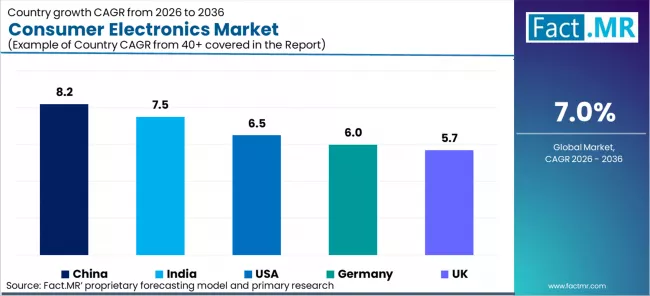
Consumer Electronics Market Cagr Analysis By Country | Source: Fact.MR
| Country | CAGR (2026-2036) |
|---|---|
| China | 8.2% |
| India | 7.5% |
| United States | 6.5% |
| Germany | 6.0% |
| United Kingdom | 5.7% |
Source: Fact.MR analysis. Updated Mar 12, 2026
Source: Fact.MR (FACT.MR) analysis, based on proprietary forecasting model and primary research
Asia Pacific Consumer Electronics Market Analysis
Asia Pacific is the largest production and consumption hub for consumer electronics, supported by strong smartphone manufacturing and rapidly expanding smart home adoption. Samsung, Xiaomi, and Huawei dominate regional competition while global brands maintain premium ecosystem positioning.
- China: Demand for consumer electronics in China is projected to grow at 8.2% CAGR through 2036. Huawei’s Mate 60 Pro relaunch in 2024 with Kirin 9000S chips accelerated premium smartphone upgrades. IDC reported China’s premium smartphone segment above USD 600 grew 18% in 2024. China’s Ministry of Commerce expanded its consumer electronics trade-in subsidy program in August 2024 with CNY 150 billion funding offering rebates for smartphones, televisions, and appliances. Xiaomi reported 30% growth in smart home and IoT revenue in Q3 2024.
- India: Demand for consumer electronics in India is projected to grow at 7.5% CAGR through 2036. Apple expanded iPhone manufacturing through Foxconn and Tata Electronics according to its January 2025 filing, improving domestic pricing competitiveness. India’s PLI Scheme approved INR 17,000 crore in FY2024-25 encouraging Samsung, Dell, and HP laptop production. Dixon Technologies reported 45% revenue growth in its mobile and laptop assembly division in Q2 FY2025.
FACT.MR’s analysis of the consumer electronics market in Asia Pacific covers China, Japan, South Korea, India, ASEAN, Australia and New Zealand, and Rest of South Asia and Pacific. Readers can find country CAGR forecasts, smartphone shipment benchmarks, AI device adoption data, and retail channel trends.
Europe Consumer Electronics Market Analysis
Europe represents a premium consumer electronics market shaped by energy efficiency regulations and strong demand for smart home appliances, premium audio products, and flagship smartphones.
- Germany: Demand for consumer electronics in Germany is projected to grow at 6.0% CAGR through 2036. The EU Energy Labelling framework implemented in March 2024 is accelerating replacement of televisions and appliances with energy-efficient models. BSH Hausgeräte reported 9% growth in connected smart appliance revenue in Germany during 2024. The German government discussed additional incentives for energy-efficient appliances through late 2024.
- United Kingdom: Demand for consumer electronics in the United Kingdom is projected to grow at 5.7% CAGR through 2036. Apple maintained strong premium smartphone share following the iPhone 16 launch in September 2024. The UK Electronics Waste Regulation update in October 2024 expanded retailer take-back programs supporting replacement device purchases.
FACT.MR’s analysis of the consumer electronics market in Europe includes Germany, France, the United Kingdom, Italy, Spain, Nordic countries, BENELUX, and Rest of Western Europe. Readers can find energy labelling compliance data, smartphone adoption trends, smart home demand, and country forecasts.
North America Consumer Electronics Market Analysis
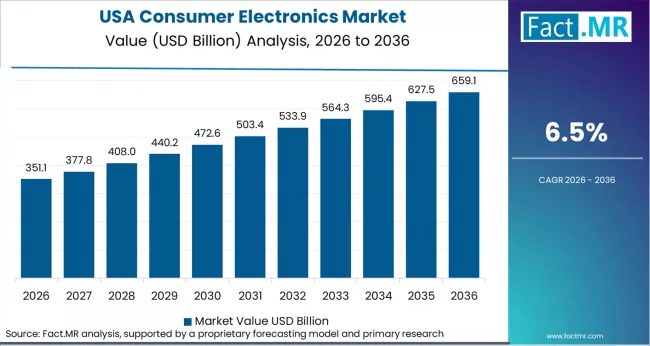
Consumer Electronics Market Country Value Analysis | Source: Fact.MR
North America generates the highest revenue per consumer electronics unit, supported by strong premium smartphone, AI PC, wearable, and smart home adoption.
- United States: Demand for consumer electronics in the United States is projected to grow at 6.5% CAGR through 2036. The FTC right-to-repair rulemaking progressing through 2024 is influencing device design and repairability demand. Apple reported stronger iPhone upgrades after Apple Intelligence feature rollout with global installed base reaching 1.4 billion devices. The Consumer Technology Association projected US consumer technology spending to reach USD 537 billion in 2025 driven by AI PCs, smartphones, and smart home devices.
FACT.MR’s analysis of the consumer electronics market in North America includes the United States, Canada, and Mexico. Readers can find US technology spending data, AI PC adoption benchmarks, wearable health program trends, and country forecasts by product type and sales channel.
Competitive Aligners for Market Players
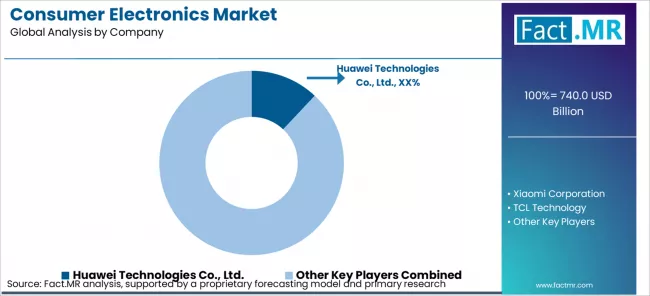
Consumer Electronics Market Analysis By Company | Source: Fact.MR
The global consumer electronics market shows a mix of concentration and fragmentation. In the premium segment, a few large brands dominate, while mid-range and entry-level categories remain highly competitive with many regional manufacturers. Apple and Samsung lead the global premium smartphone market, especially for devices priced above USD 600. At the same time, brands such as Xiaomi, OPPO, vivo, and Huawei compete aggressively in mid-range devices across Asia, Latin America, and emerging markets. In televisions, Samsung and LG dominate the premium OLED and QLED segments, while TCL and Hisense focus on delivering competitive price-to-performance products for mainstream consumers. Increasingly, competition is shifting from pure hardware specifications toward AI capabilities and integrated device ecosystems.
Apple holds a strong advantage through its tightly connected ecosystem of devices and services, including iPhone, Mac, Apple Watch, AirPods, and iCloud. This integration encourages customers to stay within the Apple ecosystem and often leads to higher cross-device sales. Samsung benefits from its vertically integrated manufacturing, producing key components such as displays and memory chips for its own devices. Retailers like Best Buy, MediaMarkt, and JD.com maintain multiple brands to balance pricing power, but strong brand loyalty in premium products still allows leading manufacturers to command higher margins.
Key Players
- Huawei Technologies Co., Ltd.
- Xiaomi Corporation
- TCL Technology
- Philips Electronics
- Sharp Corporation
- Samsung Electronics Co., Ltd.
- Apple Inc.
- LG Electronics Inc.
- Sony Corporation
- Panasonic Corporation
Bibliography
- [1] Ministry of Electronics and Information Technology, Government of India. (2024). Production-Linked Incentive Scheme IT Hardware Phase II: Approved Disbursement Notification FY2024-25, Eligible Manufacturer List Including Apple Partners, Samsung, and Dixon Technologies. October 2024. meity.gov.in
- [2] European Commission. (2024). EU Energy Labelling Regulation Rescaled Label Implementation Status: Television and Household Appliance A-Class Compliance Timeline and Member State Consumer Adoption Data. March 2024. ec. europa.eu/energy/topics/energy-efficiency/energy-efficient-products
- [3] IDC China. (2024). China Smartphone Market Quarterly Tracker Q4 2024: Huawei Mate 60 Series Market Impact, Premium Segment Above USD 600 Growth Rate, and OEM AI Feature Competitive Response. January 2025. idc.com/cn
- [4] Samsung Electronics Co., Ltd. (2025). Galaxy S25 Series Launch Press Release: Galaxy AI On-Device Feature Set, Average Selling Price Comparison Versus Galaxy S24 Series, and Enterprise AI Mobile Integration. January 2025. news.samsung.com
- [5] Apple Inc. (2024). Press Release: MacBook Pro and MacBook Air M4 Chip Launch Apple Intelligence On-Device AI Features Including Writing Tools, Image Playground, and Siri Integration for Consumer and Professional Segments. October 2024. apple.com/newsroom
- [6] International Data Corporation. (2024). Worldwide Quarterly Mobile Phone Tracker Q3 2024: Global Smartphone Shipment Volume Growth, Premium Tier Above USD 800 Performance, and Vendor Market Share. November 2024. idc.com
- [7] Apple Inc. (2025). Q1 FY2025 Earnings Call Transcript: India Manufacturing Strategy Update, Apple Store Retail Network Expansion Plan, and India Market iPhone Revenue Commentary. January 2025. investor.apple.com
- [8] Xiaomi Corporation. (2024). Press Release: Mi Home Smart Store Network Expansion to 15,000 Locations in China and Southeast Asia AI Product Experience Zones and Smart Home Ecosystem Retail Strategy. September 2024. xiaomi.com/global/newsroom
- [9] GfK SE. (2024). Consumer Electronics Market Monitor Q3 2024: Global Online Channel Share of Consumer Electronics Sales, India and China Online Penetration Data, and Platform Trade-In Programme Adoption. November 2024. gfk.com/insights
This Report Addresses
- Strategic intelligence on India PLI electronics incentives, China trade-in subsidies, EU energy labelling rules, US right-to-repair policies, and AI device adoption trends shaping demand.
- Market forecast from USD 740 billion in 2026 to USD 1,455.6 billion by 2036 at 7.0% CAGR by product type, sales channel, and region.
- Growth opportunities across China AI smartphone competition, India manufacturing expansion, Germany smart appliance replacement, US AI PC adoption, and UK premium smartphone demand.
- Country CAGR outlook for China 8.2%, India 7.5%, United States 6.5%, Germany 6.0%, and United Kingdom 5.7% driven by device innovation and retail expansion.
- Competitive analysis of Samsung, Apple, Huawei, Xiaomi, LG Electronics, Sony, TCL, Philips, Sharp, and Panasonic covering ecosystem strategies and channel partnerships.
- Technology tracking including AI smartphones, AI PCs with NPUs, OLED and MicroLED displays, health wearables, and smart home energy platforms.
- Regulatory analysis covering India PLI scheme, EU appliance energy labels, UK electronics producer responsibility rules, China AI device standards, and US right-to-repair regulation.
- Report delivered in PDF, Excel datasets, PowerPoint summary, and dashboard formats supported by IDC shipment data, OEM disclosures, retail sales reports, and primary interviews.
Segmentation
Scope of Report
| Attribute | Details |
|---|---|
| Quantitative Units | USD 740 billion (2026) to USD 1,455.6 billion (2036), at a CAGR of 7.0% |
| Market Definition | Electronic devices designed for personal and household use, including smartphones, laptops, tablets, televisions, audio devices, wearables, and home appliances sold through retail and online channels globally. |
| Product Type Segmentation | Smartphones (30%), Laptops & Tablets, Televisions, Audio Devices, Wearables, Home Appliances, Others |
| Sales Channel Segmentation | Specialty Stores (36%), Supermarkets/Hypermarkets, Online, Departmental Stores, Others |
| Application Coverage | Personal communication, entertainment, home automation, remote work and education, fitness and health monitoring, and smart home connectivity. |
| Regions Covered | Asia Pacific, Europe, North America, Latin America, Middle East and Africa |
| Countries Covered | China, Japan, South Korea, India, Australia and New Zealand, ASEAN, Rest of South Asia and Pacific, Germany, UK, France, Italy, Spain, Nordic, BENELUX, Rest of Western Europe, Russia, Poland, Hungary, USA, Canada, Mexico, Brazil, Chile, Ecuador, Rest of Latin America, Saudi Arabia, GCC, Turkey, South Africa, Rest of MEA |
| Key Companies Profiled | Samsung Electronics Co. Ltd., Apple Inc., Huawei Technologies Co. Ltd., Xiaomi Corporation, LG Electronics Inc., Sony Corporation, TCL Technology, Philips Electronics, Sharp Corporation, Panasonic Corporation |
| Forecast Period | 2026 to 2036 |
| Approach | Hybrid top-down and bottom-up model using device shipment volumes, average selling prices by product category, retail channel sales data, and primary interviews with electronics retail buyers and OEM product managers. |
Source: Fact.MR analysis. Updated Mar 12, 2026
Consumer Electronics Market by Segments
-
By Product Type:
- Smartphones
- Laptops & Tablets
- Televisions
- Audio Devices
- Wearables
- Home Appliances
- Others
-
By Sales Channel:
- Supermarkets/Hypermarkets
- Specialty Stores
- Online
- Departmental Stores
- Others
-
By Region:
- North America
- United States
- Canada
- Mexico
- Latin America
- Brazil
- Chile
- Ecuador
- Rest of Latin America
- Western Europe
- Germany
- United Kingdom
- France
- Italy
- Spain
- Nordic
- BENELUX
- Rest of Western Europe
- Eastern Europe
- Russia
- Poland
- Hungary
- Balkan and Baltic
- Rest of Eastern Europe
- East Asia
- China
- Japan
- South Korea
- South Asia and Pacific
- India
- ASEAN
- Australia and New Zealand
- Rest of South Asia and Pacific
- Middle East and Africa
- Kingdom of Saudi Arabia
- Other GCC Countries
- Turkey
- South Africa
- Other African Union
- Rest of Middle East and Africa
- North America
Frequently Asked Questions
How large is the consumer electronics market in 2025?
What will the market size be in 2026?
What is the projected market size by 2036?
What is the expected CAGR for the forecast period 2026 to 2036?
Which product type holds the leading share?
Which sales channel commands the largest share?
Which country is projected to grow the fastest?
What is the expected growth rate for India?
What is the primary restraint?
What is driving the 6.5% CAGR in the United States consumer electronics market?
Why is Germany’s consumer electronics market expected to grow at 6.0% CAGR?
What factors support the 5.7% CAGR growth in the United Kingdom consumer electronics market?
Who worked on this report


Preview the report firsthand - request a free sample
Free SampleGet the brochure for pricing and purchase details
Download PDF