- Market Value (2025): USD 358.0 Mn
- Estimated Value (2026): USD 381.3 Mn
- Forecast Value (2036): USD 718.5 Mn
- CAGR (2026-2036): 6.5%
What is the Dissolution Testers Market forecast to be worth by 2036?
USD 381.3 million in 2026 to USD 718.5 million by 2036 at a 6.5% CAGR.
- The dissolution testers market was valued at USD 357.9 million in 2025, driven by demand from pharmaceutical quality control and generic drug development.
- By 2036, market value will reach USD 718.5 million, up from USD 381.3 million in 2026.
- A 6.5% CAGR applies from 2026 to 2036, reflecting the growth assumption used in this assessment.
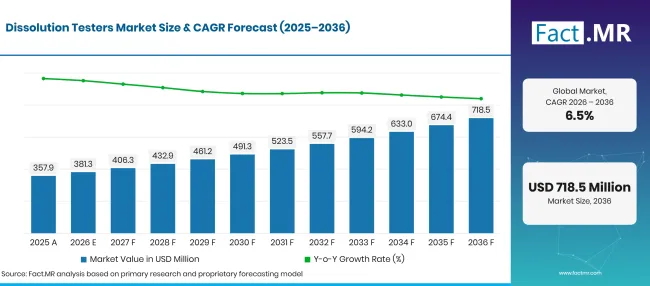
Dissolution Testers Market Forecast Global | Source: Fact.MR
| Year | Basis | Market Value (USD million) |
|---|---|---|
| 2025 | Estimated | 357.9 |
| 2026 | Estimate | 381.3 |
| 2036 | Forecast | 718.5 |
| CAGR (2026–2036) | Forecast period | 6.5% |
Source: Fact.MR analysis. Updated Oct 27, 2026
What are the defining numbers behind Dissolution Testers Market growth?
Between 2026 and 2036, the market is forecast to gain USD 337.2 million in value.
- Demand Drivers in the Market
- Pharmaceutical manufacturers use dissolution testing to assess drug-release performance, verify batch consistency and evaluate formulations before commercial release. These activities create recurring equipment requirements across product development and manufacturing, and laboratories need instruments that maintain controlled test conditions and produce consistent results.
- The shift toward automated laboratory operations has increased interest in systems that reduce manual handling, standardize test sequences and simplify data recording. Facilities processing large sample volumes may prioritize these functions because they support more organized workflows and reduce repetitive operator tasks.
- Generic drug development relies on comparing dissolution profiles to evaluate formulation performance. Pharmaceutical companies and contract research organizations use testers for formulation and analytical studies.
- Immediate-release, delayed-release and extended-release medicines require testing approaches suited to their release characteristics. Testers that accommodate different test conditions help laboratories examine products consistently, making instrument flexibility relevant across multiple dosage forms.
- Pharmaceutical research and contract testing extend demand beyond manufacturing facilities. Contract research organizations, academic institutions and research laboratories use dissolution testers to study drug release and compare formulations.
- Key Segments Analyzed
- By Product Type: Automated Dissolution Testers account for 68.5% of the market in 2026. Their leading position reflects the importance of controlled test sequences, consistent procedures and reduced manual handling in laboratory operations.
- By Application: The Pharmaceutical Industry represents 61.5% of the market in 2026. Demand arises from formulation development, manufacturing checks and finished-product quality assessment.
- By End-User: Pharmaceutical Companies contribute 52.8% of market demand in 2026. Their equipment requirements span formulation evaluation, batch assessment and routine quality-control activities.
- Analyst Opinion at Fact.MR
- Shambhu Nath Jha, Principal Consultant at Fact.MR, states, “Demand for dissolution testers is expected to grow as pharmaceutical companies strengthen quality checks and expand formulation research. Over the coming years, automated systems offering flexible testing options and reliable data handling are poised to attract greater investment.”
- Strategic Implications
- Product development needs to emphasize repeatable results, adaptable test methods and straightforward data management. These capabilities address the day-to-day requirements of pharmaceutical quality-control teams.
- Equipment performance depends on more than initial installation. Calibration, routine maintenance, operator training and timely technical assistance remain important throughout an instrument's operating life.
- Pharmaceutical customers evaluate whether equipment fits established test methods and laboratory procedures. Instrument reliability, suitable documentation and consistent performance are important considerations when laboratories select or replace testing systems.
- International expansion requires a market-specific approach. Investment levels, regulatory expectations, service coverage and purchasing constraints influence commercial decisions across individual countries.
Across the five markets, Japan records the highest growth rate at 6.4% for 2026–2036, followed by Germany at 6.0%. The United States follows at 5.6%, Brazil at 5.2%, and the United Kingdom at 4.7%.
How does the Dissolution Testers Market break down by segment?
Automated Dissolution Testers lead Product Type with a 68.5% share. The Pharmaceutical Industry leads Application at 61.5%, while Pharmaceutical Companies rank first in End-User at 52.8%.
Which Product Type dominates?
Automated Dissolution Testers make up 68.5% of the market in 2026.
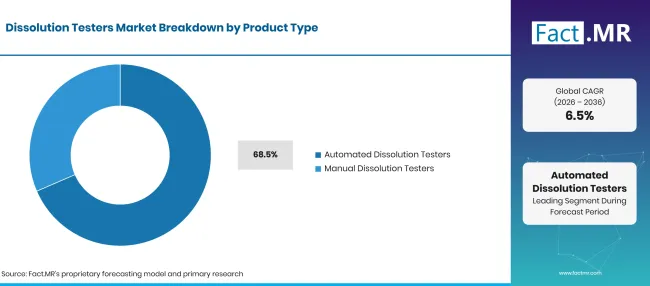
Dissolution Testers Market Breakdown Product Type | Source: Fact.MR
| Product Type | Share (2026) |
|---|---|
| Automated Dissolution Testers (Leading segment) | 68.5% |
| Other segments combined | 31.5%* |
| Total | 100.0% |
Source: Fact.MR analysis. Updated Oct 27, 2026
Automated Dissolution Testers simplify repetitive procedures and reduce operator involvement while helping laboratories maintain control over testing conditions. Automated sampling, scheduled test runs and digital data capture also support the organization of routine quality checks.
These functions are relevant to pharmaceutical manufacturers conducting frequent batch-release assessments and maintaining detailed testing records. Manual systems remain suitable for smaller laboratories with lower testing volumes or limited equipment budgets. Facilities with heavier workloads may place greater emphasis on automation when evaluating productivity, repeatability and staffing requirements.
What supports Pharmaceutical Industry within Application?
The Pharmaceutical Industry accounts for 61.5% of market revenue in 2026.
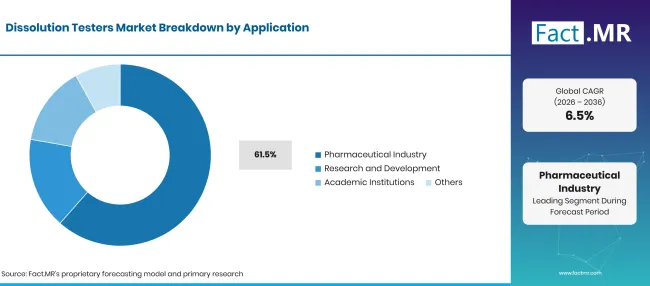
Dissolution Testers Market Breakdown Application | Source: Fact.MR
| Application | Share (2026) |
|---|---|
| Pharmaceutical Industry (Leading segment) | 61.5% |
| Other segments combined | 38.5%* |
| Total | 100.0% |
Source: Fact.MR analysis. Updated Oct 27, 2026
The Pharmaceutical Industry leads the application segment because dissolution testing supports drug formulation and routine quality control. Manufacturers examine release profiles, verify product consistency and compare results with product-specific acceptance criteria before releasing batches.
Research and development laboratories use these instruments to compare formulations and refine testing methods. Academic institutions apply them in pharmaceutical research and practical training. Repeated testing during development, manufacturing and batch release creates an ongoing need for reliable instruments. WHO guidance recognizes comparative dissolution studies as potential surrogate evidence of bioequivalence for eligible immediate-release solid oral dosage forms containing BCS Class I or III active ingredients [5].
What leads the End-User segment?
Pharmaceutical Companies account for 52.8% of market demand in 2026.
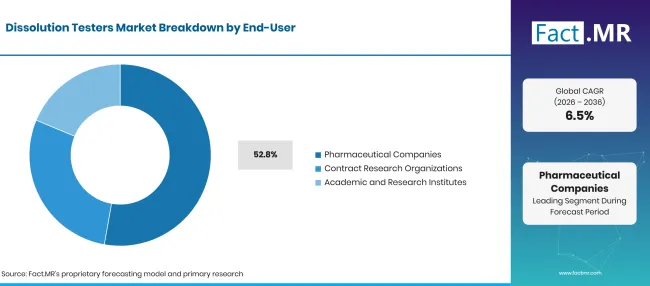
Dissolution Testers Market Breakdown End User | Source: Fact.MR
| End-User | Share (2026) |
|---|---|
| Pharmaceutical Companies (Leading segment) | 52.8% |
| Other segments combined | 47.2%* |
| Total | 100.0% |
Source: Fact.MR analysis. Updated Oct 27, 2026
Pharmaceutical Companies lead the end-user segment because dissolution testing forms part of product development and manufacturing quality checks. These organizations assess drug-release performance, compare formulations and verify batch consistency before products reach the market. Their production schedules create recurring requirements for testing equipment.
Academic institutions primarily use dissolution testers for research and training, while contract research organizations conduct studies on behalf of pharmaceutical clients. Pharmaceutical manufacturers use these instruments across development and commercial production. Differences in testing volume, research priorities and capital budgets influence equipment selection across these end-user groups.
What is accelerating Dissolution Testers Market adoption, and what is holding it back?
Pharmaceutical companies keep investing in dissolution testing to evaluate formulations and maintain quality standards. Automated instruments improve efficiency in high-volume testing, but equipment costs, method validation and maintenance raise total investment.
Drivers Impact Analysis
| Driver | (~) % IMPACT ON CAGR | Geographic Relevance | Impact Timeline |
|---|---|---|---|
| Routine dissolution testing for pharmaceutical quality control and batch-release decisions | +1.6% | Global | Short term (≤ 2 years) |
| Rising demand for automated sample handling and repeatable laboratory workflows | +1.0% | Global | Medium term (2–4 years) |
| Formulation development and comparative dissolution studies for new and generic products | +0.8% | North America, Europe, East Asia | Medium term (2–4 years) |
| Greater attention to method validation, data traceability and consistent test conditions | +0.7% | Global | Medium term (2–4 years) |
Source: Fact.MR analysis. Updated Oct 27, 2026
Opportunity Impact Analysis
| Opportunity | (~) % IMPACT ON CAGR | Geographic Relevance | Impact Timeline |
|---|---|---|---|
| Automated systems for laboratories processing large volumes of pharmaceutical samples | +1.1% | Global | Medium term (2–4 years) |
| Software and data-management tools that simplify testing workflows and reporting | +0.8% | Global | Medium term (2–4 years) |
| Greater use of contract research organizations and independent testing laboratories | +0.6% | North America, Europe, Asia-Pacific | Medium term (2–4 years) |
| Local service, calibration and operator training for installed instruments | +0.4% | Global | Long term (≥ 4 years) |
Source: Fact.MR analysis. Updated Oct 27, 2026
Restraints Impact Analysis
| Restraint | (~) % IMPACT ON CAGR | Geographic Relevance | Impact Timeline |
|---|---|---|---|
| High initial cost of automated equipment and related software | −0.2% | Global | Short term (≤ 2 years) |
| Continuing validation, calibration and maintenance requirements | −0.1% | Global | Medium term (2–4 years) |
| Limited capital budgets at smaller laboratories and academic institutions | −0.1% | Emerging markets and selected mature markets | Medium term (2–4 years) |
| Need for trained personnel and compatibility with established laboratory procedures | −0.1% | Global | Long term (≥ 4 years) |
Source: Fact.MR analysis. Updated Oct 27, 2026
Which countries are scaling the Dissolution Testers Market through 2036?
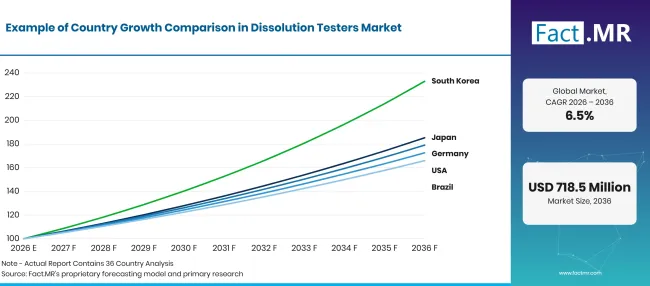
Dissolution Testers Market Growth Index | Source: Fact.MR
| Country | CAGR (2026–2036) |
|---|---|
| Japan | 6.4% |
| Germany | 6.0% |
| United States | 5.6% |
| Brazil | 5.2% |
| United Kingdom | 4.7% |
Source: Fact.MR analysis. Updated Oct 27, 2026
What supports adoption in Japan?
Fact.MR forecasts a 6.4% CAGR in Japan for 2026–2036, based on its assumptions about pharmaceutical testing activity and adoption of automated laboratory instruments.
Japanese laboratories are known for strict analytical discipline, and that habit favors instruments that deliver the same result run after run. Drug developers rely on dissolution testers to follow release profiles, compare formulations and confirm quality before products ship. Automated systems suit this setting well, since they raise throughput and keep procedures uniform from one analyst to the next.
What is supporting Germany's adoption?
6.0% CAGR, backed by a deep pharmaceutical manufacturing base that keeps routine quality control and formulation work running at scale.
Germany's drug makers and testing laboratories generate steady demand for dissolution equipment, from early formulation studies to batch release. Dissolution results help manufacturers judge drug performance and confirm that one batch matches the next. When laboratories upgrade or add capacity, they weigh automation, compatibility with existing methods and long-term reliability more than the purchase price alone.
How is the United States developing demand?
5.6% CAGR, supported by a large generic and specialty drug development pipeline and an active regulatory research environment.
Drug manufacturers and contract research organizations in the United States choose testing equipment for measurement reliability, recordkeeping needs and fit with laboratory workflow. Generic drug development adds scientific and regulatory questions around formulation characterization and modified-release products, topics the FDA covered in its 2025 research workshop [2]. These questions keep dissolution testing close to product development decisions.
What supports adoption in Brazil?
5.2% CAGR, shaped by local pharmaceutical production and the need to verify product quality inside the country.
Brazilian manufacturers must show that their products release the active ingredient as intended and stay consistent from batch to batch, which sustains demand for dissolution testers. Buying decisions often turn on instrument cost, access to technical service and available laboratory budgets. Facilities with heavy testing loads may lean toward automation, while smaller laboratories tend to prioritize affordability and the essential functions they actually use.
How is the United Kingdom developing demand?
4.7% CAGR, as a research-led market with established laboratories leaves more room for replacement than for new capacity.
The United Kingdom's pharmaceutical research, formulation development and quality-control work still needs dissolution testers to examine drug-release behavior and compare formulations under controlled conditions. Many laboratories already own capable instruments, so purchases tend to follow replacement cycles and recordkeeping requirements. Tight budgets and the level of automation already in place can slow decisions on new installations.
Who leads the Dissolution Testers Market?
Competition in the Dissolution Testers Market spans manual and automated systems, specialized testing equipment and laboratory support. SOTAX AG offers modular dissolution systems and automation solutions. Agilent Technologies, Inc. markets 708-DS dissolution apparatus, sampling systems and qualification tools. Distek, Inc. offers OLERA dissolution testers and technical support.
Teledyne Hanson (Teledyne LABS) offers dissolution apparatus, automation and accessories. Electrolab (India) Pvt. Ltd. markets dissolution testers and media preparation equipment. ERWEKA GmbH provides manual and automated systems, software and service options. Labindia Analytical Instruments Pvt. Ltd. offers DS-series testers and vessel washers. Logan Instruments Corp. covers USP Apparatus 1–7 and calibration tools. Product-specific offerings from Pharma Test Apparatebau AG and Pion Inc. require further verification against current company documentation before publication.
Which companies are the key providers?
Key companies profiled include SOTAX AG; Agilent Technologies, Inc.; Distek, Inc.; Teledyne Hanson (Teledyne LABS); Electrolab (India) Pvt. Ltd.; ERWEKA GmbH; Pharma Test Apparatebau AG; Labindia Analytical Instruments Pvt. Ltd.; Logan Instruments Corp.; and Pion Inc.
- SOTAX AG
- Agilent Technologies, Inc.
- Distek, Inc.
- Teledyne Hanson (Teledyne LABS)
- Electrolab (India) Pvt. Ltd.
- ERWEKA GmbH
- Pharma Test Apparatebau AG
- Labindia Analytical Instruments Pvt. Ltd.
- Logan Instruments Corp.
- Pion Inc.
Bibliography
- [1] World Health Organization. (2025, January 2). PQT/MED-specific annotations for the WHO guideline on biopharmaceutics classification system-based biowaivers. https://extranet.who.int/prequal/sites/default/files/document_files/bcs_biowaiverguideline_january2025.pdfWHO guidance document
- [2] U.S. Food and Drug Administration. (2025, June 3–4). Fiscal Year 2025 Generic Drug Science and Research Initiatives Public Workshop [Workshop]. FDA workshop page
- [3] Medicines and Healthcare products Regulatory Agency. (2025, July 31). MHRA Safety Roundup: July 2025. GOV.UK. MHRA source
- [4] World Health Organization. (2025, April 15). WHO Expert Committee on Specifications for Pharmaceutical Preparations: Fifty-eighth report (WHO Technical Report Series No. 1060). WHO report
- [5] World Health Organization. (2026, June 9). WHO Biowaiver List: Proposal to waive in vivo bioequivalence requirements for WHO Model List of Essential Medicines immediate-release, solid oral dosage forms (WHO Technical Report Series No. 1067, Annex 7). https://www.who.int/publications/m/item/trs-1067---annex-7--who-biowaiver-list--proposal-to-waive-in-vivo-bioequivalence-requirements-for-who-model-list-of-essential-medicines-immediate-release--solid-oral-dosage-formsWHO technical document
This Report Answers
- How is the Dissolution Testers Market divided by product type, application and end-user?
- Which subsegments lead the market in 2026, and what operational requirements help explain their positions?
- How do pharmaceutical quality control, formulation development and laboratory automation influence demand?
- Which countries have the highest CAGRs among the five markets covered in this report?
- Which companies participate in the competitive landscape, and what instrument features matter to laboratory buyers?
- What cost, maintenance and workflow considerations may constrain wider adoption of dissolution testing equipment?
What does the Dissolution Testers Market cover?
Dissolution testers are laboratory instruments that measure how an active pharmaceutical ingredient is released from a tablet, capsule or other suitable dosage form under controlled test conditions. Each system combines a vessel assembly, a paddle or basket apparatus, a temperature-controlled water bath or heating system and a sampling mechanism. Instruments are sold in automated or manual form.
Value is tracked across pharmaceutical companies, contract research organizations, and academic and research institutes. Sales reach laboratories through direct contracts with instrument makers, distributors and service partners.
What is included in the scope?
The scope encompasses automated and manual dissolution testing instruments used in pharmaceutical and related laboratory applications.
Depending on instrument configuration, relevant features include vessel arrangements, temperature control, sampling functions, automated test sequences and associated operating capabilities.
The assessment also covers the applications and end-user groups specified in the market segmentation. Country-level growth assumptions and the competitive landscape provide additional context for evaluating commercial opportunities. Laboratory workflow requirements, testing consistency, method compatibility and instrument functionality help explain purchasing priorities across facilities with different testing volumes and budgets.
What is excluded from the scope?
The market definition is limited to equipment specifically designed to perform dissolution testing.
Standalone analytical instruments used for other procedures, general laboratory equipment and pharmaceutical manufacturing machinery unrelated to dissolution testing fall outside the defined market.
Separately purchased consumables, laboratory services and software are excluded from equipment revenue when they are not bundled with a dissolution tester. This distinction keeps the assessment focused on instrument sales rather than the wider pharmaceutical testing industry.
How Was the Analysis Built?
The analysis draws on 120+ sources, 35+ company portfolios, 25+ countries, and more than 20 industry interviews.
- Primary Research: Primary research includes discussions with manufacturers, service providers, technology developers, distributors, end users, and subject-matter experts. These conversations examine purchasing priorities, product adoption, operational challenges, approval requirements, competitive positioning, and the factors that influence wider market acceptance.
- Desk Research: Desk research covers government statistics, regulatory publications, company filings, trade data, technical studies, industry associations, standards, public policy, and other authoritative sources. Every source used in the analysis is documented in the bibliography.
- Market Sizing and Forecasting: Market estimates combine historical performance, demand indicators, pricing and volume trends, segment shares, company participation, country-level growth, adoption patterns, investment activity, and barriers to market expansion.
- Data Validation and Update Cycle: Findings are validated by comparing primary interviews with public data, company activity, regulatory changes, trade patterns, and industry developments. Regular updates review new product launches, capacity changes, partnerships, approvals, and shifts in commercial adoption.
Segmentation
What is the report's scope and coverage?
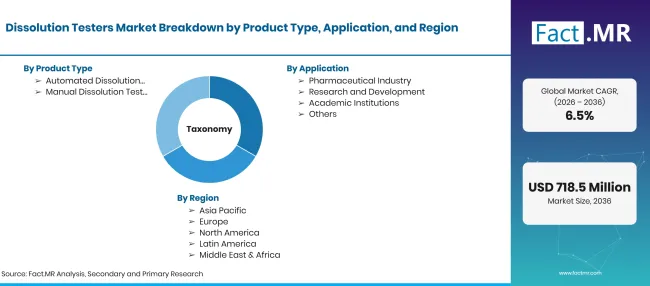
Dissolution Testers Market Taxonomy | Source: Fact.MR
| Attribute | Details |
|---|---|
| Quantitative Units | USD million |
| Market Definition | Laboratory instruments used to measure the rate and extent of active ingredient release from pharmaceutical dosage forms under controlled test conditions |
| Product Type | Automated Dissolution Testers; Manual Dissolution Testers |
| Application | Pharmaceutical Industry; Research and Development; Academic Institutions; Others |
| End-User | Pharmaceutical Companies; Contract Research Organizations; Academic and Research Institutes |
| Regions Covered | North America; Latin America; Western Europe; Eastern Europe; East Asia; South Asia & Pacific; Middle East & Africa |
| Countries Covered | Japan; Germany; United States; Brazil; United Kingdom |
| Companies Profiled | SOTAX AG; Agilent Technologies, Inc.; Distek, Inc.; Teledyne Hanson (Teledyne LABS); Electrolab (India) Pvt. Ltd.; ERWEKA GmbH; Pharma Test Apparatebau AG; Labindia Analytical Instruments Pvt. Ltd.; Logan Instruments Corp.; Pion Inc. |
| Forecast Period | 2026 to 2036 |
| Approach | Market assessment based on the market values, growth rates, segment shares, country CAGRs and company list used in this analysis. Official pharmaceutical testing guidance provides technical and regulatory context. |
Source: Fact.MR analysis. Updated Oct 27, 2026
How is the market segmented?
-
By Product Type
- Automated Dissolution Testers
- Manual Dissolution Testers
-
By Application
- Pharmaceutical Industry
- Research and Development
- Academic Institutions
- Others
-
By End-User
- Pharmaceutical Companies
- Contract Research Organizations
- Academic and Research Institutes
-
By Region
- North America
- Latin America
- Western Europe
- Eastern Europe
- East Asia
- South Asia & Pacific
- Middle East & Africa
Who worked on this report


Preview the report firsthand - request a free sample
Free SampleGet the brochure for pricing and purchase details
Download PDF